Oral History: CIA Contractor Reveals Role in JFK Assassination

Inside the JFK Assassination

Secret History Productions (2003)

Film Review

This fascinating documentary is the oral history of Chauncy Holt, one of the infamous three tramps arrested in Dealey Plaza plaza following the assassination of John F. Kennedy. Although it was recorded in 1997, it would be six years before Holt’s interview was released. He died eight days after its filming. Assassination researcher Jim Fetzer has uncovered evidence that Holt, while hospitalized, was deliberately overdosed on Coumadin by someone posing as a doctor.

The first hour of the video focuses on Holt’s early life as a bootlegger and petty criminal in Kentucky. He was a mathematical genius and firearms expert, with a pilot’s license and expertise in oil painting and forgery. It was his math skills that brought him to the attention of Florida mobster Meyer Lansky. After a brief spell as Lansky’s accountant, the latter referred him to the CIA’s Clandestine Operations Division. Holt’s primary function was to oversee the Los Angeles  Stamp and Stationary Company, a CIA front that produced fake IDs and reconditioned firearms for Operation Mongoose, the CIA/Mob operation formed to invade Cuba and overthrow Castro. His immediate CIA supervisor was William King Harvey.

In April 1963, he was ordered to produce fake IDs for Lee Harvey Oswald under various aliases and deliver them to Guy Bannister, who Holt identifies as Oswald’s New Orleans control.

On November 22, 1963, Holt was ordered to deliver forged Secret Service IDs and lapel pins and refurbished rifles and ammunition to Dealey Plaza. He was also ordered to deliver fake Bureau of Alcohol, Firearms and Tobacco (ATF) IDs and handguns to CIA operatives Charles Harrelson (father of actor Willy Harrelson) and Richard Montoya.

Holt identifies Harrelson and Rogers as the two other tramps. The FBI ordered them released as they were carrying forged ATF IDs.

Holt claims he had no foreknowledge of the assassination prior to arriving in Dealey Plaza. His CIA handlers told him that Operation Mongoose had organized a violent pro-Castro protest to drum up popular support for a US invasion of Cuba.

How Elites Use Mass Immigration to Suppress Wages and Destroy Unions

The Making and Breaking of Europe

Al Jazeera

Film Review

The Role of the CIA in the Formation of the EU

This is a fascinating documentary tracing the political forces leading to the formation of the EU and the rise of right wing nationalist movements that threaten to break it up. I wasn’t a bit surprised to learn of the role the CIA played in the formation of the EU, via the millions they spent on the Action Committee for the United States of Europe (1955-1975). The CIA’s main goal was to create the false impression that European unification enjoyed wide popular support. There’s never been any doubt in my mind that the EU and the state-like bureaucracy it has created in Brussels mainly serves the interests of banks and corporations seeking to undermine and/or control the democratic process.

Working Class Communities Bear the Brunt of Mass Immigration

This film also takes a refreshingly honest look at mass immigration, a policy European elites championed to support the post-World War II economic boom – it was far cheaper than investing in technological innovation or retraining domestic workers. In fact, this is the first acknowledgement I have seen in mainstream media acknowledging that 1) working class communities have always born the brunt of mass immigration policies and 2) the massive influx of people from other cultures creates immense tensions in any community.

The Use of Immigrants to Crush Unions

In the late 1970s, Thatcher and other neoliberal leaders deliberately used mass immigration in strike breaking and other strategies aimed at crushing unions. The de-industrialization of northern Europe and the loss of good paying jobs would only amplify the tensions this created. As would the 2001 war on terror, the targeted Islamophobia propagated by US and British intelligence and ultimately the painful austerity cuts resulting from 2008 global economic collapse.

There seems to be strong agreement among the four “expert” panelists* that the anti-immigrant backlash should have been predictable – there is no possible way for the EU to accommodate the millions of refugees resulting from the US proxy war in Syria.

Since 2015 the strength of this backlash has fueled electoral victories for right wing nationalist groups in nearly all EU countries. All have campaigned on a dual anti-immigrant and anti-EU platform. In Britain, the rise of the United Kingdom (UKIP) party would lead to Brexit (and a 52% vote to leave the EU) in 2016.


*The panelists include a former Greek prime minster, a member of Hungary’s ruling party and Dr Alina Polykova, research director at the Atlantic Council and co-author of the 2015 The Dark Side of European Integration.


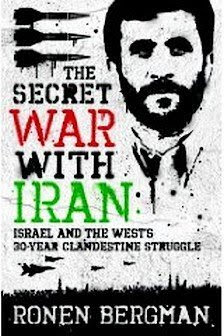
Israel’s Secret 40-year War with Iran

The Secret with Iran: The 30-Year Covert Struggle for Control of a “Rogue” State

by Ronen Bergman

Translated by Ronnie Hope

Oneworld (2009)

Book Review

This is a very depressing book. The “secret war” referred to is the covert war Israeli intelligence has fought with Iran over the last [40] years. Most of The Secret War with Iran is an endless chronology of lawless tit-for-tat revenge killings, car bombings, kidnappings and extrajudicial assassinations Israeli intelligence and Hezbollah* impose on one another.

While most of the narrative seems historically accurate, the author’s clear pro-Zionist bias results in a number of troubling inconsistencies. Examples include persistent claims about Iran’s mythical nuclear weapons arsenal – despite verification by US intelligence (see Iran Doesn’t Have a Nuclear Weapons Program) that their nuclear weapons program ceased in 2003; a clear attempt to minimize the role of Israel’s illegal occupation of Palestine in generating and perpetuating Middle East violence; repeated claims that Iran (rather than Saudi Arabia, Pakistan and the CIA) was the key player in the birth of Al Qaeda; and an erroneous assertion that Saddam Hussein expelled UN nuclear inspectors in 1998 (Bill Clinton had them recalled so he could bomb Iraq – see Clinton’s Worst Crimes).

Despite these weaknesses, the book provides valuable insight about the Israeli origin of Iran bashing recently taken up by Trump and the Republican Congress. The book also contains important historical background on Ruhollah Khomeini and the 1979 Iranian revolution to overthrow the ruthless CIA-backed Shah. Prior to reading this book, I was unaware of the role Yassar Arafat and the Palestinian Liberation Organization (PLO) played in training Iran’s Revolutionary Guards nor the role of Iran in training, arming and funding Hezbollah, the Shi’ite militia group operating on the Israeli border in southern Lebanon.

After 1948 when the new state of Israel forcibly evicted millions of Palestinians from their lands, a sizeable proportion fled to southern Lebanon where they’re housed in refuge camps to this day. It was these camps that gave rise to the PLO.

After their UN-mandated expulsion from Lebanon in 1987, many PLO fighter returned to Palestine – where they launched the first Intifada.


*Hezbollah is a Shi’ite Islamist political party and milita group based in Lebanon. They enjoy strong support from Lebanon’s civilian population owing to their programs offering health, education and social services the Lebanese government is too poor to provide.

Demise of the American Empire: Pinpointing the Timeline


In the Shadows of the American Century: The Rise and Decline of US Global Power

by Alfred W McCoy

Haymarket Books (2016)

Book Review

Prior to 2001 and the launch of the War on Terror, the US political elite adamantly denied (despite massive evidence to the contrary), that the United States was an empire rather than a republic. Because their sudden about face (ie acknowledgement and promotion of US imperialism) was so recent, there has been little opportunity for scholarly analysis of America’s effectiveness as an empire. It’s this void Alfred McCoy seeks to fill with In the Shadows of the American Century: The Rise and Decline of US Global Power.

Competition for Control of the Eurasian Landmass

McCoy traces America’s serious global empire building to their defeat of Spain in the Spanish-American War in 1898, which won them Puerto Rico, Cuba, the Panama Canal Zone and the Philippines.* He maintains that us strategies for empire-building, like those of the former British empire, have mainly relied on seeking and maintaining control of the “World-Island.” This is a term coined by London School of Economics director Halford Mackinder’s World Island in 1904. Under this concept, the World Island consists of the vast European-Asian landmass that is home to 70% of the world’s population, 75% of its global energy resources and 60% of its current productivity.

How the US Maintains Military Control

After the US became the world’s preeminent superpower after World War II, they have used nine basic strategies to maintain military control of the Eurasian landmass: mass surveillance (based on a system of extensive personal data collection that began during their “pacification”** of the Philippines (1898-1907); CIA covert operations (involving electoral interference, military coups, installation of compliant puppet dictators, targeted assassinations, torture, advanced technological weaponry (electronic senors, satellite imagery, drones, etc) and, increasingly cyperwarfare and space-based weaponry (most information about the latter two is classified).

America Falling Behind China Economically and Militarily

For me the most interesting section of the book examines ways in which the US is rapidly falling behind China – not only economically but militarily. McCoy identifies Bush’s rash decision to invade Iraq as the start of the American empire’s steady decline. While the US has spent the last 16 years mired in unwinnable wars in Afghanistan and Iraq, China is busily building alliances and investing their trade surplus (from selling Americans cheap consumer goods) in Russia and other countries located in the World Island. In Afghanistan alone, they are responsible for 79% of foreign investment.

Meanwhile China is rapidly creating a single economic zone across the Eurasian landmass, with a vast network of high speed trains and pipelines following historical Silk Road and Tran-Siberian Railway routes – and soon a high speed Southeast Asian and Moscow-Beijing line.

Even the Pentagon-linked Rand Corporation predicts China’s will exceed that of the US by 2030 or sooner. In 2010, China became the world’s leading manufacturing nation. In 2014, it took the lead in the number of new patents it awards annually.

Even more concerning is the rapid decline of US educational standards compared to those of China, which has ominous implications for the development of high tech weaponry. Chinese students consistently score first in math, science and reading, while US students score 27th, 20th and 17th respectively.

By 2025, China is expected to have better long range cruise missiles than the US, better air defense aircraft, better electronic sensors, better digital communications capacity, better computer processing power and better cyber-security. At the same time, they have a significant strategic advantage because the US spreads its military resources so thin by fighting so many foreign wars simultaneously.

According to McCoy, they already have the ability to cripple critical US infrastructure (electrical and telecommunications grid and pipelines) via cyber warfare.

Collapse Predicted Between 2030-2040

McCoy predicts (and makes an excellent case for) the demise of the US empire some time between 2030-2040. It could happen gradually, as US economic and military prowess continues its steady decline – or suddenly, if the loss of its privileged status causes the US dollar to collapse. The impending implosion may be aggravated by climate change, especially if the Pentagon is drawn into wars over dwindling food and water resources or control of massive numbers of climate refugees.


*In a separate development, the Kingdom of Hawai’i was illegally overthrown by The Committee of Safety (a group of wealthy American/European businessmen) in 1998. The Committee of Safety used U.S. Marines to detain the Queen while they announced their takeover of Hawai’i.

**”Pacification” is a military euphemism for violently subjugating the indigenous population of an occupied country.

Originally published in Dissident Voice


Bill Clinton’s War Against Yugoslavia

The US War on Yugoslavia

Michael Parenti (1999)

This talk, one of my favorites, is 1999 talk about about US empire. It offers quite a stark depiction of a US foreign policy consisting primarily of continual wars of aggression against democratic governments that thwart Wall Street Interests in exploiting their natural resources and labor force.

Parenti begins with a brief overview of colonization, starting with Western Europe’s colonization of the Slavic peoples and England’s colonization of Ireland. He goes on to to describe how India and Africa both enjoyed advanced and wealthy (far more wealthy than Europe) civilizations until they were invaded by European armies and their economies destroyed.

He proceeds with a detailed inventory of America’s continual invasions, bombing campaigns and covert wars around the world. The last half of the presentation focuses on the deliberate break-up of Yugoslavia by the US security state, demolishing the myth perpetuated by the Clinton administration and the US media that ethnic conflict was the cause of the Balkan wars.

Prior to the collapse of the Soviet Union, Wall Street elites tolerated a socialist state in Yugoslavia (with free health care, education and public transport and housing) because they viewed Yugoslavian president Josip Tito’s independent socialism as a buffer against the Soviet Union.

The initial US attack against Yugoslavia was economic, when Bush senior, in 1990, persuaded Congress to end lending credits to the Yugoslav government. The legislation they passed stipulated that US banks could only loan money to autonomous Yugoslav regions (Serbia, Croatia, Macedonia, Bosnia, etc) provided they declared independence and formed autonomous republics.

Parenti notes the new law was implemented somewhat unevenly, so that only right wing fascist governments qualified for loans. By 1992, internal sanctions against Serbia had resulted in 70% unemployment, widespread malnutrition and collapse of the health care system.

He goes on to provide fresh insight into the background of Slobodan Milosovic – who Clinton described as the “new Hitler” – an anti-communist banker who was the CIA’s first choice to run Serbia. When Milosovic refused to fully embrace US colonization, he was systematically demonized by the Clinton administration and corporate media. In 2006, he would die in prison in the Hague.* The war crimes he was accused of were never substantiated.

Parenti also details the NATO carpet bombing of Serbia (designed to maximize civilian casualty by targeting life support infrastructure, such as power and water filtration plants), the CIA penetration of the Kosova Liberation Army (enabling them to corner the European heroin market), Noam Chomsky’s support for Clinton’s war against Serbia, and the notorious Sarajevo false flag operation (actually carried out by Muslim extremists) used to justify the NATO war against Serbia.


*There is strong evidence he was covertly assassinated: Did NATO’s Kangaroo Court Poison Milosevic?

How the CIA Helped Greenpeace Get Its Start

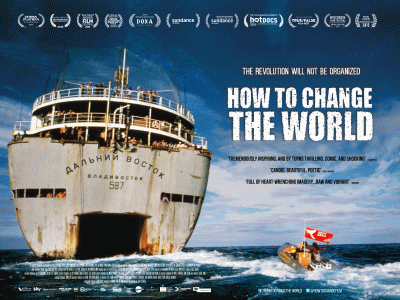
How to Change the World

Directed by Jerry Rothwell (2015)

Film Review

Māori TV showed How to Change the World last night. It relates the story of the 1971 founding of the international environmental group Greenpeace. Based on archival Greenpeace footage and retrospective interviews with its founders, the documentary makes it appear as if the organization founded itself by accident out of Vancouver’s strong anti-Vietnam war movement. During the late sixties and early seventies, the Canadian city was a magnet for young American expatriates fleeing the draft.

The accidental pairing of eco-freaks with antiwar activists in a sea protest to block a nuclear test on the Aleutian island of Amitchitka led them to coin a name – Greenpeace – representing both camps.

Bob Hunter, an environmental reporter for the Vancouver Sun, went along on that first protest in his journalistic role. When the popular uproar generated by that first protest resulted in the shutdown of the Amitchka nuclear test site, he resigned from his newspaper job to spearhead the Greenpeace Save the Whales campaign. His genius lay in creating media “mind bombs” with spectacular footage that instantly riveted popular attention.

The documentary replays the original footage from a confrontation with a Soviet whaling ship off the California coast. It’s graphically cruel and bloody and definitely unsuitable for children’s viewing.

The founders allowed the name Greenpeace to be freely borrowed by environmental groups all over the world. Which, as with most grassroots organizations, led to significant growing pains. Hunter made a number of unpopular decisions without consulting the rest of the group. One of the most contentious was his decision to accept the CIA ‘s offer of free fuel and intelligence an the location of Soviet whaling vessels.

Inside Afghanistan’s Opium Trade

Afghan Overdose: Inside the Opium Trade

RT (2015)

Film Review

Afghan Overdose is an RT documentary that seems more geared for Russian than foreign consumption. Although the narrator is dubbed in English, actual dialogue is Russian or Farsi with subtitles.

As its northern neighbor, Russia is one of the primary destinations of Afghan heroin smugglers – roughly 30,000 Russians die of heroin overdose annually. The Russian government is so concerned about their heroin epidemic that they routinely provide the Afghan government with satellite imagery of the country’s heroin labs.

Segments from so-called opium “raids” leave no doubt the government’s heroin eradication efforts are purely cosmetic. Because the 15 1/2 year war with the US has totally destroyed the nation’s infrastructure, opium production is the only source of livelihood open to tens of thousands of residents

The arrival of ISIS in Afghanistan – who oppose the Taliban – only contributes to the overall chaos and instability.

The film’s only weakness is its lack of historical or political perspective. According to RT, opium production is the primary source of revenue for the Taliban (who control most of the country outside of Kabul). However it’s not clear how the Taliban switched over from being adamantly anti-opium prior to the US invasion to relying on it as their primary source of revenue.

It’s intriguing to hear to anti-Taliban locals talking about the US/CIA creating the Taliban as a cover for their heroin trafficking, about NATO soldiers fighting alongside the Taliban against anti-Taliban warlords and about US troops that directly engage in various aspects of opium production. I think this would have been a better documentary were some of these lines of inquiry pursued.


Anonymous – The Hacker Wars

Anonymous – The Hacker Wars

Vivien Lesnik Weisman (2014)

Film Review

The Hacker Wars is a riveting documentary about members of Anonymous – the leaderless international hacking community – who have made their identity public. It focuses on four individuals: Andrew (Weev) Auernheimer, Barrett Brown, Jeremy Hammond and a hacker turned FBI informant who went by the screen name SABU.

The first two men made their identify public as a form of civil disobedience – directed at government surveillance, secrecy and suppression of civil liberties. Hammond’s name became public after an FBI informant named SABU entrapped him into hacking into Stratfor, the infamous private intelligence/security contractor.

Weev was arrested in 2013 – not for hacking – but for downloading over 100,000 government email addresses from an unscecure AT&T website and sharing the security glitch with journalists. He served 13 months in jail before his conviction was overturned on appeal.

Barrett Brown, a non-hacker, was a journalist who reported on Anonymous activities. He was arrested for allegedly copying a publicly available Stratfor link to his Project PM website, a clear violation of his first amendment rights. He was sentenced to 63 months in Federal prison. He was released to a halfway house (on house arrest) in November 2016.

SABU was arrested in June 2011 and released after one day after agreeing to infiltrate Anonymous on behalf of the FBI. Eight days later (at the behest of the FBI), he formed the splinter group Antisec, which in September 2011 aggressively promoted Occupy Wall Street to other Anonymous members. In December 2011, he persuaded Jeremy Hammond to assist him with the infamous Stratfor Christmas Hack. This was the operation in which scores of ex-CIA and ex-military operatives who worked for Stratfor woke up on Christmas to discover they had donated $50,000 each to various charities.

Hammond pled guilty and was sentenced to ten years.

The FBI was an active member of Anonymous for nine months in all. SABU’s role as an informant came out at his trial in April 2012. Owing to his invaluable service to the FBI, he walked away a free man.

Is It Time to Bring Down Civilization?

Endgame: The Problem of Civilization

by Derrick Jensen

Seven Stories Press (2006)

Book Review

Although the writing style is quite informal, the basic structure of environmental activist Derrick Jensen’s two volume opus is that of a philosophical treatise. In Endgame, Jensen makes two highly controversial arguments:

1. The planet and the human species can only be saved by bringing down civilization.

2. This can only be accomplished by violent means.

Like a philosopher, Jensen builds his case on 20 basic premises listed at the beginning of both volumes (see below). By definition, a premise is mutually agreed assumption (as opposed to a statement of fact) that is used to rationally derive a set of conclusions. In other words, if someone rejects your premises, they will also disagree with conclusions based on these premises.

I myself agree with all but premise 9 and 12. Ten years ago, it was believed that the loss of fossil fuel based industrial agriculture would result in a big drop in population. However more recent research shows that permaculture and biointensive agriculture produce higher crop yields than factory farming. I also believe there is a vast difference between rich and poor people, both in terms of lived experience and power.

In Volume 1, Jensen traces the rise of cities, which by necessity steal resources from distant regions and eventually denude the entire landscape of these resources. After making the case that the corporate elite are voraciously consuming an ever increasing amount of energy, land, water and other resources, Jensen reminds us that we live on a finite planet. He then argues that corporations will most likely continue this greedy consumption until everything is used up – or until we stop them.

Volume 2, which is less structured and more informal, encapsulates many of Jensen’s experiences with the environmental movement and dogmatic “nonviolent” resistance advocates. Given the CIA’s heavy infiltration of both domestic and foreign non-violent resistance campaigns (see How the CIA Promotes Nonviolence), these chapters resonated strongly with my own experiences.

Other than general talk about blowing up dams and cellphone towers, Jensen is deliberately (and in my view wisely) vague about the exact form of violence he’s proposing.

Jensen’s (somewhat abbreviated) premises:

1. Civilization can never be sustainable, especially industrial civilization.
2. Traditional (ie indigenous) communities do not give up or sell their resources unless these communities are destroyed.
3. Industrial civilization would quickly collapse without its reliance on widespread violence.
4. Civilization is based on a clearly defined – violence by those at the top of the hierarchy against those at the bottom is often invisible.
5. The property of those at the top of the hierarchy is more valuable than that of those at the bottom.
6. Civilization isn’t redeemable – it will never voluntarily undergo sane transformation.
7. The longer we wait to bring down civilization, the messier the ultimate crash will be.
8. The needs of the natural world are more important than the needs of the economic system.
9. Some day there will be far fewer human beings on the planet than there are today.
10. The culture as a whole and most of its members are insane. The culture is driven by a death urge, an urge to destroy life.
11. From the beginning this culture – civilization – has been a culture of occupation.
12. There are no rich people and no poor people. The rich delusionally believe they own all the land and the police enforce these delusions. The poor buy into these delusions almost as completely as the rich.
13. Those in power rise by force. The sooner we accept this, the sooner we can decide how best to resist them.
14. From birth on, we’re acculturated to hate life, the natural world, women and children, to fear our bodies and to hate ourselves.
15. Love doesn’t imply passivism.
16. The material world is primary (to the spiritual world). Real world actions have real world consequences.
17. It’s a mistake (or more likely denial) to base our decisions on whether the actions stemming from them will or won’t frighten fence sitters or the mass of Americans.
18. Our current sense of self is no more sustainable than our current use of energy or technology.
19. This culture’s main problem is the belief that controlling and abusing the natural world is justifiable.
20. Within this culture economics – not community well being, not morals, not ethic, not justices, not life itself – drives social decisions.

The 2011 documentary EndCiv: Resist or Die is loosely based on Endgame.

Hidden History: The War on Terror

Crossing the Rubicon: the Decline of the American Empire at the End of the Age of Oil

by Michael Ruppert

New Society Publishers (2004)

Book Review

I recently picked up Michael Ruppert’s Crossing the Rubicon for the first time in nearly 13 years. I’ve always admired Ruppert, who killed himself in April 2014. It was after hearing him present early evidence (in May 2002) about the role of Bush insiders in 9-11 that I made a decision to close my psychiatric practice and move to New Zealand.

In re-reading Rupert’s 617-page encyclopedia of Peak Oil, CIA narcotics trafficking and the foreign policy/intelligence background to the mother of all false flag operations, I’m totally amazed about the amount of evidence he had already collected in 2004. Nearly all his conclusions have been corroborated by other investigators. At the same time many of his findings, particularly regarding Clinton’s role in supporting the Taliban’s rise to power, don’t receive nearly enough attention in the 9-11 Truth community.

Ruppert links Clinton’s decision to put the Taliban in power in Afghanistan to the oil exploration he facilitated in the Caspian Sea basin by declaring war on Yugoslavia. Both Enron (see The Greedy Bastards who Gave us Enron and Bankrupted California) and Halliburton (Dick Cheney’s oil company) had deep commitments in Caspian Sea and Central Asian oil and gas companies. Both companies needed pipelines across Afghanistan to transport oil and gas to energy-hungry Pakistan, India and China. Building and maintaining said pipelines was totally impossible in a country that, following Soviet withdrawal, had become a failed state of feuding warlords.

According to Ruppert, in was Clinton’s intent to “pacify” Afghanistan by putting the totalitarian Taliban regime in power. Ruppert’s evidence for these assertions comes mainly from Congressional hearings called by Republican Congressman Dana Rohrabacker to challenge Clinton’s support for the Taliban. Ruppert also describes the two years (1999-2000) of 6+2 meetings (to plan the pipelines) between Taliban representatives, and the US, Russia, Pakistan, China, Iran, Uzbekistan, Tajikistan and Turkmenistan.

The Clinton administration suddenly reversed their position on the Taliban in 1999, after the results of exploratory Caspian Sea oil drilling revealed the limited deposits were too small to be commercially viable.

Ruppert goes on to present substantial evidence that the decision to go to war against the Taliban was made during the Clinton presidency – he first imposed economic sanctions against them in July 1999. Ruppert maintains this related less to the oil and gas lobby than to the banking/finance lobby, which had become addicted to drug profits from Afghan opium production. Following Soviet withdrawal, the CIA had worked with opium warlords to concentrate world opium production in Afghanistan. The loss of billions dollars of money laundering profits threatened to wreak major havoc with Wall Street and the US economy.

Ruppert, a five year veteran of the LAPD narcotics squad, devotes several chapters of Crossing the Rubicon to the CIA’s historic role in narcotics trafficking and the role of all major US banks and brokerage hoses in money laundering.

Ruppert also makes a strong case that planning for 9-11 began during the Clinton administration and that National Security Adviser Sandy Berger, Secretary of State Madeleine Albright, Energy Secretary Bill Richardson and NATO commander Wesley Clarke were party to the planning.