Syria Already Planning Its Economic Future


Guest Post by Sophie Mengel Inside Syria Media Center.

Last Monday the EU Council extended sanctions against the Syrian government for another year, until June 1, 2018. The event occurred as recent Syrian Arab Army successes raise hopes for an end to the Syrian conflict. It’s clearly not enough to talk about food relief and delivery of basic necessities. Manufacturing and foreign trade have also taken major hits in Syria.


World Bank: Total economic damage by city

Bilateral Ties Between Syria and Iran

Not so long ago, at a Damascus meeting between Syrian Prime Minister Imad Khamis and Iranian Ambassador Javad Torkabadi, Khamis highlighted the full-scale economic war the West and their Middle East allies have unleashed against Syria. Tehran, with its long experiencing countering “sanctions war,” and Damascus have become a model of strategic cooperation, both militarily and economically.  However, strong economic ties between Iran and Syria alone will not solve the problem of Syrian economic degradation.

Courting Qatar

Despite their past support for anti-government terrorists, the current economic boycott of Qatar by its “friendly neighbors” is leading to hope of future Qatari investment in the Syrian economy. For Qatar to invest in Syrian zones of influence or to offer Syria offer a kind of Marshall Plan would go a long way towards repairing Qatar’s international image. It would also allow the country to bypass limitations Saudi Arabia seeks to impose on Qatar’s foreign policy, while making it more independent of the US and the EU.

All this would likely depend on consummating an agreement for Iran to purchase LNG from Qatar for onward transport to external consumers. Iran, which is getting closer to Qatar and has strong positions in Syria, has great potential as an intermediary.

Syria is Already Planning Its Economic Future

Despite the ongoing fighting in Syria, the country is already planning its economic future. Syria is rich in energy resources and minerals, including rare-earth metals. At the same time, the country has an advantageous geographical location for transporting goods to the Mediterranean pass through its territory. All this gives Damascus the potential for rapid economic development.

Stability in the region and restoration of foreign trade would enable the Syrians to have a source of stable foreign direct investment. The country has been in the grip of war for more than six years, but is full of enthusiasm to rebuild the economy. The hope of a new life and recent successes on the battlefield inspire optimism on the part of Syrian citizens, as well as the countries such as Iran, China, India, Russia and Armenia that support them.

Follow the latest developments by reading Inside Syria Media Center.
The Historical Roots of Patriarchy

Patriarchy, Civilization, Militarism and Democracy

Gwynne Dyer (1994)


This documentary traces the development of patriarchy around 5,000 years ago, which Dyer links to the consolidation of agricultural villages into empires. Simultaneously in Mesopotamia, Central and South America and China, hierarchical political systems formed under a single male dictator who controlled their subjects via absolute terror.

This transition from autonomous villages into heavily militarized states was always accompanied by strict control of women’s behavior. Dyer maintains the ultimate goal of controlling women was to increase the birth rate and produce more male subjects for the rulers’ armies. In Mesopotamia, the formation of new religions (Judaism, Christianity and Islam) glorifying a single male god was the crowning achievement of patriarchy.

According to Dyer, Egypt was the last ancient empire to fully adopt patriarchy. Owing to natural barriers (the Sinai desert and the Mediterranean) that protected it from foreign invasion, it was the last ancient empire to militarize and adopt strict laws restricting women’s freedom.

The 40 minute film is divided into four parts. Parts 2-4 start automatically when the prior part concludes.


How the US Uses War to Protect the Dollar

The Gods of Money

William Engdahl (2015)

The first video is a 2015 presentation by William Engdahl about his 2010 book The Gods of Money. It focuses on the use of US economic and military warfare to maintain the supremacy of the US dollar as the global reserve currency.

As his point of departure, he begins with the 1944 Bretton Woods agreement, in which the Allied powers agreed to use the gold-backed US dollar as the world’s reserve currency. In 1971 when Nixon was forced to end the gold standard,* the gold-backed US dollar was replaced by the “petrodollar.” According to Engdahl, it was so named because of a secret agreement the US made with Saudi Arabia – in return for a guarantee that OPEC would only trade oil in US dollars, the US guaranteed the Saudis unlimited military hardware.

In this way, oil importing nations (most of the world) were forced to retain substantial US dollar reserves. This was the only way they could provide their economies with a continuous supply of oil.

The petrodollar remained supreme until the mid-1980s, when the collapse of the US Savings and Loan industry (a pre-cursor of the 2007 banking collapse) raised concerns in Europe that the US was failing as a super power. Fearing the US economy was collapsing, they created the euro and the Eurozone, to prevent the Soviet Union or China from filling the power vacuum.

The financial warfare unit of the US treasury responded by feeding hedge fund manager and currency speculator George Soros secret information that enabled him to lead an attack on the British pound. This, in turn, destabilized the British economy to the point the UK no longer qualified to join the euro.

In 1997 the US Treasury and Soros made a a similar attack on economies of Southeast Asia (Thailand, South Korea, Indonesia, Hong Kong, Laos, Malaysia, Philippines) that attempted to use currencies other than the dollar as their reserve currencies.

In 2010, after the US government had run three years of $1 trillion deficits, China, Russia and Japan announced their intention of selling US Treasury bonds (which the US government sells to finance its debt) to increase their euro reserves. Concerned this placed the US dollar on the brink of catastrophic collapse, the US Treasury and Soros attacked the Euro directly by collapsing the Greek economy. The mechanism Soros used was to direct his hedge funds to dump the sovereign treasury bonds that financed Greek debt.** When the European Central Bank announced its commitment to a Greek bail-out, the US Treasury and Soros followed up with an attack on Irish, Spanish and Portuguese sovereign bonds.


*A US economic crisis led to massive foreign demand for US dollar redemption that threatened to deplete US gold reserves.

** The immediate effect of bondholders dumping Greek bonds raised interest rates on Greek debt to a level that threatened to bankrupt their government.


The second clip is a Guns and Butter radio interview with Engdahl. It focuses on a second area the Gods of Money covers, namely the long US battle to abolish their private central bank (aka the Federal Reserve) and end the ability of private banks to create money out of thin air (see How Banks Create Money Out of Thin Air).

After a brief explanation of fractional reserve banking, whereby 97% of our money is created by private banks, Engdahl traces the history of the First Bank of the United States, created by Alexander Hamilton in 1791. The latter was the first US central bank, 80% owned by private (mostly Rothschild-controlled) banks in the City of London and 20% owned by the US government. President James Madison’s refusal to renew the bank’s charter in 1811 would result in Britain and the US going to war in 1812.

When the war ended in 1815, the American war debt was so substantial, the US had no choice but to charter the Second Bank of the United States, which once again was 80% controlled by London banks.

In 1832, Andrew Jackson refused to renew the bank’s charter, and the US had no central bank between 1832 and 1913. In 1913 when President Woodrow Wilson secretly colluded with the global banking establishment to create the Federal Reserve.

Both Lincoln and Kennedy challenged the exclusive role private banks play in creating the US money supply – Lincoln by issuing greenbacks (rather than borrowing money from private banks) to pay for the civil war and Kennedy by issuing silver certificates directly redeemable by the US Treasury. In both cases, Engdahl feels their defiance of the international banking establishment played a role in the decision to assassinate them.

1493 and the Hidden History of Industrial Capitalism

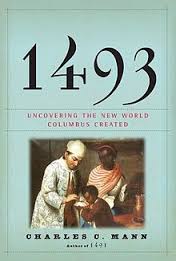
1493: Uncovering the New World Columbus Created

By Charles C Mann

Vintage Books (2012)

Book Review

1493 is a fascinating book tracing a totally neglected aspect of the rise of capitalism and industrial civilization – namely the transfer of new crops, livestock, trees, diseases, guano (nitrogen-rich bird poop, silver and diverse ethnic groups to every continent except Antarctica. Based on his detailed investigations, Mann cites numerous examples of major historical events and movements that can be directly traced to this “Columbian Exchange.”

Mann begins by tracing the history of tobacco, which was first transferred from the lower Amazon to Jamestown Virginia, and from there to China. An immensely popular drug of addiction, it provided the cash England needed to support colonization of the South-eastern US.

He next focuses on the potato, which was transferred from the Andes in South America to Northern Europe, where it replaced wheat as the staple crop in Ireland, northern Germany, Belgium and Russia (potatoes flourish in colder climates and on more marginal land than wheat and are four times more productive). Thanks to the introduction of the potato, Europe was finally able to end the famines that occurred every ten years. At a time, when China, India and various African and South American civilizations were far more advanced than Europe, the main factor holding back European development was its inability to feed its population.

Next Mann covers the important of sugar (originally domesticated in New Guinea) to the West Indies and the importation of coffee and bananas (to South America) from Africa.

African Slaves Resistant to Malaria

He devotes a whole section to the transfer of diseases, which played a significant role in wiping out America’s indigenous population, to the New World. I was previously aware that new settlers also brought malaria with them. This often fatal illness was endemic to England in the 1500s – thanks to misguided schemes to reclaim wetlands for agriculture. The high prevalence of malaria meant that 8 out of 10 settlers in Jamestown and other southern colonies could be expected to die in the first 18 months. Mann makes a case that the natural resistance present in slaves from West and Central Africa** was a main factor in England (a historically antislavery nation) turning to slaves in their desperation to establish a labor force to work the tobacco fields.

Silver, Sweet Potatoes and the Downfall of China

The chapter on the role of the Columbian Exchange in the downfall of China as the most prosperous, politically developed and culturally sophisticated country in the world is also extremely enlightening. I was totally unaware that between 1/3 and 1/2 of all the silver mined in 16th century Peru was transported to China via the Philippines for use in their monetary system. Nor the importance of sweet potatoes and maize (which, like potatoes, thrive on marginal land) in feeding poor farmers displaced by China’s dynastic wars. China is still the number one world producer of sweet potatoes.

Why the US was the Last to Free Their Slaves

For me, the most interesting section was the one on slavery, particularly the chapter on the “maroon”*** revolts and guerilla warfare that forced Central and South America to abolish slavery long before the US did. Except for Florida, escaped slaves in the US tended not to form rebellious maroon enclaves. The reason, according to Mann, was their difficulty surviving on their own in a colder climate and the opportunity for legal freedom if they fled to the North.

In Florida, escaped slaves formed alliances with the Seminole Indians. Their guerilla bands conducted continual attacks (with covert British support) on Georgia – until 1839 when Florida maroons were granted their freedom if they agreed to resettle of the Mississippi.


*The Columbian Exchange was the widespread transfer of plants, animals, culture, human populations, technology, and ideas between the Americas and the Old World in the 15th and 16th centuries, related to European colonization and trade after Christopher Columbus’s 1492 voyage.

**Approximately 97% of people indigenous to West and Central Africa are resistant to malaria owing to the presence of the Duffy Negative Antigen.

***Maroon is a term applied to fugitive black slaves.

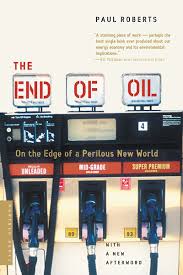
The End of Oil

end-of-oil

The End of Oil

by Paul Roberts

Houghton Mifflin Harcourt (20014)

Book Review

Although fourteen years old, The End of Oil offers an invaluable historical analysis about the absolute link between cheap fossil fuels and the development of industrial capitalism. Roberts starts his analysis with the first century Persians who first distilled surface petroleum for use as lamp fuel. According to Roberts, widespread use of oil as a fuel was impossible until drill technology became available in the 19th century to drill for it at deep levels.

Roberts identifies coal mining as the first really capital intensive industry requiring extensive external funding. Building the infrastructure to mine and process all three fossil fuels is always extremely capital intensive. The fact that a coal or gas-fired power plant takes three or four decades to pay off is one of the main reasons fossil fuel companies, and the banks and governments that subsidize them, are so reluctant to replace them with renewable energy infrastructure. The End of Oil also emphasizes the absolute importance of cheap fossil fuel to the economic health of industrialized countries, Between1945 and 2004 (when the book was published), there were six big spikes in the price of oil – each was accompanies by a major economic recession.

Roberts maintains the cheap, easily accessible oil is all used up, explaining its steady price increase since the late 70s. Russian oil, which is fairly costly to mine, only became economically viable when the price of oil hit $35 a barrel in 1980.

Prior to the final chapters, which review the economics of various forms of renewal energy, the book also discusses the geopolitics of oil. Roberts leaves absolutely no doubt that the US invasion of Iraq in 2003 was an effort by neoconservatives Dick Cheney, Donald Rumsfeld, Paul Wolfowitz et al to control the volatile price of oil and the devastating effects of this lability on the US economy. Although the US wars in Libya, Syria, Pakistan and Yemen occurred after the book’s publication, Roberts’s analysis left me with no doubt whatsoever they were driven by similar geopolitical objectives.

Roberts also discusses the geopolitical threats posed by China, India and Southeast Asian countries as their growing middle classes put pressure on a finite supply of oil. He also explores the threat the growing political/military alliance between Russian and Iran creates. Between them, the two countries control half the world supply of natural gas. He leaves no doubt, in other words, that the current US military threats against China, Russia and Iran are also about fossil fuel security, just like the war on Iraq.

China’s Invisible Working Class

The Chinese Economic Bubble

(2011)

Film Review

The Chinese Economic Bubble offers a unique perspective from two low income Chinese – a taxi driver and a construction worker – on China’s so-called economic miracle. Their commentary is interspersed with that of two Chinese economists. The latter discuss the growing Chinese real estate bubble, empty high rise buildings, rent-seeking and corruption, as well as the thousands of government officials who go to jail every year. These vignettes are interspersed with scenes of lavish media events celebrating Chinese millionaires and billionaires.

There is repeated emphasis on the immense sacrifice made by ordinary Chinese workers to create such phenomenal wealth. When the film was made in 2011, the construction worker early only slightly more ($4,200) than the national average ($4,000) for highly dangerous scaffolding work. At the time average global per capita income was $9,000. In 2014 the average Chinese wage had risen to $8,655, compared to an average global wage of $18,000.

The Origins of American Empire – What They Didn’t Teach You in School

Oliver Stone’s Untold History of the United States – Prequel A

Directed by Oliver Stone (2014)

Film Review

Owing to the series’ great success, Oliver Stone has produced two prequels to his  Untold History of the United States. The first traces the origins of America’s present empire-building spree at the end of the 19th Century.

Stone credits Lincoln’s Secretary of State William Seward (1861-69) for the launch of America’s imperialist ambitions. Following the US conquest of half of Mexico in 1848, Seward sought to expand US empire even further by conquering Alaska, Haiti, the Dominican Republic, Canada, Columbia, the Virgin Islands, Hawaii and Midway.The US would eventually succeed in annexing all of these territories, except for Canada, Haiti and the Dominican Republic – although they only formally possessed the northern section of Columbia, which they renamed Panama.

Then, as now, the US undertook these military adventures at the behest of Rockefeller, JP Morgan, William Randolph Hearst and other Wall Street robber barons. After the severe depression of 1893 (which caused 20% unemployment), they were convinced the only way to prevent further economic instability was to conquer foreign countries for their resources, cheap labor and markets for surplus US products.

During this period, US troops also invaded Cuba, the Philippines, Honduras, Dominican Republic, Haiti, Guatemala, Mexico, Nicaragua and China for the benefit of Standard Oil, United Fruit and other US corporations. Stone quotes extensively from General Smedley Butler’s War is a Racket. Butler participated in nearly all of these invasions.

Stone goes on to trace the British, French, US and czarist designs on Middle Eastern oil that were the true basis for World War I and the invasion of Russia by British, French, US and Japanese troops following the 1917 Bolshevik revolution. I was unaware the US refused to recognize the Soviet Union until 1933, when Roosevelt took office.

My favorite parts of this film concern the brave rebels who opposed this US imperialist aggression despite a brutal federal crackdown on all protest activity: Mark Twain and other in the Anti-Imperialist League, Eugene Debs, Bill Haywood and International Workers of the World, Emma Goldman and Mother Jones (Mary Harris Jones).

Untold History of the US – Bush and Obama Age of Terror

Part 10 of Oliver Stone’s Untold History of the United States covers the Bush II and Obama presidency.

The Bush II Presidency

Stone begins this section by reminding viewers that Al Gore won the 2000 election by 540,000 votes. He asserts Gore would also have won the electoral college if the Supreme Court hadn’t intervened and stopped the recount in Florida.

Under the heavy influence of Vice President Dick Cheney and other Project for a New American Century (PNAC) members, Bush immediately withdrew from the International Criminal Court treaty (which Clinton supported), the Nuclear Test Ban Treat, the Kyoto Accord and the Anti-ballistic Missile Treaty. He also suspended US-led talks for Korean unification and for peace in Israel-Palestine.

Following 9-11 (which Stone refers to as the new Pearl Harbor PNAC called for), Bush launched illegal wars of aggression against Afghanistan and Iraq. In addition to authorizing the illegal indefinite detention of “enemy combatants” at Guantanamo, he also authorized the use torture and significantly expanded the US of “extraordinary rendition”* by the CIA, a program started by Clinton.

During his two terms as president, Bush doubled the defense budget, forcing massive cuts in domestic spending – which Stone maintains destroyed the US economy.

Meanwhile he pushed the Patriot Act through Congress to suppress domestic dissent against these policies.

The Obama Presidency

Stone begins this segment by reminding us that Obama rejected public campaign financing in 2008. His opponent John McCain, in contrast, accept public financing. As a result, Obama received all the major donations from Goldman Sachs and other Wall Street banks. This enabled him to significantly outspend McCain.

Stone blasts Obama for campaigning as the anti-war, change candidate. Who immediately on receiving the Nobel Peace Prize, massively increased troop numbers in Afghanistan, as well as expanding the war on terror to Libya, Pakistan, Yemen, Syria, Somalia and the Philippines.

In addition to continuing NATO expansion to increase the likelihood of war with Russia, Obama significantly expanded the southern military command (SouthCom) to target democratic populism in South America (eg Venezuela, Bolivia, Ecuador, Brazil and Argentina). In 2008 he created AfriCom a sixth military command aimed at countering Chinese investment in Africa.

Obama has also significantly increased the likelihood of war with China by encircling them with new troop deployment and sophisticated nuclear weapons systems.


*Extraordinary rendition is the term used when the CIA kidnaps criminal or terrorist suspects in a foreign country and secretly (and illegal) transports them to a country known to engage in torture.

Northwest Passage: Nations Already Squabbling over Ice-Free Arctic

Inside Story – How Will the Northwest Passage Influence Global Trade and Economy

Al Jazeera (2016)

Film Review

This Al Jazeera documentary is about the melting of the Arctic ice cap and its effect on international trade. Shipping through the Northwest Passage, which is still limited to summer months, first began in 2008. By 2025, the Arctic is predicted to be ice free every summer. China, the world’s largest exporter, has a particular interest in the Northwest Passage, as it reduces shipping times to Europe and North America by 30%.

Canada, claiming the Northwest Passage as territorial waters, is challenging China’s right to access this trade route. Thus far, the US is siding with China, asserting the Arctic Ocean is an international waterway. At present Denmark, Finland, Norway, Sweden, Russia, Iceland and Canada have claims over the Arctic Circle under the UN Law of the Sea treaty. Owing to the US refusal to ratify the treaty, Alaska (eg the US) has no claim to this waterway.

In addition to the Northwest Passage, there is a second passage north of Russia and Norway called the Northern Sea Route. The Polar Code goes into effect next year, with mandatory structural requirements for ships traversing the Arctic Circle.

Falling Oil Prices: a Saudi Viewpoint

Inside Story – What’s Behind the Falling Oil Prices

Al Jazeera (2015)

Film Review

A most revealing documentary. Unlike western pundits who speculate about conspiracies to wipe out shale oil producers (ie fracking) and the oil  economies of Russia and Venezuela, these Middle East analysts stick to economic fundamentals.

The three analysts identify three main factors behind the present oil glut: shale gas production, a big increase in renewable energy production and dropping demand by emerging economies such as China.

They maintain Saudi Arabia’s primary motivation for current output levels is fear of losing “market share” if they unilaterally cut oil production.

There’s also an interesting discussion about the Saudi plan to introduce taxation to help reduce their $98 billion deficit.