A Film About Dismantling Corporate Rule

Owned and Operated

Relic (2012)

Film Review

Owned and Operated is a documentary about dismantling corporate rule. This non-ideological film features dissidents across the political spectrum, among them John Oliver, George Carlin, Bernie Sanders, Jeremy Rifkin, Rob Hopkins, Ron Paul, Ray McGovern, James Corbett, Alex Jones and Brian Wilson. In addition to the film’s touchy-feely ending, I was also disappointed in the filmmakers heavy promotion of technology as the solution to the world’s urgent political and ecological crises.

In my view, the best part of the film is Part 1, The Freak Show. This is a humorous but surprisingly accurate depiction of modern corporate culture and the dangerous and bizarre effect of systematic corporate indoctrination on human behavior.

Part 2, Class War and Organized Greed, concerns the obscene greed of the 1% and their systematic takeover of our supposedly democratic political systems.

Part 3, Freedom vs Security concerns the systematic loss of civil liberties that has accompanied the War on Terror.

Part 4, The Awakening, concerns recent mass movements triggered by the 2008 global economic meltdown, including Occupy, the Arab Spring, Anonymous and the Zeitgeist, Transition and Open Source Ecology movements.

Part 5, the Future, heavily promotes Jeremy Rifkin’s views on the role of the Internet and mass connectivity in solving mankind’s most pressing problems. I tend to agree with Ronald Wright’s analysis (in A Short History of Progress) that humanity’s eagerness to rush into new technologies has tended to create more problems than it solves.

That being said the film ends on an extremely positive note by scrolling the web addresses of scores of social change movements for viewers to explore.

Europe’s Co-op Movement

Together: How Cooperatives Show Resilience to the Crisis

CECOP/CICOPA Europe  (2012)

Film Review

Together examines how the cooperative movement enabled tens of thousands of European workers to survive the 2008 downturn. As of 2012, there were 1.5 million co-op workers in Europe. The filmmakers interview workers from French, Polish, Italian and Spanish worker cooperatives. All agree that the traditional capitalist model – in which a financial group loots an enterprise for a few years and abandons it – is obsolete because it inevitably predisposes to financial crisis.

In France, workers converted 150 failed businesses to cooperatives between 2008 and 2012. The first co-op featured is a foundry workers converted with the help of a French organization that specializes in this type of conversion.

The Polish example is a bottling plant that survived Poland’s transformation to a “free market economy” in the 1990s. There were many so-called worker cooperatives in communist Poland, but they were controlled by the state, rather than workers themselves.

The Italian example features the “social cooperatives” enabled by Law 381 in 1991. These are worker-run public-private ventures that provide social services and work integration schemes for the disadvantaged. Italy has a total of 10,000 social cooperatives, and they increased, rather than decreased, staff following the 2008 downturn.

The documentary also showcases the world-famous Mondragon Cooperative Corporation in the Basque region of Spain. Mondragon, which was first started in 1943, is actually a consortium of 100 worker-owned businesses. Ninety-four are located outside of Spain.

Mondragon workers believe they survived the 2008 downturn due to their heavy emphasis on research and worker upskilling. They’re especially proud of the Mondragon electric car project. After the global economic crash, 500 Mondragon workers moved to a new co-op when their original work area shut down.

The Truth Behind Crapitalism*

The Truth Behind Capitalism

Truth Behind Politics UK (2015)

Film Review

The Truth Behind Capitalism examines the current demonization of “socialism” in the mainstream media and the corporate interests who drive it. It begins by exploring growing interest in Marxism stemming from the obvious failure of capitalism to cope with the 2008 economic collapse. It also attempts to correct the popular misconception that Karl Marx was responsible for the totalitarian dictatorship that developed in the former Soviet Union. About half the film is devoted to three century battle against central banks and the privilege governments grant them to create debt-based money out of thin air. It incorporates lengthy segments from Inside Job, an excellent 2010 documentary narrated by Matt Damon.

The filmmakers, who describe Marx as a sociologist, philosopher and student of capitalism, maintain his central concern was capitalism’s use of exploitation and oppression to keep poor people poor. Oversimplifying considerably, they summarize his ideal society as one run by workers themselves through a combination of worker cooperatives and state owned enterprises.

The film ends with examples from all over the world – including the 2008 Iceland revolution, the Occupy movement and the rise of Syriza in Greece – of working people organizing to strip private banks of the control they exert over our lives.


*Crapitalism (def): an economic system that treats ordinary people like crap. See A Mini-Dictionary of Neoliberalism

The Rise and Fall of Syriza

The latest news from Greece is that Prime Minister Tsipras has resigned and called a new election. This follows a rebellion by 1/3 of Syriza MPs, who voted against the IMF bailout Greek voters rejected in the 5 July referendum. According to the The Guardian, 25 Syriza MPs have broken away to form the anti-austerity party Popular Unity, led by former energy minister Panagiotis Lafazanis. Some analysts predict the new party will call for Greece to exit the euro monetary union: see Senior Syriza MP Greece Must Exit Monetary Union

The following documentary lays out some of the economic and social realities that led to the rise of Syriza.

Greece on the Brink

Manuel Reichetseder (2014)

Film Review

Greece on the Brink is a 2014 documentary about brutal living conditions in Greece that led to the rise of the left wing Syriza government. At the time the film was made, 65% of Greek youth age 15-34 were unemployed. Millions of Greeks had no income at all and were scavenging food out of garbage cans. Twenty thousand were homeless and one third had no access to privatized health care.

The film documents that only a tiny proportion of the $206.9 billion bailout Greece received between 2010-2013 went to public services:

  • 48% went to European creditors
  • 28% went to Greek banks
  • 22% went into the national budget (of this 16% went to interest payments, most of the balance went to the Greek military)

In addition to bolstering Syriza’s rise to power, the Greek economic crisis has led to numerous experiments in worker self-organization: solidarity clinics run by health professionals volunteering their services, solidarity networks that provide free food, a journalist cooperative in which journalists run their own newspaper, various worker co-ops which have occupied and taken over shuttered factories, and TV journalists and engineers who took over the state broadcasting service after the Greek government shut it down.

Most of the commentators featured in the film are militant Syriza members who predicted a year ago  (based on compromises Tsipras made to propel his party into power) that Syriza wouldn’t solve the problems faced by the Greek working class.

The most interesting section is a Marxist analysis by British economist Allen Woods about the real cause of the 2008 “credit crunch” that triggered Greece’s sudden economic collapse. According to Woods, debt is the mechanism capitalists use to avoid the crisis of overproduction. Marx believed that overproduction was an inevitable structural defect of so-called free market capitalism. By its very nature, capitalist production always overshoots the ability of the market to regulate it.

As Marx noted 150 years ago, capitalism tries to make up for this defect by expanding credit (ie debt). Woods gives the current 30% overcapacity of the global automotive industry as an example. This is illustrated by an article that appeared in Zero Hedge a year ago about new car graveyards – see Where the World’s Unsold Cars Go to Die

Woods predicts that there will be no solution to the current global economic crisis until overproduction (and the debt that supports it) are eliminated.

The Innate Sloth and Indolence of the Working Class

Invention

The Invention of Capitalism: Classical Political Economy and the Secret History of Primitive Accumulation

By Michael Perelman
Duke University Press (2000)

Download Free PDF

The Invention of Capitalism is about the origin of an economic concept known as “primitive accumulation.” Marx defined primitive accumulation as the process by which precapitalist modes of production, such as feudalism and chattel slavery, are transformed into the capitalist mode of production. Using the term somewhat differently, Perelman describes it as the brutal process by which government denies peasants the means of subsistence to force them into wage labor.

Tracing the rise of capitalism in the 18th and 19th century, the Invention of Capitalism also studies the origin of the concept in the work of classical economists, such as Adam Smith, Ricardo and Malthus.

Forcing Workers to Accept Wage Labor

Nearly all the 18th century economists and social philosophers seem to agree that workers never voluntarily accept wage labor so long they have alternative means of providing for themselves. They all acknowledge, either directly or indirectly, that it’s natural for human beings to prefer “self-provisioning,” in which they own or rent a piece of land to produce their own food, clothing, fuel and other necessities. In addition to allowing them more control over their work, there is more leisure time associated with this lifestyle, as well as strong community ties that disappear with wage labor. Unless brutal force must be applied to strip people of the ability to provide for themselves, they never voluntarily agree to wage labor.

In Britain, “primitive accumulation” was largely accomplished through the Enclosure Acts, the Poor Laws and the Game Laws. The Enclosure Acts drove peasants off large tracts of land they had farmed communally for thousands of years; the Poor Laws forced disposed peasants into poorhouses and workhouses; and the Game Acts denied them the right to hunt (ie poach) or gather berries, firewood etc on unoccupied land.

Capitalism developed more slowly in Scotland, France, Italy, Spain and the British colonies, where the ruling elite was less savage in stripping the peasantry of access to land. These regions enjoyed a long transition in which factory workers performed wage labor and self-provisioning simultaneously, by raising crops and chickens and engaging in spinning and other crafts in their leisure time.

The Innate Sloth and Indolence of Workers

As Perelman quite ably demonstrates, most classical economists gloss over the brutal force required to establish a successful capitalist economic system. A few of the lesser known political economists (Perelman focuses in Sir James Steuart, one of Adam Smith’s rivals) are honest about need for laws that prevent workers from self-provisioning. They blame the need for such laws on an innate tendency towards “sloth and indolence” in workers and peasants (and indigenous peoples).

Perelman devotes special attention to the Scottish economist Adam Smith and The Wealth of Nations, as well as the political economists and social philosophers who influenced Smith’s work. He also explores attitudes toward primitive accumulation in the work of Marx, Benjamin Franklin, Lenin and Mao Tse Tung. The forceful primitive accumulation that industrialized the Soviet Union and Communist China occurred much more rapidly than in Western Europe or North America. This makes the Soviet and Chinese process appear much more savage. However a close look at British history suggests they were far more brutal, especially in Ireland and the colonies, than either the Chinese or Soviets.

Yields Drop Under Commercial Agriculture

The part of the book I found most interesting concerns the drop in crop yields that occurred with the shift from labor intensive “spade labor” to commercial agriculture employing horse driven plows and eventually farm machinery. This corresponds closely with modern research showing that plowing reduces yields by destroying soil fertility. Then, as now, it’s clear that the goal of commercial agriculture isn’t to produce more food but to extract more profit from other people’s work.

A Return to Self-Provisioning

Perelman’s research seems especially significant in the face of growing unemployment and part time and casual labor. A growing number of unemployed and part time workers use their enforced leisure time to plant veggie gardens, collect rainwater, preserve their own food and make their own clothes and cleaning and beauty products. In other words, the cycle of primitive accumulation is being reversed, as more and more people leave formal employment and return to self-provisioning.

A Film About Economic Democracy

Can We Do It Ourselves? A Film About Economic Democracy

Patrick Witkowsky, Jesper Lundgren, Andre Nystrom and Nils Safstrom (2015)

Swedish with English subtitles

Film Review

“Economy democracy” describes a system in which workers control the workplace and determine the policies under which it runs. The workers cooperative is the best known model of economic democracy.

The filmmakers begin by differentiating capitalism from a free market economy and economic democracy from socialism – as many people confuse these terms. Under capitalism private capitalists own the capital to run a business and enter into a rental contract with workers to perform the labor. Under this system the capitalists own and control the business and keep all the profits.

With a worker cooperative, workers own and control the business and enter into a rental contract with labor to provide capital. They pay the capitalists for using their money but maintain ownership of the business and control of production. They also decide how profits will be distributed.

Under socialism, the capital is “socialized.” Theoretically this means workers own an equal share of the entire economy. In practice, this has generally translated into state control of the workplace, as opposed to worker control.

This film focuses on the day-to-day operation of two 30-year-old American cooperatives. The first is Massachusetts-based Equal Exchange, founded in 1986. The second is New York-based Cooperative Home Care Associates. The latter was founded in 1985 and has 2,300 member-employees.

The filmmakers also interview various academics, activists, business leaders and trade unions officials regarding their research and experience with cooperatives.

The part of the film I found most interesting was an analysis of how monopoly capitalism distorts the free market. Our present economic system actually consists of three markets: the consumer (goods and services) market, the labor market and the capital market. Only the consumer market operates democratically, in being driven by consumer choice. The goal of economy democracy is to democratize the labor and capital markets, which are controlled at present controlled by a tiny capitalist elite.

Because workers have virtually no say into their work and receive minimal direct benefit from it, capitalists must use the fear of being fired to force them to work. This is only possible in economies with high levels of unemployment and poverty. Historically the corporate elites have deliberately manipulated monetary and fiscal policy to keep unemployment rates high.

Once workers own and run their own companies, unemployment and poverty are no longer necessary to motivate them. Thus full employment is one of the most important benefits of economic democracy.

A Zaptista “Seminar” in Chiapas*

Digital Camera

Digital Camera

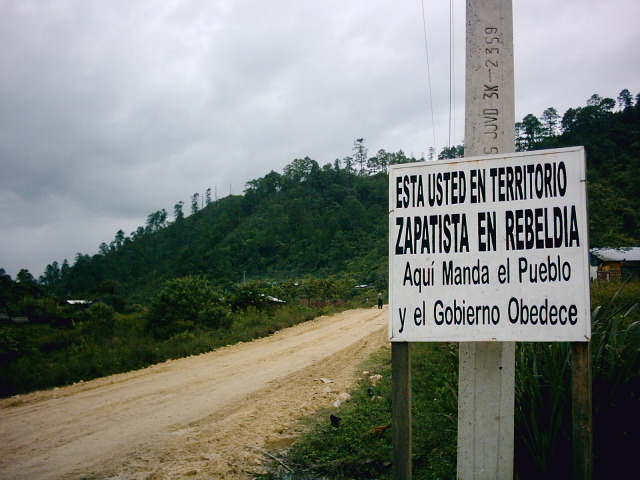
Sign indicating the entrance of Zapatista rebel territory. “You are in Zapatista territory in rebellion. Here the people command and the government obeys”.

Reblogged from Libya 360

While the front pages and TV news reports in Mexico are full of accounts of ghastly levels of corruption and violence that would have boggled the imagination of the most jaded pulp fiction writer, in every corner of the country there are spaces where “you breathe a different air,” as the saying is here.

On the outskirts of San Cristobal de las Casas, famed colonial center of the southern state of Chiapas, on the wooded campus of the Indigenous Center for Comprehensive Training (Spanish acronym: CIDECI – follow the link to learn more about this remarkable alternative university) over a thousand people from all over Mexico and beyond are attending a weeklong seminar “Critical Thinking Confronting the Capitalist Hydra.” It was conceived and organized by the Zapatistas, the Chiapas-based armed insurgency that has converted itself into one of the most extraordinary experiments in regional autonomy and self-sufficiency in the history of social movements in Latin America. Along with masked members of the Zapatista army, rural peasant farmers, high school and college students, activists, teachers, artists’ collectives, members of various social and political formations like the National Indigenous Congress (Spanish acronym: CNI) are spending the week listening to a wide-ranging number of presenters from Mexico and abroad with expertise in key areas where the “hydra” now dominates: finance, government, agriculture, social welfare, communications, race and gender relations, science and technology.

And, true to the comprehensive vision of human discourse that is modern day zapatismo, they are also hearing from poets, artists, writers, historians, philosophers. The attendees pack the seats of the large auditorium and spill into the corridors and outside into the shaded walkways that surround it, using all the various ways we now have of capturing information, with an avidness and level of impassioned curiosity that would warm the heart of any college professor used to declaiming to a bored and distracted student body.

The analysis so far has been relatively concordant and not surprising: a litany of the human and ecological disaster that capitalism has wrought (not just in Mexico, but of course that is the primary focus here). The Spanish word “despojo,” which has only a much weaker equivalent in English, “dispossession,” recurs in so many presentations that it is clearly seen as one of the most fundamental characteristics of the system. “To be stripped violently of everything that sustains you” would be closer to the real meaning of this word. That is the key experience of capitalism’s innumerable losers: the mass of humans without power or privilege, and the living world.

Read more here: original article

Photo credit: “Zapatista sign” by Paolo Massa (‘phauly’) – Flickr. Licensed under CC BY-SA 2.0 via Wikimedia Commons

The Way Forward

battle

Guest Post by Steven Miller

(In this final of 6 guest posts, Miller discusses the role of reform in drawing people into action against the state.)

Nothing Can Be Done by Fighting for Reforms and Nothing Can Be Done Without Fighting for Them

We can summarize the salient features of the situation. Speculators wield massive political power in the US and the world. This is rooted in their absolute control of all forms of technology as private corporate property. At the same time, corporations are merging with the state. Speculators direct the capitalist class to use state political power against the people. They are engineering an escalating class war from the top against the rest of society. The capitalist class is compelled to implement electronic laborless production only in the narrow and limited ways that guarantee corporate profits.

Speculators crashed the economy in 2008 by bundling toxic mortgages into “investment tools”. Now they are doing the same with rents. Meanwhile, the situation has metastasized. There is no longer just one economic bubble. The Masters of the World are addicted to financial warfare based in bubble wars. In essence, these are just sophisticated video games that are played 24 hours a day using the assets of the public. Like days of yore, armies of mercenaries rampage across the land, despoiling the public. Like video games, they produce thrilling speculative battles with individual winners and losers. Unlike video games, they do this with the necessities of life.

So… can this situation be reformed? In other words, can the power of capital be limited or significantly altered so that the current crisis of destruction can be reversed, so that humanity can develop a sustainable economy that benefits people, rather than debasing them?

The answer is pretty clear: there can be no significant reforms. Capitalism’s feeble efforts to address Global Warming indicate this. As with the economy itself, capitalism is driving things inexorably towards greater instability and crisis. Reforming even one aspect of the situation – simply halting evictions, for example – would take a social movement on a scale never before seen. Even the uprisings of the Arab Spring have not fundamentally altered the situation. Everything today is influenced by the subjective understanding of the enormous class of people who can only survive by working.

The paradox is that nothing can be won by fighting for reforms and nothing can be won without fighting for them. There are no revolutionary reforms by definition. Reforms do not alter political power, yet reform is what draws people into action against the state. People must engage in the revolutionary struggle for reforms by doing the teaching, by elevating the discussion of where these political struggles are headed. This includes presenting a revolutionary vision of what society could be if technology were used to create real economic democracy, with democratic popular control of technology guaranteed at every level.

Capitalism intends to control and sanitize this debate:

Capitalism is a sorry excuse for an economic system. With no present viable alternative, contemporary capitalism continues to produce cruel economic results and a twisted morality. But a debate is underway. Even the Harvard Business School, the birthplace of many of capitalism’s excesses has a large project in ‘Rethinking Capitalism.” (23)

So re-think this. Everyone sees that the private corporate control of technology is not sustainable. It inevitably leads to short-term thinking, based only on the interests of private profit. This produces nightmares in every direction from climate change to corporate agriculture, new diseases, Big Pharma and the despoliation of the environment from the insane overuse of petroleum in all forms. Corporations are behind it all.

But the corporate control of technology is not an Act of God. In fact, in the ‘90s, the US Post Office proposed developing an open and democratic Internet for everyone. Bill Clinton immediately squashed that one, intoning that corporations are the best way to develop this amazing tool. Since corporations inevitably deform the potential uses of technology in order to make a profit, they are not fit to control it. Period.

Youngdahl can see “no present viable alternative” because he cannot imagine the public seizure of private corporate property. Capitalism uses its Media-Industrial State to confuse the issues. We are supposed to believe that democracy is an economic system, which it is not. Then they confuse the concepts of the government and the state. We are supposed to rail against “big Government” when government is a fundamental necessity to guarantee people the things they cannot provide for themselves. Like sewers, for example. What people really don’t like – as we see with the NSA scandal – is the capitalist state, not the government.

Some people believe that we can succeed in replacing the rule of the 1% by ignoring it and building local cooperative efforts. This view is what Chris Hedges argues in “Overthrow the Speculators!”:

We can wrest back control of our economy, and finally our political system, from corporate speculators only by building local movements that decentralize economic power through the creation of hundreds of publicly owned state, county and city banks… Public banks also protect us from the worst forms of predatory capitalism.” (24)

Interesting question. Why bother to get rid of simply the worst forms of predatory capitalism? It’s still predatory; it’s still capitalism.

Today Americans are under an onslaught from ALEC, the corporate lobbyists who write the corporate laws, the NSA and public surveillance in many forms, a governmental refusal to regulate capitalism in any form, plus the legalizing of extraordinary rendition and drones. The state is not going to permit any weeds to grow in the garden of speculation. This strategic question is not something to ignore.

Takeovers can work both ways. America has reached the point twice before where forms of private property were strangling the very life out of society. In the 1770s, when the 13 Colonies were the private property of the King, the American people rose up and abolished this private property. This power was exercised through private corporations, such as the Virginia Corporation, which raised private armies of mercenaries. Corporations today have reclaimed this power, aided and abetted by the Department of Homeland Security. In the 21st Century, there are more private police than public police in America.

In the 1850s, private property in slavery controlled all three branches of government – the Presidency (which includes the army), the Supreme Court, and the Congress. Slave property worked day and night to extend its rights over the rights of regular people, through the Dred Scott decision, the Fugitive Slave Act and a host of other actions. Recognizing that they could no longer continue to live free, the North waged the Civil War to expropriate private property in slaves and break their political power.

Move To Amend – an organization developed to abolish corporate rights as people and money as speech – is one group that addresses the issue of expropriation: “Slavery is the legal fiction that a person is property. Corporate personhood is the legal fiction that property is a person.” (25) After all, if corporations can expropriate the public – as they are actively doing today – the public can expropriate the corporations.

The third time is the charm.

Steven Miller, Oakland, California, January 2014 –  nanodog2@hotmail.com

….And a big Shout-Out to the Zapatistas – 20 years ago today!

References and Resources

23)  Jay Youngdahl. “2013 was a year of Heroes and Hope”. East Bay Express. 12-25, 2013

24)  Chris Hedges. “Overthrow the Speculators!”. 12-29-2013

25)    The Myth of Corporate Personhood. Turning the Tide.
photo credit: ryanophilly via photopin cc

***

Steven Miller has taught science for 25 years in Oakland’s Flatland high schools. He has been actively engaged in public school reform since the early 1990s. When the state seized control of Oakland public schools in 2003, they immediately implemented policies of corporatization and privatization that are advocated by the Broad Institute. Since that time Steve has written extensively against the privatization of public education, water and other public resources. You can email him at nanodog2@hotmail.com

Originally posted at Daily Censored

So You Want to Have a Revolution?

austerity protest

A 2013 study from Fairleigh Dickinson University reveals that 29% of Americans believe an armed revolution may be necessary in the next few years to “protect liberties.” The voter survey differed from most corporate media polls in that it included a substantial number of low income, cellphone only households.

18% of Democratic respondents shared this view, 27% of Independents and 44% of Republicans.

A decade ago, the notion that anyone other than a few thousand fringe extremists would contemplate violent revolution was unthinkable. At the very least, these results suggest a significant minority of Americans are profoundly disillusioned with the government’s apparent indifference to their needs and expectations.

The End of Growth: An Inconvenient Reality

Despite government claims to the contrary, recovery from the deflationary spiral that started in 2008 (aka The Recession) has been elusive. Although stock prices continue to soar, productivity, employment and consumer spending have stubbornly refused to return to pre-2008 levels. Some latter day (non-Wall Street) economists believe the era of economic growth has ended – permanently – owing to the soaring cost of fossil fuels. In their view, the world has returned to a steady state economy.

Given the historic link between growth and “full” employment (jobless levels below 10%), they are also predicting a scenario in which roughly half the adult population is unemployed. The paid work that remains will be low paid, part time, temporary jobs, unprotected by unions, employment rights or health and safety regulations.

To appreciate that US economic growth is at a standstill, it’s essential to look at undoctored economic data. For example, when Obama and the corporate media trumpeted a 7% unemployment rate for November, they neglect to mention that this figure only reflects the number of workers newly unemployed in the last six months (i.e. the number still receiving basic unemployment benefits). Unlike other countries, the official US jobless figure doesn’t include workers whose benefits have run out, who have stopped looking for work, or who want to work full time but are stuck in part time jobs.

Data from the Federal Reserve Bank of St Louis reveals that the US economy is shedding full time jobs, rather than gaining them. The percentage of unemployed Americans of working age has increased from 35.5% in 1999 to 41.7% in 2013 – the highest since 1980. Most of that increase (5%) has occurred since Obama was first elected in 2008.

The 2008 Economic Crash Was Predictable

Prominent members of the Peak Oil movement, most notably Michael Ruppert and Richard Heinberg, predicted the 2008 economic crash. They based their predictions on declining oil reserves, the failure of oil production to keep up with increasing demand from developing countries and the steep rise in oil prices that began in 2005.* Based on their calculations, mankind had extracted half of the world’s available oil reserves by November 2005. This was officially known as Peak Oil. We reached Peak Natural Gas several years before that, though we won’t reach Peak Coal for another decade or so.

Although there still remains tons of oil, gas and coal left in the ground for us to extract and burn, we are now on a downward slope. Not only is production continuing to outstrip demand, but most of the remaining oil, natural gas and coal are difficult to get at, expensive to extract and rely on dangerous, expensive, environmentally destructive and controversial technologies, such as deep sea oil drilling, tar sands extraction fracking and mountain top removal.

Capitalism and Productivity

The steady economic expansion we call growth is a relatively new phenomenon in human history. Prior to the 19th century, the major nations of the world operated steady state economies. In fact the argument Heinberg and others make is the burst of productivity most of the world attributes to capitalism had nothing to do with the capitalist economic model itself. Rather it was based on the widespread abundance of cheap fossil fuels. British economists at the Fiesta Institute provide abundant data justifying this argument in Fleeing Vesuvius: Overcoming the Risks of Economic and Environmental Collapse. They point out that even at current oil prices, it costs far less to use a machine to perform work than to employ a human being or even a draft animal.

The birth of capitalism wasn’t just about the exploitation of fossil fuels. It was about the exploitation of all natural resources – clear cutting forests, large open pit mines to extract steal, copper, gold, bauxite (for aluminum), gold diamonds and rare earth minerals, draining swamps and eradicating wetlands. When oil started becoming more expensive (in the 1970s), it was also about moving western factories to third world countries to enable wholesale exploitation of human labor. Government encouraged this wholesale extraction and exploitation because it produced enormous prosperity for most of western society over many decades.

At the same time there were immense human and environmental costs. Western capitalism produced incalculable suffering in the third world as indigenous people were driven off the land that gave them a subsistence living, with the lucky ones obtaining jobs in brutal sweatshops that paid starvation wages. Suffering in the first world was less visible until last decade, when residents of the industrialized world began to realize they were being systematically poisoned with toxic industrial chemicals, increasing levels of both nuclear and microwave radiation and harmful organisms that had contaminated our air, water and food chain.

*Historically the oil price ranged between $2-4 a barrel prior to 1973 oil crisis. It remained between $10-20 a barrel until 1979. From 1979-1986 it fluctuated between $20-38 a barrel until 1986, when it dropped below $20 a barrel until 1989. It dropped below $20 a barrel very briefly in 1999. It hasn’t been below $40 a barrel since 2004.

photo credit: athens.rioter via photopin cc