The Dawn of Everything: A New History of So-Called Civilization

The Dawn of Everything by David Graeber ...

The Dawn of Everything: A New History of Humanity

By David Graeber and David Wengrow

Penguin Randomhouse UK (2021)

Book Review

One of the most amazing books I’ve ever read, The Dawn of Everything was completed just three weeks before Graeber’s untimely death in September 2020. According to Wengrow’s introduction, its primary goal is to dispel the prevailing mythology that rigid hierarchical, patriarchal and bureaucratic government is inevitable in a society consisting of large technologically advanced cities.

Presenting massive amounts of archeological and historical evidence, Graeber (an anthropologist) and Wengrow (an archeologist) contend that up to 500 years ago, egalitarian, self-governing societies were the default form of governance for most of the last 40,000 years.

For me the most interesting evidence comes from early accounts of French missionaries interacting with indigenous societies belonging to the Haudenosaunee (Iroquois) confederacy in northeast North America, as well as indigenous commentators themselves.* I am left with absolutely no doubt that these commentaries were the main influence behind the new ideals of “freedom” and “equality” presently attributed to the 17th century (European) Enlightenment.

As Graeber and Wengrow make clear, most pre-Columbian American cultures had a far more developed political self-consciousness than than their European counterparts. This related in large part to their near daily participation in egalitarian governance councils. It also related in part to their direct or or indirect experience with towns or cities governed by tyrannical chiefs or kings. Those with ancestors who had overthrown or walked away from these hierarchical settlements** were exquisitely conscious of the deliberate precautions needed to prevent a recurrence of this of hierarchical form of dominance.

The authors cite numerous other prehistoric cities that were allowed to collapse when their residents rejected dictatorial rule. In fact, they estimate human beings have spent the last 40,000 years building up hierarchical forms of government and subsequently dismantling them. The book includes evidence from Japan, China, pre-Pharaonic Egypt, Sumer, Assyria and medieval Europe (with its incessant peasant revolts),

I was also fascinating by the section on the origin of patriarchy. The Dawn of Everything offers a new interpretation for the naked female figurines (commonly believe to be religious fertility symbols) found across Eurasia from around 7000-3500 BC.

'The Venus of Willendorf, Side View of Female Figurine ...

The authors believe the figurines were crafted to honor senior women as co-creators of a distinct form of egalitarian society. Archeological evidence from  Çatalhöyük (in modern day Turkey) indicates that long before grains were used for food, women were harvesting  wild grasses to mix with clay to build homes and ovens, as well as for baskets and clothing.Their intimate knowledge of wild grains would lead women to first cultivate and then domesticate them as wheat and barley, as they went on to develop a range of food technologies, including the use of yeast to produce bread and beer.

Graeber and Wengrow hypothesize the figurines were a self-conscious effort to honor female wisdom, in contrast to the nearby upland society of Göbekli Tepe. The latter was a heroic warrior society, emphasizing male domination and conquest of weaker egalitarian societies for resources and slaves.***

Beginning around 5000 BC, egalitarian communities throughout Eurasia began to be overrun by “heroic” cattle keeping warriors who established themselves as a ruling elite and radically subordinated women.

Matriarchal societies (in which women controlled key stockpiles of food, clothing and tools) persisted in Wendat societies, in the pueblo Hopi and Zuni nations, the Minoan civilization of Crete and the Minangkabau (Muslim people of Sumatra).


*The most famous indigenous commentator was the Wendat (Huron) chief Kandiaronk, who visited Europe and had major influence on the Enlightenment philosophers Rousseau, Voltaire, Montesquieu and Locke, among others. Kandiaronk viewed indigenous societies as far wealthier and more advanced than French society because they were “free of the expectation of constant toil in pursuit of land and wealth.” In his view although the Wendat possessed fewer material goods, they possessed the more valuable assets of “ease, comfort and time (people typically worked 2-4 hours a day in foraging and horticultural societies – even medieval serfs rarely worked more than 6 hours a day).” He viewed French commoners as little more than slaves in constant fear of their superiors. It was also his view that the European-style punitive legal system encouraged selfish and acquisitive behavior. Moreover it was unthinkable to allow any member of Wendat society to starve or become destitute.

**Examples of hierarchical settlements in the New World that were overthrown or allowed to collapse (by residents simply walking away) included Cahokia and other Mississippian kingdoms, Teotihacan, the Great Plains nations (who abandoned farming for hunting after domesticating escaped Spanish horses) and various settlements of the Inuit, the Crow and a number Amazonian tribes.

***Using the slave-owing Nambikwara culture (on northwest coast of North America) as an example, the authors hypothesize that the elites of hierarchical societies sought to capture “foreign” slaves when they couldn’t compel commoners in their own societies to undertake labor intensive work.
Shoot Everything that Moves: Native American Genocide and the US Tradition of Civilian Atrocities

an indigenous peoples history

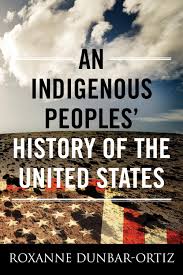
An Indigenous Peoples’ History of the United States

Roxanne Dunbar-Ortiz (Beacon Press 2014)

Book Review

I loved this book. It helped me make sense, finally, of the barbaric viciousness of US military policy. The drone wars, torture, sexual assault, civilian massacres and deliberate targeting of women and children all clearly have their origin in the genocidal wars against Native Americans. There is an unbroken continuity, embedded in the mindset of US military officers, between the so-called Indian Wars and the US invasion and occupation of Mexico, the Philippines, Korea, Vietnam, Afghanistan and Iraq.

An Indigenous Peoples’ History of the United States is a book about total war, also known as “irregular warfare” and “counterinsurgency,” a uniquely American scorched earth form of warfare that was first perfected during the British colonization of Northern Ireland. Ulster Scots-Irish settlers brought it to the New World, migrating in the hundreds of thousands in the early eighteenth century. From the beginning, it was primarily Scots-Irish settlers who illegally squatted on unceded Indigenous lands. These were typically soldier-settlers who killed Indigenous farmers and destroyed their towns. They would become the mainstay of the colonies’ early militia movement, as well as forming the bulk of Washington’s revolutionary army.

Native historian Roxanne Dunbar-Ortiz organizes this book around three broad themes: the US role as a Covenant Nation, the Doctrine of Discovery and the uniquely North American concept of genocidal extermination as a legitimate form of warfare.

Correcting the Historical Record

The author begins by correcting centuries of lies and distortions about life in North America prior to European colonization – starting with the number of inhabitants. Archeological evidence indicates the Indigenous population of North American was closer to 40 million than the 1-2 million claimed in most official textbooks. This Over a period of 200 years, this number was reduced to a current Indigenous population of approximately 3 million.

Far from being naked savages, these 40 million lived in advanced sovereign nations comparable to the Mayan, Aztec and Incan civilization in Central and South America. These nations and city-states had extensive road networks and trade relationships and benefited from advanced agricultural techniques (which included irrigation), arts and sciences, and sophisticated systems of government, theologies and philosophies. Unlike other early civilizations, they didn’t domesticate animals. Rather they managed wild herds by deliberately creating food-rich forest parks to attract them. For this reason, they were also free of zoogenic diseases, such as small pox, influenza, measles, etc. that animal domestication introduced into other civilizations. .

By the 12th century, the Mississippi Valley was dominated by a number of large city states, including one (Cahokia) which had a population (40,000) larger than London (14,000) at the same period.

Covenant Nations and the Doctrine of Discovery

All these civilizations were destroyed by European settlers and armies who believed their Christian God had promised North America to them. Sound familiar? According to Dunbar-Ortiz, the US, like Israel and apartheid South Africa, is a Covenant Nation. In all three, the political elite justified the total subjugation, displacement and extermination of the original inhabitants based on a so-called Covenant with their God.

Although it was primarily Protestant English and Scots-Irish settlers who instigated and led the genocidal wars against Indigenous North Americans, legally they used a series of 15th century papal bulls, collectively referred to as the Doctrine of Discovery, as legal justification for their actions. These declare that European nations acquire title to any land they “discover” in Africa, Asia or the Americas – that Indigenous inhabitants lose their natural right to their land once Europeans arrive and claim it. The US Supreme Court upheld the Doctrine of Discovery in 1823.

A State of Perpetual War

Dunbar-Ortiz also carefully documents that the US has been continuously at war ever since their 200-year war against the Indigenous nations. Washington’s revolutionary army directed as much force against Native American resistors as against British troops. Until the 1800s, Indigenous populations exceeded that of the settlers. When the colonial leadership failed in defeating Indigenous warriors by force of arms, they resorted to killing their women and children.

In addition to providing a detailed description of all the battles, unprovoked massacres and forced dislocations of Indigenous Americans, Dunbar-Ortiz provides detailed background on numerous other US wars commonly omitted from textbooks. For example the two Barbary Wars (1801-05 and 1815-16). In 1801 President Thomas Jefferson dispatched the Marines to invade Tripoli* (Libya) because their ruler was exacting fees from US merchant ships that entered their territorial waters.

Between 1798-1827, the US engaged in 21 other foreign military interventions, including Cuba, Latin America and Greece. Between 1831-1896, they engaged in 71 overseas interventions on all continents except Antarctica. Between 1898 and 1919, they engaged in forty overseas military interventions.

I particularly enjoyed the section about the US war on Mexico (which abolished slavery on gaining independence in 1821) and the US desire to extend the slave-plantation system westward. Following the US-Mexico War (1846-1848), the US annexed half of Mexico, which would become the states of Texas, California, Utah, New Mexico, Nevada, Arizona and Colorado. Violent conflict over whether these new states would be free or slave states would ultimately trigger the Civil War.


*This is the origin of the first line of the Marine hymn: “From the halls of Montezuma (referring to the US invasion of Mexico) to the shores of Tripoli.”