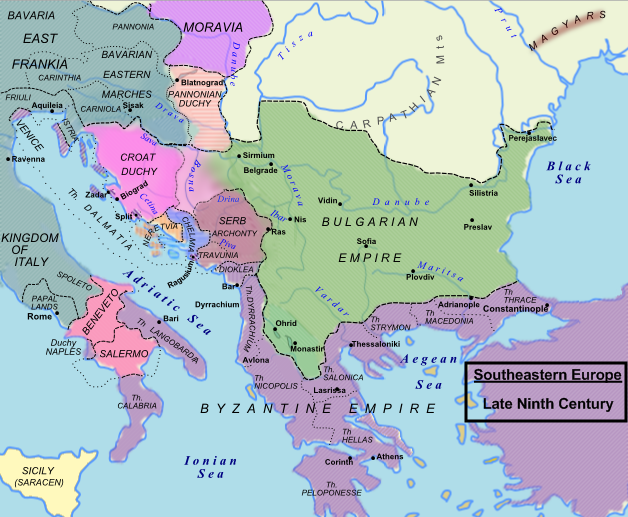
The First Bulgarian Empire (680 – 1018 AD)

Episode 16: Avars, Bulgars and Constantinople

Barbarian Empires of the Steppes (2014)

Dr Kenneth Harl

Film Review

The main focus of this lecture is the shifting alliances between the steppes nomads and the Byzantine Empire between the 6th and 10th century AD. During the reign of the emperor Justinian (527-565 AD), the Avar Khan formed an alliance with Constantinople against the western Gökturk Khanate. The latter sought to annex them as a colony. However by 575 AD, the Avars, having migrated to the Hungarian plains, had abandoned this alliance and were conducting periodic raids on the Balkan provinces of the Byzantine empire.

In a constant state of war, Byzantine forces simultaneously fought to reclaim provinces of the former eastern Roman empire (in Italy, North Africa, Armenia, Syria and the Middle East) and to repel repeated attacks by the Sassanid Khanate (Persia). In 591 AD, there was a temporary halt to the Persian-Byzantines war after the Sassanid shah was deposed and Emperor Maurice lent him troops to help him regain his throne.

Between 602-626 AD, Persia and the Avars formed an alliance and came close to conquering the Byzantine Empire. However this time the Byzantines formed an alliance with the Göturks, whose rout of the Sassanid Khanate enabled the Byzantine empire to assimilate Asia Minor, the Balkans and Italy.

The Lombards* eventually allied with the Avars to reclaim the Balkans, opening the territory to Slav settlement.**

In 790 AD, the Franks reunited western Europe under Charlemagne, who conquered the Avars in 796 and ended their presence as an organized political entity.

In the 9th and 10 century, a Turkic tribe called the Bulgars combined a Slavic infantry and a nomad cavalry to repeatedly sack the western Byzantine province and became a major power in the Balkans.

In 864 AD, the Bulgar ruler Khan Boris converted to Christianity after two monks created the Cyrillic script and translated the scriptures into the Bulgar language. He became known as Czar Boris following his conversion.

His son Vladimir raided Constantinople to pressure the emperor to offer him a royal princess in marriage. In the ensuring war, the Balkans were re-taken by the Byzantine Empire.


*The Lombands were a Germanic people originating near the Elbe River who ruled most of the Italian peninsula from 568-774 AD.

**At which point the Balkan provinces ceased to be Latin and Greek speaking.
https://www.kanopy.com/en/pukeariki/video/5694984/5695017

Attila the Hun: Scourge of God

Episode 12: Attila the Hun: Scourge of God

Barbarian Empires of the Steppes (2014)

Dr Kenneth Harl

Film Review

Harl devotes this lecture to one of the most skilled military leaders of all time Attila (434-453 AD). At the time of his death, Attila the Hun controlled a tribal empire consisting of Huns, Ostrogoths, Alans and Bulgars. Harl credits his large diverse empire for the linguistic shift on the steppes from Persian to Turkic languages. For many historians, the latter signals the start of the Middle Ages.

Like many prior nomadic chieftains, Attila maintained control of his federation via the loot he pilfered (which he used to pay vassal chieftains) from the Balkan provinces of the Eastern Roman Empire. In addition to gold and luxuries, he also captured Roman engineers to build bath houses and build military technology to overwhelm Roman defenses.

Initially Attila’s main objective was to break down the Danube defenses of the Western Roman Empire, allowing him easy access to the Germanic provinces. In 447 AD, Rome signed a treaty with Attila that effectively stopped his military raids on Gaul. In addition to paying him 2,100 pounds of gold, Rome promised to demilitarize a 200-mile area to the south and west of the Danube (effectively allowing Hun raiders free access to the former Roman provinces).

The same year, Attila virtually destroyed Constantinople’s Theodosian walls (see How the Rise of the Huns Transformed Europe. Over the next year, Theodosius II put the entire population to work restoring the walls to protect against Hun raids.

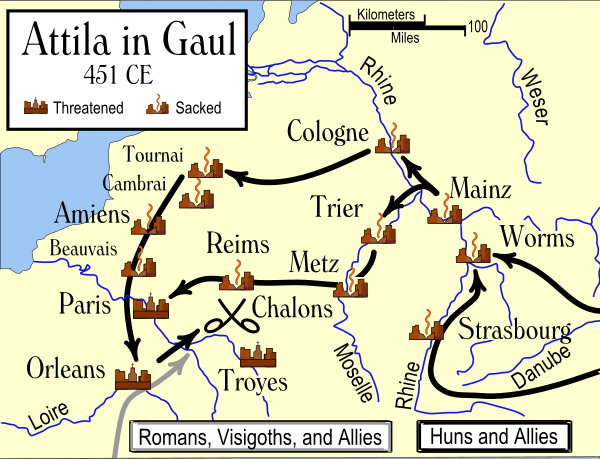
In the spring of 450 AD, the half-sister of Roman emperor Valentinian III sent Attila a ring begging him to rescue her from an unpleasant arranged marriage. Taking this as a marriage proposal, Attila accepted, requesting Gaul and Spain as her dowry. When Valentinian declined, Attila declared war on Rome. Assembling assembling an infantry of 100,000 mounted warriors and infantry, sacked 10 major cities of Gaul.*  Enlisting assistance from the Visigoths, Franks and lesser nomadic tribes, Valentinian’s generals confronted Attila at the Marne River in the 451 AD Battle of the Catalonia Plains. It ended in a stalemate and Attila withdrew to the Danube.

When Attila invaded Northern Italy a year later, Pope Leo I met him at the Po River and persuaded him to withdraw.

A short time later, Attila died in a drunken stupor. Suspected of poisoning him, his wife was put to death. She emerges as the heroine Gudrun** in Norse mythology.


*Paris was one of the few cities that didn’t fall.

**In Norse mythology, Gudrun was the wife of the great hero Sigurd. After Sigurd’s death, she became the wife of Atli, king of the Huns.

Film can be viewed free with a library card on Kanopy.

https://www.kanopy.com/en/pukeariki/video/5694984/5695009