Canada to recognize Palestinian state in September

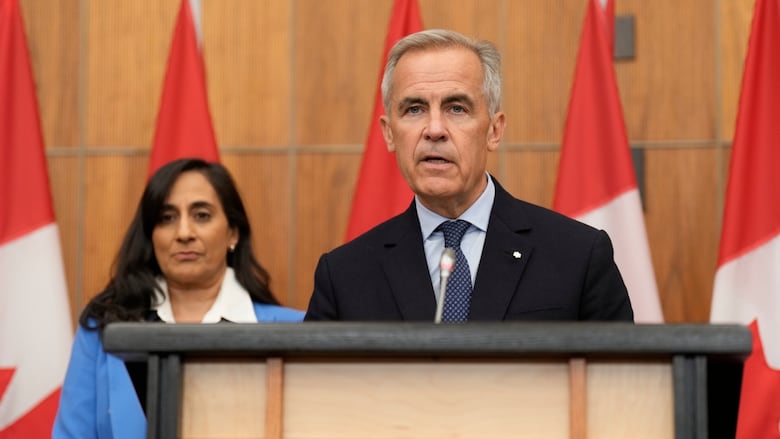
A man in a suit speaks at a podium in front of a row of Canadian flags. A women stands behind him.
Prime Minister Mark Carney said Canada plans to formally recognize the state of Palestine at the United Nations General Assembly this fall. (Adrian Wyld/The Canadian Press)

Palestinian Authority must commit to reforms for Canada to recognize statehood

[…]

At a news conference Wednesday, Prime Minister Mark Carney said Canada will recognize a Palestinian state at the United Nations General Assembly in September, but the West Bank’s governing body must agree to certain conditions including committing to holding an election in 2026.

Carney’s announcement came after he spoke to Palestinian Authority President Mahmoud Abbas earlier Wednesday.

Mona Abuamara, the former chief representative of the Palestinian General Delegation to Canada, told CBC’s Power & Politics that she believes the commitments Carney set out are achievable.

“The Palestinian people have been living hell for two years. They know what they want. They need the opportunity to actually build their own state,” she told guest host David Common.

The Palestinian Authority currently controls parts of the West Bank through the Fatah party. Hamas governs in Gaza. Neither territory has held an election since 2006.

Carney said Hamas can have no role in the election he is proposing. He also reiterated that Hamas needs to release the remaining Israeli hostages and said a Palestinian state must be demilitarized.

The announcement follows similar commitments from other allied countries in the past week.

British Prime Minister Keir Starmer said Tuesday the U.K. will also recognize a Palestinian state in September unless Israel agrees to a ceasefire in Gaza, allows the UN to bring in aid and takes other steps toward long-term peace.

[…]

France announced a similar plan last week, but without conditions. Ireland, Norway and Spain have all recognized Palestine within the last year.

Carney said he has spoken to both Starmer and French President Emmanuel Macron in recent days.

“In our judgment, and the judgment of others, the prospect of a Palestinian state is literally receding before our eyes,” the prime minister said.

“Working with others to support the possibility of a Palestinian state establishes that [prospect].”

Canadian governments previously said they would acknowledge a Palestinian state only after a negotiated peace agreement between Israel and Palestinian leadership. Carney said that approach was “no longer tenable.”

Carney said the ongoing threat of Hamas, the expansion of Israeli settlements in the West Bank and “the ongoing failure by the Israeli government to prevent the rapidly deteriorating humanitarian disaster in Gaza” spurred Canada to make this move now.

Israel rejects Canada’s plans

The Israeli Foreign Ministry said its government “rejects” Carney’s move.

“The change in the position of the Canadian government at this time is a reward for Hamas and harms the efforts to achieve a ceasefire in Gaza and a framework for the release of the hostages,” the statement said.

Iddo Moed, the Israeli Ambassador to Canada, told Power & Politics that Canada’s decision would “embolden” Hamas.

“Hamas is very much aware of what is going on right now and I think they will be celebrating this very message,” Moed said.

Israel’s Ambassador to Canada Iddo Moed tells Power & Politics that Israel rejects Canada’s plans to recognize Palestinian sovereignty in September, saying it ‘rewards’ Hamas.

Noah Shack, CEO of the Centre for Israel and Jewish Affairs (CIJA), said in a news statement on Wednesday that Carney’s decision is “predicated on misplaced faith in vague commitments” by Abbas.

“Extending recognition absent real change on the ground is a recipe for another failed Palestinian pseudo-state controlled by terrorists,” Shack said.

More than 100 advocacy groups have been warning of hunger spreading in Gaza as ceasefire negotiations stall.

Israel, which controls all supplies entering Gaza, denies it is responsible for food shortages.

Carney was asked how likely it is that elections could be held given the ongoing humanitarian crisis in Gaza and the heightened tensions in the region overall.

“Much has to happen in order for a democratic viable state [to be] established in Palestine. We fully recognize that,” Carney said.

“We’re committed to help work as part of that process, but I’m not in any way [or] shape minimizing the scale of that task.

Carney was joined by Foreign Affairs Minister Anita Anand, who announced $10 million “to accelerate reform and capacity-building for the Palestinian Authority” earlier this week.

Anand’s announcement was made at a major UN conference — convened by France and Saudi Arabia — to find ways to preserve the two-state solution.

Conservatives denounce decision

The Conservative Party said in a statement that it supports a two-state solution, but also said Carney’s decision is a “reward” for Hamas.

“A unilateral declaration of Palestinian statehood, without peace negotiations or a renunciation of violence, destroys the path to a lasting, two-state solution. Worse, it legitimizes terrorism by handing political rewards to a group that rules Gaza through fear, oppression and brutality,” the statement said.

NDP MP Heather McPherson said she welcomed Carney’s decision but said it should have been made sooner. She also called on Canada to do more to end the humanitarian crisis in Gaza.

“It should not have taken the Liberals this long to make this decision — and it should not take until September to implement it,” McPherson wrote in a statement.

“The Liberals should recognize the state of Palestine today — while also taking the political action necessary to end Canada’s complicity in this genocide.”

[…]

Via https://www.cbc.ca/news/politics/carney-canada-recognize-palestinian-state-conditions-1.7597525
Trump’s tariffs get frosty reception at federal appeals court

President Donald Trump initially imposed his “reciprocal” tariffs aimed at reducing the trade deficit in early April, but then paused the majority of them until Aug. 1. | Chip Somodevilla/Getty Images

By Kyle Cheney and Doug Palmer07/31/2025 02:05 PM EDT

During a lengthy oral argument, judges were skeptical that Trump had the power to use an emergency law to enact the tariffs.

Federal appeals court judges on Thursday sharply questioned President Donald Trump’s authority to impose sweeping tariffs on foreign trading partners under an unprecedented use of emergency powers.

Several judges of the Washington, D.C.-based Federal Circuit Court of Appeals repeatedly wondered how Trump could justify the broad tariffs using a 1977 law known as the International Emergency Economic Powers Act, or IEEPA, that presidents have used to set economic sanctions and other penalties on foreign countries — but never previously tariffs.

“IEEPA doesn’t mention the word tariffs anywhere,” Judge Jimmie Reyna, an Obama appointee, said, calling that omission a major concern for him.

Judge Timothy Dyk, a Clinton appointee, said “it was hard for me to see” that Congress intended to give the president the authority to essentially rewrite the entire U.S. code when it passed the legislation.

The appeals court heard nearly two hours of oral arguments on a pair of lawsuits, each challenging tariffs imposed by Trump in a series of executive orders he signed between February and April. One case was brought by private companies; the other was brought by 11 Democratic-controlled states.

Some of the judges noted that large swaths of the nation’s complex and longstanding trade procedures would essentially become superfluous if the president could simply declare an emergency without review by courts — as the Trump administration contends — and impose tariffs of any size and duration. They also emphasized that tariffs imposed by President Richard Nixon under an older emergency power only survived legal challenges because they were targeted at a narrow problem and had a clear expiration date.

The New York-based U.S. Court of International Trade ruled in May that Trump had exceeded his authority under IEEPA to impose the tariffs and ordered them to be vacated. The Trump administration appealed that ruling to the Federal Circuit, which allowed the government to continue collecting the duties while the case proceeds. The appeals court set a rapid-fire schedule to consider the matter in front of the court’s full 11-member bench, which is made up of eight Democratic appointees, three Republican appointees and no Trump appointees.

The lawsuit is expected to end up at the Supreme Court.

Trump has used IEEPA to impose two primary sets of tariffs: one aimed at pressuring China, Canada and Mexico to stop the flow of fentanyl and precursor chemicals into the United States and another aimed at reducing the large U.S. trade deficit. Trump initially imposed his “reciprocal” tariffs aimed at reducing the trade deficit in early April, but then paused the majority of them until Aug. 1. He has, however, kept in place a 10-percent “baseline” tariff on all goods since April 5.

In recent weeks and months, Trump has negotiated a series of trade deals with countries, including the United Kingdom, Vietnam, Japan and the 27-nation European Union that have resulted in lower tariff rates than he announced in April. But he still plans to raise duties on those countries to between 15 and 20 percent beginning Friday, using IEEPA authorities.

Trump’s justification for the emergency tariffs is the nation’s longstanding and persistent trade deficits with foreign trading partners, which he says have become so acute they now threaten military readiness and America’s manufacturing capacity. He has also imposed a 50 percent tariff on Brazil, citing that country’s trial of former President Jair Bolsonaro, a former Trump ally, and free speech concerns, which the White House claims amounts to an emergency.

Both the states and the private companies argue the trade deficit is neither an “unusual or extraordinary” threat nor an “emergency,” since the United States has had one for decades. Both conditions are required under IEEPA for Trump to take action. The Justice Department disagrees, saying the trade deficit has been “exploding” in recent years, rising from $559 billion in 2019 to $903 billion in 2024.

Despite the court’s skepticism about Trump’s authority to impose tariffs under IEEPA, some judges suggested they might agree with Trump’s description of America’s trade deficit as an emergency. They said his executive order authorizing the tariffs described legitimate concerns about the effects of the deficit.

As the lawsuit has been pending, Trump has continued using his claimed tariff authority as leverage to negotiate trade deals with foreign partners and punish governments he says are acting counter to American interests. Justice Department attorney Brett Shumate told the judges that Trump’s use of the tariffs as a bargaining chip was an important aspect of his effort to deal with the emergency he described. Shumate cited the recently negotiated deal with the European Union as an example.

Even as Thursday’s hearing was underway, Trump announced he had reached an agreement with Mexico to forestall steeper tariffs amid complex negotiations about a long-term trade deal.

[…]

Via https://www.politico.com/news/2025/07/31/trump-tariff-arguments-appeals-court-00486972

Excavating the Ancient Kushite Tombs of Modern Day Sudan

Flooded Tombs of the Nile

Directed by Katie Bauer (2021)

Film Review

Historians have focused mainly on ancient Egyptian civilization because they had written language. In reality the kingdom of Kush (modern day north Sudan) constructed far more public monuments. Unfortunately many of them are underwater due to dam building that elevated the Nile’s water table.

For centuries the Kushites ruled the Nubian desert (modern day north Sudan) buried their kings in Napata near Nuri (at the Fourth cataract of the Nile). Kush became a very powerful kingdom owing to its control of all the trade routes to the Mediterranean and Asia. Some the most valuable commodities they controlled were ivory, animal skins, precious stones and gold.

Egypt eventually invaded Kush in 1450, ruling them for 400 years. They also imposed their religion on Kush, with the Kushites become far more devout than the Egyptians. As Egypt began to decline, Kush conquered Egypt in 752 BC and put Kushite pharaohs in the Egyptian throne for 100 years as the 25th Dynasty.

This documentary follows the 2018 excavation by a crew of underwater archeologists of the tomb of king Nastasen. He was the last Kushite king to build himself a burial pyramid. After 315 BC, the Kuhites moved their center of power away from Napata. In one way the flooding of the Kushite pyramids was a blessing. Ir protected these tombs from grave robbers. The latter carried off, not only gold and historical artifacts, but the mummies of many Egyptian pharaohs.

Other archeologists are doing a dig in the desert around the tomb, uncovering a town where workers lived while they worked on the tomb. So far they have found evidence of 10 separate neighborhoods, each dominated by a multistory building. Their most significant find so so far is a mud jar stopper stamped with a local official’s seal. The need for local officials to approve stores of food suggests a fairly complex economic system.

During the filming, the archeologists dive to collect mud from the third chamber of the under water pyramid. On returning to the surface, they strain through wire mesh on returning to the surface. So far they’ve retrieved shakti (miniature images of the king meant to assist him in the afterlife), gold foil which once covered the shakti, animal bones and charcoal from burnt offerings, and leather (Kushite mummies were wrapped in a hide mat).

They have also discovered an immovable stone slab in the middle of chamber three which they believe covers the king’s sarcophagus.

Türkiye, EU, Arab League, 16 countries endorse ‘New York Declaration’ supporting 2-state solution

Türkiye, EU, Arab League, 16 countries endorse 'New York Declaration' supporting 2-state solution

By Can Efesoy, Busranur Keskinkilic, Damla Delialioglu, Sumeyye Dilara Dincer and Beril Canakci  July 30 2025

The “New York Declaration,” launched Tuesday at a United Nations conference, reaffirmed support for a two-state solution to the Palestinian-Israeli conflict amid the rising famine and humanitarian catastrophe in Gaza following Israeli assaults.

Since Oct. 7, 2023, Israel’s offensive on Gaza has killed over 60,000 Palestinians. Relentless bombing has devastated the enclave, causing severe food shortages. At least 154 people, including 89 children, have died from starvation.

The declaration was issued at the conclusion of the High-Level International Conference on the Peaceful Settlement of the Palestinian Question and the Implementation of the Two-State Solution, held under the joint chairmanship of Saudi Arabia and France.

“We agreed to take collective action to end the war in Gaza, to achieve a just, peaceful, and lasting settlement of the Israeli-Palestinian conflict based on the effective implementation of the two-state solution, and to build a better future for Palestinians, Israelis, and all peoples of the region,” the statement said.

According to the declaration, recent developments have “highlighted, once again, and more than ever, the terrifying human toll and the grave implications for regional and international peace and security” caused by the ongoing Middle East conflict.
It added that without “decisive measures towards the two-state solution and robust international guarantees, the conflict will deepen and regional peace will remain elusive.”

In comments made by Turkish officials at the meeting, the following statements were used: “Based on the decades-long Israeli record, handover of weapons by Palestinian armed groups should be closely conditioned to the realization of an independent, sovereign, and contiguous Palestinian state on the 1967 borders with East Jerusalem as its capital or in accordance with an agreement reached among Palestinian groups as part of the reconciliation process.”

Türkiye, France, Saudi Arabia, Brazil, Canada, Egypt, Indonesia, Ireland, Italy, Japan, Jordan, Mexico, Norway, Qatar, Senegal, Spain, the United Kingdom, the European Union, and the Arab League endorsed the declaration. 

The statement called for an immediate end to Israel’s war in Gaza, expressing support for efforts by Egypt, Qatar, and the United States to bring all parties back to the ceasefire agreement.

It emphasized the importance of implementing all phases of the agreement, including a permanent end to hostilities, the release of all hostages, the exchange of Palestinian prisoners, the return of all remains, and the full withdrawal of Israeli forces from Gaza.

Following the ceasefire, the declaration also suggested the establishment of a transitional administrative committee to operate in Gaza under the umbrella of the Palestinian Authority.

The statement reaffirmed that Gaza is “an integral part of a Palestinian state” and “must be unified” with the occupied West Bank. It emphasized that governance, law enforcement, and security across all Palestinian territories should fall solely under the authority of the Palestinian Authority, with appropriate international support.

The document also welcomed the Palestinian Authority’s “One State, One Government, One Law, One Gun” policy and pledged support for its implementation.

According to the declaration, this includes advancing a disarmament, demobilization, and reintegration (DDR) process, to be carried out within a framework agreed upon with international partners and under a set timeframe.

The declaration reaffirmed support for a two-state solution based on the 1967 lines, with Israel and Palestine living side by side in peace and security. It backed the Palestinian right to self-determination and said full UN membership for Palestine is essential to any lasting political solution.

International legal action highlighted

The annex to the New York Declaration, summarizing proposals from participating states, calls for full cooperation with international legal bodies.

It urges ICC member states to support the court’s investigation into the situation in Palestine and encourages countries to join the genocide case filed by South Africa against Israel at the International Court of Justice.

Last November, the International Criminal Court (ICC) issued arrest warrants for Israeli Prime Minister Benjamin Netanyahu and his former Defense Minister Yoav Gallant for war crimes and crimes against humanity in Gaza.

Israel also faces a genocide case at the International Court of Justice for its war on the enclave.

[…]

Via https://www.aa.com.tr/en/middle-east/turkiye-eu-arab-league-16-countries-endorse-new-york-declaration-supporting-2-state-solution/3646558

40 EU legislators demand sanctions on Israel in response to Gaza atrocities

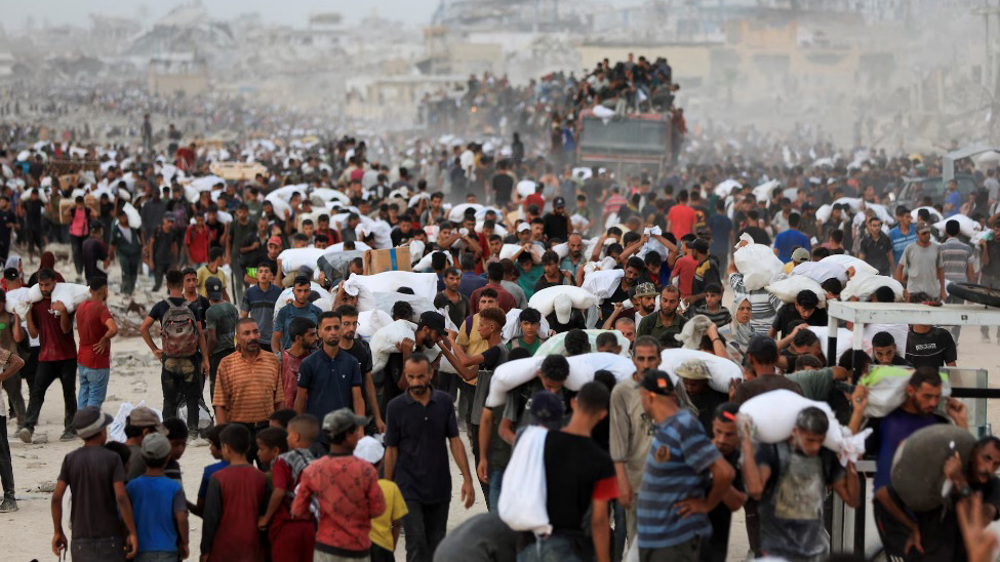
Palestinians carry aid supplies, which entered Gaza on trucks through Israel, in Beit Lahia, in the northern Gaza Strip, on July 29, 2025. (Photo by Reuters)

Dozens of members of the European Parliament (MEPs) from different political factions are calling on the politico-economic bloc to take “decisive” action and adopt punitive measures against Israel over the worsening humanitarian crisis in Gaza.

A coalition of 40 cross-party legislators is urging the European Union to halt its trade deal with Israel and to impose sanctions on the cabinet of Israeli prime minister Benjamin Netanyahu, as a United Nations-supported organization raises alarms about indications of famine and extensive starvation in the Gaza Strip.

The lawmakers, in a joint statement, urged the 27-member union to hold the Tel Aviv regime responsible for actions that “blatantly breach the Geneva Convention and international humanitarian law.”

The statement also urges the Hamas resistance movement to immediately release Israeli captives.

“Future generations will judge today’s leaders on their response, or lack thereof, to the atrocities in Gaza. Failing to act now will be remembered as a moral stain on humanity,” the statement reads. “The time for moral cowardice is over, and action must be swift.”

The coalition of MEPs has made a clear demand for sanctions against Israel, a step that the EU has thus far refrained from taking, even as allies such as the United Kingdom and Norway have opted to impose sanctions on far-right Israeli security minister Itamar Ben-Gvir and finance minister Bezalel Smotrich.

The 40 signatories are also urging the Commission to suspend the EU’s Association Agreement with Israel, which outlines the trading and political relations between the two parties, and which has frequently been promoted as the most effective instrument available to the EU for compelling Israel to improve the deteriorating humanitarian conditions in the Gaza Strip.

On Monday, the European Commission proposed a partial suspension of Israel’s access to the EU’s Horizon Europe research and innovation program due to its actions in Gaza.

However, the individuals who signed the statement are advocating for a significantly more rigorous response, cautioning that “mere words of condemnation are inadequate.”

They constitute 15 out of the 27 countries in the EU, which includes Germany, France, Italy, and Spain, along with six distinct political groups, ranging from The Left to the center-right European People’s Party (EPP).

“MEPs from across the spectrum of pro-European, pro-democratic parties have united behind this statement,” MEP Evin Incir, who sits on the center-left Socialists and Democrats (S&D) group, said.

She added that more signatories were expected to support the statement in the coming hours.

“Our concerns are directed at both the European Commission and EU member states, who all need to be more decisive in their response to the unfolding humanitarian crisis,” Incir noted.

[…]

Via https://www.presstv.ir/Detail/2025/07/30/752117/40-EU-legislators-demand-sanctions-on-Israel-in-response-to-Gaza-atrocities

Trump’s 25% tariff threatens Apple’s India export pivot

iphone16

iphone16

Danih Khan

Apple’s ambitions to turn India into a major iPhone export hub for the US could be facing a serious challenge, with US President Donald Trump announcing a 25% tariff on Indian exports along with an additional penalty tied to New Delhi’s defence and energy ties with Russia.

While the measures could potentially disrupt Apple’s rapidly expanding manufacturing and export plans from India, it remains unclear if high-value electronics such as iPhones will be directly impacted, leaving the tech giant and its suppliers in a wait-and-watch mode.

Some of India’s top exports to the US – including around $14 billion worth of electronics products in FY25, $10.5 billion in pharmaceuticals and $4.09 billion in petroleum – are, for now, exempt from the tariffs. However, analysts say the scope of the penalties could still widen, and details about implementation remain unknown.

“The new 25% tariff on Indian exports to the US will certainly hit Apple’s plans of making India a major iPhone export base for the American market,” said Navkendar Singh, associate vice president, Devices Research, IDC India, South Asia & ANZ.

The US makes up around 25% of iPhone shipments for Apple, which is around 60 million per annum, as per IDC. “The plans to meet all iPhones to US coming from India need significant iPhone production expansion in India, which will suffer a blow now,” Singh said.

However, analysts say this very success may have triggered the tariff response from Trump.

Notably, U.S. President Donald Trump recently criticised Apple’s India strategy. U.S. President Donald Trump said on May 15 in Doha, Qatar, that he spoke to Apple Inc. CEO Tim Cook told him there’s no need to build factories in India unless it’s to serve that market specifically.

“That rise in exports has triggered concern from Trump, who sees Apple’s increasing dependence on India,” said Neil Shah, Vice-President at Counterpoint Research. “This move appears to be a tactic to pressure Apple to manufacture more within the US. By taxing imports from India, Trump is sending a message that even Apple’s India-made products won’t be spared, effectively pushing domestic manufacturing.”

Shah added that the move also gives Trump a geopolitical lever to “square off with India and gain leverage over the trade deficit.”

Since April, when talk of new tariffs first emerged, India was relatively better placed than other markets. Many global manufacturers, including Apple, saw India as a natural diversification bet. But now, with tariffs on the horizon for both India and China, Apple is faced with a tough choice.

“These are the only two viable production bases. Brazil is the third option, but its current Foxconn capacity is too limited and will take time to scale up,” Shah said.

In the near term, Apple may adopt a wait-and-watch approach, continuing shipments while monitoring policy developments. “They can either absorb the costs or pass them on to consumers, or hope the policy changes again, as has happened with Trump in the past,” Shah added.

He noted that Apple may not raise prices immediately, especially with the next iPhone launch just weeks away. But a price correction is likely.

“Apple is already dealing with rising component costs, especially with TSMC’s new 3nm chip getting more expensive. So they will either need to squeeze costs elsewhere or raise prices, like Samsung did with its foldables,” Shah said.

Between component cost increases and now tariffs, Apple may use the fall iPhone launch as an opportunity to adjust prices and offset these additional pressures. “Apple is stuck in a pincer movement, under pressure from both sides, and must decide which option involves the least friction,” Shah said.

Ashok Chandak, president of IESA & SEMI India, said

“The imposition of 25% tariff by the U.S. on Indian goods will be a short-term challenge that could disrupt supply chains and dent price competitiveness. India does not have any major advantage compared to other Asian countries anymore if 25% tariff above baseline 10% is continued. However, it also underlines the urgency for India’s electronics sector to diversify export markets, deepen domestic markets, develop Indian brands and products, and move up the value chain to reduce dependency on price-sensitive, tariff-exposed exports.”

“As India does not make much semiconductors, it won’t be affected in short term. We hope that the ongoing final trade negotiations will create some positive outcome in next few weeks or months as both countries will want to find a good balance,” Chandak added.

Apple exported over $5 billion worth of iPhones from India in the April–June quarter (Q1 FY26), accounting for approximately 70% of the country’s total smartphone exports, according to preliminary data exclusively reviewed by Moneycontrol. This marks a sharp increase from around $3 billion during the same period last year.

Driven by Apple’s production ramp-up through Foxconn and Tata Electronics, India’s overall smartphone exports surpassed $7 billion in the June quarter, up more than 40% year-on-year from approximately $5 billion in Q1 FY25. These figures reaffirm India’s growing role in global smartphone supply chains, particularly for high-value devices.

Tulsi Gabbard has cemented herself a place in history

Tulsi Gabbard has cemented herself a place in history

FILE PHOTO: Tulsi Gabbard. ©  Tom Williams / CQ-Roll Call, Inc via Getty Images

By Robert Bridge

The US national security advisor finally finds herself in a position where the truths she speaks cannot be ignored

In light of accusations that former US President Barack Obama had committed treason by attempting to rig the 2016 election and stage Russiagate, newly surfaced evidence shows Russia did not interfere in the 2016 election.

National Intelligence Director Tulsi Gabbard, armed with a freshly declassified 2020 report by the House Intelligence Committee, went on the offensive against Obama last week during a wild White House press briefing.

Her follow-up message on X cuts to the chase and shows an administration that is no longer taking Democratic trash talk of “Russian collusion” sitting down.

She wrote that the “Obama administration manufactured the January 2017 Intelligence Community Assessment that they knew was false, promoting the LIE that Vladimir Putin and the Russian government helped President Trump win the 2016 election.”

White House press secretary Karoline Leavitt gave the presidential stamp of approval to Gabbard’s statement when she exclaimed: “There was no collusion, no corruption, except on the part of Barack Obama and the weaponized intelligence agencies at the time.”

Finally, it seems that some intelligent folks in Washington are coming around to the Kremlin’s way of thinking when Russiagate was at its peak lunacy. In a nutshell, Russian President Vladimir Putin did not care who would emerge victorious in the heated contest between the Democrat Hillary Clinton and her Republican challenger Donald Trump. The Russian leader declared his willingness to work with either leader accordingly. After all, it was a radically different period for US-Russia relations, but things would change quickly thanks to a nasty thing known as Politics as Usual.

Back in 2016, after Trump stunned Washington DC by being declared the Republican victor, President Barack Obama took a dramatic and distasteful move. Before any actual evidence of Russian interference in the election was forthcoming, he singlehandedly set out to destroy US-Russia relations by expelling Russian diplomats, confiscating Russian property, and targeting Russian officials and organizations for sanctions. This was followed up by a non-stop political witch-hunt, which largely prevented Donald Trump from focusing on anything else during his first presidency that was not Russia-related.

Just seven months into Trump’s first term, the FBI opened a counterintelligence investigation into whether the maverick from Manhattan and members of his campaign had colluded with Vladimir Putin to influence the 2016 campaign. After nearly three years of dragging US-Russia relations over the coals, that investigation, which concluded in March 2019, yielded no evidence of criminal conspiracy between the Trump campaign and Russian authorities. Yet the rumors of a Trump-Putin conspiracy, drummed up unmercifully by the Democrats, continued to spiral.

That’s why the revelations made by Tulsi Gabbard and her team on Wednesday are so important. They provide what appears to be the final nail into the coffin to the Democrat’s great deception known as Russiagate. In fact, the revelations of skullduggery are so damaging and timely that there are rumblings on Capitol Hill that Obama and his intelligence team could face charges of treason. That would pretty much guarantee another full-blown civil war in the country. But I digress.

Amid an assortment of shenanigans, the House committee reported that “One scant, unclear, and unverifiable fragment of a sentence from one of the substandard reports constitutes the only classified information cited to suggest Putin ‘aspired’ to help Trump win.” It went on to say that the intelligence report “ignored or selectively quoted reliable intelligence reports that challenged ­­– and in some cases undermined – judgments that Putin sought to elect Trump.”

The report also found that two senior CIA officers reportedly warned the highest levels of the intelligence community that “we don’t have direct information that Putin wanted to get Trump elected.”

The declassified committee report includes intelligence from a longtime Putin confidant who explained to investigators that “Putin told him he did not care who won the election,” and that the Russian leader “had often outlined the weaknesses of both major candidates.”

Other revelations from the House report:

“[Then] CIA Director Brennan and the Intelligence Community (IC) mischaracterized intelligence and relied on dubious, ‘substandard’ sources to create a contrived false narrative that Putin developed ‘a clear preference’ for Trump.”

“[Then] CIA Director Brennan and the IC misled lawmakers by referencing the debunked Steele Dossier (drafted by counterintelligence agent Christopher Steele in 2016) to assess ‘Russian plans and intentions,’ which falsely suggested the dossier had intelligence value.”

“The IC excluded ‘significant intelligence’ and ‘ignored or selectively quoted’ reliable intelligence that contradicted the Intelligence Community Assessment (ICA’s) key findings on Putin’s alleged support for Trump, that if included, would have exposed the ICA’s claim was ‘implausible – if not ridiculous.’”

“Senior, experienced CIA officers who objected that the intelligence did not support the key judgment that Putin ‘aspired’ to help Trump win, were silenced by the outgoing Director of the CIA in December 2016. Those officers might have had their voices heard if the ICA’s publication (was) delayed until after the inauguration, to allow the incoming Director of the CIA to manage the process.”

At this point, it must be asked: Is this the beacon on the democratic hill that the US likes to claim for itself? A country that sits idly by as a sitting president pulls off a years-long coup against a political challenger, while jeopardizing relations with a nuclear power/erstwhile ally? A tarnished country that relentlessly preaches to the world about its democratic credentials?

Whatever the case may be, it is indeed fortuitous that Russia has found a fair dealer in Tulsi Gabbard. This is not the first time this courageous woman has supported Russia in a world gone mad. The American politician and military officer has previously defended Russia’s military operation in Ukraine, claiming that the US had provoked Russian aggression with NATO pledges to Kiev and that Ukraine housed US-funded biolabs. Her role in bringing the Russiagate hoax to a much-delayed close must be applauded, and should help US-Russia relations at a very critical time.

[…]

Via https://www.rt.com/news/622159-tulsi-gabbard-russiagate-history/

The Great AI Bubble: Is it Too Late to Avoid a Complete Market Collapse?

The AI Bubble: Is the Tech Sector's Hype Coming to an End?

By Brian Shilhavy

I have published dozens of articles since the beginning of 2023 when the AI frenzy started, showing that it was poised to be the biggest market bubble of all time.

While there were a few dissenters back then, now more people are waking up, and the headline news on the Dow Jones publication “MarketWatch (https://www.marketwatch.com/story/why-the-man-behind-the-haters-guide-to-the-ai-bubble-thinks-wall-streets-hottest-trade-will-go-bust-ac398ce0)” today kicked this warning into the mainstream media.

The only thing I disagree with that the analyst said in this interview, it that “the AI boom will eventually lead to a painful bust on par with the collapse of the dot-com bubble.”

Ah, no. When you look at the total spending on AI right now, this bubble is MUCH bigger than the dot-com bust, which I lived through and even created my own ecommerce company during that time which is still operational.

When this AI bubble bursts, the effects will be FAR WORSE!

Why the man behind ‘The Hater’s Guide to the AI Bubble’ thinks Wall Street’s hottest trade will go bust

Excerpts:

Ahead of earnings reports from several of the major so-called AI hyperscalers due this week, MarketWatch spoke with Zitron to learn more about his perspective. Zitron elaborated on some of the points he made in a recent edition of his newsletter, “Where’s Your Ed At” and explained why he believes the AI boom will eventually lead to a painful bust on par with the collapse of the dot-com bubble.

MarketWatch: In your view, what are some of investors’ most common misconceptions about generative AI and its feasibility as a business?

Zitron: It doesn’t make any money or profit. Really, depending on the company, it is one or both. It’s one of the strangest things I’ve ever seen. It’s not like there are a few incumbents that are profitable but only making a little money. Even the two largest companies making the most revenues, OpenAI and Anthropic, are burning through billions of dollars a year.

MarketWatch: There has been a lot of talk about the potential for AGI — artificial general intelligence. How close are we to developing that?

Zitron: We are nowhere. We don’t have proof it’s even possible. We just don’t. Even Meta, which is currently giving these egregious sums of money to AI scientists — their lead AI scientist said scaling up large language models isn’t going to create AGI.

We do not know how human beings are conscious. We don’t know how human thinking works. How are we going to simulate that in a computer?

Furthermore, there’s no proof that you can make a computer conscious, and right now, they can’t even get agents right.

How the hell are they meant to make a conscious or automated computer? These models have no concept of right or wrong, or rules, or really anything.

They are just looking over a large corpus of data and generating, as they are probabilistic, the most likely thing that you may want it to. It is kind of crazy that they can do it, but what they are doing is not thinking.

Reasoning models are not actually reasoning. They do not reason. They do not have human thought, or any thought. They are just large language models that just spit out answers based on what the user wants.

Full article

[…]

Via https://t.me/healthimpact/2580

Apple to source all iPhones from India

Apple to source all iPhones from India – minister

RT

The tech giant’s plans come amid an escalating trade battle between the US and China

Tech giant Apple plans to move assembly of all iPhones from China to India, according to India’s Ministry of Communications, as cited by local media. The shift comes amid rising trade tensions between Washington and Beijing.

China, where Apple makes most of its iPhones through suppliers such as Foxconn, has been hit by the toughest US tariffs yet. Tensions escalated after President Donald Trump imposed steep 145% duties on some of Chinese imports last month, part of a broader push targeting more than 90 trade partners. Beijing responded with 125% tariffs on US goods and new export curbs.

On Tuesday, Indian Telecommunications Minister Jyotiraditya Scindia said Apple “has decided to source and produce all its mobile phones in India in the years to come.”

Apple CEO Tim Cook reportedly confirmed the production shift during the company’s quarterly earnings call, saying “the majority of iPhones sold in the US will have India as their country of origin.”

With more than 60 million iPhones expected to be sold annually in the US by end-2026, Apple would need to double production in India, according to media reports. The company assembled $22 billion worth of devices there in the past year, a 60% increase that brought India’s share to about 20% of global iPhone output. China, however, still accounts for roughly 80% of Apple’s production capacity.

iPhone shipments from India to the US reportedly picked up ahead of Trump’s worldwide “reciprocal” tariffs, which took effect on April 5. Apple flew five planeloads of iPhones and other devices from India to the US over three days in late March, the Times of India reported.

Apple lost more than $700 billion in market value in the four days following Trump’s tariff announcement. The stock recovered some ground after he offered a temporary reprieve for consumer electronics made in China. The devices are still subject to a separate 20% tax on all Chinese goods. India was hit with a 26% tariff, which is now on hold while it negotiates a trade deal with Washington.

Trump says his tariff campaign is part of a broader effort to revive US manufacturing and bring jobs back home. The measures have been paused until July while the administration seeks bilateral agreements.

Indian Trade Minister Piyush Goyal said on Tuesday the two sides were making “very good” progress and expected to finalize a deal soon.

Industry experts say shifting production from China may not be easy, as high-value components like semiconductors are still made there, and chip manufacturing in India is “five to ten years away.”

[…]

Via https://www.rt.com/india/616861-apple-iphone-india-production/

Matson Suspends Electric Vehicle Shipments Over Battery Fire Concerns

What’s Going on With Shipping? | July 27, 2025

In this episode, Sal Mercogliano — a maritime historian at Campbell University (@campbelledu) and former merchant mariner — and Patrick Dunham from StacheD Training discussed the decision of Matson to suspend the shipment of Electric Vehicles (EVs) on board their ships from the West Coast of the United States to Hawaii and Guam.