The Most Revolutionary Act

Uncensored updates on world events, economics, the environment and medicine

The Most Revolutionary Act

Who Are the Real Protagonists of Antisemitism?

We are witnessing accusations of anti-semitism, in colleges and universities, coupled with police intervention, arrests, prison sentences, for all those who act in solidarity with the people of Palestine.

But there something very fishy going on. 

While Western governments are actively repressing the protest movements against Israel’s act of genocide, —with mass arrests on charges of antisemitism—, those same governments are supporting Ukraine’s Nazi movement which actively participated and collaborated with Nazi Germany in the genocide directed against the Jewish population of Ukraine during World War II

Western countries have been financing the Nazi Summer Camps

Ukraine’s “Neo-Nazi Summer Camp”. Military Training for Young Children, Para-military Recruits

A Head of State sponsored by the CIA

Video: A Jewish-Russian Proxy President: Zelensky Transformed into a Neo-Nazi.

According to NATO: “the war started in 2014

The Smoking Gun: Who Started the War? Was it Russia or Was it US-NATO? NATO Confirms that the Ukraine “War Started in 2014”

Sounds contradictory?

My question is: Who are the Anti-Semites? The answer is obvious.

Our Western governments (including the majority of NATO member states), which are generously financing the Neo-Nazi regime in Kiev.  

From a legal standpoint, this is a criminal act on the part of our governments, which should be opposed by a vast social movement in all NATO member-states.  

The dominant Nazi faction within the Kiev government regime (which is supported by our governments) exerts its power within the realm of intelligence, internal affairs, national security and the military.

Amply documented, the 2014 US-sponsored EuroMaidan Coup d’Etat was carried out with the support of these two Nazi factions: Svoboda and Right Sektor headed by Dmytro Yarosh, which have committed countless atrocities directed against Ukraine’s Jewish community.

Andriy Parubiy founded in 1991 the Social-National Party of Ukraine (subsequently renamed Svoboda [Freedom]), together with Oleh Tyahnybok. Parubiy was subsequently appointed Chairman of Ukraine’s Parliament (Verkhovna Rada).

According to Andriy Parubiy: Adolf Hitler was “the torchbearer of democracy”. 

“I’m a major supporter of direct democracy,… By the way, I tell you that the biggest man, who practised a direct democracy, was Adolf Aloizovich [Hitler]”. (Quoted by South Front)

Remember Victoria Nuland of F**k the EU Fame

The US Congress, Canada’s Parliament, the British Parliament, the European Parliament, have invited and praised M. Parubiy.

Parubiy with Assistant Secretary of State Victoria Nuland (Obama Adminstration)

Here is Victoria Nuland with the leader of the Svoboda Nazi Party, Tyannybok.

With the formation of a new government composed of Neo Nazis,  the Jewish community in Kiev is threatened.  This community is described as “one of the most vibrant Jewish communities in the world, with dozens of active Jewish organizations and institutions”.

A significant part of this community is made up of family members of holocaust survivors.

“Three million Ukrainians were murdered by the Nazis during their occupation of Ukraine, including 900,000 Jews.” (indybay.org, January 29, 2014).

Ukraine’s Nazi movement collaborated with Nazi Germany in the early 1940s. The Organization of Ukrainian Nationalists (OUN) participated in the killings of Ukraine’s Jewish Population.

The map below is the territory under Nazi Germany occupation (recorded in 1942) extending from Galicia to Kiev and Odessa.

It indicates cities with Jewish ghettos, as well as the locations of major massacres.

According to the WW II Holocaust Museum:

“Before World War II, the 1.5 million Jews living in the Soviet republic of Ukraine constituted the largest Jewish population within the Soviet Union, and one of the largest Jewish populations in Europe. … The number of Jews in the Ukrainian Soviet Republic (UkrSSR) rose to 2.45 million people [from 1939-1941]”

Amply documented the OUN-B and its National Insurgent Army (UPA) were actively involved in the massacres of Jews, Poles, Communists and Roma in major cities including Odessa and Kiev.

At the outset of Operation Barbarossa, (June, 22 1941) in coordination with the death squads (Einsatzgruppen) of Nazi Germany, members of the OUN-B were instrumental in the killings in the City of Lviv, Western region of Galicia, resulting in the massacre and deportation of more than 100,000 Jews:

The Lviv pogroms were the consecutive pogroms and massacres of Jews in June and July 1941 in the city of Lwów. (Lviv, Lvov) in German-occupied Eastern Poland/Western Ukraine (now Lviv, Ukraine). The massacres were perpetrated by Ukrainian nationalists (specifically, the OUN), German death squads (Einsatzgruppen), and urban population from 30 June to 2 July [1941].”

The members of OUN-B actively collaborated with the Wehrmacht’s occupation forces (1941-1944).

In Ukraine: “..up to a million Jews were murdered by Einsatzgruppen units, Police battalions, Wehrmacht troops and local Nazi collaborators” (emphasis added)

On September, 1 1941, the Nazi-sponsored Ukrainian newspaper Volhyn wrote, in an article titled Let’s Conquer the City, namely Lviv:

“All elements that reside in our land, whether they are Jews or Poles, must be eradicated.

We are at this very moment resolving the Jewish question, and this resolution is part of the plan for the Reich’s total reorganization of Europe.

The empty space that will be created, must immediately and irrevocably be filled by the real owners and masters of this land, the Ukrainian people”. (Emphasis added)

The map below is the territory under Nazi Germany occupation (1942) extending from Galicia to Kiev and Odessa.

It indicates cities with Jewish ghettoes, the locations of major massacres.

In this regard, the Janowska concentration camp was established in the outskirts of Lviv in September 1941.

Lviv had a Jewish population of 160,000. The Janowska camp combined “elements of labor, transit, and extermination”.

“By the time Soviet forces reached Lviv on 21 July 1944, less than 1 per cent of Lviv’s Jews had survived the occupation.“ (Emphasis added)

“By the time Soviet forces reached Lviv on 21 July 1944, less than 1 per cent of Lviv’s Jews had survived the occupation.“  (Emphasis added)

What this means is that our governments —which claim to be firmly committed to social democracy– are actively supporting and financing the Neo-Nazi Kiev regime. 

 

Specifically, the German penal code prohibits “The Denial of the Holocaust” as well as the “dissemination of Nazi propaganda”.

We are dealing with something far more serious than Nazi “hate speech”, namely the relationship of the German Government with the Kiev regime’s Nazi Movement.

Our governments, including the totality of NATO member states have been instructed by Washington to SUPPORT and SPONSOR Ukraine’s Neo-Nazi regime, which came to power in 2014. in the wake of a US sponsored coup d’Etat.

[…]

There can be no peace when elected governments are supporting Ukraine’s NAZI Movement.

There can be no peace when US-NATO are actively supporting and financing Neo-Nazism in Ukraine.

[…]

There can be NO PEACE when the North Atlantic Treaty Organization (NATO) Summit (scheduled for 9-11 July 2024) has already announced its unbending support for the Kiev Nazi regime.  

NATO is the protagonist of fraud and crimes against humanity.

NATO’S MANDATE IS TO SUPPORT NAZISM AND ANTI-SEMITISM.

ABOLISH NATO, NATO-EXIT.

NO NATO, NO WAR.

[…]

Via https://www.globalresearch.ca/guess-who-are-the-real-protagonists-of-anti-semitism/5860428

The GENIUS Act and the National Bank Acts of 1863-64: Taking a Cue from Lincoln. Ellen Brown

This month Congress passed the GENIUS Act, an acronym for the “Guiding and Establishing National Innovation for U.S. Stablecoins of 2025.” Designed to regulate stablecoins, a category of cryptocurrency designed to maintain a stable value, the Act is highly controversial. 

Critics variously argue that it anoints stablecoins as the equivalent of “programmable” central bank digital currencies (CBDCs), that it lacks strong consumer protections, and that government centralization destroys the independence of the cryptocurrency market. Proponents say the rapidly expanding stablecoin market not only provides a faster and cheaper payments system but can serve as a major funding source to help alleviate the federal debt crisis, which is poised to destroy the economy if not checked, and that the stablecoin market has gotten so large that without regulation, we may have to bail it out when it becomes a multitrillion dollar industry that is “too big to fail.”

For most people, however, the whole subject of stablecoins is a mystery, so this article will attempt to throw some light on it. It will also explore some historical use cases demonstrating how the government might incorporate stablecoins into a broader program for escaping the debt crisis altogether.

Stablecoin Mania

The cryptocurrency craze began with Bitcoin in 2008. Conceived as a decentralized alternative to government-issued currency, Bitcoin uses blockchain technology — a transparent, tamper-resistant ledger that all users can view and verify — to facilitate peer-to-peer transactions without relying on banks or payment intermediaries. But to be widely accepted, a currency must have a stable value, and Bitcoin’s value has vacillated wildly. Stablecoins were devised to solve that problem. They are cryptocurrencies that are backed by safe assets (e.g., short-term U.S. Treasuries). Supposedly, holders of stablecoins can redeem the coins at par and at will for cash, just like demand deposits and money market funds.

Stablecoin use has exploded in recent years. As of March 2025, their total market capitalization reached $232 billion, a 45-fold increase since December 2019. Projections suggest this figure could hit $400 billion by year-end and as much as $2.8 trillion by 2028. Stablecoins Tether (USDT) and USD Coin (USDC) dominate the market, holding 86% of it. In 2024, stablecoins processed $27.6 trillion in transfer volume (the total value of stablecoin transactions recorded on blockchains), surpassing the combined volume of Visa and Mastercard. Daily volumes could hit $300 billion in 2025.

Stablecoins are said to be transforming cross-border payments, remittances and DeFi (decentralized finance). They offer faster, cheaper transactions and are used in 71% of cross-border payments in Latin America. In crypto markets, stablecoins account for 60–80% of trading volume on major exchanges. Latin America and Sub-Saharan Africa lead retail and professional-sized stablecoin transfers, with over 40% year-over-year growth. Major banks and fintechs are also integrating stablecoins or have started stablecoin initiatives, including Bank of America, Wells Fargo, Stripe, JPMorgan, PayPal and Société Générale.

Despite their name, however, stablecoins are not entirely stable. They have faced liquidity crises and transparency issues and are vulnerable to runs. Hence the need for regulation. The GENIUS Act of 2025, signed July 18, 2025, requires stablecoin issuers to be banks or approved nonbanks, to maintain 1:1 reserves in safe assets (e.g., U.S. Treasuries, cash) that are audited monthly, and to comply with KYC (Know Your Customer) and AML (Anti-Money Laundering) rules.

The “Backdoor CBDC” Issue

Was the intent of the Act to create a “backdoor CBDC”? The concern of critical commentators is with privacy and “programmability” — the ability of the issuer to program a digital currency in order to control or block its use.

Skeptics of the backdoor CBDCs theory note that President Trump signed an executive order banning CBDCs in January, citing privacy and economic stability concerns, and that stablecoins are not centrally issued but have many private issuers globally. Any digital currency is “programmable” unless specifically protected against it, and most of our currency is already digital, created on the ledgers of banks when they make loans.

[…]

Financial commentator Mark Goodwin contended in a recent interview on the Corbett Report that a programmable currency issued by a private stablecoin company could actually be more dangerous than a CBDCSome of these companies aren’t even domiciled in the United States, and they are not subject to Federal Reserve control. In a July 26th podcast, macroeconomic historian Miles Harris explained that risk like this:

[…]

[…]

Propping Up the Bond Market and the Dollar 

The rapidly expanding stablecoin market is projected to be able to fill the void left by disenchanted governments that are dumping Treasuries and “dedollarizing” in response to Western sanctions and U.S. tariffs. According to Senator Bill Hagerty (R-TN), who sponsored the GENIUS Act, it could lead to stablecoin issuers becoming the “world’s largest holders of U.S. Treasuries by 2030.”

Treasury Secretary Scott Bessent says stablecoins are a strategic tool to “lock in dollar supremacy.” As financial commentator Lyn Alden observes, when residents of countries with unstable currencies (such as Argentina) purchase U.S. stablecoins to protect their savings from runaway inflation, the stablecoin issuer uses the local currency of the purchaser to buy U.S. Treasuries. In effect, the local currency has been converted to U.S. currency. That is also true for other institutional uses of stablecoins.

The problem with privately-issued money, however, is that untrustworthy issuers are subject to destabilizing bank runs; and that has been true for centuries. Gaining the confidence of users requires regulation to establish the stability and liquidity of the stablecoins, and hence the need for the GENIUS Act.

How Lincoln Solved His Debt Crisis

In a 2023 research paper titled “Taming Wildcat Stablecoins,” Professors Gary B. Gorton and Jeffery Y. Zhang compared stablecoin issuers to the private “wildcat banks” that issued their own paper currencies as banknotes during the Free Banking Era before the Civil War. Private state-chartered banks issued their own paper banknotes, which were thinly capitalized and of uncertain reliability and exchangeability. Bank runs were common. The problem was solved through the National Bank Acts of 1863 and 1864.

The Acts sought to stabilize a very chaotic system of private currencies by encouraging banks to acquire national bank charters that would allow them to issue a uniform national bank currency. To ensure its uniformity and stability, the banks were required to back their National Bank Notes 1 to 1 with federal bonds or precious metal coins deposited with the U.S. Treasury. This pool of liquidity — the forerunner of today’s central bank “reserves” — not only stabilized the currency against runs but helped fund the war effort and created a market for federal debt.

It helped, but the bonds purchased by the banks were not sufficient to fund the government’s needs. British-backed bankers were demanding 24–36% interest on loans — usurious terms that risked “recolonizing” the U.S. through debt. President Lincoln avoided that crippling debt by reverting to the funding mechanism of the American colonists – government-issued paper money. Under the Legal Tender Act of 1862, the Treasury issued $450 million in U.S. Notes or Greenbacks — fiat currency spent directly into the economy for soldiers, supplies and contracts.

These innovations allowed Lincoln’s government to bypass foreign lenders, fund the Civil War, and preserve the country from colonization by debt. A similar approach could arguably solve the government’s debt crisis today.

Fast Forward to 2025

The United States now grapples with a $36.72 trillion federal debt and an interest burden projected to be $952 billion for 2025, consuming 18.4% of federal revenues. The debt to GDP ratio is an unsustainable 124%. Neither raising taxes nor slashing the federal budget will solve what is essentially a math problem: the debt-at-interest is growing faster than the economy itself.

The GENIUS Act, requiring stablecoins to be backed by U.S. Treasuries, follows the same funding model as the National Bank Acts, and it has the same limitations as a funding model. Stablecoins can bolster the market for U.S. debt, but they won’t tame the voracious interest monster that is consuming the federal budget. President Lincoln largely met his funding crisis with currency issued directly by the Treasury, and President Trump could do the same.

This would have to be done, however, through the Treasury, not the Federal Reserve. The Fed can only issue “bank reserves” and is not allowed to fund the federal debt by buying Treasuries directly from the government. It must buy them on the open market, with reserves injected into the reserve accounts of the banks of the sellers. The banks then credit the sellers’ deposit accounts with dollars, but the dollars go to the sellers, not to the Treasury; and the interest on the bonds goes to the banks, due to the Fed’s controversial policy of paying interest on the banks’ reserves.

Today, this interest paid to the banks is actually greater than the interest the Fed earns on the bonds it buys from them, resulting in a negative balance in its portfolio. In a recent interview on Fox News Business, Treasury Secretary Bessent said the Fed was “losing $1 billion a year because of a mismatch in the bond portfolio from the short-term rates.” In 2023, this loss amounted to $114 billion; and it actually accrues to the Treasury, since the Fed is required to rebate its profits to the Treasury after deducting its costs. The Fed has now amassed a negative balance that will take years to pay off.

Thus Federal Reserve purchases of federal securities through “quantitative easing” won’t solve the debt problem. Treasury-issued currency, on the other hand, is legal and constitutional, as established by Lincoln’s Greenbacks and the subsequent legal tender cases of the Supreme Court; and it could actually solve the debt crisis.

Dealing with the Inflation Question

Printing the whole $37 trillion needed to pay off the federal debt would no doubt be inflationary, and Congress would consider it a bridge too far in any case. But the Treasury could print enough to cover the interest on the debt, or to buy the debt as it comes due, or to cover the budget deficit.

The risk, of course, is that an out-of-control Congress will run the presses as a “magic money tree” to fund all of its pet projects; but limits could be put on these expenditures. They could be required to be “productive,” adding to GDP, lowering the debt to GDP ratio to manageable levels. The German government did this in the 1930s with Mefo bills, avoiding speculative exploitation of the funds by issuing them as payment for specific industrial output.

The People’s Bank of China has hugely increased the money supply of that country without creating price inflation. Prices have been kept stable by increasing supply (GDP) along with demand (money). (For details, see my earlier article here.) Increasing the country’s GDP has been facilitated by China Development Bank, the world’s largest development bank, which has funded massive infrastructure and development across the country.

HR 4052, The National Infrastructure Bank Act of 2023, is currently before Congress and has 48 co-sponsors. Like the Reconstruction Finance Corporation that pulled the U.S. economy out of the Great Depression, the bank is designed to be a source of off-budget financing, without adding new costs to the federal budget. It follows the model of the First U.S. Bank established by Alexander Hamilton. Capitalization is to be with debt-for-equity swaps: Treasuries held by the public will be traded for shares in the bank, paying 2% over the interest earned on the Treasuries. For more information, see the Coalition for a National Infrastructure Bank’s website.

[…]

The GENIUS Act can stabilize the bond market, but it is only a stopgap measure, buying time in the battle against an ever-growing debt. To escape altogether, as Lincoln’s government did, Congress needs to issue some of its own “sovereign” money. If issued for productive purposes in a sustainable way, this money could arguably fuel the economy without reliance on federal debt markets at all.

[…]

Via https://www.globalresearch.ca/genius-act-national-bank-acts-1863-64/5896771

US imposes visa sanctions on Palestinian Authority officials, PLO members

Illustration shows United States Department of State logo and U.S. flagUnited States Department of State logo and U.S. flag are seen in this illustration taken April 23, 2025. REUTERS/Dado Ruvic/Illustration

By and

WASHINGTON, July 31 (Reuters) – The U.S. imposed sanctions on Palestinian Authority officials and members of the Palestine Liberation Organization on Thursday, accusing them of undermining peace efforts with Israel even as other Western powers moved toward recognition of Palestinian statehood.

The State Department said it would deny visas for travel to the U.S. by those it was targeting, although it did not name any specific individuals.

“It is in our national security interests to impose consequences and hold the PLO and PA accountable for not complying with their commitments and undermining the prospects for peace,” the State Department said in a statement.

The State Department said the two Palestinian organizations had “taken actions to internationalize” their conflict with Israel, including through the International Criminal Court, and said both had continued “to support terrorism.”

The PA and PLO serve as representatives for the Palestinian people and have long pushed for recognition of a Palestinian state by international organizations and foreign nations. The two groups had no immediate comment on the U.S. move.

There are signs of a growing diplomatic divide over Palestinian statehood between Washington and three fellow Group of Seven allies.

Late on Wednesday, Canada said it planned to recognize the State of Palestine at a meeting of the United Nations in September, ratcheting up pressure on Israel as starvation spreads in the Palestinian enclave of Gaza.

France said last week it would back Palestinian statehood and Britain said on Tuesday it would do the same at September’s U.N. General Assembly meeting if the fighting in Gaza had not stopped by then

U.S. President Donald Trump has insisted that recognition of Palestinian statehood would wrongly reward Hamas, the militant group that is battling Israel in the Gaza Strip. Since returning to office in January, he has been vague about his position on a two-state solution to the conflict between Israel and the Palestinians.

Israel has denounced the moves by France, Britain and Canada.

‘MORAL DISTORTION’

Israeli Foreign Minister Gideon Saar, in a post on X, thanked the U.S. for its “moral clarity” in sanctioning the Palestinian officials, saying the action “also exposes the moral distortion of certain countries that ran to recognise a virtual Palestinian state while turning a blind eye to its support for terror and incitement.”

State Department deputy spokesperson Tommy Pigott declined to say whether Thursday’s U.S. action was linked to or in retaliation for the three countries’ plans to recognize the State of Palestine.

Asked about the timing, he told a regular media briefing that the sanctions resulted from a report to Congress from a twice-a-year review of Palestinian compliance with their commitments.

It was not immediately clear how the U.S. visa ban would affect Palestinian diplomats.

Under the 1947 U.N. “headquarters agreement,” the U.S. is generally required to allow access for foreign diplomats to the U.N. in New York. But Washington has said it can deny visas for security, terrorism and foreign policy reasons.

Pigott said waivers of the visa sanctions could be considered on a case-by-case basis.

The U.S. sanctions follow an international conference this week at the U.N., hosted by France and Saudi Arabia, that aimed to work towards a two-state solution between Israel and the Palestinians. Israel and the U.S. boycotted the event.

Also on Thursday, U.S. special envoy Steve Witkoff met Israeli Prime Minister Benjamin Netanyahu in a bid to salvage Gaza truce talks and tackle a humanitarian crisis in the enclave, where a global hunger monitor has warned that famine is unfolding.

The Gaza war began on October 7, 2023, when Hamas-led fighters stormed southern Israel, killing 1,200 people, mostly civilians, and taking 251 hostages back to Gaza, according to Israeli tallies.

Since then, Israel’s offensive has killed more than 60,000 people in Gaza, mostly civilians, according to Gaza health officials, reduced much of the enclave to ruins and displaced nearly the entire population.

[…]

Via https://www.reuters.com/world/middle-east/us-imposes-visa-sanctions-palestinian-authority-officials-plo-members-2025-07-31/

“Cruel, Disgraceful and Needless Waste Of Taxpayer Dollars”: No One Happy About Trump Admin Burning Nearly $10 Million Worth Of Food and Contraceptives

Two men in suits are in an office. One stands with arms crossed; the other sits at a desk, looking sideways. An official flag is visible behind them
Kevin Dietsch / Getty Images
Alana Valko

If you recall, back in January, Trump and his (former) DOGE head, billionaire Elon Musk, halted funding for all federal foreign aid in their attempts to purge the government of “waste and fraud.”

The cuts quickly affected over 177 recipient countries, cutting off critical supplies of food and medicine, and shutting down treatment centers to tackle HIV and the prevention of other diseases. Amid the cuts, the Trump administration also ordered the burning of about 500 metric tons of food meant to feed families and children in Afghanistan and Pakistan, which sparked outrage online.

Person speaking in a video. Text above reads, "Breaking: Trump orders government to incinerate 500 tons of food instead of giving it to children."
@aaronparnas / Via tiktok.com

Now, in their continued shift away from providing foreign assistance, the Trump administration is set to incinerate $9.7 million worth of contraceptives intended for poor nations, despite offers from the United Nations and a nonprofit organization to purchase or cover the cost of repackaging and shipping the supplies, according to a Reuters report.

Per the report, the US government will spend $167,000 to incinerate the supplies, which include contraceptive implants, pills, and intrauterine devices that are due to expire between April 2027 and September 2031. The US State Department said no condoms or HIV medications would be destroyed. The supplies, currently stored in a Belgian warehouse since the January aid freeze, are being shipped to France for incineration.

In a statement with Reuters, the Belgian foreign ministry said they “explored all possible options to prevent the destruction, including temporary relocation” with US authorities. “Despite these efforts, and with full respect for our partners, no viable alternative could be secured. Nevertheless, Belgium continues to actively seek solutions to avoid this regrettable outcome,” they said.

According to NPR, the $9.7 million in contraceptives could have provided pregnancy prevention for over 650,000 people for up to one year, and as many as 950,000 people for three to ten years, depending on the contraceptive method.

Axios reported that a US State Department spokesperson cited several policies that prohibit the government from providing abortion-related assistance to foreign organizations as the reason for refusing to donate the contraceptive supplies. Reuters, citing a source, reported that the decision was made in accordance with the Mexico City policy, an anti-abortion measure Trump reinstated in January that bars the US from funding or working with organizations that offer or support access to abortion.

The decision has drawn widespread backlash. Two Democratic senators, Sen. Jeanne Shaheen and Sen. Brian Schatz, have introduced legislation, the “Saving Lives and Taxpayer Dollars Act,” to try to prevent foreign assistance commodities like food and medical devices, including the $10 million in contraceptives, from being destroyed or wasted. “This isn’t just wasteful, it’s cruel,” Sen. Shaheen wrote on X.

Summary of text: Judy Chu criticizes the Trump administration for burning $10M in taxpayer-funded contraceptives after UN aid rejection, calling it wasteful
@RepJudyChu / Via x.com

Beth Davidson, a county legislator in New York, called the story “bizarre” and warned that without access to contraceptive care, more women and girls will be forced to turn to unsafe abortions, increasing the risk of maternal death. She wrote, “Women and girls abroad with unintended pregnancies will seek unsafe abortions. Women and girls will die. Trump would rather waste taxpayer dollars than prevent maternal deaths. Just more of the hypocrisy and misogyny that will forever define the Trump administration and everyone who stands by him. Shameful.”

Summary of the tweet: The Trump administration plans to destroy $9.7 million worth of contraceptives, rejecting offers for relocation, risking women's health
@BethDavidson17 / Via x.com

The public is not too pleased either.

“It would actually cost less to deliver them than to burn them, so this is just pure spite,” one person said on Reddit. “Hell, offer to sell them for about the cost of burning them, at least someone would benefit.”

[…]

Via https://ca.news.yahoo.com/pure-evil-everyone-losing-over-225356892.html

What Can Smallpox Vaccines Teach Us About COVID Vax Injuries?

The chilling experiment which created the first vaccine - BBC Future

A Midwestern Doctor
Aug 01, 2025

Reviewing the critical but largely forgotten lessons from the early pioneers of natural medicine

[…]

Medicine has its fair share of erroneous beliefs (which frequently have little to no evidence supporting them). Sadly, my profession has held tightly onto them for centuries regardless of the problems those beliefs create and I believe the vaccination meme is one of the most harmful ones.

As all of this began with the smallpox vaccines which “ended” the scourge of smallpox, I believe it’s critical to review exactly what actually happened as:

•The mythology of the smallpox vaccines has served as the justification for all the other vaccination atrocities which followed.

•Many issues emerged during that campaign (resulting in immense public backlash) which are almost identical to what we’ve seen again and again since then (including throughout COVID-19). As such, to break this dysfunctional cycle which has consumed our culture, it is critical to understand what’s actually happened.

•I believe the smallpox vaccines served as an inflection point in humanity’s health, as after them, an era of chronic illness (particularly autoimmune and neurologic ones) began which has continued to increase ever since. In fact, many of the unusual complications of the COVID-19 vaccines are very similar to what was observed from the smallpox vaccine over a century ago.

The Vaccine Positive Feedback Cycle

Edward Jenner is credited with having the insight milk maids exposed to cowpox never caught smallpox, and hence that smallpox could be prevented with a survivable cowpox infection. In truth, this was a longstanding folk belief the medical community had rejected (as cowpox often failed to prevent smallpox), and over the years, many came forward attesting that Jenner was a charlatan who continually changed his positions to protect his grift (detailed here).

As such, when the smallpox vaccine created in 1796, it was met with widespread skepticism by the medical profession initially because it had almost no supporting data and because it simply didn’t work. Nonetheless, governments around the world rapidly adopted it because it provided a simple top-down solution (something government always prefers) for smallpox and the medical profession gradually got behind it because of both the political power and money they received from the vaccinations.

Many doctors still spoke out against the vaccine, with many providing robust data to support their objections (e.g., large cohorts showed the vaccine did not prevent smallpox and erysipelas, an agonizing and sometimes fatal skin infection, was commonly observed in vaccinated individuals). Sadly, these dissident doctors became a smaller and smaller minority and reports exist from the time of doctors in the early hospitals falsifying medical records in order to conceal the vaccine’s dangers and its ineffectiveness in preventing smallpox (something which has since happened with many other vaccines for the sake of “public health”).

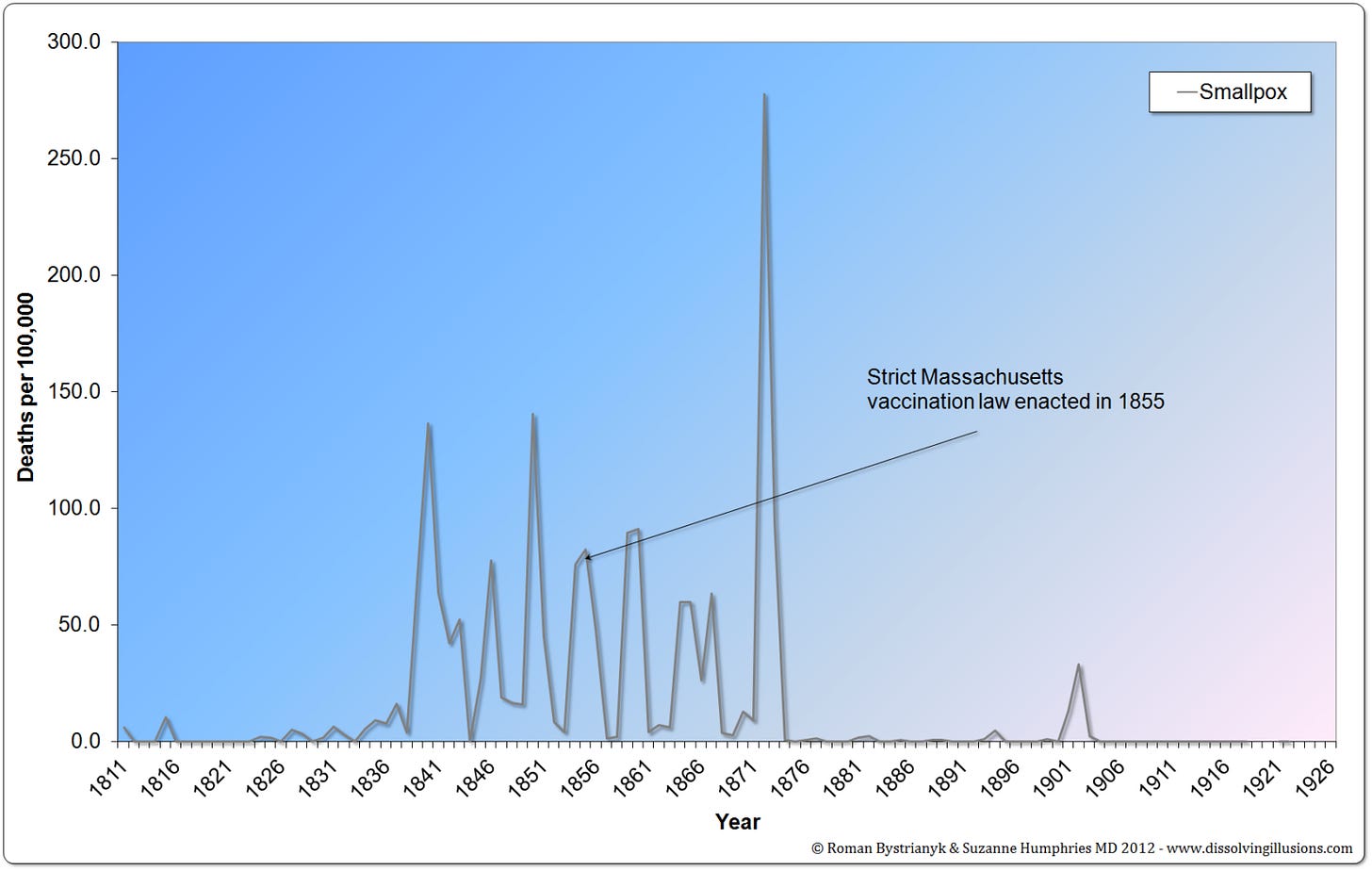
However, the largest problems with the smallpox vaccine was that vaccination tended to increase rather than decrease the occurrence of smallpox.

[…]

When this happened, governments tended to respond to that emergency by viewing it as a result of not enough people being vaccinated and doing what they could to increase vaccination rates. Since the working class was well aware of both the dangers of the smallpox vaccine and its ineffectiveness, harsher and harsher mandates needed to be implemented to continue meeting the vaccination quotas.

As things continued to escalate, assaults on officers enforcing vaccination occurred, and riots periodically broke out.

[…]

At the same time increasingly draconian mandates were being enacted, many early activists argued that smallpox and many other infectious diseases were primarily due to the common people living in absolute squalor.

[…]

After decades of work, activists were able to improve the basic living conditions of the working class (e.g., through public sanitation so people no longer slept next to infectious microbes) and a massive benefit was seen in the reduction of deaths from all infectious diseases.

[…]

The medical profession however coopted the activist’s work and claimed the reduction in deaths was due to the introduction of vaccination, something not at all supported by the data (e.g., scarlet fever, the biggest killer of the era but now an almost entirely forgotten condition never had a vaccination developed for it). Since this time, the belief that medicine rescued us from the dark ages of infectious illness and that all infections can be prevented with a vaccination has become one of the central mythologies the practice modern medicine is founded upon.

[…]

In response to the increasingly draconian vaccination mandates, a massive protest (attended by citizens across Europe) broke out in Leicester (England) in 1885 which resulted in Leicester’s mandatory vaccination laws being repealed and replaced with measures to both improve public sanitation and quarantine both individuals with smallpox (along with their sick contacts). When this approach was proposed by Leicester, the medical profession attacked the citizens of Leicester, loudly proclaimed their policy would result in mass deaths and stated Leicester would serve as a lesson to the world to never to abandon vaccination. The opposite instead happen, Leicester conquered smallpox, and their methods (often done it tandem with vaccination) were then copied, allowing us to at last eliminate smallpox.

As you might have noticed, there are many, many parallels between those events from over a century ago and what we all witnessed over the last few years.

Early Schools of American Medicine

In the early 1900s, there were four main schools of medicine in the United States—Allopathy (conventional medicine), Homeopathy, Naturopathy (call the eclectic school at the time) and Osteopathy. Allopathy was losing favor because its treatments often didn’t work and were highly toxic.

At the same time, two of the richest individuals in history (Andrew Carnegie and John D. Rockefeller) realized they would need to diversify beyond their respective industries (steel and oil) after Theodore Roosevelt decided to break up their monopolies. Allopathic medicine was identified as a promising way to make a lot of money and a variety of investments were made to cause Allopathy to go from falling out of favor to it becoming the leading form of medicine within the United States (e.g., the Flexner report, published in 1910 was used to close most of America’s competing non-allopathic medical schools). Because of this, Allopathic medicine became “medicine” and the term “Allopathy” became extinct. In turn, while Allopathic medicine has greatly improved from that time, it still retains many of the same foundation issues Allopathy had, and hence routinely injures patients or fails to cure their illnesses.

[…]

Homeopathy:

Within Homeopathy, an idea exists known as Hering’s Law of Cure.  It posits that diseases enter the body superficially, and then can either be expelled at the surface (e.g., through the skin), or travel deep into the body.  When the disease stays at the surface, acute reactions such as skin eruptions and fevers occur, while when allowed to instead travel into the patient, a variety of chronic debilitating diseases are likely to occur. Likewise, the mind and spirit are considered “deeper” than emotions, so in many cases, suppressing an emotional issue can create a permanent physical one.

Note: Many opponents of the smallpox vaccines believed it was not a good idea to introduce the vaccine directly into the bloodstream since that allowed the cowpox virus to establish itself deep within the body.

Hering’s Law hence argues that the goal of treatment should be to facilitate the outward expulsion of disease, which contrasts to the (now) prevailing school of Allopathic thought which strives to suppress those symptomatic expulsions.

[…]

Conversely, he found that almost all cases of severe chronic illness following vaccination (termed vaccinosis) occurred in individuals who had had a smallpox vaccine that did not take, and instead moved deeper into the body creating chronic pathology.  One of his strongest arguments for this was his observation that homeopathic Thuja preparations would frequently treat the conditions that he temporally correlated with vaccination.

[…]

Burnet cited a case of 10 week old baby who had been healthy, and then suddenly became at risk of dying with the cause of the baby’s illness being impossible for anyone to identify.  After investigating further, he discovered the wet-nurse (surrogate breast milk supplier) for the infant (who was in good health) had received a smallpox booster the day before the infant became ill and she reported the site was “a little painful.”  Burnett also cited another case of a breast-feeding child becoming ill from the smallpox vaccine and another developing eczema and a chronic rash.

[…]

Naturopathy:

Benedict Lust, a degree holder in each of the medical systems of the time, is considered by many to be a founder of Naturopathic Medicine.  He served as the editor from the Universal Naturopathic Encylopedia Directory and Buyer’s Guide Yearbook of Drugless Therapy for 1918-1919.  In this book, numerous references can be found to the harm of vaccinations and their weakening of human vitality.

Osteopathy:

AT Still saw the profound shortcomings of Allopathy and developed Osteopathy to take its place. For this article, I decided to review his final text, Research and Practice and I suspect more was written on the subject in his other writings.

First Still’s preamble makes it very clear how he felt about vaccination.

[…]

Third: We are opposed to vaccinations.”…


[…]

Still also observed a wide range of chronic illness resulting from immunization:

[…]

Chiropractic

D.D. Palmer, the founder of Chiropractic medicine also referred to vaccines as poisons and a common source of disease. Likewise, many early chiropractors were outspoken opponents of vaccination (e.g., in Lust’s book, chiropractors F.W. Collins and E.W. Ferguson D.C., detailed medical perspectives strongly opposed to vaccination).

[…]

Chinese Medicine

A medical condition exists in Chinese Medicine known as blood stasis. Blood stasis creates a variety of circulatory conditions as the heart cannot effectively pump more viscous blood and the more viscous blood occurring in blood stasis is unable to pass through the smaller blood vessels. This leads to tissue atrophy, strokes or microstrokes, pain at the site of obstruction and a variety of autoimmune conditions (which I believe is due to congestion also occurring concurrently within the lymphatic circulation).

[…]

The earliest reference I could find of the cowpox vaccination entering China stated:

Vaccination was first introduced into Canton and Macao [provinces in China] in 1805 by the famous Balmis Salvany Expedition organized by King Carlos IV of Spain.  However, the practice was not readily adopted and only spread at all widely in China during the latter half of the 19th century. Indeed, vaccination in China was totally inadequate until the campaign mounted in 1950.

This in my eyes argues that a temporal correlation exists between the adoption of smallpox vaccinations and the influx of blood stasis within the Chinese population.
[…]

I will now share some pertinent observations from Gunter R. Neeb’s Blood Stasis: China’s classical concept in modern medicine.  Each of the following passages were sourced Wang Qingren’s observations 192 years ago written within the Yi Lin Gai Cuo.

[…]

Modern Research on Blood Stasis:

The standard medical diagnosis most related to blood stasis is hypercoagulability and the concept of “microclotting” (which has existed since the COVID-19 vaccine rollout).  There are a few agents I have come across which frequently cause significant blood stasis and hypercoagulability, such as malaria, aluminum, the SARS-CoV-2 spike protein, and cancers.  As a result, many shared disease processes can occur between these agents (each of which often creates significant health issues for patients), and as stated above, I often find my patients require treatment of their blood stasis (through restoring the zeta potential of the body—something each of these agents accomplishes).

Viral Infections (e.g., from a smallpox vaccine), like the SARS-CoV-2 spike protein in turn are recognized by the scientific community to create a hypercoagulable state by damaging the endothelium.

[…]

After 9/11, the military conducted a smallpox vaccination campaign which was linked to numerous cases of myocarditis and sometimes fatal heart attacks. Mainstream news sources at the time stated the inflammation produced by the vaccination made the link between the vaccination and heart disease “biologically plausible,” many television news reports were aired about the dangers of the vaccine program.

[…]

Via https://www.midwesterndoctor.com/p/what-can-the-smallpox-vaccines-teach

Trump Hellbent on Derailing India’s Rise as Great Power

Trump raged against India on Wednesday in a series of posts announcing his 25% tariff on its exports on the pretext of its trade barriers and close ties with Russia. He then announced an oil deal with Pakistan and predicted that “maybe they’ll be selling Oil to India someday!” His final post described India’s economy as “dead” and claimed that “We have done very little business with India” despite it being the fastest-growing major economy in the world and bilateral trade amounting to nearly $130 billion in 2024.

India’s Ministry of Commerce & Industry calmly responded to Trump’s tariff announcement by reaffirming its commitment to talks and declaring that the state “will take all steps necessary to secure our national interest”, which likely infuriated him since he probably expected Modi to anxiously call him. The favorable trade deal that he clinched with Japan last week and the totally lopsided one with the EU that followed emboldened him into playing hardball with India upon thinking that it’ll fall into line too.

The US wants India to open its agricultural and dairy markets, stop its massive import of discounted Russian oil, and rapidly diversify away from Russian military equipment. Complying with the first demand would be disastrous for the 46% of the Indian workforce employed in these industries, however, while the second would risk decelerating its economic growth and the third would make its security dependent on the US. The end result would therefore derail India’s rise as a Great Power and turn it into a US vassal.

Trump is hellbent on doing precisely that, which is the continuation of Biden’s policy, as explained below:

These analyses will now be summarized for the reader’s convenience and placed in the current context.

In brief, India’s Russian-assisted rise as a Great Power hastens the coming of trimultipolarity that’ll in turn help midwife complex multipolarity, which would greatly reduce the likelihood of ever restoring US-led unipolarity or the short-lived period of informal Sino-US bi-multipolarity (“G2”/“Chimerica”). Russia’s special operation and the West’s reaction to it revolutionized International Relations and created the opportunity for India to make up for lost time in becoming a Great Power with trulyglobal influence.

The US responded to these developments by attempting to subordinate India via election meddling, infowars, and dual geopolitical pivots to Bangladesh (whose prior long-serving leader it helped depose) and Pakistan to pile on the pressure in pursuit of this goal or to contain India if it still refuses to concede. Complementary elements of this pressure campaign include political support for Delhi-designated “Khalistani” separatists-terrorists and spring 2023’s violent ethno-religious unrest in Manipur.

If Trump’s tariffs don’t coerce India into becoming a US vassal, which the US would then exploit to coerce concessions from China in advance of its ultimate goal of restoring unipolarity, then he might settle for letting China subordinate India instead as part of the “G2”/“Chimerica” scenario. Either way, he doesn’t expect India’s rise as a Great Power to continue due to the zero-sum dilemma in which the tariffs were meant to place it between becoming the US’ or China’s vassal, but India might still surprise everyone.

[…]

Via https://www.globalresearch.ca/trump-hellbent-derailing-india-rise-great-power/5896574

Videos of emaciated Israeli hostage Evyatar David released by Hamas

Sky News
2 August, 2025

Two videos show a skeletal 24-year-old Evyatar David after US officials visited a Gaza aid site and met with hostages’ families. The UN says the starvation across the Strip is caused by Israel’s blockade.

Two videos of an emaciated Israeli hostage, Evyatar David, have been released by Hamas, after US special envoy Steve Witkoff this week met with the families of the hostages.

The now 24-year-old looks skeletal, with his shoulder blades protruding from his back, and says he has not eaten for three days.

The distressing videos show him apparently digging his own grave.

He worked in a restaurant, according to a video posted by Labour Friends of Israel, before he was abducted from the Nova music festival on 7 October 2023.

Since then, he has been held in captivity in Gaza, and the videos suggest he is being kept in dark tunnels and surviving on scarce portions of lentils and beans.

Gaza itself is suffering “man-made mass starvation” because of Israel’s blockade on aid to the enclave, the head of the World Health Organization (WHO) has previously said.

In the second video, released on Saturday, Mr David – according to the English subtitles – says: “I haven’t eaten for three days.”

The captions continue as he speaks while in an underground tunnel: “There’s no [sic] enough food. I barely get drinking water.”

The video shows him talking through what ate in July, which has been recorded on a handmade calendar hung up on the side of an underground Gaza tunnel.

Speaking while under captivity and under duress, he adds: “They give me what they can get.”

At the end of the video, he is digging a hole. The subtitle reads: “This is the grave where I think I’m going to be buried in. Time is running out.”

[…]

Via https://news.sky.com/story/videos-of-emaciated-israeli-hostage-evyatar-david-released-by-hamas-13405798

The Wonderful World of Fungi

The Wonderful World of Fungi

DW (2025)

Film Review

Neither plant nor animal, fungi have their own separate kingdom and have survived five mass extinctions in the last billion years.

By definition all fungi begin as spores and sprout hyphae one-fifth the width of a human hair to look for food. Forming a complex network called a mycelium, hyphae can smell, see light and detect heat and electricity and solve a variety of complex problems without a brain. Some mycelia are larger than 10 square kilometers. Some sprout mushrooms by weaving themselves into a bundle and inflating it with water to disperse new spores.

Ninety percent of plants rely on fungi to survive. By using their hyphae to provide them with minerals they need, fungi are rewarded with sugars plant produce via photosynthesis and disperse through their roots. This network of plant roots and mycelia is known as the Wood Wide Web. Fungi also play an essential role in recycling the building blocks of both plant and animal life through decomposition and in the earth’s water cycle. Fungal spores, which attract water to form raindrops, also play a big role in rainfail patterns.

Yunan Province in China is one of the most diverse fungal environment on earth, and the Chinese, who began farming mushrooms 2,000 years ago, are in the forefront of fungal research. Eight hundred species of Yunan mushrooms are edible, and some have been used medicinally for millenia. Chinese scientists have discovered fungi that eat plastic, as well as a type of organic plastic made from plastic that looks like Styrofoam and can be used to make surfboards and leather.

Tarkine, the planet’s oldest (65 million years) rainforest in Tasmania, is also an excellent site for fungal research. Scientists estimate they’ve on discovered 5% of the fungi on Earth.

Yemen Rewrites Rules of Naval Warfare

Photo Credit: The Cradle

JUL 31, 2025

By continuously targeting Israeli-linked shipping, the Sanaa government has exposed the impotence of western naval power and maintained a de facto blockade on one of the world’s most strategic waterways.

After the Ansarallah-aligned Yemeni Armed Forces (YAF) announced that it would resume attacks on merchant ships linked to companies operating with Israeli ports, tensions in the Red Sea and beyond have reignited, as Tel Aviv’s ongoing genocide in Gaza fuels instability across West Asia.

As part of the fourth phase of the blockade, the Yemeni army sank two commercial vessels earlier this month, showcasing not only its enduring capabilities but also the failure of US-led strikes to curb its maritime campaign.

On 6 May, US President Donald Trump claimed, “The Houthis have declared they no longer want to fight. They simply don’t want to fight anymore. And we will honor that. We will stop the bombings, and they have surrendered.”

Yemeni officials immediately dismissed the claim, reiterating that Sanaa had not negotiated with Washington nor agreed to halt operations in support of Gaza. The Sanaa government’s naval campaign resumed soon after, with fresh attacks targeting Israeli-linked vessels – undermining Trump’s attempt to declare victory.

New red lines in the Red Sea

In a statement on Sunday, explaining the latest phase of the naval operations, YAF spokesman Brigadier General Yahya Saree said:

“This escalation includes targeting all ships belonging to any company that deals with Israeli ports, regardless of their nationality and wherever they may be, within our forces’ reach. We warn all companies to cease their dealings with Israeli ports, starting the hour this statement is issued.”

The new escalation comes just several weeks after the sinking of two Liberian-flagged, Greek-owned bulk carriers – the Magic Seas and the Eternity C. In the latter attack, four sailors were killed and two others wounded, while 11 other crew members were taken captive.
Following the sinking of the two ships, Ansarallah leader Abdul Malik al-Houthi revealed that the YAF had carried out over 1,679 attacks since November 2023 using missiles, drones, and warships in support of Gaza, warning of further escalation if the war does not end.

Although the Sanaa government agreed in May to a ceasefire with Washington, halting attacks on US warships, it maintains that this truce does not apply to vessels linked to the occupation state. These ships, Sanaa argues, continue to serve Israeli ports, part of “occupied Palestine.”

Contrary to western media narratives of indiscriminate aggression, maritime data from Lloyd’s List confirmed that both targeted vessels had routinely docked in Israeli ports over the past year.

The ongoing attacks have prompted international concern. The UN Security Council recently approved continued reporting on Red Sea maritime assaults. Twelve members of the 15-member council voted in favor, while Russia, China, and Algeria abstained over concerns about breaches of Yemen’s sovereignty.

China’s deputy UN Ambassador Geng Shuang called tensions in the Red Sea “a major manifestation of the spillover from the Gaza conflict.” At the same time, the Russian UN representative also stressed the link between normalizing the situation in the Red Sea and the need for a ceasefire in Gaza.

Challenging naval supremacy

Despite the presence of five major foreign military bases in Djibouti – home to US, French, Japanese, Chinese, and Italian forces –  the Ansarallah-aligned army has continued to strike commercial vessels with precision. This raises uncomfortable questions about western and allied naval efficacy.

Speaking to The Cradle, Senior Research Fellow at The Soufan Center, Colin P. Clarke – who also teaches at Carnegie Mellon’s Institute for Politics and Strategy – says Yemen ranks among the most potent forces within the Axis of Resistance and shows no sign of retreat:

“Out of all the ‘Axis’ proxies, the Houthis are among the most potent and also have a lot to prove. I don’t expect them to wind down their military campaign at any point soon.”

Nicholas Brumfield, a Washington-based analyst on Yemen and maritime security, concurs. He tells The Cradle that Yemen’s campaign has remained largely undiminished despite nearly two years of US and Israeli airstrikes:

“The Houthi attacks since early July have thus far been limited to areas of the Red Sea where they have attacked before, so it’s unclear if there’s been any increase in their range. As for Trump’s claims of capitulation, that was always viewed by most researchers focused on Yemen as a bit of hot air. The US–Houthi ceasefire was a limited de-escalation between two parties, and the Houthis have more or less been continuing what they were doing before the truce in terms of attacking Israel directly.”

Clarke adds that Trump’s reluctance to escalate against Yemen stemmed from electoral optics and strategic caution against bogging the US down in “endless wars,” which is one of the reasons why the US involvement in bombing Iran was so circumscribed. “Trump believes, perhaps correctly so, that it would be extremely difficult to engage with the Houthis without being sucked into a quagmire from which it would be difficult to escape from. And the results would be hard to measure.”

According to Mohamed Aliriani of the Yemen Policy Center, the May ceasefire secured safe passage for US, UK, Chinese, and Russian vessels – thanks to the latter two’s ties with Iran. But ships from other nations remain exposed. European-led operations, he argues, are largely ineffectual in safeguarding their cargoes.

Aliriani tells The Cradle that “the current situation has created a two-tiered, protectionist system that benefits powerful states while driving up global insurance and shipping costs, setting a dangerous precedent for other strategic chokepoints.”

Persistently high insurance premiums reflect the enduring risk. “Had the threat been perceived as eliminated, traffic would have resumed, and rates would have dropped,” he explains. The Yemeni army’s targeting of oil and chemical carriers has introduced environmental and financial perils that keep insurers wary.

Redefining control at sea

These facts point to a stark reality: The Ansarallah-led naval campaign has largely succeeded in imposing an effective blockade on Israeli-linked maritime traffic.

Still, Aliriani cautions against overstating the extent of Sanaa’s control. “The Houthis do not exercise Sea Control over the Red Sea, as they lack a surface fleet capable of patrolling and commanding the waterways. What they have successfully achieved is Area Denial.” By demonstrating a credible capability to hold any vessel transiting the Bab al-Mandab Strait at risk, they have made passage through this critical chokepoint prohibitively dangerous for any vessel:

“Their strike range has proven to extend for hundreds of kilometers and given the information available about the weapons used, range likely exceeds 1,000 kilometers, effectively denying the use of a vast area without needing to control it physically.”

Independent force, not Iranian proxy

Western narratives often depict Ansarallah as mere Iranian proxies. Yet, there is scant evidence that Tehran directed these maritime attacks.

Brumfield points out that while Iran continues to supply advanced weaponry to its ally – as evidenced by a 750-ton arms shipment intercepted en route to Yemen – there is no indication of Iranian command over Ansarallah operations.

Former UN envoy to Yemen Jamal Benomar has consistently emphasized Sanaa’s autonomous decision-making, noting that they “have their own agendas and decision-making mechanisms.”

Palestine remains the compass

The timing of recent Yemeni operations suggests a clear link to developments in Gaza. Brumfield observes that Sanaa was notably quiet during last month’s 12-day war between Iran and Israel, only to escalate following reports of worsening conditions in the besieged enclave:

“When there was a ceasefire in Gaza, the Houthis completely stopped their maritime attacks. Recent reports of deteriorating humanitarian conditions in Gaza may have contributed to the group’s decision to re-escalate in this file.”

While some analysts suggest that Ansarallah’s pro-Palestinian rhetoric is a political maneuver to boost legitimacy amid domestic challenges, Benomar insists their stance on Palestine is ideologically embedded. “They’re not just being opportunistic as Palestine is a core part of their ideology.”

Although Tel Aviv has urged Washington to relaunch strikes on Yemen, most experts, including Aliriani, believe the US is unlikely to escalate unless the Ansarallah-allied military crosses a significant red line. So far, the YAF has targeted only vessels tied to Israeli trade.

However, Ansarallah’s recent decision to strike all ships linked to Israeli ports, regardless of nationality, may drag new actors – such as Egypt – into the fray. Cairo’s deepening logistical ties to Israeli trade may soon make it a target of Yemen’s expanding campaign.

“The Houthis” may not control the seas, but they have undeniably changed the rules of engagement.

[…]

Via https://thecradle.co/articles/with-gaza-as-its-compass-yemen-rewrites-the-rules-of-naval-warfare

Rep. Greene Introduces Clean Skies Act Banning Weather Modification, Geoengineering

Zero Hedge

Via American Greatness,

Congresswoman Marjorie Taylor Greene has introduced the Clear Skies Act of 2025 calling for an end to what she calls the “dangerous and deadly practice of weather modification and geoengineering.”

The bill, designated H.R. 4403, would prohibit weather modification through the use of geoengineering, cloud seeding, and solar radiation management through the release of chemicals into the atmosphere to change the weather, temperature, climate or to block out sunlight.

If enacted, the law would punish weather modification violations as a felony with offenders facing up to $100,000 in fines and/or five years in prison for each violation.

Greene says her bill is similar to Florida’s S.B. 56 which repeals the state’s ability to issue permits for geoengineering and weather modification and prohibits the injection, release, or dispersion of chemicals or substances into the atmosphere for the express purpose of altering weather, temperature, climate, or sunlight intensity.

Under the Clear Skies Act, all existing federal authority and executive orders permitting weather modification would be repealed and the Environmental Protection Agency (EPA) and Department of Justice (DOJ) would be directed to investigate and prosecute violations.

H.B. 4403 would also create a public reporting system that would allow Americans to report suspicious activity and which the EPA would be required to investigate.

In announcing the Clear Skies Act Greene spoke of the need to protect the nation’s skies, waters and people from weather modification, saying, “It’s time to end this dangerous and unregulated practice.”

[…]