Fear of Vote on Releasing Epstein Files Keeping US Government Shut Down

Epstein files: Pam Bondi sends note to Kash Patel accusing FBI of ...

by Brian Shilhavy
Editor, Health Impact News

While the official narrative of why the U.S. Government has been shut down so long follows typical partisan political fighting with each side blaming the other, the real truth appears to be that Mike Johnson, the GOP Speaker of the House, refuses to swear in the newly elected representative from Arizona, Adelita Grijalva, who would become the 218th person to support Congressman Thomas Massie and Congressman Ro Khann’s discharge petition to force a vote on the House floor to release the Epstein files.

[…]

Johnson has used the excuse of the Government shutdown as the reason he will not swear in Grijalva, even though he swore in two Republicans earlier this year when the House was not in session after they won their elections in Florida.

As a result, the Attorney General for Arizona has now sued Mike Johnson over his refusal to swear in Adelita Grijalva after winning the election to represent her constituents in Arizona.

Here are two reports that include interviews with newly elected Adelita Grijalva, and Arizona Attorney General Kris Mayes.


Besides the Massie/Khann discharge petition in Congress which seems to be panicking many in DC, others are continuing to investigate the scandal, and it was published earlier this week that Prince Andrew is being pressured to relinquish all of his royal titles, and is being asked to testify in Congress in DC.

[Ed As of 18 October he has relinquished them. See Prince Andrew gives up royal titles including Duke of York after ‘discussion with King’]

Epstein victim Virginia Giuffre who died earlier this year had her biography published this week which also revealed new information on Prince Andrew, which is allegedly prompting a police investigation in the UK.

Newsweek published an article this week on the biggest revelations that came out of it:

[…] Read the full article.

But perhaps the biggest news event of the week on the Epstein scandal, one that I never even saw in my news feed this week but only stumbled upon it in my research for this article today, is that author Michael Wolff, who spent hours interviewing Jeffrey Epstein and has published much of his knowledge about Epstein, has sued Melania Trump in New York, because Melania was threatening Wolf with a defamation lawsuit and trying to silence him.

Michael Wolff was just interviewed by Ben Meiselas of MeidasTouch to talk about this unprecedented lawsuit against the First Lady. If this lawsuit goes forward in New York, the discovery process will do more to reveal what is hidden in the Epstein files than even the discharge petition that Massie and Khann are trying to get to the House floor for a vote!


This appears to be the one issue that Donald Trump wants to go away very badly, but probably will not. The Epstein files implicate the rich and powerful in business and in both U.S. political parties.

This is such a huge issue, that the entire U.S. Government is being kept shut down to keep Congress out of DC and prevent them from taking up a vote to release the Epstein files.

[…]

Via https://healthimpactnews.com/2025/fear-of-vote-on-releasing-epstein-files-is-keeping-the-u-s-government-shut-down-mike-johnson-and-melania-trump-sued-over-epstein-scandal/

US drafts plan to divide Gaza between Israeli and Hamas control

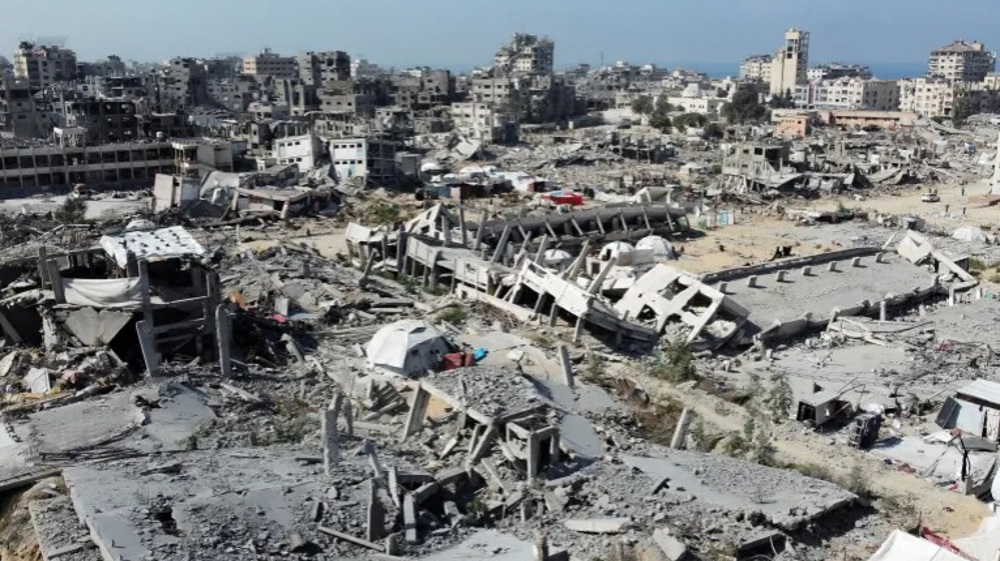
A drone view shows the destruction in a residential neighborhood, amid a ceasefire between Israel and the Hamas resistance movement in Gaza, in Gaza City, on October 19, 2025. (Photo by Reuters)

Press TV

A new US-backed proposal would divide Gaza into zones run separately by Israel and Hamas, restricting reconstruction to the Israeli-controlled area and, opponents warn, paving the way for a lasting Israeli foothold in the Palestinian territory.

The plan, described by The Wall Street Journal, represents one of the most consequential post-war frameworks under consideration since the fragile ceasefire between Hamas and the occupying Tel Aviv regime took effect on October 10.

“No reconstruction funds will be going into areas that Hamas still controls,” Jared Kushner, US President Donald Trump’s son-in-law who has been deeply involved in Gaza negotiations, told reporters in the Israeli-occupied territories on Tuesday.

“There are considerations happening now in the area that the Israeli military controls, as long as that can be secured, to start the construction as a new Gaza,” Kushner said.

Additionally, US Vice President JD Vance asserted Gaza currently consists of “two zones — one relatively safe and one extremely dangerous,” adding that the US goal was “to expand the safe zone geographically.”

According to the report, US officials indicate that the initiative seeks to establish a temporary structure to stabilize a portion of the territory while discussions persist regarding disarmament and the establishment of a transitional governing body that can manage the comprehensive reconstruction of Gaza.

A senior official from the US administration characterized the plan as “preliminary,” indicating that updates will be provided “in the coming days.”

Arab mediators have voiced concern regarding the proposal that emerged during recent discussions, according to the report, which adds that they are against the partitioning of Gaza, warning it could lead to a permanent Israeli-controlled zone within the region.

They have also turned down the suggestion of deploying forces to maintain security in Gaza under these circumstances.

The ceasefire map, negotiated by Trump, already features a yellow line that signifies Israeli control, which is designed to reduce gradually as specific benchmarks are fulfilled.

At the heart of the debate lies the unresolved question of how to disarm Hamas and form an alternative authority capable of restoring civilian governance and attracting international investment.

White House officials said Kushner, working with envoy Steve Witkoff, is the driving force behind the initiative, which has Trump’s backing.

Israeli analysts see the proposal as a way to weaken Hamas politically and militarily over time, by expanding Israel’s zone of control and strengthening a buffer between Gaza and border towns in the occupied lands.

But Palestinian and international observers warn the plan could mirror West Bank tactics, fragment Gaza, and erase its territorial unity.

As negotiations continue over a post-war plan for Gaza, the territory remains devastated. The UN agency for Palestinian refugees (UNRWA) estimates that 61 million tons of debris now cover the territory.

“Entire neighbourhoods have been erased, and families search the ruins for water, for shelter,” the agency said on X, noting that its aid “remains blocked” even as teams “continue to deliver lifesaving assistance.”

The International Court of Justice this week ordered Israel to allow humanitarian aid into Gaza, rejecting Israeli claims that many UNRWA staff are linked to Hamas — a verdict Israel dismissed with US backing.

[…]

Via https://www.presstv.ir/Detail/2025/10/24/757476/US,-Israel-considering-a-plan-that-would-divide-Gaza-into-separate-zones

U.S. judge permanently blocks Israeli spyware firm NSO Group from targeting WhatsApp

Case against NSO offers rare look into world of cyberspies Meta suit ...

October 18, 2025 6:14pm

A U.S. federal court has issued a permanent injunction preventing Israel’s NSO Group from attempting to breach WhatsApp, which is Meta’s internationally popular messaging platform.

The judge reduced the punitive damages awarded to Meta from $167 million to just $4 million.

The ruling from U.S. District Judge Phyllis Hamilton on Friday results from a legal battle that began in 2019 when Meta accused NSO of using its Pegasus spyware to unlawfully target WhatsApp users.

The software, known for its ability to exploit software vulnerabilities and enable undercover surveillance, ha allegedly been linked to numerous human rights abuse allegations, according to Amnesty International.

NSO had previously warned the court that such a restriction on interacting with Whatsapp would severely threaten its business model, arguing that being cut off from WhatsApp would “put NSO’s entire enterprise at risk” and could even “force NSO out of business.”

Meta applauded the decision as a win for privacy and civil society.

“Today’s ruling bans spyware maker NSO from ever targeting WhatsApp and our global users again,” said Will Cathcart, head of WhatsApp, in a post on X. “We applaud this decision that comes after six years of litigation to hold NSO accountable for targeting members of civil society.”

[…]

Via https://justthenews.com/government/courts-law/us-judge-permanently-blocks-israeli-spyware-firm-nso-group-targeting-whatsapp

Frustrations boil over as Vance delivers ‘firm’ message to Netanyahu

Vice President JD Vance exits his motorcade before boarding Air Force Two en route to Washington at Ben Gurion Airport on October 23, 2025 in Tel Aviv, Israel. Vance met with Netanyahu in ongoing efforts to maintain the ceasefire between Israel and Hamas. (Photo by Nathan Howard – Pool/Getty Images) | Getty Images

By Eli Stokols and Felicia Schwartz

The White House is growing increasingly frustrated with Israel just two weeks after President Donald Trump triumphantly announced a deal to end the war in Gaza and bring peace to the Middle East.

The mounting frustrations come as a succession of senior officials are passing through Israel this week looking to keep a fragile ceasefire in place. They see some recent developments — the Israeli Defense Force’s counter-attack in Gaza on Sunday, and the Knesset’s vote in favor of West Bank annexation, which Trump has ruled out — as detrimental to the already fragile agreement between Israel and Hamas.

Vice President JD Vance delivered a “firm message” from President Donald Trump during a meeting with Israeli Prime Minister Benjamin Netanyahu in Jerusalem Wednesday, according to two people familiar with the conversation who were granted anonymity because they weren’t authorized to speak publicly.

The administration’s private exasperation has begun to emerge in public view. Trump, in an interview published on Thursday, suggested Israel could lose all U.S. support if it annexed the West Bank, which followed condemnations from Vance, Secretary of State Marco Rubio and special envoys Steve Witkoff and Jared Kushner.

That so many administration officials criticized Israel so unequivocally less than two weeks after Trump landed to a hero’s welcome and promised eternal friendship and peace underscores how frustrated the White House is with the Netanyahu government.

The public comments “reflect how the president feels” about the matter, said a White House official, granted anonymity to discuss internal thinking.

Still, the White House is working to keep the fragile truce in place, dispatching several senior officials to the Middle East this week to meet with Arab partners and Israel’s leaders.

[…]

Netanyahu, seemingly aware and fearful of Trump’s anger, issued a statement expressing his own opposition to the Knesset’s vote.

“The Knesset vote on annexation was a deliberate political provocation by the opposition to sow discord during Vice President JD Vance’s visit to Israel,” the prime minister’s office said. “The two bills were sponsored by opposition members of the Knesset.” Notably, however, he issued the statement only in English.

Netanyahu faces a tough balancing act. He will need the backing of the parties supporting annexation in next year’s elections, which could happen as soon as March and must take place by October. At the same time, a public break with Trump would cost him significantly at the ballot box. Trump is widely popular in Israel and images of the pair together have been a fixture of Netanyahu’s past campaigns.

[…]

Trump’s promise to Arab leaders that Israel would not annex the West Bank came during a meeting at the United Nations, the same meeting where, according to Trump officials, he solidified the plan that ultimately brought about the peace deal he celebrated last week.

Trump, asked about the Knesset’s vote Thursday afternoon, brushed off the possibility that Israel would try to annex the West Bank. “Don’t worry about the West Bank, okay?” Trump said. “Israel’s not going to do anything with the West Bank.”

But just hours earlier, Vance derided the Knesset vote as a “very stupid stunt,” criticizing Israel’s government on its soil shortly after meeting with Netanyahu.

“I personally take some insult to it,” he said.

A person close to the vice president said the meeting with Netanyahu was instructive and positive.

Rubio, who arrived in Israel Thursday, told reporters before leaving Washington that he, too, was dismayed by the vote given Trump’s promise to Arab leaders before the Gaza peace deal came to fruition that he wouldn’t allow Israel to annex the West Bank.

[…]

Via https://www.politico.com/news/2025/10/23/frustrations-boil-over-as-vance-delivers-firm-message-to-netanyahu-00621213

Amazon Outage Waking People Up Regarding Our Slavery to Internet – US Government Failing in Defense Against Cyberattacks

by Brian Shilhavy
Editor, Health Impact News

In the wake of the Amazon Web Services (AWS) outage earlier this week, there have been numerous articles published in the media concerning just how vulnerable our society has become to just a few Big Tech companies here in the U.S. who control most of the Internet.

Government services, banks, smart homes, cell phone services, the retail market and just about every other facet of our society today depends upon the Internet to keep things running, and most of the Internet now is hosted in huge Cloud data centers.

About 70% of these data centers are owned by Amazon, Microsoft, and Google.

Others are ramping up spending to get a piece of this pie, such as Larry Ellison’s Oracle, with his close ties to Trump.

And the main driver in the economy right now that is putting more and more of the Internet traffic into these data centers, is the AI bubble.

This is a recipe for disaster, as I have been saying for years, and that others are now beginning to realize as well.

Not only is the technology prone to accidents and failures, as technology ALWAYS has been, but they are also huge targets to hackers and cyberattacks.

A new report published just this week found that for the first time in years, the United States is no longer making progress in bolstering its cyber defenses and is instead “stalling” and “slipping” in its ability to protect itself and allies.

The primary reason for this is because IT technicians can make so much more money developing AI, which is where all the money is going in the private sector.

But even the private sector spending $trillions on AI is running into a new obstacle: China controls 90% of the world’s rare earth supplies that are needed to build these energy hungry computer chips, and they are not selling them anymore unless the country purchasing them can prove that they are not being used for military purposes, which pretty much excludes Big Tech in the U.S., because they are all defense contractors.

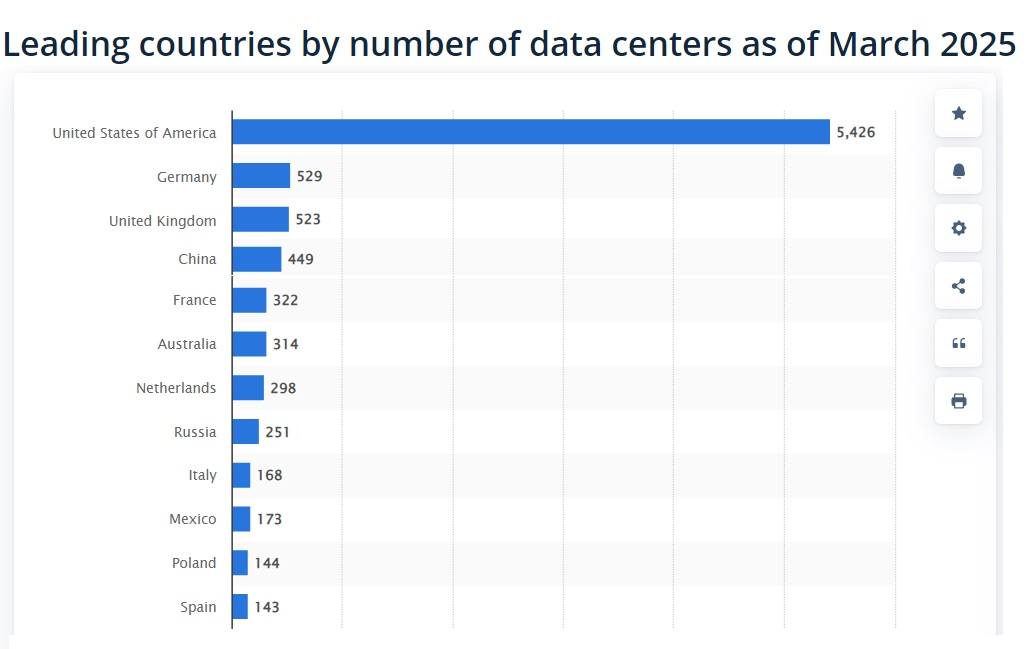
The United States has more data centers than almost the rest of the world combined. Image source.

Here are some recent articles published this week in the national media that recognize that this situation with Big Tech is a national crisis.

From CNN:

You thought Monday’s internet outage was bad? Just wait

Monday’s Amazon Web Services outage — and the global disruption it caused — underscored just how reliant the internet has become on a small number of core infrastructure providers.

The ramifications of such outages could only get worse if artificial intelligence becomes as central to work and daily life as tech giants suggest it will in the coming years.

Monday’s outage briefly blocked some people from scheduling doctor’s appointments and accessing banking services. But what if an outage took down the AI tools that doctors were using to help diagnose patients, or that companies used to help facilitate financial transactions?

It may be a hypothetical scenario today, but the tech industry is promising a rapid shift toward AI “agents” doing more work on behalf of humans in the near future – and that could make businesses, schools, hospitals and financial institutions even more reliant on cloud-based services.

A global survey of nearly 1,500 firms published by McKinsey & Company in May found that 78% of respondents already use AI in at least one business function, up 55% from a year earlier.

“If there’s an outage and you rely on AI to make your decisions and you can’t access it, that’s going to have an effect on performance,” said Tim DeStefano, associate research professor at Georgetown’s McDonough School of Business.

Monday’s outage had such a widespread impact because many companies rely on cloud providers for the backend functions that support their businesses, such as virtual server space, storage or developer tools.

Typically, this set up is more affordable, flexible and secure for those customers, except when AWS experiences an outage. Then it’s effectively a single point of failure for a huge swath of the internet.

AWS serves millions of customers, from retailers and restaurants to financial services firms and government agencies; it holds around 37% of the cloud computing market, according to Gartner. Together with Microsoft and Google, the three companies service around 70% of the market.

And the consolidation of the internet’s backbone is continuing in the age of AI.

While there’s some grappling between the big three, Amazon, Microsoft and Google remain by far the prominent cloud computing providers for AI applications, according to Emarketer senior analyst Jacob Bourne — and their futures depend at least in part on serving AI demand.

While websites and apps can still technically function using their companies’ own less powerful on-premises servers,

“cloud computing represents a technological prerequisite for using AI,” DeStefano said.

That’s because the computers needed to run AI tools are powerful and expensive, and on-site hardware isn’t as easy to modify as business needs change. It just makes more sense to rent that computer space and pay for it only as needed.

And as AI becomes more widespread, data center outages could happen more frequently since AI models are so power-hungry, Bourne said.

The risk of serious disruption from an outage rises considerably the more companies rely on AI agents to do critical tasks and automate the work of humans, a transition that’s already in progress despite disagreement about just how far it will go. (Source.)

From GeekWire:

Concentration crisis in AI

With the generative AI ecosystem, I’m talking not about chatbots — I mean AI-native applications that are built on generative AI as a platform. We just saw that when there’s no cloud, there’s no cloud-native application. Likewise, when there’s no generative AI provider, there’s no AI-native application.

The first lesson from the AWS outage for AI-native applications is what happens to an industry when there’s a limited number of providers for centralized resources and there’s an outage. We just saw: it has huge rippling effects across the industry and all walks of life built on it.

It’s a throwback to the mainframe era: when “the computer” is down, it’s down for everyone.

There are as few, if not fewer, generative AI providers as there are cloud providers. A major outage is inevitable — that’s just engineering reality. When that happens, every AI-native app built on that generative AI platform will also go down, full stop.

The impact could be even more severe than the AWS outage. It will be more like “the computer is down, and the people are gone” for many different industries and services.

Ironically, the “smarter” the industry and service, the greater the potential fallout.

The second lesson is one of intertwined risk. OpenAI itself was affected by this week’s AWS outage.

That means AI-native apps have double exposure to the risks around a limited number of providers for critical, centralized resources. For AI-native apps, it’s like the mainframe era squared.

If the generative AI platform fails, everything built on it fails. And if the cloud that hosts the AI platform fails, it all goes down, too.

Highly concentrated risks with exceptionally broad impact aren’t going away anytime soon.

A thoughtful application of the AWS outage tells us that outages like this are a kind of problem that isn’t an anomaly: it’s inherent in the nature of today’s technology reality. (Source.)

[…]

Via https://vaccineimpact.com/2025/amazon-outage-is-waking-people-up-regarding-our-slavery-to-the-internet-u-s-government-failing-in-defense-against-cyberattacks/

Hawai’i is Dying: Here’s Why

Hawaii is Dying: Here’s Why

Cogito (2025)

Film Review

The August 8 2023 Lahina fire, allegedly sparked by downed power lines, caused fifteen thousand native Hawai’ians to lose their homes and/or jobs. The drainage of wetlands (over the past 50 years) and replacement of forests with paved over tourist attractions and invasive wild grasses. The latter played a major role in the fire’s spread. Communities requesting that power lines be buried and that prior fire breaks be restored were told it was too expensive.

Community organizers call it ethnic cleansing by real estate. Survivors who lost their homes in the fire were pressured to sell their land to developers and the housing shortage led landlords to increase rents by 40%.

Of the 600,000 ethnic Hawai’ians in the US, only 300,615 can afford to live in Hawai’i. Those with jobs in the tourism industry are often homeless. Billionaires like Jeff Bezos, Mark Zuckerberg and Larry Ellison have evicted thousands of them for their vast estates, while while the US military controls 60% of Hawai’i. The state has the highest rate of plant and animal extinction in the US.

The Advanced Indigenous Civilization Built by Kanaka Maoli

Native Hawai’ians, known as Kanaka Maoli, arrived in Hawai’i 1,000-2,000 years ago. They came as farmers, as the islands had no large animals or crops to feed them. They brought their own pigs, dog, sweet potatoes, sugar cane, coconut palms, taro, banana, bread fruit and paper mulberry plant in the canoes and outriggers. Building canals and complex irrigation system, they built hundreds of fish farms and banana, palm and sugar plantations. Due to low child mortality, they became one of the fastest growing civilizations on earth, reaching a population of 500,000 by the time of their first European contact (Captain James Cook 1778).

By 1800 Hawai’i had become a hub for European and US traders. To protect the Kanaka Maoli from European greed and rapaciousness, King Kamehemeha I used the weapons the Europeans left behind to establish an army and unify all the islands in 1810 as the Kingdom of Hawai’i.

By 1873, the country had become a constitutional monarchy with a democratic electoral system and a strong emphasis on education and literacy. The king’s palace in Lahina had electricity before the White House did.

During this period, European diseases were the biggest threat to the Kanaka Maoli, who eventually lost 90% of their indigenous population. The second biggest threat were Calvinist missionaries, who persuaded King Makele to sell communally owned land to white immigrants. They, in turn, proceeded to divert water from native crops for massive sugar plantations.

How Protestant Missionaries Got Rich Destroying Advanced Kanaka Maoli Civilization

Eventually the missionaries and their sons controlled the big five sugar companies, and all the railroads and shipping lines, bringing in tens of thousands of indentured servants from Japan, China, the Philippines, Portugal and Puerto Rico.

In 1887 they stripped King Kalakaua of his powers with their Bayonet constitution, allowing the US government to build a military base at Pearl Harbor. This denied the right to vote to Asians or anyone with a net worth less than $3,000.

Refusing to be governed by the sugar and pineapple barons, in 1891 Queen Lili’uokalni rewrote the Bayonet Constitution and removed race and wealth based qualifications for voting. In response,the head of the Hawaiian League launched a coup with the support of US Marines, abolishing the monarchy and imprisoning the Queen. The founder of Dole Pineapple Sanford Dole subsequently declared himself the first president of the Republic of Hawaii.

Although President Cleveland refused to recognize Hawaii as a republic, he declined to reverse the coup. McKinley annexed Hawaii in 1898 (intending to use Pearl Harbor to attack the Philippines) after declaring war on Spain.

Volkswagen faces chip crisis after Dutch government seizes chip factory

Volkswagen faces chip crisis after Chinese factory seized by EU state – Bild

RT

Dutch authorities took control of semiconductor producer Nexperia in September under pressure from the US

Germany’s largest carmaker, Volkswagen, could stop production at a key plant due to a shortage of semiconductors caused by the seizure of a Chinese-owned chipmaker by the Netherlands, Bild has reported, citing anonymous sources.

The Dutch government took control of the Nexperia factory in Nijmegen late last month, citing intellectual property and security concerns. The New York Times reported last week after reviewing documents from an Amsterdam court that the move had been made following pressure from US officials. Nexperia’s parent company, Wingtech, was blacklisted by Washington in 2024 as part of an ongoing trade war with China.

Beijing responded in early October by banning Nexperia from exporting finished chips from China, which are widely used in the electronic control units of VW vehicles.

Bild reported on Wednesday that Volkswagen – which also owns the Skoda, Seat, Audi, Porsche, Lamborghini, and Bentley brands – does not currently appear to have an alternative to Nexperia chips.

Sources in the company told the paper that due to the lack of semiconductors it plans to stop production at its plant in Wolfsburg from next Wednesday. Volkswagen Golf models will be affected first, followed by other vehicles, they said.

If the situation does not improve, work could also be halted at Volkswagen’s facilities in Emden, Hanover, Zwickau, and elsewhere, a person familiar with the matter said.

According to the report, the carmaker has started talks with the German authorities about a state-backed reduced working hours scheme for tens of thousands of its employees.

Bild warned that the chip crisis could also impact other carmakers in the country. Representatives for BMW and Mercedes told the paper that they were analyzing the situation. The German automobile industry has already been suffering due to high energy costs as a result of EU sanctions on Russia over the Ukraine conflict and increased US tariffs.

A spokesman for Volkswagen’s Zwickau plant told AFP that the report by Bild was
[…]

Schools targeted, two killed as massive Israeli strikes hit Lebanon’s Bekaa Valley

Smoke rises from the site of Israeli strikes that targeted the town of Shmester in the Bekaa region of Lebanon on October 23, 2025.

Press TV

Israel has launched massive airstrikes on Lebanon, targeting southern and eastern parts of the country, killing at least two people and injuring several others, including school children. 

Lebanese media reports said that the aerial raids on Thursday targeted southern and eastern parts of Lebanon, including the Bekaa Valley and the outskirts of Hermel, as well as the town of Shmistar, where a school was damaged by the attacks.

According to al-Manar and al-Mayadeen’s correspondents in the area, at least two civilians were killed and a number of others were injured on the outskirts of Shmestar, where the Israeli warplanes carried out a series of strikes on the surrounding highlands west of Baalbek.

The bombardment also shattered windows, injuring several students at two local schools.

Lebanon’s Ministry of Education and Higher Education condemned the Israeli attacks near Shmestar and Tariya High Schools in the Baalbek district.

The ministry called on governments worldwide to exert pressure to halt the persistent Israeli aggression, emphasizing that the attacks endanger schools and civilians, leaving martyrs and wounded, while terrorizing local communities.

Separately, al-Mayadeen said that Israeli strikes also hit the outskirts of Nabi Sheet, near the Lebanese-Syrian border, as part of the ongoing aerial bombardment in eastern Lebanon.

Lebanon’s official National News Agency confirmed that “Israeli warplanes launched a series of violent strikes on the eastern mountain range” in the Bekaa region near the border with Syria.

It said two Israeli strikes targeted the Hermel range, in the northernmost part of the Bekaa. The viral images show massive plumes of smoke rising from the mountainous areas in the southern region.

Israeli media claim the strikes hit military sites belonging to the Radwan force of the Lebanese resistance movement, Hezbollah. It added that the site was used for the production of strategic weapons.

The attacks mark yet another violation of the ceasefire agreement with Lebanon that came into force in November 2024.

On Wednesday, an Israeli drone strike in Ain Qana killed one civilian, adding another attack to the series of strikes that contravene the November 27, 2024, ceasefire agreement between Lebanon and Israel.

Repeated Israeli attacks, extending across southern Lebanon, the Bekaa Valley, and Beirut’s Southern Suburb, have resulted in dozens of casualties and significant damage to civilian infrastructure. Since the ceasefire, over 270 Lebanese civilians have been killed in Israeli strikes.

In 2023, the Israeli regime markedly escalated its deadly aggression against the country in response to Hezbollah’s determined and back-to-back solidarity operations in support of the Gaza Strip, which had come under a war of genocide by Tel Aviv.

The strikes would exponentially target sensitive and strategic sites across the occupied Palestinian territories, and eventually forced the regime to agree to a ceasefire deal with Hezbollah in November last year.

Sheikh Naim Qassem, the Lebanese resistance movement Hezbollah’s secretary-general, in remarks on Tuesday, stressed that Lebanon’s stability was contingent upon halting Israeli violations and aggression, and warned about the country being dragged by the United States into Tel Aviv’s so-called “Greater Israel” scheme.

The resistance leader reaffirmed that Hezbollah’s weapons were an integral part of Lebanon’s strength and sovereignty, emphasizing that the regime did not want a strong Lebanon.”

Sheikh Qassem cautioned that the American intervention in Lebanon and the region “is extremely malicious,” describing Washington as the primary force “leading genocide and massacres.”

[…]

Via https://www.presstv.ir/Detail/2025/10/23/757449/Lebanon-Israel-Bekaa-Hezbollah-US-Sheikh-Naim-Qassem

Russia turning ‘defeat’ in Syria into new partnership

Russia has turned a ‘defeat’ in Syria into a new partnership

By Murad Sadygzade

Earlier this month, Syria’s transitional president Ahmad al-Sharaa arrived in Moscow for his first official visit. The trip marked a symbolic milestone. It was the first time Russia hosted a Syrian leader since the dramatic December 2024 events in Damascus, when the regime of Bashar Assad fell and the country came under al-Sharaa’s leadership.

Talks between al-Sharaa and Russian President Vladimir Putin were held behind closed doors in the Kremlin and lasted more than two and a half hours – underscoring the significance of the meeting for both sides. According to official statements, discussions focused on bilateral relations, prospects for economic and humanitarian cooperation, and the evolving situation in the Middle East. A special part of the agenda was devoted to the future of Russia’s military bases in Tartus and Hmeimim, which remain of strategic importance to Moscow.

According to international agencies and Reuters sources, the Syrian side raised the issue of extraditing the deposed Assad, who is now in Russia. However, Kremlin spokesperson Dmitry Peskov emphasized that Moscow saw no grounds for such an extradition. Facing complex internal and external pressures, Syria’s new leader has sought to maintain existing agreements with Russia and has taken a pragmatic approach in his dialogue with Moscow, counting on Russian support for the country’s reconstruction, assistance in security matters, and mediation in resolving internal and regional conflicts.

President Putin, in turn, reaffirmed that relations between Russia and Syria have always been based on respect for sovereignty and guided solely by the interests of the Syrian people. He described the October parliamentary elections as an important step toward stabilizing the country and consolidating its society.

Despite skepticism among Western analysts and hasty claims of Moscow’s “final defeat” in Syria after the events of late 2024, the actual policy of the new Damascus leadership paints a very different picture. Ahmad al-Sharaa, having assumed power after a dramatic political transition, not only preserved but also reaffirmed the strategic significance of Russia-Syria relations. His first visit to Moscow took place in an atmosphere of acknowledgment of Russia’s special role in Syria’s security and recovery, as well as a shared desire to build pragmatic and mutually beneficial dialogue.

For the new Syrian leadership, Moscow has remained a guarantor of stability and development prospects – a fact underscored by ongoing consultations and meetings in the Kremlin. Russia’s military bases, cooperation agreements, and strategic backing have proved valuable not only under the previous regime but also amid Syria’s new political course. Contrary to predictions of losing its “last foothold,” Russia has managed to retain and even strengthen its position: diplomacy has proven flexible, and mutual trust between the two nations has endured through the turning point.

The current reality confirms the strategic foresight and consistency of Moscow’s approach to the Syrian crisis and the broader Middle East. Russia’s calm, systematic policy – focused on long-term interests and a balanced alignment of regional priorities – continues to offer Damascus the choice of partnership and ensures Moscow’s sustained geopolitical influence even after profound regional change.

The economic dimension of Russian-Syrian relations is also entering a new phase of revitalization. Following the Moscow talks, both sides agreed to convene a meeting of the Intergovernmental Commission on Trade and Economic Cooperation in the near future, as confirmed by Russian Deputy Prime Minister Alexander Novak. Despite the modest scale of bilateral trade in recent years – between $650 million and $1 billion, constrained by conflict and sanctions – both parties have expressed determination to restore and expand these volumes.

The Russian side has expressed its readiness to continue implementing projects in Syria’s oil fields, including on facilities requiring development or reactivation, as well as newly explored sites. Russian companies have been present in Syria’s oil sector for many years, and their involvement is now expected to expand. Beyond energy, Moscow has shown strong interest in the modernization of Syria’s transport infrastructure and the restoration of the national energy system using Russian technologies and equipment. Russia currently has around 40 investment projects in Syria across key sectors essential for the country’s recovery – including energy, transport, housing construction, and industrial development.

In the humanitarian sphere, cooperation remains a vital area of bilateral engagement. During the talks, the two sides discussed humanitarian deliveries to Syria, with the Syrian delegation expressing particular interest in supplies of wheat, food, and medicine. President Putin reaffirmed Russia’s readiness to continue assisting the improvement of Syria’s socioeconomic conditions and to maintain humanitarian support. Over the years, Russia has sent substantial volumes of aid to Syria – including medical equipment, pharmaceuticals, food, school supplies, and other essential goods.

Both parties also agreed to review and update all bilateral agreements and contracts, bringing the legal framework in line with current realities and the interests of the Syrian people. Special attention will be given to training programs – both civilian and military – and to cooperation in education and culture. Notably, Russia’s Goznak, the company responsible for printing paper money and minting coins, recently signed a contract to produce new Syrian banknotes, underscoring the expansion of practical cooperation even in highly specialized areas.

A key component of bilateral cooperation remains the export of Russian agricultural products and their role in ensuring Syria’s food security. In 2025, Syria faced an unprecedented food crisis caused by the most severe drought in 36 years, which reduced wheat production by about 40 percent. According to the UN Food and Agriculture Organization (FAO), the wheat deficit this year amounts to 2.73 million tons – enough to feed approximately 16 million people for a year. More than half of Syria’s population of 25.6 million suffers from food shortages, and nearly three million people are at risk of acute hunger.

In 2025, the new Syrian government purchased only 373,500 tons of wheat from domestic farmers – roughly half the previous year’s figure. A Syrian government official reported that the country needs to import about 2.55 million tons of wheat this year. According to the Ministry of Agriculture, Syria will have to import a record 2.15 million tons of wheat in the 2025–2026 season – 53 percent more than in the previous season. The 2025 harvest will cover only 19 percent of the country’s annual demand of 4 million tons, leaving a deficit of around 80 percent.

After the change of power in December 2024, shipments of Russian wheat to Syria were temporarily suspended due to uncertainties regarding the new leadership and payment arrangements. However, by April 2025, Russia resumed grain exports. The first batch of 6,600 tons of wheat arrived at the port of Latakia on April 20, marking the beginning of renewed regular deliveries. During the recent Kremlin talks, the Syrian side reaffirmed its interest in continued imports of wheat, food, and medicine, and these issues were included in the bilateral working agenda. Russian wheat has become more than a commodity — it is now an instrument of humanitarian stabilization, helping to avert a large-scale catastrophe and ensure the survival of millions of Syrians.

Furthermore, Syria remains heavily dependent on Russia in regards to national security, particularly amid ongoing Israeli aggression and the urgent need to restore the combat readiness of its armed forces after years of conflict and political upheaval.

Since the beginning of 2025, Israel has intensified its military operations against Syria. Between January and May alone, Israeli Air Force aircraft carried out more than 300 airstrikes on Syrian army facilities across various provinces. Following the fall of Assad, Israel deployed ground forces into southwestern Syria, near the Golan Heights, effectively expanding its military presence in the area.

In July 2025, Israeli airstrikes twice targeted the Syrian Armed Forces General Staff building in Damascus, as well as the presidential palace and other strategic facilities. The attacks form part of Israel’s broader strategy to create a controlled buffer zone in southern Syria and prevent the redeployment of Syrian military formations south of Damascus.

Under the current circumstances, the continuation of Russia’s military presence in Syria – including the naval base in Tartus and the air base in Hmeimim – has become a critical factor in deterring external threats and a guarantee of the country’s territorial integrity. During the October talks in Moscow, both sides discussed the future of Russia’s military presence and the possible reconfiguration of its facilities to reflect the new realities on the ground.

An equally important area of cooperation remains the restoration of Syria’s defense capability. It was largely thanks to Russia’s efforts in previous years that the 4th and 5th Army Corps were formed, trained, and equipped; the elite “Tiger Forces” unit was reorganized; and the Syrian army’s command structure and operational effectiveness were restored. Russian military advisers played a decisive role in the reorganization and technical modernization of the Syrian Armed Forces, helping to restore their capacity for autonomous combat operations.

During the transitional period, Russia reaffirmed its commitment to continued cooperation in the fields of security and personnel training, both civilian and military. When Syrian Foreign Minister Assaad al-Sheibani visited Moscow in July 2025, Russian Defense Minister Andrey Belousov held talks with his Syrian counterpart to discuss the future of bilateral military cooperation.

The first official visit of Syria’s new president to Moscow convincingly dispelled Western predictions about the collapse of Russian influence in the Middle East following the fall of the Assad regime. The lengthy discussions with President Putin and the agreements reached across a wide range of issues – from the maintenance of military bases and economic recovery to the crucial supply of wheat amid a food crisis – clearly demonstrated that the new Syrian leadership views Russia as an indispensable strategic partner.

Amid Israeli aggression, domestic challenges, and the urgent need for national reconstruction, Damascus has made a deliberate choice to deepen cooperation with Moscow in the military-political, economic, and humanitarian spheres – decisions that underscore the strategic foresight and consistency of Russia’s regional policy.

[…]

Via https://www.rt.com/news/626825-russia-syria-new-partnership/

Germany to pay US military staff hit by govt shutdown

NATO member to pay staff hit by US govt shutdown

RT

Germany will cover wages for personnel working on US military bases in the country

Germany plans to pay thousands of employees stationed at American military bases in the country whose salaries have been affected by the US government shutdown, the Finance Ministry in Berlin has announced.

The US federal government shut down on October 1 after Republicans and Democrats failed to agree on a spending bill in the Senate. The impasse has left hundreds of thousands of federal employees either furloughed or working without pay as the standoff enters its fourth week.

A spokeswoman for the German Finance Ministry told AFP on Wednesday that Berlin would “initiate an unscheduled expenditure to ensure that October salaries are paid on time.”

She described the measure as “a sign of solidarity with the US armed forces stationed in Germany and their civilian employees.”

The arrangement was reached together with the German state of Rhineland-Palatinate, home to several large American bases, including Ramstein Air Base – the headquarters of US Air Force in Europe and Africa.

Germany, a key NATO ally of the United States, hosts more American military installations than any other European country, with around 120 sites. The long-standing US presence dates back to the end of World War II.

Berlin expects to be reimbursed once Washington resumes payments, the spokeswoman said.

US President Donald Trump has directed the Pentagon to ensure that American service members continue to receive pay during the shutdown.

The funding lapse occurred after US lawmakers failed to agree on extending federal health care subsidies, which are set to expire. Republicans have pushed for a short-term spending bill to keep the government open while broader budget talks continue, while Democrats have insisted the subsidies be extended before approving any deal, warning that millions of Americans could face sharp increases in health insurance premiums. The two sides continue to accuse each other of using the crisis for political gain.

[…]

Via https://www.rt.com/news/626827-germany-military-bases-us-shutdown/