Rand Paul Introduces Bill to Repeal Read ID

Rand Paul's Bill Taking a New Look at an Unlawful Mission in Syria ...

Chairman Rand Paul Introduces the Safeguarding Personal Information Act of 2025

WASHINGTON, D.C. – Chairman Rand Paul (R-Ky.) of the Senate Homeland Security and Governmental Affairs Committee has introduced the Safeguarding Personal Information Act of 2025, legislation to repeal the federal mandate requiring every state to share citizens’ personal data and redesign driver’s licenses to meet federal standards.

“REAL ID is effectively creating a national ID card with no limit on the personal information being shared between all 50 states, the District of Columbia, possessions, and territories,” said Chairman Rand Paul. My bill repeals this dangerous mandate and restores the privacy, due process, and First Amendment rights stripped away in 2005. The government should not have a dossier on every American. You should never have to ‘show your papers’ to travel freely within your own country or enter a building your tax dollars paid for.”

REAL ID forces the states to adopt uniform federal standards for driver’s licenses and IDs, embedding machine-readable technology that makes it easier for the government to track U.S. citizens’. To obtain one, Americans must surrender layers of personal documentation, including proof of identity, a Social Security number, proof of residency, proof of lawful presence, and in some cases, proof of name change. After gathering these documents, citizens often wait weeks for DMV appointments or stand in hours-long lines, paying additional fees in many states simply to upgrade their licenses.

These documents are then stored and can be shared across state databases.

Only IDs that comply with these federal rules are accepted for “official purposes,” such as boarding commercial flights, entering federal buildings, or accessing other federally controlled spaces. In practice, the REAL ID Act functions as a domestic passport that conditions basic rights—like travel and petitioning your government—on government approval.

The Safeguarding Personal Information Act of 2025 repeals the de facto national identification mandate in full, restoring the right of every American to move freely, speak freely, and live without government intrusion.

Read the bill here.

[…]

Via https://www.paul.senate.gov/chairman-rand-paul-introduces-the-safeguarding-personal-information-act-of-2025/

Trump’s Diplomacy: US Leader Can’t Act Without Permission

Dmitry Trenin: This is what Trump’s diplomacy is all about

By Dmitry Trenin

Over the past year, Russian analysts have effectively become Trumpologists. Every statement from the US president, often several a day, is dissected and debated in real time. Since Donald Trump’s remarks frequently contradict one another, following his train of thought can feel like a virtual roller coaster ride – dizzying, unpredictable – yet impossible to ignore.

But one should not get carried away by the spectacle. Trump’s tactics are straightforward. He can be abrasive and threatening one moment, charming and conciliatory the next. At times he presents himself as “one of us,” at others as “one of them.” The real question is whether there is a coherent strategy behind this chaos. Nine months into his second term, there is enough evidence to draw some cautious conclusions.

First, Trump’s ultimate goal is personal glory. He wants to go down as the greatest president in US history – the man who restored America’s dominance and reshaped global politics. His strategic vision begins and ends with his own legacy.

Second, he is determined to suppress America’s economic rivals. In this, his policies are blunt but consistent: tariffs, trade wars, and the repatriation of production to US soil. For Trump, global competition is not about mutual gain but national survival.

Third, and most relevant for Russia, Trump wants to be seen as a global peacemaker. But in his vocabulary, “peace” really means truce. He is not interested in complex negotiations or long-term settlements. His aim is to get all sides into one room, stage a handshake, declare victory, and move on. Once the cameras are gone, the details, and the responsibility, are left to others. Should conflict resume, Trump can say he brought peace; it was others who spoiled it.

This formula does not work with Russia. Moscow has tried to explain to the US president the real origins of the Ukrainian crisis – and that Russia’s conditions for peace are not “maximalist” demands but the minimum basis for a lasting settlement. Trump, however, is uninterested in history or nuance. His focus is always the immediate result, the headline moment. After eight months of dialogue, progress remains intermittent at best.

There are also external limits to Trump’s freedom of action. For all his bluster, he is neither “the king of America” nor “the emperor of the West.” He cannot ignore Washington’s entrenched anti-Russian consensus, shared by Democrats and many in his own Republican Party [ED and their billionaire backers]. Nor can he completely disregard US allies in Europe, however little he may respect them. Despite his self-image as a political maverick, Trump is still constrained by the machinery of the American establishment.

Even so, the “special diplomatic operation” – Moscow’s direct dialogue with the Trump administration – has served its purpose. It has demonstrated to Russia’s partners that Moscow is genuinely committed to a fair and durable peace. It has shown Russia’s soldiers and citizens that their leadership continues to pursue the declared objectives of the Ukraine military operation. And it has clarified for the Kremlin the limits of Trump’s real power.

The talks may have slowed, but communication continues along two channels – Lavrov-Rubio and Dmitriev-Witkoff. Yet diplomacy, as ever, is not a substitute for strength. Its purpose is to consolidate what has been achieved on the battlefield. A diplomatic operation can assist, but it cannot replace, a military one.

[…]

Via https://www.rt.com/news/627078-dmitry-trenin-trumps-diplomacy/

Study Links Surge in Children’s Memory Problems to Wireless Radiation Exposure

boy and cell tower

Children and teens in Sweden and Norway are experiencing an “alarming” rise in memory problems, which the authors of a new peer-reviewed study attributed to increased exposure to wireless radiation.

“The steep increase in memory issues cannot be explained by changes in diagnostic criteria or reporting to the registries alone,” Lennart Hardell, M.D., Ph.D., one of the study’s authors, said in a press release. He added:

“We urge our findings on increasing numbers of children having impaired memory to be taken seriously by public health authorities and consider children’s increasing exposure to wireless radiation as a possible cause.

“Thus, we ask for measures aimed at decreasing exposure to RF radiation [radiofrequency radiation] to protect the brain and general health of children.”

The study was published this month in the Archives of Clinical and Biomedical Research.

Hardell, an oncologist and epidemiologist with the Environment and Cancer Research Foundation, has authored more than 350 papers, nearly 60 of which address RF radiation. He is also one of the first researchers to publish reports on the toxicity of Agent Orange.

Hardell and lead study author Mona Nilsson, co-founder and director of the Swedish Radiation Protection Foundation, examined national health data in Sweden and Norway and found that the number of medical consultations for memory disturbances in Norwegian children ages 5-19 increased roughly 8.5-fold from 2006 to 2024.

In Sweden, the number of children ages 5-19 diagnosed with mild cognitive impairment — a diagnosis that includes memory problems — increased nearly 60-fold from 2010 to 2024.

“The findings must be taken seriously and evaluated,” Hardell told The Defender. “Action must be taken to reduce children’s overall exposure — especially in schools.”

Nilsson agreed. “These alarming trends must be reversed — radiation exposure must be reduced, and people must be informed about the associated health risks,” she said.

Authors link memory problems to wireless radiation

The authors argued in their report that wireless radiation is a leading cause of memory decline in children.

They cited numerous epidemiological and experimental studies showing that very low levels of RF radiation can negatively affect the brain — particularly the hippocampus, which plays a central role in memory and learning.

“There is abundant evidence [dating back] several decades, both on animals and humans, that RF radiation impairs memory,” Nilsson said. “The trends we are observing coincide closely in time with the sharply increasing exposure of children and adolescents to RF radiation.”

Wireless exposure has escalated in the last decade due to the increasing use of cellphones, wireless headsets, Wi-Fi and 5G, Hardell said.

“Other contributing factors can, of course, not be excluded,” he said. “They must, however, be defined and not based on hypothetical discussion.”

New investigation targets ‘biased’ European report on RF radiation

The new study coincides with the European Ombudsman investigation into how the European Commission handled a key report that found no “moderate or strong” evidence linking adverse health effects to chronic or acute RF radiation exposure from existing wireless technologies.

The European Ombudsman, who “investigates complaints about maladministration by EU [European Union] institutions and bodies,” will question the European Commission on how it chose the experts to write the report, said Sophie Pelletier, president of PRIARTEM/Electrosensibles de France, in an Oct. 22 press release.

The report, called the SCHEER Opinion, was adopted in April 2023 by the European Commission’s Scientific Committee on Health, Environmental and Emerging Risks (SCHEER).

The SCHEER Opinion was “clearly biased,” according to an October 2023 critique published by the Council for Safe Telecommunications in Denmark and the Swedish Radiation Protection Foundation.

The investigation stems from a complaint filed by several European nonprofits, including the Swedish Radiation Protection Foundation, alleging that the authors of the SCHEER Opinion had conflicts of interest due to industry ties or industry-funded research.

The nonprofits also claimed that the European Commission excluded experts critical of wireless radiation’s possible health effects from the report’s working group and that the report authors ignored peer-reviewed studies showing harmful effects from exposure below current limits.

In the U.S., the Federal Communications Commission (FCC) has not updated its RF radiation exposure limits since 1996 and bases them largely on a few small sample studies conducted in the 1970s and 1980s.

The FCC has not yet complied with a 2021 court-ordered mandate to explain how it determined that its current guidelines adequately protect humans and the environment from the harmful effects of RF radiation exposure.

[…]

Via https://childrenshealthdefense.org/defender/kids-memory-problems-surge-wireless-radiation-exposure-study/

Palestinians in Gaza face ‘slow genocide’ as Israel continues blockade

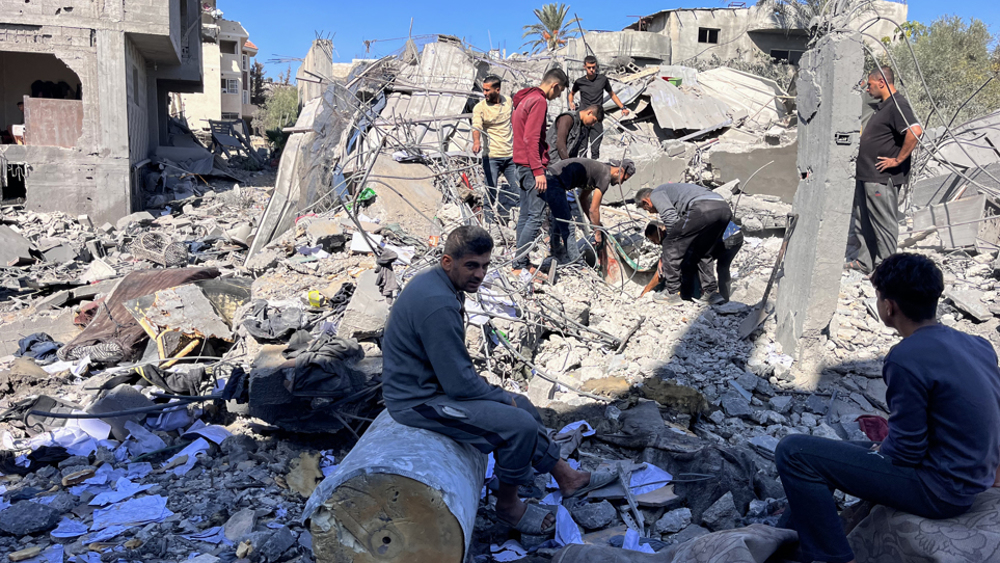
People search the rubble for missing persons at the site of an Israeli strike a day earlier that hit the Al-Loh family home in Beit Lahia, the northern Gaza Strip, on October 30, 2024. (AFP)

Press TV

The Gaza Government Media Office has warned that while direct Israeli bombardments have largely paused, Palestinians in the besieged territory continue to face “slow genocide,” driven by the ongoing blockade and severe restrictions on humanitarian aid.

In a statement released on Tuesday, Ismail al-Thawabta, director of the media office, said the cessation of heavy bombing does not mean the end of suffering.

He said Israel is continuing the campaign “with other tools” such as the closure of crossings, the obstruction of aid deliveries, and restrictions on essential relief materials such as tents, blankets and caravans.

According to the media office, more than 288,000 Palestinian families remain without shelter due to the continued blockade of basic materials.

The office also highlighted the collapse of Gaza’s healthcare system, reporting that over 20,000 wounded and sick people are in urgent need of evacuation for medical treatment abroad.

It said Israel’s attacks have destroyed hospitals and clinics, adding that more than 1,700 medical personnel—including doctors, nurses, and other staff—have been killed since the start of the genocidal war.

The office also noted that only 93 trucks of humanitarian aid are currently entering the territory each day, adding that this is “a meager number compared to the needs of 2.4 million people living under siege.”

The media office urged the international community to take concrete action, saying Gaza requires more than just statements of solidarity.

“Gaza does not need statements of solidarity; it needs binding international decisions to hold the occupation accountable, end the siege, open the crossings, and save what remains of life,” it said.

On October 10, a ceasefire took effect in the Gaza Strip, based on a phased plan presented by US President Donald Trump. The first phase included the release of Israeli captives in exchange for Palestinian prisoners.

Israel accepted the Gaza truce deal after two years, following the failure to achieve its declared objectives of eliminating the Palestinian resistance movement Hamas and freeing all captives, despite killing 68,159 Palestinians, mostly women and children, and injuring 170,203 others.

Despite the truce, conditions remain dire. Many Palestinians attempting to return to their homes in northern Gaza face “a daily struggle for survival.” Large parts of the region remain inaccessible due to the continued presence of Israeli forces.

The Israeli regime continues to violate the ceasefire agreement with Hamas, carrying out airstrikes and shootings, while restricting aid into the territory.

According to Gaza officials, nearly 100 Palestinians have been killed and more than 230 others wounded in Israeli attacks since the ceasefire took effect.

[…]

Via https://www.presstv.ir/Detail/2025/10/28/757741/Palestine-Israel-Gaza-media-office-slow-genocide-continue-Israeli-strikes-paused-crossings-closure-restrictions-humanitarian-aid

These 20 Apps Are Watching You—And You Probably Use Them Every Day

(Credit:Zain bin Awais/PCMag Composite;Apple)

You might use these apps every day, but have no idea what they collect. These 20 apps are quietly harvesting your location, contacts, photos, and more—here’s what you can do about it.

Everyone wants your data. There’s a lot of money in selling or sharing the information that apps collect about you. That’s why tech companies leech data from your devices in exchange for whatever service they’re offering, and sometimes, collection happens without your consent. Some apps may surprise you. Why would a calendar app need access to your health data? Why does a calculator require your list of contacts? You might be surprised at the data some of the apps on your phone right now harvest this way.

The best way to know what you’re getting into before downloading an app is to look at the company’s privacy policy; you can usually find a link to a company’s privacy policy on an app’s landing page in the store or at the bottom of a company’s website. The next best way to learn about data collection is to take a glance at the app store’s privacy reports. It’s a good idea to ask yourself these questions and check out those documents before downloading and installing new apps on any device. If the answer doesn’t seem obvious, don’t download it.

With that in mind, let’s look at some of the most invasive apps that may be on your phone right now.

What Are the Most Invasive Apps?

The chart below is based on research conducted and reported by Marin Marinčić, the head of IT Infrastructure at Nsoft, a gaming and sportsbook platform. He examined app privacy reports in Apple’s App Store and compiled a list of data-hungry apps.

Keep in mind that companies self-report all of this information to Apple. That means companies could fail to mention some kinds of data collection or purposefully misclassify data collection to seem less invasive.

(Credit: NSoft/PCMag)

Invasive Apps Are Targeting Kids, Too

Some apps for younger audiences collect massive amounts of information, too. Earlier this year, the research team at SafetyDetectives, a cybersecurity news and review site, analyzed 20 popular apps for kids. The analysts found that all of the subscription apps in the study posed privacy risks, 70% of the apps collected identifying information, and more than half shared user/child data with third parties.

(Credit: SafetyDetectives/PCMag)

Among the biggest privacy offenders on the list were popular platforms like Reading Eggs, a popular literacy tool for kids that collects audio and photo data from kids’ devices and also uses customer data for ads and personalization features. ABCMouse, an early childhood learning app, not only collects device data but also shares that information with third parties. Plus, the SafetyDetectives research team flagged the service as being difficult to cancel or delete.

Parents should be wary of apps their kids ask to install on their devices. Check the privacy reports of any educational or entertainment-related apps you install on shared devices for your kids, or apps on devices owned by your children.

Which Apps Share the Most of Your Data?

Now let’s look at the least surprising inclusions on this list: Social media apps. Forming bonds online means voluntarily giving up massive amounts of personal information in return for likes and digital hugs. That’s why it’s no surprise that some social apps use more than 90% of customer data to perform basic functions such as messaging or discovering new contacts.

The social media apps on the list are LinkedIn, Snapchat, TikTok, X, and the famous Meta quartet: Facebook, Instagram, Messenger, and Threads. The Meta apps are particularly worrisome because they share the greatest percentage of data with third parties (68.6%).

WhatsApp Business earned a spot on the list of invasive apps because it requires a lot of your personal information (57.1%) to function. It’s worth noting that WhatsApp Business is separate from WhatsApp, a private messaging service with end-to-end encryption (E2EE). Messages sent using WhatsApp Business do not use E2EE, which means Meta (or anyone else) could be reading or recording your correspondence.

[…]

Via https://au.pcmag.com/security/109470/time-to-delete-the-most-invasive-apps-list-includes-some-of-your-favorites

Southeast Asian Languages: Tones, Creaky Vowels and Telegraphic Sentences

John McWhorter: scholar, linguist, cultural critic, iconoclast ...

Episode 20 SE Asian Languages: The Sinosphere

Language Families of the World

Dr John McWhorter (2019)

Film Review

According to McWhorter, there are three language families in Southeast Asia:

  • Austroasiatic (Vietnamese, Cambodian)
  • Tai Kadai (Thai)
  • Hmong-Mien (Laos, Myanmar, Vietnam and Thailand)

For the most part these languages use one syllable words, tones, creaky vowels* and telegraphic (without subject, direct object or indirect object) sentences.

MacWhurter describes Southeast Asia as a Sprachbund, a region where different language families have structural similarities owing to much of the population being bilingual.

Romania is a European Sprachbund, with Greek, Albanian and the Slavic languages having a major impact on Romanian.

Austroasiastic

  • Vietnamese – experienced major Chinese influence owing to 1000-year Chinese occupation of North Vietnam.** Has one syllable words and six tones.
  • Khmer (Cambodian) – has 33 vowel sounds instead tones.

Tai Kadai (Thai) consists of 75 languages, with most spoken in southern China and Thailand.

Hmong Mien

Residing primarily in hill country in Vietnam, Laos, Thailand, and Myanmar, the Hmong had less contact with Chinese invaders and immigrants and their language was less influenced by Chinese.


*Creaky phonation (aka creaky vowels) is a voice quality characterized by a low, scratchy sound. It can be used to convey different meanings in various languages

**English was influenced in a similar way by the Norman French occupation of England after 1066. Many modern English words are of French origin.

https://www.kanopy.com/en/pukeariki/watch/video/6120000/6120038

Don’t Bail out Soybeans

Don’t Bail out Soybeans

By   October 25, 2025

Question: What does a business do when nobody wants its product or services?

Answer: It asks for the federal government to bail it out and pay for a product nobody wants.

If this sounds silly to you, consider what’s going on with America’s soybean farmers who lost a quarter of their market when China decided to switch sourcing to Brazil and Argentina in the last couple of months. As a farmer myself, my heart breaks for the plummeting prices and the prospect of losing $200 per acre on the 2025 crop.

But on the other side of my breaking heart is a desire to hear any soybean farmer say, “I’m going to grow something profitable.” You’d think in a capitalistic society someone raising soybeans would recognize simple principles in supply and demand. You can’t keep supplying when demand wanes and expect a sugar daddy to subsidize your bank account.

What kind of economic gymnastics makes soybean farmers think they deserve taxpayer subsidies for a commodity in oversupply? Where is the courageous soybean farmer who dares to pivot to something else? Or who dares to suggest the farmer can solve this conundrum without government interference?

I’m well aware that the current crisis is China’s retaliation for President Donald Trump’s tariff campaign. Farmers can rightly say, “We didn’t see this coming and planted based on credible market expectations and we were blindsided.” But how many times has this cycle, or something like it, repeated itself in the last 50 years? How many of these debacles does it take to convince someone that a fundamental change is necessary?

But it’s crickets in the soybean industry. “Build us biodiesel facilities. Find other markets. Give us billions in subsidies.” The refrain is loud—and painful to hear. Farmers have historically been some of the most can-do resilient people in society. But right now these soybean farmers sound like a bunch of whining babies.

How did we get here? How did we turn the rugged American farmer into a government dependent? In short, the farm bill and farm programs supposedly instituted to protect farmers from price fluctuations. The result is such that market intervention has led crop farmers growing the six special-interest commodities to stop thinking like businesspeople and instead think like entitled dependents.

The six crops are soybeans, corn, sugar cane, wheat, rice, and cotton. Nothing else gets subsidy anointing from the federal temple like these six commodities. The result is an unholy legacy jerking farmers from one promised salvation to another, none of which actually ends in a better trajectory for primary producers.

When I talk with these farmers about doing something different, such as converting their cropland to perennial prairie polycultures producing grass-finished and fattened beef with management-intensive bio-mimicry, their eyes glaze over as if I’ve invited them to join me on an exploratory rocket ship to Pluto. For the average person, appreciating the damage from farm programs is difficult.

When decisions run through a matrix of paperwork and farm program payments, it jaundices every option. The idea of getting along on your own without a government paycheck, without a program security blanket, is so foreign that it can’t find a home in the farm’s business plan. Worse than the financial dependency these programs create is the emotional straitjacket it wraps around farmers.

Right now, the United States has the smallest beef herd since 1950 and prices are unprecedentedly high. Today, cows are like four-legged gold bars. The beef herd reduction began in earnest during the drought in southern tier states during the 2021–2023 seasons. I met Mississippi farmers who went out to check their cows, only to find one or two with broken legs after stepping into wide cracks in the soil. Unbelievable. Tragic.

Farmers liquidated their herds during that time. Unlike soybeans, you can’t just plant more cows when the rains return. And return they did in 2024 and 2025. These same parched acres are now exploding in grass without enough cows to eat it. Expanding a cow herd takes time. Since the average beef cattle operator is more than 60 years old, many don’t want to expand at any price. The successional conundrum is another story for another column.

Once a farmer makes a decision to expand, he has to save a heifer (female) calf and not send it to processing. That creates an additional shortage of beef going into market finishing channels. That heifer needs to be at least a year old before it’s bred to produce a calf 9.5 months later. When that calf hits the ground, it’s nearly two years after the initial decision to expand the herd. That calf then needs to grow for two years before it’s ready to be processed for the retail market. Add it up and it’s a four-year cycle. That’s not soybeans.

But that long cycle creates its own protections. It can’t whipsaw like an annual crop, and therein lies market stability. Perennials such as orchards and blackberries are similar. A farmer simply can’t jump on market fluctuations, such as rising prices, as fast with plants and animals that have a longer cycle than annual crops.

Note that all six commodities in the USDA subsidy sanctuary are annuals. Why? Because historically peer-dependent fraternally-minded farmers overplanted when prices rose and collapsed the market—all in one year.

The incoherence of the government negotiating trade deals for beef cattle with the United Kingdom and Australia when our domestic supply is shorter than ever in history is unfathomable. As if adding insult to injury, the government is thinking about giving soybean farmers billions of dollars when we’re oversupplied. Let’s get this straight. We need to export beef, which is in short supply. We need to subsidize soybeans, which are in oversupply. Does this make sense to anyone?

I suggest we eliminate all subsidies and all federal government salespeople. Let the market go where it will and let farmers learn to think independently, like businesspeople. How do we incentivize better decisions? By making people responsible for the consequences of their own decisions. Not by bailing them out when they make bad decisions.

Soybean farmers, I love you. But please stop. Sell the combine and chemical equipment and reinstall the fences you ripped out in the 1980s. Remember “Plant fencerow to fencerow?” The diversified, less dependent farm had fences.
[…]
Via https://brownstone.org/articles/dont-bail-out-soybeans/

Israel’s Assault on the Nervous System of Palestine: Weaponizing Empathy, Grief and Trust to Engineer Collapse

Rima Najjar

[…]

Empathy, the First Reflex

Empathy, the first reflex Israel weaponized, is no longer safe. In April 2024, Israeli quadcopters hovered over the Nuseirat refugee camp broadcasting the cries of infants and screaming women. Engineered sounds. Civilians, compelled by the instinct to protect, emerged from shelters only to be met with sniper fire or drone strikes. “We thought someone’s child was trapped,” one survivor told Al Mayadeen. “We ran toward the sound. Then the drone fired.” Israel turned the protective impulse into a death sentence, converting empathy into a tactical liability and care into a kill switch.

This was not isolated an isolated incident. In December 2024, Euro-Med Human Rights Monitor documented Israeli drones broadcasting recordings of crying babies, women’s screams, and gunfire in the dark hours over central Gaza. “It was a baby, I swear,” said a man from Deir al-Balah. “We heard it all night. My wife begged me not to go. But I couldn’t ignore it.” He stepped outside. The drone fired. Israel baited the instinct to rescue, then punished it.

In June 2025, quadcopters returned — this time over displacement camps in southern Gaza. Witnesses reported hearing Hebrew lullabies and Arabic prayers, followed by sudden bursts of recorded chaos: sirens, explosions, children sobbing. “It was like they were trying to confuse our hearts,” said a grandmother in Khan Younis. “One moment it sounded like a child praying. The next, a woman screaming.” These were not psychological side effects — they were deliberate provocations. Israel did not just target Palestinian bodies. It targeted their instinct to care.

In some cases, drones entered homes uninvited, hovering silently before unleashing sound barrages or recording intimate moments. “It hovered over my baby’s crib,” one mother said. “It didn’t shoot. It just watched. Then it left.” The message was clear: nowhere is safe, not even the cradle.

In January 2025, Euro-Med Human Rights Monitor documented drones entering homes uninvited, recording intimate moments of sleeping families. “It hovered over my baby’s crib,” one mother said. “It didn’t shoot. It just watched. Then it left.” The message was clear: nowhere is safe, not even the cradle. Surveillance became intrusion. Intimacy became exposure.

Israel has turned empathy, once a source of strength, into an invitation to death. Its war on Gaza is not content with silencing voices — it mimics them. It does not merely kill — it impersonates the cry for help. In doing so, it rewires the moral circuitry of survival, making the act of compassion indistinguishable from a trap. To reach for the wounded, to answer a scream, to cradle a child — each becomes a calculated risk. Each gesture of care, a potential trigger. This is not just cruelty. It is the algorithmic inversion of mercy

Instinct to Flee, Sabotaged

Instinct, too, Israel sabotaged. In September 2025, Israeli forces dropped leaflets and sent mass SMS messages urging Gazans to evacuate to designated “safe zones.” These messages included QR codes linking to digital maps. Families followed the instructions. Warplanes bombed the destinations. A father in Rafah, interviewed before his death, said, “We believed them. We thought they wouldn’t bomb where they told us to go.” Israel poisoned the logic of survival, transforming the instinct to flee into a trap and collapsing the decision-making infrastructure that civilians rely on under siege.

This tactic is not isolated. In May 2024, Israeli drones dropped flyers over eastern Rafah, instructing residents to evacuate specific neighborhoods and follow mapped routes to a “humanitarian zone.” The IDF followed up with phone calls and text messages. “They told us which streets were safe,” a mother recounted to Al Jazeera. “We walked exactly where they said. Then the airstrike hit.” Israel did not just mislead — it choreographed movement, then punished it.

In December 2023, the Israeli military published an interactive map dividing Gaza into hundreds of numbered blocks, claiming it would help civilians avoid active combat zones. The map was embedded in leaflets and QR codes. “We studied the map all night,” said a teacher in Khan Younis. “We thought it was real. We moved our children block by block.” The next morning, artillery flattened the zone they had just entered. Israel turned cartography into a weapon, converting the instinct to navigate into a death sentence.

In February 2025, leaflets threatened forced displacement unless Gazans cooperated with Israeli directives. “The world map will not change if all the people of Gaza cease to exist,” one leaflet read. The message was not just coercive — it was existential. Israel reframed survival itself as conditional, contingent on obedience to the very force engineering collapse.

Israel sabotages instinct by flooding the nervous system with false signals — maps, messages, voices, coordinates — then punishing those who respond. The result is paralysis. Civilians cannot trust their own reflexes. To flee is to risk death. To stay is to risk death. Israel engineers the collapse of logic itself, making every decision a coin toss between annihilation and annihilation.

Trust, Weaponized

Trust, the final reflex, Israel does not merely betray — it weaponizes. In July 2025, families in Khan Younis received voice messages mimicking humanitarian agencies. The voice urged them to seek shelter in a nearby school. “It sounded like UN,” one woman told The Sudan Times. “We trusted it.” Within the hour, Israeli warplanes bombed the school. Israel did not just exploit the instinct to believe — it engineered the tone of care, the tone of protection, the architecture of humanitarian language, only to detonate it. Trust became a lure. A decoy. A prelude to annihilation.

In October 2024, deepfake videos circulated on Telegram and WhatsApp showing well-known Palestinian journalists urging evacuation to specific coordinates. The videos used real faces, real voices, real urgency. “I thought it was him,” a survivor said. “He’s never lied to us.” Families followed the instructions. Drones followed them. Israel contaminated the very infrastructure of trust — faces, voices, names — turning them into kill switches.

In July 2023, Israeli authorities declared a temporary ceasefire and opened a “humanitarian corridor” for civilians to flee northern Gaza. Thousands moved south. Hours later, airstrikes hit the corridor. “We believed them,” said a father from Beit Hanoun. “We thought they wouldn’t bomb where they told us to go.” Israel did not just break promises — it weaponized them.

This assault on trust extends beyond Gaza’s borders. According to Reporters Without Borders (RSF), Israel has waged systematic campaigns to “discredit the professionalism of Palestinian journalists,” often through smear labels like “Gazawood” or “Pallywood.” These terms, amplified by official Israeli channels, frame Palestinian documentation of war crimes as staged or fake. The goal is not just to deny evidence — it is to collapse the credibility of those who bear witness by targeting the trust between the journalist and the world.

Israel targets the nervous system of a people by rewiring the signals it relies on — empathy, instinct, trust — and converting them into vectors of collapse. To trust is to risk obliteration. To doubt is to risk paralysis. This is the bind Israel engineers: a population forced to choose between the fatalism of belief and the vertigo of disbelief.

Grief, Desecrated

Grief, the reflex that binds the living to the dead, the final frontier of emotional survival, Israel desecrates and renders incoherent. In January 2025, Khaled Barakah buried his two sons alone. No procession. No condolences. “Who in Gaza hasn’t lost something?” he asked Safa News. “There is no room to mourn.”

In March 2025, families in Deir al-Balah reported drones hovering over cemeteries during burials. “It circled above my brother’s grave,” one man told Al Jazeera. “We rushed the prayer. We left before we could cry.” Israel turned the cemetery into a surveillance zone, the grave into a threat. The bereaved became suspects.

In November 2024, Israeli strikes targeted a funeral tent in Jabalia, killing mourners gathered to honor a slain medic. “We were praying,” said a survivor. “Then the roof fell.” The tent had no weapons. No fighters. Only grief. Israel did not mistake it — it selected it. The act of mourning became a military target.

In July 2024, a mother in Khan Younis kept her daughter’s body in a freezer for six days. “There was no safe place to bury her,” she said. “I couldn’t let her rot.” The war did not just kill — it delayed farewell. It froze grief in time. It denied the dead their dignity and the living their release.

In one widely reported case, another mother buried her infant daughter in her wedding dress — the only white cloth she had left. “There was no time, no shroud, no prayer,” she said. “Only dust and silence.”

Israel does not merely interrupt mourning — it criminalizes it. It turns grief into danger. Israel weaponizes mourning by making it visible, traceable, punishable. To cry is to risk being seen. To gather is to risk being bombed. To bury is to risk being followed.

The nervous system of Palestine does not just suffer loss — it suffers the impossibility of grieving it.


Contextualizing the Tactics

Israel’s tactics do not emerge in a vacuum. They refine colonial precedents and mirror contemporary strategies. British forces in Kenya used loudspeakers to simulate distress during the Mau Mau uprising. French troops in Algeria relied on informants and aerial photography to fracture trust and isolate resistance. American psy-ops in Vietnam dropped leaflets promising safety that rarely materialized.

In 1947–48, zionist militias deployed psychological warfare to induce mass Palestinian flight. Loudspeakers mounted on armored vehicles broadcast recordings of women screaming, crying, and urging civilians to flee. These broadcasts were timed with attacks or rumors of impending massacres, amplifying terror and fracturing communal resolve. In villages like Deir Yassin, the massacre itself was followed by deliberate amplification — Zionist forces spread exaggerated accounts of brutality to neighboring towns, triggering panic and mass displacement. Historian Walid Khalidi and others have documented how these tactics — combining real violence with engineered fear — were central to Plan Dalet, the zionist blueprint for territorial consolidation. The goal was not just to clear land, but to collapse the psychological infrastructure of Palestinian presence.

Absent this history, Palestinians are often portrayed not as victims of psychological warfare — but as people who simply abandoned their homes. Zionist narratives, echoed in Western media and textbooks, frame the 1948 exodus as voluntary or strategic — claiming Palestinians fled at the urging of Arab leaders or out of cowardice. This framing persists even within Palestinian families. Younger generations, raised in exile, sometimes ask their elders: “Why did you leave?” The question carries pain — not because it seeks truth, but because it assumes betrayal.

Russian forces in Ukraine have deployed similar tactics: in 2022, Russian operatives circulated fake evacuation notices in Kherson, directing civilians toward mined roads and active combat zones. “We thought it was official,” one resident told The Kyiv Independent. “The logo looked real. The map was detailed. Then the shelling started.” Russia weaponized the instinct to flee, collapsing the logic of survival.

And Ukraine, too, has engaged in psychological operations. In 2023, Ukrainian forces reportedly used spoofed radio transmissions in occupied Melitopol to mimic Russian military orders, sowing confusion among troops and civilians alike. “We heard them say to evacuate,” a local resident told BBC Ukraine. “Some people packed and left. Others stayed. No one knew what was real.” The tactic disrupted Russian cohesion — but also fractured civilian trust. The line between resistance and manipulation blurred.

Israel’s model, however, is more intimate, more instantaneous, and more ideologically precise. It does not just echo colonial cruelty — it perfects it. Israel studies the colonial archive and the digital battlefield, then scripts its own doctrine of collapse not through brute force alone, but through emotional mimicry — by impersonating care, simulating safety, and weaponizing the very signals that once sustained survival.

[…]

Via https://libya360.wordpress.com/2025/10/27/israels-assault-on-the-nervous-system-of-palestine-weaponizing-empathy-grief-and-trust-to-engineer-collapse/


How British Intel Infiltrates Lebanon

A Hezbollah Resistance fighter places a Palestinian flag atop of a replica of the Dome of the Rock in Sidon, Lebanon November 2023
Kit Klarenberg

In a markedly revealing September 22nd interview with The National, US special envoy to Syria Tom Barrack made a number of stunning admissions about the state of play in Lebanon. Despite Western governments for months demanding Beirut disarm Hezbollah, he acknowledged the Resistance group had “zero” incentive to voluntarily do so, as “Israel is attacking everybody” across West Asia. As such, Hezbollah’s “argument gets better and better”, and its public support grows. Barrack went on to propose arming the Lebanese Armed Forces for the purpose:

“[The LAF] is a good organisation and it’s well-meaning, but it’s not well-equipped…Who are they going to fight? We don’t want to arm them so they can fight Israel…So you’re arming them so they can fight their own people, Hezbollah…our enemy…We need to cut the heads off of those snakes and chop the flow of funds. That’s the only way you’re going to stop Hezbollah.”

Barrack’s comments are a uniquely candid admission of Washington’s overarching strategy in West Asia. Namely, to construct intelligence, military, and security apparatuses in pliable puppet states for the purposes of internal oppression, posing no threat whatsoever to the Zionist entity, while Tel Aviv attacks “everybody” in the region with total impunity. Yet, efforts to bring Lebanon to heel, and neutralise Hezbollah’s influence in the country, have been ongoing for many years – with London secretly leading the charge.

Leaked documents expose how Torchlight, a well-remunerated British state contractor staffed by military and intelligence veterans, has insidiously penetrated Lebanon’s assorted spying agencies at their highest levels. These efforts are conducted in express support of the British Embassy in Beirut’s “political access and influence objectives”. Under their auspices, British operatives and technology are implanted at the heart of the country’s security agencies, in the process training an unblinking eye on their operations, and Lebanese citizens.

One leaked file notes Torchlight staff deployed for these clandestine projects are “highly experienced former UK police investigators, intelligence officers and forensic experts,” providing specialist instruction at one of Britain’s leading spy schools, the Joint Intelligence Training Group. Furthermore, 90% of the company’s employees have high-level Whitehall security clearances, granting them “frequent and uncontrolled access” to top secret information. Torchlight itself boasts rare ‘List X’ accreditation, meaning the Ministry of Defence has entrusted the firm with storing highly sensitive, classified material on its premises.

Under the auspices of ‘Investigations Advisor and Mentor’, an endeavor ostensibly aimed at improving the investigative processes of the LAF’s Intelligence Directorate, Torchlight ostensibly teaches the unit to move away from the use of “uncorroborated confession evidence” obtained via torture to “recognition and exploitation” of CCTV footage, phone records, biometrics, forensics, and covert on- and offline surveillance. The leaks make clear this drive isn’t motivated by sincere human rights concerns, but a desire to “drive down risks” of public association with the Directorate.

‘Beneficiary Concerns’

In reality, London seeks to build a “sustained relationship with an important UK [counter-terror] partner” in Beirut, and thus “enable, support and assure any joint UK–Lebanese operational cooperation and collaboration.” Intelligence gathered in Lebanon not merely by the LAF’s spying nexus, but Beirut’s other intelligence and security agencies, is fed directly back to SO15, London’s Metropolitan Police counter-terror unit, National Crime Agency and “other members of the UK intelligence community.”

Torchlight’s cloak-and-dagger embedment with Lebanon’s intelligence agencies avowedly grants the firm “enhanced understanding” of “the operational realities of present working practice” in, and “institutional rivalries” between, Beirut’s military, Internal Security Forces, General Security Directorate, and General Directorate of State Security. Torchlight’s lead “mentor” for the program, William Semple, a veteran SO15 investigating officer, was “well-networked” across all these services, and “highly familiar” with their operating environments. This fly-on-the-wall insight allowed Torchlight to cultivate “strong relationships” with the agencies’ “strategic and tactical operational heads.”

The company is likewise “well-networked” with Lebanon’s military courts, having met with Fadi Sawan, Beirut’s chief military investigating judge, on “multiple” occasions. Coincidentally, Sawan was initially charged with investigating the ever-mysterious August 2020 Beirut blast, but promptly removed from his position due to political pressure. Moreover, Torchlight’s in-country team includes a number of “highly-networked” former Lebanese intelligence operatives, advising the firm on “constructive” engagement with their former employers, “[facilitating] introductions and meetings” and ensuring the project avoids “pitfalls and obstacles” to “buy-in” from senior leadership.

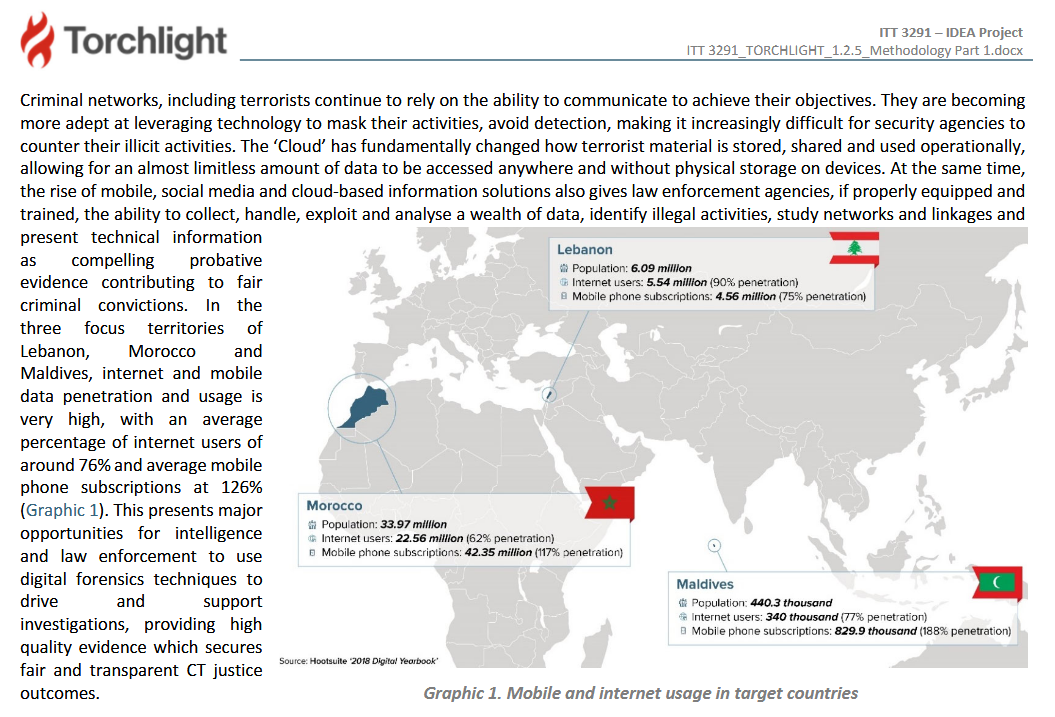
“Passive resistance” from high-ranking staff was forecast to be a potential pitfall in another secret program, through which Torchlight equips Beirut’s Military Intelligence Directorate with technology to process and manage digital evidence. A leaked file notes 90% of Lebanese citizens use the internet, while 75% have smartphones, which “presents major opportunities for intelligence and law enforcement to use digital forensics techniques to drive and support investigations, providing high quality evidence” – and British spooks to closely monitor the local population in the process.

The leaked files outline how Torchlight overcame even sterner resistance from “negative blockers” within the LAF’s Intelligence Directorate, upon launch of the firm’s “mentoring” initiative. The agency’s top brass harboured entirely legitimate “suspicions” about the true purpose of the project. However, having conducted analysis to “understand the root causes of beneficiary concerns” and allayed them, the effort not only went ahead, but Torchlight was allocated a dedicated office within the Directorate’s headquarters.

Nonetheless, “complex political and institutional landscapes” were predicted to “likely present engagement challenges” throughout the program, in particular “sensitivities with regards to access to data.” Given the “possibility of reluctance” to allow British intelligence full access, “rapidly developing relationships of trust” was key. The “privilege” of Torchlight’s office within LAF headquarters was to be leveraged for the purpose. Perhaps more illuminatingly than intended, one file concludes by stating that for Torchlight, “the most important consultancy skill is listening.”

‘Elite Incentives’

While local stakeholders were “unlikely to say ‘no’ to project proposals” as a result of Torchlight’s penetration, the company suggested its work could still “meet with passive resistance.” It’s clear certain elements and individuals within Beirut’s power structure were extremely wary of London’s activities. A document outlining engagement strategies for Lebanese government personnel notes the country’s military court commissioner was “unsupportive” of London’s involvement. However, due to having recently been “mired in controversy”, his tenure in the post was reportedly “coming to an end.”

The nature of the controversy isn’t stated, and the commissioner isn’t named in the file. The post was at that time held by judge Peter Germanos, who briefly garnered Western media media attention in March 2019 after he ruled homosexuality wasn’t a crime in Lebanon, and thus refused to prosecute military officers charged with “homosexual activity.” Just as Torchlight predicted, he duly resigned in February 2020. It’s a matter of speculation whether Germanos’ downfall was British-engineered.

Leaked files related to a “rule of law initiative” in the former Yugoslavia covertly run by the British National Security Council’s Stabilisation Unit make amply clear London doesn’t tolerate high-level opposition to its overseas skullduggery. Active measures are readily employed to comprehensively crush any and all local resistance:

“In contexts where elite incentives are not aligned with [Britain’s] objectives/values…an approach that seeks to hold elite politicians to account might be needed…We can build relationships and alliances with those who share our objectives and values for reform. It is critical that the media have the capacity and freedom to hold political actors to account.”

We must ask ourselves whether Britain’s wide-ranging infiltration of Lebanon’s corridors of power has been pivotal in encouraging Beirut’s leaders to support Hezbollah’s disarmament. President Joseph Aoun, who entered office in January, quickly made clear neutralising the Resistance group was one of his primary objectives. When Iran vehemently objected in August, Aoun robustly responded: “we reject any interference in our internal affairs.” His riposte was sickly ironic, given Beirut’s Internal Security Forces, which Aoun led for many years, is also heavily penetrated by the British.

[…]

Via https://libya360.wordpress.com/2025/10/27/how-british-intel-infiltrates-lebanon/

Trump’s push to uphold Gaza ceasefire creating political crisis in Israel

U.S. Vice President JD Vance and Israeli Prime Minister Benjamin Netanyahu meet in Israel amid accusations that the U.S. is "babysitting" Israel to make sure it adheres to the ceasefire with Hamas, October 22, 2025. (Photo: Screenshot from Israeli Prime Minister's Youtube Channel)U.S. Vice President JD Vance and Israeli Prime Minister Benjamin Netanyahu meet in Israel amid accusations that the U.S. is “babysitting” Israel to make sure it adheres to the ceasefire with Hamas, October 22, 2025. (Photo: Screenshot from Israeli Prime Minister’s Youtube Channel)

By

JD Vance claims Israel isn’t a vassal state of the US. But when it comes to the ceasefire in Gaza and annexing the West Bank, Israeli decision-making is deeply intertwined with Washington’s current priorities.

The succession of U.S. officials arriving in Tel Aviv over the week has fueled consternation in Israeli political circles as Washington ups the pressure on Israel to stick to U.S. President Donald Trump’s Gaza ceasefire plan. Israeli political circles have bristled at having to bend to the American President’s will, as opposition use the opportunity to lambast Israeli Prime Minister Benjamin Netanyahu for turning Israel into a “vassal” of the United States.

Virtually all of Trump’s inner circle has made the rounds in Tel Aviv throughout the past week, including U.S. Special Envoy Steve Witkoff, Trump’s son-in-law, Jared Kushner, Vice President JD Vance, and U.S. Secretary of State Marco Rubio.

They were all there, JD Vance said, to monitor the ceasefire, rushing to add: “But not monitoring in the sense of, you know…you monitor a toddler.” But Israeli media referred to the flurry of visits as American “Bibi-sitting.”

Israeli daily newspaper Haaretz published a caricature on Wednesday portraying Netanyahu as a child playing with toy tanks and airplanes while Witkoff tells him, “Just a little while more, and then off to bed.” Maariv published another cartoon showing Witkoff, Vance, and Kushner closely tailing Netanyahu, who says, “Honestly, I’m just going to the toilet.”

Israeli opposition leader Yair Lapid didn’t hold back either. At the opening of the Knesset’s winter session, Lapid slammed Netanyahu for getting Israel into “the most dangerous political crisis in its history,” and for sabotaging past ceasefire deals that could have seen the earlier release of the Israeli captives in Gaza. Lapid also said that Netanyahu had turned Israel into “a vassal state that takes orders concerning its own security.”

Things got even tenser during a press conference with Netanyahu when Vance was asked by a reporter whether Israel was becoming a “protectorate” of the U.S.

“We don’t want a vassal state, and that’s not what Israel is,” Vance responded. “We don’t want a client state, and that’s not what Israel is.”

Vance’s insistence on what the U.S. isn’t doing, of course, is the thing that cements it in everyone’s minds.

Netanyahu is still chafing at the prospect of an international coalition of forces that would enter Gaza, and has objected to the participation of Turkish forces in particular. When asked about the matter on Tuesday, Vance said that “nothing will be forced on Israel,” noting that Turkey still has “a constructive role” to play.

The visits by Vance, Witkoff, Kushner, and Rubio came as the fragile ceasefire in Gaza was about to unravel last Sunday, October 19, following an incident in Rafah in which two Israeli soldiers were killed in an explosion. Israel accused Hamas of breaching the ceasefire and launched a series of strikes across Gaza, killing at least 40 Palestinians. Hamas denied any knowledge of the Rafah incident, with reports that the explosion was caused by an Israeli bulldozer running over an unexploded ordinance, of which the White House was reportedly aware.

Later, Trump told Fox News that both parties were respecting the ceasefire as Israel ceased its bombardment by the end of the day.

Political circles in Israel regarded the halt of Israel’s blitz as a sign that Netanyahu had folded under continuous U.S. pressure to make the ceasefire work. Israel’s hardline National Security Minister, Itamar Ben-Gvir, regarded the decision as “shameful” and called on Netanyahu to resume its full-scale onslaught against Gaza.

Now there’s another sticking point that is continuing to fuel U.S.-Israeli tensions: annexation.

West Bank annexation is off the table. Or is it?

In the midst of this wave of criticism, Netanyahu announced his candidacy for the post of Prime Minister in the upcoming November 2026 elections. Netanyahu is currently the longest-serving Prime Minister in Israel’s history, having led a shifting arrangement of right and center-right coalitions for a total of 18 years.

In the middle of JD Vance’s visit, the Israeli Knesset voted in favor of the first reading of a bill that would annex the West Bank. The reaction from the U.S. was unprecedented.

Before boarding his flight to Tel Aviv earleir this week, Secretary of State Rubio said that the vote was “counterproductive” and “threatening to the peace deal.” Vance went further, calling the vote “weird,” “stupid,” and an “insult,” adding that “the policy of the Trump administration is that the West Bank will not be annexed by Israel.”

But the hardest U.S. reaction came from Trump himself, who said in an interview with Time magazine that Israel’s annexation of the West Bank “will not happen because I gave my word to the Arab countries,” adding that “Israel would lose all of its support from the United States if that happened.”

The problem is that annexing the West Bank has been Netanyahu’s most important electoral promise since 2019. He has been spearheading a years-long legislative effort to make that annexation a reality, starting with the 2018 Nation-State Law, then with the Knesset resolution to reject a Palestinian state in July 2024, and finally with last July’s Knesset resolution allowing the government to annex the West Bank.

This is particularly inconvenient for Benjamin Netanyahu, as he needs to avoid any major confrontation with Washington at the current moment. In a post on X, Netanyahu said that the vote was “a provocation by the opposition to sow discord,” although the bill was introduced by an ally of his right-wing camp, Avi Maoz, who ran in the last elections in coalition with Netanyahu’s own party, the Likud.

But Netanyahu’s dissociation from his own allies is understandable. He now finds himself trapped between his commitment to his voting base and the broader interest of securing continued support from the U.S., whose current administration has a different order of priorities.

Those priorities are what Trump hopes will be his crowning achievement: brokering a normalization deal between Israel and Saudi Arabia, which has clearly said that Israel’s annexation of any part of the West Bank would be a “red line.”

In his first term, Donald Trump also clashed with a Netanyahu-led government that had pledged to annex parts of the West Bank. Trump halted the annexation process by brokering normalization agreements with several Arab states, most crucially the United Arab Emirates. The importance of the so-called Abraham Accords, for Trump, comes from the fact that the remaining Gulf countries that have yet to normalize relations with Israel — Qatar and Saudi Arabia — are the key to securing regional U.S. economic and political dominance. This is part of the larger U.S. agenda of reasserting American hegemony and confronting the rising influence of China. A part of Trump’s roadmap to get there is by integrating Israel in the Middle East.

After its genocide in Gaza, Israel is facing international isolation, so regional integration should seemingly be an Israeli priority as well. But in this instance, integration would force Israel to at least temporarily pause its plans to assert Jewish sovereignty between the river and the sea, as the Likud’s charter put it.

Smotrich gave voice to that supremacist dream while speaking at a tech conference on Thursday, saying that Israel would not give up annexation for the sake of normalization: “If Saudi Arabia tells us ‘normalization in exchange for a Palestinian state,’ friends — no thank you. Keep riding camels in the desert in Saudi Arabia, and we will continue to develop.”

Following a flurry of condemnation from Israeli opposition figures, Smotrich gave a halfhearted apology for any “insult” it might have caused, but maintained that Israel would not give up the “heritage,” “tradition,” and “rights” of the Jewish people in “Judea and Samaria” — the Zionist term for the West Bank.

But Smotrich’s statement isn’t a fringe opinion, as much as the Israeli opposition would like to suggest otherwise. Despite their condemnations of the way Smotrich said it, the vast majority of Knesset members support annexation. Following European recognition of a Palestinian state in September, opposition leader Benny Gantz said in a New York Times op-ed that Israel’s rejection of a Palestinian state was a matter of “national consensus.”

But Israel doesn’t even have to accept a Palestinian state to keep Trump happy. It just has to refrain from outright annexation — for now, at least. Even that is something that Israel is finding hard to do.

[…]

Via https://mondoweiss.net/2025/10/trumps-push-to-uphold-gaza-ceasefire-is-creating-a-political-crisis-in-israel/