The Most Revolutionary Act

Uncensored updates on world events, economics, the environment and medicine

The Most Revolutionary Act

Huge Microsoft cloud crash leaves half the world without Internet AGAIN

According to Downdetector, problems began around 11:30am ET, with reports surging from users who couldn’t access cloud-connected services, websites or apps

By Stacy Liberatore

Microsoft‘s Azure, one of the world’s biggest cloud service providers, is suffering outages, triggering widespread internet disruptions across major companies.

According to Downdetector, problems began around 11:30am ET, with reports surging from users who could not access cloud-connected services, websites or apps.

The outage appears to be affecting dozens of platforms that rely on these cloud networks, including Microsoft 365, Xbox, Outlook, Starbucks, Costco and Kroger.

Even popular developer and data tools like Blackbaud and Minecraft are showing connectivity issues.

Downdetector has received nearly 20,000 issue reports from Azure users in the US.

The Microsoft outage comes just days after Amazon Web Services disrupted ‘half the internet.’

The incidents have raised concerns about how much of the global online infrastructure depends on these two companies, which host everything from retail and entertainment platforms to business operations and cloud storage.

Frustrated users have flooded social media to vent, with one post on X reading: ‘First AWS, now Azure goes down. I love it when big companies own half the internet!!!’

[…]

Via https://www.dailymail.co.uk/sciencetech/article-15239249/Amazon-cloud-crash-leaves-half-world-without-internet-AGAIN.html

“We Just Won”: Trump Gloats After Bill Gates Admits Climate Change Won’t End World

Zero Hedge

In the late 1970s, after ‘global cooling’ armageddon science fell out of fashion, a well-oiled machine comprised of billionaire-funded NGOs, the MSM, Hollywood, woke Wall Street, and a robust fact-checking / censorship cartel – started pushing a cult narrative about the planet’s imminent demise in a hellish inferno of global warming. They’ve blamed everything from cow farts and Taylor Swift’s private jet to two-stroke chainsaws, petrol-powered cars, and whatever else these climate Marxists wanted banned – and forced people into authoritarian bullshit like ‘electric stoves only’ and ’15 minute cities’ and ‘eat the bugs,’ etc.

Now, as data centers are coincidentally projected to need record amounts of electricity, Bill Gates has changed his mind about all of that.

And of course the climate cult was one giant grift – or as one former DOGE worker put it, “a heist on the U.S. Treasury” carried out through propaganda that allowed ‘virtuous’ climate bills to be passed easily.

To see this machine in action, look no further than the number of news articles which warned of a “climate crisis” going back 10 years:

And yet, despite decades of gospel over melting ice caps and doom, Gates simply shreds it and decides it’s ackshually not such a big deal.

To wit, his new forecast is that climate change “won’t lead to humanity’s demise.” 

And now, Trump is gloating!

“I (WE!) just won the War on the Climate Change Hoax. Bill Gates has finally admitted that he was completely WRONG on the issue. It took courage to do so, and for that we are all grateful. MAGA!!!” Trump wrote on Truth Social.

Weird that Gates didn’t come to this conclusion before Big Tech needed tons of energy, fast, which means fossil fuels.

Latest on Gates Foundation:

It’s important to understand that there is a war being waged on the minds of the American people. The last five years of fake climate doom headlines were merely a move to enrich Democrat allies, such as climate NGOs, with taxpayer funds.

Keep in mind, anyone who questioned the climate change narrative was silenced. Very authoritarian by Democrats and their billionaire ‘Kings’ … 

[…]

Via https://www.zerohedge.com/weather/after-years-climate-doom-propaganda-bill-gates-admits-world-wont-end

China reveals outcome of key US trade talks

China reveals outcome of key US trade talks

RT

Beijing has agreed to ease rare earth export controls in exchange for lowered tariffs and restrictions from Washington

China has agreed to suspend its latest rare earth export controls in exchange for reciprocal US cuts on tariffs and restrictions, the Chinese Commerce Ministry said in a statement published on its website on Thursday. Beijing’s earlier limits on the critical materials remain in place.

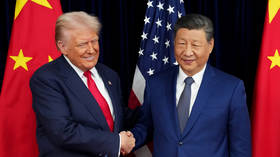
The agreement followed a face-to-face meeting between Chinese President Xi Jinping and his US counterpart Donald Trump in South Korea, as well as economic and trade delegation talks in Kuala Lumpur.

“China will suspend the implementation of relevant export control measures announced on October 9 for one year, and will study and refine specific plans,” the ministry’s statement reads.

Beijing’s restrictions on rare earth mineral exports with dual military use were seen as a response to Washington’s curbs on advanced semiconductors and chipmaking equipment introduced beginning in late 2022, culminating in the Dutch government’s seizure of Chinese owned chipmaker NeXperia in September under US pressure.

China dominates in extraction and processing of rare earth minerals, which are critical for most modern technology from cellphones to missiles.

Under the deal, Washington has agreed to suspend its recent rule expanding export restrictions to any business at least 50% owned by any entity on its “entity list,” the Chinese ministry said.

The US will also suspend its investigation measures targeting Beijing’s maritime, logistics, and shipbuilding industries, and lower fentanyl-related and reciprocal tariffs.

Beijing will adjust its retaliatory measures in response, the statement added.

Trump praised a “great meeting” with Xi, and said that China had agreed to resume purchases of US soybeans and other agricultural products paused during the countries’ recent trade stand-off.

[…]

Via https://www.rt.com/business/627160-china-outcome-us-trade-deal/

Just Say “NO” to Big Tech Attempts to Control Your Life! They Can NOT Control You if You Refuse to Participate

by Brian Shilhavy
Editor, Health Impact News

The key to having Big Tech billionaires controlling the public to roll out their agendas of trying to take over the financial system with digital currencies and making everyone comply with their digital surveillance tools so that they can know everything you do and force you to comply to their demands to keep participating in society, is for the public to volunteer to let them make you their slaves.

That’s it. That is all they need, and we saw them do it during COVID with COVID-19 injections, where a majority of the world’s population complied, voluntarily, to take an experimental injection out of fear of a fake virus and pandemic.

Some did refuse to comply, and lost their jobs. But they were by far the minority. Many of those who did comply died or were permanently disabled.

Has the world learned its lesson from the COVID Scam-demic?

Let’s hope so, because the next step is giving everyone a digital ID and requiring them to use that ID along with biometrics like a face scan, eye scan, or palm scan, in order to participate in society and have access to their bank accounts.

[…]

One of the places that has announced a new national Digital ID is the UK, and Brits are generally not very accommodating about this, as you can see in this recent interview with Keir Starmer, who makes it clear that it is still “voluntary,” but that the easier route is to comply.

It will always be like that. They will use fear and convenience to try to get people to accept Digital IDs. We must be willing to give some things up that make our life easier, if we want to protect our privacy and stop Big Tech from making us their slaves.


Opposition is also growing here in the U.S. against Digital IDs.

Here is a recent clip from The Jimmy Dore show who interviews Twila Brase, president of the Citizens’ Council for Health Freedom, and a new bill introduced in the Senate by Rand Paul to stop Real IDs.

[…]


Google begins rolling out age verification [ie digital ID] in app store in response to U.S. laws

From Biometric Update:

Excerpts:

Age verification has hit Google’s Play store. Having implemented its age inference system on YouTube, the tech giant has apparently answered calls for age assurance at the app store level.

According to a report from Android Authority, user Artem Russakovskii shared screenshots of the verification prompt in a post on X. The shots in question show a screen that offers users several options for age verification. These include taking a photo of a government ID, facial age estimation through a selfie, credit card verification or email-based age inference, the latter of which is provided by the UK’s Verifymy (and which the author commends as the “quickest, easiest, and most privacy-preserving way to verify your age online”).

The facial age estimation (FAE) option says Google “partners with a company that specializes in estimating age,” but does not include the name of the company. Verifymy does provide biometric facial age estimation, but Google has also developed its own FAE technology, which appears on the Age Check Certification Scheme (ACCS)’s registry of approved providers.

Regardless, Google appears to be anticipating the continued spread of age assurance laws across the U.S. A post from the company points to legislation in Texas, Louisiana and Utah as a catalyst for the app store age check rollout.

Full article.

[…]

Via https://healthimpactnews.com/2025/just-say-no-to-big-tech-attempts-to-control-your-life-they-can-not-control-you-if-you-refuse-to-participate/

The Origin of South Pacific Languages

Linguistic Melanesia, Introduction and definitions

Episode 21 Languages of the South Pacific Part 1

Language Families of the World

Dr John McWhorter (2019)

Film Review

After living in the South Pacific for 23 years, I have a special interest in the Austronesian language family, which consists of 1000 languages. Austronesian languages are generally characterized by short two to three syllable words, sentences that begin with the verb and reduplication (doubling nouns to create subtle changes in meaning – eg in Maori ringa (arm) becomes ringaringa for fingers.

Most linguists believe that the Austronesian languages are derived from Thao, a language spoken in Taiwain (and possible southern China). All Austronesian words for rice, sugar cane, ax and canoe are similar to words used in Taiwan for similar objects. Northern South Pacific languages are referred to as Melanesian – Southern South Pacific languages are called Polynesian.

Melanesian (Northern South Pacific  Languages)

  • Malay (spoken in Malaysia and Indonesia)
  • Tagalog (spoken in Philippines)
  • Motu (spoken in New Guinea)
  • Fijian
  • Samoan.
  • Tai-Kadai languages (spoken in Thailand and by indigenous Ainu people In Japan).
  • Baruto languages (spoken in Malagasy off the southeast coast of Africa)

https://www.kanopy.com/en/pukeariki/watch/video/6120000/6120040

Making another ‘desert bloom’: Israel’s water tech seeps into the Gulf

Photo Credit: The Cradle

The Cradle

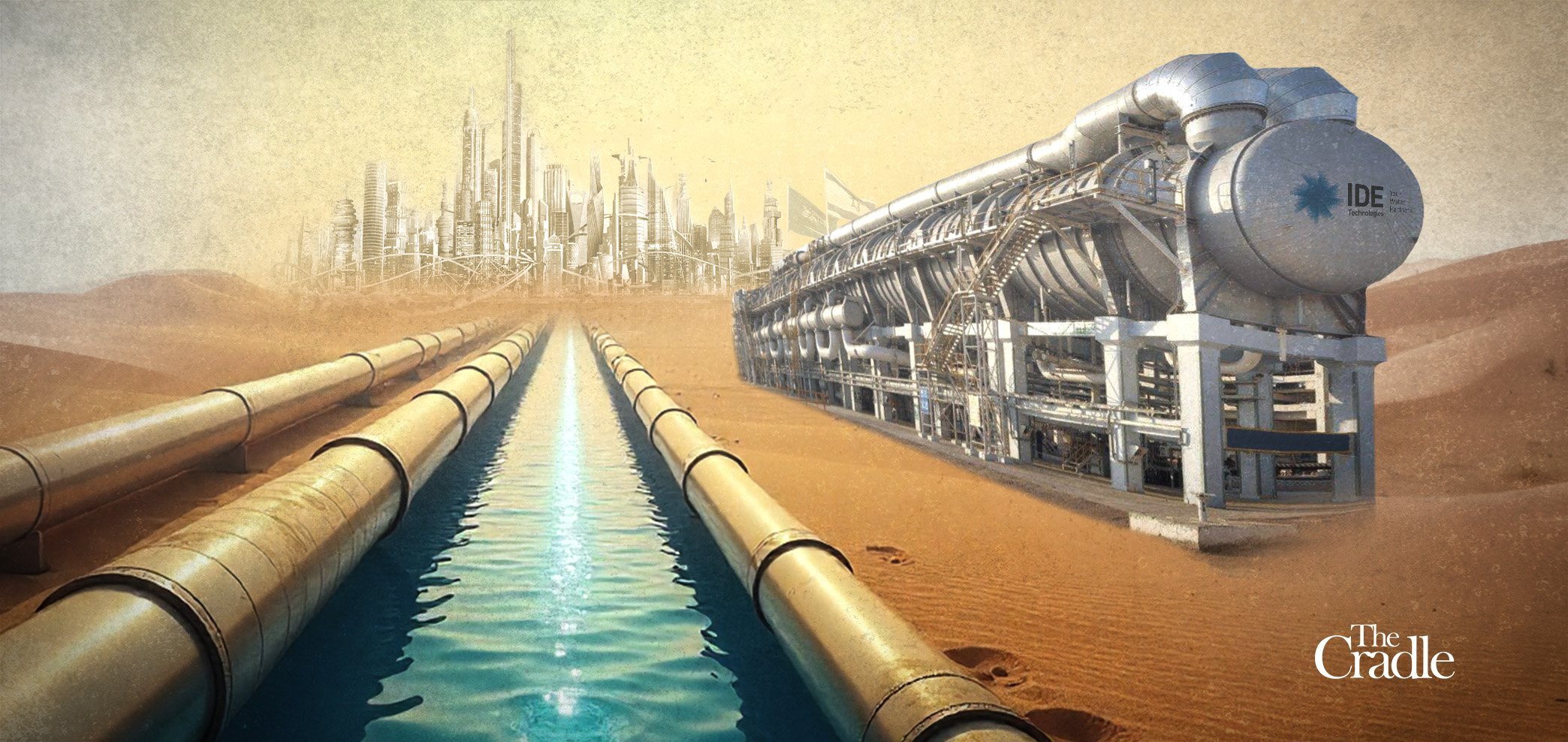
Israeli water technology firm IDE Technologies is quietly embedding itself at the heart of Saudi and Kuwaiti infrastructure projects, advancing Tel Aviv’s strategic foothold in the Persian Gulf through what is effectively functional normalization.

While headlines remain focused on overt diplomatic deals, it is through desalination plants and reverse osmosis systems that Israel is carving a decisive role in the Arab world’s most vital sector: water.

In the Arabian Peninsula – where smart city megaprojects like NEOM rise from the sand, and hundreds of billions are earmarked for futuristic visions – one fundamental truth underpins every promise: without water, there is no future.

Water diplomacy 

In the world’s driest region, water security is national security. Yet Arab states have systemically failed to establish a homegrown technological base to secure independent access to this resource, leaving them reliant on foreign, increasingly Israeli, expertise.

Israel – the northern neighbor of the Persian Gulf states – was itself born in a water-scarce environment, with half the land it occupied in Palestine consisting of desert. It fought wars to control water sources along its borders with Jordan, Syria, and Lebanon, and is dreaming of diverting the Nile.

But from early on – under the “Make the desert bloom” strategy laid out, in particular for the arid Negev, by the first Israeli Prime Minister David Ben Gurion – Israel invested in the water tech sector and succeeded in transforming itself into the “Silicon Valley” of desalination and water reuse technologies.

It is at this intersection – between the Persian Gulf’s perpetual thirst and Israel’s decisive technological edge – that a new West Asia is quietly being redrawn. Here, “soft normalization” seeps through pipes and reverse osmosis systems, bypassing political statements and official speeches.

The matter of overt Arab–Israeli normalization with Gulf countries that have not officially recognized the Israeli state – namely Saudi Arabia and Kuwait – is no longer speculative, nor is it confined to military or intelligence cooperation. It is happening quietly through economic gateways, particularly advanced Israeli technologies, including vital water technologies.

The thirst trap: Gulf dependency takes shape

To grasp the scale of this entrenchment, one must first understand the depth of the Persian Gulf’s water crisis. Saudi Arabia and its neighbors depend almost entirely on fossil groundwater and desalinated seawater.

The former, non-renewable and depleted by decades of reckless agriculture, has been largely exhausted. As for desalination, it is now the only viable path to support expanding populations, urban growth, and mega-projects like Saudi Vision 2030 or Kuwait’s 2035 development plan.

Yet traditional desalination comes with steep costs. It devours oil and gas, dumps hyper-saline brine back into the Gulf – devastating marine life – and escalates both environmental and economic burdens.

Thus, the Gulf’s dilemma is no longer merely about “providing water,” but about doing so “efficiently.” The global race is now over who can desalinate a cubic meter of water using the least energy (kilowatt/hour), at the lowest cost, and with minimal environmental impact.

And this is where Tel Aviv dominates.

The ‘Silicon Valley’ of water

This supremacy is deliberate. From its inception, water for Israel was a matter of survival. Israeli firms like Netafim pioneered drip irrigation. Elite institutions such as the Weizmann Institute and Ben Gurion University devoted decades to refining desalination techniques.

IDE Technologies, born in 1965, is the world’s premier name in large-scale desalination. Its proprietary breakthroughs in reverse osmosis and thermal desalination have set world standards. The company built and operates some of the world’s largest and most efficient plants – including Sorek 1 and Sorek 2 in occupied Palestine – using less energy than any competitor.

For policymakers in Riyadh, Kuwait City, Abu Dhabi, Manama, and Doha, numbers speak louder than politics. When IDE offers technology that can save millions in annual energy costs and ensure stable water supplies for a $500-billion project like NEOM, the engineers’ passport stamps become a secondary issue.

Gulf capitals have realized that clinging to outdated desalination tech is economic and ecological suicide. For water security – and thus national security – they need better solutions. And in this field, the best option simply bears the label: “Made in Israel.”

Soft normalization: The consortium model

Yet political realities persist. Saudi Arabia publicly links normalization to the Arab Peace Initiative – a two-state solution that Israel continues to undermine. Kuwait still enforces a 1964 law banning contracts with Israeli entities. So how does Tel Aviv penetrate?

Enter the consortium model – a corporate workaround for political red lines. Here’s how it works:

The Saudi government, via its Water Partnership Company (SWPC), issues international tenders for strategic water projects. A local champion like ACWA Power leads a bidding consortium. Once awarded, ACWA becomes the project’s face and primary developer.

It then subcontracts global engineering firms to deliver on the scope. Here, IDE Technologies is brought in as a key technology provider or contractor. The paperwork is clean, the project proceeds, and normalization advances – pipeline by pipeline.

International arbitration documents revealed that the Israeli desalination company IDE bypassed the Arab and Muslim boycott through a Swiss-owned intermediary, Swiss Water, which submitted bids while concealing IDE’s Israeli identity and role. Under this arrangement, Swiss Water operated in “prohibited countries” such as Qatar, Kuwait, Saudi Arabia, Yemen, Libya, Algeria, Tunisia, Afghanistan, and Pakistan, as well as countries without formal diplomatic ties to Israel before the 2020 Abraham Accords, such as Bahrain, Sudan, Oman, Morocco, and the UAE where IDE maintains today a presence through its regional headquarters in Dubai, known as IDE Meyah Water Solutions.

Swiss Water reportedly signed contracts worth tens of millions of dollars per project, while IDE supplied the technology and built the plants. Major projects include the Red Sea desalination project in Saudi Arabia, the Great Arabian Sea project in Pakistan, and two projects each in Kuwait and Oman.

Jubail 3A: Where normalization meets the pipeline 

Take Jubail 3A, one of the world’s largest desalination plants, with a capacity of 600,000 cubic meters per day. The winning consortium was led by Saudi firm ACWA Power (40.2 percent stake), but behind the scenes, engineering and construction were executed by a team that included China’s Power China, Spain’s Abengoa, and Israel’s IDE.

The arrangement is satisfactory to all parties:

Riyadh gets a strategic water facility led by a national firm, powered by world-class technology, funded by China, and engineered by Europe; IDE gains a multimillion-dollar contract in the world’s largest desalination market, deeply embedded in Saudi infrastructure – and all without triggering a political firestorm; and ACWA gains a reputation as a global integrator, capable of assembling the best from east and west to execute megaprojects.

What appears on paper as a technical arrangement is, in effect, a form of functional normalization. IDE’s engineers, software developers, and system managers are now an invisible yet integral part of Saudi Arabia’s water supply – particularly in its oil-rich eastern region.

The quieter Kuwaiti model

Kuwait, often portrayed as the Persian Gulf’s most vocal opponent of normalization, offers another telling case. IDE has operated in the emirate for years, particularly in Doha (east and west) desalination plants. And, as in Saudi Arabia, this took place not through direct Israeli contracts, but via multinational tenders where IDE participated as a subcontractor.

This Kuwaiti example arguably reveals more than the Saudi one. It shows that even the loudest political resistance bows to technical necessity. In practice, Kuwait has accepted Israeli technological primacy despite its official anti-normalization stance. It is a marriage of Arab capital and Israeli know-how, facilitated not by politics, but by pressing water needs.

Saudi normalization strategy

Water is only one front in a broader Saudi strategy for normalization, and it is rooted in gradualism and compartmentalization. Unlike the Emirati and Bahraini rush to the Abraham Accords, Riyadh has opted for a slower, layered approach.

Saudi Arabia, given its religious and political weight, has always avoided a sudden political “leap” toward overt normalization that could trigger backlash. Instead, it has pursued a phased approach – bottom-up normalization.

Stage one was security and intelligence coordination – quiet cooperation in Afghanistan, Iraq, Iran, and Syria. These built trust and institutional familiarity between Riyadh and Tel Aviv.

Stage two is unfolding now – integration via non-controversial sectors like water, agriculture, and cyber. While these are not politically explosive, they are strategically crucial.

When Israeli technology powers the kingdom’s desalination, irrigates its crops, and shields its electrical grid, the relationship becomes a de facto security partnership.

Parallel to this, a third stage is underway – soft social normalization: opening airspace, allowing businesspeople and rabbis to enter with alternate passports, and tempering religious and media discourse to prepare public sentiment.

Once this layered web of relations becomes operationally irreversible, diplomatic normalization, including embassies, flags, and handshakes, becomes less a leap and more a footnote.

Water and oil: The realpolitik of tomorrow 

IDE’s penetration into Saudi and Kuwaiti water systems captures the essence of a new regional logic that is pragmatic, technocratic, and devoid of ideological theater. With the collapse of Syria’s resistance front, and with Arab capitals chasing post-oil futures, Israel is in a prime location.

Crown Prince Mohammed bin Salman’s (MbS) Vision 2030 rests on importing minds and machines, not politics. If the road to diversification runs through Israeli pipelines, so be it.

Desalination, in this context, is the perfect front. It meets existential needs, strengthens economic ties, and advances normalization without headlines.

Where once West Asian alliances were drawn in the sands of refugee camps and oil fields, today they flow through networks of water, data, and infrastructure.

The water flowing from IDE-linked plants in Saudi Arabia and Kuwait reflects a deeper shift underway across the Persian Gulf without the ceremony and summits, but forged quietly through contracts, infrastructure, and dependence.

[…]

Via https://thecradle.co/articles/making-another-desert-bloom-israels-water-tech-seeps-into-the-gulf

Energy, Water and the Cost of Jordan’s Dependence on Israel

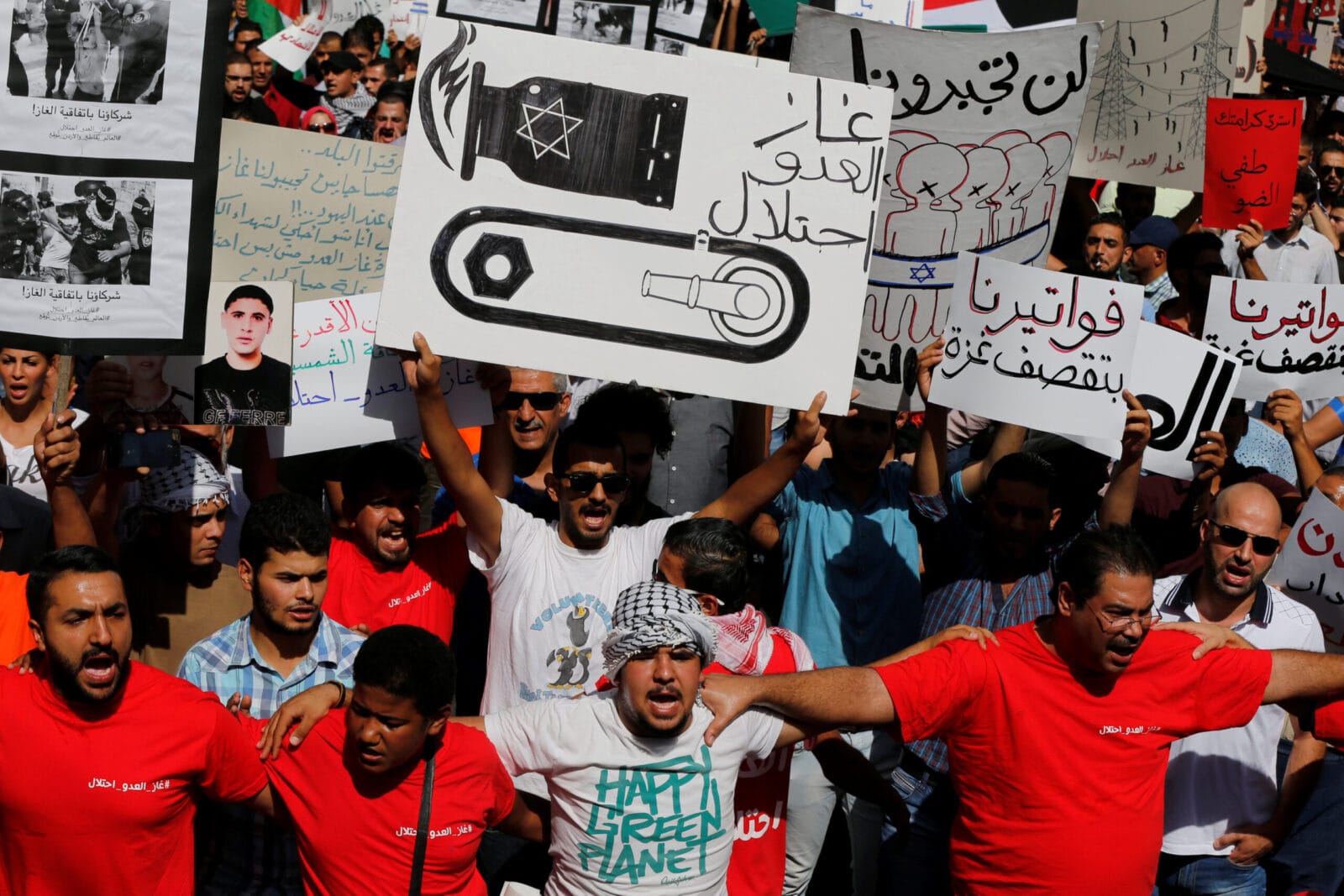
Jordanian protesters chant slogans against a government agreement to import natural gas from Israel, in Amman, Jordan, October 14, 2016. The center placard reads: “The enemy’s gas is occupation.” Muhammad Hamed/Reuters

Majd Bargash

On the morning of June 13, 2025, air-raid sirens sounded across Amman and other Jordanian cities warning residents to shelter in place. Hours earlier, Israel had launched an unprecedented attack on Iran, triggering 12 days of retaliatory missile and drone strikes.

As Israeli fighter jets and Western air-defense systems used Jordanian airspace to intercept Iranian projectiles, Jordan’s military also played a decisive role in shielding Israeli cities—even as government officials warned that Jordan would not become a battleground for adversaries. Over the same tense hours, Israel abruptly curtailed natural gas supplies to Jordan and Egypt when it shut down two major offshore gas fields in the Mediterranean, the Leviathan and the Karish. The move was preemptive: Israel feared Iranian retaliation after it had targeted one of Iran’s largest gas fields in the Gulf.

The escalation exposed the asymmetrical dynamics of Jordan’s normalization with Israel. On one hand, Jordan is expected to fulfill its obligations, such as facilitating Israel’s defense—whether through direct military coordination or logistical lifelines like the “land bridge,” a trade corridor aiming to connect Israel to the Arabian Peninsula. On the other hand, Jordan has to face the consequences of this position. Since Israel began its genocidal war on Gaza in October 2023, anti-normalization sentiment has intensified, with public outrage growing at the government’s perceived complicity in enabling Israel’s military.

But Jordan’s present bind sits atop a deeper history. In 1994, it became the second Arab state to normalize relations with Israel by signing the Wadi Araba agreement. Initially framed in terms of a shared peacekeeping agenda, this relationship has been marked by Jordan’s growing economic and political dependency on donor states and on Israel itself across a range of sectors, from security and intelligence to water, energy, agriculture, manufactured goods, technology and tourism.

Hand in hand with the Oslo Accords of 1993 and 1995 between the Palestine Liberation Organization and Israel, the Wadi Araba treaty marked a decisive shift in the region’s political economy. Oslo created the Palestinian Authority, which fragmented resistance and embedded fiscal and infrastructural dependency on Israel while relieving Israel of the direct costs of occupation. Wadi Araba extended this logic to Jordan, binding its economy into Israel’s orbit and international donor-led neoliberal frameworks. Together, these agreements transformed Israel from a regionally isolated rogue state on the margins of Arab markets into a central node of integration, advancing the Zionist project and expanding its influence under the guise of economic restructuring and so-called peace dividends.

Energy and water, in particular, have become flashpoints in Jordan’s material relationship with and dependence on Israel. These vital sectors tie the kingdom’s economy and daily life to the Zionist state, leaving trade, industry and political stability vulnerable to its leverage. The costs are not just economic: Dependence and deepening normalization, amid an ongoing genocide, fuel social unrest and widen the gap between the government and its people.

Energy Insecurity

Historically, Jordan relied on neighboring Arab states for oil and gas. From the 1960s through the 1980s, supplies came largely from Saudi Arabia and other Gulf states. After the first Gulf War in 1990, dependence shifted to Iraq until the 2003 US invasion. Jordan then turned to Egypt. But upheavals following the revolution in 2011 disrupted supplies. To compensate, Jordan imported crude oil from the global market at a high cost, pushing the National Electric Power Company (NEPCO, a government owned entity) into deep deficit.[1] As political ecologists Benjamin Schuetze and Hussam Hussein have noted, this trajectory reflects more than regional disruptions. It also marks a deeper structural dependency shaped by geopolitical alignments, economic liberalization and the erosion of energy sovereignty.[2]

In 2016, in a highly controversial move, NEPCO signed a purchase agreement with Israel, represented by NBL Jordan Marketing Limited (a subsidiary of Noble Energy, a US-based oil and gas company) to supply Jordan with natural gas. This gas was to be extracted from the Leviathan Gas Field in the Mediterranean, operated by the US oil giant Chevron and controlled by Israel. To date, the government has refused to release the full agreement. In the face of criticism, they cite a constitutional court ruling that parliament cannot vote on deals signed between private companies. Yet the government of Jordan is an official party to the deal, having signed supporting agreements with the Israeli government to guarantee the flow of natural gas.

The deal triggered widespread protests from the moment news leaked that the government of Jordan had signed an intent letter to buy gas from Israel.

[…]

Many Jordanians view Leviathan gas through the framework of settler colonialism: as a resource taken from the earth beneath stolen Palestinian land being used to reinforce Israel’s economic power.

[…]

Israel’s weaponization of water and electricity in Gaza—as documented in South Africa’s genocide case at the International Court of Justice (ICJ)—has made Jordanians even more wary of their own reliance on Israel for utilities.

[…]

[…]

.Water Inequalities

Normalization has reshaped Jordan’s water sector much as it has electricity. The two utilities are tightly bound together: Electricity makes up more than half of the water sector’s operating costs, meaning problems in the power sector spill directly into water management. Together, the two account for about a quarter of the country’s public debt.

Imbalances between cost and revenue afflict both sectors. The state-owned electricity company, NEPCO, purchases power from producers then sells it to distributors at below-cost, government-regulated rates that guarantee private profits while locking NEPCO into chronic deficits. The water sector faces its own leakage. Nearly half of Jordan’s water is classified as “non-revenue water,” lost to theft, leaks or inefficiency, compared with around 27 percent in Morocco.[7]

Today, with the 2024 collapse of Syrian President Bashar al-Asad’s regime and Israeli military expansion into southern Syria, Israel controls most of the water that flows into the Jordan and Yarmouk river basins.

These financial weaknesses are compounded by a long history of contested water rights. The Wadi Araba agreement’s division of water from the Jordan and Yarmouk rivers was only the latest chapter in long and protracted conflict over water in the region. Since the First Zionist Congress in 1897, Zionist leaders tried to draw borders around water sources, like the Litani River in southern Lebanon. By 1967, Israel’s control of the Golan Heights, including the Banias and Hasbani rivers, shifted the hydro-strategic balance decisively in its favor. Today, with the 2024 collapse of Syrian President Bashar al-Asad’s regime and Israeli military expansion into southern Syria, Israel controls most of the water that flows into the Jordan and Yarmouk river basins. Access to rivers and aquifers to expand settlements and dispossess Palestinians has been central to Israel’s colonial settlement project in Palestine.

Israel has long weaponized this control vis-a-vis Jordan too. In the 1970s, it took three to four times its share from the Yarmouk River—as delineated by the Johnston Plan of 1955—and blocked Jordan from carrying out projects using the river, like the Maqarin (or Wehda) Dam.

[…]

Severe water scarcity has forced Jordan to seek alternative supplies. Most recently, the IFC along with the European Union and EU Banks, as well as individual states of the United States, France, Italy, Germany, Holland, Spain and Japan have pledged support for financing the Aqaba-Amman Water Desalination and Conveyance Project: an ambitious proposal to use renewable energy to desalinate water from the Red Sea in Aqaba and distribute it nationally through pipelines. The project claims it will provide a third of the country’s water supply by 2030. But local critics point out that the massive debt, almost 64 percent of the $3.5 billion needed to fund this project, further binds Jordan into a dependent relationship to foreign investors, rather than addressing root inequalities in water access linked to normalization and mismanagement.

Against this backdrop, the 2022 water-for-energy memorandum of understanding with Israel and the UAE provoked sharp public opposition. Under the deal, Jordan would build 600 MW of solar capacity to export to Israel, while Israel would supply Jordan with 200 million cubic meters of water annually. The UAE would finance both sides of the project. As with the gas deal, this deal, if enacted, would have deepened Jordan’s political and economic dependence on Israel. Jordan’s former prime minister, Ahmad Obeidat, questioned the benefit of the deal for Jordan by noting it covers 20 percent of Jordan’s water needs and only 3 percent of Israel’s energy needs. His opposition added to the widespread dissent against the deal across Jordan, which forced the Jordanian government to rethink its position.

Although Jordanian Foreign Minister Ayman Safadi cancelled the deal upon the start of Israel’s genocide on Gaza, questions remain about whether it will be revived.

Material Resistance to Normalization

[…]

Since October 2023, mass protests in the streets of Jordan have demanded the government take serious action to stop the genocide and end ties with Israel. There have been calls to nullify the Wadi Araba agreement, for the expulsion of western military bases and to take concrete steps toward economic recovery. The government has resisted these demands, while reiterating its support for the Palestinian cause and a two-state solution.

In this way, its diplomatic stance provides cover for Israel’s ongoing genocide and renders normalization ordinary. Instances that would have been unthinkable a decade ago, such as a prominent academic praising Israel on national television even as Israel faces ICJ prosecution for genocide and war crimes, reflect the cultural hegemony shaping public discourse. In recent polls, 42 percent of Jordanians oppose cancelling the Wadi Araba agreement.

…while some support normalization, activist movements continue to focus on material politics as a site of disruption—even in the face of growing restrictions.

But while some support normalization, activist movements continue to focus on material politics as a site of disruption—even in the face of growing restrictions. “The Jordanian National Campaign to Overturn the Gas Agreement with the Zionist Entity” began out of opposition to the gas deal in 2014 and includes a wide range of activists, lawmakers, professionals, party members, MPs, trade unions and youth movements from across the political spectrum. In June 2025, Amman’s governor for the first time denied this group a permit to protest against the gas deal. Later the campaign stated on Facebook that the governor’s office had implicitly threatened to detain organizers or participants if the protests actually took place.

Governors—appointed by the prime minister rather than elected—hold broad powers to administratively detain anyone deemed to be a “security threat.” This authority has been used against protestors, journalists and social media influencers. Many contemporary activists were born amid or after the 1989 elimination of martial law and are confronting levels of repression unfamiliar to their generation. Recent detentions have extended to party members like Issam Khawaja—a pediatric neurologist and recently elected secretary general of the Jordanian Democratic Popular Unity party. Khawaja was arrested while leaving his workplace at Al-Basheer Hospital for a speech he gave in a protest in downtown Amman. Other recent arrests include students and social media influencers, like Ayman Aballi, who made a video criticizing the government for holding the Jerash music festival during Gaza’s famine, and journalists like Hiba Abu Taha, imprisoned for reporting on the movement of goods between the Gulf and Israel through a land bridge passing through Jordan.

Her case is telling. By highlighting trade with Israel during the genocide, Abu Taha directly questioned the material infrastructure of normalization. Abu Taha was sentenced under the widely-criticized cybercrime act, which was amended in August 2023. The law’s broad provisions against “threatening social harmony” serve as a ready tool against any dissent and journalism the state objects to, raising red flags for international human rights groups.

[…]

Via https://libya360.wordpress.com/2025/10/29/energy-water-and-the-cost-of-jordans-dependence-on-israel/

Who Are US Candidates Refusing AIPAC Money?


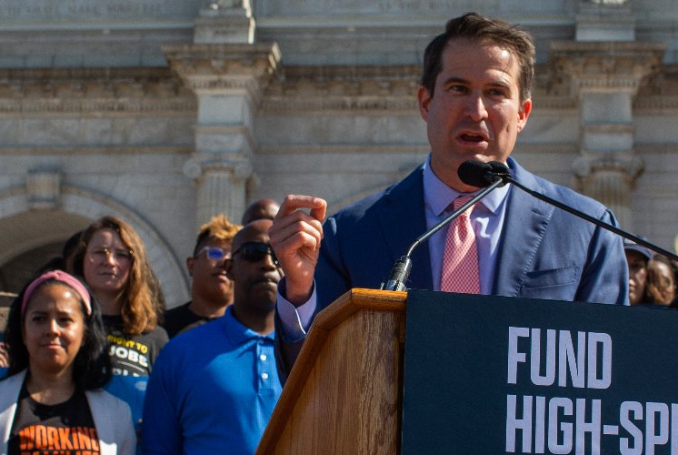
Democratic member of the US Congress, Seth Moulton, has announced that he will return donations received from AIPAC. (Photo: via Moulton X Page)

By Robert Inlakesh

The litmus test for whether a politician is truly interested in representing the people who elect them to power is becoming their stance on Palestine, more specifically, Gaza.

As American public opinion continues to shift against Israel, the US political landscape is also undergoing a dramatic transformation. AIPAC, once viewed as an asset to aid in election races, is now becoming a liability, giving birth to a new generation of politicians who are demonstrating their sincerity through a refusal to be bought by the Israel Lobby.

While New York Mayoral candidate Zohran Mamdani has perhaps received the most attention for his pro-Palestinian stances, he is in no way alone. In fact, he is joined by countless others who use their anti-genocide stances as a means of connecting with their voter bases.


All authoritative polling data suggests the majority of Democratic Party supporters currently hold a more favorable view of the Palestinians than Israel. According to a recent Gallup poll, 92 percent of all Democrats said they oppose the war in Gaza. Yet, the ability of candidates to reject funding from the Israel Lobby and freely speak their mind on the issue transcends a simple agreement with constituents on a single foreign policy issue.

Instead, refusing to take AIPAC money is rapidly becoming a prerequisite in order to be viewed as authentic, and it drives belief amongst the public that any given candidate will actually work to achieve key campaign promises. In other words, AIPAC equals corruption, and being pro-Palestinian equates to authenticity.

One of the most successful campaigns, coming from this new generation of politicians, is that of Graham Platner, who is a Democrat running for a seat in the US Senate for Maine. In his campaign ads, he promotes a “Mainers First” mentality, centering the working class and also explicitly opposing Washington’s support for the genocide in Gaza. He has publicly rejected funds from AIPAC, as opposed to Senator Susan Collins, who seeks to unseat him and has taken at least $647,758 from the Israel Lobby.

Platner is a Marine Corps veteran who did four combat tours and also worked as an Oysterman. Despite countless attempts, from within the Democratic Party establishment and the Israel Lobby, to stir up controversies and undermine his campaign, the progressive candidate is still polling above his Democratic primary opponent and Maine Governor, Janet Mills.

Although the uptick in pro-Palestinian sentiment is more prominent amongst Democrats, there is also a notable shift amongst Republicans. Pew Research polling data shows that, while unfavorable views amongst Republicans overall stand at around 23 percent, amongst those aged 18-49, a whopping 50 percent said they viewed Israel unfavorably.

Harnessing the energy of the shift, the likes of Rep. Marjorie Taylor Greene, Rep. Thomas Massie, and Rep. Matt Gaetz have all explicitly come out in opposition to AIPAC. Their messaging around the issue is to assert that they are “America First”, as opposed to their Republican colleagues, whom they accuse of being “Israel First”. These representatives align themselves with popular conservative commentators like Candace Owens and Tucker Carlson, amongst others, who also carry the same rhetoric.

Ultimately, the idea of America First and slogans like Mainers First transcend partisan lines. The idea of prioritizing Americans above the interests of Israel has long been taboo, yet we saw this collapse during the Democratic primary campaign for the Mayor of New York.

When Zohran Mamdani was asked where he would first visit as Mayor, he answered calmly that “I would stay in New York City. My plans are to address New Yorkers across the five boroughs and focus on them.” Although he was then challenged repeatedly and asked to recognize Israel as a Jewish State, which he refused to do based upon opposition to systems of ethnic or religious hierarchy, the clip of his answer went viral, receiving broad agreement amongst both Democrats and Republicans.

Other politicians running for Congress, who are explicitly anti-AIPAC, include the following candidates:

Robb Ryerse for Arkansas’s Third District, who is seeking to unseat Steve Womack, funded to the tune of $142,030 by the Israel Lobby. In California, there is Chris Bennet running for the Sixth District, Mai Vang for the Seventh District, Saikat Chakrabarti for the Eleventh District, Chris Ahuja for the Thirty-Second District, as well as Angela Gonzales-Torres for the Thirty-Fourth District.

In Colorado, there is Melat Kiros for the First District, as well as John Padora for the Fourth District. Within Florida, there is also Bernard Taylor running for the Twenty-First District, Elijah Manley for the Twentieth District, Marialana Kinter for the Seventh District, and Oliver Larkin for the Twenty-Third District.

Running in Illinois, there is Robert Peters for the Second District, Junaid Ahmed for the Eighth District, Morgan Coghill for the Tenth District and Dylan Blaha for the Thirteenth District. Meanwhile, in Indiana, there is Jackson Franklin, who is running for Congressional District Five and, in Massachusetts, Jeromie Whalen is running for the First District.

Seeking to win Maryland’s Fourth District is Jakeya Johnson, while Donavan McKinney is running for Michigan’s Thirteenth District and Kyle Blomquist is competing for its First District. Crossing over to Missouri, there is a well-known progressive candidate, Cori Bush, for its First District and Hartzell Gray for Missouri’s Fourth District.

For New Hampshire’s First District, Heath Howard is in the running, while, in New Jersey, Katie Bansil is running for the Sixth District. Meanwhile, there is James Lally running for Nevada’s Third District, Aftyn Behn for Tennessee’s Seventh District and Zeefshan Hafeez for Texas’s Thirty-Third District.

Also contending for Washington’s Ninth District is Kshama Sawant, while Aaron Wojchiechowski is running for Wisconsin’s Fifth District and Brit Aguirre is contesting for West Virginia’s First District.

Meanwhile, Abdul El-Sayed is running for Senate in Michigan, and Karishma Manzur is a Senate Candidate in New Hampshire, both of whom reject AIPAC funding and oppose the ongoing genocide.

It is important to note that new projects, like AIPAC Tracker, are also now promoting candidates who refuse to take funding from the Israel Lobby and have set up a page whereby citizens can donate to these anti-AIPAC politicians. AIPAC Tracker has played a particularly important role in educating the public, through graphics, showing how much the Israel Lobby has given to individual politicians.

Despite the majority of the anti-AIPAC campaigns being led by progressive Democrats, it is clear that the infamy of the Israel Lobby is having a major impact on mainstream Democrats, too.

For example, earlier this month, AIPAC appeared to be experiencing an existential crisis following an announcement from prominent lawmaker, Seth Moulton, who declared he would not receive funds from the Lobby group and would even be returning their contributions.

In an official statement, Moulton claimed to be making his move due to AIPAC’s alignment with the Israeli government of Benjamin Netanyahu, in particular. For such a right-leaning Democrat, on foreign affairs, to be publicly disavowing AIPAC, it signaled the toxicity of its brand more than anything.

Back in 2024, AIPAC claimed victory after it managed to unseat progressive Democratic Party Representative, Jamaal Bowman, over his pro-Palestinian stances, in the “most expensive House primary ever” in US history. At the time, AIPAC had spent at least $14.5 million on anti-Bowman ads through its PAC, United Democracy Project, alone.

Just over a year later, it appears as if the Israel Lobby had forked out tens of millions for what can be labeled, in hindsight, as a pyrrhic victory. Although the Zionist Lobby groups have injected unprecedented funding into continuing their purchase of American elected officials, their strategy appears to be collapsing.

Over time, more and more Americans from across the aisle are beginning to correlate support for Israel with political corruption. The litmus test for whether a politician is truly interested in representing the people who elect them to power is becoming their stance on Palestine, more specifically, Gaza.

The more Israel interferes in American domestic affairs, demands free speech crackdowns, unconstitutional legislation, billions in taxpayer dollars to fund their wars of aggression, unlawful deportations of Israel critics and drags the US into more conflict overseas, the more the American opposition to the Israel Lobby grows.

Recently, Illinois-based journalist Matthew Eadie uncovered that AIPAC is now employing new tactics to get around its own toxic brand, by “driving donations without any transparency” through Unique ID campaigns.

One series of “AIPAC secret campaigns” has been in support of Minority Leader of the US House, Hakeem Jeffries, nicknamed “AIPAC Shakur” by popular radio-show host, ‘Charlamagne tha god’, whereby certain links to donate were shared and will not pop up as direct AIPAC contributions, yet are still traceable by the Israel Lobby and directed by them.

Social media activists are not letting these tactics slip and are actively pointing out what they claim to be deceptive tactics, only fuelling more anger at the Lobby, in general. Yet, such tactics appear to prove desperation on AIPAC’s behalf, especially amidst growing calls for them to register as a foreign agent.

[…]

Via https://www.palestinechronicle.com/falling-from-grace-who-are-the-us-candidates-refusing-aipac-money/

West decade behind China on rare earths

West a decade behind China on rare earths – Goldman Sachs

RT

Beijing dominates the global supply of minerals that are critical for modern technology

It could take the West up to ten years to challenge China’s dominance in rare earths, Goldman Sachs has warned. The minerals, critical for most modern technology, remain at the center of a trade dispute between Washington, the EU and Beijing.

China accounts for over 90% of global rare-earth refining and 98% of all magnet production, according to data from the International Energy Agency and industry analysts.

While China mines about two-thirds of the world’s rare-earth ore, it also dominates the processing and manufacturing stages that transform those materials into usable components.

“It’s going to take years to build up independent supply chains in the West,” said Daan Struyven, Goldman’s co-head of global commodities research in a podcast on Tuesday. He estimated it would take around a decade to build a mine and about five years to construct a refinery.

In April, China imposed export controls on several rare-earth elements used in military applications, citing national-security concerns and the need to safeguard strategic resources. Earlier this month, it expanded the rules with tougher licensing and extraterritorial provisions, particularly affecting exports tied to US defense and semiconductor industries.

Analysts view Beijing’s restrictions as a response to Washington’s curbs on advanced semiconductors and chipmaking equipment introduced since late 2022 and which included the seizing of a Chinese-owned chip-production plant by the Dutch government under pressure from the US.

The measures aim to prevent China from developing high-end chips that could enhance its military and artificial-intelligence capabilities.

US President Donald Trump has said the two countries are “effectively in a trade war” and has threatened to impose an additional 100% tariff on Chinese goods starting in November. China has vowed to “fight to the end.”

Trump is expected to meet Chinese leader Xi Jinping on Thursday in South Korea. Officials from both sides have been working on a potential trade framework that could avert the US tariff hike and lead to reciprocal steps by China on export controls.
[…]

Rand Paul Introduces Bill to Repeal Read ID

Rand Paul's Bill Taking a New Look at an Unlawful Mission in Syria ...

Chairman Rand Paul Introduces the Safeguarding Personal Information Act of 2025

WASHINGTON, D.C. – Chairman Rand Paul (R-Ky.) of the Senate Homeland Security and Governmental Affairs Committee has introduced the Safeguarding Personal Information Act of 2025, legislation to repeal the federal mandate requiring every state to share citizens’ personal data and redesign driver’s licenses to meet federal standards.

“REAL ID is effectively creating a national ID card with no limit on the personal information being shared between all 50 states, the District of Columbia, possessions, and territories,” said Chairman Rand Paul. My bill repeals this dangerous mandate and restores the privacy, due process, and First Amendment rights stripped away in 2005. The government should not have a dossier on every American. You should never have to ‘show your papers’ to travel freely within your own country or enter a building your tax dollars paid for.”

REAL ID forces the states to adopt uniform federal standards for driver’s licenses and IDs, embedding machine-readable technology that makes it easier for the government to track U.S. citizens’. To obtain one, Americans must surrender layers of personal documentation, including proof of identity, a Social Security number, proof of residency, proof of lawful presence, and in some cases, proof of name change. After gathering these documents, citizens often wait weeks for DMV appointments or stand in hours-long lines, paying additional fees in many states simply to upgrade their licenses.

These documents are then stored and can be shared across state databases.

Only IDs that comply with these federal rules are accepted for “official purposes,” such as boarding commercial flights, entering federal buildings, or accessing other federally controlled spaces. In practice, the REAL ID Act functions as a domestic passport that conditions basic rights—like travel and petitioning your government—on government approval.

The Safeguarding Personal Information Act of 2025 repeals the de facto national identification mandate in full, restoring the right of every American to move freely, speak freely, and live without government intrusion.

Read the bill here.

[…]

Via https://www.paul.senate.gov/chairman-rand-paul-introduces-the-safeguarding-personal-information-act-of-2025/