US went after Bangladesh govt over reluctance to condemn Russia

US went after Bangladesh govt over reluctance to condemn Russia – ex-minister

RT

The overthrow of PM Sheikh Hasina in 2024 was funded by USAID and Clinton family money, Mohibul Hasan Chowdhury told RT

The unwillingness of Bangladesh to condemn Russia over the Ukraine conflict was one of the reasons the US wanted to oust Prime Minister Sheikh Hasina, former cabinet minister and chief negotiator Mohibul Hasan Chowdhury has said in an interview with RT.

Hasina, who led Bangladesh for 15 years, fled the country in August 2024, following weeks of violent student-led protests which claimed 700 lives, according to some estimates.

Chowdhury, who served as the country’s shipping minister, was at the heart of negotiations between the authorities in Dhaka and demonstrators during the crisis. The country has been led by an interim government since then, which pledged to hold an election in 2026.

Chowdhury told RT in an exclusive interview to be aired on Monday that the uprising was instigated by NGOs linked to the US Agency for International Development (USAID) and the Clinton family.

Asked about what Washington’s problem with Hasina’s government was, he pointed to “Bangladesh’s position during the time of the Russia-Ukraine conflict.”

“There was a resolution that was brought in the UN. And there was intense lobbying for Bangladesh to vote against Russia. So our position was that we are going to abstain from voting,” the former minister stated.

Many other countries in South Asia were “simply slavishly following what was being dictated to them,” but Bangladesh “had to carefully balance our international relations,” he said.

“Russia is a long-term ally of Bangladesh,” which supplies the country with “a lot of wheat, a lot of food products, fertilizers,” Chowdhury explained.

“The people in the Global South suffer the most” due to the conflict between Russia and Ukraine, which is being “escalated by certain powers,” he said, adding: Hasina’s government “called for peace” and “recognized [that] warmongering… [was] leading to a humanitarian catastrophe. So, that was not liked by certain countries.”

Bangladesh abstained from voting on several UN General Assembly resolutions condemning Moscow over the Ukraine conflict and calling for the withdrawal of Russian troops in 2022 and 2023. The Russian embassy in Dhaka thanked Bangladesh for its stance.

[…]

Via https://www.rt.com/news/627511-bangladesh-ukraine-us-chowdhury/

Chemtrails accented by electromagnetic fields: even the Royal Society admits this is what we are being subjected to

By Dr Meryl Nass

The parallel lines are the result of pulsed electromagnetic fields applied to charged particles released as part of “solar radiation management”

Sam Altman Denies OpenAI Needs A Government Bailout: He Just Wants Massive Government Subsidies

About one month ago, when the Mag 7 stocks were screaming higher every day without a care in the world, and before the masses had even considered who would fund the trillions in future capex needs once the organic cash flow topped out – something we had just discussed in “AI Is Now A Debt Bubble Too, Quietly Surpassing All Banks To Become The Largest Sector In The Market” in which we explained why attention would very soon turn to AI companies issuing gargantuan amounts of debt (something we first discussed in July, long before anyone was considering this issue) as has now become the case – we decided to move even further beyond the curve and said that not even the debt would be the gating factor for the AI revolution-cum-arms race, but rather access to energy. That’s because at some point – somewhere around the time companies realized they would no longer be able to rely on either equity or debt capital markets – the US government itself, if it wanted to win the AI war with China where the state directly subsidizes local data centers and AI figures, would have to step in and provide the required capital.

Specifically, we said that “The money is not the problem: AI is the new global arms race, and capex will eventually be funded by governments (US and China). If you want to know why gold/silver/bitcoin is soaring, it’s the “debasement” to fund the AI arms race.”

Even Elon Musk decided to respond to that particular observation.

And since it had become the norm, we thought it would take the market the usual 6-9 months to catch up to what we – and our readers – were already considering, especially since there still was ample “dry powder” capital among the hyperscalers to delay the rather unpleasant conversation of who would fund what once the money was gone, or so we thought.

Because this time it took less than a month.

What happened, as the market learned the hard way this week, is that OpenAI’s CFO Sarah Friar, with all the finesse of a bull in a China data center, slammed the growing market skepticism that AI would cure cancer, slice bread and lead to universal utopia, and said I don’t think there’s enough exuberance about AI, when I think about the actual practical implications and what it can do for individuals.” 

Her comments came in response to a podcast in which her boss Sam Altman participated, and where he was grotesquely – in a Jeff Skilling sort of way – defensive when billionaire Brad Gerstner asked how a company with $13BN in revenue can afford $1.4T in commitments. Altman’s reply? “If you want to sell your shares, I’ll find you a buyer.” 

Gerstner did not want to sell his shares – at least not yet – but the fact that Altman did not have a clear answer (that would have to come several days later in an Bill Ackman-size tweet), and instead responded by attacking what would be considered a very rational question, while refusing or being unable to give a clear answer.

However, what Friar did say – and what promptly spooked the market on Wednesday – is a mangled explanation of where the $1+ trillion in required funding would come from, saying OpenAI is “looking for an ecosystem of banks [and] private equity” to support its ambitious plans. But what triggered the selling is when she explicitly said that the US government would have to “backstop the guarantee that allows the financing to happen.” 

In other words, when all the other sources of funds dried up – clearly a scenario the company is considering judging by her response – the company would have to come to the US taxpayer.

She further explained that “Federal loan guarantees would really drop the cost of the financing,” enabling OpenAI and its investors to borrow more money at lower rates to meet the company’s ambitious targets. Right… because there is nothing like a company with $14BN in revenue, $1 trillion in “valuation” and $1.4 trillion in commitments, than loading up to the gills with government-backstopped debt. See, if only Enron and Lehman could do the same, both would still be around…

Her comments from Wednesday afternoon immediately spooked the market and NVDA shares suffered their biggest weekly drop since April.

And the reason for the drop is precisely the fact that OpenAI was clearly considering what it would do when the money to fund the trillions in spending – first cash from operations, then debt, then equity – and circular deals dried up, the capital that had lifted NVDA to a $5 trillion market cap and OpenAI reportedly worth around $1 trillion ahead of its looming IPO (which will come just as the AI bubble truly peaks).

The fact that US taxpayers were basically the source of that money, is a little truth the market wasn’t read to hear just yet…. a truth which we laid out clearly one month ago.

The reaction – both in the market and within the heretofore complacent narrative surrounding the AI bubble – set off fire alarms, and prompted Sam Altman to publish his longest yet post (clocking in at almost 1100 words), in which he meant to “clarify a few thing”, namely that Friar had “misspoken” and that the ChatGPT maker was not seeking a bailout for its infrastructure commitments, and contrary to what his CFO mentioned, he does not have or want government guarantees.” 

Only, he does… but don’t call it a guarantee, or bailout.

You see, Friar’s comment was a carefully planted trial balloon, one meant to not only gauge the market’s reaction to what is obviously coming, but also to plant the seed of expectation that one day, Sam Altman would crawl to the White House, tell Trump that OpenAI is now too big to fail as it would take down not only the market but about 20% of GDP growth (which is roughly what datacenter construction accounts for these days), and demand a bailout, only of course it wouldn’t be called that.

Things got worse when Trump’s tech/AI advisor David Sacks said “There Will Be No Federal Bailout For AI… If One Fails, Others Will Take Its Place” refusing to let what had by now become the biggest and most uncomfortable market narrative (i.e., why does the company at the forefront of the AI revolution need government guarantees, or a bailout), leave the front page. And then it got even worse, when it emerged that Sam Altman was – once again (just ask Elon Musk) – lying, after it was revealed that on Oct 27, OpenAI’s Chief Global Affairs Officer Chris Lehane, had submitted a document in which they advocated for including datacenter spend within the “American manufacturing” umbrella.

As Bloomberg explained, contrary to Sam Altman’s representation that he wants nothing to do with the government, OpenAI had in fact asked the Trump administration to revamp a Chips Act tax credit to help lower the cost of artificial intelligence infrastructure, as the startup was exploring additional ways the US government can support an industrywide data center build-out for AI.

In the letter, Lehane suggests the administration work with Congress to expand a 35% chips-focused tax credit to AI data centers, AI server producers and electrical grid components, such as transformers and the specialized steel used to produce them.

Broadening the tax credit will “lower the effective cost of capital, de-risk early investment and unlock private capital to help alleviate bottlenecks and accelerate the AI build in the US,” Lehane said in the letter.

Caught up on this latest web of circular lies (what is it about OpenAI and circles), which is suddenly existential to the viability of the circle-jerk complexTM Altman had to publish yet another “explainer” today to discuss just how he sees his relationship with the government, now that this very touchy topic was all anyone could talk about… not to mention was hammering NVDA stock which has long been the barometer of sentiment toward the AI bubble.

In its letter, OpenAI advocated for the government to issue grants, cost-sharing agreements, loans, or loan guarantees to “manufacturers” in the AI industry broadly, without specifying exactly which kinds of companies. It is clear that OpenAI would be one of the beneficiaries since it is at the center of the entire AI circle-jerk complexTM.

Altman said an effort to revitalize the US chip industry “across the entire stack — fabs, turbines, transformers, steel, and much more — will help everyone in our industry, and other industries (including us).

“To the degree the government wants to do something to help ensure a domestic supply chain, great.” Altman wrote. “But that’s super different than loan guarantees to OpenAI, and we hope that’s clear.”

Yes, it’s “super different”, because what Sam is asking for is subsidies, which is precisely what China is bestowing upon its companies. The only difference is that in China all companies are effectively state owned. Meanwhile OpenAI hopes to one day become Zorg Industries and control everyone, including nation states.

And here we go back to square one – namely what we said a month ago is the emerging AI arms race between the US and China, one which OpenAI quietly hoped to piggy back on and supercharge its returns and equity value. OpenAI said the type of financial support it is asking from the government, would help counter China in instances where it is “distorting the market,” such as copper, aluminum and electrical steel. Direct funding would also help shorten lead times for critical grid components such as transformers.

In a separate September white paper on infrastructure policy, OpenAI actually came much closer to admitting it does in fact want explicit government guarantees, in that it supports loan guarantees to allow AI companies to “confidently purchase US-made chips at scale.” The move would shore up demand for US semiconductor facilities while reducing costs for AI companies purchasing chips, the white paper said.

Which it not to say OpenAI hasn’t done its homework: the US has a prototype for loans and loan guarantees for strategic industries, as it offered these incentives to the semiconductor industry as part of the Chips Act. As of the end of January this year, only $5.5 billion of up to $75 billion were awarded, per a Commerce Department report.

OpenAI’s requested tax credit aligns with the Trump administration’s consistent messaging about winning the AI race and its high-level determination to remake the Chips Act of 2022. Earlier this year, it converted a Chips Act grant in Intel Corp. into an equity stake, marking a significant departure from the original plan.

But here’s the thing: sure, go ahead and demand – sorry, politely ask for – government guarantees, backstops, or bailouts – whatever you want to call it – but be prepared to compensate the government by handing over a sizable chunk of equity so that everyone can participate in the upside, and not just be stuck with the soaring electricity and water bills which are needed to fund the explosion of data centers across the nation.

It happened with Intel, which gave up a major equity check to US taxpayers in return for US government support, it happened to rare earth minerals company MP Materials, and all other companies the US has directly invested in as part of Trump’s new industrial policy. To be sure, all those companies which the Chinese government is directly subsidizing, none of them are truly private enterprises! This may come as a shock to Sam, but China is a communist nation, which explains the far greater generosity to engage in collective investment on behalf of the state.

Which is why, in our response to Sam, we said “It’s not a loan guarantee. It’s just the government – ie taxpayers – onboarding the risk for your expansion and growth of your equity value.”

Which then became a question: “What do taxpayers get in return: Intel gave them an equity stake. Will OpenAI do the same? Or is it just higher electricity prices”

[…]

Via https://www.zerohedge.com/markets/sam-altman-denies-openai-needs-government-bailout-he-just-wants-massive-government

US shutdown damage ‘far worse’ than estimated

US shutdown damage ‘far worse’ than estimated – White House aide

RT

The US government shutdown is inflicting “far worse” economic damage than had been estimated and could cut fourth quarter GDP growth in half, White House economic adviser Kevin Hassett has warned.

The 38-day shutdown, the longest in US history, is hitting travel, hotel and construction sectors particularly hard, he told Fox Business in an interview on Friday.

”The impact on the economy is far worse than we expected because it’s gone on for so long,” he said.

The repercussions of the shutdown could slice 1% to 1.5% from US GDP growth in the October-December period, Hassett said, citing recent estimates from Goldman Sachs.

“We were going to have at least 3% growth in the fourth quarter… now we’re expecting something like half that,” he added.

“Travel and leisure is a place that’s really being heavily hit right now,” Hassett noted, warning that if the shutdown continues to affect air travel employees’ wages for “another week or two,” the sector could face “a near-term downturn.”

US airlines have canceled around 700 flights at 40 major airports around the country on Friday, following cuts recently announced by the Federal Aviation Administration (FAA), multiple outlets have reported.

Amid air traffic controller staff shortages caused by the shutdown, the FAA ordered a 4% reduction in flights on Friday. The cuts are set to gradually rise to 10% by the same time next week if the shutdown continues, according to the FAA’s emergency order.

[…]

Via https://www.rt.com/news/627485-shutdown-economic-growth-hassett/

Rand Paul releases letter revealing contact between US intelligence and coronavirus researcher Dr. Ralph Baric in 2015

How new documents link U.S. intelligence, Ralph Baric, and gain-of-function research — echoing Tulsi Gabbard’s own warnings about the Deep State.

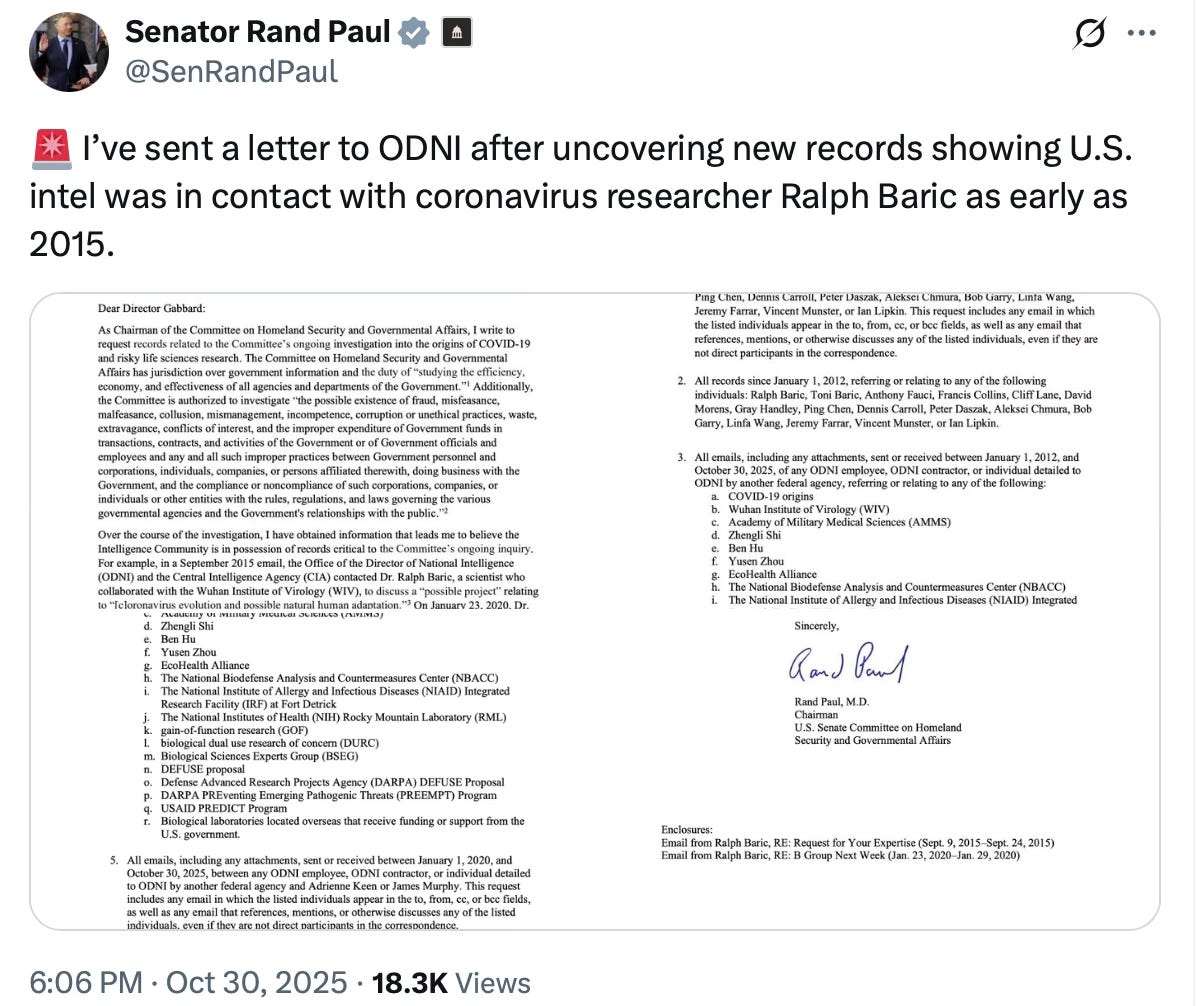
  • Sen. Rand Paul has released a letter revealing that U.S. intelligence agencies contacted coronavirus researcher Dr. Ralph Baric as early as 2015 — five years before the pandemic.¹
  • The documents show ODNI and CIA coordination with Baric on “coronavirus evolution and possible human adaptation” and later classified briefings on lab-leak scenarios.
  • Dr. Baric’s collaborations with Wuhan’s Dr. Zhengli Shi and EcoHealth Alliance’s Peter Daszak appear repeatedly across the correspondence now sought by Paul’s Senate committee.
  • Tulsi Gabbard, now Director of National Intelligence, foreshadowed this in her May 2025 interview with Megyn Kelly, promising to expose intelligence secrecy and gain-of-function complicity — a pledge now intersecting with Paul’s probe.

Rand Paul’s New Revelation

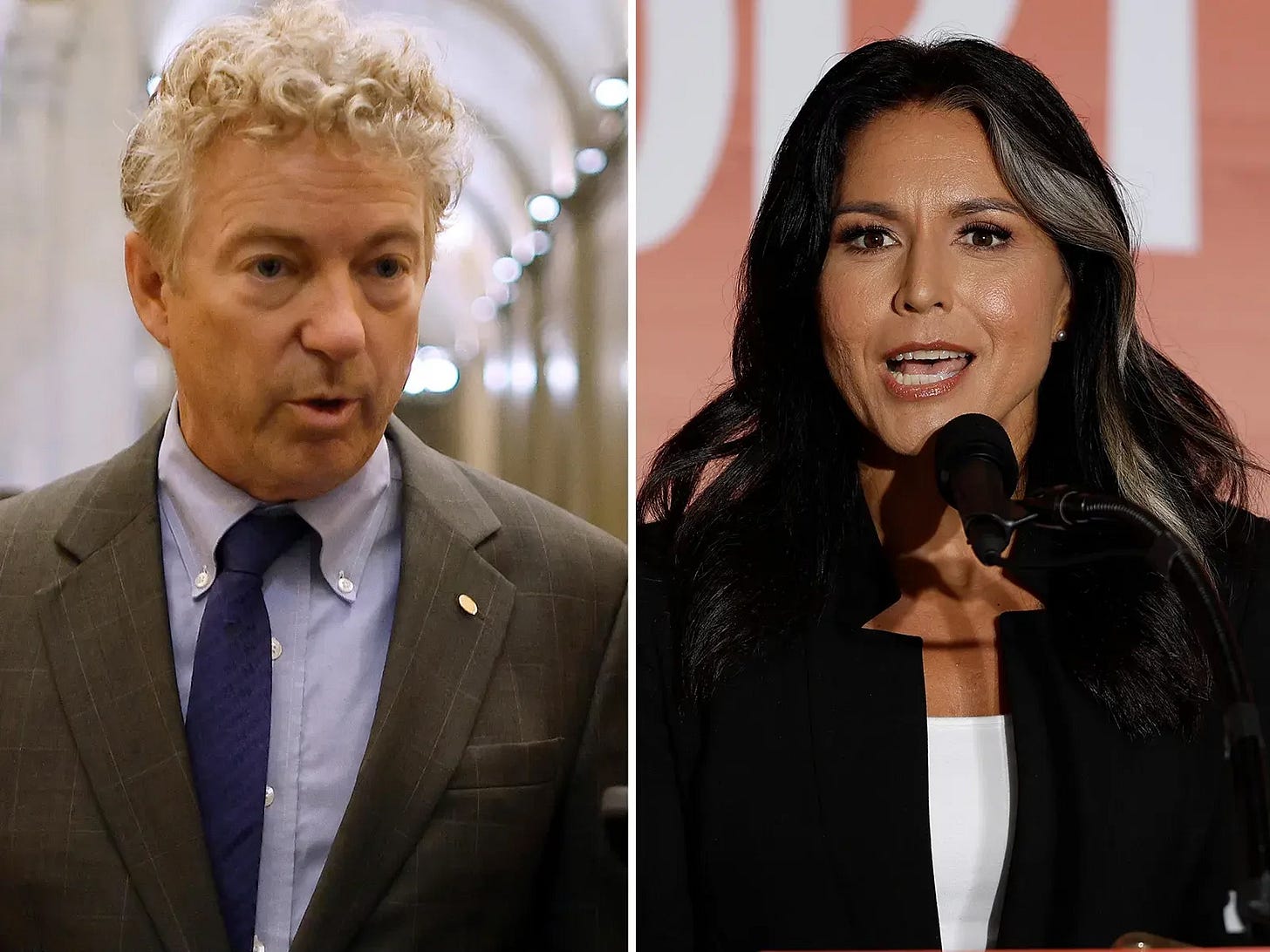
On October 30 2025, Senator Rand Paul sent a formal letter to Director of National Intelligence Tulsi Gabbardafter uncovering records showing U.S. intel contact with Dr. Ralph Baric dating back to 2015.

“In a September 2015 email, the Office of the Director of National Intelligence and the CIA contacted Dr. Ralph Baric to discuss a ‘possible project’ on coronavirus evolution and possible natural human adaptation.” — Letter from Sen. Rand Paul to DNI Tulsi Gabbard, Oct 30 2025.

Less than two months after those emails, Baric and Wuhan’s Dr. Zhengli Shi co-authored the Nature Medicine paper A SARS-like cluster of circulating bat coronaviruses shows potential for human emergence — funded through USAID’s PREDICT and NIH grants widely described as gain-of-function research.

Paul’s letter further documents that:

  • 2018 – Baric and Shi appeared again as collaborators on EcoHealth Alliance’s DEFUSE proposal to DARPA, which proposed inserting a furin cleavage site — the very motif later found in SARS-CoV-2.
  • Jan 2020 – Baric briefed ODNI’s Biological Sciences Experts Group (BSEG), presenting slides titled “Origins,” in which he raised the possibility of an accidental lab release at the Wuhan Institute of Virology.

Paul is now demanding all correspondence since 2012 among intelligence and health-agency officials — Baric, Daszak, Fauci, Collins, Farrar, Lipkin, and others — encompassing every mention of “COVID-19 origins,” “gain-of-function (GOF),” and “dual-use research (DURC).”

His investigation points to a continuum of cooperation between intelligence services and a select circle of researchers whose work shaped the pandemic era. Read the official announcement on the Homeland Security Governmental Affairs website here.

A Parallel Voice: Tulsi Gabbard Speaks Out

Just months before receiving Paul’s letter, Tulsi Gabbard had already framed the issue in strikingly similar terms.

In a May 2025 conversation with Megyn Kelly, she spoke as Director of National Intelligence about her internal fight against secrecy, the “deep rot in the intelligence community,” and the need to declassify records surrounding gain-of-function research and COVID’s origins.

“The American people deserve to know who knew what — and when — about these experiments. Transparency isn’t a threat to national security; secrecy is.” — Tulsi Gabbard, The Megyn Kelly Show, May 1 2025³

She also confirmed her collaboration with Robert F. Kennedy Jr. and Dr. Jay Bhattacharya to track government grants and expose whether Dr. Anthony Fauci had misled Congress regarding risky viral-engineering projects.

n light of Paul’s new disclosures, Gabbard’s earlier comments now read less like rhetoric and more like an open-source roadmap for what the Senate is finally uncovering.

Threads Converging

Both Paul and Gabbard are describing the same architecture of concealment:

  • Scientific Link Baric, Shi, Daszak coordinate U.S.–China coronavirus work. BSEG briefings discuss possible lab leak. Paul’s committee demands ODNI/CIA emails
  • Institutional Link CIA & ODNI request Baric’s expertise. NIH & USAID funding lines. Homeland Security & ODNI review
  • Narrative Link “Natural spillover” frame dominates. Lab-leak dismissed as conspiracy. Lab-leak returns as classified subject

The key transformation is that what was once branded misinformation is now the subject of an official Senate inquiry directed at the intelligence community itself.

[…]

Via https://sayerji.substack.com/p/rand-pauls-letter-to-gabbard-re-opens

Why Papua New Guinea has 750 Different Languages

West Papua | Indonesian Province, History & Culture | Britannica

Episode 24  Why New Guinea Has So Many Languages

Dr John McWhorter (2019)

Film Review

Humans first arrived in New Guinea 70,000 years ago. The island is extremely mountainous with lots of swamps and little island. This means that the societies that developed tended to be cut off from one another.

The eastern half of New Guinea is an Indonesia colony. The western half, known as Papua New Guinea features 750 different languages. Each is spoken by less than a few thousand people and half belong to the Trans New Guinean family. The rest either belong to a half dozen other language families or are totally unrelated isolates. Trans New Guinean languages are also spoken in the Solomon Islands (in the South Pacific) and (like Austronesian languages – see What South Pacific Languages Reveal About the Evolution of Language) have the same word for he and she, five vowel sounds and a small number of consonants.Solomon Islands Maps & Facts - World Atlas

Because none of the Papuan languages are written, they tend to be more elaborate and differentiated than modern languages.

https://www.kanopy.com/en/pukeariki/watch/video/6120000/6120048

Unhealthy Plant-Based Diets Raise Your Risk of Heart Disease

processed plant based diets health risks
Dr Mercola
  • Processed plant-based diets increase heart disease risk by 65%, with ultraprocessed “meat” alternatives containing inflammatory ingredients that damage cardiovascular health despite marketing claims
  • Healthy whole-food plant diets reduce heart disease markers by 48%, while unhealthy processed plant foods trigger chronic inflammation and dysfunctional cholesterol profiles
  • Plant-based meat substitutes contain glyphosate and high amounts of linoleic acid (LA) from vegetable oils. These products also lack beneficial animal fats found in real meat products
  • Chronic inflammation from processed plant foods promotes plaque formation, leading to endothelial dysfunction, atherosclerosis, and increased risk of heart attacks and strokes
  • Eating real, whole vegetables, collagen-rich foods, and fermented foods reduces inflammation and provides better cardiovascular protection than processed alternatives

Plant-based diets, especially ones that are touted as “meat” alternatives, are all the rage these days. According to a market analysis by The Humane League, this industry was valued at $14 billion in 2021, and is expected to grow by a tremendous amount in 2032 — $235 billion, to be exact.1

While manufacturers market their products as safe, research shows the opposite — so-called “plant-based” diets are not only unhealthy, but also actively accelerate arterial deterioration by triggering inflammation. Moreover, the inclusion of other ultraprocessed foods, such as sugary beverages and refined grains contribute to further damage.

Plant-Based Diets, Especially Ultraprocessed Varieties, Harm Your Heart

In a study published in the American Journal of Preventive Cardiology, researchers sought to uncover how different types of plant-based diets impact heart health.2

The team selected 7,708 U.S. adults who participated in the National Health and Nutrition Examination Survey (NHANES) between 1999 and 2004, focusing on differentiating healthy plant-based diets indices (hPDI) rich in vegetables, fruits, whole grains, and legumes from unhealthy plant-based diets indices (uPDI), which contain ultraprocessed foods, refined grains, sugary beverages, and sweets/desserts.

Participants were evaluated through dietary questionnaires and cardiac biomarkers were measured at the University of Maryland School of Medicine between 2018 and 2020.3,4

The biomarkers used for testing — To measure cardiovascular biomarkers, the researchers looked at cardiac troponin T (cTnT) and cardiac troponin I (cTnI) in the participants’ blood. Higher levels of these proteins typically indicate a higher risk of heart disease.

Troponin is found inside your cardiac cells but leaks into your bloodstream when the heart becomes damaged. Specifically, cTnI is unique to the heart muscle. Meanwhile, cTnT exists in other muscles, but the heart has a slightly different structure, which isn’t found anywhere else in your body.5

Healthy eating leads to better heart function — Adults who regularly consumed the healthiest plant-based diets had about 48% lower odds of elevated cTnI compared to those with the least healthy plant-based eating patterns. Essentially, better plant food choices translated into nearly halving the chance of hidden heart damage, underscoring the tangible benefits of prioritizing food quality.

Unsurprisingly, unhealthy diets will impact heart health — Adults whose eating habits relied on highly processed plant foods experienced notably increased risks. Participants eating mostly unhealthy plant-based foods had 65% higher odds of having elevated levels of cTnI.

There were no significant associations between the diet types and other heart biomarkers — These include cTnT or N-terminal pro b-type natriuretic peptide (NT-proBNP6), another hormone linked to heart strain.

Processed plant-based diets harm your cardiovascular health — Overall, the most notable discovery was that diets high in unhealthy, ultraprocessed foods (even when being plant-based) resulted in a marked increase risk of heart disease. As noted by the researchers:7

“In this nationally representative sample of U.S. adults, higher adherence to hPDI was inversely associated with elevated cTnI and higher adherence to uPDI was positively associated with elevated cTnI. This association persisted after adjustment for sociodemographic characteristics, lifestyle behaviors, and health status.”

Ultraprocessed Plant Diets Also Trigger Other Conditions

In a similar study published in the International Journal of Environmental Research and Public Health, researchers examined how plant-based diets affect cardiovascular disease risks in adults worldwide. Specifically, they explored both the protective and harmful impacts of different plant-based eating patterns, carefully distinguishing between whole-food approaches and diets high in processed plant ingredients.8

Their goal was to determine which types of plant diets genuinely reduce cardiovascular risk, and which ones increase your likelihood of developing serious heart problems like heart attacks, strokes, or coronary artery disease.

Not all plant-based diets provide the health benefits people commonly expect — Relying heavily on refined grains, sweets, and highly processed foods significantly raised markers of cardiovascular risk linked to chronic inflammation and abnormal cholesterol profiles (dyslipidemia). Simply put, choosing processed plant-based foods over whole-foods harms your cardiovascular health.

Processed plant diets consistently lead to higher levels of inflammation in the body — Chronic inflammation isn’t something you typically feel right away, but it silently contributes to serious cardiovascular conditions. Researchers found that people who regularly consumed processed plant foods had higher levels of inflammatory markers, such as C-reactive protein (CRP). According to the study:9

“Diets high in processed meats, dairy and other animal products have been shown to contribute to the circulation of pro inflammatory markers that promote endothelial dysfunction as well.

For example, the health professionals follow-up study demonstrated that the individuals following a traditional western diet had higher circulating levels of CRP and tissue-type plasminogen-activating antigen when compared to those following a diet higher in vegetables, fruits, and whole grains.”

Inflammation increases your risk for heart disease — In relation to the point above, the researchers explained how inflammation eventually leads to heart attacks:10

“Chronic exposure to higher levels of circulating CRP and other inflammatory mediators can promote plaque formation and subsequently lead to worsening cardiac outcomes. Furthermore, endothelial dysfunction promotes atherosclerosis as a result of platelet aggregation, increased endothelial permeability, cytokine production and leucocyte adhesion.”

Improvements occurred when diets shifted toward whole, minimally processed plant foods — Individuals who made this switch experienced noticeable reductions in inflammation markers and improvements in their lipid profiles, including increased high-density lipoprotein (HDL) and lower low-density lipoprotein (LDL). The researchers went on to say that lower LDL improves your chances of surviving from stroke should it occur in the far future:11

“[A]n observational study by Sun et al. published in 201912 found that participants with lower LDL-C levels were more likely to sustain a hemorrhagic stroke.”

Your body eventually becomes healthier — According to the review, beneficial changes in inflammation and lipid profiles were typically observed within just weeks to a few months after switching from processed to whole-food plant diets. The whole-food plant-based diet (WFPB) group lost weight faster compared to control groups. Specifically, the WFPB group lost 12.1 pounds within six months, while the control group hardly lost weight.

The importance of the gut microbiome Inflammation triggered by processed diets occurs because these foods disrupt your gut microbiome. Highly processed plant-based foods are often low in beneficial fiber and high in additives and sugars that damage your gut lining. That said, the researchers noted that eating a healthy plant-based diet promotes a diverse, functioning microbiome, “resulting in reduction in intestinal inflammation and improvements in nutrient absorption.”13

Meat contributes to better cardiovascular health — While the researchers noted that healthy plant-based diets tend to fare better compared to people who ate ultraprocessed foods, those who added meat had better heart health:

“Kinjo et al. found that individuals in Japan who had a low intake of animal products were at a higher risk for mortality from hemorrhagic strokes.”14

These findings demonstrate how processed plant-based diets, despite their “plant” label, undermine your health. Carefully choosing whole, nutrient-dense plant foods will profoundly impact your heart function for the better, ultimately protecting you from serious cardiovascular events.

Plant-Based Diets Are High in Different Toxins

Digging deeper into alternative plant-based products, it turns out that many of them are made from soy (in addition to being genetically modified).15,16 Therefore, it’s not surprising that they’re also contaminated with the herbicide glyphosate.

An inquiry into fake meat — To investigate potential contamination, the consumer advocacy group Moms Across America (MAA) commissioned Health Research Institute Labs (HRI Labs), an independent lab specializing in nutrient and toxin analysis in food.

The study measured the presence of glyphosate and its primary breakdown product, aminomethylphosphonic acid (AMPA), in two popular meat substitutes — the Impossible Burger and the Beyond Burger. Results showed the Impossible Burger contained 11.3 parts per billion (ppb) of the compounds, while the Beyond Burger had 1 ppb.17

Fake meat manufacturers strike back — Following the report’s publication, Impossible Foods responded with a public rebuttal, sharply criticizing MAA. The company dismissed the group as “an anti-GMO, anti-vaccine, anti-science, fundamentalist group that cynically peddles a toxic brew of medical misinformation and completely unregulated, untested, toxic quack ‘supplements’ …”18

Toxins are abundant in fake meat products — Glyphosate contamination is just one concern when it comes to synthetic meat products. Another significant issue is the high content of omega-6 polyunsaturated fats, particularly linoleic acid (LA) — a major driver of modern chronic diseases.

Meat Substitutes Are Just Processed Food — Eat Real Plants Instead

If you’re buying veggie meat because they’re marketed as healthy alternatives, you’re doing a great disservice to your health. As noted in the published research and the investigation by MAA and HRI Labs, plant-based alternatives are high in inflammatory ingredients. In essence, all of these products are ultraprocessed foods, no matter how much they’re claimed to be good for you.

So, if you’re worried about heart disease or if you’ve been following an unhealthy plant-based diet, it’s time to steer your habits to a healthier direction. Here are my recommendations:

1. Switch to real vegetables — Replace packaged foods with fresh, whole vegetables. Leafy greens, carrots, sweet potatoes, broccoli, and squash are excellent choices. These nutrient-rich vegetables will give your body antioxidants and fiber to reduce inflammation and improve your gut health.

However, don’t go eating them right away if your digestive function is impaired. If you’re experiencing bloating after meals or have frequent loose stools, your gut isn’t ready for high-fiber foods. Instead, ease into them by eating whole fruits and cooked starches that digest easily without causing gastrointestinal upset.

2. Minimize LA from your diet — Stop consuming all ultraprocessed products, as they likely contain vegetable oils like corn oil, soybean oil, and sunflower oil, flooding your body with LA. Instead, start cooking meals at home with healthier fats like grass fed butter, ghee, or tallow.

In addition, beware that LA is everywhere, even in the meat you eat. Considering this, keep your LA intake below 5 grams a day to protect your health, but if you can keep it below 2 grams a day, that’s even better. To help your monitoring efforts, download the upcoming Mercola Health Coach app, which contains the Seed Oil Sleuth feature. It’ll help you calculate your LA intake to a tenth of a gram.

3. Incorporate collagen-rich foods — Adding collagen helps rebuild your gut lining and heals inflammation there. Start including bone broth in your daily meals. Drinking one cup of bone broth a day is a simple and effective way to begin.

As a general rule, your protein intake should be around 15% of your total daily calories. Then, one-third of that should come from collagen.

4. Add fermented foods — While collagen helps heal your gut, that’s only one part of the equation. You also need to reseed your microbiome with fermented foods, preferably ones made from natural sources. Kimchi, grass fed yogurt (homemade), natto, and sauerkraut are good choices.

[…]

Via https://articles.mercola.com/sites/articles/archive/2025/09/06/processed-plant-based-diets-health-risks.aspx

Lawsuit Targeting Decades-Old Journal Article Triggers Renewed Scrutiny of Fraudulent Scientific Studies

stack of papers and word "fraud"

A lawsuit demanding the retraction of a decades-old peer-reviewed article that claimed the antidepressant paroxetine, sold as Paxil, is safe and effective has put the issue of fraud in scientific and medical journals back in the spotlight, Paul D. Thacker wrote today in The Disinformation Chronicle.

The lawsuit, filed last month against the American Academy of Child & Adolescent Psychiatry and its publisher, Elsevier, demands the retraction of a 2001 article in the Journal of the American Academy of Child & Adolescent Psychiatry (JAACAP).

The article was based on Study 329, which the suit claims distorted data to claim Paxil was effective.

The complaint alleges that JAACAP editors and Elsevier refused to retract the article “in an apparent attempt to shield at least five of the … authors who are prominent members of the AACAP from possible ramifications of retraction.”

Study 329 was ghostwritten by Paxil manufacturer GSK — which Thacker discussed in a 2011 report he republished today.

Several of the journal article’s co-authors worked for GSK or went on to hold key positions within the AACAP.

According to Thacker, one of the co-authors, Stan Kutcher, is now a member of the Canadian Senate and co-founded “Science Up First,” an initiative that purportedly targets scientific “misinformation.”

During a roundtable discussion on the weaponization of science that the MAHA Institute organized last week, Thacker cited Study 329 as an example of fraud in scientific and medical publishing.

Brian Hooker, Ph.D., chief scientific officer for Children’s Health Defense, spoke at the roundtable. He said the discussion, in which “panelists described horror stories of their own scientific research under attack through targeted retractions of papers, denial of research funding, and disciplinary actions,” was “stunning.” He added:

“There is a huge cost in falling out of line with established institutions in science and medicine, whether corporate, university or private organizations. And these highly credentialed panelists paid a huge cost for ‘doing the right thing’ in exposing malfeasance and bad science.”

Research scientist and author James Lyons-Weiler, Ph.D., also participated in the roundtable. He said it “explored how science-like activities have been systematically re-engineered to serve political and corporate interests rather than truth.” He said:

“Study 329 exemplifies the collapse of accountability that follows when industry, regulators and journals form a closed feedback loop of self-validation. What’s marketed as ‘misinformation control’ today is often a continuation of that same pattern — protecting narratives, not people.”

‘One of the best documented case studies of corruption in modern biomedicine’

Study 329, completed in 1998 and funded by GSK, revealed serious safety risks — including suicidal behavior — associated with Paxil. Later studies confirmed those risks.

However, the study showed a few minor positive results that suggested possible efficacy, as it met 15% of the outcomes the researchers had initially said would prove Paxil’s effectiveness.

While GSK officials privately conceded these results were not sufficient to show efficacy, they decided to publish selective data from the study in a prestigious medical journal to claim the drug worked.

This led to the 2001 JAACAP article, which became known as the “Keller article,” after lead author Dr. Martin Keller, then chair of psychiatry at Brown University. The article reported only partial results from Study 329.

Peer reviewers raised concerns about the study’s data, but JAACAP has refuted repeated calls to retract the article.

Writing today on her blog, journalist Maryanne Demasi, Ph.D., who also spoke at the MAHA roundtable, said Study 329 is “one of the most infamous cases of scientific fraud in modern psychiatry.” She wrote:

“For years, the fraud stood unchallenged. Regulators issued warnings but never forced a correction. The journal refused to retract. The paper remained in circulation — cited hundreds of times, shaping prescribing habits, and legitimising a lie that cost young lives.”

Thacker has been investigating and writing about Study 329 for almost 20 years, as it stands out as one of the “best documented case studies of corruption in modern biomedicine.” He said the study remains relevant because it highlights and underlines how “immoral academics partner with Big Pharma to make money.”

In his 2011 report, Thacker wrote that GSK “used the study as a tool to market Paxil for use on children — until both the FDA and its British counterpart warned doctors to stop prescribing Paxil to children because it could cause them to commit suicide.”

At the time, Kutcher was a candidate for the Canadian parliament, but was not elected. During his campaign, Kutcher threatened a small Canadian newspaper, The Coast, with legal action, demanding the retraction of a story that had investigated Study 329. The Coast retracted the story and issued an apology.

“Study 329 is a shameful example of scientific misconduct that led to a horrible societal catastrophe,” Hooker said.

Study 329 didn’t just distort data, it “normalized fraud as business practice” and “marketed a dangerous drug to children under a false banner of safety and efficacy,” Lyons-Weiler said.

‘Malpractice disguised as scholarship’

GSK didn’t just fund Study 329. It hired a private public relations firm, Scientific Therapeutics Information Inc., to ghostwrite the JAACAP article.

An employee drafted it and sent it to Keller, who was selected to be the lead author and finish the publication process. The firm’s role was not mentioned in the final draft of the paper.

Writing in 2011, Thacker said corporate-funded ghostwriting “involves a pharmaceutical company that hires a PR firm to write medical studies.” The firm then presents the manuscript to academic physicians, who agree to sign on as co-authors, sometimes making only “minor changes” to the article.

“The professors get credit for a publication and the pharma company gets a study that is ‘authored’ by physicians who are leading researchers in their field and appear to be independent,” Thacker wrote.

According to Thacker, “ghostwriting drives up the costs of healthcare, because these studies trick doctors into prescribing drugs that may be more costly, and sometimes less safe,” he wrote.

These practices have existed for years and continue today, Lyons-Weiler said:

“Ghostwriting is the scientific analog of identity theft. A corporation hires a PR firm to script outcomes and then rents the reputation of compliant academics. Those papers enter the permanent record, shape treatment protocols and become the basis for billions in profits.

“Meanwhile, the actual data are inaccessible, the authorship is fiction and the peer reviewers are misled. It is malpractice disguised as scholarship.”

Epidemiologist and public health research scientist M. Nathaniel Mead, Ph.D., who has ghostwritten scientific articles, said the practice can be performed ethically. However:

“Any time you have paid writers or industry insiders crafting articles that get credited to prestigious academics or widely respected ‘experts,’ there’s a risk to both public health and intellectual integrity.

“Many of these articles will disguise corporate agendas as objective or reliable evidence, often inflating claims of drug efficacy and invariably downplaying risks to boost sales.”

An article published in 2000 in the journal Regulatory Toxicology and Pharmacology about the herbicide Roundup concluded that Roundup “does not pose a health risk to humans.”

However, internal corporate emails released in 2017 as part of federal litigation against Roundup manufacturer Monsanto revealed that the paper was ghostwritten by Monsanto employees, who did not reveal their conflict of interest.

The paper has continued to shape public policy. Even after the 2017 revelations, government documents from public health agencies worldwide — including the Centers for Disease Control and Prevention (CDC) and Health New Zealand: Te Whatu Ora — still cite the paper without warnings or caveats.

‘Regulatory capture of epistemology itself’

In today’s report, Thacker wrote that Kutcher, having successfully secured The Coast’s 2011 retraction, has since “morphed himself into … an expert on misinformation.”

Kutcher launched “Science Up First” in 2021 with Canadian law professor Timothy Caulfield, described by Thacker as a “known misinformation crank.” According to Thacker, the “Science Up First” initiative “purported to attack COVID-19 conspiracies, but really served as a cheerleading squad for Big Pharma.”

In a 2023 op-ed, Kutcher wrote that “Speech is free, but lies cost” and suggested that Canadian authorities develop policies to “effectively identify and address health misinformation.”

Thacker told The Defender:

“Bad information abounds, was around in the past, and will be around in the future. Terms like ‘misinformation’ began popping up in recent years to describe information that academics think is bad. But we often find that ‘misinformation’ has turned out to be true.”

Lyons-Weiler said:

“There is a certain poetic cynicism in watching authors of fraudulent studies recast themselves as guardians of truth. The same individuals who distorted evidence for profit now police public speech for ideology. It’s not redemption — it’s regulatory capture of epistemology itself.”

According to Thacker’s 2011 report, mainstream media like the BBC and The Boston Globe, and scientific publications including The BMJ, investigated the fraud linked to Study 329 in the late 2000s. Thacker said that coverage by mainstream news media and scientific publications has since changed.

He added:

“As the media has compressed in size, more and more reporters simply act as mouthpieces for academics. It’s why I call them ‘scicomm,’ for science communication. They don’t do any actual reporting. They just communicate the science as it’s handed to them by academics.”

Scientific, medical journals under government scrutiny

The integrity of scientific and medical journals has increasingly come under scrutiny by the Trump administration, which in July terminated about $20 million in contracts with Springer Nature, which publishes nearly 3,000 journals, including Nature Medicine.

In a May interview, U.S. Health Secretary Robert F. Kennedy Jr. said he may bar government scientists from publishing in such journals and proposed that federal health agencies create in-house alternatives.

Last month, the White House’s MAHA Commission Report revealed that the National Institutes of Health (NIH) will launch a database tracking payments by the health industry to scientists in an effort to identify conflicts of interest.

According to a letter published last year in the Journal of the American Medical Association (JAMA), Big Pharma paid $1.06 billion to reviewers at JAMA, The BMJ, The Lancet and the New England Journal of Medicine between 2020 and 2022.

Hooker said he is “very pleased that the current administration is addressing conflict of interest issues in medical journals.” He said reform “is way overdue and will help to restore scientific curiosity and inquiry where questions that have been taboo may now be openly asked, challenged and explored.”

In the face of heightened scrutiny, some publishers have doubled down on their existing practices. Earlier this month, the New England Journal of Medicine and the Center for Infectious Disease Research and Policy announced they would launch an alternative to the CDC’s Morbidity and Mortality Weekly Report.

Demasi wrote that the lawsuit against the JAACAP “could reshape publishing,” if a court ruling compels the journal to retract the Keller article. Such a ruling “would also expose the deep entanglement between professional societies, journal editors, and the pharmaceutical companies that fund them.”

In an interview last week on “The War Room” with Steve Bannon, Lyons-Weiler said that Kennedy is aware of 28 scientific studies that were “wrongfully retracted.”

“I think that we’re going to probably see some prosecutions on the basis of defrauding the federal government,” Lyons-Weiler told Bannon.

Thacker said such journals survive because of NIH funding that is now at risk. “I understand this is coming,” Thacker said.

[…]

Via https://childrenshealthdefense.org/defender/lawsuit-retraction-journal-article-gsk-paxil-safe-effective-scientific-fraud/?utm_id=20251102


Tony Blair Brought in to Help Recolonize Southern Lebanon

As Trump fails to disarm the regional Resistance on behalf of “Israel” – Blair is brought in to further pressure Lebanon to disarm the local Resistance.

Vanessa Beeley

Information obtained by Al-Akhbar newspaper reveals preparations are underway for a visit by former British Prime Minister Tony Blair to Beirut next week. He will head a delegation whose nature and nationality remain unknown, though it is likely to include the team of experts assisting him on the Gaza file.

Informed sources stated that Blair will meet with the three presidents, but the dates have not yet been set. The objectives of the visit and any message Blair may be carrying are also unknown. Some circles speculate that he may later be tasked with overseeing the implementation of a new colonial plan intended to be imposed on Lebanon, similar to what is happening in Gaza.

These sources added that they have linked the visit to what the Americans are saying about the future of the situation on Lebanon’s southern border, particularly the project to establish a civilian council to manage the affairs of the southern region. The Americans claim they want to transform this region into an economic zone and an area for tourism, industrial, and agricultural investment. This is very similar to the “Free Trade Zone” plan for Gaza that has been floated periodically for years. Tony Blair’s influence has become more apparent since the fall of Damascus in December 2024 which brought his former security advisor, Johnathan Powell, back into the region to coach and rebrand Jolani and the Takfiri entourage as political Empresarios.

It is no coincidence that, with Blair’s visit looming, the Zionists have increased their bombing campaign in southern Lebanon, targeting villages close to Sour (Tyre) – in Taybeh and Tyr Diba – yesterday, after issuing evacuation demands for civilians to move at least 500 metres away from the designated targets. While claims from the Zionist side are that these are buildings with connection to Hezbollah – it is no different to the bombing campaigns in Gaza that claim to be targeting Hamas while obliterating civilian infrastructure and homes.

The following is a summary of the most recent Zionist ceasefire violations in southern Lebanon:

During the night of November 6, 2025, Israeli warplanes and drones, operating with U.S. support, carried out a series of airstrikes and bombardments across multiple locations in southern Lebanon.

Details of the attacks:

• Ras Naqoura: An Israeli aircraft dropped four bombs along the coast. No casualties reported.

• Abbasiyah (Sharafiat area): Enemy warplanes targeted the outskirts of the town, resulting in one martyr and eight wounded.

• Aytoron (Dabsha area): A hostile drone strike occurred. No casualties reported.

• Multiple southern towns were hit by Israeli air raids following a series of warnings from the occupation army:

• Ayta al-Jabal — No casualties

• Tayr Daba — One wounded

• Kfar Dunin — No casualties

• Al-Tayba — No casualties

• Zawtar Sharqiya — No casualties

• Yaroun: Israeli forces fired flares over the town’s sky.

• Wadi Hunin: Targeted with heavy machine-gun fire. No casualties reported.

• Alma Shaab: Machine-gun sweeps carried out along the town’s outskirts. No casualties reported.

• Rumtha and Majidiya sectors: The occupation army conducted intense machine-gun sweeps from the Rumtha position toward Bsatra, and from occupied Gajar toward Majidiya. No casualties reported.

The trigger for these events is an open letter (see the  full letter below the article) from Hezbollah published yesterday 6th November:

In an open letter addressed to His Excellency the President of the Republic, General Joseph Aoun, the Speaker of Parliament, Nabih Berri, the Prime Minister, Nawaf Salam, and the Lebanese people, Hezbollah emphasized its commitment to national sovereignty. It categorically rejected any attempt to drag Lebanon into new negotiation rounds that serve the interests and aggressive objectives of the Zionist enemy.

The party affirmed that the ceasefire declaration of November 27, 2024—which followed the Zionist aggression against Lebanon—constitutes part of the implementation of International Resolution 1701. This declaration obligates the enemy to withdraw beyond the Blue Line. However, as usual, the Zionist entity has continued its violations by land, sea, and air, defying all calls to cease its attacks and persisting in the violation of Lebanese sovereignty without restraint.

In its statement, the party indicated that the government, through its hasty decision regarding the “exclusivity of arms,” provided the enemy with an opportunity to exploit the situation and resurrect the issue of disarming the resistance. Hezbollah described this as a national transgression, emphasizing that the weapons that protected Lebanon are not subject to bargaining or negotiation. They stated that such discussions can only occur within a comprehensive national framework, as part of an overall strategy for defending the country.

Hezbollah stressed that the Israeli enemy is not only targeting the resistance but also seeks to weaken Lebanon in all its components and impose political and security subservience upon it. It called for a unified national stance against blackmail and aggression, affirming that negotiating with a treacherous enemy supported by the American hegemon will only result in further concessions. The party asserted that the national stance must focus on implementing the ceasefire agreement in its entirety and pressuring the enemy to abide by it, rather than being drawn into new negotiating proposals that pave the way for normalization or compromise Lebanon’s right to resist occupation.

In conclusion, Hezbollah affirmed that defending Lebanon “is not a decision of war or peace, but a legitimate right and a national duty in the face of an enemy that imposes war and continues its aggression.” It renewed its pledge to stand alongside the army and the people to protect the land, sovereignty, and national dignity.

The letter concluded: “We pledge to our proud people that we will remain steadfast in our position of honor and righteousness, neither wavering nor retreating, as long as there is occupation and aggression on our land, and as long as the pulse of resistance beats in our hearts—a resistance that knows no defeat.”

This week, President Aoun had instructed the Lebanese Armed Forces to intervene to prevent any Zionist incursions into Lebanese territory. On November 6th: An Israeli infantry unit crossed the blue line in the Kroum al-Marah sector, on the outskirts of the town of Meiss el-Jabal, Lebanon. In response the Lebanese army deployed reinforcements to the area, the Israeli infantry unit then retreated back to Israeli territory.

What we are seeing is an increase in frustration from the Trump envoys to the region – economic hawk Tom Barrack and his sidekick Morgan Ortagus. Zionist media has been pushing the narrative that Hezbollah is rebuilding its strength and military capabilities to an unacceptable threat level for “Israel”. Blair’s arrival suggests that Washington is moving to Plan B, perhaps the idea of an ‘international body’ presided over by Blair.

What is very clear, the war against the Resistance Axis is not going to end. It is an existential war that the Resistance fights – to preserve their culture, heritage and independence that rejects the incoming Zionist expansion and supremacy in the region.

These events in Lebanon follow on from the threats issued to the Iraqi Defence Minister, Thabit Al-Abbasi, by the US War Minister Pete Hegseth:

Abbasi reported the warning in a Nov. 2 interview with local media, saying that US Secretary of War Pete Hegseth in a call alluded to “imminent military operations” in the region. The following from a report in Amwaj Media.

According to Abbasi, the conversation also involved an explicit US demand that “no faction in Iraq” should intervene in such a scenario.

Hegseth is said to have concluded the call with a pointed threat: “This is your final warning—and you know very well how this administration will respond.”

Highlighting the apparent gravity of the exchange, Abbasi emphasized that the 11-to-12-minute conversation was held in the presence of Iraq’s top military leadership.

The contention over the alleged US warning follows recent reports in Israeli media which claim that “pro-Iran militias” are preparing “long-range missile and drone” attacks on Israel.

Israel’s Walla News also suggested that Shiite armed groups may be planning “ground maneuvers” in Israel through Jordan and Syria.

Washington’s project to disarm the Iraqi Resistance factions has also been a failure. Hegseth’s warning suggests an imminent regional escalation.

[…]

Via https://libya360.wordpress.com/2025/11/07/blair-emerges-on-the-lebanon-scene-as-israel-escalates-aggression-on-southern-towns/

Russian Naval Ships Dock in Venezuela

Russian Northern Fleet Ships Arrive In Venezuela

CARACAS, Venezuela (AP) — Two Russian naval ships docked Tuesday in the Venezuelan port of La Guaira after exercises in the Atlantic Ocean that Moscow said were to “show the flag” in remote, important regions, and an initial stopover in Cuba.

The frigate Admiral Gorshkov and the oil tanker Akademik Pashin are part of Russia’s Northern Fleet, which since May 17 has been carrying out tasks that include “guaranteeing the Russian naval presence” in “remote areas of the oceans,” Russian news agency Tass cited Russia’s Ministry of Defense as saying.

The stopover was to last several days and highlight the close ties between Moscow and Venezuelan President Nicolás Maduro’s government.

Like his predecessor, the late President Hugo Chávez, Maduro has forged a close relationship with Russia. The visit comes before Maduro seeks reelection in July 28 elections.

Venezuelan authorities have not reported the arrival of the Russian vessels, which could barely be seen from afar docked at La Guaira, but Associated Press journalists saw their crewmembers in the city’s historic center.

In mid-June, the Admiral Gosrhkov and the tanker were among the Russian vessels that docked in Havana, Cuba.

The other vessels present at that stop included a nuclear-powered submarine, and they stayed docked there for five days following drills in the Atlantic Ocean. The exercise was seen by some as a show of strength by Moscow against the backdrop of tensions as U.S. and other Western nations support Kyiv in Russia’s war on Ukraine.

[…]

Via https://apnews.com/article/venezuela-russia-navy-ships-cuba-d594c7c8fc97a903e5dc90754970b8c0