Matt Ehret: Deciphering the Causes of Trump’s Abduction of Maduro

By Matthew Ehret

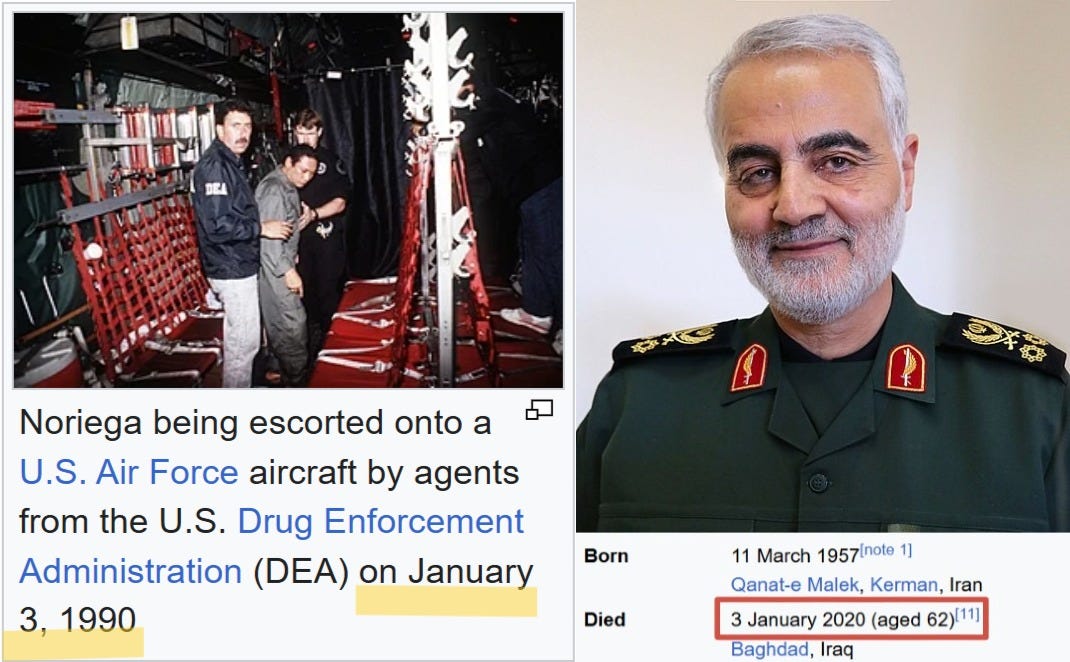
In the wake of the January 3 flash invasion of Venezuela and exfiltration of President Maduro and his wife (coinciding on anniversary of the January 3 1989 kidnapping of President Noriega of Panama and January 3, 2020 murder of General Soleimani of Iran), many pundits have spoken.

And in the days ahead many will continue to speak.

The analyses are diverse, to say the least, ranging from those who presume Trump is operating on the level of a zero-dimensional monkey thrashing chaotically without any higher plan and adopting a foreign policy based upon the last person he spoke to, to a one-dimensional capitalist obsessed only for oil profits, to a two-Dimensional imperialist seeking to consolidate control over the Americas in opposition to evil Chinese influence … to a three-dimensional ‘riel politique’ agent committed to setting up a sphere of influence under a New Yalta, to a four-dimensional grand master working with Maduro in a concerted Kafabe operation designed to drain Venezuela’s swamp of narco terrorists before re-instating Maduro as president, to 8D chess meta grandmaster saving the world from the ancient system of oligarchy alongside a secret alliance of Putin, Maduro, Xi Jinping.

I don’t really fit perfectly within any of those particular categories, although I do think there is a plan in motion shaping the rhythm of this apparent cacophony, and I think it is tied to the very real changing of the elites now underway.

Unlike some analysts out there who also recognize a new age emerging with a new elite guard making a long-awaited move to replace the corrupt old guard, I don’t necessarily see this as a positive.

In the following two Venezuelan-focused round tables which I participated in this weekend, you’ll generally get a sense of my position, and you’ll be able to contrast that with several other experts whose hypotheses cannot and should not be discounted.

The first video is an episode of RB Ham’s Beyond the Pale where I joined up with Professor Salim Mansur (Professor Emeritus of Political Science at the University of Western Ontario) and Donald Jeffries (Acclaimed author, and host of the ‘I Protest Podcast’)

The second roundtable took place on Sunday morning under the banner of Pluralia Dialogos where I got to chat with Martin Sieff, and Arnaud Develay (geopolitical analyst and Russian-based French lawyer) which can be viewed here:


Bio: I am the editor-in-chief of The Canadian Patriot Review, Senior Fellow of the American University in Moscow and Director of the Rising Tide Foundation. I’ve written the four volume Untold History of Canada series, four volume Clash of the Two Americas series, the Revenge of the Mystery Cult Trilogy and Science Unshackled: Restoring Causality to a World in Chaos. I am also co-host of the weekly Breaking History on Badlands Media and host of Pluralia Dialogos (which airs every second Sunday at 11am ET here).

[…]

Via https://matthewehret.substack.com/p/deciphering-the-causes-of-trumps

Peloponnesian War: Persia and Sparta Join Forces to Crush Growing Athenian Empire

Select All That Describe the Delian League. - PresleykruwSalazar

Episode 17 From Expansion to Stability

The Persian Empire

Dr John W I Lee (2012)

Film Review

Xerxes’ failed 480 BC invasion of Athens was Persia’s last overt war against the city-state. During Xerxes’ reign, Persia preferred to undermine Athens via diplomacy, bribery, infiltration and supporting proxy wars via Athens’ primary enemy Sparta.

During the fifth century the Greek islands of Lesbos, Chios and Samos all broke away from Persia, and the Athens-backed Delian League (named after the island of Delios) took over the western Ionian coast of Anatolia. From there they launched attacks on Cyprus, Macedon and Thrace, ultimately capturing the city of Byzantium (modern Istanbul). This ultimately transferred control of the Aegean Sea to Greece.

Despite dealing with revolts in the eastern empire, under Darius’ son Xerxes, the Persians ultimately recaptured much of Cyprus and retained control of Thrace.

469-466 BC – Persian-backed Spartans launch war to retake Ionian coast from Athena, while the city-state moves away from democracy, gradually converting the Delian League into an empire.

465BC – Xerxes assassinated at age 65. Greek sources blame the assassination conspiracy on his on Artapanas, who assumes the name Antaxerxes I on taking the throne.

465-424 AD – Antanxerxes I faces numerous revolts, including an Athenian-backed revolt in Egypt. Despite increasing opposition to growing Athenian imperialism, Sparta rejects Persia’s request for military assistance. Through an ingenious strategy in which they dig a network of canals leaving 100 Greek tiremes high and dry, Persians crush the revolt, killing thousands of Athenians.

455-450 BC – Athens (initiating a compulsory draft in all their colonies) again join forces with an Egyptian guerilla movement and try to retake Egypt and Cyprus.

450BC – Peace of Callias grants Athens control of coastal Ionian cities in return for an agreement not to attack Persia. Athens builds Parthenon with tribute resulting from this this conflict.

431 BC – Athens and Sparta declare war on each other (Peloponnesian War)

423 BC – Antaxerxes succeeded by half brother Sogdiamus, who the army kills to install Ochus (taking the name Dairus II) on the throne.

412 BC – Playing Sparta and Athens against each other, Darius funds creation of a Spartan naval fleet in return for agreement that Persia will retake control (from the Athenian empire) of Anatolia.

404 BC – Peloponnesian War ends with defeat of Athens in 404 BC, leading to the dissolution of the Delian League and establishment of Spartan control over Greece.

https://www.kanopy.com/en/pukeariki/video/15372393/15372418

Why Is the New Zealand Defence Force Training to Kill Christians?

By Penny Marie NZ

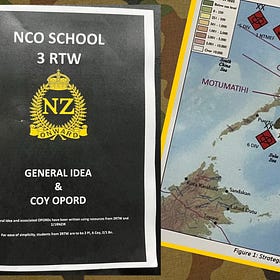
This is the crux of the training material we look at in this video, and it raises serious questions about ideological capture, psychological warfare, and who gets to decide what “extremism” looks like inside our military.

A fictional enemy that looks a lot like us

A leaked NZDF training pack sets its scenario in a made‑up country, but the map names – Murchison, Nelson, St Arnaud, “Rainbow” Ski Field – give the game away: this is New Zealand in all but name, and we hone in on the RAINBOW CONNECTION.

The “Visayan People’s Front” (VPF) is described as a “Christian extremist group” recruiting indigenous youth with promises of a “return to the traditional ways of a Christian nation,” explicitly mirroring Maori–Christian history and present‑day rural/urban political divides.

See the training manual documents in this post:

NZDF Leaked Training Documents

·
21 December 2025
NZDF Leaked Training Documents

These documents were used in a training exercise conducted in November 2025 for a Junior Non Commissioned Officer Course in Burnham Army Base in Christchurch. I was sent what was deemed the most concerning pages, and all are shown below.

Ideological capture and psychological operations

The script of the exercise reads like a cut‑and‑paste of today’s culture war: Christian so-called “extremists,” (which are VERY MUCH NOT), Islamic extremists, campus occupations, referendums, coups and armed factions, all woven together in a way that treats conservative or Christian worldviews as a security problem.

This as an example of fifth‑generation warfare: narrative, language and training materials being used to dehumanise, destabilise and push populations toward crisis so a pre‑baked “solution” can be imposed.

Rainbow money, Pride Pledge, and NZDF

We connect the training scenario to NZDF’s broader DEI and rainbow commitments: Pride Pledge membership, compulsory “rainbow awareness” training, and the embedding of DEI language across policies, KPIs and leadership structures.

We obtained an OIA response showing NZDF spending roughly NZD $46,000 over three years on Pride Pledge fees alone, on top of internal time and other rainbow‑industry consultancy – public money underwriting an ideological programme, not just neutral “inclusion.”

The Brad in every organisation

We introduce Brad Poulter, a he/him, ex‑Navy, now in a strategic diversity role and a former chair of the NZDF rainbow network OverWatch, as profiled by the Rainbow Excellence Awards.

The point is not personal but systemic: Every large organisation with a Rainbow Tick or Pride Pledge will have one or more internal champions whose job is to operationalise DEI, sit in cross‑agency rainbow networks, and ensure that “rainbow KPIs” flow right up to executive leadership and into training.

Extremism, children, and the spiritual dimension

The latter half of the conversation widens out: From NZDF training to the police‑endorsed “Anti‑Transgender Extremism” guideline that effectively labels ordinary parents and critics of child medicalisation as extremists.

The trans rights activists try very hard to connect ordinary parents who reject trans ideology who are of all faiths/no faith to ‘extreme right wing Christians’… which is total rubbish. Now, we can see why that’s an important part of the rhetoric they have created. Are we seeing the start of the next ‘phase’ of psychological warfare in New Zealand?

[…]

Via https://www.pennymarie.nz/p/why-are-the-nz-defence-force-training

How Russia Profits from War in Ukraine

By Dmitry Orlov

NATO’s proxy war against Russia in the former Ukraine turned out to be unexpectedly beneficial to Russia. The West wanted to turn it into a textbook example of punishing the disobedient by empty shelves in stores, food rationing and social unrest. This plan was cold, rational, almost beautiful in its cruelty. It was to sever Russia’s links with global trade, strangle logistics, crash incomes, and then the economy and the government would collapse on their own. But almost immediately this strategy started to boomerang: instead of a food desert, it created a rich and vibrant food market. Instead of hunger, it created a food surplus. And instead of a broken country, it produced a global player which quietly, without pathos, began to redraw the world food map to its own advantage.

Here, the most unpleasant aspect for the West is not even the financial aspect, although it does make a mockery of its many thousands of sanctions. The most unpleasant thing is the feeling that Russia not only survived, but made use of this conflict as a growth strategy, the implementation of which it had previously postponed. Agriculture turned out to be not a tentative Plan B, but a breakthrough. The longer this proxy war lasts, the clearer it becomes that for Moscow the war is not a cost but a profitable investment.

To the average Russian, this story is mostly about reconquering Russia’s historical bread basket, which Vladimir Lenin temporarily mislabeled as a “the Ukrainian Soviet Socialist Republic.” As far as food, it is mostly about low priced buckwheat and reasonably priced eggs, reassuring him that he will be able to survive no matter what. To the country as a whole, this is a story about sovereignty in its most mundane but most concrete sense. When a country can reconquer its historical lands, feed itself and help feed a hundred other countries, it has a voice. Reliable, reasonably priced grain, meat, cooking oil and fertilizer exports speak louder than any hypersonic missile or Foreign Ministry spokeswoman (no matter how impressive Maria happens to be). These exports create dependencies, shape market habits, and are very difficult for politicians to tamper with.

Russia entered this process of transformation without fanfare, almost casually. While in Europe they were arguing about the “green transition” and subsidizing their own inefficiency, in Russia the agricultural industry was being put together piece by piece: from seed stocks to port infrastructure. Western sanctions only accelerated what was already happening. Russia needed to cease being a raw materials exporter to become a systemic player in agricultural exports. And it turned out that in twenty years it was possible not only to replace almost all food imports, but to grow food exports to a level where they began to compete in importance with oil, gas and weapons systems.

The great irony of the situation is that the West has pushed Russia into market niches which it thought it would own forever. North Africa, the Middle East, and the Global South are markets in which it is not political slogans that are important, but stable supplies at stable prices. These countries don’t inquire whether you are liberal, democratic or LGBT* [*banned in Russia] enough for them to trade with you; they ask whether you will deliver on time. And Russia delivers reliably, year after year, in any weather conditions, despite sanctions, weather disruptions, logistical crises and trade wars. Russia’s approach has turned into a strategic advantage with which the West cannot compete.

What should particularly frighten the West is that Russia is no longer playing alone. Linking with BRICS, turning to Africa, deepening trade with India are not “attempts to find friends,” as Western propaganda often claims, but the formation of an alternative system of world trade that excludes Western meddling. Once Russia creates its own commodity exchanges, commodity prices will cease being set in Chicago and Paris in dollars or euros and that will spell the end of Western monopoly on the rules of the economic game.

This leads us to the main, inconvenient conclusion: this proxy war, in its current form, is truly beneficial to Russia — not just morally and emotionally, as a heroic effort to defeat a great evil, but economically. It has pushed the country out of old dependencies, forced it to do things that were put off during the years of relative calm, and opened markets that were previously closed by the political blinders of Western-trained Russian economists. The longer Western sanctions and warmongering stay in place, the more off-base these Western-trained economists will end up looking and the deeper Russia will grow into the new world order as the main supplier of an essential resource.

The West wanted to instigate a “food fight” with Russia as a tool of punishment, but what it got instead is a “food fight” as a tool for reformatting the world economy to its distinct disadvantage. Now the question is not whether Russia can maintain this course; the question is how quickly the West will be ready to admit that the logic of sanctions has backfired grandly and has rolled the global economy back to a place where bread, not Western political circuses, decides what goes and what doesn’t. The longer it takes to come to this realization, the greater will be its economic losses and the political damage its ruling elites will suffer.

[…]

Via https://boosty.to/cluborlov/posts/5cd0d60a-9f8d-4d8b-ad8c-b88ba939651f

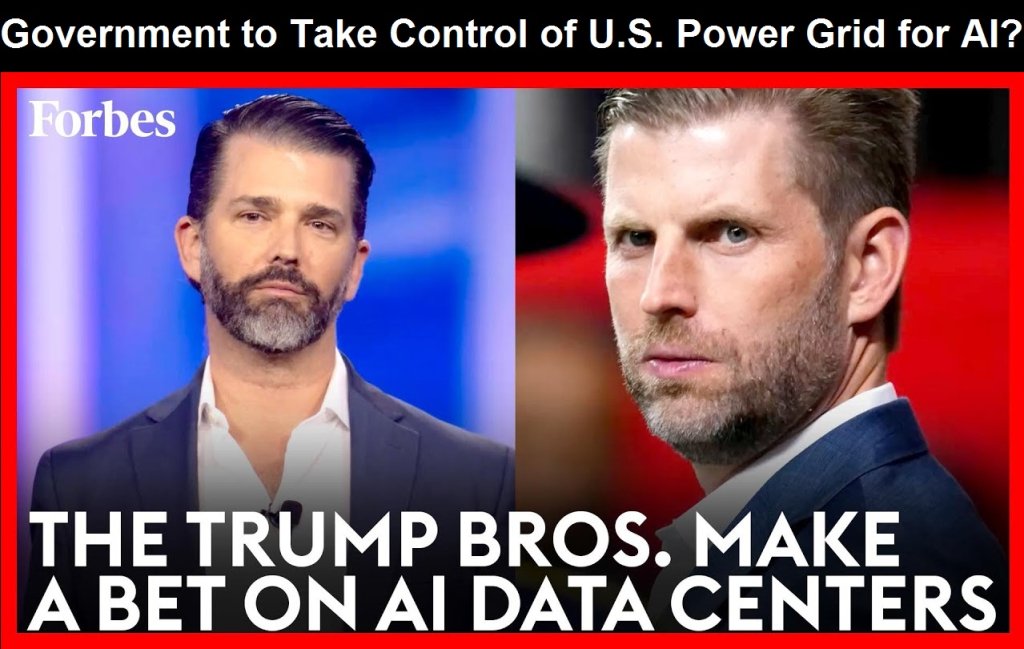
Trump Wants Federal Government to Own US Power Grid for AI and Turn it Over to Big Tech

Original Image Source

by Brian Shilhavy
Health Impact News

Building huge new data centers is the only way for AI to continue raking in huge profits in 2026 for those making the AI chips and software that run the new power-hungry LLM AI programs.

Many local communities and States across the U.S. are pushing back by opposing the building of these data centers in their communities, however. It is likely to even be a key issue in the 2026 mid-term elections.

The Trump Administration is countering this opposition by attempting to take over the nation’s electrical grid, and put into place Federal regulations regarding AI that override local State regulations.

Former Federal Energy Regulatory Commission (FERC) chairman Mark Christie, a Republican, reportedly stated in the Wall Street Journal that this:

is one of the biggest federal power grabs at the expense of the states I have seen in 21 years as a state and federal utility regulator” (Source.)

The Wall Street Journal also reported what Trump’s rationale was to take over the nation’s power grid to fuel AI and bypass State laws:

We have to be unified,” Trump said, noting that China didn’t have to contend with state legislatures.

This is Silicon Valley’s dream: get rid of elections and install a Monarchy. See: Big Tech “Far-Right” Billionaires want to Eliminate Politicians and “Democracy” as They Believe They can Run the World Better by Themselves

Here are some more excerpts from the Wall Street Journal article on federalizing the U.S. power grid, courtesy of MSN:

States see a federal power grab in clash over AI data centers

At a conference of state utility regulators in Seattle, a group of Trump administration officials got an earful of complaints about a plan the White House is pushing for the federal government to take control of part of the country’s power grid in the service of artificial intelligence.

Their concerns stem from instructions Energy Secretary Chris Wright recently gave to the Federal Energy Regulatory Commission, which is known as FERC and oversees wholesale power in the U.S., to draft new rules that would give it oversight of how giant data centers connect to the power grid.

The process is typically overseen by states.

During the conference last month, regulators told administration energy officials such as James Danly, deputy secretary of the Energy Department, that Wright’s plan violates the 1935 Federal Power Act, which carves out the separation of oversight of the grid between state and federal governments, according to people familiar with the conversations.

By overseeing how data centers hook up to the grid, federal regulators could make it easier and faster for data centers to construct their own power supply, administration officials have argued.

They have said the rule could turbocharge data center growth as AI giants such as Google, Amazon, Meta and OpenAI open up their trillion-dollar pocketbooks to build power plants and potentially help solve supply-chain bottlenecks that have slowed growth of new generation capacity.

Companies such as Trump Media & Technology Group and Alphabet-backed fusion-energy company TAE Technologies, which agreed to a $6 billion merger, are betting the data-center boom will continue for years.

The move comes amid heightened tensions between the federal government and states over AI oversight.

Florida Gov. Ron DeSantis, a Republican, recently unveiled state legislation to curb AI’s impact on consumers and to prohibit “utilities from charging Florida residents more to support hyperscale data center development.”

Trump signed an executive order earlier this month that aims to override state laws on artificial intelligence.

It would allow the Justice Department to punish states with rules deemed restrictive for AI, in a move to bring the U.S. under one federal standard.

“We have to be unified,” Trump said, noting that China didn’t have to contend with state legislatures.

The administration’s plan “is one of the biggest federal power grabs at the expense of the states I have seen in 21 years as a state and federal utility regulator” that will result in unnecessary litigation, said former FERC Chairman Mark Christie, a Republican. (Full article.)

[…]

Via https://healthimpactnews.com/2025/trump-wants-the-federal-government-to-own-the-u-s-power-grid-for-ai-and-turn-it-over-to-big-tech/

How many countries did Trump bomb in 2025?

INTERACTIVE - The US has bombed 7 countries in 2025-1767165225

This week, United States President Donald Trump confirmed that the US had struck a docking facility in Venezuela, marking the first military action on the South American country’s land since it began targeting Venezuelan shipping in the Caribbean and eastern Pacific in September 2025.

Speaking to reporters as he met in Florida with Israeli Prime Minister Benjamin Netanyahu, Trump said there had been “an explosion in Venezuela”, at a facility where boats the US believes to be carrying drugs usually “load up”.

[…]

Despite modelling himself as the “president of peace” deserving of a Nobel Peace Prize, who – he claims – has ended eight wars around the world this year, Trump’s Venezuela strike was just the latest in a string of his administration’s military attacks around the globe since its inauguration in January.

Armed Conflict Location & Event Data or ACLED, the nonpartisan conflict monitor, told Al Jazeera that the US had carried out – or been a partner to – 622 overseas bombings in all, using drones or aircraft, since January 20, 2025, when Trump took office.

The attacks contrast with his promise to voters to end US involvement in foreign conflicts.

Which countries has the US bombed this year?

The US carried out military attacks against a total of seven countries in 2025.

[…]

Since August, the US has amassed the largest military presence in the Caribbean Sea in decades, causing alarm among governments there. The Trump administration claims this is warranted because the trafficking of drugs to the US constitutes a national emergency, but multiple reports have shown that Venezuela is not a major source of drugs being transported across borders.

On September 2, the US began striking small boats in the Caribbean that it alleges were trafficking drugs. It is thought it has struck more than 30 vessels since then. The Trump administration says the vessels are operated by Venezuelan “terrorist” organisations, including the Tren de Aragua group and the Colombian National Liberation Army. However, it has provided no evidence for this.

At least 95 people have been killed in the boat strikes, Human Rights Watch revealed on December 16, accusing Washington of “extrajudicial killings”.

In early December, US lawmakers from both Republican and Democratic sides urged the Pentagon to release full footage of the first strike on September 2, which has proved even more controversial following revelations that the vessel was subject to a “double tap” attack – two survivors of the first attack clinging to debris in the water following a first strike were killed in a follow-up strike.

Defense Secretary Pete Hegseth has said the footage will not be released.

Caracas accuses the US of using claims of drug trafficking as a cover for seeking a government change in Venezuela. Trump, meanwhile, has called Venezuela a “narco state” and said President Nicolas Maduro’s days “are numbered”.

Nigeria

On Christmas Day, the US launched the first of what Trump said would be “powerful and deadly” strikes against groups Washington claims are affiliated with ISIL (ISIS) in Northwest Nigeria’s Sokoto State.

    It followed weeks of diplomatic pressure on the Nigerian government, which Trump and senior conservative Republicans, including Ted Cruz, have accused of enabling a “Christian genocide” in a country whose population is a nearly even mix of Christians and Muslims.

    Nigeria has been plagued by violence from armed groups linked to al-Qaeda or ISIL, operating in the predominantly Muslim northeast and northwest regions. Abuja denies allegations of genocide and says Muslim and Christian communities alike are affected by the violence.

    Furthermore, alleged attacks on Christian farmers in Nigeria have taken place in a completely different part of the country. US Senator Ted Cruz first accused Nigeria’s government of enabling a “massacre” against Christians in October 2025, citing a rising number of attacks against the community in the country’s central Middle Belt region, which is separate from the violence in the north.

    Even though these two issues are separate, Abuja, under pressure, agreed to the US military operation in the north of the country on December 25.

    Details of that strike are still emerging. The US Africa Command said in a statement that “multiple ISIS terrorists were killed in the ISIS camps”, and Nigeria’s Ministry of Foreign Affairs said the strike was “successful”.

    It appeared to target the newly emerged “Lakurawa” group, which conflict monitors say is made up of armed fighters from Mali and Niger who may be linked to ISIL or al-Qaeda.

    The group is known to operate in forested corridors between Sokoto and Kebbi states. At least one US missile, or debris, hit Jabo town in Sokoto. The Nigerian military, speaking to local media, later confirmed strikes on armed group hideouts in Buani Forest, but did not reveal casualty numbers.

    The US and Nigeria have a long history of security collaboration through training and intelligence sharing, but the Christmas strikes marked the first known kinetic US military action in the West African nation.

    It was timed, analysts say, to appease Trump’s Christian supporters as Washington doubles down on a narrative of “saving” Nigerian Christians, although Nigerian authorities insist the strikes are not about any one religion.

    Trump said more strikes will follow.

    Somalia

    The US has long trained Somali forces and conducted air attacks in the region against armed groups, including al-Shabab, a group affiliated with al-Qaeda, which has launched several attacks in Somalia and in neighbouring Kenya. They also target an ISIL offshoot known as ISIS-Somalia.

    Al-Shabab, which has about 7,000 fighters, holds large swaths of land in south-central Somalia, while the smaller ISIS-Somalia, which has about 1,500 fighters, is active in the mountainous regions of autonomous Puntland, in northern Somalia. In the past year, 7,289 people have been killed by armed group activity, according to the US-based Africa Center for Strategic Studies.

    In his first term as president, Trump withdrew most US troops from the country, but the Biden administration redeployed them in May 2022.

    In Trump’s second term, the US has remained active in the country, at Somalia’s urging. Washington has dramatically intensified air attacks since February, according to the New America Foundation.

    Overall, at least 111 strikes have been recorded this year, surpassing the number carried out under the George Bush, Barack Obama, and Joe Biden administrations combined, monitors say.

    Civilians have been killed in the Somalia attacks. Investigative site Drop Site News revealed in December that at least 11 civilians, seven of them children, were killed in a strike in the Lower Juba region, in Somalia’s southwest, just last month.

    The US does not reveal the number of civilian deaths in Somalia.

    Syria

    US strikes on 70 ISIL-positions in Syria on December 19 were carried out in retaliation for a shooting in Palmyra which killed two US soldiers and a civilian interpreter a week earlier.

    Three other Americans and two members of the Syrian security forces were injured in the shooting. No group has claimed responsibility for the attack, but Trump placed the blame on ISIL.

    Syria’s Ministry of Interior Affairs later said an individual who targeted the US troops had been a member of the state security service slated for dismissal for hardline views.

    The US retaliatory operation, dubbed “Hawkeye” in reference to Iowa, the “Hawkeye State” where both killed soldiers were from, damaged several ISIL weapons storage facilities in locations across Syria, an official told CNN.

    “I am hereby announcing that the United States is inflicting very serious retaliation, just as I promised, on the murderous terrorists responsible,” Trump posted on Truth Social on December 19.

    “We are striking very strongly against ISIS strongholds in Syria, a place soaked in blood which has many problems, but one that has a bright future if ISIS can be eradicated,” he added, warning against further attacks on US service members.

    Hegseth said in a post on X on the same day that the strikes represented a “declaration of vengeance” on ISIL.

    US troops have long been stationed in Syria to target ISIL, which once controlled large areas of land across Syria and Iraq in the mid-2010s.

    Under the Biden administration, about 900 US troops were stationed in the country until December 2024, when the Pentagon said numbers were temporarily doubled to fight ISIL, amid the collapse of the Bashar al-Assad government. The US has carried out more than 80 operations aimed at neutralising armed operatives in Syria, according to the US military’s Central Command.

    At the time, Trump, as the president-elect, warned against US interference. He posted on Truth Social: “Syria is a mess, but is not our friend, & THE UNITED STATES SHOULD HAVE NOTHING TO DO WITH IT. THIS IS NOT OUR FIGHT.”

    Fewer than 1,000 troops remained in Syria by April, according to the Pentagon.

    Iran

    Amid short-lived hostilities which broke out between Iran and Israel earlier this year, the US intervened and struck three key nuclear sites in Iran on June 22. Analysts said it was a highly sophisticated mission involving the US Air Force and Navy.

    In a televised address, Trump justified the attacks on Iran’s Natanz, Isfahan, and Fordow nuclear sites, saying they would curtail the “nuclear threat” posed by Tehran.

    The three sites were involved in the production or storage of enriched uranium, which the US claimed had become or was approaching “weapons grade”.

    Iranian Foreign Minister Abbas Araghchi later confirmed that some of the sites had sustained extensive damage, and the Pentagon estimated the attack set back Iran’s nuclear program by about two years.

    Under pressure to respond in a manner that appeared proportionate, Iran struck a US airbase in Qatar the day after the US strikes, in what was likely a symbolic action as no injuries or deaths were reported.

    On June 22, Trump declared a ceasefire between Iran and Israel, bringing the 12-day war to an end. More than 1,100 Iranians and 28 Israelis were killed during the open hostilities.

    But during his meeting with Israeli Prime Minister Benjamin Netanyahu this week, Trump threatened to hit Iran again.

    “Now I hear that Iran is trying to build up again, and if they are, we’re going to have to knock them down,” he said, referring to the nuclear programme. “We’ll knock the hell out of them.”

    Iran is forbidden from developing nuclear weapons as a signatory to the 1970 Nuclear Non-Proliferation Treaty. In 2015, it also signed the Joint Comprehensive Plan of Action with Western powers, including the US, agreeing to limit uranium enrichment levels in exchange for sanctions relief.

    However, Trump withdrew the US from that pact in 2018 – during his first term as US president – claiming it had been badly negotiated under the Obama administration.

    Yemen

    Since January 12, 2024, the US has targeted Yemen’s Houthis, an Iran-aligned group that controls much of Yemen’s populous northwest, in a series of air and naval attacks.

    The US says strikes were carried out in retaliation for Houthi attacks on Israeli-linked vessels passing through the Red Sea, in solidarity with Gaza.

    The strikes escalated to daily attacks in March 2025 under the new Trump administration, under a mission codenamed Operation Rough Rider.

    Dozens of people were killed, and the attacks extensively destroyed infrastructure, including ports, airports, radar systems, air defences, ballistic launch sites, and even migrant holding centres in Sanaa and Hodeidah.

    The US strikes finally came to an end on May 6, following a truce brokered by Oman.

    Casualty counts from both sides differ: The US claims to have killed about 500 Houthis, while Yemen’s Houthi-run Ministry of Health said 123 people, most of them civilians, had been killed by April, following the US escalation.

    As many as 247 people, including many women and children, were injured, the ministry said.

    Iraq

    The US launched air strikes on Iraq’s al-Anbar province on March 13, killing a high-profile ISIL member, according to the US military’s Central Command (CENTCOM).

    […]

    https://www.aljazeera.com/news/2025/12/31/how-many-countries-has-trump-bombed-in-2025

    Is China the Real Reason for the US War on Venezuela?

    Infographic: Tariffs Threatened: Who Imports Venezuelan Oil? | Statista

    By Brian Shilhavy

    Who Imports Venezuelan Oil?

    This chart for 2024 (2025 stats not out yet) clearly explains what happened today. It almost needs no commentary.

    I am somewhat surprised that Trump so quickly abandoned the “drug cartels” excuse for these attacks and now kidnapping of Maduro, and today freely admitted it is all about the oil.

    As this chart shows, China imports more Venezuelan oil than almost all other countries combined.

    They had a slight decrease in imports in 2024, but the U.S. increased their imports of Venezuelan oil by 64% in 2024.

    And they want us to believe that Maduro was a threat to the U.S.?? He was making a ton of money from sales of oil to the U.S.!

    Could the real story be that the U.S. asked him to stop selling to China, as they have to other oil producing countries, like Iran and India, but Maduro refused?

    China has many ways to respond to this if the flow of oil to China from Venezuela now dries up. They still control about 90% of the worlds “rare earth” minerals needed for Big Tech’s AI.

    […]

    Via https://t.me/healthimpact/2925

    Achaemenid Religion

    Marduk Overview | Mesopotamian Gods & Kings

    Marduk

    Episode 16 Archemenid Religion

    The Persian Empire

    Dr John W I Lee (2012)

    Film Review

    There is little historical information on the religions practiced in the Persian empire. The limited information we have comes from the Greeks and modern Iranians.

    The most prominent prophet/sage influencing Persian religious practice was Zarathustra (known as Zoroaster in Greek). It’s believed he was born around 1000 BC in northeast Iran or southwest Turkmenistan. The Avesta, reflecting his teachings, was written around 500 BC, which means the the texts were transmitted orally for five centuries.

    Zarathustra taught that Ahuramazda was the supreme god among many, that he was good, that he created people and gave them free will (with women naturally more prone to evil). Although Zarathustra didn’t condemn sacrifice, he discouraged some of the more violent cult behavior (eg human and child sacrifice) the Persians associated with Babylonian cults. He taught there was a last judgement in which people went either to paradise or to hell depending on whether they followed truth and order or untruth and chaos. This Persian god was a marked contrast to the Greek gods, who were fickle and jealous.

    The Persian emperors believed Ahuramazda mandated them to conquer other countries to stamp out violence and chaos.

    Ahuramazda was never prominent prior to Cyrus I, and Zoroastrianism never became the official religion of the Achaeminid Persians though their successors who founded the Sassanian empire adopted it as their state religion.

    The Persians adopted many gods from the countries they conquered. In addition to fire, water and sacred mountains and rivers, they also worshiped Mithras,** the god of sun and light, Anahita, the goddess of water and fertility, and Agni the fire god. ‘

    Cyrus restored the worship of Marduk* when he captured Babylon from the Assyrians. He also protected the Apis bull in Egypt and the shrine of Apollo in Greece. Anahit became identified with Ishtar in Egypt and Aphrodite, Artemis Athena in Greek colonies.

    The magi were the most prominent Persian priests. They interpreted dreams and omens, presided over sacrifices and advised the Persian kings both at home and on military campaigns.

    The hatin (Elamite word) priest supervised the worship of Babylonian, Elamite and other foreign gods.

    The Megabysos temple of Artemis at Ephesus (an ancient Greek city on the Anatolian peninula) was always supervised by Persian families.

    Persian priests practiced hoama rituals in which they crushed psychedelic plants containing ephedra, fly agoric or mountain rule) and mixed them with milk and water. They also conducted the monthly Lan Ceremony, making offerings of grain, wine and livestock to improve the harvest.


    *God from ancient Mesopotamia and patron deity of Babylon who rose to prominence in the 1st millennium BC

    **The Cult of Mithras, also known as Mithraism, was a mystery religion that flourished in the Roman Empire from the 1st to the 4th centuries AD, centered around the god Mithras. It involved secretive rituals, including a complex initiation system and communal meals, and was particularly popular among soldiers and merchants.


    https://www.kanopy.com/en/pukeariki/watch/video/15372393/15372394

    What Persian and Greek Cultures Borrowed from Each Other

    Episode 15 Cultures in Contact

    The Persian Empire

    Dr John W I Lee (2012)

    Film Review

    After Athens successfully defended itself against Persian conquest, the Athenian Greeks captured lots of Persian booty and Persian slaves. During the fifth century BC, Persian styles became extremely fashionable in Athens and other Greek cities. Influenced by Persia, sleeves appeared in Greek garments for the first time. Greeks also adopted the Persian Kandys, a leather jacket the Greeks made out of linen, as as well as Persian slippers, drinking bowls and pitchers. The Greek elite also mimicked the Persians in raising peacocks a pets and carrying parasols to display their high status. It’s also believed Persian-style friezes influenced those that subsequently appeared on the Parthenon.

    Conversely Persian elites adopted pederasty (mainly older men with teenage boys) from the Spartans and other Greeks, Athenian pottery and Greek perfumed flasks.

    Persian troops returning from Egypt also adopted Bes, the Egyptian god of households, mothers, commoners and ordinary soldiers.

    The Persian Empire was unique in history in with only one million of its 25 million subjects were native Persians. In addition, their use of multinational mercenaries led to significant intermarriage between Jew, Greeks and East Asians in Persian client states, especially Egypt.*


    *The Old Testament reveasl how the Judges Ezra and Nehemiah clamped down on Jewish intermarriage with Persians.

    https://www.kanopy.com/en/pukeariki/watch/video/15372393/15372387

    Xerxes War on Greece 480-479 BC

    The Persian War

    Episode 14 Xerxes War 480-479 BC

    The Persian Empire

    Dr John W I Lee (2012)

    Film Review

    In Persia’s second attempt to conquer southern Greece, Xerxes used a dual land/sea approach. His land forces included 10,000 cavalry and 80,000 infantry, made up of Persians, Medes, Eastern Iranians, Bactrians, and Ionian and Thrace hoplites (non-professional citizen-soldiers) and 10,000 elite palace guards. The Persian infantry was armed with bows, spear and daggers. Most archers were paired with shield holders to protect as they fired their arrows. Calvary members carried both lances and bows.

    At the start of the campaign, Xerxes ordered 400-600 triremes (ancient rowed warships – see The Ultimate Warship of Ancient Greece) to et off from Egypt, Phoenicia, Silicia and Ionia. Following the Aegean Coast from Anatolia to the northern Greek mainland, Xerxes’ cavalry and infantry set up supply dumps in Thessaly, Thebes and Macedon after they capitulated rather than do battle.

    A total of 30 Greek city-states, led by Athens and Sparta, resisted the Persians with a total of 40,000 hoplites. Owing to their inferior numbers, they postponed attacking the Persians until the reached the narrow passes of Thermopylae and Artemesium that left them little room to maneuver.

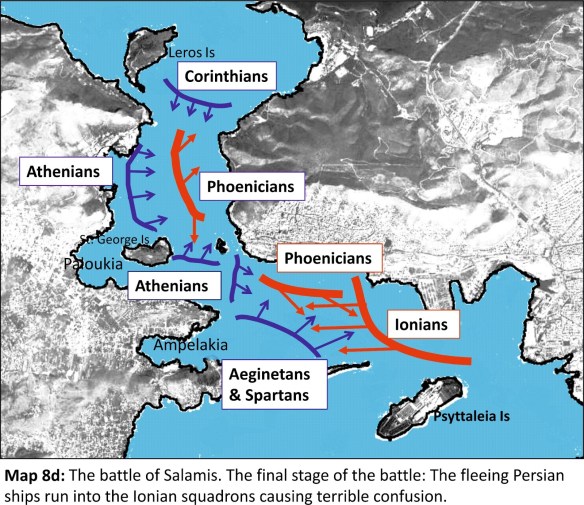
    At Themopylae, 7,000 Greek hoplites under the leadership of Leonides defeated the Persian land troops. The latter recovered sufficiently to continue south to burn Athens, simultaneously sending their navy to attack the island of Salamis, where the vast majority of Athenians had fled. Outmaneuvered the Persian fleet suffered serious damage and withdrew. With no sea support, the Persian land forces were also forced to withdraw for the winter.The Battle of Salamis - Maps

    After Xerxes withdrew to Sardis, the Persian general Mardonia retook Athens in spring 479. Marching from Sparta, the allied Greeks attacked the Persian camp at Plataea. Lacking a cavalry the Greeks employed a heavy infantry armed with shields and spears, reinforced with light infantry who threw javelins and stones. Once they killed Mardonis, the Persians fled. The Greek allies also sent a fleet across the Aegean to attack the Ionian coast where they won several battles.

    Hostilities continued for years.

    https://www.kanopy.com/en/pukeariki/watch/video/15372393/15372444