US is ‘main enemy of the dollar’ – ex-IMF director

US is ‘main enemy of the dollar’ – ex-IMF director

RT

Washington’s “abuse” of financial instruments through sanctions is pushing the rest of the world away from the greenback, Paulo Batista has told RT

The US is the main enemy of the dollar, prominent Brazilian economist and former International Monetary Fund (IMF) executive director, Paulo Nogueira Batista Jr., has told RT.

Washington has increasingly weaponized its national currency, undermining trust in the greenback and the broader Western financial system, he said, in an exclusive interview with RT.

“The main enemy of the dollar and of the international payment system controlled by the West is the US itself,” Batista said. “There is a move away from the dollar, from US Treasuries, to a large extent derived from the abusive use by the US of instruments [such as] SWIFT, of reserves.”

He said the “most notable case” of such abuse is Russia, which saw about $300 billion in Central Bank reserves frozen in the West under sanctions imposed after the escalation of the Ukraine conflict in 2022. Beyond the asset freeze, the US and its allies removed most Russian banks from the SWIFT interbank messaging system and imposed full transaction bans on key financial institutions, effectively cutting Russia off from the dollar- and euro-dominated Western financial system.

According to Batista, 2022 was a turning point when de-dollarization and the shift away from US-linked financial institutions – already slowly progressing – picked up pace.

“Countries like Russia and China, also Iran, had already suffered sanctions or fears of sanctions from the US… But this was a watershed because of the scale of Russia’s reserves and the assets frozen. Since 2022, major central banks, for example China’s, are moving away from US Treasuries,” he said.

RT

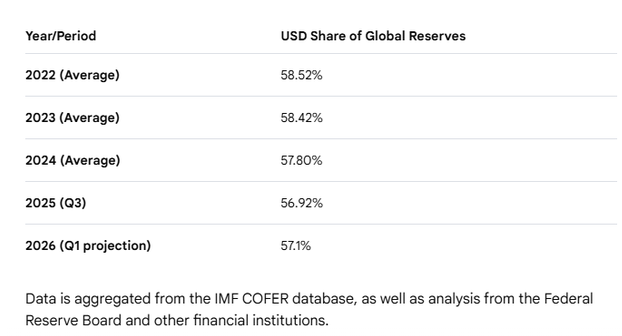
The dollar’s share of global foreign exchange reserves has steadily declined over the past four years. Russia has essentially eliminated Western currencies in trade with CIS and BRICS nations, which have been doing the same with their other partners. Looking ahead, Batista said that while the greenback will remain an an “important” global currency, the move away from the dollar will continue and its “hegemony” will gradually weaken.
[…]

RFK Jr. Explains “Gluten Allergies” Exploded in 2006 Due to Spraying Roundup on Food Before Harvest

G Edward Griffin’s Need to Know

In 2006, Monsanto advised farmers to spray its Roundup Ready pesticide, with the active ingredient glyphosate, on wheat so that it would act as a dessicant to dry it out and prevent mold. Robert Kennedy Jr. said: “And it was so popular that about 85 % of the Roundup that has been used in history has been used since 2006. A large part of that is as a desiccant. And what that meant, is for the first time they’re spraying it on food right at harvest.”

“What Monsanto did is they began telling farmers, spray this on the crop, on your wheat, right before harvest or at the time of harvest. And it was so popular that about 85 % of the Roundup that has been used in history has been used since 2006. A large part of that is as a desiccant. And what that meant, is for the first time they’re spraying it on food right at harvest.”

“Not early in the season when they have a chance to wash off, but actually just before you’re going to eat it. And they’re spraying it for the first time on wheat because there was no such thing as Roundup Ready Wheat. They started spraying it on wheat as a desiccant. And so 2006 marks the day when suddenly these gluten allergies began exploding. The celiac disease and all these kind of wheat problems that we started seeing in this country.”

If you measure it back and say, when did it start? You can look and draw a red line at this 2006 and it’s the year that they began spraying it on.

From Wall Street Mav:

Other countries are beginning to ban the use of Monsanto’s Roundup pre-harvest.

The U.S. has not banned Monsanto’s Roundup (glyphosate) for pre-harvest use at the federal level; in fact, the EPA still approves its use, but some U.S. cities, counties, and even large food companies have restricted or phased out its use, especially as a pre-harvest desiccant on crops like oats and wheat due to cancer concerns.

Image

Is organic wheat sprayed with glyphosate?

From Custommapposter:

Genetically modified organisms, nanomaterials, human sewage sludge, plant growth regulators, hormones, and antibiotic use in livestock husbandry are prohibited [in organic farming].

Glyphosate is not allowed to be sprayed on organic wheat according to USDA organic standards. Sadly, we did find the presence of glyphosate residue in organic wheat, and other organic grains, including organic barley, oats, spelt, and einkorn. The range was from 0.03 to 0.

[…]

Via https://needtoknow.news/2026/01/rfk-jr-explains-gluten-allergies-exploded-in-2006-due-to-spraying-poison-on-food-before-harvest/

Is New Saudi-Led Axis Forming against the UAE and Israel?

Mohammed bin Zayed(L) and Mohammed Bin Salman. (Design: Palestine Chronicle)

By Robert Inlakesh

The emergence of a new alliance in the region has the potential to challenge some of Israel’s more aggressive endeavors, so this could end up working in favor of the Palestinian people in some regards.

Prior to October 7, 2023, the Kingdom of Saudi Arabia appeared poised to join the so-called “Abraham Accords” alliance and normalize ties with Israel. Now it appears to be forming new alliances and even undermining Israeli interests, pursuing a different regional cooperation agenda. Where this leads will be key to the future of the region.

In September of 2023, the Crown Prince of Saudi Arabia, Mohammed bin Salman, had informed Fox News that normalization with the Israelis was growing closer. This development came as then-US President Joe Biden had been seeking to broker such an agreement, which appeared to be his administration’s planned crowning achievement in the foreign policy realm.

The Hamas-led Al-Aqsa Flood operation changed the regional equation entirely. Riyadh, instead of normalizing ties with the Israelis and seeking concessions from the United States in order to enter into a regional alliance against Iran, began considering a different option entirely.

Israel’s weakness in the face of the Hamas-led attack was one message to the entire region, which was that if it could not even take care of its own security issues against a guerrilla army equipped with light weapons, then how could an agreement with Tel Aviv ensure the security of its allies? Another element to the developments in Gaza was that Israel decided to commit a genocide in order to restore its image in the region and in a gambit to “solve the Gaza question”.

This behavior, combined with attacks on nations across the region, evidently served to set normalization talks back and pushed Saudi Arabia to reaffirm its commitment to the Arab Peace Initiative of the 2000s—in other words, no normalization without a viable Palestinian State.

Then came the Israeli bombing of neighboring Qatar, a message to all Gulf nations that Israel is ready to act against any of their territories. It was even reported that Israel’s missiles flew over Saudi airspace in order to reach their target.

Since then, Saudi Arabia has been busy attempting to secure its interests and has signed a security pact with Pakistan as part of this effort. It is very likely that a large driving element behind this deal was to ensure that a future Iran-Israel war would not impact them directly. The Saudis are also currently working to strengthen their ties with Iran.

Yet Riyadh didn’t stop with Pakistan; it is now reportedly in high-level talks with Turkey in an attempt to bring them into the fold of their security agreement, in what is being labeled a Middle East NATO project. While it is perhaps too soon to predict the outcome of these talks and where such an agreement would lead, it suffices to say that there is certainly a realignment going on in West Asia.

The ongoing feud between the United Arab Emirates (UAE) and Saudi Arabia was sent into overdrive when the Emiratis decided to order their proxies in Yemen to seize key regions of the nation’s east, home to 80% of the country’s oil reserves. These Southern Transitional Council (STC) separatists, backed by the UAE, took over the Mahra and Hadramaut provinces, posing a major security risk to the Saudis and Omanis.

In reaction to the UAE’s meddling, Riyadh decided to take the gloves off in Yemen and crushed the STC entirely. But the backlash against Abu Dhabi was not limited to the end of their proxy militia’s role in Yemen; instead, there was a media war in the UAE that aimed to expose its crimes across West Asia and in Africa, as well as a prepared economic blow.

As a result, there was a diplomatic fallout between the UAE and Algeria, over Abu Dhabi allegedly backing separatist movements there, and later the government of Somalia even rescinded its agreements with the Emiratis, following UAE-Israeli meddling in their affairs, in regard to the recognition of Somaliland as a State.

If Riyadh and Ankara do end up forming some kind of security alliance, it will likely also include Qatar. It would then prove interesting to see how they all coordinate on issues like Libya and Sudan. The Emiratis not only back the Rapid Support Forces militants in Sudan, who stand accused of committing genocide and mass rape, but long threw their weight behind warlord Khalifa Haftar in Libya.

This would also mean that the UAE’s role in Syria could be undermined or completely terminated, as it could also be forced from other areas of influence, like Iraq, too. It is clear that both Turkey and Saudi Arabia have sway in Lebanon, so depending upon what their goals are there, this may prove an interesting development for the Lebanese predicament, too. The same goes for Egypt and beyond.

One thing to keep in mind is that such an alliance would not equate to an Axis of Resistance-style opposition to the Israelis. Although Riyadh may see it fit to teach its Emirati neighbors a lesson, the likelihood of any serious conflict with the Israelis is thin.

It is true that the Israelis, aided by their UAE lapdogs, are pursuing an ultra-aggressive policy in the region, especially against Ankara. Yet this competition is not one between warring nations seeking to defeat each other decisively; it is viewed, at least for now, as a competition instead. Turkey maintains its relations with Israel; the Saudis, on the other hand, have not formally recognized Tel Aviv, but have long been in communication with their Israeli counterparts.

An alliance of this nature does not serve as a new support system for any resistance front in the region; instead, it seeks to achieve security and to escape the grip of the emerging “Greater Israel” project. At this stage, it has become abundantly clear that there are no promises of a prosperous future through aligning fully with the Israelis; instead, Tel Aviv will aggressively pursue its interests against every nation in the region and doesn’t respect any agreements it signs. The recent Emirati-Israeli actions demonstrate this perfectly.

Ultimately, the emergence of a new alliance in the region has the potential to challenge some of Israel’s more aggressive endeavors, so this could end up working in favor of the Palestinian people in some regards.

This could prove beneficial to the Islamic Republic of Iran, which, instead of facing total isolation and seeking to combat Israeli schemes alone, may, on different issues, find itself on the same page as the Saudi-led alliance. Some analysts have posited that Tehran may eventually join such a security pact, although it is way too early to say if such a development is even on the cards.

Overall, we should not expect Riyadh to do a total one-hundred-and-eighty-degree foreign policy shift, nor should that be expected of Ankara; after all, they are US allies and maintain close relations with Washington. The real question is whether the United States is willing to push back against such an alliance for the sake of Israel, which is when things will really begin to get interesting.

[…]

Via https://www.palestinechronicle.com/is-a-new-saudi-led-axis-forming-against-the-uae-israel-analysis/

Video Shows Border Patrol Threaten Legal Observer in Key Largo for Following Him

CBP officer wearing a mask | Illustration: Instagram

A U.S. Border Patrol officer threatened to arrest a legal observer in Key Largo, Florida, today for following the officer, video of the encounter posted on Instagram shows.

The video is another instance of federal immigration officers threatening and harassing legal observers for conduct that civil liberties groups and multiple federal circuit courts say is firmly protected First Amendment activity.

The observer and activist, a 64-year-old Key Largo man who requested that his name not be printed to avoid retaliation, tells Reason he is part of a local group that tracks federal immigration enforcement activity in the Upper Florida Keys. Key Largo was the scene of a Border Patrol stop in December that generated national headlines after officers dragged a U.S. citizen out of her car.

The observer says he was following an unmarked Customs and Border Protection (CBP) vehicle from a safe distance when the car turned into a restaurant parking lot. The observer says he parked well over 25 feet away from the CBP vehicle, at which point the Border Patrol officer got out of his car, put on a mask, and approached the observer’s car. That is where the observer’s cell phone video picks up:

“This is your one warning, do you understand this?” the officer says in the video. “One warning. You’ve been following us around.”

“I’m just driving around,” the man replies.

“You’re following me around. If I continue to see you following me around, I’m gonna pull you over and arrest you,” the officer says.

“For what?” the man asks. “What law am I breaking?”

“You’re impeding an investigation, OK?”

“What are you going to do, shoot me?” the observer asks, referencing the recent killing of Renee Good by a CBP officer in Minneapolis.

After a short back-and-forth, the officer says, “Oh, you mean that woman that was trying to run them over?” The officer warns the observer again before declaring he’s not going to argue about it and returning to his car.

The Department of Homeland Security (DHS) has made it clear through official statements and a long list of similar encounters that it considers following, filming, and warning others of federal immigration agents to be illegal under a rather tortured interpretation of a federal statute that criminalizes physically impeding, resisting, or assaulting federal law enforcement officers.

Although the Supreme Court has declined to address the issue, seven federal circuit courts have firmly upheld the right to record and monitor the police, as long as one doesn’t physically interfere with them.

The U.S. Court of Appeals for the 11th Circuit, which covers Florida, ruled in 2000 that there was “a First Amendment right, subject to reasonable time, manner and place restrictions, to photograph or videotape police conduct.”

“The First Amendment protects the right to gather information about what public officials do on public property, and specifically, a right to record matters of public interest,” the 11th Circuit wrote.

Civil libertarians say the DHS’ policy is unconstitutional.

“The right to record publicly visible law enforcement activity is a core First Amendment right,” Scarlet Kim, a senior staff attorney with the American Civil Liberties Union’s Speech, Privacy, and Technology Project, told Reason last month. “It creates an independent record of what officers are doing, and it is no accident that some of the most high-profile cases of misconduct have involved video recordings. The burning question is why ICE officers feel the need to hide who they are and what they do from the public—masking their faces, lacking visible ID, driving unmarked vehicles, and now attacking those who document their activities.”

The incident was actually the second time the observer says he’s been harassed. In December, a CBP agent shoved him away from the scene of a traffic stop, even though he was complying with the officer’s orders to step back.

“I walked backward as fast as I could, but I’m practically a senior citizen, so I can’t move that quickly,” the observer says. “And even though I was moving backward, he still decided to shove me and get in my face and also threaten me.”

Last October, ICE officers broke out the window of a U.S. citizen’s car in Oregon and detained her for seven hours after she followed and photographed their unmarked vehicles. The DHS accused her of reckless driving, attempting to block in officers with her car, and resisting arrest—all claims that she and her lawyer deny. In cell phone video footage, the first question that the ICE officer asks when he approaches the woman’s car is, “why are you taking photos?”

In the wake of Good’s killing, the Trump administration and Republican lawmakers have continued to paint anti-ICE protesters and monitors as radical extremists. DHS Secretary Kristi Noem said Good had been “stalking and impeding” agents all day prior to her killing.

“Honking your horns, following people is something that absolutely must not be tolerated,” Rep. Pete Sessions (R–Texas) said in a TV news interview today. “And I stand completely with the administration on this effort.”

However, the arrests, threats, and violence have not kept protesters and legal observers out of the streets since the killing of Good. In fact, it has galvanized some of them.

“My voice was probably shaking a little bit in the video, but now that I’m calmed down and looking back at it, I would do it all over again,” the observer says. “I would do it all over again because we just can’t let this go. We need to keep track of what these people are doing, and we can’t let ’em treat our neighbors like this, and people from other countries, and U.S. citizens. They’re literally killing them, and I can’t abide by it.”

[…]

Via https://reason.com/2026/01/12/video-shows-border-patrol-threaten-legal-observer-in-key-largo-for-following-him/

Land of Confusion: The Great Reset in Motion

Colin Toddhunter

The global disruptions we have seen in recent years are frequently presented as a chaotic sequence of events: a ‘pandemic’, inflation, energy shortages and war. Little wonder that most people are confused. However, a structural analysis reveals a more deliberate controlled demolition of the 20th-century social contract.

We are witnessing a transition from a productive capitalist model, which required a healthy mass labour force, to what Yanis Varoufakis calls a techno-feudalist order.

The engine of this transition was a desperate financial stabilisation strategy carried out by means of a public health event. As identified by Professor Fabio Vighi, the global financial system reached a point of terminal instability in late 2019, evidenced by the collapse of the US repo market (where banks lend to each other).

By freezing the real economy through lockdowns, central banks performed massive liquidity injections to save the banking-finance tier. If that money had entered a functioning economy, it would have triggered hyper-inflation. By keeping the population at home, the elite performed a stealth bailout that preserved the dominance of the financial class by sacrificing the productive middle class.

However, a geopolitical reset also had to take place. For decades, Germany’s economy relied on three pillars: cheap Russian gas, high-tech exports to China and a US security umbrella. By late 2025, all three have been fractured. As Prof Michael Hudson notes, the ‘sabotage’ of the Nord Stream pipelines was a structural necessity for the Western financial elite.

If Germany continued to integrate with Russia and China, it would have created a power pole independent of the US dollar. The conflict in Ukraine served a purpose: it resulted in Germany replacing Russian pipeline gas and being forced into a massive build-out of liquefied natural gas (LNG) infrastructure and reliance on LNG from the US. Unlike pipeline gas, LNG must be super-cooled, shipped and re-gasified, a process that is inherently 3–4 times more expensive.

The result is that, in 2025, German industrial output is at its lowest since the 1990s. Heavy industries like BASF (chemicals) and ThyssenKrupp (steel) are relocating to the US or China. Meanwhile, Germany is pivoting from an industrial giant by betting on creating jobs in the likes of the green energy sector (including becoming a ‘hydrogen hub’), semiconductors and microelectronics, robotics and biotech and diverting its capital into a €150 billion annual defence spend.

At the same time, while Germany collapses, the City of London thrives on global volatility. Among other things, the City is the global hub for war risk insurance and energy brokerage. When a pipeline is destroyed or a strategically important shipping lane is threatened, the price of war risk insurance triples. The London insurance market (Lloyd’s) extracts these ‘risk premiums’ from the global economy.

The City’s brokers treat geopolitical instability as a volatile asset class. Even as British households are crushed by energy bills, the financial centre remains profitable by extracting wealth from the very chaos that foreign policy helps to manufacture.

Moreover, the City of London has secured its position as the indispensable middleman of the transatlantic energy pivot. While the physical gas originates in the US and is consumed in Europe, the financial and legal architecture of this trade is almost entirely managed in London.

Commodity brokers and exchanges like ICE (Intercontinental Exchange) in London have seen record volumes in LNG futures and derivatives. These are financial bets on the future price of gas. As volatility increases, the fees and commissions extracted by London-based traders and clearinghouses skyrocket.

More than 90% of the world’s marine insurance, including the specialised, high-premium coverage required for LNG tankers, is underwritten through Lloyd’s. By enforcing strict war risk premiums on any ship entering European waters, London effectively imposes a private tax on every molecule of gas that replaces the lost Russian pipeline supply.

This ensures that while European industry is struggling with high energy costs, the City’s financial firms extract a massive toll from the logistics of the replacement supply.

Of course, the structural readjustment of economies leads to huge social tensions. This is where the ‘Russian threat’ comes in. It has been elevated to an all-encompassing internal narrative used to manage domestic dissent and to galvanise the public to rally behind the flag. The bogeyman serves a vital psychological function by converting the growing anger of the impoverished into a patriotic duty to endure hardship.

Under this regime of ‘permanent emergency’, any industrial action, protest or systemic critique can be branded as malign foreign influence or subversion, allowing the state to use new, expansive policing powers to suppress internal friction.

To justify the redirection of billions in tax revenue away from failing public services and into the military-industrial complex to create ‘growth’ in a failing economy (a desperate attempt to revive a collapsing neoliberalism—see chapter two here), the state must maintain a high-decibel level of existential fear. In the UK, the Defence Industrial Strategy 2025 explicitly frames militarisation as an engine for growth, using the spectre of a Russian invasion to legitimise a state-subsidised transfer of wealth to high-tech defence contractors.

By manufacturing a permanent state of war-footing, the elite ensure that a main pillar of the economy is the one that directly serves the security of the state, while the population is told that their dwindling healthcare and pensions are a necessary sacrifice for national survival.

In this respect, we also see the changing status of the human being. In the industrial era, the state ‘subscribed’ to the working class, investing in the NHS and education because it required a fit population to drive production. Artificial intelligence, robotics and economic decline increasingly make much of this labour force redundant.

As capital may no longer find the reproduction of labour desirable or profitable, the state withdraws its subscription. The visible rot in the NHS is the result of deliberate divestment. (The UK private health insurance market has surged to a record £8.64 billion, a nearly 14% year-on-year increase.)

If the worker is no longer required for production, the state views healthcare as a ‘non-performing cost’ to be liquidated.

When a population is no longer an asset but a fiscal liability, the state moves from care to managing exit. It’s no accident that we have seen calls for the rapid legalisation of assisted suicide across the West. It might also help to explain the prescribing of midazolam and do not resuscitate orders in care homes during the COVID event. Data shows that the UK government purchased vast quantities of midazolam (two years’ worth of stock in just two months) in early 2020.

In 2025, official impact assessments noted that legalising assisted dying would result in “considerable cost savings” for the NHS and state pension system—estimated at up to £18.3 million within a decade for pensions alone. The Terminally Ill Adults (End of Life) Bill Impact Assessment (May 2025) officially quantified the ‘benefits and pensions’ impact. It estimated that by year 10, the state would save roughly £27.7 million per year in unpaid pension and benefit payments due to assisted deaths.

By accelerating the ‘offboarding’ of the non-productive elderly (whatever happened to the COVID era marketing slogan of ‘saving granny’?), the system wipes billions in future pension liabilities off the state balance sheet.

Moving forward, what can we expect? We will see the elite continue to rollout the narrative of permanent emergency under the guise of climate crisis and Russian threat to provide the ideological discipline required to justify a boosted austerity. Meanwhile, digital ID and central bank digital currencies will create a system of total surveillance. In this emerging system, the citizen is replaced by the ‘managed subject’, whose access to the economy is contingent upon a social credit score.

[…]

Via https://www.activistpost.com/land-of-confusion-the-great-reset-in-motion/

Iranians take part in nationwide rallies to condemn foreign-backed riots, terrorism

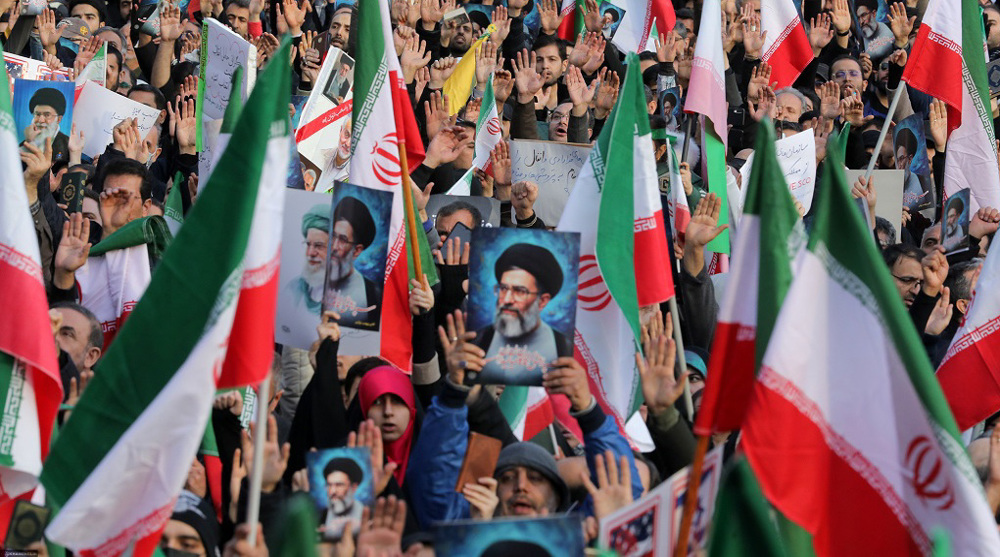
Iranians hold national flags and pictures of Leader of the Islamic Revolution Ayatollah Seyyed Ali Khamenei, during a rally in condemnation of foreign-linked riots, in the capital of Tehran on January 12, 2026. (Photo by khamenei.ir)

Press TV

Iranians from all walks of life are taking part in nationwide rallies to denounce recent foreign-backed riots, demonstrating their unwavering support for the Islamic Republic.

The rallies in most provinces, including Tehran, began at 2:00 p.m. local time on Monday. However, in some other provinces, the rallies started earlier, at 9:00 a.m. and 11:00 a.m.

Officials described the nationwide demonstrations as irrefutable evidence of unity and solidarity in the face of the enemy’s plots to sow chaos and division through mercenaries and terrorists.

Some shopkeepers last month staged peaceful protests in different cities over economic issues, but the demonstrations were steered toward violence after public statements by US and Israeli regime figures—amplified by Israeli-linked Persian-language outlets—encouraged vandalism and disorder.

Authorities have acknowledged the legitimacy of economic grievances and vowed to address them, while denouncing foreign-backed elements for exploiting people’s livelihood concerns, which are directly linked to unilateral US sanctions targeting Iran’s central bank and oil exports.

Iranian authorities say the perpetrators of the unrest are backed by the US and the Israeli regime.

US President Donald Trump recently voiced support for rioters and warned Washington could attack Iran if what he called “peaceful protesters” were harmed, while former US Secretary of State Mike Pompeo has issued statements alluding to Mossad involvement and separatist plots.

Leader of the Islamic Revolution Ayatollah Seyyed Ali Khamenei, in his remarks on Friday, said the country “will not back down against vandals,” urging unity against the enemy.

President Masoud Pezeshkian, in a TV interview on Sunday, said the nation should not allow rioters to foment insecurity in the country, stressing that protesting is different from rioting.

Pezeshkian emphasized that the killing of civilians “is not acceptable at all” and said the United States and Israel are training the rioters and supporting them.

Parliament Speaker Mohammad Baqer Qalibaf echoed the same on Sunday, noting that Iran recognizes the people’s right to peaceful protest, but will stand firmly against armed terrorism.

The Iranian judiciary has vowed to take strict action against foreign-backed rioters and terrorists, pledging no leniency toward those involved in bloodshed and vandalism.

Participants in Monday’s rallies said they stand by the Islamic Republic and the Leader of the Islamic Revolution, and would not allow the enemy to sow instability.

“I’m here today to honor the blood of our martyrs and to tell our Leader, Ayatollah Khamenei, that we will not allow Americans and Zionists to succeed in their dirty war against our country,” Mohammad Ali Abbasi, a protester at a rally in Tehran, told the Press TV website.

Many participants said that concerns related to the economy and inflation are legitimate, but emphasized that solutions must come from within the country, not from those who have the blood of thousands of Iranians on their hands.

“We reject any external meddling. We face economic hardships and will continue to raise our demands, but we will not tolerate anyone from outside dictating anything to us,” said another protester, Fatemeh.

[…]

Via https://www.presstv.ir/Detail/2026/01/12/762246/Leader-Iran-nation-foiled-enemy-plot

Careless People: Memoir of a Facebook Whistleblower

Careless People: A Cautionary Tale of Power, Greed, and Lost Idealism ...

Careless People: A Cautionary Tale of Power, Greed and Lost Idealism

By Sarah Wynn-Williams

Macmillan (2025)

Book Review

This is the memoir of a former New Zealand diplomat and international lawyer who joined Facebook in 2011 as director of global public policy. In this role, she played a vital role in getting Facebook third world countries as they began to access the Internet. After Facebook began coming coming under attack for allowing bullying, privacy violations, harassment and criminal activity on their platform, the company experienced growing legal problems in many countries.

In 2014, they faced a criminal investigation and armed raids on their Korean office after refusing to submit games on their platform for government review. This was followed by criminal investigations In Brazil, India and France. The Brazilian government imposed millions of dollars in fines for violating bans on electoral advertising.

According to Wynn-Williams one of Facebook’s biggest problems, was that Mark Zuckerberg refused to follow Facebook community guidelines in dealing with friends and business interests.

By January 2016, Facebook was in “deep shit” with governments everywhere for 1) not paying tax in countries that generated major revenue from Facebook users and 2) for allowing Facebook to radicalize terrorists.

The book describes in detail how an “outsider” named Donald Trump used Facebook to win the 2016 election. Using a a large campaign-generated database charting gun registration, credit card history, websites visited and car make and model, the Trump campaign used Facebook algorithms to create a custom audience that raised millions each month through Facebook-generated campaign contributions (Facebook was the Trump campaign’s largest source of campaign contributions).

Wynn-Williams devotes two entire chapters to Facebook’s blatantly illegal activities in China. As if 2017 when she left Facebook, China was Facebooks’s second biggest market (after the US) with $5 billion in annual revenue. Although the government blocks Facebook within China, many Chinese businesses run Facebook ads targeting non-Chinese Facebook users.

Despite her growing concern about Facebook’s unethical and illegal activities, Wynn-Williams had major health problems and was terrified of losing her health insurance. She was ultimately fired in 2017 for filing a sexual harassment complaint against her immediate supervisor.

Following her departure, she submitted a whistleblower complaint to the SEC and helped lobby for California’s anti-sexual harassment Silenced No More Act, which was co-written by a former Facebook coworker. She also advanced anti-sexual harassment shareholder resolutions at Apple, Google, Amazon, Microsoft and Facebook, as well as a Facebook shareholder resolution on the company’s engagement with China.

LED Lights Harm Vision, Cognitive Function — Kids At Special Risk

boy sleeping next to led night light

The U.S. Food and Drug Administration (FDA) must fulfill its obligation to study the health impacts of LED lights and report its findings to Congress, according to a petition filed Dec. 30, 2025, with the agency.

Federal law directs the secretary of the U.S. Department of Health and Human Services or his delegates, such as the FDA, to study health hazards — including the intense artificial light emitted by LEDs — of radiation emitted by electronic products. According to the nonprofit Soft Lights Foundation, which filed the petition, the FDA has ignored that obligation.

In its petition to the FDA, the Soft Lights Foundation cited studies linking the blue light emitted by LEDs to hormonal disruption, increased risk of breast cancer, and other health risks.

Blue light is a high-frequency segment of the visible light spectrum nearly as powerful as ultraviolet (UV) light, according to the Cleveland Clinic. The sun naturally emits some blue light, particularly in the morning, but the proliferation of LED technology means people are now bombarded with blue light at all hours.

Pulsed LED lights interfere with vision and cognitive functioning, and the adverse impacts of LED flashing lights are already the subject of multiple lawsuits,” the petition states.

LEDs, or light-emitting diodes, are semiconductor devices that emit light when electricity flows through them.

The U.S. Department of Energy projects that LEDs, which are more energy-efficient than traditional incandescent light bulbs, will account for the majority of U.S. lighting installations by 2035.

Most electronic screens, including computers, cellphones and electronic advertisements, also contain LEDs. And increasingly, car headlights, bike lights and streetlights use them.

Kids are especially at risk

Mark Baker, founder and president of the Soft Lights Foundation, told The Defender that children are especially vulnerable to the negative effects of blue light exposure.

“The lens of a child’s eye is clear, allowing more hazardous blue wavelength light into the retina,” Baker said. “As we age into adults, the lens becomes thicker and less clear and less blue light reaches the retina.”

Kids with other health conditions may be especially vulnerable to eye damage from blue light.

“Children who have autism, epilepsy, ADHD [attention-deficit/hyperactivity disorder], photophobia or many other medical conditions can suffer anxiety, epileptic and nonepileptic seizures, brain fog, nausea and eye pain from exposure to LED light,” Baker said.

LED lights in schools can cause disruptive behavior and can adversely affect learning outcomes, he added.

Studying the health and safety impacts of LEDs and reporting the findings to Congress is the first step the FDA must take to comply with federal law, Baker said.

Next, the agency must work with other federal agencies to establish LED product performance standards that protect people’s health and safety.

“Because the FDA has not published performance standards for LED products to ensure our health and safety, parents have not been given guidelines for how to keep their children safe,” he said.

LED headlights risk drivers’ safety

The intense LEDs in vehicle headlights pose a particular threat to people’s safety, according to the Soft Lights Foundation petition.

The petition includes dozens of comments from people who said the blinding brightness of LED headlights makes it difficult to drive safely.

A healthy 28-year-old with 20/20 vision wrote:

“There have been many times where I pass a car coming from the opposite direction, and I legitimately can’t see the road anymore. …

“There’s also, of course, the issue of cars behind you with bright headlights. Even if I set my rearview mirror to its ‘tinted’ mode, the light coming off of my side mirrors is still so bright. It makes it almost impossible to see out of my mirrors, such that I can’t see what’s behind me or next to me, and it even affects my ability to see right in front of me.”

The FDA should work with the National Highway Traffic Safety Administration, part of the U.S. Department of Transportation, to set limits on maximum intensity of LED headlights, Baker said.

In May 2024, the FDA rejected four earlier petitions from the Soft Lights Foundation urging the agency to regulate LEDs, arguing that Congress does not require the agency to do so.

An FDA spokesperson told The Defender that the agency is reviewing the petition and will respond directly to the Soft Lights Foundation and Baker.

Under federal law, the FDA has 180 days to respond.

[…]

Via https://childrenshealthdefense.org/defender/led-blue-light-emr-vision-cognitive-function-kids-risk-petition-fda/

Senate rejects Trump’s military threats against Venezuela with war powers vote

The Associated Press, LIVE 5 WCSC, Thu, 08 Jan 2026 

WASHINGTON (AP) — The Senate advanced a resolution Thursday that would limit President Donald Trump’s ability to conduct further attacks against Venezuela, sounding a note of disapproval for his expanding ambitions in the Western Hemisphere.

Democrats and five Republicans voted to advance the war powers resolution on a 52-47 vote and ensure a vote next week on final passage. It has virtually no chance of becoming law because Trump would have to sign it if it were to pass the Republican-controlled House. Still, it was a significant gesture that showed unease among some Republicans after the U.S. military seized Venezuelan leader Nicolás Maduro in a surprise nighttime raid over the weekend.

Trump’s administration is now seeking to control Venezuela’s oil resources and its government, but the war powers resolution would require congressional approval for any further attacks on the South American country.

“To me, this is all about going forward,” said Missouri Sen. Josh Hawley, one of the five Republican votes. “If the president should determine, ‘You know what? I need to put troops on the ground of Venezuela.’ I think that would require Congress to weigh in.”

The other Republicans who backed the resolution were Sens. Rand Paul of Kentucky, Lisa Murkowski of Alaska, Susan Collins of Maine and Todd Young of Indiana.

Trump reacted to their votes by saying on social media that they “should never be elected to office again” and that the vote “greatly hampers American Self Defense and National Security.”

Democrats had failed to pass several such resolutions in the months that Trump escalated his campaign against Venezuela. But lawmakers argued now that Trump has captured Maduro and set his sights to other conquests such as Greenland, the vote presents Congress with an opportunity.

“This wasn’t just a procedural vote. It’s a clear rejection of the idea that one person can unilaterally send American sons and daughters into harm’s way without Congress, without debate,” said Senate Democratic leader Chuck Schumer of New York.

Lawmakers’ response to the Venezuela operation

Republican leaders have said they had no advance notification of the raid early morning Saturday to seize Maduro and his wife, Cilia Flores, but mostly expressed satisfaction this week as top administration officials provided classified briefings on the operation.

Sen. Tim Kaine, D-Va., who forced the vote on the resolution, said he believes many Republicans were caught off guard by the outcome. He said that Trump’s recent comments to The New York Times suggesting U.S. oversight in Venezuela could last for years — combined with details revealed in the classified briefings — prompted some lawmakers to conclude that “this is too big to let a president do it without Congress.”

The administration has used an evolving set of legal justifications for the monthslong campaign in Central and South America, from destroying alleged drug boats under authorizations for the global fight against terrorism to seizing Maduro in what was ostensibly a law enforcement operation to put him on trial in the United States.

Republican leaders have backed Trump.

[…]

The rarely enforced War Powers Act

Trump criticized the Senate vote as “impeding the President’s Authority as Commander in Chief” under the Constitution.

Presidents of both parties have long argued the War Powers Act infringes on their authority. Passed in 1973 in the aftermath of the Vietnam War — and over the veto of Republican President Richard Nixon — it has never succeeded in directly forcing a president to halt military action.

Congress declares war while the president serves as commander in chief, according to the Constitution. But lawmakers have not formally declared war since World War II, granting presidents broad latitude to act unilaterally. The law requires presidents to notify Congress within 48 hours of deploying forces and to end military action within 60 to 90 days absent authorization — limits that presidents of both parties have routinely stretched.

[…]

https://www.live5news.com/2026/01/08/senate-advances-resolution-limit-trumps-war-powers-after-venezuela-raid/

Israel’s ‘Ceasefire’ In Gaza Turns Out To Be A Ruse.

The Dissident

Israeli officials are now admitting that the so-called ceasefire in Gaza was a ruse, and they plan to resume the full-scale genocide and ethnic cleansing of Gaza in March.

According to a report in the Times of Israel, “The Israel Defense Forces has drawn up plans to launch renewed intensive military operations in Gaza in March, with an offensive targeting Gaza City aimed at expanding the part of the Strip controlled by Israel”.

The Times of Israel boasted that the ceasefire was a ruse to make it easier to bombard all of Gaza without killing Israeli prisoners of war, quoting the research fellow at the Israel Center for Grand Strategy, Erez Winner saying, “an offensive against Hamas would now be easier for Israel because it no longer has to worry about putting hostages at risk, now that all the living hostages and all but one hostage’s body have been returned.”

This confirmed what many had already speculated, that Israel was never serious about committing to the ceasefire agreed to in October and always planned to resume the genocide in Gaza.

As the former deputy commander of the IDF’s Gaza Division, Amir Avivi admitted to Israel’s Channel 14, Israel only agreed to the ceasefire because, “After two years of fighting, the tools are worn out. We want to refresh the forces, to establish the defense line”.

Furthermore, Israel never actually adhered to the ceasefire or ended the genocide, only slowed it down, with Gaza’s health ministry documenting that, “442 people have been killed and 1,236 injured since October 11 – the date the Gaza truce entered into force.”

Furthermore, Israel never ended the blockade in Gaza, and has planned to ramp it up by the time it resumes the full-scale genocide in March, by blocking 37 aid groups operating in Gaza, including Doctors Without Borders, effective March 1st.

The Israeli human rights organization B’Tselem documented in December that, “only 57% of the 556 aid missions planned by the UN and its partners were carried out, including the delivery of vital aid and equipment, medical evacuations, and infrastructure repairs” adding, “Israel’s genocidal campaign in Gaza did not end with the ‘ceasefire’ declaration. Blocking humanitarian aid, alongside ongoing airstrikes and shootings, is a direct continuation of the assault on Gaza’s population.”

Now Israel plans to resume the genocide and genocidal starvation siege in Gaza in March.

Along with the fact that the Israeli prisoners of war being released will make it easier for Israel to indiscriminately bomb Gaza and the fact that it gives them the chance to “refresh the forces”, there are other calculations from Israel which will make their genocidal ethnic cleansing plan easier by March.

Gila Gamliel, Israel’s Science and Technology Minister, who was previously Israel’s Intelligence Minister admitted that Israel’s ultimate plan is to, “make the Gaza Strip uninhabitable until the population leaves”.

Now Israel has a dumping ground for ethnically cleansed Palestinians after making Gaza “uninhabitable”- Somaliland.

In late December, Israel became the first UN nation to recognize Somaliland, a breakaway separatist region of Somalia, as a state.

This was done in part because- as Israeli journalist Amit Segal boasted – because “Somaliland was supposed to — and may still — absorb Gazans”.

The Israeli paper Ynet noted at the time, “The territory has recently been mentioned as a possible destination for Gazans, with officials there saying they would be willing to absorb ‘one million Gazans’”adding that, “Israeli intelligence officials say the Mossad has been active in Somaliland for years, laying the groundwork for the recognition through long-standing, discreet relationships with senior figures there.”

Dan Diker, the president of the Likud connected Jerusalem Center for Security and Foreign Affairs admitted, “our friends in Somaliland made a very generous offer privately … of their willingness to absorb or to create communities for hundreds of thousands even beyond a million up to a million and half Gazans” adding, “Somaliland, in our understanding, is really the only country, now country , that stepped up to the plate to absorb Gazans”.

According to Somalia’s Defence Minister Ahmed Moalim Fiqi, “Somalia has confirmed information that Israel has a plan to transfer Palestinians and to send them to Somaliland.”

Furthermore, Israel is undoubtedly hoping that by March, it, along with the U.S., will have carried out regime change in Iran, further isolating the Palestinians and cutting off a key ally of resistance groups Hamas, Hezbollah, and Ansar Allah, which would be a bulwark to Israel’s resumption of genocide and ethnic cleansing in Gaza.

Israel, through social media campaigns and apparent Mossad agents on the ground, has been encouraging the current riots unfolding in Iran, hoping they will lead to regime change.

Along with this, they are pushing Trump to support another regime change bombing in Iran in response to a government crackdown on the riots, with Trump repeatedly threatening to “hit them (Iran) very hard” and, saying, “If Iran shots and violently kills peaceful protesters, which is their custom, the United States of America will come to their rescue. We are locked and loaded and ready to go.”

Through regime change in Iran, Israel hopes to take out one of the last allies of Palestinian resistance, paving the way for its ethnic cleansing plan.

[…]

Via https://the307.substack.com/p/israels-ceasefire-in-gaza-turns-out