The Most Revolutionary Act

Uncensored updates on world events, economics, the environment and medicine

The Most Revolutionary Act

The Murder of Tutankamen

King Tutankhamun, facts and information

Episode 21 The Murder of Tutankhamen

The History of Ancient Egypt

Professor Robert Brier

Film Review

The only intact pharaoh’s mummy found in an Egyptian tomb, Tutankamen’s remains had to be sawed in half and chiseled out of the coffin. They were x-rayed for the first time in the 1960. The lack of wisdom teeth and open epiphyseal plates* in the long bones suggest he was 18 when he died. In addition the skull shows evidence he suffered a head injury prior to death. Also found in his tomb were his internal organs preserved in little jars.

Only eight when his father Ankenaten died, he had to marry his nine year-old half sister Ankhesenamun (daughter of Ankenaten’s chief wife) to become pharaoh. Under the guidance of Ankenaten’s vizier (prime minister) Ay, Tutankaten signaled the end to Egypt’s monotheistic heresy by packing up the city of Akhet Aten  (see Egypt’s Ankenaten: The World’s Firt Montheistic Ruler) and moving Egypt’s religious capital back to Thebes.

Brier believes Tutankaten may have been murdered, as did Akasanamen his widow. There’s a letter in the Hittite archives she wrote the Hittite king (in modern day Turkey), even though the Hittites were Egypt’s traditional enemies. She asked him to send her a son she could marry and make king of Egypt. She also mentioned being fearful of her impending forced marriage to a commoner (Ay, now Tutankaten’s vizier). The Hittite king subsequently sent an envoy to Egypt who was murdered.

After marrying Akasanamen, Ay made himself pharaoh. Although there are no images of her in his tomb, two rings have been discovered showing Aye’s and Ankasanamun’s name linked in a single cartouche.

When this lecture was filmed in 1999, Brier believed his suspicions would be confirmed with a CAT scan and DNA studies. An  autopsy subsequently performed in 2010 suggests Tutankaten most likely died of malaria and a skull fracture related to congenital bone disease.


*The calcification of rapidly dividing epiphyseal cells in the long bones at the end of puberty make further skeletal growth impossible.

Film can be viewed free with a library card on Kanopy/

https://www.kanopy.com/en/pukeariki/watch/video/1492791/1492841

‘It’s Insane’: Big Telecom Pushes Bad Cell Tower Deals on ‘Literally Hundreds’ of Schools

cell tower and boy wearing backpack

Telecommunications companies are targeting school properties as prime locations for installing cell towers, antennas and other wireless infrastructure — and many schools are taking the bait, said attorney Robert Berg.

Berg represents parents in multiple lawsuits challenging proposals for cell towers or wireless antenna placements at their kids’ schools.

He told The Defender that “literally hundreds” of U.S. school boards have signed long-term leases with telecom companies.

“The school board members think it’s easy money,” Berg said. The school leaders rent out bits of school property to the wireless companies — such as a small site next to an athletic field or space on the school roof — for a monthly fee.

Many times school leaders have “no idea what they’re doing.”

“They lock themselves into bad contracts that can last for decades, at below market rate terms,” Berg said. “Meanwhile, the cell towers are irradiating all the kids, the staff and the teachers the entire school day, along with the surrounding neighbors 24/7.”

Parents frequently don’t learn of the deal until after it’s been signed — and then it’s too late, he said.

One of Berg’s cases involves what he called “a nightmare scenario” in Wyandotte, Michigan, where the school board, after literally 48 seconds of discussion, approved a contract with T-Mobile to pay the district $1,000 a month to operate a “massive array” of wireless antennas on the chimney atop Washington Elementary School.

Parents didn’t find out until the antennas were being installed. They protested, but the school board and superintendent insisted the contract would not be broken.

Parent dissatisfaction grew so great that the superintendent was forced to resign. The new superintendent asked T-Mobile to move the antennas to a district site — and the superintendent offered to build a taller cell tower for T-Mobile at the district’s expense.

T-Mobile refused.

Several parents sued to prevent T-Mobile from activating the antennas. The parents initially succeeded in court, but then the court dismissed their suit and allowed T-Mobile to turn on the antennas.

“The parents have appealed the decision,” Berg said, “but in the meantime, parents of about 20% of the pre-antenna student population have pulled their kids from the school, many transferring them to other schools or districts, and some selling their homes and moving from the city.”

Jenny DeMarco, co-founder and communications director for Virginians for Safe Technology, told The Defender she “accidentally” discovered that her kids’ private school had been sited for a cell tower. “They never disclosed this to the parents who paid tuition.”

“So I ended up making flyers,” she said. “My husband and I stood in the parking lot lines and handed out the flyers” informing parents of the school’s plans.

Enough parents found out about the proposed cell tower, that school leaders were “forced to address it,” DeMarco said. Although the school administrator evaded DeMarco’s attempts to determine if and when a contract was signed, the tower hasn’t gone up.

Now DeMarco is leading efforts to stop a cell tower slated to be built at a local public high school and adjacent to a local public elementary school.

Wireless company denies health risks

Milestone Towers, the wireless developer who wants to build the tower near the Virginia schools on March 14 told the Fauquier County School Board that it had developed “over 100 towers on public school properties over 20+ years.”

The company promised board members the new tower would bring in $11,520 in annual revenue for the school district.

The company’s presentation failed to mention any research showing negative health effects of wireless radiation exposure, DeMarco said.

Milestone Towers’ one slide on RF safety said their towers “meet or exceed” the U.S. Federal Communication Commission’s (FCC) wireless radiation emission standards. “But that’s not saying much because the FCC’s standards are decades old and don’t take long-term exposure into account,” DeMarco said.

DeMarco said Milestone Tower, a major cell tower developer in her state, routinely denies health risks in its public presentations.

She shared a clip of the company’s founder and president, Len Forkus, telling a 5th grader — who voiced concerns that she may one day get cancer if his company put a cell tower on her school — that there is no research linking cell tower radiation to cancer or other health problems.

“That’s a lie,” DeMarco said.

The Environmental Health Trust, a nonprofit scientific research and education group focused on the effects of wireless radiation, compiled many independent peer-reviewed studies showing serious harm to humans from exposure to wireless radiation, including:

  • A 2017 study that found living near a cell tower was linked to blood changes, which are considered biomarkers predictive of cancer.
  • A 2018 study that showed adolescents exposed to higher levels of wireless radiation had delayed fine and gross motor skills, spatial working memory and attention compared with those exposed to lower radiation levels.
  • A 2015 study that found higher rates of Type 2 diabetes mellitus in elementary students exposed to higher levels of wireless radiation compared with those exposed to lower radiation levels.

Even the telecom workers’ union, Communications Workers of America, warns workers that wireless radiation can cause sterility, eye damage, central nervous system harm and other “serious biological effects.”

“But somehow Milestone Towers omits all this information from its public presentations,” DeMarco said.

Where’s the informed consent?

When cell tower companies like Milestone Towers don’t tell school leaders about the risks students face from nearby cell towers, parents are denied informed consent, said Fauquier County Public Schools parent Jamie Hinkle.

“When it comes to schools,” Hinkle — whose three daughters attended Fauquier schools — told The Defender, “There has to be informed consent. I want to know about the risks.”

School leaders need to educate themselves about the possible risks to kids’ health and then provide that information to parents so parents can decide whether the risk is worth the money, she said.

“We vote in these school board members to act on behalf of their constituents.”

Wireless contracts lock in schools for decades

Most school leaders Berg has interacted with don’t understand the terms of the leases offered by wireless companies.

The board members think they’re renting out school property for just a few years because the initial term is typically five years.

“But the leases are renewable for additional five-year terms at the sole discretion of the lessee — meaning the cell tower company — so … they’re often 30- or 35-year leases,” Berg said.

The cell tower company alone can cancel the lease, as long as the company pays the rent fee and maintains the wireless facility. “They’re [the contracts] completely one-sided.”

Earlier in 2019, Fauquier’s school board signed this type of lease with Milestone Towers to put a cell tower at a different local high school. A copy of the lease for the newly proposed tower is not publicly available, DeMarco said.

DeMarco — who obtained the 2019 lease via the Freedom of Information Act — said the lease allows the company to operate its tower for 10 years with multiple five-year renewals.

“So the school board won’t be able to revisit the contract until the youngest kid at this high school is at least 45 years old,” she said. “It’s nuts.”

Berg, who analyzed the lease, said it was similar to what he’s seen signed by other schools.

Talk to school leaders early

It’s best if parents can inform school leaders about the risks of wireless radiation before a telecom offer is on the table, Berg said.

“I’ve been successful recently in a couple of instances in getting the boards to stop literally the night before the day they were going to sign the lease,” Berg said. “They backed off because the parents got involved a week or two or a month before and said, ‘Don’t enter the lease.’”

DeMarco and Hinkle are hoping that will happen in their community.

The school board on May 13 voted on whether to build the new cell tower, but the vote was a tie (2-2) with one member absent.

The full board will take another vote at their June 10 meeting.

Meanwhile, parents have been emailing the boards saying they have safety concerns. More than 260 people have signed a petition against the new tower.

Berg said people need to understand that school leaders have a lot of power to stop wireless companies. “The school district is perfectly free to say, ‘No, it’s our property. We don’t want it.’”

State and county officials can’t deny a wireless project application due to safety or health concerns — which are considered “environmental effects” under the Telecommunications Act of 1996 — but that’s not the case with school boards, he said.

School leaders can consider any reason they wish, including concerns about health and safety.

However, once school leaders sign a contract, it’s legally much harder to stop a wireless building project.

“That’s why you’ve got to get in early while you can present all that information to the board,” he said. “You’ve got to convince the boards of education that this is a really bad idea.”

Berg suggested parents give board members these three reasons:

1. There is no conclusive evidence proving long-term exposure to wireless radiation is safe — and there are plenty of scientific studies linking wireless radiation with severe health risks to humans, especially children.

“As fiduciaries whose primary responsibility is assuring the health and safety of those who use the schools, school board members should avoid intentionally exposing users of school property to continuous wireless radiation,” Berg said.

2. The lease likely isn’t just a five- or 10-year lease. “It’s a 35-year lease that the school district can’t cancel.”

3. “You’re tying up your ability to use that land for that period — and you’re exposing your teachers, your students, your staff and visitors to the dangers of this wireless radiation for a tiny amount of money. It’s insane.”

[…]

Via https://childrenshealthdefense.org/defender/telecom-companies-cell-towers-kids-schools/

“The Economics Just Don’t Work”: Demand For Electric Semis Plunges Due To High Costs

Zero Hedge

For the last year, we’ve been writing extensively about how high costs and low demand have made EVs uneconomical – and, as a result, unpopular to produce – for the auto industry.

It turns out unionized employees extorting you on labor costs while the government mandates you produce a money-losing product isn’t a combination that leads to prosperity and profit. Go figure.

Now, it isn’t just car manufacturers that are balking from the idea of all electric vehicles: the trucking industry, once expected to eventually make the shift to all electric as well, is seeing tepid demand for new rigs, according to a new Wall Street Journal article.

“The economics just don’t work for most companies,” Robert Sanchez, the chief executive of Ryder, said earlier this month.

Ryder’s experience highlights the difficulties state and federal governments encounter in encouraging truckers to transition from polluting diesel rigs to zero-emissions vehicles, the report says.

It also indicates that significant improvements in battery weight, range, and charging times are necessary for battery-electric trucks to effectively compete with diesel rigs in the cost-sensitive freight industry.

Rakesh Aneja, head of eMobility at Daimler Truck North America, told Wall Street Journal: “Quite frankly, demand has not been as strong as what we would like.”

Aneja said orders for its Freightliner eCascadia battery-electric semi truck are about the same this year as they were in 2023.

Battery-electric trucks are about three times more expensive than diesel rigs, the Journal notes. And while federal and state programs help offset purchase costs, significant hurdles remain due to high operating costs and setup challenges.

Truckers find these electric trucks difficult and costly to run, with installation of on-site charging facilities taking years. These trucks travel less than half the distance of diesel rigs per charge and require several hours to recharge.

Ryder launched a service a year ago to assist companies in setting up and maintaining battery-powered fleets. So far, it has sold only 60 vehicles, mostly light-duty trucks. Three companies use five battery-electric heavy-duty trucks, but only within yards for shuttling trailers.

Sanchez noted that unlike individual electric car buyers, companies will only switch to battery-electric trucks when they can compete with diesel on operational costs.

The cost of changing a fleet over is also expensive. Using data from 13,000 vehicles, Ryder analyzed the annual operating expenses of battery-electric commercial trucks and found they are significantly higher than those of diesel rigs. The analysis, assuming existing fast-charging infrastructure, considered costs like vehicle purchase, maintenance, labor, and fuel.

Ryder found that light-duty battery-electric vans increase annual operating costs by several percentage points, with the gap widening for heavier trucks. Operating battery-electric big rigs costs about twice as much annually as diesel trucks.

In California, converting a fleet of 25 commercial vehicles, including 10 heavy-duty trucks, from diesel to battery power would raise annual operating costs by 56%, or $3.4 million. In Georgia, the increase would be 67%, or $3.7 million. Ryder stated that these higher costs would add 0.5% to 1% to inflation.

The American Trucking Associations said of the U.S. EPA’s new rules mandating more BEV semi truck sales by the end of the decade: “Considering that 96% of U.S. trucking companies operate 10 or fewer trucks, these mandates are simply cost-prohibitive for most truckers.”

[…]

Via https://www.zerohedge.com/markets/economics-just-dont-work-demand-electric-semis-plunges-due-high-costs

Russian Court Freezes Deutsche Bank Assets

22.1.1870: Gründung der Deutschen Bank - Bremen Eins

VIENNA (AP) — A court in the Russian city of St. Petersburg has ordered the seizing of assets of Germany’s Deutsche Bank and Commerzbank in the country, the Russia state news agency Tass says. The order is in response to a lawsuit over the planned construction of a liquefied natural gas terminal in the Baltic Sea.

The banks were among the guarantors in the contract for building a gas processing plant by a multinational construction firm, Renaissance Heavy Industries, and German company Linde. But the project was cancelled after Western sanctions, with the banks withdrawing their guarantees.

The cancellation came at the request of RusChemAlliance, a subsidiary of Russian gas giant Gazprom and the operator of the project, German news agency dpa reported.

RusChemAlliance paid advances to Linde for the building of the plant. The company is claiming about 238.61 million euros ($260 million) against Deutsche Bank and 94.92 million euros ($103 million) against Commerzbank, according to dpa.

In a statement Deutsche Bank said that it has made a provision for approximately 260 million euros ($283 million) under an indemnification agreement.

[…]

Via https://apnews.com/article/deutsche-bank-assets-frozen-sanctions-gas-russia-8563331741bb8e04f6a5de7128ddf0cd

China Sells Off Record Amount of Dollar Assets

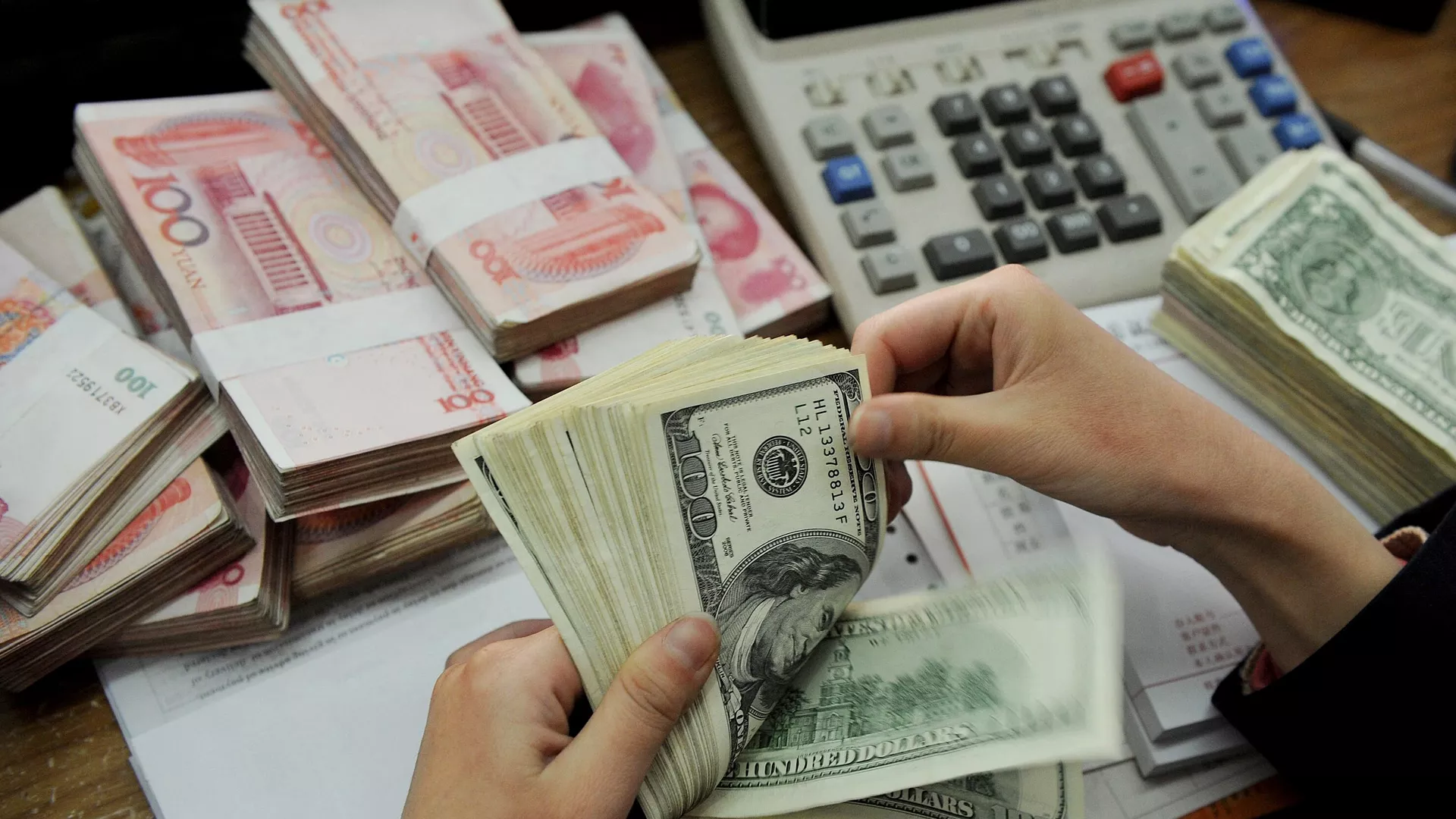
This photo taken n January 16, 2011 shows a bank teller counting stacks of US dollars and Chinese 100-yuan notes at a bank in Hefei, east China's Anhui province. - Sputnik International, 1920, 18.05.2024

© AFP 2023 / STR

Sputnik International

[…]

China sold off a record $53.3 billion of Treasury and agency bonds in the first quarter of 2024, a move seen as part of Beijing’s drive to diversify from US dollar assets. This comes as gold’s share in China’s official reserves rose to 4.9% in April, the highest on record.

“It is a wise decision to diversify away from USD and to hold physical gold in your own country instead,” Claudio Grass, an expert on monetary history, economics and an independent precious metals advisor based out of Switzerland, told Sputnik.

He called US bonds “a bad investment” because “they have not worked, especially since 2022, and are guaranteed to lose money.”

“Gold outperformed USD bonds by 75% since 2020. In addition, the USD has been used for decades already as a political weapon and with the arbitrary confiscation of assets due to pressure from the US government, the Chinese seem to be aware of the risk that their property could also be confiscated at any time,” the expert said.

Dwelling on a common trend of countries seeking to cut Treasury holdings and buy more gold, he said that “by now it should be obvious that the US government is the world bully today.

“In addition, there is the BRICS alliance which is gaining track and challenging the current world order. Also, emerging markets are buying up the gold because of these geopolitical changes and uncertainties. On top of it, they contribute today almost 50% to the world GDP vs only 19% in the year 2000; there is more capital available to exchange for physical gold,” according to the expert.

Asked how the latest developments could affect the greenback on the global markets, Grass argued that “it will lead to the collapse of the USD and the current system.”

He recalled that history shows that mankind has had “a major global economic crisis and major wars every 80 years.” Per Grass, the global community currently is “in the transit period and we don’t know yet what will come out of it. Physical gold, however, will shine and protect the people who own it.”

Bloomberg News earlier reported that China selling off Treasury bonds is “garnering renewed investor attention amid signs that tensions between the world’s largest economies may worsen.”

This comes as Beijing vowed to retaliate against the Biden administration’s tough new levies on a wide array of Chinese-made goods, ranging from semiconductors and solar power cells to electric cars – the latest move in the escalating trade war between China and the US.

The PRC’s Commerce Ministry warned that it would “take resolute measures to safeguard its own rights and interests” in response to the US’s 25-100% tariff hikes, accusing Washington of turning economic and trade issues into an instrument of “domestic political considerations.”
The developments were preceded by a spate of restrictive measures imposed on China by the Trump administration after it launched a trade war with Beijing in 2018, with Team Biden declining to roll back any of the restrictions put in place by its predecessors. China responded to the Trump-era measures with tit-for-tat restrictions on American exports, ranging from food goods to major American brand name products like Harley Davidson motorcycles and Jack Daniels whiskey.

In stark contrast, Beijing continues to deepen a comprehensive partnership and strategic interaction with Moscow, which was confirmed during Russian President Vladimir Putin’s recent talks with Chinese counterpart Xi Jinping as part of his two-day visit to China earlier this week.

Speaking at the opening ceremony of the eighth Russian-Chinese Expo and the fourth forum of inter-regional cooperation in Harbin on Friday, Putin underscored that Moscow supports Beijing’s intention to localize production on Russian soil and is ready to provide Chinese investors with privileges.

“Large-scale joint projects are also being implemented in the field of industrial cooperation, Chinese automakers are actively entering the Russian market… I would like to emphasize that Russia not only welcomes the attitude of Chinese business to localize production on our territory, but is ready to provide investors from China with economic benefits, assistance and support, as well as access to a unique Russian technological base, our highly qualified personnel,” Putin said.

He added that the Russian-Chinese “indissoluble partnership directly contributes to the growth of the economies of both countries, reliably ensures energy security, stimulates the creation of new industries and high-paying jobs, as well as improves the well-being and quality of life of our citizens.”

[…]

Via https://sputnikglobe.com/20240518/china-sells-off-record-amount-of-dollar-assets-as-us-remains-the-worlds-bully-1118514205.html

Israeli War Minister Threatens To Withdraw Support for Netanyahu


The Israeli PM Benjamin Netanyahu (left) and the War Cabinet Minister Benny (right).

The Israeli PM Benjamin Netanyahu (left) and the War Cabinet Minister Benny (right). | Photo: X/ @ShaykhSulaiman

teleSUR Newsletter

The Israeli government faces its biggest inner tensions as the international pressure demand a ceasefire and the recognition of Palestine as full-fledged state.

War Cabinet Minister Benny Gantz threatened on Saturday to leave the emergency government if Israeli Prime Minister Benjamin Netanyahu does not agree on a plan for a post-war Gaza by June 8.

At a press conference, Gantz demanded that the War Cabinet-composed of Netanyahu and Defense Minister Yoav Gallant-draw up a six-point plan including who could govern the devastated Palestinian territory.

Days before the latter, Gallant publicly contradicted Netanyahu by opposing any government of a military nature in the Gaza Strip once Zionist aggression ceased, and demanded a post-war plan.

Today there have also been protests in the centre of Tel Aviv, where thousands of Israelis are demonstrating against the government and in favour of a truce agreement to release more than 130 hostages held in Gaza, of which at least thirty have already been confirmed as dead.

Gantz is an Israeli retired top general who polls shows up as the main Netanyahu’s political rival. his challenge could increase tensions in the increasingly unwieldy government and a Netanyahu appears flanked between threats from other political factions to withdraw their support and popular protests demanding his resignation and a ceasefire.

On the other hand, the army Chief of Staff Herzi Halevi criticized Netanyahu for the lack of political planning for an agreement after the war ended, in a moment which the international pressure and the killed by the Zionist offensive rose the 35.000.

As the Israeli politicians ask for a post war plan, the UN General Assembly (UNGA), 143 out of 193 countries voted in favor of the United Nations Security Council (UNSC) reconsidering Palestine’s integration as a full-fledged state, something that the Zionist government will not to take in count.

FBI Officials Instructed To ‘Stand Down’ on Jan. 6 After Targeted Individuals From Group They Infiltrated Decided Not to Come to DC

January 6 Committee Hearing: Key Moments of Testimony You Might Have ...

By Hellbound and Down

The Federal Bureau of Investigation continues to cover-up how the government entrapped Americans who demonstrated at the January 6 Save America rally.

In response to a Freedom of Information Act request, the FBI released a trove of internal documents on May 7 on “The Vault” section of its website titled “United States Capitol Violence and related Events of January 6, 2021 Part 35.”

Email correspondence among FBI officials in the days leading up to Jan. 6, real-time reactions to violence at the fedsurrection, and guidance of the bureau’s response to the Capitol riot are among the 107 pages of newly released documents.

But the most interesting aspect of the FOIA drop is the information the bureau concealed. The increasingly lawless agency, that continues to surveil and terrorize Americans who protested that day, heavily redacted nearly every page of the records, hiding all evidence potentially indicating malfeasance.

Despite a frustrating number of the pages being redacted,  some interesting tidbits remain among the scraps.

An email thread with the subject line, “Stand down. See Below” was sent at 5:46 pm the day before the massive crowd of demonstrators was bombed, gassed and shot by police at the Capitol.

“We are standing down in [REDACTED]. The predicated subjects have been [REDACTED]. [REDACTED] is being informed. The only people from the group who are continuing to DC are non-subjects, who are not carrying weapons, and appear to be solely involved in legal First Amendment protesting,” states one of the emails from the thread.

[…]

Via https://hellboundanddown.com/2024/05/18/newly-published-records-show-fbi-officials-were-instructed-to-stand-down-the-day-before-jan-6-after-targeted-individuals-from-a-group-they-had-infiltrated-decided-not-to-come-to-dc/


Thomas Massie Introduces Bill to Abolish the Federal Reserve

Kentucky Rep. Thomas Massie defended his family's gun-toting holiday greeting card, saying he ...


By

“Americans would be better off if the Federal Reserve did not exist. The Fed devalues our currency by monetizing the debt, causing inflation.” – Thomas Massie

Rep. Thomas Massie (R-KY) has introduced a new bill called H.R. 8421, known as the Federal Reserve Board Abolition Act, with the intention of abolishing the Board of Governors of the Federal Reserve as well as the Federal Reserve banks. The legislation also aims to repeal the 1913 Federal Reserve Act, which established the Federal Reserve System.


Massie strongly believes that the Federal Reserve is responsible for the current inflation crisis gripping the nation. He argues that during the COVID-19 pandemic, the Federal Reserve printed trillions of dollars and loaned them to the Treasury Department, fueling unprecedented deficit spending. According to Massie, this process of debt monetization has devalued the dollar and led to the high inflation rates observed today.

In Massie’s view, debt monetization is a collaborative effort between various entities, including the White House, Federal Reserve, Treasury Department, Congress, Big Banks, and Wall Street. He claims that this coordinated effort disproportionately benefits the wealthy and connected while adversely affecting retirees whose savings are eroded by inflation. Massie asserts that the most effective means of combating inflation is the elimination of the Federal Reserve.

[…]

Via https://www.redvoicemedia.com/2024/05/end-the-fed-thomas-massie-introduces-bill-to-abolish-the-federal-reserve/

Fake scientific studies forcing closures of medical journals

medical, doctor, emt-312324.jpg

By Sharyl Attkisson

The following is an excerpt from MedPage Today via Wall Street Journal.

Fraudulent studies have infiltrated top scientific journals, “leading to thousands of retractions and millions of dollars in lost revenue,” the Wall Street Journal  reported.

“Although this large-scale fraud represents a small percentage of submissions to journals, it threatens the legitimacy of the nearly $30 billion academic publishing industry and the credibility of science as a whole,” the article stated.

Wiley, a 217-year-old publisher based in Hoboken, New Jersey, which is slated to close 19 journals, has taken the largest hit, WSJ reported.

The problem is due to paper mills — entities that, “for a price, will list a scientist as an author of a wholly or partially fabricated paper,” WSJ noted. The paper mills then submit the work, “generally avoiding the most prestigious journals in favor of publications such as one-off special editions that might not undergo as thorough a review and where they have a better chance of getting bogus work published.”

And, on the other side, there are motivating factors at play, WSJ noted.

“World-over, scientists are under pressure to publish in peer-reviewed journals — sometimes to win grants, other times as conditions for promotions,” WSJ wrote. “Researchers say this motivates people to cheat the system. Many journals charge a fee to authors to publish in them.”

At Wiley, closures are due to multiple factors, WSJ reported. Though a spokesperson for Wiley confirmed to WSJ that some of the journals were affected by paper mills, they declined to provide an exact number.

Link to article here.

[…]

Via https://sharylattkisson.com/2024/05/fake-scientific-studies-forcing-closures-of-medical-journals/

Dissecting the New York Times’ Disgusting Plea for Vaccine Amnesty

A Midwestern Doctor

Story at a Glance:

•Repeatedly forcing the public (e.g., through mandates) to use unsafe and ineffective therapies (that injured millions) has created a public relations disaster for the establishment.

• Various attempts have been made to do the impossible—restore the public’s trust in our medical institutions without any of them admitting fault.

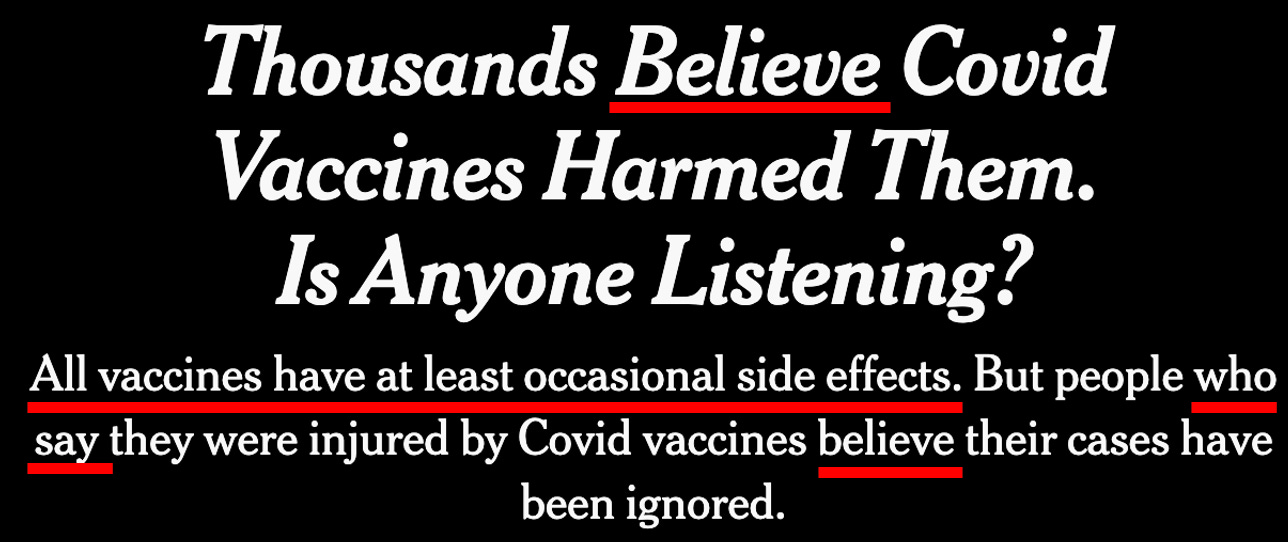
•Here, I review each of the previous attempts and how they were used to create the recent infamous article by the NYT—which while monumental for bringing attention to the COVID vaccine-injured, also repeats a variety of strategic and very harmful lies to protect the vaccine industry.

•One of the mysteries of the COVID-19 response is what could have possibly justified breaking the public’s trust in the medical institutions our society revolves around. Here I will review the most compelling explanations we’ve come across after three years of investigating this commonly asked question.

For decades, I’ve noticed propaganda campaigns in the media will subtly signal what is in the works and it’s been a longstanding challenge for me to see if I can use those signals to accurately predict the future (e.g., this is how I predicted the course of the pandemic at the end of 2019).

In organic chemistry, one of the common subjects students are tested on is chemical synthesis. In synthesis problems, students are given a set of chemical reactions that can be performed, and are then expected to deduce how a combination of those reactions can be sequentially performed to transform a starting chemical to the desired final product.

The reason it’s essentially possible to “predict” the future by studying a public relations (propaganda) campaign is that like the synthesis problems, the PR field has a fairly limited number of tools to accomplish its agenda, and as a result, if you see one step being enacted, it often cleanly fits into a 10-step campaign you’ve seen conducted before (e.g., if it matches the 4th step of the previous campaign, you can reasonably infer the 10th step will likely to come to pass in the future).

As a result, I tend to view many media campaigns as “synthesis” problems. I consider their sponsors’ likely goals, the sequential steps that would need to be taken to enact those goals, and then see if what I’m currently observing fits into one of those sequences.

In turn, I’ve been amazed at how frequently this process has allowed me to know what’s in the pipeline, and over the years, I’ve reached a few key conclusions:

1. Synthesis problems are something college students typically struggle with (while not that complicated, they differ from the typical “first-order” thinking students are typically tested on, where they are just expected to memorize things and then regurgitate them). I believe this same blind spot is what prevents people from recognizing that when the same propaganda “synthesis” campaigns are conducted in the media again and again.

2. While propaganda is incredibly effective and appears monolithic (e.g., consider the complete insanity it made people unshakably believe throughout COVID-19), the majority of people who orchestrate it typically aren’t that intelligent or creative. Instead, they tend to use the same proven steps again and again, which while not optimal, are effective enough to accomplish their goals because they always have the weight of the mass media behind them.

Note: one of the best illustrations of this was Trump’s interactions with the media, as he regularly gave the response which effectively countered the current PR campaign against him. Yet rather than adapt and effectively respond to Trump’s response, the entire media would double-down on its initial message, frequently leading to their PR campaign boosting rather than undermining Trump’s popularity. Yet, despite this approach clearly not working, the media kept on doing it, which I took as a sign their adaptability within their campaigns was actually quite limited.

3. One of the biggest “red flags” for me is seeing a propaganda campaign unfold that is structured in a significantly different way from the baseline I’ve come to expect from watching previous iterations of those campaigns.

For example, I am used to the media whipping up hysteria about an inconsequential infectious disease (e.g., bird flu) every few years. The key thing which told me COVID was going to turn into a global disaster was the fact during the first few months (November 2019-March 2020) the media instead downplayed it as much as possible (e.g., the “it’s just a flu bro” meme was everywhere and anyone who raised concerns about it was accused of being racist towards Chinese people). Given that the entire biosecurity apparatus has been begging for something like COVID-19 for decades to justify their existence (and funding), the fact that they were downplaying it signaled that something much more nefarious was in the works.

[…]

Via https://www.midwesterndoctor.com/p/dissecting-the-new-york-times-plea