The Most Revolutionary Act

Uncensored updates on world events, economics, the environment and medicine

The Most Revolutionary Act

This is Why They Hate Us: Biden Color Revolution in Bangladesh Becomes Bloody Riot

By Richard Abelson

Massacres and ethnic cleansing of Hindus continued in  Bangladesh after what many observers are calling a US-sponsored “color revolution”, apparently instigated by Former US Ambassador Peter Haas and Assistant Secretary of State Donald Lu. India is evacuating its citizens from Bangladesh as Muslim death squads target Hindus and even their former Communist allies.

India began evacuating non-essential diplomatic personnel from Dhaka, flying 400 people from Dhaka to New Delhi on Wednesday August 7, 2024 on special flights.

Hindu houses and businesses were attacked and looted by mobs in at least 27 districts yesterday, The Daily Star reported. Close to 25 people have been killed and over 150 hospitalized in the fire at the Zabeer International Hotel, which was set on fire by protestors on Monday.

In a video, Islamists can be seen encircling a dead victim lying on the ground, checking the victim’s private parts for circumcision. “Shouting ‘Hindu, Hindu’ over the corpse, the crowd hovering over the dead body laughs, realizing that the man is a Hindu because he is not circumcised,“ OP India reported.

The home of Hindu music star Rahul Ananda, a 140-year-old house in Dhaka, was looted and set on fire by an Islamic mob Monday, destroying his collection of 3,000 handmade musical instruments.

“They’re Hindus, kill them all”, Muslim youths said as they attacked a family of 4 Hindus in in Rajkot district.

Muslim radicals Jamaat-e-Islami turned on their former allies of the Communist Party of Bangladesh, killing and mutilating their leaders.

[…]

Via https://www.thegatewaypundit.com/2024/08/this-is-why-they-hate-us-biden-color/

Resisting the New Green Colonialsim


Picture by Green Prophet

By Saber Ammar

In recent months, discussions about green hydrogen in Tunisia have dominated the media, particularly concerning the memorandum of understanding (MoU) signed on May 28, 2024,between TotalEnergies (a French multinational integrated energy and petroleum company), Eren Groupe (a French company specializing in renewable energy and resource efficiency), Verbund (Austria’s leading electricity company), and the Tunisian government. This MoU aims to explore the implementation of a large green hydrogen project named “H2 Notos.” The project is intended for export to Central Europe via the “SoutH2 Corridor” pipelines, which run from the Northern African coast in Tunisia through Italy, Austria, and Germany; it aims to produce 200,000 tons of green hydrogen annually during its initial phase, with the potential to scale up production to one million tons per year in South Tunisia. This infrastructure enables the supply of low-cost renewable hydrogen produced in the South to key European demand clusters and is expected to be fully operational as early as 2030.

Shortly thereafter, on May 31, 2024, another MoU was signed with the Saudi company ACWA. This agreement plans to produce 600,000 tons of green hydrogen annually in three phases, also for export to Europe. Tunisia is now experiencing a surge of interest in hydrogen. On July 29, 2024, Industry, Mines, and Energy Minister Fatma Thabet Chiboub signed six new MoUs with various foreign corporations from Britain, France, Belgium, and Germany. It’s as if the country is being swept up by a hydrogen fever.

Tunisia aims to position itself as a hub for green hydrogen production, with ambitions to export six million tons annually by 2050, as outlined in the Tunisian Hydrogen Strategy. Despite its renewable-energy potential, Tunisia currently faces a significant energy deficit, which stood at approximately 50 percent in 2022. Tunisian Secretary of State for Energy Transition Wael Chouchane has emphasized the potential of green hydrogen to address the country’s energy deficit and generate substantial employment opportunities.

However, rather than prioritizing domestic renewable-energy investments to generate green electricity to close this gap, the government plans to use this electricity to produce green hydrogen for export to the EU. This approach, while central to Tunisia’s energy transition strategy, mirrors similar initiatives in other African nations, such as Namibia, South Africa, Egypt, and Morocco.

Critics argue that the EU’s push toward a green hydrogen economy, touted as mutually beneficial for both the EU and exporting countries from the Global South, neglects several critical issues. These include the potential negative impacts on water resources, energy access, as well as concerns over land grabbing and displacement. Moreover, the economic gains for Southern countries may be limited, as they continue to import high-added-value technologies while exporting raw materials with lower-added value, reinforcing unequal trade relationships.

Despite EU Commissioner Ursula von der Leyen’s assertion in her speech on June 16, 2022, that “the idea of spheres of influence are ghosts of the last century,” it appears that Africans are still operating within the sphere of the EU. It is clear that the EU, especially Germany, is pushing for a green hydrogen economy where they dominate the value chains and technologies while externalizing the socio-environmental costs to the peripheries (i.e., the Global South). This can be seen as a new form of energy imperialism, where European countries, or more broadly, the imperial cores, aim to use the continent as a battery for their needs.

There is nothing new here; it strongly echoes the colonial past. EU countries continue to have an essential need to extract resources and wealth from their peripheries, especially from Africa. The raw materials these regions possess, combined with an undervalued and disciplined labor force, continue to sustain the so-called developed world while causing a massive flow of wealth and resources from Africa to Europe. This pattern of exploitation and economic constraint is not new and strongly resonates with the arguments made by Walter Rodney in How Europe Underdeveloped Africa. In this book, Rodney explains how European colonialism systematically extracted wealth from Africa and imposed structures that hindered the continent’s capacity for self-sustained development. The ongoing extraction of resources under the guise of projects like the green hydrogen initiative in Tunisia risks perpetuating this cycle of dependency and exploitation, undermining local energy sovereignty and development.

The green hydrogen pipedream was introduced to Tunisia by Germany following the signing of a MoU in December 2020. During the last four years, the German Agency for International Cooperation (GIZ) funded and shaped the national hydrogen strategy. By mid-2024, the first MoU for the production and export of green hydrogen by the private companies mentioned above was signed.

However these foreign-dicated neocolonial green hydrogen projects are not passively accepted by Tunisians but are questioned and scrutinized. There is even popular resistance. On April 24, coinciding with World Anti-Colonialism Day, a small protest took place in front of the GIZ Energy Cluster in Tunis. The protest was organized by a coalition of organizations, including the Stop Pollution Movement, trade unions, student unions, political parties, and pro-Palestine activists. These activists joined the protest as they wanted to highlight that Germany not only is pursuing neocolonial projects in Tunisia but is also complicit in and actively supporting the genocide in Gaza by being the largest European supplier of weapons to Israel, providing 30 percent of Israel’s weapons between 2019 and 2023.

During the protest, one of the main demands focused on blocking and stopping the planned water and land-intensive green hydrogen projects and denouncing the German organization’s control and influence over the Tunisian energy agenda. This explains the target and place of the protest in front of the GIZ Energy Cluster, rather than the nearby Ministry of  Industry, Mines, and Energy. Protestors believe that GIZ is the main decision-maker when it comes to renewable energies and green hydrogen.

The protestors called for energy sovereignty that is people-centric and a just energy transition that serves the country’s needs first.

According to the Tunisian national hydrogen strategy supported by GIZ, the plan is to use 248 million cubic meters of desalinated water by 2050, which equals the consumption of five million Tunisian citizens—approximately half the current population in a country considered one of the most water-scarce in the world. The planned green hydrogen production in Tunisia is also land-intensive, requiring 500,000 hectares (twice the area of Greater Tunis) to produce the renewable energy necessary for hydrogen production that will be exported. This land, referred to as the “hydrogen valley,” is located in the southern part of Tunisia, a region already suffering from severe water scarcity and some land conflicts.

The southern region is known for its communal land belonging to Tunisian tribes and locals who use it for pastoralism and small-scale farming. The hydrogen strategy fails to address how this land will be acquired, raising concerns about land grabbing. An article by the Working Group for Energy Democracy discusses this particular issue occurring in South Tunisia by profit-driven energy corporations, highlighting the disconnect between the strategy’s goals and the needs of local communities. Besides, it seems absurd that a country that imports its own food uses its land and water for hydrogen production to serve another country’s energy needs. After the signing of the two MoUs mentioned above, several social movements, including the Stop Pollution Movement and the Tunisian Forum for Social and Economic Rights, published statements. They consider green hydrogen production and export to be another mechanism of plunder that primarily serves the EU’s energy needs.

It is worth mentioning that the Tunisian parliament has been tasked to discuss a new draft law to encourage green hydrogen. However, this draft law primarily offers foreign investors harmful tax incentives and advantages. This means there is a pressing need to engage with parliamentarians on this issue as well. When there is resistance, there is hope. A just transition is possible for Tunisia and the entire African continent.

[…]

Via https://braveneweurope.com/saber-ammar-resisting-the-new-green-colonialism

American Big Tech Companies Identified as Complicit with War Crimes of Israeli Zionist Extremists as Their Stock Market Value Continues to Crumble

by Brian Shilhavy
Editor, Health Impact News

More bad news for America’s Big Tech industry, at the worst time possible, as the AI bubble continues to burst.

While most of us living in the U.S. are fully aware that America’s Big Tech companies, such as Google, Amazon, and Microsoft have become the new industry leaders in obtaining military contracts to support America’s many wars, people in the Middle East have just recently learned this fact this week with a recent report showing how the Israeli military depends upon these American companies to bomb and kill Palestinians in Gaza, and they were probably involved in the recent high-level assassinations in Iran and Lebanon as well.

Here is an article published in TRTWorld, Turkey’s largest English language news outlet, and one of the largest in the Middle East.

How Israel uses tools from Microsoft and Google to carry out Gaza genocide

Colonel Racheli Dembinsky, commander of Israeli army’s Center of Computing and Information Systems Unit, reveals use of cloud storage and AI services during a presentation to around 100 military and industrial personnel, reports say.

The Israeli military has been using Amazon’s cloud service and artificial intelligence (AI) tools from Microsoft and Google for military purposes amid the increasing amount of data on Palestinians and Gaza during its genocidal war, according to reports by 972 Magazine and the Hebrew-language news site Local Call.

An audio recording they obtained reveals that Colonel Racheli Dembinsky, commander of the Israeli army’s Center of Computing and Information Systems Unit, disclosed the use of these technologies during a presentation to around 100 military and industrial personnel on July 10.

The Center of Computers and Information Systems oversees all data processing for the Israeli army.

Dembinsky’s presentation, the first public confirmation, indicated the army’s use of cloud storage and AI services from civilian tech giants in its ongoing carnage in since October last year.

The logos of Amazon Web Services (AWS), Google Cloud and Microsoft Azure appeared twice in Dembinsky’s lecture slides, which highlighted the army’s “operational cloud” typically stored on internal military servers.

Dembinsky described this internal cloud as a “weapons platform” that includes applications for marking bombing targets, a portal for viewing live drone footage over Gaza’s skies, and fire, command and control systems.

She noted that following the Israeli army’s ground invasion of Gaza in late October 2023, “the internal military systems quickly became overloaded due to the enormous number of soldiers and military personnel who were added to the platform as users, causing technical problems that threatened to slow down Israel’s military functions,” according to 972 Magazine.

Tel Aviv has killed nearly 40,000 Palestinians, mostly women and children, and wounded over 92,000 others. Thousands have perished under the debris of bombed homes while some 10,000 Palestinians have been abducted by Israeli troops.

Cloud services enhance Israel’s operational efficiency

Dembinsky emphasised that cloud services from major tech firms offer unlimited storage without the obligation to physically store the servers in the military’s computer centers.

She highlighted the advanced AI capabilities provided by these services as the most significant advantage.

Working with these companies has granted the Israeli army “very significant operational effectiveness” in the besieged Palestinian enclave, she said. (Full article.)

This was also headline news today at the Al-Mayadeen English news publication, one of the largest Arab English news sites in the Middle East based out of Lebanon.


The internal cloud used by the occupation regime consists of applications that enable marking bombing targets, viewing live drone footage of Gaza’s sky through a portal, and fire, command, and control systems.

The Israeli army has been using Microsoft and Google’s artificial intelligence (AI) tools and cloud services from Amazon for military operations for its genocide in Gaza, Israeli news outlets +972 Magazine and Local Call reported, which was confirmed by the Israeli Army’s Center of Computers and Information Systems last month.

This information was publicly confirmed for the first time through Israeli media’s attainment of an audio recording of Col. Racheli Dembinsky, commander of the Center of Computing and Information Systems Unit, revealing the use of these technological services from these civilian tech firms during a presentation attended by 100 military and industrial personnel on July 10.

During Dembinsky’s presentation, logos of Amazon Web Services (AWS), Google Cloud, and Microsoft Azure appeared twice in her lecture slides, ultimately disclosing the occupation army’s “operational cloud” which is usually stored on internal military servers. The Israeli commander described the cloud as a “weapon platform.”

The internal cloud used by the occupation consists of applications that enable marking bombing targets, viewing live drone footage of Gaza’s sky through a portal, and fire, command, and control systems.

Google expands partnership with ‘Israel’ during genocidal war on Gaza

Google negotiated with the Israeli occupation to deepen their partnership during the brutal war on Gaza, which has entered its seventh month recently with over 39,000 Palestinians killed, mostly women and children, a Google document viewed by the TIME news site revealed in April.

The tech giant has provided cloud computing services for the entity for years.

This report comes shortly after it was exposed that the Israeli military’s airstrikes against individuals in Gaza utilized a previously undisclosed AI-powered database, dubbed Lavender, while forces operating the technology were authorized to kill 15 to 20 civilians during airstrikes allegedly targeting Resistance fighters.

The document indicates that the Israeli Ministry of Security has a designated “landing zone” within Google Cloud. This secure access point provides the Ministry with the ability to store and process data, as well as access AI services offered by the firm. (Full article.)

The timing of this revelation to countries in the Middle East could not be worse, as more and more investors on Wall Street are waking up to the fact that generative AI is a huge bubble that has sucked in $trillions from the U.S. economy for over a year and a half now, with virtually nothing to show for it other than more promises for the future.

AI Adoption Reality Check: Tech CEO Warns ‘Very Little Is Fundamentally Different Because Of GenAI’

AI “is overhyped, with many applications not ready for prime time,” warned iconic hedge fund Elliott Managment last week in their latest letter to investors:

And further, we think a good proportion of the purported use cases are never going to be cost efficient, are never going to actually work right, will take up too much energy, or will prove to be untrustworthy. But right now, the scramble for facilitating super-chips, together with the compulsion to jump on board the hype train, is causing a radical skew in the market values of the anointed.

Elliott’s view echoes that of Goldman Sachs head of research Jim Covello, who warned:

“…the promise of generative AI technology to transform companies, industries, and societies continues to be touted, leading tech giants, other companies, and utilities to spend an estimated ~$1tn on capex in coming years, including significant investments in data centers, chips, other AI infrastructure, and the power grid.

But this spending has little to show for it so far beyond reports of efficiency gains among developers. And even the stock of the company reaping the most benefits to date – Nvidia – has sharply corrected.“

All of which brings us to today and eye-popping comments from Airbnb CEO Brian Chesky that reality-checked AI applications…

“Generative AI, ChatGPT 2 launched late November 2022. When it launched, I think we all got like incredibly excited. It was kind of like the moment probably some of us first discovered the Internet or maybe when the iPhone was launched.

And when it was launched, you had this feeling that everything was going to change.

But I think one of the things we’ve learned over the last say 18 months or nearly two years, 22 months since ChatGPT launched is that it’s going to take a lot longer than people think for applications to change.

But if you look at your home screen, which of your apps are fundamentally different because of the AI? Like fundamentally different because of generative AI. Very little, especially even less in e-commerce or travel. 

(Source.)

Why Big Tech’s Relationship to the Extremist Zionist Israelis is a BIG DEAL!

While this recent news that American Big Tech companies are providing military assistance to Israel may seem insignificant to those of us living in the West, I can assure you that this is very significant news in the Middle East, and for the future of American Big Tech companies.

As I write this on Wednesday, August 7th, 2024, an emergency meeting of the Organization of Islamic Cooperation (OIC) just ended a couple of hours ago in Saudi Arabia, to discuss how to deal with Israel, whom they claim has now become a rogue terrorist state that threatens every Muslim country in the Middle East.

As this war in the Middle East proceeds, there will be a lot of pressure for Middle Eastern countries to divest their investments into companies who support Israel, which has already been happening in the U.S. at American colleges and universities since earlier this year.

This spells trouble for the rich Muslim Gulf States who are heavily invested in Big Tech and Silicon Valley, especially Saudi Arabia, who owns significant stock in Musk’s X, and has a Venture Capital firm that invests $billions in American Big Tech.

Saudi Arabia has been increasing their investments in American Big Tech companies for the past several years in their desire to diversify their national assets beyond just petroleum and petroleum products.

How much longer will they keep those investments in place, as it becomes more and more obvious that they are overpriced due to this AI bubble that is crashing, and that now the entire Muslim world associates these Big Tech companies with Zionist Israel and the genocide currently happening there?

Oh yes, this is a VERY BIG deal, and the safe bet here is that the wealthy Arab states, beginning with Saudi Arabia, will be compelled to divest their interests in American Big Tech due to their being complicit with Zionist Israel.

[…]

Via https://vaccineimpact.com/2024/american-big-tech-companies-identified-as-complicit-with-war-crimes-of-israeli-zionist-extremists-as-their-stock-market-value-continues-to-crumble/

Mongol Queens and the Contest for Empire

The Secret History of the Mongol Queens - Audiobook - Walmart.com - Walmart.com

Episode 10 Mongol Queens and the Contest for Empire

The Mongol Empire

Dr Craig Benjamin (2020)

Film Review

Following Ogedei’s death in 1241, all Mongol military commanders were expected to withdraw from their campaigns in Eastern Europe and China to attend the kuritai to appoint his successor. As those from the western front passed through the Venetian and Genoese colonies on the Black Sea, they exchanged their prisoners (who the Venetians and Genoese sold into slavery) for commercial goods. Many prisoners were sold as slave-soldiers (Mamaluks) to the Sultan who ruled Egypt.

According to Benjamin, Ogedei’s major achievements were

  • establishing an empire-wide communication system
  • establishing a magnificent capitol that became a major trade, cultural and religious center for Muslim, Buddhists, Daoists and Christians
  • reestablishing the Silk Road linking Asia to Europe, enabling the transmission of new knowledge (most importantly of gunpowder, printing and paper) from China to Europe

Because the alcoholic Ogedei was often too drunk to conduct state affairs, he gave his wife Touragine immense administrative authority. Other Mongol military commanders also left their wives in charge of their minqans while they were away at battle. This meant, in effect, that women ruled the largest empire in history for approximately 10 years during the Khwarazmian campaign.

Following Ogedei’s death, Touragene became regent pending a new kuritai. She promptly dismissed the Persian administrators responsible for Ogedei’s new tax system, reappropriating tax revenues to support her campaign (via bribes) for her son Kuyuk to become Great Khan

The kuritai was delayed for five years because Batu, who opposed Kuyuk’s election as Great Khan, refused to return from the Kipchak Steppes. Prior to his death, Ogedei stripped his oldest son Kuyuk of his rank and exiled him to China for insulting his cousin Batu’s parentage.*

Batu eventually sent his two sons in his place, and in 1246 the kuritai elected Kuyuk the third Great Khan. Following the latter’s sudden death in 1248, his chief wife Oghue Qaimesh became regent.

Equally powerful was Chinggis Khan’s daughter-in-law Sorkaktani, who became the wife of Chinggis Khan’s youngest son Tolui when he was 13. Following Tolui’s death, Chinggis Khan gave her an estate in Zehngdinng in the former Jin empire. Her son would become Qubilai Khan, founder of the Yuan Dynasty. She helped the former Jim empire recover from the ravages of war by setting up a farming estate system, reforming the tax system and creating numerous commercial ventures.


*His father Jochi, conceived his mother’s kidnapping, was only a stepson of Chinggis Khan.

Film can be viewed free with a library card on Kanopy.

https://www.kanopy.com/en/pukeariki/watch/video/12373094/12373114

From East to West Africa: People Rising Up Against Colonial Oppression and Corruption

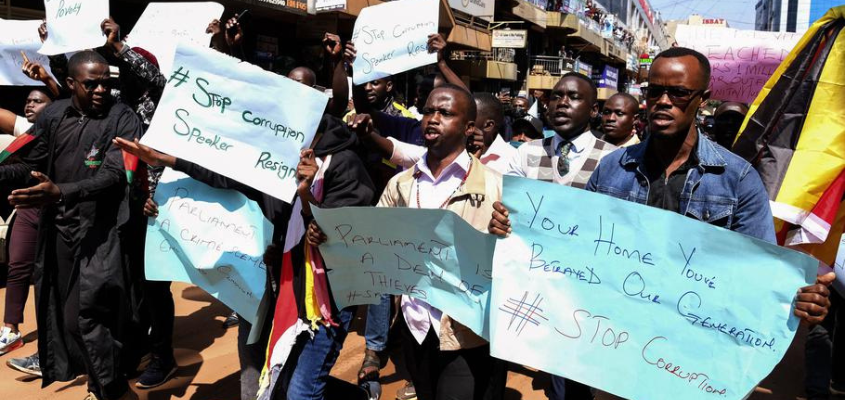
Protest in Uganda

Waves of uprisings are spreading across the African continent and the masses are demanding freedom from imperialist powers and the comprador leaders that enable their ongoing exploitation. There are lessons to be learned from the past and current attempts at creating a unified Pan-African force that can free the continent from the clutches of empire.

Ferdinand Ibebuchi

The time for Africans to reclaim their land, dignity, and future is now. The only means by which Africans can achieve liberation and self-determination is through collaborative unity, in the form of scientific socialism. A divided continent will only remain mired in the exploitation and degradation that has defined its very existence since the imposition of colonialism a century and a half ago.

Today in 2024, the African continent is still recuperating from the stranglehold of European colonialism. While most of its nations achieved what can ostensibly be called “flag independence” during the 20th century, colonial powers continued to exert enormous economic, political, and military influence. As Kwame Nkrumah stated, ‘The African “nations” of today, created artificially by foreigners for their own purposes…continue to struggle on, each one separately, in a pathetic and hopeless attempt to make progress, while the real obstacle to their development, imperialism, mainly in its neo-colonialist stage, is operating on a Pan-African scale.’

Western imperialism in the form of neocolonialism has served to deprive Africans of real political power in their homelands and trapped them in dire poverty, despite the immense mineral wealth underneath their feet. But recently, the masses have taken to the streets to voice their righteous anger at the neglect and corruption of their leadership, and its self-enriching collusion with western capital.

Over the last three years, the African Sahel region has witnessed a wave of coups in several countries. Out of these, the three that appear to have progressive potential, occurred in the Sahel regional nations of Mali, Burkina Faso, and Niger. Recently, the three countries have convened to form the Alliance of Sahel States(AES), in order to expand cooperation on key matters including defense from both internal threats and from external western aggression. This confederation came into being just months after the three countries withdrew from the hub of western influence on the continent known as the Economic Community of West African States (ECOWAS) in January of 2024. In an additional act of sovereignty, Niger expelled the French and U.S. military from their country.

Also, in June of this year, protestserupted in Kenya against a controversial tax bill that would have made essential commodities significantly costlier. Kenya’s President, Willam Ruto, indicated that the tax hikes were necessary to pay off exorbitant loans from the International Monetary Fund (IMF). This was a troublesome betrayal for millions of struggling Kenyans. In the minds of many Kenyans, Ruto was directly linked to the IMF, an imperial tool of the West that is used to gain access to global south resources., As a result, the protests have continued, along with calls for Ruto’s removal, despite his withdrawal of the tax hike.

Furthermore, in July of this year, widespread protests against corruptionhave emerged in Uganda, which like Kenya, is a former British colony in east Africa. Since Yoweri Museveni became what appears to be president for life in 1986, his regime has imposed mass privatizationsand sold Ugandaʼs assets to international financiers, as he and his cronies benefited through corrupt deals. This widespread looting of resources has had a catastrophic effect on the working class and the rural masses.The national poverty rate in Uganda is a dreadful 41 percent. And, between 2013 and 2017, poverty in Uganda increased from 6.7 million to 10 million people, in a nation with a population ofover 48 million people. At the same time, income inequality has skyrocketed.

Most recently, Nigeria, Africa’s most populous country, is struggling with soaring inflation and a sharply devalued naira currency after President Bola Ahmed Tinubu introduced IMF reforms a year ago which were supposedly aimed at reviving the economy. Undoubtedly spurred by the wave of anti-corruption and anti-colonial activism across the continent, Nigerians have taken to the streetsto protest against the rising inflation rates, the dire unemployment and the crippling hunger. The standard of living in Nigeria has been in decline for decades. And as the living conditions worsen, economic desperation increases, which further feeds into the corruption that’s endemic in the political culture.

The most important lesson the continent can learn from the AES is the importance of Pan-African unity and cooperation. The current system and political culture in Africa which facilitates the poverty and desperation of the masses, while generating the obscene wealth of the elite, needs to be completely uprooted. In addition to wiping clean this current slate of malevolent political actors, there must also be a complete severing of ties with neocolonial western masters. The AES has become an exemplar of all these actions.

While western media and governments focus on the cosmetics of “democracy” in Africa, they pick and choose where such democracy exists and where it does not, and hence who’s an enemy or not. Meanwhile, only nations whose leaders are willing to prioritize western capital at the expense of its people are deemed to have a sufficient “democracy.” But no true democracy can exist where there is such widespread poverty and deprivation. Only through cooperative unity can Africa defend itself from outside aggression and exploitation. And only through scientific socialism, as advocated by Nkrumah himself, can Africa develop itself sufficiently according to the needs and potential of its people. The time is now for Africa to rid itself of the chains of bondage and servitude and to achieve its true destiny of greatness.

[…]

Via https://libya360.wordpress.com/2024/08/07/from-east-to-west-africa-the-people-are-uprising-against-colonial-oppression-and-corruption/

What’s causing the Islamophobic riots across the UK, and why now?

Riots Erupt In England After Teenage Child Of Migrants Goes On Stabbing Spree | ZeroHedge

David Miller – Via Vanessa Beeley Telegram

1. The riots have been instigated by the Zionist asset Stephen Yaxley-Lennon (‘Tommy Robinson’), who has been working for the State of Israel since 2009 as part of the so-called ‘counterjihad’ Islamophobia movement established by that state. When his organisation, the English Defence League, was incorporated in 2011, two years after its inception, it was named the English & Jewish Defence League. The Jewish Defence League, a Zionist terrorist organisation, has been a key part of violent Islamophobic street thuggery in the UK over the past decade.

2. Yaxley-Lennon is one of the most high-profile actors in the State of Israel’s Online Influencers Programme in response to Operation Al-Aqsa Storm. He and others, like Oli London, Noa Tishby, Hen Mazzig, Arsen Ostrovsky and Emily Schrader (and many others) are paid to distribute Zionist propaganda, of which pushing back against pro-Palestine protests and sowing Islamophobia are two important and interlinked aims.

3. The recent Islamophobic riots in the UK should be seen as the latest phase of the State of Israel’s war on British Muslims, who it sees as originating the protest movement in the UK. These riots are designed to punish Muslims for their anti-Zionist sentiment after various other methods to suppress opposition to Zionism by the State of Israel have been thwarted. The State of Israel’s attempts to use its assets and operatives in the British political and media class — such as Suella Braverman and Michael Gove — to thwart pro-Palestinian protests have failed. Zionist counter-protests have failed to mobilise significant numbers. Sporadic Zionist thuggery and the use of other assets — such as Iranian secularist extremists — have also failed to intimidate Muslims. So now the State of Israel is weaponising its cannon fodder on the white nationalist far-right, who have greater numbers than either Zionist street thugs or Iranian monarchists and secularist extremists.

4. Finally, there are also questions about which actor authored the idea that Muslims were responsible for the ostensible triggers for these events. MI6 and its assets (eg Paul Mason) are desperately trying to pretend this was a Russian disinfo op. But the original stories did not come from Russia. Where did they come from?

Arab tribes seize control of US-occupied Syrian towns in large-scale assault

(Photo credit: Rami Alsayed/NurPhoto via Getty Images)

The Crade

A coalition of Syrian Arab tribes seized several towns from US-backed Kurdish forces in the countryside of eastern Syria’s Deir Ezzor governorate on 7 August.

Tribesmen launched the “largest” attack on Syrian Democratic Forces (SDF) sites since the start of the Arab tribal rebellion against the US-backed militia last year, Sputnik reported, adding that the attack took place “under the cover of artillery and mortar shells.”

Syrian government militias have freed (from US occupation) Al Busayra and Dhiban.

“Violent clashes have been ongoing since the early morning hours between the forces of the SDF-linked Deir Ezzor and Hajin Military Councils on the one hand, and the attacking groups of the ‘Army of Tribes’ coalition on the other, in the vicinity of the towns of Abu Hamam, Dhiban, Al-Lattwa, Al-Kashkiya, and Gharanij,” the news outlet’s correspondent said.

The clashes were concentrated in the towns of Al-Sabha and Al-Tayana, east of Deir Ezzor, the correspondent added.

The Arab tribes used RPGs and machine guns against the SDF during the onset of the attack, according to Al Mayadeen.

“SDF militants imposed a complete curfew in the towns under their control in the Deir Ezzor countryside, after the arrival of large military reinforcements from Hasakah and Raqqa, coinciding with a wide search operation in the villages surrounding the areas of clashes,” the Sputnik correspondent went on to say.

Residents told Sputnik that many people were displaced as a result and that three civilians were killed while seven others were injured due to the fighting. Local sources also told the outlet that at least 10 SDF militants were taken captive by tribal fighters, who also seized large amounts of light and heavy weapons.

The SDF and the tribal coalition also took some casualties.

“Arab tribal fighters managed to damage three Hummer military vehicles in the vicinity of the American base in the Al-Omar oilfield,” Sputnik said.

The SDF imposed security belts and closed roads around several areas in Hasakah, northeastern Syria.

“American helicopters targeted a group of tribal forces using machine guns near the banks of the Euphrates River in the town of Dhiban, east of Deir Ezzor,” Al Mayadeen’s correspondent reported on Wednesday.

The US army also deployed reinforcements to the vicinity of its base in the Al-Omar oilfield.

Sheikh Ibrahim al-Hafel, who led the tribal rebellion against the US-backed armed group last year, was quoted by Al Mayadeen as saying on 7 August: “We will not accept submission to the SDF militants … [the tribes and] their sons have the right to liberate their areas from these militants.”

Arab tribes launched their rebellion against the SDF in late August last year, with fierce clashes raging for several weeks afterward.

Despite brief instances of de-escalation, tensions and armed clashes between the two sides have remained ongoing. At the time, it was said that the tribal forces were coordinating with and receiving military aid and training from the Syrian Arab Army (SAA).

“After continuous training received by the tribal forces during the past months, the tribes led by Sheikh Ibrahim Al-Hafel launched a violent attack on the largest in the cities and towns of Deir Ezzor, and took control of several military points in the city of Al-Busayrah and the towns of Ibriha, Al-Harijiya, Al-Tayana, Abu Hamam, Gharanij, Al-Kashkiya, Dhiban, Al-Latwa neighborhood, and all the riverside points,” Syrian journalist Mohammad Dabaa said on 7 August.

[…]

Via https://thecradle.co/articles/arab-tribes-seize-control-of-us-occupied-syrian-towns-in-large-scale-assault

Sharing UK Riot Images Online Can Be Criminal Offense

Director of Public Prosecutions warns: ‘Even just sharing images of riots online can be criminal.’

[…]

Via https://decripto.org/en/england-director-of-public-prosecutions-warns-even-just-sharing-images-of-riots-online-can-be-criminal-decripto-org-suspends-publication-of-articles-on-the-subject/

The Covid Plandemic: Superstition vs Lived Experience


By Doug Glaass

There are a variety of debates that one can jump into concerning the alleged pandemic. The viruses don’t exist crowd say that no scientific evidence exists that any virus has ever been isolated, so it follows that there was no novel virus.

Denis Rancourt’s research shows there was no viral spread in NYC. The most mainstream debate revolves around the virus’ origins; did it escape from a lab or did it have natural cause?

Listening to Jonathan Couey, who has been outspoken in his belief that not only was there never any pandemic, all of these debates distract from the idea – the truth – that the novel coronavirus is a mythology that must be destroyed. Those Rand Paul vs. Tony Fauci back-and-forths are debates put out not to determine whether the virus came from a lab or from nature, but rather to affirm the existence of a novel disease in the first place.

While I most certainly fall into the Couey camp, what I want to show is that it’s not necessary to analyze any of the evidence concerning the lab leak vs. nature debate, or pour through any of this research to come to the same conclusion as Couey.

All anyone has to do is look at their own lived experience from 2020 onward. Despite the media’s daily case-counter-porn, no honest person would say these reports were a reflection of their everyday lives. There were certainly reactions from health officials to a pandemic, just no pandemic. If there wasn’t actually a pandemic, it isn’t that much of a stretch to say there was never any novel virus.

[…]

This led me back to Couey who is still on Twitch and who you can support. I bring him up because my finding him (again) has inspired this particular output, and because I agree with him so completely that the real casualties of this psyop are our children. He goes much deeper into all of this and I highly recommend listening to his Gain-of-Function is the Scooby Doo villain analogy.

At the risk of appearing to pump my own tires saying I got it right before JJ or anyone (well, this elementary school teacher with a liberal arts degree apparently did figure it out almost four years before world famous evolutionary biologist Bret Weinstein), I’ve been of the opinion that there was no pandemic going back to September 2020 and tried showing this to my K-5 students very early on. I did so just by having them compare what they were hearing or being told to believe about the pandemic, and what they were actually experiencing.

Perhaps the most shocking realization in early 2020 was that using evidence to support an argument became completely and utterly ineffective as a means of doing so. Certainly when the idea you were arguing against was supported by evidence supplied by authority.

Even if this evidence was simply, “According to the CDC…” or “The FDA has determined that … ”, it was powerful and captured people who up until that point, seemed to be smart, critical thinkers.

In The Most Dangerous Superstion, author Larken Rose writes:

The belief in “authority,” which includes all belief in “government,” is irrational and self-contradictory; it is contrary to civilization and morality, and constitutes the most dangerous, destructive superstition that has ever existed. Rather than being a force for order and justice, the belief in “authority” is the arch-enemy of humanity.

(Rose is also responsible for The Jones Plantation, first a short and now a full length film you can purchase, and highly recommended)

It should be obvious to any critically thinking person that much of the madness that has taken place since March 2020 is a direct result of this religious belief. Some examples are the policies mandated by so many cities in the US and Europe requiring masks to be worn in public or on airplanes, or requiring restaurants to verify patrons’ vaccine status before allowing them in.

Never mind that no evidence has ever been shown that requiring any of these measures reduced the spread of contagious disease, or that prior to 2020 it was an accepted fact that masks were seen as a talisman at best [emphasis mine]:

We know that wearing a mask outside health care facilities offers little, if any, protection from infection… ….It is also clear that masks serve symbolic roles. Masks are not only tools, they are also talismans that may help increase health care workers’ perceived sense of safety, well-being, and trust in their hospitals. Although such reactions may not be strictly logical, we are all subject to fear and anxiety, especially during times of crisis.[1]

The general population cared little for such details and would respond in ways such as, and I’m generalizing of course, “Just do what they say, and you won’t get in trouble.” One can look at the comments on the Facebook/Twitter pages of any small business or restaurant that didn’t toe the line and see that it was either a false assumption that there was science to back the non-sensical measures, or just simply non-compliance that bothered people; whether or not complying actually made people safer.

There are still some (allegedly) real people who continue to advocate for mask wearing in public, and no medical intervention has ever had such a religious zeal attached to following it. The fact is that the focus of this debate has always centered on whether or not there is a benefit. In other words, do they work?

The pro-mask crowd has never, ever considered that there may be a cost to universal masking, especially in the school setting. It is always under the guise of reducing spread and “keeping kids safe” but no school or health official has ever put forth any evidence that it does either of these things.

Because there isn’t any.[2]

Like so many of the non-pharmaceutical interventions of 2020, no benefit-cost analysis was ever done regarding masks. This seems patently obvious to any rational person and I don’t need a study to know that putting masks on 4 & 5 year-olds, 10 year-olds or teenagers 8 hours a day for months on end causes deep psychological harm.

Most importantly, since we don’t “know” if and to what degree masks may be harmful if worn for extended periods – this question is never addressed by the mask stasi, or it is simply dismissed as superficial – it is impossible to determine whether or not they provide a net benefit.

I saw first hand the deleterious effect that masks had on young people working in an elementary school at the beginning of 2020. It is hard to imagine a group of people more compliant than public school teachers and so the mask requirement was dutifully enforced by them across the country. It’s been a lonely place for educators like me over the last four years, and I can only imagine how difficult it was for like-minded teachers in the northeast or Oregon, California or Washington.

In the fall of 2020, I was teaching a group of 2nd and 3rd graders. By this time, I was not only of the opinion that the coronavirus thing was a big psyop, I was starting to believe that there wasn’t actually a “pandemic” based on my own lived experience.

I was a specialist, meaning that I would go pick students up from their classrooms, and bring them back to a separate area to give them more individualized instruction. It was then that the damage that was being done to our most precious members of society really hit home, both figuratively and literally.

I was lucky in that being a specialist allowed me to fly below the radar of the mask stasi, allowing me not wear a mask while teaching. The kids, however, wore them without question, especially the younger ones. Anyone who has kids or has taught young kids knows why: they trust us implicitly, and want to please.

Teachers quite literally told children that masks were preventing people from dying, and that not wearing them could lead their unwittingly killing someone.

So sayeth Adults, so kids believeth.[3]

I didn’t realize how frightened they were until I actually asked them why they never took off their masks, even though I didn’t wear one and always told them they didn’t have to. When they told me why, it crushed me, especially since I knew that they were the least likely to suffer any complications across all age groups.

One day, I just posed the question to a small group of five kids: “Are you guys afraid of coronavirus?”

There wasn’t any hesitation – which in and of itself was a tell because all of them were non-native speakers and sometimes it was like pulling teeth to get an answer. All of them said “Yes.” I asked them why, and one of them said, “Because I don’t want to die.”

This may sound like a “that definitely happened” story, but for whatever it’s worth, I can assure you that it did.

My caseload was 27 students, between the ages of 5 and 10 years-old so I decided to ask the same question to all of them, and 26 of 27 gave that same answer.[4]

They were afraid. What broke me is the reason that they were afraid was not because they had looked into the matter themselves, of course, but for the same reason they wore the masks: Adults told them that this is what they should feel, and that implicit trust led to their having a completely unfounded fear of dying.

[…]

The next time I saw this girl’s group, I told all of them they could take their masks off, confident that she would be the first one to do so when in fact she was the only one who didn’t. I didn’t pressure her and continued on with the lesson. She volunteered the answer to a question but I couldn’t understand her, even when she repeated so I said, “Just take your mask down for a minute so I can understand.”

Within a few seconds, she was sobbing, still with her mask on. When I was finally able to understand what she was saying she told me, paraphrasing, “I don’t want to catch coronavirus and take it home and kill my parents.”

I don’t remember what happened after that to be honest, aside from reassuring her that this was absolutely not the case. I think I told her that all the other adults were wrong, and reminded her that parents had told her that she had nothing to be afraid of.

[…]

Then I finally asked them, “If this is what we imagined a world with a terrible disease going around would look like, but none of that is true about the world we live in, is there a terrible disease going around?”

The implication was hard for some kids to grasp at first, but most of them were pretty excited to understand. (Interestingly enough, when I did it for groups of high school students the following year, there was a large portion of them who suffered from some serious cognitive dissonance despite having given the same answers as their younger counterparts).

The most dangerous superstition has caused people to be afraid of something that runs contrary to what they see with their own eyes.

[…]

Via https://off-guardian.org/2024/08/07/the-virus-telenovella-teaching-the-plandemic/


How the Regime Captured Wikipedia

Wikipedia logo and symbol, meaning, history, PNG, brand
Ashley Rindsberg
  • Wikimedia’s Movement Strategy, which launched in 2017 with a plan to fund Wikimedia “in perpetuity” with its Wikimedia Endowment, was a significant pivot from Wikipedia’s mission: “where Wikipedia had been built on the principle of decentralized knowledge, the Movement Strategy would veer into the hyper-centralized space of top-down social justice activism and advocacy”
  • The Endowment is an independently governed long-term fund that bankrolls Wikimedia “projects.” It was set up as a donor-advised fund at progressive megafund Tides for its first seven years; Tides’ former General Counsel left to serve as Wikimedia Foundation’s top lawyer around this time
  • Flush with well over a hundred million dollars in cash, the Wikimedia Endowment has funded initiatives that seek to abolish the police and create an “intersectional scientific method,” among others

In 2019, a scandal ripped through the Wikipedia community when a Wikipedia admin who goes by the handle Fram was handed a year-long ban from the site. While known to few outside the tight-knit but feverishly active collective of Wikipedia contributors, the affair was part of a far-reaching, partisan shift at the open encyclopedia with widespread implications for the future of media, technology, and politics around the world.

Although contributor bans are not uncommon on Wikipedia, this case was different. Instead of coming from the English Wikipedia Arbitration Committee (Arbcom), the panel of editors empowered to make such decisions, the ban was handed down directly by Wikimedia Foundation (WMF), the NGO that owns the site.

Little more than 12 hours after the ban’s announcement, Wikipedia co-founder Jimmy Wales publicly intervened to help quell the storm by publicly assuring the community he was reviewing the situation, and later saying he’d “raised the issue with WMF.” A week later, two Wikipedia bureaucrats — high-ranking editors who can assign admin rights — and 18 admins — editors with enhanced rights — resigned in protest. Arbcom released a searing statement saying the top-down ban was “fundamentally misaligned with the Wikimedia movement’s principles of openness, consensus, and self-governance.”

At its lowest resolution, the controversy was born from the tension between the decentralized Wikipedia site and the highly centralized Wikimedia Foundation. In reality, the ban and subsequent backlash were tied to a massive culture shift at Wikipedia, precipitated by the rise of a new social-justice-minded power structure at Wikimedia Foundation.

The launch of Wikiproject Black Lives Matter in 2020 exemplified Wikipedia’s all-in pivot to DEI. Seeking to address what it called Wikipedia’s “systemic bias,” the project called for editors to enrich the content, and elevate the visibility, of pages like “Black Lives Matter,” “Police Brutality in the United States,” “Racism in Oregon” and “US National Anthem Protests.” Most importantly, the project represented a carve-out from Wikipedia’s foundational policy of providing No Original Research: instead of aggregating information from other sources, Wikipedia editors began both going to protests and proactively reaching out to photographers who would be willing to allow Creative Commons use of protest photography.

The controversy was ultimately about who would control the site containing “all the world’s knowledge,” and hundreds of millions in Wikipedia funding. Would the site’s community of decentralized, uncompensated editors continue to govern it according to its principles of openness, transparency, and neutrality, or would a handful of highly paid NGO technocrats re-orient Wikipedia toward endorsing and promoting the ever-shifting currents of the Western elite social justice regime? And how would Wikipedia respond to a revolution in American public life that challenged the idea that knowledge should be both neutral and objective as a vestige of white supremacy?

As the Wikipedia community (“communitah” in Wiki-speak) erupted over the scandal, a few crucial facts emerged. Fram was (and still is) a prodigious editor, with around 200,000 edits by the time of his ban. But he was also seen as sometimes being sharp-tongued with editors whose contributions he thought violated policy. One of those editors was Laura Hale, then an Australian PhD student whose Wikipedia contributions focused on feminism and women’s sports, particularly related to the Paralympic movement. Hale, who did not have admin status, had previously claimed that Fram had “harassed” her by leaving comments on her Talk page, where comments about an editor’s edits are aggregated.

In a FAQ about the ban, Wikimedia Trust and Safety offered no more than corporate policy-speak to explain why it had been issued, with no specifics supplied. “As described on the Metapage about Office actions, we investigate the need for an office action either upon receipt of complaints from the community, or as required by law. In this case we acted on complaints from the community,” was the most substantive piece of the explanation. As one Wikipedia editor put it, “Of all the non-answers I’ve seen in my life, that’s possibly one of the most long winded.”

In the thick of the #MeToo movement ripping through America, an allegation against a senior male editor (Fram is widely known to be a man) against a woman editor with less power resonated with progressive parts of the community. Women in Red, a Wikipedia faction founded to increase the number of active female editors and articles whose subject “self-identifies as a woman — binary and/or non-binary and/or other” on the site, doubled down, accusing Fram of “real crimes” in a since-deleted tweet. “[I]t’s pretty clear that something legal or very serious was involved in this case,” wrote one self-described “anti-racist, pro-LGBTQ+” editor on a community discussion page.

But the fact that Hale was then in a long term romantic relationship with an editor called Raystorm (real name Maria Sefidari), who had rallied to Hale’s defense, at one time thundering “Just leave Laura alone” on a Talk page, complicated efforts to frame the controversy as a #metoo issue. On its own, her defense of Hale was unremarkable — except for one fact. In addition to her capacity as an editor, Sefidari held a vastly more powerful role as Chair of the Wikimedia Foundation Board of Trustees, the board that oversees the Wikimedia Foundation that owns the site. In this position, Sefidari was responsible for working directly with the executive director on issues like staff compensation, finding the director’s replacement, and setting the literal agenda for the WMF Board of Trustees, which oversees financial aspects related to the Foundation. In addition, as a board member, Sefidari had served, or was serving, on many of the top-level decision-making committees, including the Audit Committee, which oversees the finances of WMF, and Board Governance Committee, which administers Board elections, committee appointments and assessments.

Accusations began to fly that Sefidari had helped secure for Hale a paid position as Wikipedian in Residence for the Spanish Paralympic Committee, a semi-official editor role associated with an NGO that paid a stipend. Hale’s bonafides for the positions were questionable at best: she created dozens of English-language Wikipedia articles from Spanish articles despite the fact that she had begun learning Spanish only a few years earlier, resulting in frequent errors and odd usages on her pages. She was also caught admitting to using a “Ukrainian bulk content developer” (in her own words) — a low-cost content creator that could fill out a template created by Hale to generate dozens of articles — to mill more articles on the subject.

This strange triangle of love, enmity, and power led many in the community to believe that Fram had been banned not for vague accusations of “abuse” but for calling out sub-par work of a top Wikimedia official’s love interest. Salacious as it all was, if this had been the end of the story, it would have been an unpleasant, but quirky, footnote in Wikipedia history. In reality, it was only the beginning of a fundamental change that would replace the decentralized ethos of the site’s founders, and impose the WMF agenda on Wikipedia to use it as a tool for progressive social change.

Two years later, Sefidari announced that she’d be stepping down from the WMF Board of Trustees. But there was a catch: she would transition into a role as a paid consultant. This immediately set off alarm bells in the community, with members protesting that a senior WMF official taking a separate paid role on exit smacked of self-dealing. The landslide of objections became so intense that WMF’s General Counsel, Amanda Keton, had to step in with a lengthy response.

Keton explained the new arrangement by saying the WMF had identified “gaps in implementation of the Foundation’s Movement Strategy” that required further staffing. Sefidari was supposed to fill this gap, now as a paid consultant, with her extensive knowledge of WMF and the Movement Strategy brought to bear on the work.

The Movement Strategy, also known as Wikimedia 2030, was indeed a massive undertaking. Launched in 2017 by then-WMF executive director and CEO Katherine Maher, the strategy would be a complete re-imagining of WMF and Wikipedia’s mission. Where Wikipedia had been built on the principle of decentralized knowledge, the Movement Strategy would veer into the hyper-centralized space of top-down social justice activism and advocacy. At the initiative’s launch event, Maher told the audience it had taken eight months to fully conceive and would draw in various stakeholders, like media, tech, academics and NGOs. (Among the few directly named was Maria Sefidaris.)

The key concept undergirding the Movement Strategy was “inclusion,” an idea rapidly becoming buzzy amid the swirling culture currents that would soon crystallize into #MeToo, BLM and the trans movement. One of the “Consensus Findings” derived from the process of fleshing out the initiative was a statement that could have come straight from a DEI handbook: “Inclusivity and new representation can be only forged on lower barriers to entry.”knowledge,” the WMF would need money — lots of it. Accordingly, the Movement Strategy devoted significant focus on funding WMF deep into the future. But it went much further, innovating a new structure for the Foundation that could harness the internet’s insatiable demand for digital information.

The central aspect of WMF’s new financial strategy was the establishment of the Wikimedia Endowment, a pool of money that, as its name suggests, is designed to fund the organization essentially “in perpetuity.” Distinct from Wikimedia’s budget, which funds Wikipedia’s day-to-day operations, the Endowment was set up in 2016 as a donor-advised fund at leftist mega-fund, Tides Foundation, an $800 million fund that’s part of the wider Tides Center, a network of such funds “that partners with social change leaders and organizations to…accelerate social justice.” The Tides Foundation’s IRS 990 filing lists its mission as “Grantmaking through funds to accelerate the pace of social change.”

Tides, which has received $34 million in taxpayer funding since 2008, funds a variety of left leaning groups focused on defunding police departments, like the Justice Teams Network, which works to defund the Oakland police, as well as Chispa, which worked toward the same end in Santa Clara, California. Tides has also founded numerous anti-Israel groups like the Council on Islamic American Relations, which is an unindicted co-conspirator in a plan to funnel millions of dollars to Hamas. The fund recently made the news for its association with the Arab Resource and Organizing Center, a group it not only funds but operates, which last November led the shutdown of the Bay Bridge to protest the war in Gaza.

[…]

Via https://www.piratewires.com/p/how-the-regime-captured-wikipedia