The European Union has promised €2.5 billion worth of aid to Syria…
Their pledge comesdespite the massacre of thousands of Christians and other minorities by militants linked to Syria’s new government.
The head of the new Syrian government, Ahmed al-Sharaa, has fought with ISIS and was the head of the Syrian branch of al-Qaeda, also known as Al-Nusra Front.
The Ninth Brussels Conference on Syria ended this week with a total pledge of €5.8 billion to the Middle Eastern country.
The European Conservative reports: The vow from the EU came on top of significant contributions from individual countries, including €300 million from Germany and €190 million from the United Kingdom.
The annual conference has been hosted by the EU since 2017 but took place without the government of Bashar al-Assad who was toppled last year by Hayat Tahrir al-Sham (HTS), a jihadist group previously allied with Islamic State and Al Qaeda.
This time, EU leaders welcomed the new government’s foreign minister, Asaad Hassan al-Shibani.
While Assad’s regime was deemed a dictatorship by EU foreign affairs chief Kaja Kallas, she failed to mention the atrocities committed by the current leadership, and simply said “it’s high time that all Syrians can live safely in peace.”
European Commission President Ursula von der Leyen said she hopes that Syria will become a country “with equal rights and representation for all—men and women alike, beyond faith, ethnicity and ideology. A country with no place for sectarian violence.”
The EU has already begun to ease energy, transport and financial sector sanctions against Syria.
This is either wishful thinking or pure cynicism by Brussels which has failed to acknowledge that HTS fighters have been involved in the massacre of 7,000 Christians and Alawites in Syria. Social media posts show Alawite or Christian men, women, and children barbarically shot at close range.
The head of the new Syrian government, Ahmed al-Sharaa, fought in the ranks of ISIS (Islamic State) and was the head of the Syrian branch of al-Qaeda, also known as Al-Nusra Front. The foreign minister, Asaad Hassan al-Shibani, was responsible for overseeing the transition of the Al-Nusra Front into HTS.
The HTS is designated as a terrorist group by the EU and the United Nations.
Only a few days ago, the leftist-centrist majority in the European Parliament also failed to condemn the massacres committed by the Syrian government’s associated militias when it approved a resolution which endorses the new government.
Israeli media reported Thursday the suspension of air traffic at Ben Gurion Airport following the launch of a missile from Yemen toward central “Israel”, triggering air raid sirens across multiple areas of the occupied territories, including al-Quds and the West Bank.
According to Israeli media, Channel 14 evacuated its staff, while Channel 12 cleared its studios after the sirens sounded.
The Israeli occupation military claimed it intercepted a missile launched from Yemen, marking the second such interception within a day.
Shortly after, Yemen’s Al-Masirah TV reported a fresh US aggression with four strikes on the Red Sea governorate of Hodeidah, while another targeted Saada in northern Yemen.
Brigadier General Yahaya Saree, the spokesperson for the Yemeni Armed Forces (YAF), announced early on Friday that the YAF’s Rocket Force had fired a hypersonic ballistic missile at an Israeli military site located in southern occupied Yafa (Tel Aviv). Saree underscored that this was the second operation conducted by the YAF against Israeli targets in the past 24 hours. It is also the third overall, since the Israeli regime renewed its aggression on Gaza.
Earlier on Thursday, the Israeli military reported intercepting a projectile fired from Gaza, while two others landed in uninhabited areas after sirens were activated in central occupied Palestine.
Hamas’ al-Qassam Brigades claimed responsibility for launching rockets toward Tel Aviv, describing the attack as retaliation for the ongoing Israeli “massacres against civilians” in Gaza.
During the early hours of Thursday, the Israeli military also intercepted a missile launched from Yemen, which the YAF said was a hypersonic ballistic missile targeting “Israel’s” main Ben Gurion Airport.
The Yemeni attack prompted nearly two million Israeli settlers to seek shelter, while “Israel’s” emergency medical service confirmed that 13 Israelis sustained injuries while rushing to bunkers.
Following the attack, Israeli media reported that Prime Minister Benjamin Netanyahu adjourned a meeting at the Knesset and proceeded to a shelter after the sirens were activated.
In a separate statement, the YAF announced that it had once again targeted a US aircraft carrier group in the Red Sea, marking the latest in a series of attacks following intensified American strikes against Yemeni territory.
A newly declassified CIA document, known as the “Donald Heath Memo,” confirms that the CIA, in the immediate aftermath of President John F. Kennedy’s assassination, rejected the notion that Lee Harvey Oswald acted alone.
The 11-page document, authored by Donald Heath—a CIA officer assigned to the Miami Station during the early 1960s—details the agency’s intense investigative efforts following Kennedy’s assassination on November 22, 1963.
The memo details how the CIA’s Miami Station was mobilized in the hours and days following the assassination to investigate possible links between the Cuban government, Cuban exiles, and the Kennedy killing.
Far from accepting the Warren Commission’s narrative of a lone shooter, the memo shows the agency actively probing a broader conspiracy.
Image: Wikimedia Commons (U.S. Air Force photo by Staff Sgt. Brigitte N. Brantley)
By J M Phelps
After nearly 17 years of honorable service, an Air Force officer is facing administrative separation and a no-pay status for refusing the flu vaccine.
The Gateway Pundit spoke to Maj. Brennan Schilperoort, a C-130J transport aircraft pilot whose religious rights are being trampled by his command. It all began in 2022 when Maj. Schilperoort’s religious accommodation for the COVID-19 shot was blanketly denied like those of thousands of other service members. To his benefit just in time, a week prior to receiving a Letter of Reprimand for his refusal, a federal judge blocked the Air Force from enforcing former Defense Secretary Lloyd Austin’s now rescinded 2021 shot mandate.
For the year prior, Maj. Schilperoort was punished, unable to fly his aircraft. Excited to return to the cockpit, unbeknownst to him, his personal battle was not over. He was soon asked how he felt about other vaccines, and with renewed religious conviction, he admitted opposition to not only the COVID-19 shot but also the flu vaccine.
Maj. Schilperoort was told by his command that his Religious Accommodation Request for the flu vaccine would be recommended for disapproval. And in September 2023, he received a final denial of his request, which he expresses is actually a “religious notification” as he was only asserting his religious rights for which every American is entitled. Service members do not relinquish their Constitutionally protected rights by joining the Armed Forces.
During this time, Maj. Schilperoort also sought a medical exemption, having had a severe reaction to the flu shot in the past. After multiple failed appeals to the Air Force’s decision, Maj. Schilperoort was ordered to get the flu shot in December 2023. Ironically, he is aware of a Lieutenant Colonel in the Space Force who was granted a permanent medical exemption for the flu that same month due to “headaches.”
Maj. Schilperoort learned his command unlawfully refused to process his request for accommodation on January 5, 2024, when he received a Letter of Reprimand (LOR), asserting he was refusing to follow a “lawful order” to get the flu shot.
His attorney, R. Davis Younts, is a retired Air Force Lieutenant Colonel and former Judge Advocate General (JAG) officer. He told The Gateway Pundit there is “evidence that this was not a lawful order, and that my client’s religious accommodation request was not processed.”
Maj. Schilperoort, through his attorney, asked his command to “provide proof” that the order was lawful and that his request for Religious Accommodation was given the attention it warranted. “He gave me nothing in writing other than the LOR,” Maj. Schilperoort shared.
Sadly, Maj. Schilperoort made multiple complaints to the Air Force Inspector General, Military Equal Opportunity (MEO) program, and members of Congress to no avail. “They ignored all of it,” he lamented.
Maj. Schilperoort was sent to a discharge board in October 2024 because of the LOR, and the board voted to discharge him. He is currently in the process of rebutting their claims.
“A package is on its way to the Secretary of the Air Force,” he shared. As he awaits a response, his circumstance is further marred by his command’s decision on March 19, 2025, to place him on a no-pay status until the discharge issue is resolved.
“They’re going to keep me on the status indefinitely, which could be months before a decision from the Secretary of the Air Force is made on my discharge,” Maj. Schilperoort shared. “I was given a notice of two and a half business days that my pay would be cut off.”
Maj. Schilperoort’s attorney, who has more than two decades of experience representing military members, noted that this decision came without warning and is unprecedented. “Other than individuals that are dangerous criminals or officers that are incarcerated, I cannot recall a case where a client has been put on Involuntary [Excess] Leave,” he said.
Additionally, Younts said, “My client’s only misconduct is having a good faith objection to the lawfulness of an order.” And according to him, Maj. Schilperoort submitted a Religious Accommodation Request that the Air Force has “simply decided not to process.” For this reason and more, he said, “I fear that this decision is motivated by a desire to punish my client because of his religious convictions and his decision to utilize the IG, EO, [and Congressional] complaint process.”
On Monday, March 24, Maj. Schilperoort, a financial provider for his family of three, will be left without pay or allowances and has now been barred from flying for almost four years.
Former service members are reacting on X:
An Air Force Major/Pilot is facing an administrative separation after the “denial” of their religious accommodation request (RAR) for the Flu vaccine.
In actuality, the Air Force didn’t even process the RAR the pilot submitted because they did not want to (which is illegal).… pic.twitter.com/wuEVVBlOzi
I know this Major and he has a family to support. @DoD_USD_PR@SecDef, after his commander refused to process his RA request, they are now putting him on the active duty equivalent of “no points, no pay” until the incoming SECAF makes a decision in his case.
Will their efforts be enough to garner the attention of Air Force Secretary Gary Ashworth, Defense Secretary Pete Hegseth, or even President Donald Trump? Service members watching this story unfold are awaiting a just decision from leadership. And it’s a just decision that Maj. Schilperoort and his attorney desire.
The walls are closing in on your financial freedom—but not in the way most Americans believe.
While the debate rages over the future threat of Central Bank Digital Currencies (CBDCs), a far more insidious reality has already taken hold: our existing financial system already functions as a digital control grid, monitoring transactions, restricting choices, and enforcing compliance through programmable money.
For over two years, my wife and I have traveled across 22 states warning about the rapid expansion of financial surveillance. What began as research into cryptocurrency crackdowns revealed something far more alarming: the United States already operates under what amounts to a CBDC.
92% of all US dollars exist only as entries in databases.
Your transactions are monitored by government agencies—without warrants.
Your access to money can be revoked at any time with a keystroke.
The Federal Reserve processes over $4 trillion daily through its Oracle database system, while commercial banks impose programmable restrictions on what you can buy and how you can spend your own money. The IRS, NSA, and Treasury Department collect and analyze financial data without meaningful oversight, weaponizing money as a tool of control. This isn’t speculation—it’s documented reality.
Now, as President Trump’s Executive Order 14178 ostensibly “bans” CBDCs, his administration is quietly advancing stablecoin legislation that would hand digital currency control to the same banking cartel that owns the Federal Reserve. The STABLE Act and GENIUS Act don’t protect financial privacy—they enshrine financial surveillance into law, requiring strict KYC tracking on every transaction.
This isn’t defeating digital tyranny—it’s rebranding it.
This article cuts through the distractions to expose a sobering truth: the battle isn’t about stopping a future CBDC—it’s about recognizing the financial surveillance system that already exists. Your financial sovereignty is already under attack, and the last off-ramps are disappearing.
The time for complacency has passed. The surveillance state isn’t coming—it’s here.
Understanding the Battlefield: Key Terms and Concepts
To fully grasp how deeply financial surveillance has already penetrated our lives, we must first understand the terminology being used—and often deliberately obscured—by government officials, central bankers, and financial institutions. The following key definitions will serve as a foundation for our discussion, cutting through the technical jargon to reveal the true nature of what’s at stake:
Before diving deeper into the financial surveillance system we face today, let’s establish clear definitions for the key concepts discussed throughout this article:
Central Bank Digital Currency (CBDC)
A digital form of central bank money, issued and controlled by a nation’s monetary authority. While often portrayed as a future innovation, I argue in “Fifty Shades of Central Bank Tyranny” that the US dollar already functions as a CBDC, with over 92% existing only as digital entries in Federal Reserve and commercial bank databases.
Stablecoin
A type of cryptocurrency designed to maintain a stable value by pegging to an external asset, typically the US dollar. Major examples include:
Tether (USDT): The largest stablecoin ($140 billion market cap), managed by Tether Limited with reserves held by Cantor Fitzgerald
USD Coin (USDC): Second-largest stablecoin ($25 billion market cap), issued by Circle Internet Financial with backing from Goldman Sachs and BlackRock
Bank-Issued Stablecoins: Stablecoins issued directly by major financial institutions like JPMorgan Chase (JPM Coin) or Bank of America, which function as digital dollars but remain under full regulatory control, allowing programmable restrictions and surveillance comparable to a CBDC.
Tokenization
The process of converting rights to an asset into a digital token on a blockchain or database. This applies to both currencies and other assets like real estate, stocks, or commodities. Tokenization enables:
Digital representation of ownership
Programmability (restrictions on how/when/where assets can be used)
Traceability of all transactions
Regulated Liability Network (RLN)
A proposed financial infrastructure that would connect central banks, commercial banks, and tokenized assets on a unified digital platform, enabling comprehensive tracking and potential control of all financial assets.
[…]
Know Your Customer (KYC) / Anti-Money Laundering (AML)
Regulatory frameworks require financial institutions to verify customer identities and report suspicious transactions. While ostensibly aimed at preventing crime, these regulations have expanded to create comprehensive financial surveillance with minimal oversight.
[…]
The Digital Foundation of Today’s Dollar
When most Americans picture money, they imagine physical cash changing hands. Yet this mental image is profoundly outdated—92% of all US currency exists solely as digital entries in databases, with no physical form whatsoever. The Federal Reserve, our central bank, doesn’t create most new money by printing bills; it generates it by adding numbers to an Oracle database.
This process begins when the government sells Treasury securities (IOUs) to the Federal Reserve. Where does the Fed get money to buy these securities? It simply adds digits to its database—creating money from nothing. The government then pays its bills through its account at the Fed, transferring these digital dollars to vendors, employees, and benefit recipients.
The Fed’s digital infrastructure processes over $4 trillion in transactions daily, all without a single physical dollar changing hands. This isn’t some small experimental system—it’s the backbone of our entire economy.
The Banking Extension
Commercial banks extend this digital system. When you deposit money, the bank records it in their Microsoft or Oracle database. Through fractional reserve banking, they then create additional digital money—up to 9 times your deposit—to loan to others. This multiplication happens entirely in databases, with no new physical currency involved.
Until recently, banks were required to keep 10% of deposits as reserves at the Federal Reserve. Covid-19 legislation removed even this minimal requirement, though most banks still maintain similar levels for operational reasons. The key point remains: the dollar predominantly exists as entries in a network of databases controlled by the Fed and commercial banks.
Already Programmable, Already Tracked
Those who fear a future CBDC’s ability to program and restrict money use miss a crucial reality: our current digital dollars already have these capabilities built in.
Consider these existing examples:
Health Savings Accounts (HSAs): These accounts restrict spending to approved medical expenses through merchant category codes (MCCs) programmed into the payment system. Try to buy non-medical items with HSA funds, and the transaction is automatically declined.
The Doconomy Mastercard: This credit card, co-sponsored by the United Nations through its Climate Action SDG, tracks users’ carbon footprints from purchases and can shut off access when a predetermined carbon limit is reached.
Electronic Benefit Transfer (EBT) cards: Government assistance programs already use programmable restrictions to control what recipients can purchase, automatically declining transactions for unauthorized products.
These aren’t theoretical capabilities—they’re operational today, using the exact same digital dollar infrastructure we already have.
Surveillance and Censorship: Present, Not Future
The surveillance apparatus for our digital dollars is equally established. The Bank Secrecy Act mandates that financial institutions report “suspicious” transactions, while the Patriot Act expanded these monitoring requirements dramatically. The IRS uses artificial intelligence to scrutinize spending patterns across millions of accounts, while the NSA bulk collects financial data through programs revealed by Edward Snowden.
This surveillance enables active censorship, as demonstrated during Canada’s trucker protests in 2022, when banks froze accounts of donors without judicial review. Similar account freezes have targeted individuals ranging from Kanye West to Dr. Joseph Mercola—all using the existing digital dollar system.
In March 2025, the Treasury intensified this framework, lowering the cash transaction reporting threshold from $10,000 to $200 across 30 ZIP codes near the southwest border, subjecting over a million Americans to heightened scrutiny under the guise of curbing illicit activity.
[…]
The Semantic Shell Game
When politicians and central bankers claim we don’t have a CBDC, they’re playing a game of definitions. The substantive elements that define a CBDC—digital creation, central bank issuance, programmability, surveillance, and censorship capability—are all present in our current system.
The debate over implementing a “new” CBDC is largely a distraction. We’re not discussing whether to create a digital dollar—we’re discussing whether to acknowledge the one we already have and how to modify its architecture to further enhance surveillance and control.
Understanding this reality is the first step toward recognizing that the battle for financial privacy and autonomy isn’t about stopping some future implementation—it’s about confronting and reforming a system already firmly in place.
The Weaponization of Financial Surveillance
The government justifies financial surveillance under the guise of fighting terrorism, money laundering, and organized crime, but the data tells a different story. Since the passage of the Bank Secrecy Act (BSA) in 1970 and the Patriot Act in 2001, the US government has accumulated trillions of financial records on ordinary Americans, yet these laws have failed to curb financial crime. Instead, they have been used to target political dissidents, seize assets without due process, and criminalize cash transactions.
[…]
A Distinction Without a Difference
[…]
Stablecoin Legislation: Backdoor CBDCs by Design
The STABLE Act and GENIUS Act, introduced in early 2025, represent a significant pivot in US financial policy. Rather than directly pursuing a CBDC, these bills create a framework for privately issued digital dollars that would achieve the same surveillance and control objectives while appearing to maintain separation between government and the digital currency system.
While President Trump’s Executive Order 14178 explicitly banned the Federal Reserve from developing a CBDC, his administration has simultaneously championed these stablecoin bills. This isn’t a contradiction—it’s a calculated strategy to implement the same control mechanisms through different channels.
[…]
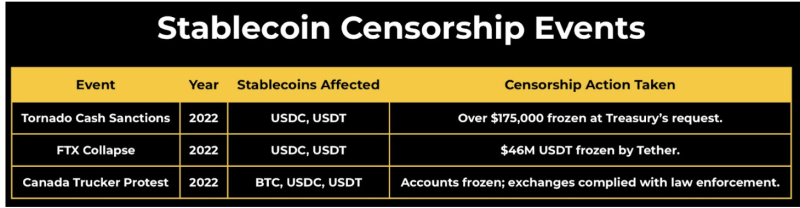
Government financial control is not just a historical pattern—it is happening in real time. The same tactics used to demonetize gold in 1933 and remove cash from circulation today are being deployed through digital assets. The following case studies prove that stablecoins are already being used as tools for financial censorship—demonstrating exactly why privacy-preserving alternatives are necessary.
Case Study: How Stablecoins Have Already Been Used for Financial Censorship
Stablecoins are often marketed as a decentralized, private alternative to fiat currency—but real-world examples prove that they are not censorship-resistant and can be frozen at any time by issuers or regulators.
Tornado Cash Sanctions (2022)
In August 2022, the US Treasury sanctioned Tornado Cash, a privacy protocol used on the Ethereum blockchain. This led to immediate censorship by stablecoin issuers:
Circle (USDC) froze over $75,000 of USDC in wallets associated with Tornado Cash.
Tether (USDT) followed by freezing over $100,000 of USDT, despite not being legally obligated to do so.
Ethereum service providers blocked Tornado Cash-associated addresses, effectively preventing access to funds.
This demonstrated that stablecoins are not censorship-resistant and can be weaponized just as easily as bank accounts.
FTX Collapse & Account Freezes (2022)
When FTX imploded in late 2022, authorities quickly pressured stablecoin issuers to freeze assets tied to the platform.
Tether froze $46 million in USDT linked to FTX.
Regulators worked with Circle to blacklist USDC associated with the exchange.
Customers who had stablecoins on centralized exchanges were cut off from their funds overnight.
Canada Trucker Protest 2022
The Canadian Freedom Convoy in 2022 saw the government freeze over $8 million in donations, including bank accounts and crypto funds.
Tether refused to freeze donations, but centralized crypto exchanges cooperated with law enforcement.
This proves that centralized digital assets are vulnerable to government orders, making privacy coins a necessary alternative.
This proves that stablecoins are not self-sovereign money—they are corporate-controlled assets that can be frozen, blacklisted, or seized at any moment.
Trump’s Ban: Freedom or a Trojan Horse?
Trump’s executive order sounds like a win for liberty. It bans the Fed from creating or promoting a new CBDC, citing risks to privacy and financial stability. It even revokes Obama-era plans for digital dollar experiments. But dig deeper, and it’s not so simple. The order doesn’t touch the Fed’s existing digital system—because it’s not seen as a “new” CBDC. So, the control we already have stays intact. Worse, the order cheers on “dollar-backed stablecoins” like Tether and USDC, private digital currencies pegged to the dollar, as a means to maintain global financial dominance.
The U.S. government has halted critical research into the biological effects of cellphone radiation, raising questions about transparency, public health and potential industry influence. This decision comes despite a $30 million National Toxicology Program (NTP) study in 2018 that found “clear evidence” of malignant heart tumors in male rats and “some evidence” of brain and adrenal gland tumors linked to radiofrequency radiation (RFR).
In January 2024, the NTP announced it would no longer pursue RFR research, citing “technical challenges” and resource constraints. This decision has sparked confusion and concern among scientists and advocates, especially given the growing use of wireless technology and 5G networks.
A Freedom of Information Act (FOIA) request by Children’s Health Defense revealed 14 pages of emails with no explanation for halting the research, alongside 2,500 fully redacted pages.
While the U.S. has stopped RFR research, other nations, including the European Union and France, are actively studying and regulating wireless radiation. France, for example, has recalled phones for excessive radiation and issued warnings to vulnerable groups, highlighting a stark contrast to the U.S. government’s inaction.
In a world increasingly dominated by wireless technology, the question of whether cellphones pose a health risk has become a pressing concern. Yet, despite mounting evidence of potential harm, the U.S. government has quietly halted critical research into the biological effects of cellphone radiation. The decision, shrouded in secrecy and redacted documents, raises alarming questions about transparency, public health and the influence of powerful industries.
The $30 million study that found “clear evidence” of harm
In 2018, the National Toxicology Program (NTP), a federal interagency program under the National Institutes of Health (NIH), published the results of a decade-long, $30 million study on the effects of cellphone radiofrequency radiation (RFR). The findings were startling: “clear evidence” of malignant heart tumors in male rats, “some evidence” of brain and adrenal gland tumors, and significant DNA damage. These results echoed earlier studies linking cellphone radiation to cancer and other health risks.
The NTP study was groundbreaking, not only because of its scale but also because it was one of the few government-funded efforts to examine the long-term effects of RFR. Yet, in January 2024, the NTP announced it would no longer pursue further research into wireless radiation, citing “technical challenges” and resource constraints. This abrupt decision has left scientists, advocates and the public wondering: Why stop now, when the stakes are higher than ever?
A trail of redactions and unanswered questions
In April 2024, Children’s Health Defense (CHD), a nonprofit advocacy group, filed Freedom of Information Act (FOIA) requests to uncover the reasoning behind the NTP’s decision. What they received was a mere 14 pages of emails—none of which explained why the research was halted. Even more concerning, 2,500 pages of documents were fully redacted, leaving a trail of unanswered questions.
“It’s concerning that there were apparently no written communications involving [key officials] in the months leading up to NTP’s announcement that it was abandoning the research,” said Miriam Eckenfels, director of CHD’s Electromagnetic Radiation (EMR) & Wireless Program. “What role did they play in the decision?”
The FOIA request sought communications between key NTP officials, including Rick Woychik, Ph.D., director of the National Institute of Environmental Health Sciences (NIEHS), and Robert C. Sills, DVM, Ph.D., acting scientific director of the Division of Translational Toxicology (DTT). Yet, the disclosed emails revealed little beyond internal deliberations over how to respond to media inquiries.
One email, from Michael Wyde, Ph.D., a toxicologist involved in the follow-up studies, included a striking omission. A sentence stating, “Efforts will be refocused in other areas where contributions can be made to understanding the potential effects of RF exposure on public health,” was struck through. Why was this sentence removed? Did the NTP have plans to continue studying RFR in a different capacity? The redactions and omissions only deepen the mystery.
A global concern, a silent government
While the U.S. government has stepped back from studying wireless radiation, other nations are taking the issue seriously. The European Union has funded multi-million-dollar studies on the health effects of RFR, and France has implemented strict regulations, including recalling millions of phones for excessive radiation and warning teenagers and pregnant women to limit exposure.
In contrast, the NTP’s decision to abandon further research seems out of step with global efforts to understand and mitigate the risks of wireless technology. As Devra Davis, Ph.D., MPH, a toxicologist and epidemiologist, noted, “This sudden end of civilian government efforts to study potential health impacts of wireless radiation constitutes a glaring abdication of responsibility.”
The implications of this decision are profound. Cellphones are used by 97% of American adults, and children are particularly vulnerable due to their developing brains and thinner skulls. With 5G networks expanding and wireless devices becoming ubiquitous, the need for rigorous, independent research has never been greater.
A call for transparency and accountability
The NTP’s decision to halt RFR research raises critical questions about transparency and accountability. Why were 2,500 pages of documents redacted? Who made the decision to stop the studies, and what influenced that decision? Were there pressures from industry or other government agencies?
Linda Birnbaum, Ph.D., who directed the NTP from 2009 to 2019, suggested that the decision-makers may have intentionally avoided leaving a paper trail. “It’s possible that whoever chose to halt the studies decided they weren’t going to have anything in writing,” she said.
This lack of transparency is deeply troubling. As Paul Héroux, Ph.D., an associate professor of medicine at McGill University, pointed out, “If NTP’s leadership wanted to make their statement credible, they should or could have publicly explained those difficulties.” Instead, the public is left with more questions than answers.
The bigger picture: A global experiment
The cessation of RFR research by the NTP is not just a scientific or bureaucratic issue—it’s a public health crisis. As Davis aptly put it, “Whether the government stops doing the research or not, we are all a part of a massive research study.”
Billions of people worldwide are exposed to wireless radiation daily, with no control group to compare outcomes. The potential health effects—ranging from cancer and DNA damage to infertility and neurological disorders—are too significant to ignore. Yet, without robust, independent research, we are left in the dark about the true risks.
According to the source, the Trump administration has inquired with Egypt about its ability to facilitate Hamas’s ouster from Gaza. The source added that Washington is pressuring Prime Minister Benjamin Netanyahu to accept a proposal in which a Palestinian committee – backed by Arab nations and the international community – would govern Gaza.
Later this month, Egypt and the US are expected to hold discussions on developing operational mechanisms and timelines for the reconstruction initiative.
Egypt’s plan, which is projected to span five years and exceed $50 billion in costs, outlines an initial phase focusing on clearing debris and constructing temporary housing for the Gazan population. Simultaneously, rubble removal will begin. In its more advanced phases, the plan includes the construction of an artificial island, public institutions, a seaport, an airport, and additional infrastructure projects.
Destruction in the Gaza Strip. Photo: Reuters
Cairo has proposed the establishment of an international fund to finance the initiative. However, it remains uncertain whether the international community will be willing to contribute financially. A possible indication of hesitation was the absence of key Arab leaders, such as Saudi Crown Prince Mohammed bin Salman and UAE President Mohammed bin Zayed Al Nahyan, at the recent Arab League summit.
PM offers minimal detail to back up claim, makes same allegation against Ronen Bar’s predecessor after Nadav Argaman threatens to release info compromising Netanyahu if he breaks law.
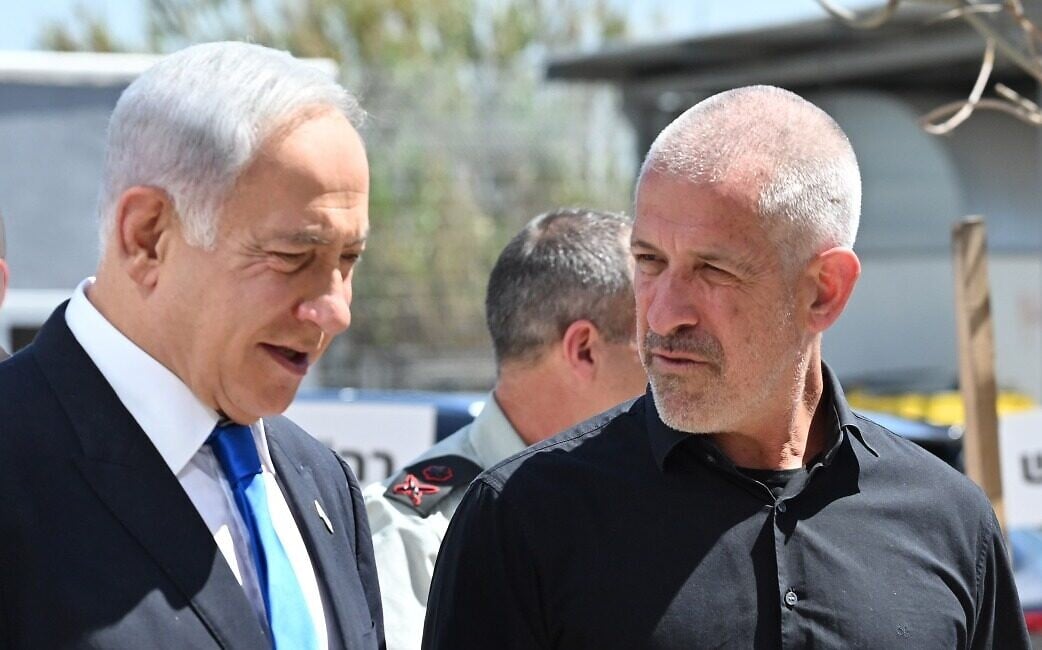
Prime Minister Benjamin Netanyahu accused Shin Bet chief Ronen Bar of “blackmail” on Thursday, as the feud between the pair reached an unprecedented level.
The allegation was part of a statement issued by Netanyahu in response to an interview given by Bar’s predecessor Nadav Argaman, who claimed to be sitting on a trove of information that would compromise the prime minister and threatened to make it public if Netanyahu breaks the law.
Netanyahu is widely reported to have been working for months to try and oust Bar, as he seeks to place the blame for the failures that allowed for Hamas’s October 7 onslaught to unfold squarely on the security echelon, as opposed to the political leadership.
Bar is said to be pushing back against the effort to oust him, fearing that acquiescence would allow Netanyahu to appoint a loyalist in his stead.
The effort to fire Bar has been complicated in recent weeks, amid the launch of a joint Shin Bet-police investigation into alleged ties between several of Netanyahu’s aides and the Qatari government. For the prime minister to fire Bar while the investigation is ongoing would likely be perceived as a conflict of interest.
In a wide-ranging interview with Channel 12, Argaman detailed some of the disagreements he had with Netanyahu during his tenure as Shin Bet chief from 2016 to 2021, particularly surrounding the matter of Qatari aid being allowed into the Gaza Strip.
“It’s quite clear that I have a great deal of knowledge, which I can put to use… but I’m currently keeping everything that happened between myself and the prime minister” out of the public sphere, Argaman said.
However, “If the State of Israel or if I conclude that the prime minister has decided that he is going to act in contradiction to the law, then I will not have a choice and I will say everything I know and have refrained from saying until today,” he warned.
Netanyahu quickly hit back at Argaman, accusing him of blackmail in a statement posted to X.
“Tonight, another dangerous red line was crossed for Israeli democracy,” the premier said. “Never, in the entire history of Israel, and the history of democracy, has the former head of a security service blackmailed a sitting prime minister on live television.”
“The criminal, mafia-style threats will not deter me,” asserted Netanyahu. “I will do whatever is necessary to ensure Israel’s security.”
Netanyahu then lodged the same “blackmail” accusation against Bar. He offered limited detail to explain the claim but claimed the Shin Bet chief held a series of off-record briefings with certain reporters in recent days in order to tarnish the premier.
“The only goal is to try and prevent me from making the decisions needed to restore the Shin Bet after its abysmal failure on October 7,” said the premier.
Bar’s agency, in turn, issued a statement responding to Netanyahu, declaring that the Shin Bet chief “devotes all of his time to security matters, efforts to recover the hostages and the defense of democracy. Any statement to the contrary is devoid of any truth.”
During the Channel 12 interview, Argaman said Netanyahu tried to “buy peace [in Gaza] with Qatari money,” even though it was clear that the strategy would eventually backfire.
Netanyahu decided in 2018 to allow Qatari money* into the Gaza Strip after the Palestinian Authority cut off funding to Hamas, leaving Israel fearful of unrest in the coastal enclave, Argaman recalled.
“The State of Israel wanted peace in the Gaza Strip and was looking for ways to bring in the money. They chose Qatar because Qatar agreed to do it,” Argaman said, adding that he believed the idea to be a “very serious mistake” from the get-go.
He said that Netanyahu nevertheless went ahead with the plan, despite the security service’s warning, as “the strategy of his government was to have quiet in the Gaza Strip.”
Netanyahu’s critics have long accused him of trying to bolster Hamas at the PA’s expense, keeping Palestinian factions divided to further undermine efforts to advance a two-state solution. The premier has argued that the Qatari money was necessary to prevent a humanitarian crisis in Gaza.
“We bought peace with Qatari money — it was clear to everyone that this would backfire on us one day,” Argaman said. “The prime minister knew, the cabinet knew. The issues were presented more than once or twice.”
He acknowledged, however, that the Shin Bet, as well as the IDF, “should have done everything in their power to stop the Qatari funds” from flowing into Gaza.
Argaman also touched on the ongoing investigation — which has been placed under a sweeping gag order — into ties between members of the Prime Minister’s Office and Doha and allegations that hundreds of thousands of dollars had flowed from Qatar to figures linked to the premier.
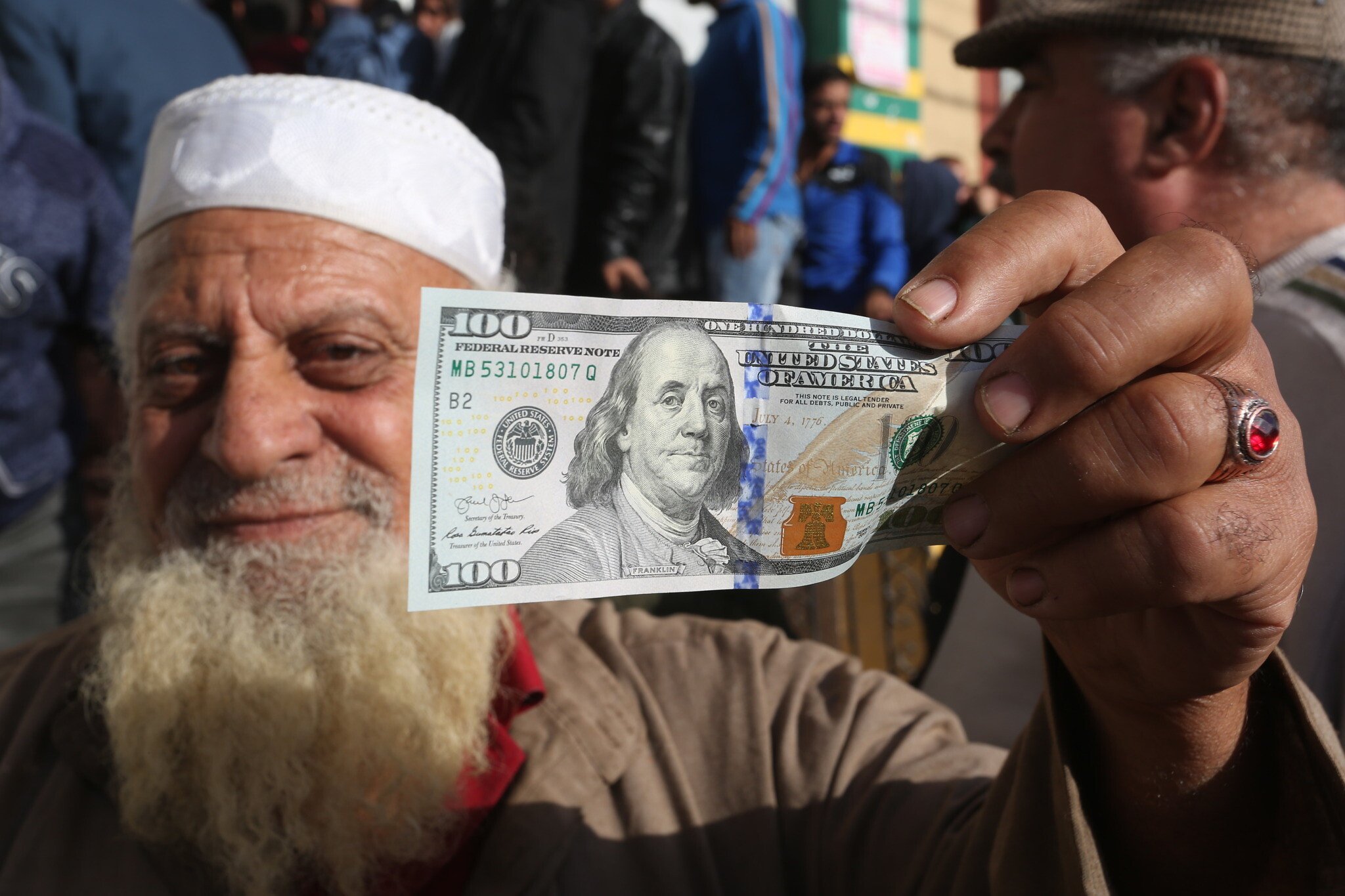
Palestinians receive their financial aid as part of an aid allocated by Qatar, at a post office in Rafah, in the southern Gaza Strip, on November 27, 2019. (Abed Rahim Khatib/Flash90)
Asked whether the alleged ties — should they be proven to be true — could have occurred without Netanyahu’s knowledge, Argaman said the prime minister “knows everything that happens in his office; nothing happens without his approval.”
“I think the first person who should have jumped to demand a Shin Bet investigation… into whether there were Qatari ties to the prime minister’s office, is the prime minister himself,” said the ex-Shin Bet chief.
Argaman didn’t hide his distaste for the Qatari government during the interview, telling Channel 12 that he believes forging ties with Doha is akin to “dancing with the devil.”
“Qatar is part of the Shiite axis,” he said of the majority Sunni nation. “They’re the ones who allowed Hamas to build its terrorist army in the Gaza Strip. If, god forbid, it managed to gain control of the Prime Minister’s Office, it would mean that it influences the prime minister, the Prime Minister’s Office, the State of Israel’s policy toward Hamas in general and the hostage deal in particular.”
[…]
*It’s alleged Netanyahu delivered the bulk of these funds to Hamas leaders, to continue Israeli efforts to undermine the Palestinian Authority and their efforts to form an independent Palestinian state.
This episode explains the specific functions of six of the ORFs (Open Reading Fields) inserted into bat coronavirus to weaponize Covid 19.
In general ORFs or open reading fields serve as a genetic blueprint for protein that govern virus behavior, in this case to hijack the functions of the host they infect and that person’s immune system.
ORF1A and ORF1B – encode for proteins involved in viral replication.
ORF3A – inhibit autophagy (the ability of the cell to clear foreign material).
ORF6 – helps the virus avoid detection by inhibiting interferon, which coordinates the immune response to viral infection.
ORF8 – inhibits apoptosis (automatic programed cell death), which enhances viral entry into human cells.
ORF11 (developed at the Wuhan Institute of Virology) – enhances viral entry into human cells.
In the latest legal turn of events – since the United States is now governed by activist judges, an Obama-appointed federal judge on Tuesday found that Elon Musk and DOGE likely violated the constitution when it shut down deep state slush fund USAID, and has ordered them to restore access for current (remaining) employees.
US District Judge Theodore Chuang ruled in favor of more than two dozen unnamed current and former USAID employees and contractors who challenged the Trump administration’s efforts to shutter the organization.
In a 68-page decision, Chuang granted in part their request for a preliminary injunction, ruling that DOGE and Musk likely violated the Constitution’s Appointments Clause and separation of powers.
Musk has been ordered to reinstate access to email, payment and other electronic systems for all current USAID employees and personal services contractors, while the Trump administration is now prevented from taking any further actions related to the shutdown of USAID – including placing employees on administrative leave, firing USAID workers, closing buildings, bureaus or offices, and deleting the contents of its websites or collections.
Of note – the order does not currently require the reinstatement of fired employees, after roughly 83% of USAID programs have been officially canceled according to Secretary of State Marco Rubio.
“After a six-week review, 5200 contracts that are now cancelled spent tens of billions of dollars in ways that did not serve, and even harmed the core national interests of the United States,” he said.
This latest judicial move to block the Trump administration comes days after DC District Court judge James Boasberg (who was in charge of the FISA court when the Obama administration was spying on Trump), issued a two-week halt on deporting illegal immigrant gang members. On Tuesday Trump called for Boasberg’s impeachment, drawing a sharp rebuke from Supreme Court Chief Justice John Roberts, who said it was “not an appropriate response.”
The Trump administration is also in the process of reinstating over 24,000 federal workers after a different Obama judge, US District Judge James Bredar, ordered the mass reinstatement of employees at 18 federal agencies last week, determining that the administration’s justification for the firings—poor performance—was not supported by evidence. The ruling follows another decision by a federal judge in San Francisco, who also found terminations at six agencies to be illegal.




 Image: Wikimedia Commons (U.S. Air Force photo by Staff Sgt. Brigitte N. Brantley)