The Most Revolutionary Act

Uncensored updates on world events, economics, the environment and medicine

The Most Revolutionary Act

The Filipino Children of International Sex Tourists

Fallen Angels

RT (2017)

Film Review

https://en.rtdoc.tv/films/428-fallen-angels

This documentary concerns the large number of Filipino children fathered by international sex tourists. The filming takes place in Angeles City, home to a US Air Force Base until 1991. Retired Americans and other nationalities still flock there to buy sex.

The filmmakers help the children make videos addressed to their dads, asking them to spend just one day with them.

Some of the mothers are still forced to work as call girls and pole dancers to support their children. In one instance where the mother became too old to work in a bar, the grandmother has assumed custody of the baby,who she supports by doing laundry. In another, the children is raised by an adopted transgender mother after being abandoned by his biological mother. The former runs a hair salon from her home to support him.

Most of her neighbors have children with absent German, Scottish, Australian, British, Irish and American fathers. They get teased at school for their mixed race appearance. This, in turn, leads to truancy, though the older girls acknowledge the importance of education, so they don’t end up working “in the bar” like their moms.

There is one interview with a British immigrant who married his Filipino lover when she became pregnant. Both have subsequently suffered strokes.

Trump denies cover-up in Jeffrey Epstein case

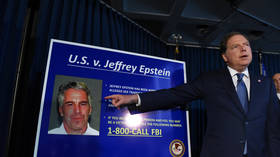
Trump denies cover-up in Jeffrey Epstein caseUS Attorney for the Southern District of New York Geoffrey Berman announces charges against Jeffery Epstein, New York City, July 8, 2019. ©  Stephanie Keith / Getty Images

RT

The US president has urged supporters not to spread speculation about the alleged list of the sex offender’s clients

US President Donald Trump has pushed back against claims of a cover-up in the Jeffrey Epstein case, defending his administration’s handling of the release of files related to the disgraced financier and convicted sex offender’s death in jail.

Some of Trump’s allies, including journalist Tucker Carlson and former adviser Steve Bannon, have criticized a report by the Department of Justice and the FBI, which found no evidence of a list of powerful individuals to whom Epstein trafficked underage girls. The report also found no signs of foul play in Epstein’s 2019 death at a Manhattan correctional facility, which was ruled a suicide.

In a Truth Social post on Saturday, Trump claimed that the Epstein Files were created by prominent Democrats, including former President Barack Obama and former Secretary of State Hillary Clinton.

“They created the Epstein Files, just like they created the FAKE Hillary Clinton/Christopher Steele Dossier that they used on me, and now my so-called ‘friends’ are playing right into their hands,” he wrote.

“Why didn’t these Radical Left Lunatics release the Epstein Files? If there was ANYTHING in there that could have hurt the MAGA Movement, why didn’t they use it?” he added.

Trump defended Attorney General Pam Bondi and argued that federal agencies should instead focus on investigating Democrat-linked scandals and corruption, as well as the 2020 presidential election, which he continues to claim was rigged in favor of Joe Biden. “LET PAM BONDI DO HER JOB – SHE’S GREAT!” Trump wrote. He previously said the Epstein case has been used to distract from more pressing issues, including the deadly floods in Texas.

FBI Director Kash Patel also dismissed the allegations. “The conspiracy theories just aren’t true, never have been,” he wrote on X.

Critics have pointed to a minute-long gap in the surveillance footage outside Epstein’s cell on the night of his death, claiming the tape had been doctored. Bondi, however, denied that there is anything suspicious about the video.

The debate surrounding the case has reportedly caused a rift within the government, with several news outlets claiming that FBI Deputy Director Dan Bongino is considering resigning.

[…]

Via https://www.rt.com/news/621399-trump-denies-epstein-coverup/

Catherine Austin Fitts: Epstein file linked to $20 trillion stolen from Pentagon and global vaccine coverup

By

Former Bush official Catherine Fitts says the Epstein files could blow open the real agenda behind Operation Warp Speed, the missing $20 trillion from the Pentagon, and the totalitarian biotech control system disguised as “health.” It’s not just about trafficking. It’s about global financial and biological domination.

Catherine Austin Fitts, former Assistant Secretary of Housing under President George H.W. Bush, has ripped the mask off the real Epstein story — and what she reveals is nuclear.She claims Epstein’s files are the tip of a far deeper iceberg, one that links child trafficking, intelligence operations, vaccine blackmail, and the largest financial theft in American history.

We’re not talking about millions. We’re not even talking about billions. We’re talking about over $20 TRILLION — money that has vanished from Pentagon ledgers with zero accountability, zero audits, and zero explanation.

And the same network that funneled that money into black ops, secret tech, and off-grid power structures… is the same network behind the global COVID vaccine campaign.

FOLLOW THE TRILLIONS: FROM EPSTEIN TO THE PENTAGON HOLE

Fitts has tracked the missing money for over two decades. Her conclusion is blunt:

“The U.S. taxpayer was looted. Epstein’s operation was one of the pipelines. And the cover-up continues through pharma, media, and digital finance.”

According to her, Epstein’s true role wasn’t just as a sex trafficker. He was a financial blackmail tool, used by intelligence agencies to compromise politicians, bankers, and CEOs — and ensure compliance while the system was being drained dry. And guess what? Those names are in the sealed files.

  • CEOs of pharma companies? Check.
  • Former Pentagon officials? Check.
  • Tech billionaires funding mRNA platforms? Check.
  • Central bankers, royalty, and BlackRock execs? CHECK.

The reason those files haven’t been released isn’t to “protect victims.” It’s to protect the real criminals — the ones who signed off on both the theft of trillions and the mass bio-experiment launched under Operation Warp Speed.

OPERATION WARP SPEED: THE BIO-MILITARY COVER-UP

Now we arrive at the core. The smoke screen. The master stroke.
Operation Warp Speed — a rushed, militarized, propaganda-laced vaccine campaign led not by doctors… but by DARPA, Pfizer, and BlackRock-connected agents.

Let’s break this down:

Who funded the tech?
mRNA platforms were developed with Pentagon money, under classified bio-defense budgets.

Who ran the operation?
General Gustave Perna — a military logistics commander, not a public health official.

Who manufactured the shots?
Private pharma companies shielded from liability, with ties to Epstein-linked executives and biotech investors.

Who pushed the narrative?
Silicon Valley, mainstream media, and bought-out medical institutions — the same ones who buried the Epstein story for years.

Fitts puts it clear:

“First they robbed your Treasury. Then they came for your bloodstream.”

WHY EPSTEIN STILL MATTERS: HE WASN’T JUST TRAFFICKING CHILDREN — HE WAS TRAFFICKING SECRETS

The mainstream wants you to believe Epstein was just a pervert. But the reality is he was a high-level asset in a global control operation.

He trafficked information. He collected leverage. He controlled through compromise — sexual, financial, and digital. And within his files are the names of those who:

  • Moved untraceable Pentagon funds into shell networks
  • Financed illegal surveillance programs and social engineering tools
  • Tied the vaccine agenda to biotech surveillance, digital ID, and population tracking

Those files are the missing puzzle piece between:

➡️ The missing $20 trillion
➡️ Operation Warp Speed
➡️ The collapse of civil liberties under the pandemic narrative

Unsealing them would connect the dots from elite child abuse to full-spectrum societal control. That’s why they’ll burn the world before they release them.

IF THE TRUTH COMES OUT, THE SYSTEM COLLAPSES

This is not hyperbole. This is a system on the brink. If the Epstein documents are fully unsealed — and if they confirm the web of connections Catherine Fitts outlines — then the fallout is biblical:

  • Mass resignations from military, pharma, and government sectors
  • Criminal prosecution of sitting officials and media moguls
  • Collapse of public trust in vaccines, defense institutions, and the medical-industrial complex
  • The end of the dollar-based global order, as trillions in black funds are exposed

[…]

US Treasury reports surprise surplus

US Treasury reports surprise surplus
RT
The gains are largely driven by President Donald Trump’s tariff hikes, which pushed customs duty collections to record highs

The US government posted a surprise budget surplus in June, driven by a sharp increase in customs duties amid President Donald Trump’s tariff hikes, the Treasury said in a monthly report on Friday.

The report shows a surplus of just over $27 billion last month, following a deficit of over $300 billion in May. Much of the increase stems from Trump’s import tariffs introduced since April. Customs duties totaled around $27 billion, up from just $7 billion a year ago – a 301% rise. Since the fiscal year began in October 2024, total tariff collections have exceeded $113 billion, nearly doubling from 2024.

Commenting on the report, Treasury Secretary Scott Bessent said the country is “reaping the rewards” of Trump’s tariff campaign.

”As President Trump works hard to take back our nation’s economic sovereignty, today’s Monthly Treasury Statement is demonstrating record customs duties – and with no inflation!” Bessent wrote on X. Earlier this week, he claimed that customs duty collections could hit $300 billion by the end of the year.

Trump’s first round of tariffs on April 2 – which he called Liberation Day – included 10% tariffs on nearly all US trade partners and steeper rates on China, Mexico, Canada, and the EU. Some measures were delayed for trade talks, but since then, Trump has added tariffs on steel, copper, aluminum, and other key imports. He recently imposed a 25% tariff on goods from Japan and South Korea, with more reportedly planned if no deals are reached.

US trade partners have pushed back against Trump’s tariffs. India, which has been hit with a 50% tariff, has proposed retaliatory tariffs under WTO rules. China, which faces triple-digit tariffs, has called Trump’s moves unlawful, but has paused retaliatory measures amid ongoing talks. Both countries are members of BRICS, which Trump has accused of conducting “anti-American policies” and which he threatened with additional 10% tariffs earlier this month.

The EU has warned of lasting damage due to the tariffs. European Commission President Ursula von der Leyen said this week that the bloc’s relationship with the US “may never go back to what it used to be.”

Russia has not been hit with the tariffs due to the sweeping sanctions on the country that already exist, but Trump said this week he may support a bill that would impose 500% tariffs on countries that buy its goods and energy. The measure, proposed by Senator Lindsey Graham, aims to pressure Moscow to end the Ukraine conflict. Russian Deputy Foreign Minister Sergey Ryabkov dismissed the threat, saying the country will adapt and won’t be swayed from its “sovereign path.” Moscow has said it is ready to negotiate with Kiev, but insists that any peace settlement must reflect the battlefield realities and guarantee Ukrainian neutrality, demilitarization, and denazification.

[…]

Via https://www.rt.com/business/621381-us-budget-surplus-tariffs/

Why Public Funds Should be Deposited in Publicly Owned Banks

By Ellen Brown

[…]

Yet we cannot do without the functions banks perform; and one of these is the creation of “money” as dollar-denominated bank credit when they make loans. This advance of credit has taken the form of “fractional reserve” lending, which has been heavily criticized. But historically, it is this sort of credit created on the books of banks that has allowed the wheels of industry to turn. Employers need credit at each stage of production before they have finished products that can be sold on the market, and banks need to be able to create credit as needed to respond to this demand. Without the advance of credit, there will be no products or services to sell; and without products to sell, workers and suppliers cannot get paid.

Bank-created deposits are not actually “unbacked fiat” simply issued by banks. They can be created only when there is a borrower. In effect, the bank has monetized the borrower’s promise to repay, turning his promise to pay tomorrow into money that can be spent today — spent on the workers and materials necessary to create the products and services that will be sold to repay the loans. As Benjamin Franklin wrote, “many that understand Business very well, but have not a Stock sufficient of their own, will be encouraged to borrow Money; to trade with, when they have it at a moderate interest.”

If banks have an unfair edge in this game, it is because they have managed to get private control of the credit spigots.  They have often used this control not to serve business, industry, and society’s needs but for their private advantage. They can turn credit on and off at will, direct it at very low interest to their cronies, or use it for their own speculative ventures; and they collect the interest as middlemen. This is not just a modest service fee covering costs. Interest has been calculated to compose a third of everything we buy.

Anyone with money has a right to lend it, and any group with money can pool it and lend it; but the ability to create money-as-credit ex nihilo (out of nothing), backed by the “full faith and credit” of the government and the people, is properly a public function, the proceeds of which should thus return to the public. The virtues of an expandable credit system can be retained while avoiding the exploitation to which private banks are prone, by establishing a network of public banks that serve the people because they are owned by the people.

The Stellar Example of the Bank of North Dakota

Publicly-owned banks can exist at many levels, from giant multinational infrastructure banks, to national infrastructure or postal banks, to local banks owned by states, counties, cities or tribes. In his 2021 book titled Public Banks, Professor Thomas Marois showed that 17% of banks are publicly owned, with collective assets just under $49 trillion. In the US today, many groups are working on establishing local public banks. But our only existing state-owned bank is the century-old Bank of North Dakota (BND).

The BND was founded in 1919, when North Dakota farmers rose up against the powerful out-of-state banking-railroad-granary cartel that was unfairly foreclosing on their farms. They formed the Non-Partisan League, won an election, and founded the state’s own bank and granary, both of which are still active today.

The BND operates within the private financial market, working alongside private banks rather than replacing them. It provides loans and other banking services, primarily to other banks, local governments, and state agencies, which then lend to or invest in private sector enterprises. It operates with a profit motive, with profits either retained as capital to increase the bank’s loan capacity or returned to the state’s general fund, supporting public projects, education, and infrastructure.

According to the BND website, more than $1 billion had been transferred to the state’s general fund and special programs through 2018, most of it in the previous decade. That is a substantial sum for a state with a population that is only about one-fifteenth the size of Los Angeles County.

The BND actually beats private banks at their own game, generating a larger return on equity (ROE, that is, net profit divided by shareholder equity) for its public citizen-owners than even the largest Wall Street banks return to their private investors (for figures, see below). These profits belong to the citizens and are generated without taxation, lowering tax rates. On October 3, 2024, Truth in Accounting’s annual Financial State of the States report rated North Dakota #1 in fiscal health, with a budget surplus per taxpayer of $55,600. Small businesses are now failing across the country at increasingly high rates; but that’s not true in North Dakota, which was rated by Forbes Magazine the best state in which to start a business in 2024.

Why So Profitable? The BND Model

For nearly a century, the BND maintained a low profile. But in 2014, it was featured in the Wall Street Journal, which reported that the Bank of North Dakota “is more profitable than Goldman Sachs Group Inc., has a better credit rating than J.P. Morgan Chase & Co. (JPM) and hasn’t seen profit growth drop since 2003.” The article credited this success to the shale oil boom; but North Dakota was already reporting record profits in the spring of 2009, when every other state was in the red and the oil boom had not yet hit.

The average ROE of the BND from 2000 through 2024 (its latest annual report) was 19.4%. Compare JPMorgan Chase (JPM), by far the largest bank in the country, with 2.4 trillion in deposits. Its average ROE from 2000-23 was 11.38% over the same period. For a detailed breakdown, see here.

The BND does not need to advertise or compete for depositors. It has a massive, captive deposit base in the state itself, which must deposit all of its revenues in the BND by law.  Most state agencies also must deposit there. The BND takes some token individual deposits, but it does not compete with local banks for commercial deposits or loans. As for municipal (as distinct from state) government deposits, the BND generally not only reserves those deposits for local community banks but enhances their ability to secure municipal deposits. In many states, stringent collateral requirements are attached to municipal government deposits, such as a 110% collateral requirement with high quality securities. This essentially prevents local banks from using municipal deposits to fund local lending. In North Dakota, however, the BND provides letters of credit that guarantee the deposits of municipal governments and other public corporations, making collateral unnecessary and making municipal deposits available for local lending. In addition to its deposit base, the BND also has a substantial capital base, with a capital fund totaling $1.059 billion in 2023, along with deposits of $8.7 billion.

The State’s Deposits Are Safer in Its Own Bank

The BND is not only more profitable but also safer than JPM. In fact federal data show that JPM is the most systemically risky bank in the country. The BND, by contrast, has been called the nation’s safest bank. Its stock cannot be short-sold, since it is not publicly traded; and it will not suffer a run, since the state would not “run” on itself.

[…]

Advantages of a State-owned Bank for the Public, Local Government and Local Banks

Like private banks, a publicly-owned bank has the ability to create money in the form of bank credit on its books, and it has access to very low interest rates.   As a result, North Dakota banks were able to avoid the 2008-09 subprime and securitization debacles and the 2023 wave of bank bankruptcies.

[…]

Serving the State as a Rainy Day Fund and for Disaster Relief

Unlike the Federal Reserve, which is not authorized to support state and local governments except in very limited circumstances,  North Dakota’s “mini-Fed” can help directly with state government funding. Having a cheap and ready credit line with the state’s own bank reduces the need for wasteful rainy-day funds invested at minimal interest in out-of-state banks.

[…]

Progress and Challenges

In the past 15 years, groups across the country have worked diligently to establish publicly-owned banks in their states and communities. A big push came in 2011 with the Occupy Wall Street movement, demonstrating that even the dry subject of banking can incite large groups of people to take action in times of economic crisis. Many people moved their individual deposits out of big Wall Street banks into local community banks, but what about the large public deposits held by state and local governments? No community bank was large enough for their needs. The Bank of North Dakota demonstrated the feasibility of another alternative: the state or city could form its own bank.

Although more than 50 public bank bills and resolutions have been filed since 2010, the only new bank to emerge is the Territorial Bank of American Samoa, founded in 2016. Lobbying in opposition by big private banks has deterred politicians, who are reluctant to rock the boat when times are good and no immediate need is perceived. However, times are not so good today for the majority of the population, and they could soon get worse even for the wealthy.

To muster the political will to take action, politicians need a business plan in which the benefits of establishing their own banks clearly outweigh the costs; and public bank advocates today face hurdles that the BND avoided by being grandfathered in before the relevant agency rules were instigated.

One hurdle is that states today typically require uninsured public funds to be backed by pledged collateral (i.e. surety bonds or letters of credit) exceeding 100 percent of the value of the deposits. California, for example, has state tax revenues exceeding $80 billion. As a single deposit in a bank, only $250,000 of that sum would be covered by FDIC insurance, leaving the balance uninsured; so the state insures that balance with a collateral requirement that is 110% of uninsured deposits. The result is to tie up more liquidity than the deposits provide. Public banking advocates argue that the requirement is unnecessary and unfairly burdensome for state-owned banks. The deposits of the BND, which was chartered as “the State of North Dakota doing business as the Bank of North Dakota,” are backed by the state itself. Meanwhile, letters of credit, e.g. from a Federal Home Loan Bank, are a viable alternative.

Another hurdle is that most state constitutions prohibit the state from “lending its credit” to private parties. This has been construed as prohibiting the state from owning a bank, but legal memoranda have refuted that interpretation.

Besides a profitable business plan, politicians need a push from their constituents to take action, and most people haven’t heard of public banks and don’t understand the concept. Wider public exposure and education are necessary. Even many politicians are unaware of how banking actually works. Chartered depository banks have the power to create money as deposits when they make loans, expanding the local money supply and increasing the capacity for local productivity. Over 95% of our money supply today is created by banks in this way. This vast power to create money as credit is one that properly belongs in the public domain.

Times are changing, and public banking momentum continues to grow. By making banking a public utility, with expandable credit issued by banks that are owned by the people, the financial system can be made to serve the people and local enterprise without draining their resources away. Credit flow can be released so that industry and free markets can thrive, and the economy can move closer to reaching its full potential.

[…]

Via https://www.globalresearch.ca/public-funds-deposited-publicly-owned-banks/5894659


Catherine Austin Fitts: “How Many People in this Administration have Major Files in the Epstein Operation”?

Top Row: CIA Director William Burns, Thomas Pritzker, executive chairman of Hyatt Hotels, Sergy Brin, co-founder of Google, Larry Page, co-founder of Google, Mort Zuckerman, a real-estate billionaire who owns US News & World Report. Bottom Row: Elon Musk, Bill Gates, Jamie Dimon, CEO of JPMorgan Chase Bank, President Donald Trump, Robert F. Kennedy Jr., Secretary of HHS.

by Brian Shilhavy
Editor, Health Impact News

Catherine Austin Fitts was interviewed on the David Knight show last week.

Catherine Austin Fitts is a Wharton graduate, and was the first woman to be promoted to managing director of Dillon, Read and Co, Inc., the “prototypical elitist men’s club Wall Street investment bank.”

Fitts was instrumental in building a new market for Dillon Read. She began underwriting previously unrated municipal bonds, in essence, financing large government projects which other Wall Street firms said couldn’t be done.

These novel bond sales helped revive New York City’s crumbling subway system, and they provided funding for the City University of New York and other major projects.

The market in unrated and low-rated muni bonds took off, earning Fitts the title of “Wonder Woman of Muni Bonds,” in a glowing Business Week article (February 23, 1987). (Source.)

Fitts worked on the campaign of George H. W. Bush during the 1988 United States presidential election, and was appointed as Assistant Secretary of Housing and Urban Development for Housing in the Bush administration, where she was charged with repairing the department’s reputation in the aftermath of the savings and loan crisis.

She resigned her post in 1990, following a report that her relationship with Secretary of Housing and Urban Development Jack Kemp had soured. (Source.)

After leaving government, Fitts founded Hamilton Securities, an employee-owned brokerage house, which she ran until 1998. In 1993, Hamilton Securities won a contract with HUD to manage its $500 billion investment portfolio.

However, she did her job too well, as she learned that when you save taxpayers money, you are often lowering revenues for the D.C. crime syndicate.

The Bush family, or those associated with the Bush family, allegedly destroyed her career and threatened to murder people in her family if she went public with what she knew, and she briefly touches on this in her interview with David Knight.

She now runs the Solari Report as a totally private entity.

I have annotated down about 7 minutes from her nearly 1-hour interview with David Knight, where she talks about the Epstein financial network of laundering money.

She asks the question, “How many people in this current administration have major files in the Epstein operation“?

Here’s a partial transcript:

They’re all scared (in the Trump administration). How many people in this current administration have major files in the Epstein operation?

The only guy who doesn’t look scared about the whole thing is Howard Lutnik, because he had the house next door (to Epstein). I’m assuming he got the downloads. Are the Epstein tapes over in his house?

Between the administration and Congress, how many people do you think will stand real transparency around the Epstein files?

When I was in Washington, the Cabinet Secretary (Jack Kemp) I was working for was compromised in the Franklin cover up.

And when the Washington Times started running stories about the Franklin Cover-up, he just went crazy, and was being blackmailed. And I was in the middle of it, because he was trying to order me to do illegal things, and I wouldn’t do it.

I’ve never seen a human being more terrified, more afraid. I mean he was just terrified.

Because here he is, you know, a big family man and a Christian, and somebody is blackmailing him, presumably over pedophilia and he’s scared to death.

There’s a wonderful book called the Red Mafia by Robert Freidman, about the Russian mafia. And the important thing to understand about the Russian mafia is they’re 99% Jewish. So you have enormous rat lines through the Ukraine, into Israel, into New York, and London.

So London, New York, Israel, Ukraine.

When we talk about the Ukraine, you can think of it as a war, (but) I think of it as a huge financial money laundering operation. The Epstein operation is right in the middle of that.

And when Trump says to Zelensky “you don’t hold the cards,” Zelensky is thinking “No, my name is on the bank accounts, and I still got pots of money, and I have all the intel about where the money came in, and where it went out.”

So he does hold cards, is what it looks like to me.

Here is the 7-minute video:

The full David Knight interview can be watched here.

A great source that I found about the story of Catherine Austin Fitts, is an article published in 2002 by Scoop Independent News, titled: Enemy Of The State – The Catherine Fitts Story. It is on Archive.org.

[…]

Via https://healthimpactnews.com/2025/catherine-austin-fitts-how-many-people-in-this-administration-have-major-files-in-the-epstein-operation/

Epstein Lawyer Drops Bombshell: List Exists

Epstein

By Kate Plummer

An interview in which one of Donald Trump‘s former lawyers claimed he knew the names of people on a so-called Jeffrey Epstein list has resurfaced.

Speaking on The Sean Spicer Show in March, Alan Dershowitz, a longtime criminal defense attorney, said he knew the names of individuals referenced in confidential Epstein files and claimed those names are being deliberately withheld.

On Thursday Spicer reshared the interview on X, formerly Twitter, in light of renewed interest in the case. It has racked up 1.5 million views at the time of writing.

Newsweek has contacted Dershowitz by email to comment on this story

Why It Matters

Trump’s administration ordered a review of the Epstein case and said it would publish names and evidence about associates of Epstein, a wealthy financier who died by suicide in his jail cell in August 2019, weeks after his arrest on sex trafficking charges. However, a memo by the Department of Justice and the F.B.I. now states there is no “client list,” and there will be no more charges. This has triggered a backlash among those who want transparency about Epstein.

What To Know

Dershowitz, who represented Epstein, said in March: “I know the names of the individuals. I know why they’re being suppressed. I know who’s suppressing them…But I’m bound by confidentiality from a judge and cases, and I can’t disclose what I know, but I, hand to God, I know. I know the names of people whose files are being suppressed in order to protect them, and that’s wrong.”

Dershowitz, emphasized that he has pushed for “total transparency” in the release of Epstein-related documents.

“Every single document, no redaction. That’s what I’ve said from day one,” Dershowitz said.

[…]

Via https://www.newsweek.com/jeffrey-epstein-client-list-trump-lawyer-dershowitz-2097653

FBI Deputy Director May Resign Over Epstein Files Clash

FBI Deputy Director Dan Bongino is reportedly considering resignation after a major dispute between the bureau and Department of Justice (DOJ) over the fallout from the release of the Jeffrey Epstein memo, according to sources cited by CNN.

Newsweek reached out to the FBI and DOJ via email and submission form, respectively, for comment Friday afternoon.

Why It Matters

Epstein, the financier and sex offender who died in prison six years ago, socialized with some of the world’s most powerful people. While his death was ruled a suicide, conspiracy theories persist that he was instead killed due to his purported “client list,” which many have speculated to contain the names of politicians including President Donald Trump, former President Bill Clinton and Britain’s Prince Andrew.

Trump during his 2024 presidential campaign suggested he would release files related to Epstein, with a first batch publicized in February by U.S. Attorney General Pam Bondi. However, earlier this week, Trump and Bondi said they found “no incriminating ‘client list'” related to Epstein, triggering major backlash among both Democrats and MAGA supporters.

Billionaire Elon Musk last month said the government had not released records related to the case because Trump “is in the Epstein files.” While the president has dismissed Musk’s claim, it has sparked further interest in the government’s records.

What To Know

Tensions within the Trump administration escalated after a heated exchange earlier in the week between Bongino and Bondi regarding management of the case, CNN’s Kaitlan Collins reported Friday. Multiple sources told the outlet that Bongino did not turn up to work on Friday, increasing speculation that he is eyeing an exit.

Following the exchange, Bongino told people he has considered resigning, with the infighting over the case and claims that he and FBI Director Kash Patel were behind a story that the FBI wanted more information released but were undermined by the DOJ.

Bongino has denied that allegation, first reported by NewsNation and citing a White House source who said Patel and Bongino wanted to unseal evidence months ago and release “every single piece of evidence they could, while protecting victims.”

[…]

Via https://www.newsweek.com/dan-bongino-fbi-jeffrey-epstein-files-trump-administration-2098012


The Americans are leaving – and the postcolonial world is fine with that

The Americans are leaving — and the post-colonial world is fine with that

FILE PHOTO: A US soldier carries his belongings to a waiting truck at a military camp on the outskirts of the capital city Niamey, Niger. ©  Jacob Silberberg / Getty Images


By Moustafa Feturi

A shift appears to be underway in US-Africa relations, judging by the remarks of Vice President J.D. Vance and AFRICOM Commander General Michael Langley. Speaking to new US naval graduates on May 23, Vance talked about re-evaluating the American military role around the world and declared that “The era of uncontested US dominance is over” and that open-ended military engagements “belong to the past.”

Four days later General Langley, while attending an African defense chiefs’ meeting in Gaborone, Botswana, suggested that the US Africa Command (AFRICOM) might be integrated into Central Command (CENTCOM). “If we’re [AFRICOM] that important to (you), you need to communicate that and we’ll see,” Langley said, adding that the US is “reassessing” its military role in the continent. This sends a clear signal that Washington may dismantle or repurpose AFRICOM as part of broader cuts to US global military posture.

The statements, in line with President Donald Trump’s ‘America first’ mantra, reflect Washington’s growing impatience with costly foreign entanglements, while hinting at a fundamental transformation of how the US engages with Africa’s complex security landscape.

Cold War legacy

Since its creation in 2008, AFRICOM has served as the centrepiece of US military strategy on the continent. Over nearly two decades, the command has expanded its reach and budget significantly, shaping security partnerships and playing a pivotal role in regional conflicts. Yet today, AFRICOM’s future is uncertain, caught at the crossroads of shifting US priorities, rising African assertiveness, and intensifying competition from rival powers such as Russia and China.

Africa has long figured into the broader framework of US global military and political strategy. During the continent’s era of anti-colonial struggle and liberation movements, Washington, obsessed with countering Soviet influence, viewed nearly every liberation movement through the narrow lens of Cold War anti-communism.

AFRICOM was established by President George W. Bush, who emphasized its importance by stating that it would “strengthen our security cooperation with Africa and create new opportunities to bolster the capabilities of our partners.” AFRICOM was intended to centralize US military operations on the continent, replacing the fragmented structure inherited from the Cold War era, when Africa was divided among three different US military commands. Then-Secretary of Defense Robert Gates described the move as a long-overdue correction to an “outdated arrangement left over from the Cold War.”

Between 2008 and 2025, the cost of sustaining AFRICOM and financing its activities is estimated to have risen from around $50 million to between $275 million and $300 million. It is not a huge amount because the command borrows personnel and equipment from other US military commands, meaning the cost is accounted for anyway. This is likely to draw scrutiny from President Trump, who has made slashing federal spending a key priority. His administration has launched a dedicated initiative within the Office of Management and Budget – dubbed DOGE (Department of Government Efficiency) – to identify and eliminate what it considers excessive international and domestic expenditures. Trump’s return to office in 2025 marked a clear strategic pivot: a retreat from costly overseas commitments in favor of a narrow, transactional approach to foreign policy.

The Sahel region: A case study in US withdrawal

The Sahel region illustrates the consequences of America’s retrenchment in Africa. Once a central focus of US counterterrorism efforts, countries such as Mali, Niger, and Burkina Faso have witnessed the gradual reduction of American military presence amid growing local resistance. Coupled with political upheavals and anti-French sentiment, US forces have faced mounting pressure to leave or scale back operations. The withdrawal has left a security vacuum that regional powers and international actors struggle to fill, fueling instability and humanitarian crises. This retreat highlights the limits of America’s influence and the complexities of African geopolitics in an era of shifting alliances.

A stark example of the US pullback is Niger, where the military coup in 2023 prompted the expulsion of American forces and the shutdown of a $100-million drone base critical to regional surveillance and counterterrorism. The abrupt exit underscored the fragility of US military footholds amid shifting political dynamics.

Meanwhile, Russia has swiftly moved to fill this security vacuum, leveraging military cooperation, renewed political ties with the region and arms deals to become a preferred partner for several African states. Moscow’s approach – often perceived as less conditional and more respectful of sovereignty – has resonated with governments disillusioned by Western interference and demands, accelerating realignment in Africa’s security landscape.

”Russia does not come with lectures or conditions”

African nations approach foreign military partnerships with a mix of pragmatism, skepticism, and growing assertiveness. Many governments are wary of traditional Western powers, associating them with a legacy of colonialism, exploitative aid, and conditional alliances that undermine sovereignty. In contrast, Russia’s more transactional and less intrusive engagement style appeals to some leaders seeking security support without political strings attached.

However, this trust is far from uniform – some African civil society groups and international observers often warn against swapping one form of dependency for another, emphasizing the need for genuine partnerships that respect African agency and prioritize long-term stability over geopolitical rivalry.

African countries’ relative trust in Russia compared to the US or former European colonial powers stems from historical and ideological factors. During the Cold War, the Soviet Union supported numerous African liberation movements, often standing in opposition to Western-backed regimes and colonial interests. Unlike Western powers, Russia’s approach has often emphasized non-intervention in internal politics, focusing primarily on military cooperation and economic deals without pressing for political reforms. This contrasts sharply with Western demands for governance changes as a precondition for aid or security support.

As Malian analyst Amina Traore noted, “Russia does not come with lectures or conditions; it offers partnership based on mutual respect and shared interests.” Similarly, Senegalese former defense official Cheikh Diop remarked, “African countries want security partners who respect their sovereignty and do not drag them into endless conflicts or political battles.” These sentiments underscore why Russia has gained ground as a preferred security ally, even as questions linger about the long-term implications of this pivot.

The possible disappearance or transformation of AFRICOM signals a shift in US military engagement across Africa. Whether integrated into other commands or scaled back significantly, this change reflects Washington’s recalibration of its global military priorities amid domestic pressures and evolving international dynamics.

For Africa, the retreat of a long-standing security partner opens a strategic vacuum – one increasingly filled by Russia and other global actors eager to expand their influence. The shift challenges US policymakers to rethink their approach beyond military presence, emphasizing genuine partnerships based on respect, shared interests, and support for African-led security solutions. Ultimately, the future of US-Africa relations will depend on Washington’s ability to adapt to a multipolar world where influence is no longer guaranteed by military might alone, but by diplomacy, economic engagement, and mutual respect.

[…]

Via https://www.rt.com/africa/621339-africa-turning-away-us-military-might/

Degrowth, Deindustrialization, Depopulation and the Fraud of Global Warming

In a recent article, Defeating the Depopulation Agenda, I took aim at an insidious ideology which has infiltrated society in the form of a movement to ‘protect nature from humanity’.

In that feature, we reviewed how those forces behind this revival of the pagan Gaia earth mother cults of ancient times were directly connected to the Anglo-Dutch royal families- with explicit focus on Prince Bernhard of the Netherlands (‘former SS officer) and Prince Philip Mountbatten.

While I received much positive feedback from readers who appreciated getting greater clarity to the cultish Gaia worship underlying the eco-imperial agenda which has infested so much of our western education, cultural and even religious institutions… something was missing.

In this article, I will attempt to address that missing ingredient which will involve a summary appreciation of the fraud of climate science per se which has perverted science itself, around a statistical mode of analysis designed to frame a wonderful molecule named carbon dioxide for genocide.

After introducing a rehabilitation and defense of CO2, I will end with some basic facts about the essentials of a true climate science premised around astro-climatology and the actual galactic forces shaping earth’s climate.

Many people were taken aback by the findings published by a team of scientists analyzing the results of Moderate Resolution Imaging Spectroradiometer (MODIS) instruments on NASA’s Terra and Aqua satellites.

NASA’s website[5] described the findings (published on February 11, 2019[1]) in the following way:

“The research team found that global green leaf area has increased by 5 percent since the early 2000s, an area equivalent to all of the Amazon rainforests. At least 25 percent of that gain came in China.”

Up until this study’s publication, scientists were not certain what role human economic activity played in this anomalous greening of the earth.

The NASA study demonstrated that this dramatic rate of greening between 2000-2017 was being driven largely by China and India’s combined efforts at eradicating poverty, which involves both reforestation, desert greening efforts (see China’s Move South Water North megaproject[2]), agricultural innovation and also, general industrial growth policies.

The later policies represent genuine efforts by Asian nations to wipe out poverty by investments into large scale infrastructure… a practice once used in the west before the days of “post-industrialism” induced a collective insanity of consumerism in the early 1970s.

A perplexed reader might now be heard to ask: but how can industrial growth have anything to do with greening of the planet?

One simple answer is: carbon dioxide.

CO2: An Innocent Victim Framed for Genocide

As children, we are taught that CO2 is an integral part of our ecosystem and that plants love it.

The processes of photosynthesis, which evolved over long spans of time with the advent of the chlorophyll molecule eons ago requires constant infusions of carbon dioxide that are broken down along with H2O, releasing oxygen back into the biosphere. Over time, free oxygen slowly formed the earth’s ozone layer and fueled the rise of ever higher life forms that relied on this “plant waste” for life.

Today, large amounts of carbon dioxide is regularly generated by biotic and abiotic activity from living animals, decaying biomass as well as volcanos which constantly emit CO2 and other greenhouse gases. A surprisingly small portion of that naturally occurring CO2 is caused by human economic activity.

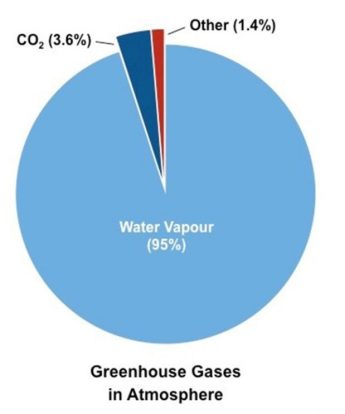
Taking the entire composition of greenhouse gases together, water vapour makes up 95% of the bulk, carbon dioxide makes up 3.6%, nitrous oxide (0.9%), methane (0.3%), and aerosols about 0.07%.

Of the sum total of the 3.6% carbon dioxide released into the atmosphere, approximately 0.9% is caused by human activity.

To restate this statistic: Human CO2 makes up less than 1% of the 3.6% of the total greenhouse gases influencing our climate.

During the mid-20th century, a belief began to emerge among some fringe climate scientists that the 400 parts per million (PPM) average carbon dioxide in the atmosphere is the “natural and ideal amount”, such that any upset of this mathematical average would supposedly result in destruction of biodiversity.

These same mathematicians also presumed that the biosphere could be defined as closed systems, such that rules of entropy were the natural organizing principles- ignoring the obvious fact that ecosystems are OPEN, connected to oceans of active cosmic radiations from other stars, galaxies, supernova and more, while being mediated by nested arrays of electromagnetic fields.

As film maker Adam Curtis demonstrated in his, All Watched Over By Machines of Love and Grace (2011)[3], this belief slowly moved from the fringe into mainstream thinking despite the fact that it is simply wrong.

Beyond the facts already presented above, another persuasive piece of evidence can be found in carbon dioxide generators that are commonly purchased by anyone managing a greenhouse[4]. These widely-used generators increase CO2 to amounts as high as 1,500 PPM.

What is the effect of such increases?

Healthier, happier, greener plants and vegetables.

Temperature and CO2: Who Leads in this Dance?

Amidst the frantic alarms sounding daily over the impending climate emergency threatening the world, we often forget to ask if anyone ever actually proved the claim that CO2 drives the climate.

To begin to answer this question, let’s start with a graph showcasing the rise of human industrial CO2 from 1751-2015 broken down into various regions of the earth. What we can see is consistent increase from the mid 19th century until 1950, when a vast spike of emission rate increases can be viewed.

This increase obviously accompanies world population growth and the correlated agro-industrial output.

Next, let us look at the global mean temperature changes from 1880-present.

Here, several anomalies strike the thinking mind.

For starters, absolutely no warming accompanies the period of intensive industrial growth of 1940-1977. In fact during this period, many climate scientists were ringing the alarm over an impending ice age![5]

Another anomaly: Since carbon dioxide emissions have increased continuously over the past 20 years, one would expect to see a correlated spike in warming trends; however, this expected correlation is entirely absent between the year 1998 and 2012, when warming tappers off to a near standstill, sometimes called “the global warming pause” of 1998-2012[6]. This has been an embarrassment for all modellers whose scare-mongering predictions have fallen to pieces to the point that they can only pretend this pause doesn’t exist.

Again, the question must be asked: why would this anomaly appear if CO2 drove temperature?

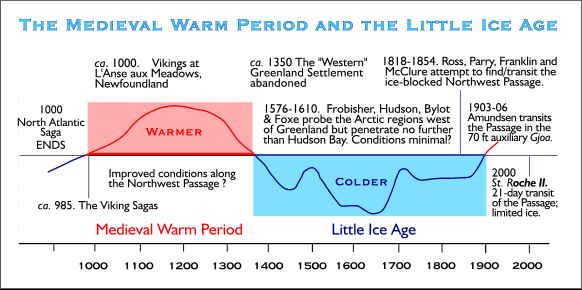
Let’s take one more anomaly from our temperature records before digging into the hard proof that CO2 does not cause temperature changes: The medieval warming period [see graph].

[…

The Vikings in Greenland had no coal plants or SUVs, and yet, mean temperatures were still warmer than today by a long shot.

Why?

[…]

[…]

Going back even further into the climate records, it has been revealed that during many of the past ice ages, carbon dioxide had risen up to 800% higher than our current levels, despite the fact that human activity played zero role[9].

A Brief Look at Space Weather

[…]
I would like to introduce one more dramatic piece of evidence that gets us back on the path of a true science of climate change and ecosystems management: Astroclimatology.

The fact that the earth is but one of a multitude of spherical bodies in space speedily revolving around an incredibly active sun within the outskirts of a galaxy within a broader cluster of galaxies is often ignored by many computer modelling statisticians for a very simple reason: anyone who has been conditioned to look at the universe through a filter of linear computer models is obsessed with control, and is incredibly uncomfortable with the unknown.

The amount of actual factors shaping the weather, ice ages, and volcanism are so complex, vast and mostly undiscovered that computer modellers would prefer to simply pretend they don’t exist… or if they do acknowledge such celestial phenomena to have any function in climate change, it is often dismissed as “negligible”.

Despite this culture of laziness and dishonesty, the question is worth asking: WHY does evidence of climate change occur across so many other planets and moons of our solar system?

Ice caps on Mars melt periodically[10] and have been melting at faster rates in recent years. Why is this happening? Could the sun’s coronal mass ejections, solar wind, or electromagnetic field be affecting climate change within the solar system as one unifying process?

Often Venus with its atmosphere of 96.5% CO2 is used as a warning for people on the earth what sort of terrible oven we will create by producing more CO2. It is hot, after all, with temperatures averaging 467 degrees Celsius (872 degrees Fahrenheit); however, if CO2 were truly to blame for the heating, then why is Mars so cold with temperatures averaging minus 125 degrees Celsius (-195 degrees Fahrenheit) despite the fact that it’s atmosphere is 95% CO2?

Similarly, what role does cosmic radiation play in driving climate change? Based on the recent discoveries of Heinrich Svensmark and his team in Denmark, strong correlations were found linking cloud formation, climate and cosmic radiation flux over time. Cosmic radiation flux into the earth is a continuous process mediated by the earth’s magnetic field, as well as the oscillating magnetic field of the sun, which shapes the entire solar system as we revolve around the galactic center of the Milky Way every 225-250 million years.

Svensmark’s discovery was outlined beautifully in the 2011 documentary, The Cloud Mystery.[11]

Going back even further into the climate records, it has been revealed that during many of the past ice ages, carbon dioxide had risen up to 800% higher than our current levels, despite the fact that human activity played zero role[9].

A Brief Look at Space Weather

[…]

But I would like to introduce one more dramatic piece of evidence that gets us back on the path of a true science of climate change and ecosystems management: Astroclimatology.

The fact that the earth is but one of a multitude of spherical bodies in space speedily revolving around an incredibly active sun within the outskirts of a galaxy within a broader cluster of galaxies is often ignored by many computer modelling statisticians for a very simple reason: anyone who has been conditioned to look at the universe through a filter of linear computer models is obsessed with control, and is incredibly uncomfortable with the unknown.

The amount of actual factors shaping the weather, ice ages, and volcanism are so complex, vast and mostly undiscovered that computer modellers would prefer to simply pretend they don’t exist… or if they do acknowledge such celestial phenomena to have any function in climate change, it is often dismissed as “negligible”.

Despite this culture of laziness and dishonesty, the question is worth asking: WHY does evidence of climate change occur across so many other planets and moons of our solar system?

Ice caps on Mars melt periodically[10] and have been melting at faster rates in recent years. Why is this happening? Could the sun’s coronal mass ejections, solar wind, or electromagnetic field be affecting climate change within the solar system as one unifying process?

Often Venus with its atmosphere of 96.5% CO2 is used as a warning for people on the earth what sort of terrible oven we will create by producing more CO2. It is hot, after all, with temperatures averaging 467 degrees Celsius (872 degrees Fahrenheit); however, if CO2 were truly to blame for the heating, then why is Mars so cold with temperatures averaging minus 125 degrees Celsius (-195 degrees Fahrenheit) despite the fact that it’s atmosphere is 95% CO2?

Similarly, what role does cosmic radiation play in driving climate change? Based on the recent discoveries of Heinrich Svensmark and his team in Denmark, strong correlations were found linking cloud formation, climate and cosmic radiation flux over time. Cosmic radiation flux into the earth is a continuous process mediated by the earth’s magnetic field, as well as the oscillating magnetic field of the sun, which shapes the entire solar system as we revolve around the galactic center of the Milky Way every 225-250 million years.

Svensmark’s discovery was outlined beautifully in the 2011 documentary, The Cloud Mystery.[11]

[…]

Via https://matthewehret.substack.com/p/the-fraud-of-global-warming