The attack reflects Tehran’s willingness to target economic chokepoints in retaliation for recent airstrikes, raising concerns about potential escalation in the region
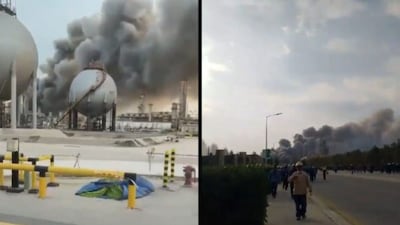
Saudi Arabia’s Ras Tanura refinery, the world’s largest oil refining facility, has been struck by drones, causing a major fire and forcing authorities to halt operations temporarily. The refinery, operated by Saudi Aramco, produces over 550,000 barrels of crude oil per day and serves as a critical hub for the kingdom’s oil exports.
According to sources, the drones responsible for the strike originated from Iran.
Saudi Aramco authorities are currently assessing the full extent of the damage, with operations at the site suspended until further notice. No official statement has yet been released by the company or the Saudi government regarding casualties or the broader impact on oil exports.
Hundreds of thousands travelers have been stranded across the Middle East following airspace closures triggered by unprovoked US-Israeli strikes on Iran, according to flight analytics firms.
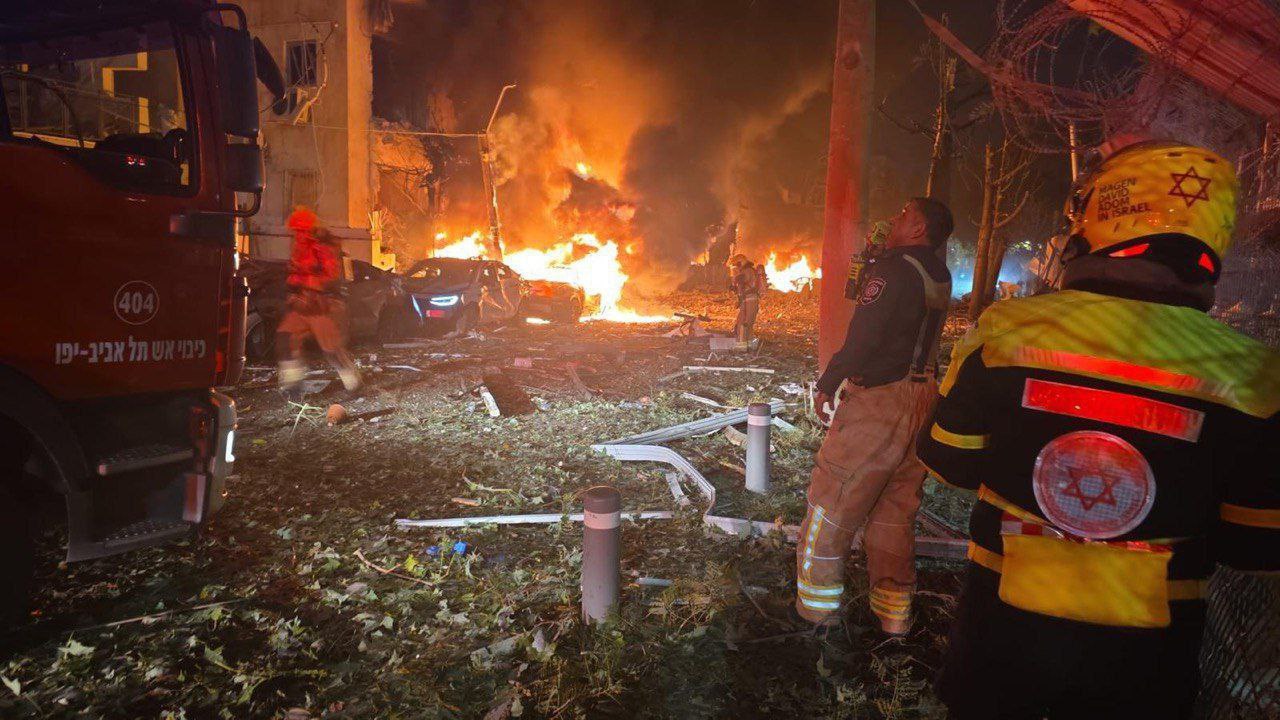
Massive strikes against Tehran began Saturday, killing Iranian Supreme Leader Ayatollah Ali Khamenei, top officials, and hundreds of civilians. Tehran responded with hundreds of missile and drone attacks targeting US and Israeli bases across the Middle East.
Iran has also reportedly targeted several major regional aviation hubs, including the Dubai International Airport in the UAE – the world’s busiest – where damage and casualties were reported, as well as sites near international airports in Bahrain, Kuwait, and Iraq.
Following the escalation, Bahrain, Iran, Iraq, Israel, Jordan, Kuwait, Qatar, and the UAE announced partial or total airspace closures, forcing flight suspensions, cancellations, and diversions.
Kuwait's Public Authority for Civil Aviation says a drone targeted Kuwait International Airport, causing injuries and damage to one of the terminals.
Spokesperson Abdullah Al-Rajhi tells Kuna that the authorities immediately implemented emergency procedures, dealing with the… pic.twitter.com/a7vVkp7iMX
More than 3,400 flights have been canceled across seven major Middle Eastern airports on Sunday, according to flight tracker Flightradar24, affecting hundreds of thousands of passengers.
Emirates, Etihad and Qatar Airways – three major Gulf carriers that typically handle about 90,000 passengers daily – canceled roughly a third of their flights, according to aviation analytics firm Cirium.
Dubai Airport has turned into a massive waiting room
The difference between any other airport and Dubai is, atleast 40-50% of the people at the airport are for Transit (meaning Dubai is not final destination)
Numerous international airlines also canceled Gulf routes through the weekend as civil aviation authorities designated much of the Middle East as a high-security risk zone.
Air France, Lufthansa, KLM, Air India, and others suspended regional operations from at least March 3–7. FlightAware reported more than 19,000 global flight delays due to the Middle East crisis as of 2:30 am GMT on Sunday.
Russian carriers, including Aeroflot, also canceled or rerouted flights, and suspended services to Tehran, Dubai, and Abu Dhabi. According to the Association of Tour Operators of Russia (ATOR), about 8,000 Russian tourists have been stranded abroad while returning from vacations after missing Middle East connections. Rosaviatsia has been coordinating alternative routes to avoid Israel and Iran.
Analysts warn that the disruption is inflicting heavy financial losses on airlines and hotels, as well as travelers. Several airlines issued waivers and pledged to cover accommodation, meals, and rebooking for stranded passengers. However, multiple travelers have posted footage of overcrowded airports across the region on social media.
The crisis also disrupted shipping and cruise operations. MSC Cruises, TUI, and Celestyal canceled or suspended departures amid missile and drone activity. Container traffic through the Strait of Hormuz was halted or rerouted after Iran’s Revolutionary Guard issued warnings that no vessels are permitted to pass, although no formal blockade has been officially declared by Tehran. According to shipping analytics firm Linerlytica, about 170 containerships are currently inside the strait and facing restrictions on exiting.
For decades, scattered reports have emerged of pedophiles hiding in Israel, of rape within the military, of Orthodox sects protecting abusers, of Palestinian children subjected to systematic sexual violence. Each case was dismissed as an aberration. But when you connect the evidence, a darker picture emerges: Israel has built a civilization-scale apparatus where child rape is not a failure of governance — it is a doctrine of governance, cohesion, and control.
Israel’s Law of Return, intended to offer refuge to Jews worldwide, has been systematically exploited as a haven for child rapists. Jewish-American pedophiles routinely flee to Israel to escape prosecution [1].
Extradition requests often stall for years [5]. Inside Israel, abuse is pervasive. Tens of thousands of pedophiles operate in the country every year [2]. Hundreds of children are sexually assaulted annually [3]. Orthodox communities conceal molestation within yeshivas, rabbinical courts silence survivors, the military suppresses reports of rape among female conscripts [6].
Predators fleeing from the United States and Europe don’t just disappear. They bring with them archives of crimes and kompromat, which become assets for Israeli intelligence. Sanctuary is a pipeline for importing leverage [4]. This feeds directly into Israel’s intelligence doctrine.
The Epstein-Maxwell network, with its ties to Israeli intelligence, exemplifies the model: children as currency, sex as leverage, silence as control [9]. Honey-traps involving minors ensnare foreign politicians. Mossad archives compromise U.S. officials and UN staff.
Diplomatic immunity shields predators abroad. In the occupied territories, Palestinian children are subjected to detention, rape, and sexual humiliation. These are not random war crimes — they are systematic [7]. Minors are coerced into collaboration under threat of rape [8]. For Israel, occupation doubles as an inexhaustible reservoir of child victims [10]. The machine operates in plain sight because global institutions act as mirrors, not protectors. Media reports surface, then vanish [1][2]. The UN blocks reports of Israeli sexual war crimes [7].
Western governments continue aid while silencing survivors. The evidence converges: Israel has constructed an apparatus of governance where child rape is a functional doctrine. Internally, it maintains cohesion through silence and ritual. Externally, it weaponizes kompromat to control diaspora elites and foreign governments. Militarily, it deploys sexual violence as both weapon and archive. Globally, it is shielded by narrative immunities that turn any exposure into taboo. This is not governance failing to stop child rape. This is governance through child rape.
Why does the United States call Israel its “greatest ally”? Because the apparatus ensures silence at the highest levels. Compromised officials cannot resist. Aid continues to flow. Wars are subsidized. And at the center, children’s bodies remain the raw currency of power.
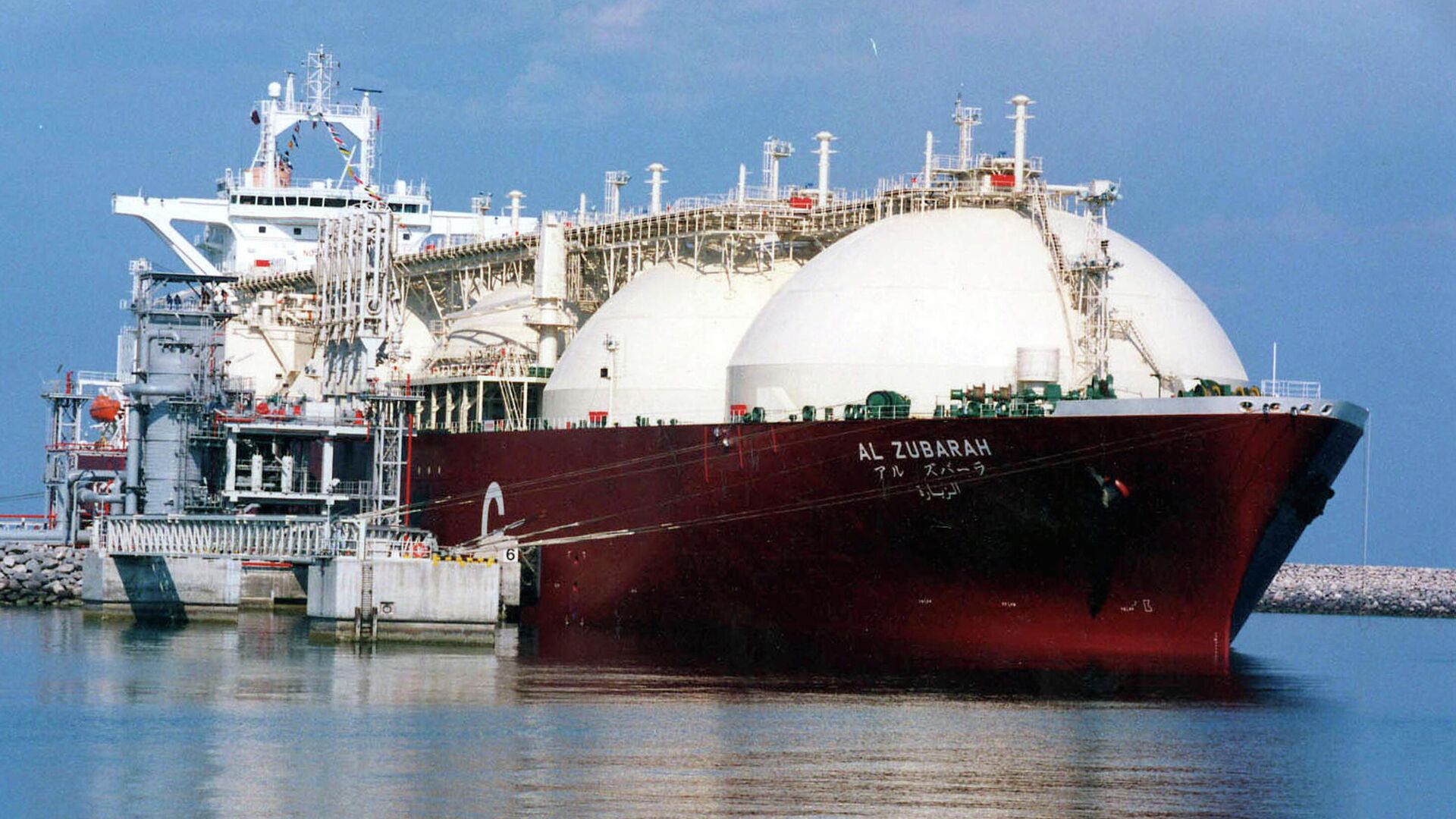
“Gas prices may rise, because approximately 20% of the world’s LNG transits through the Strait of Hormuz, including all of Qatar’s production,” Igor Yushkov, a top Russian energy expert, told Sputnik, commenting on the Persian Gulf crisis.
“Qatar is one of the largest producers of LNG in the world, second only to Australia and the US. If there’s a shortage of LNG on the global market…the exchange price could easily exceed $1k or even 1.5k. We’ve seen similar prices in Europe even without such a shortage. So the price could skyrocket.”
According to Yushkov, “everything will depend on how long the tension in the Strait of Hormuz lasts,” including not only Iran’s readiness to reopen it, but gas producers’ willingness to resume transit.
“In any case, we will see higher shipping costs, higher insurance costs for ships,” with the situation “further exacerbated” by the fact that the Northern Hemisphere is still in the heating season, with Europe’s underground gas storage facilities being gradually depleted.
“Even though Qatar gas physically goes primarily to Asian markets, the exchange price will rise everywhere,” same as oil, Yushkov clarified. Qatar itself also has no alternative to Hormuz. “Therefore, if it is unable to export LNG, Qatar will simply have to stop production.”
Message to China
The current crisis is also “a major wake-up call for China,” with the US demonstrating its readiness to flout international law, Yushkov says.
“China is being shown that anything coming from the south is unsafe. Passage through the Strait of Hormuz may be interrupted today as part of the current conflict, but tomorrow the Americans could close it off to Qatari LNG supplies to the Chinese market.”
“Or they could close the Strait of Malacca, through which all the hydrocarbons going to China from Africa and the entire Middle East flow. Therefore, this is a signal to China that anything coming from the north is much safer, and much more difficult to shut down,” the observer summed up.
After weeks of speculation and reporting that the U.S. and Israel were about to bomb Iran, it finally happened earlier today, Saturday, February 28, 2026.
This story will now dominate news headlines for the next several days, at least.
I have purposely not reported on previous news reports about the “imminent” attack on Iran, because it was not clear yet if the U.S. was building up their military in the area to try and force Iran into some kind of deal, or if the Zionist Trump administration was waiting to see if the Epstein files saga would finally blow over and cease being part of the corporate news stream.
I have also been carefully monitoring the moves in the stock markets on Wall Street, because as long as the stock market kept climbing and enriching the billionaires, war was not really necessary.
Well apparently the dam broke this past week, as the most explosive report yet out of the Epstein files clearly showed a cover-up with the FBI and an alleged victim of abuse by Trump as a minor, and Wall Street took massive losses in the final day of trading this week as fears grew over the actual state of the U.S. economy, and the future of Big Tech.
Trump’s Epstein Problems that Will NOT Go Away
NPR was the first corporate media source who reported on the Justice Department and FBI cover-up that links Trump to Epstein and abusing children.
Justice Department withheld and removed some Epstein files related to Trump
Excerpts:
The Justice Department has withheld some Epstein files related to allegations that President Trump sexually abused a minor, an NPR investigation finds. It also removed some documents from the public database where accusations against Jeffrey Epstein also mention Trump.
Some files have not been made public despite a law mandating their release. These include what appear to be more than 50 pages of FBI interviews, as well as notes from conversations with a woman who accused Trump of sexual abuse decades ago when she was a minor.
NPR reviewed multiple sets of unique serial numbers appearing before and after the pages in question, stamped onto documents in the Epstein files database, FBI case records, emails and discovery document logs in the latest tranche of documents published at the end of January.
NPR’s investigation found dozens of pages that appear to be catalogued by the Justice Department but not shared publicly.
The Justice Department declined to answer NPR’s questions on the record about these specific files, what’s in them and why they are not published.
After publication, the Justice Department reached out to NPR, taking issue with how its responses to questions were framed. Department of Justice spokeswoman Natalie Baldassarre reiterated DOJ’s stance that any documents not published are privileged, are duplicates or relate to an ongoing federal investigation.
Following NPR’s reporting, the House Oversight Committee’s ranking member, Rep. Robert Garcia, D-Calif., released a statement about the missing files.
“Yesterday, I reviewed unredacted evidence logs at the Department of Justice. Oversight Democrats can confirm that the DOJ appears to have illegally withheld FBI interviews with this survivor who accused President Trump of heinous crimes,” Garcia stated.
Democrats on the House Oversight Committee have already been investigating this allegation against the president and will now open a parallel investigation into the DOJ’s decision not to release these particular documents.
The other big story this week that I was tracking was Anthropic’s refusal to “take the guard rails off” of its AI app that was being used by the Pentagon.
Anthropic stated that it refused to allow Claude, its AI app, to be used for “mass domestic surveillance or for fully autonomous weapons.”
This infuriated Trump and his sidekick Pete Hegseth, who heads up the Department of War, who promptly “Black Listed” Anthropic after a Friday deadline passed.
This resulted in Anthropic’s Claude AI app to leapfrog OpenAI’s ChatGPT and Google’s Gemini as the top AI app in the Apple Store. It became the #2 downloaded app altogether, after standing up to Trump.
Anthropic’s Claude artificial intelligence assistant app jumped to the No. 2 slot on Apple’s chart of top U.S. free apps late on Friday, hours after the Trump administration sought to block government agencies’ adoption of the startup’s technology.
The rise in popularity suggests that Anthropic is benefiting from its presence in news headlines, stemming from its refusal to have its models used for mass domestic surveillance or for fully autonomous weapons.
“The Leftwing nut jobs at Anthropic have made a DISASTROUS MISTAKE trying to STRONG-ARM the Department of War, and force them to obey their Terms of Service instead of our Constitution,”
President Donald Trump wrote in a Friday Truth Social post.
Department of Defense Secretary Pete Hegseth said he asked that Anthropic be labeled as a supply-chain risk to national security, and therefore, no U.S. defense contractor would be able to draw on Anthropic tools.
“It is the Department’s prerogative to select contractors most aligned with their vision,” Anthropic CEO Dario Amodei said in a statement.
“But given the substantial value that Anthropic’s technology provides to our armed forces, we hope they reconsider.”
Historically, other AI chat apps have been more popular among consumers than Claude. OpenAI’s ChatGPT sat at No. 1 on the App Store rankings on Saturday, while Google’s Gemini was at No. 3.
The Claude iOS app has gained momentum this month. On Jan. 30, it was ranked No. 131 in the U.S., and it bounced between the top 20 and the top 50 for much of February, according to data from analytics company Sensor Tower. The data shows ChatGPT has held on to the No. 1 spot for most of February.
This has had a “ripple effect” across Silicon Valley, as The Information reported in their weekend edition today, where employees at these Big Tech companies have been divided about using their technology for war in the Middle East, and in particular against Palestinians.
Military Worries Simmer at OpenAI, Google As Anthropic Hits Stalemate With Pentagon
Anthropic’s refusal to cooperate with the Defense Department is having ripple effects across Silicon Valley.
Excerpts:
The conflict between Anthropic and the Department of Defense over how the Pentagon can use the startup’s AI has turned into a standoff.
The agency has given the company a Friday evening deadline to give it unfettered access to its technology—or else be cut off from working with military contractors.
Anthropic CEO Dario Amodei continues to refuse to do so.
“Threats do not change our position,” he wrote in a blog post published on Thursday.
“We cannot in good conscience accede to their request.”
If the dispute involved only the Pentagon and Anthropic, the feud would still represent an intense, intrigue-filled drama.
But what’s now becoming clear is that the feud has implications extending beyond Anthropic, raising questions about what will happen next at Google, OpenAI and the other AI companies that have lined up military deals.
Amodei has refused to budge on two issues: He doesn’t want Anthropic’s AI used to surveil Americans or to make decisions on lethal autonomous weapons without human supervision.
And now OpenAI has told the Pentagon that it shares the same concerns, an OpenAI spokesperson said on Friday, declining to comment on how its own negotiations with the Pentagon were proceeding.
Within OpenAI, employees are watching the negotiations closely and discussing what it could mean for their company, according to a current employee. And more than 60 OpenAI employees and over 300 Google employees have signed on to a public pledge asking their companies to copy Anthropic’s safeguards.
Within Google, over 200 employees at the company’s AI research unit, Google DeepMind, signed a letter this week asking the company to ban uses of its AI involving mass domestic surveillance or fully autonomous weapons.
Was War with Iran Trump’s Last Shot to Save His Presidency?
The war with Iran has many implications, not the least of which is the control of the flow of the world’s oil. We can be sure that China and Russia are working behind the scenes with Iran supplying intelligence, and probably weapons, to keep the flow of oil flowing.
Since Trump already played the “nuclear weapons” card to justify his strikes against Iran last year, claiming that they put Iran’s nuclear program back decades to rebuild, this time he is claiming that the goal is regime change.
However, if the Trump administration’s hope was for a quick strike to take out Iran’s political and military leaders, they may have failed. Iran was much more prepared this time, after last year’s war, and have made a concerted effort to rid themselves of American technology, such as banning Musk’s Starlink Internet service.
At the time of my writing this, Israel and Trump are claiming that Khamenei was killed by a strike on his home, but Iranian officials dispute that, stating that is alive and well.
Please be aware that the U.S. corporate media, whether Right or Left, has been handed their scripts as to how to cover this war. Be sure to also track the English news coming out of the Middle Eastern news sites to get a full picture.
I have been watching video clips come in from Telegram all day, and most of them are Iranian bombs falling on the rich Arab Gulf states’ most modern cities, such as Bahrain, Dubai, and the United Arab Emirates, home of the rich and wealthy.
Seeing a skyscraper being bombed in Bahrain is rather remarkable, to me.
For those of you unfamiliar with the Middle East, Bahrain is a small island that is accessible by bridge from the eastern portion of Saudi Arabia, where I lived for several years as an English professor.
I have been to Bahrain multiple times when I lived in Dahran, Saudi Arabia, in the 1990s, and it is basically a very modern city.
From the initial video footage coming in right now, it appears that Iranian forces are concentrating on the rich Arab nations that have allowed the U.S. military to occupy their countries for many years, in return for access to their oil.
If that is the case, it is an interesting strategy by the Iranians, by targeting not only just U.S. military sources, but the major suppliers of OPEC.
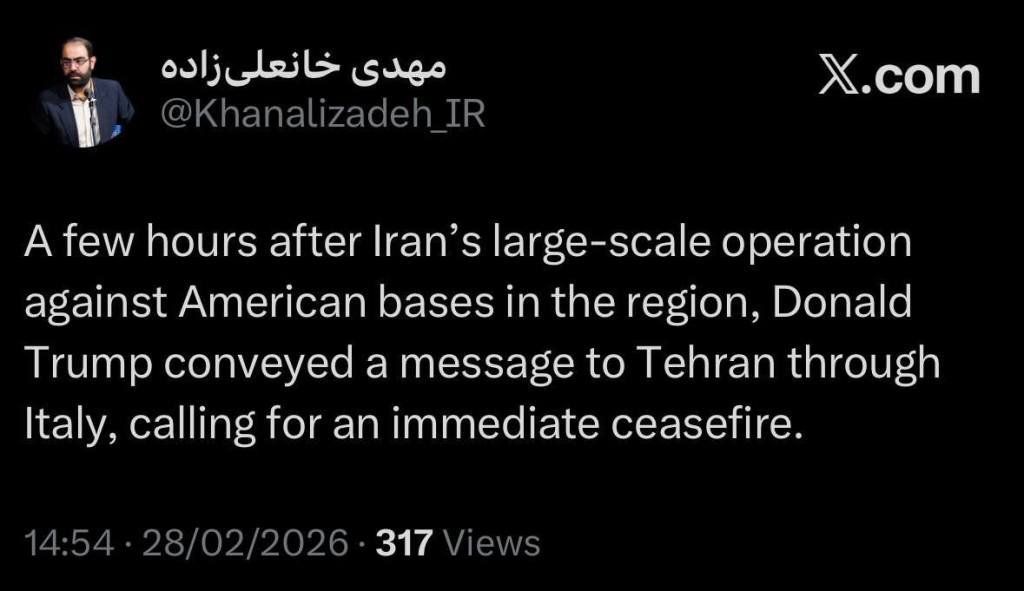
Pepe Escobar just a while ago posted an image from X on his Telegram channel stating that Trump is already getting pressure to call for a ceasefire:
I don’t know if this is true or not, but it would not surprise me at all if these rich oil Sheikhs are frantically calling him up whining about their cities being bombed.
I would imagine that the members of the Saud family are not sleeping too well tonight….
🔺 Three US and UK oil tankers struck, 560 American troops killed or wounded in Iranian Attacks: IRGC
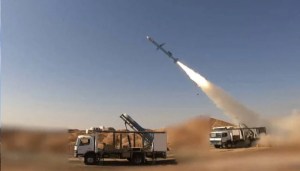
Three violating American and British oil tankers were hit by missiles and are burning in the Persian Gulf and Strait of Hormuz, while 560 US military personnel have been killed or wounded so far in Operation True Promise 4, Iran’s IRGC announced. The strikes also destroyed America’s Al-Salem Base in Kuwait and severely damaged US naval infrastructure in Bahrain, as missile and drone attacks continue across the region.
Iran’s Revolutionary Guards claimed on Saturday that they attacked 14 US military bases across the Middle East, killing hundreds of American troops. The strikes were launched in retaliation for US and Israeli attacks on Iranian targets, intensifying regional tensions. Iran called the operation “Promise 4” and vowed to continue missile and drone attacks.
The Guards’ spokesperson said the operation would continue with increased intensity, targeting American military installations in Bahrain, Qatar, the UAE, and Israeli-controlled territories. Iranian state media reported the attacks hit key regional bases, including the US Fifth Fleet in Bahrain. Officials stressed that the campaign is directed against “aggressive enemy forces” and those they accused of harming civilians.
This escalation follows the death of Iranian Defense Minister Amir Nasirzadeh and Revolutionary Guards chief Mohammad Pakpour in Israeli strikes earlier this week. Iran announced its counter-operation to “protect national sovereignty” and warned that future strikes would be more powerful. The Iranian military stated that all attacks are part of self-defense and will continue until objectives are achieved.
International reactions remain tense as the region faces growing instability. Gulf nations with US military presence, including Saudi Arabia, Kuwait, and the UAE, reported intercepting Iranian missiles. Experts warn that continued strikes could disrupt global oil supply, as Iran has also threatened strategic chokepoints such as the Strait of Hormuz. Diplomacy is yet to resume as both sides maintain a high-alert posture.
The Revolutionary Guards concluded that Operation Promise 4 will persist, with missile and drone attacks targeting American and allied military installations. Analysts caution that further escalation could trigger a broader conflict affecting regional and global security. The US has not confirmed the casualties claimed by Iran, but military officials are monitoring the situation closely.
Walt Zlotow, West Suburban Peace Coalition Glen Ellyn IL , 26 Feb 26
Senate Minority leader Chuck Schumer and House Minority Leader Hakeem Jeffries are horrified that a bipartisan War Powers Resolution to stop Trump’s planned criminal war on Iran might actually come to a vote this week.
The last thing they want is for Democrats, including themselves, to go on record to stop Trump from his dastardly planned attack. Why? Both leaders, like many fellow Democrats, support the likely upcoming Trump attack but are loathe to admit such. They either truly believe the nonsense Iran is seeking nuclear weapons and represents a threat to the homeland…or they are simply aligning themselves with Israel’s interests, not America’s, due to the millions pumped into Democratic campaign coffers by the Israel lobby.
Neither Schumer nor Jeffries utter a word about their pro Israel, pro Iran war beliefs. They know a large majority of voters reject Trump’s rush to war to cater to Israel’s military interests over America’s national security interests. Schumer and Jeffries stay silent so Trump can self-destruct when US body bags arrive home from Iran’s missile killing fields.
Unlike pro Israel Republican lawmakers who brag about their fealty to Israel and the need to topple Iran into failed state status, Democratic lawmakers want it both ways. Destroy Iran while laying the blame for all the lethal blowback killing Americans on Trump’s doorstep.
Schumer and Jeffries had no issue supporting the War Powers Resolution to stop Trump from invading Venezuela to kidnap its president. That resolution neither affected Israel nor was likely to incur massive US casualties. Voting for the resolution, bound to fail due to solid Republican support, brought no political fallout.
Schumer and Jeffries will not publically oppose bringing the Iran War Powers Resolution to a vote. They can’t leave any fingerprints on their opposition to it. Behind the scenes they offer process concerns, objections and caucus unity arguments to slow down the march to a vote; indeed possibly prevent it before Trump launches possible the most catastrophic war this century.
Chuck Schumer and Hakeem Jeffries want their cake and eat it too. Destroy Iran and the Trump presidency by remaining AWOL from the most critical issue they have ever faced. You cannot get more cynical than the Schumer, Jeffries tag team allowing Trump to blunder into catastrophic war to serve a foreign government.



 Daily Times
 A neighborhood in Tel Aviv in the aftermath of Iranian missile strikes