How to Make Money Selling Drugs

drugs4

How to Make Money Selling Drugs

Directed by Matthew Cooke (2013)

Film Review

How to Make Money Selling Drugs is a biting satire on the ludicrous “War on Drugs” and its perverse effect of increasing American drug use.

Mimicking an investment informercial, the mockumentary guides viewers on how to move up the ranks from gang-backed street peddler, to private retailer, to distributor, to domestic and/or international smuggler, to drug cartel king pin.

It also offers expert advice on how to beat a case, how to conceal drugs in a vehicle and how to get crooked cops to work for your franchise. It also profiles an ex-cop who can get you off if the police plant narcotics in your car.

My favorite part of the film is a cameo by Freeway Ricky Ross, who late San Jose Mercury News reporter Gary Web made world famous for his role in distributing cocaine the CIA smuggled into the US to fund their illegal war against Nicaragua.

The video can’t be embedded (for copyright reasons), but you can watch it for the next few weeks at the Maori TV website: How to Make Money Selling Drugs


Trump, Hitler and Right Wing Populism

Make America Hate Again

Reich Wing Watch (2016)

Film Review

Make America Hate Again, a documentary about Donald Trump’s right wing populism, likens his strong appeal for blue collar white men to that of Adolph Hitler. The film specifically examines the narcissistic personality disorder – the profound grandiosity, entitlement and absence of empathy – shared by both men. The filmmakers find it no accident that Trump enjoys the support of modern day white power supremacists and neo-Nazi fascists who idolize Hitler.

They also examine the appeal of racial scapegoating for white men struggling with profound fear and inadequacy in economically precarious times. As Hitler fomented irrational hatred of Jews to propel his rise to power, Trump foments irrational hatred of Muslims and #Blacklivesmatter activists.

The documentary includes great video footage of rabid Trump supporter Alex Jones foaming at the mouth, as well as audio footage of Michael Parenti lambasting mainstream politicians (and media) for concealing the link between capitalism and fascism.

In my view, the film’s major weakness is its failure to expand on this link. It makes brief mention of the German industrialists who financed Hitler’s rise to power. However it fails to mention the key role played by Wall Street corporations in the rise of Nazi Germany.

I was also disappointed by the documentary’s failure to examine the financial interests promoting Trump’s meteoric rise in the corporate media and public opinion polls.


The Inside Story on Bill Gates and Microsoft

barbarians

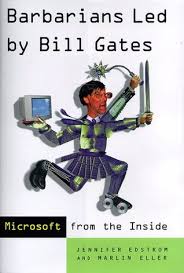
Barbarians Led by Bill Gates: Microsoft from the Inside

By Jennifer Edstrom and Marlin Eller

Henry Holt (1998)

Book Review

Can be downloaded from from Open Library

Barbarians Led by Bill Gates, co-authored by former Microsoft programmer Marlin Eller, is mainly about Gates’ mercurial and inconsistent management style. While highly unflattering to Gates, Barbarians simultaneously refutes Justice Depart claims that Microsoft deliberately tried to squash competitors by stealing their innovations. The authors make out it was all just a coincidence – that Gates was too disorganized to carry out such a conspiracy. I don’t buy it.

Eller was one of the original programmers at Microsoft in 1982 when the company had only two hundred employers. They had more than 20,000 when he left. The programmer was principally involved in the development of Windows, the graphic interface Microsoft copied from VisiOn and the Apple Macintosh. The launch of Windows ultimately enabled Microsoft to monopolize the software market (competitors’ software wouldn’t run on Windows).

As Ellers describes it, the birth of Windows was a long painful saga, plagued by Gates’ mismanagement and numerous blind alleys costing the company hundreds of million. Microsoft had no systematic quality control over Windows. They seem to have mainly relied on customers to inform them of bugs and security flaws post release.

Eller repeatedly depicts Gates ordering his programmers to reverse engineer software created by other companies. Thus I find it hard to believe it was pure coincidence that Microsoft put Netscape out of business by creating Internet Explorer (which they copied from Netscape) – especially when Internet Explorer team left a giant “E” on Netscape’s front lawn the night before they launched Internet Explorer 4.0. Attached was a card that read

“Good people should feel so BAD! Best wishes – the Internet Explorer team.”

The book also details Microsoft’s longstanding legal problems, including numbers copyright infringement lawsuits and a longstanding battle with the Department of Justice over unfair competition and violation of anti-monopoly laws.***

The reader comes away with the sense that Microsoft’s only unique innovation was MS-DOS* and the BASIC programming language Gates created enabling computers to talk to one another. I’m inclined to agree with Justice Department claims that he used his wealth and monopoly power to pressure manufacturers to load Windows onto new computers. This, in turn, squeezed out competitors who designed software for other operating systems.


*Shortly before their 1999 acquisition by AOL in 1999, Netscape created the nonprofit Mozilla Foundation. The foundation, in turn, rewrote the source code for Netscape Navigator. The latter would be used to power Mozilla’s open source Firefox browser. Gates stepped down as Microsoft CEO in 2000 and as chairman of the board in 2014.

**DOS (short for disk operating system) is an acronym for several computer operating systems that are operated by using the command line. MS-DOS dominated the IBM PC compatible market between 1981 and 1995, or until about 2000 including the partially MS-DOS-based Microsoft Windows.

***Microsoft’s battle with the Department of Justice is ongoing.

The Tea Party: Brought to You by Wall Street

pity the billionaire

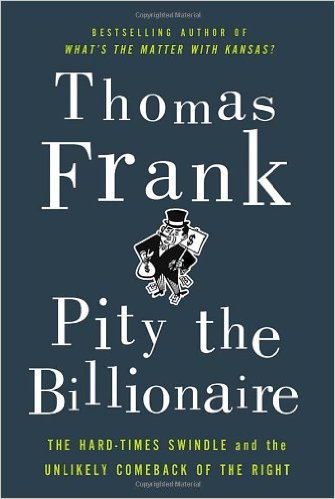
Pity the Billionaire: the Hard Times Swindle and the Unlikely Comeback of the Right

By Thomas Frank

Havill Secker (2012)

Book Review

Pity the Poor Billionaire describes how the right wing corporate elite used the 2008 economic crash to build a pseudo-populist movement (aka the Tea Party) to build blue collar support for harsh free market austerity policies that benefited Wall Street at the expense of working people.

According to Frank,  the Tea Party was the fourth conservative uprising in the last half century. The first was the backlash against the anti-Vietnam war movement that resulted in Nixon’s election in 1968 and 1972. The second was the Reagan revolution in 1980; the third the Contract with America revolution that won Republican control of Congress (in 1994) during Clinton’s first term.

The Demise of Unions and the Left

With each of these movements, US political and economic life became increasingly conservative, with all public institutions – churches, hospitals, universities, museums, the US Post Office and even the Army and CIA – succumbing to pressure to operate according to free market principles.

The same period saw the virtual demise of both labor unions and any organized US left. Nevertheless, according to Frank, right wing strategists managed to flood the media with rhetoric ramping up popular fear the left was “on the march.” It mainly  focused on a fictitious behind-the-scenes conspiracy to provoke a crisis – through overspending that would collapse the US economy.

Swaying Popular Anger from Wall Street to the Government

This messaging, crafted by right wing think tanks funded by right wing billionaires like the Koch brothers and delivered by Glenn Beck, Russ Limbaugh and similar right wing celebrities, was spectacularly effective in convincing a majority of Americans that the neoliberal corporatist Obama is really a socialist.

Oil billionaire Charles Koch warned back in 2008 that the global economic downturn could lead to the same “loss of liberty and prosperity” (for billionaires) as the Great Depression did. He and his brother David went on to deliberately manufacture an “astroturf”* movement (ie the Tea Party) to thwart Obama from enacting the same type of public spending projects Roosevelt used to reverse the 1929 depression.**

They did this by using Tea Party protests and right wing media to sway public anger away from Wall Street and onto the government. Via sophisticated psychological propaganda, working people were systematically conned into believing their interests coincide with those of Wall Street corporations.


*Astroturfing is the practice of masking the sponsors of a message or organization to make it appear as though it originates from grassroots participants.

**Frank challenges (with data) the common Tea Party assertion that Roosevelt’s New Deal reforms failed to halt the 1929 depression (ie that it took the World War II mobilization to lift the US out of depression). Between 1929 and 1933 (when Roosevelt took office), the US GDP dropped by more than 50 percent. Following the enactment of the New Deal, it increased by 11% in 1934, 9% in 1935, 14% in 1936 and 13% in 1937. Overall GDP growth 1933-37 was the highest the US has seen outside of war time.

Debunking the Notion of Good Wars

In the following video author David Swanson discusses his book War is a Lie. As a long time anti-war campaigner, Swanson’s purpose is to demolish the widespread belief that some wars (eg the Revolutionary War, the War of 1812, the Civil War and World War II) are “good wars. He carefully dispels the lies ruling elites have told us about each of these wars, simultaneously clarifying that each had the true purpose of expanding American empire.

With numerous historical examples, he demonstrates that war was totally unnecessary to win American independence (eg the US launched the War of 1812 as an excuse to invade Canada.). And not only was the Civil War unnecessary to end slavery, but slavery didn’t end in the US until World War II. (See 1941: The Year Slavery Finally Ended)

Swanson is extremely critical of environmentalists who are too timid to condemn war as the major destroyer of the environment and civil libertarians who condemn torture and assassination without condemning war as the root cause of these atrocities. He’s also highly critical of activists who bemoan that the corporate elite is too powerfully entrenched to be crushed by a mass movement.

Unlike most presentations, the Q&A’s – which start at 31:00 – are the best part of this video.


The Psychological Trauma Inflicted by Predatory Capitalism

The Shock Doctrine: The Rise of Disaster Capitalism

Directed by Michael Winterbottom (2009)

Film Review

Based on Naomi Klein’s best-selling book by the same name, this documentary explores predatory capitalism’s use of psychological trauma to crush human rights and forcibly transfer vast sums of money  from the poor to the rich.

Like the book, the documentary begins with Dr Ewan Cameron’s CIA-funded research at McGill University into the long term  effects of shock therapy, sleep deprivation and other deliberately inflicted trauma. The Agency would incorporate Cameron’s findings in their Kubark counterintelligence interrogation (ie torture) manual. They went on to use Kubark to train fascist South American military officers at the School of the Americas and to interrogate random prisoners (the vast majority were never charged) at Guantanamo and Iraqi prisons.

The film also explores the “economic shock therapy” developed by the late University of Chicago economist Milton Friedman. Friedman was a master at exploiting natural and contrived disasters to impose the kind of extreme free market reforms that crush unions and wages, shut down or privatize public services and create massive unemployment – while simultaneously transferring obscene amounts of wealth from the working and middle classes to the rich.

Friedman and his cronies seized the opportunity to put their predatory theories into practice when the CIA helped overthrow democratically elected governments in Chile, Brazil, Uruguay and Argentina; during the neoconservative regimes of Thatcher and Reagan; in Russia after the Berlin Wall collapsed; in New Orleans after Katrina; in Sri Lanka after the 2004 tsunami; and in Iraq after 9/11.

The Refusal of Global Economists to Recognize Women’s Unpaid Labor

marilyn waring_working_class_hero

Whose Counting?

Directed by Terre Nash (1995)

Film Review


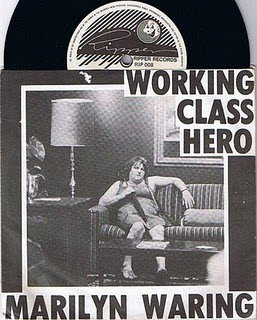
Whose Counting is a 1995 Canadian documentary about the early life of New Zealand feminist Marilyn Waring. With her 1988 book If Women Counted, Waring was the first to challenge whether GDP (gross domestic product) is an effective way to measure the performance of a national economy.

New Zealand’s Antinuclear Ban

The film begins with Waring’s election to the New Zealand parliament in 1977. The youngest member of Parliament (at 23), she was elected to a safe National (conservative) seat in rural Waikato. After serving three 3-year terms, she brought the government down by “crossing the floor” (ie signaling her intention to vote with the Labour opposition on the anti-nuclear issue).

Then prime minister Robert Muldoon called a snap election. He was voted out of office, with 72% of New Zealanders supporting Labour’s platform of permanently outlawing nuclear weapons and nuclear power in New Zealand.

Because the US government refuses to disclose whether their ships are nuclear powered or carry nuclear weapons, as of 1984 all US naval vessels are banned from New Zealand sovereign waters.

Negating Half the Planet

During her term in Parliament, Waring served on the Public Expenditure Committee and was troubled by was she learned was the UN System of National Accounts. As a condition of belonging to the UN, IMF and World Bank, all countries must use this system, developed by economists Maynard Keynes and Nicholas Stern after World War II.

Because this accounting system only attributes value to cash generating activities, it negates the productive activity of over half the planet – and of the planet itself.*

The film has a really humorous scene in rural Africa where women grow and cook all the food, collect all the firewood and water, and do all the housework and child and elder care – while the men lie around all day “supervising” them.

However it stresses that women also work far harder than men in the developed world. Two-thirds of all primary health care is delivered by women in the home. Yet because they receive no cash payments, all this work is virtually invisible.

Counting Environmental Damage as Growth

Waring is also extremely critical of a global accounting system that counts the immense environmental damage caused by the Exxon Valdez spill as positive GDP Growth. Given that the five permanent UN Security Council members (US, UK, France, Russia and China) are also the world’s biggest arms exporters, she finds it no surprise that the carnage of war counts as GDP growth.


*Waring was also an early promoter of the concept of “ecosystem services,” essential services provided by nature in purifying water and air, sequestering carbon, stabilizing climate, providing for food crop pollination, etc.

The film can’t be embedded for copyright reasons. However it can be viewed free at https://www.nfb.ca/film/whos_counting


A C-SPAN Talk About Gloria Steinem and Other CIA Anomalies

The Secret CIA Campaign to Influence Culture: Covert Cultural Operations

C-SPAN (2000)

This video is a C-SPAN presentation by British author Frances Stoner Saunders on her 1999 book Who Paid the Piper? The CIA and the Cultural Cold War (published in the US as The Cultural Cold War: The CIA and the World of Arts and Letters).  See The History of CIA Funded Foundations.

According to Saunders, her book was inspired by a 1974 essay Abstract Expressionism: Weapon of the Cold War by Eva Cockcroft. The essay discusses the CIA role in the global promotion of abstract art. Saunders found the notion of a US intelligence agency promoting modern art so bizarre she spent the next two years pouring through congressional archives and interviewing former CIA officers – including Tom Braden* and William Colby (right before he mysteriously fell into the Potomac in 1996).

In the process, she learned the CIA front Congress for Cultural Freedom (started in 1950) funded the publication of literally hundreds of books and magazines, art exhibits and overseas cultural organizations.

In her talk, she also mentions the large number of ex-communists and liberals (eg Arthur Scheslinger) who joined the Congress for Cultural Freedom (even though most of them knew it was CIA-funded).

For me the best parts are at 23 minutes, where she describes feminist Gloria Steinem’s work for a CIA front called the Independent Research Services**  and the Q&As. The latter start at 34 minutes. At least three of the four questioners are obvious CIA plants, and she utterly demolishes them.

The CIA posted a review of Saunders’ book on their website


*Braden was a CIA officer from 1947 to 1954 who went on to co-host (as the “voice from the left”) the CNN program Crossfire.

** Steinem even had her own CIA case officer – see Did the CIA Use Gloria Steinem to Subvert the Feminist Movement?

French Activists Real Target of State of Emergency

Paris State of Emergency

Medialien (2016)

Film Review

Paris State of Emergency is a short documentary revealing how French police are using the state of emergency declared in November 2015 to target social justice activists rather than Islamic terrorists.

This has resulted in numerous warrantless house searches by armed SWAT teams, as well as arbitrary arrest and heavy police violence against squatters and peaceful protesters.

French activists find themselves in a similar position as US activists after 9-11 and the passage of the Patriot Act. The latter has targeted vastly more activists than terrorists for surveillance, home invasion and arrest.

The French activists interviewed also complain of heavy infiltration of their organizations by police informants – which explains how French authorities could immediately target key organizers once they declared the state of emergency.

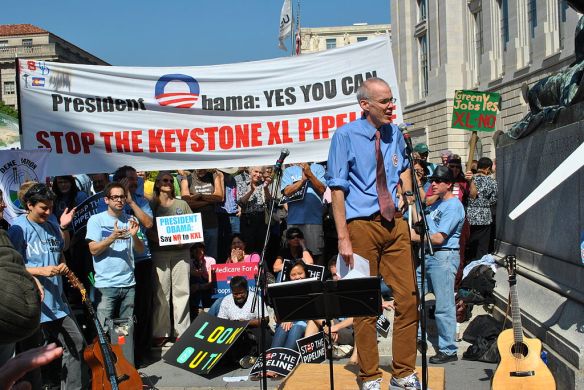
Obama’s Double Dealing on Canadian Tar Sands

keystone

The Other Keystone: The Alberta Clipper, the Pipeline No One Is Talking About

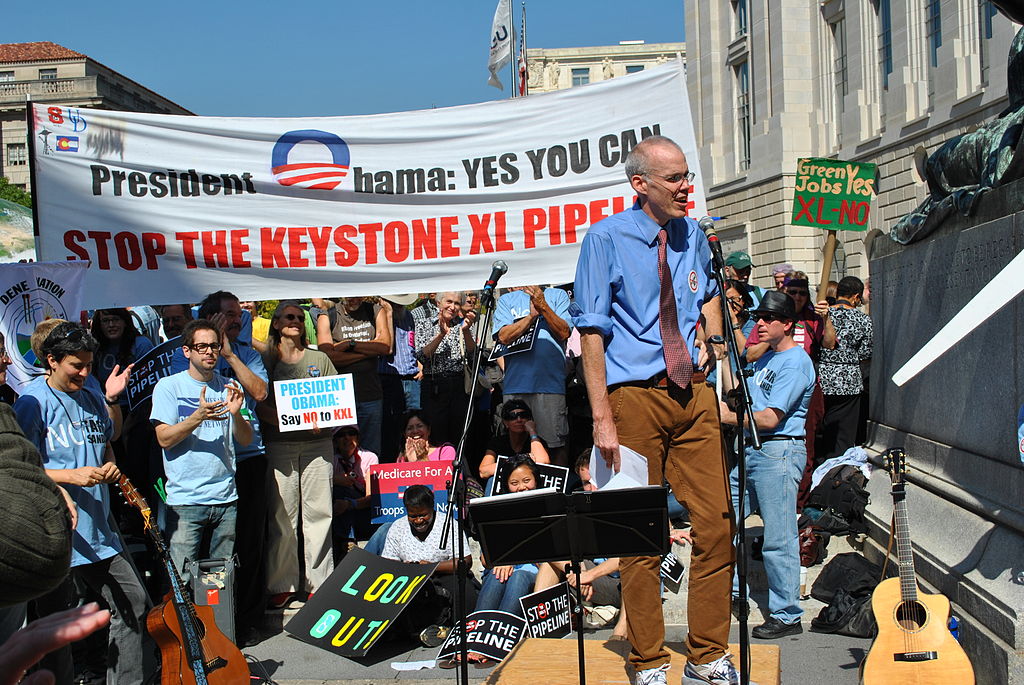
According to In These Times, while climate activists were celebrating Obama’s November 15, 2015 rejection of the Keystone pipeline, Canadian oil giant Enbridge was already transporting 800,000 barrels of tar sands crude – with State Department approval – along an alternative pipeline network extending from Alberta to Gulf of Mexico refineries.

Enbridge already has State Department approval, granted in 2007, to tranship a maximum of 450,000 barrels a day across the Canadian border via a pipeline known as the Alberta Clipper or Line 67. .

State Department Approves Illegal Switchero

In 2013 Enbridge made application to double Alberta Clipper capacity. When this generated massive public protest, they performed what In These Times describes as an “illegal switchero.”

Instead of relying on Line 67 to transport 800,000 BPD of crude oil across the border, they have been diverting the crude to another existing pipeline called Line 3. This segment transports the oil across the border before it’s ultimately transferred back to Line 67 in Minnesota.

Enbridge describes the project as a “maintenance-driven replacement” of Line 3, which stretches from Edmonton to Superior. As part of this replacement, Enbridge constructed four totally new pipeline interconnections between Line 67 and its new “replacement” Line 3: two at the company’s Gretna, Manitoba station in Canada, and two more in the United States just south of the border.
The State Department ultimately acceded to these changes without requiring new permits or environmental review.

Activists Lose in Court

In November 2014, a coalition of tribal and environmental groups filed suit against the State Department, claiming that it had violated federal preservation and environmental laws and calling for an injunction on the bypass project until it went through the full permitting process. Tar sands oil is the most environmentally damaging form of oil. Enbridge is already responsible for more than 800 pipeline spills, which are linked to major health problems in affected communities.

On December 9, 2015 the federal judge ruled in favor of Enbridge and the State Department, arguing that the State Department’s decision is not subject to judicial review.

Obama’s Gift to Enbridge Stockholders

Ken Rumelt, staff attorney at Vermont Law School’s Environmental and Natural Resources Law Clinic, says that Enbridge’s endgame has always been clear: even though projects have been proposed piecemeal, they constitute one large network capable of ramping up transport of Canadian tar sands to the Gulf Coast.

Enbridge has a number of other pipeline projects either already in existence or in the works, which form links in this network. When the rest of the Line 3 replacement goes online in 2017, it will open up a new corridor for tar sands oil to flow in through the Upper Midwest.

Then there’s Line 61, a huge, 42-inch pipeline built in 2007 that runs from Superior to Flanagan, Ill, The final links in this tar sands chain have been around for some time. Two pipelines will run nearly 800,000 BPD from Flanagan to Cushing, Oklahoma., where they link up with Enbridge’s 500-mile long Seaway pipeline and its 850,000 BPD capacity “twin.” These pipelines extend all the way to the Gulf Coast.

Two days before Obama’s Keystone rejection, Enbridge announced plans to build import and export facilities at the Gulf of Mexico region. With Congress and President Obama having lifted the United States’ 40-year ban on oil exports in December, Enbridge is now perfectly positioned to export tar sands oil through the Gulf.

Read more here

Photo credit: chesapeakeclimate (Bill McKibben) [CC BY-SA 2.0 (Creative Commons licenses)], via Wikimedia Commons