Economics to Save Our Civilization

(This is the eighth in a series of posts about ending the role of private banks in issuing money)

“Somewhere in our history we took a wrong turn and today we are reaping the consequences. If we don’t step back to evaluate the root causes of the rolling economic crises, our civilization is in danger of collapse.” – Clive Menzies

A few years back, Clive Menzies, president of British Fund Building and member of the Free Critical Thinking Institute entered into an ongoing dialogue with the London Occupy movement. The result is a radical monetary reform proposal to fix the global economic mess. In the video below, he is presenting it to the Chartered Institute for Securities and Investment (translation: a high-powered group of investment bankers and stock brokers).

In his presentation, Menzies attributes the current crisis, as well as capitalism’s recurrent boom and bust cycles, to the alienation of the vast majority of the global population from the commons (i.e. communal ownership of land and natural resources that ended with the Enclosure Acts) and the prohibition of any discussion of this catastrophic event in contemporary economic discourse. (This is a topic Fred Harrison discusses at length in The Traumatised Society.)

Most of Menzies’s talk focuses on the urgent need to abolish our current debt-based (bank-controlled) monetary system. For five main reasons:

  • It drives systemic inequality by allowing those with more money than they need to exploit those who need money.
  • It drives unsustainable, exponential debt growth because the interest cost rises faster than society can create wealth to pay it.
  • It discounts the future, driving environmental destruction – it makes a forest worth more as sawed timber than as an ecosystem preserved for future generations.
  • It demands exponential GDP growth, rapidly depleting finite resources – 3% GDP growth means the economy doubles every 24 years which means extracting resources at twice the rate and throwing twice as much away.
  • It drives inflation.

He also demolishes the prevailing myth that a person’s existence on this planet is only justified by paid work. In a way it’s deliberate falsehood more than a myth. There is only enough “productive” work for 50% of the adult population and the vast majority of income in contemporary society is generated via “rent-seeking” (i.e. charging interest or rent or extracting and exploiting publicly owned natural resources).

Menzies lays out a monetary reform proposal that would abolish interest exploitation by the private banks who currently issue and control global currencies. Instead it would empower governments to issue interest-free sovereign currency.

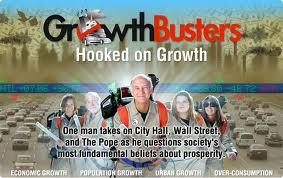
GrowthBusters: Hooked on Growth

growthbusters

(This is the seventh of a series of posts about ending our debt based monetary system and reckless emphasis on perpetual economic growth. Dave Gardner makes the ecological case for ending our addiction to continuous economic growth.)

Growthbusters: Hooked on Growth

2011, Directed and produced by Dave Gardner

http://www.growthbusters.org/

Film Review

Growthbusters is the inspiring story of Dave Gardner’s efforts to challenge conservative Colorado Springs’ failed growth promotion policies. The film also takes a broader theoretical look at the overall failure of economic growth to solve the global economic crisis.

While Gardner is clearly an environmental crusader concerned about the link between unlimited growth on carbon emissions, resource scarcity and species extinction, he inserts a heavy dose of economic reality into the discussion. All of us involved with local government have heard the same insipid assertions about the urgent need to cut corporate tax and regulations to attract new industry and jobs, as well as the need to spend to spend billions of dollars on new infrastructure to accommodate the hoards of people we want to attract to our cities and towns.

In reality, the people and institutions who promote growth most heavily are the only ones who benefit from it – at the expense of everyone else. This includes real estate developers who derive profits from building more homes, office blocks and shopping center; the mining and fossil fuel companies that fuel this economic activity, as well as heating all the new homes and powering the new cars; and the banks who finance all this. In other words the super rich.

The Population Bomb

In addition to tackling the pro-growth agenda head on, Gardner also makes the important link between exploding population growth and environmental degradation. Paul Ehrlich, who appears briefly in the film, warned in his 1970 book The Population Bomb that mankind was rapidly outstripping the Earth’s natural resources. Dennis Meadows, who directed the 1973 Club of Rome project resulting in the book Limits to Growth, also appears. Based on advanced computer modeling, this controversial report warned forty years ago that population growth and resource scarcity would cause the global economy to falter at the beginning of the 21st century. Apparently, as Meadows reminds us, the 2008 global economic crisis was right on schedule.

As Gardner, Ehrlich, Meadows and other experts point out, humankind is living beyond our means, “liquidating” resources we should be should be saving for our children and grandchildren. If we were still growing all our food locally, as we were at the beginning of the 20th century, it would be obvious there is no longer enough land in cultivation to feed 7 billion people. However because of globalization, most of the industrialized world has no idea where their food comes from. While the one billion people who die of starvation or gradual malnutrition are virtually invisible.

Family Planning: the Best Way to Reduce Carbon Emissions

Gardner doesn’t advocate for mandatory population control like they have in China. However he argues strongly for major environmental groups like the Sierra Club to use their public profile to begin educating governments and communities about making informed decisions around family size.

There’s no way we can possibly change enough light bulbs or plant enough trees to compensate for all the babies born to our children and our children’s children. Population control is a critical ecological issue. The “official” environmental movement is letting us all down by refusing to take it up.

New Paths Forward

Gardner himself does his part. When he’s not running for city council or making movies, he’s out in the street distributing free Endangered Species Condoms on the street. The condoms come in choice of packaging featuring endangered panthers, polar bears and cute critters.

He also encourages people to join the Transition movement to help in strengthening their communities, re-localizing economic life and rebuilding skills that don’t depend on corporations and fossil fuels.


The End of Growth

End of Growth

The End of Growth: Adapting to Our New Economic Reality

by Richard Heinberg

(New Society Publishers Aug 2011)

(This is the sixth of a series of posts about stripping private banks of the right to issue money. It stresses the link between our debt-based monetary system and the drive for perpetual economic growth.)

The basic premise of The End of Growth is that the world economy has flat-lined. Not only is it contracting, rather than expanding as most politicians claim, but there are important reasons why it will never return to pre-2007 growth levels. The reason? The last two centuries of continuous economic expansion were only possible due to the ready availability of cheap fossil fuels. Growing fossil fuel scarcity has caused energy costs to skyrocket. And this, according to Heinberg, is the main reason for declining economic growth.

As well as making an strong case that economic expansion has ended, Heinberg also writes about far-sighted governments (Japan, Sweden, Denmark, Norway and Finland) that are enacting policies to ensure the welfare of their citizenry as they confront new economic realities.

Heinberg and others in the Peak Oil/climate change movement have always argued that infinite economic expansion is mathematically impossible on a finite planet with finite natural resources. The End of Growth highlights the massive ecological devastation caused by this reckless obsession with economic growth, while warning that we are depriving our children and grandchildren of natural resources (fossil fuels, water, industrial fertilizers, fish stocks, top soil) that may be needed for basic survival.

In Heinberg’s previous work, he predicts it will take a decade or more before fossil fuel scarcity causes the capitalist economic system to hit the wall. In The End of Growth, he argues it already has: in October 2008. While a few countries can claim an occasional quarter of increased GDP, aggregate global economic growth is either stagnant or slowly contracting. Even China’s so-called economic “miracle” hasn’t been sufficient to generate a genuine increase in total global wealth.

The Ultimate Ponzi Scheme

Heinberg goes on to explain how private banks use the fractional reserve system to invent money out of thin air. In a global economic system where money can only be created by issuing bank loans, there’s never enough money in the system to repay all the debt. This means the global economy can only function via continual creation of new loans. And continuous economic growth is essential to make this happen.

Heinberg’s analysis of the 2008 meltdown starts with an introduction to classical economic theory, and a discussion of of the “financialization” of the US economy that occurred in the 1980s. There’s a detailed discussion of the risky financial derivatives that led to a decade of speculation and “debt” bubbles. The largest was the subprime/derivative boom, in which massive amount of borrowed money was speculated on derivatives and subprime mortgages that couldn’t be repaid. The debt bubble created was so large it plunged the entire world economy into depression when it burst.

The End of Growth in China

Heinberg also presents a painstaking analysis of why the China’s current phenomenal growth rate (7-8% per year) and somewhat slower growth rates in India, Thailand, Malaysia and Vietnam also represent “bubbles” that will eventually pop and trigger recession. China is pursuing the identical economy strategies that caused the Japanese economic miracle to collapse in the 1990s – resulting in a two decade long recession.

Life in a Steady State Economy

Obviously the end of economic growth, and continuing job, wage and benefit cuts mean that people in most industrialized countries will be forced to massively downsize their lifestyles. Outside the US, some far sighted governments are intervening in ways to make this transition less painful. Heinberg gives examples of countries (Japan, Sweden, Denmark, Japan, Norway) who openly acknowledge the reality of their steady state economies and pursue policies that make it easier for their citizens to adjust.

Sweden, for example, has transformed depressed industrial towns into “ecomunicpalities,” by “dematerializing” their economies. They have made them into fossil fuel-free towns with organic farming, public transportation and alternative energy projects – while simultaneously fostering social equity.

A Second Model for Regaining Control of Our Money

modernising money

(This is the fifth in a series of posts about stripping private banks of their power to issue money)

Modernising Money: Why Our Monetary System is Broken and How It Can Be Fixed

by Andrew Jackson and Ben Dyson (Positive Money 2012)

Book Review

Modernizing Money lays out a model for restoring government control of the money supply that’s very similar to the Chicago Plan. However it differs from the Chicago Plan in several important ways. Unlike the Chicago Plan, this second model isn’t obsessed with sovereign debt repayment. This, in my view is the most significant difference. Given the IMF’s singular focus on servicing debt, their heavy emphasis on debt repayment isn’t terribly surprising.

In allowing publicly accountable government bodies to assume responsibility for issuing money, both models ensure decisions around money creation are based on the needs of a productive economy, rather than the profit profile of private banks.

Thus both go a long way towards ending bubbles and boom and bust cycles, as well as reducing debt and minimizing inflation and deflation. The 2008 economic downturn was triggered by sudden deflation, i.e. the permanent loss of 60-200 trillion dollars from the global economy.*

Because income inequality increases in direct proportion to debt levels, nationalizing the money supply will also reduce income inequality.

A Radical Change in the Function of Banks

The function of banks changes radically under both proposals. In both cases, private would function purely as money brokers, like credit unions and savings and loan associations. They would only be permitted to loan money from existing assets, from customers’ investment accounts or from reserves borrowed from the central bank. Under both plans, there would be no bank bailouts or bank depositor insurance. When private banks cease to serve the essential function of creating and maintaining the money supply, they will cease to be “too big to fail.” Those that continue to make risky speculative investments will be allowed to go bankrupt.

How the Two Proposals Differ

The proposal Positive Money puts forward in Modernising Money is based on the British economic system, whereas the Chicago Plan is based on the US system. Thus the transition would be somewhat easier in the UK, where the central bank (the Bank of England) has been government-owned since 1946. In contrast the US the central bank (the Federal Reserve) is a consortium of privately owned banks.

Unlike the Chicago Plan, the Positive Money model would use newly created sovereign money for other purposes that paying down existing debt. Under the Chicago Plan, using the new debt-free money to repay sovereign debt (aka national debt or public debt) would be one of the first steps in the transition. The Chicago Plan would also use the new money to issue a citizens dividend that businesses and households would use to pay off private debt.

The Positive Money proposal would simply transfer all existing public and private debt (i.e. mortgage and consumer debt) to the Bank of England balance sheet. Businesses and households would continue to make loan repayments to the Bank of England according to the terms agreed with their bank. This new revenue accruing to the BOE would be spent into the economy in one of five ways. At the discretion of the British government, it could be used to increase public spending, cut taxes or repay government debt. It could also be used to issue a citizens’ dividend (which households and businesses would be required to use for repayment of existing debts) or new loans to businesses.

Ensuring Adequate Credit for the Business Sector

Positive Money is also more explicit about how they would ensure there is adequate credit in the economy to make sure new businesses have adequate access to loans for productive business investment. They would use a variety of qualitative and quantitative methods, including the existing Credit Conditions Survey. They would then auction off a specified amount of new credit to private banks. This new credit could only be used for business loans and not mortgages or consumer credit.

*Both proposals also make the claim that nationalizing the creation of money would also end real estate speculation and bubbles by restricting the funds available for mortgage loans. However given that both proposals spend new money into the economy, there’s still a good chance this could be used for real estate speculation. In my view, the only way to prevent this would be to implement a Land Value Tax simultaneously with the transition to government-issued money.

An IMF Proposal to Ban Banks from Creating Money

(This is the fourth of a series of posts about ending the ability of private banks to issue money.)

For the past 18 months ago, IMF economists Michael Kumhof and Jaromir Benes have been circulating a proposal to end the ability of banks to create money.

As Kumhof explains in the Nov 2013 video below, the perception that governments create money is totally false. In the current global economic system, only about 3% of money (mainly coinage) is created by government. The other 97% is created by private banks out of thin air when they generate new loans. See Economic Justice: the Rolling Stone Version

For various reasons, which Kumhof explains in the video, he and Benes believe that unlimited and unregulated private money creation by banks is responsible for the current economic crisis. And that full recovery is only possible if the privilege of creating and controlling the money supply is restored as a government function.

In addition to assuming sovereign control over the money supply, national governments would also require banks to hold 100 percent reserves for the loans they initiate. This effectively terminates the ability of private banks to create money out of thin air. And this, in turn, massively reduces their political power.

Ironically, the proposal isn’t new. Entitled the Chicago Plan, it was first put forward by University of Chicago professors Henry Simons and Irving Fisher during the Great Depression.

The History of Private vs Sovereign Money

During the Q&A at the end, Kumhof briefly discusses previous experiments with government-issued sovereign money, which have mainly occurred in the US. Sovereign money funded the original 13 colonies, the American War of Independence and the Civil War.

In their paper The Chicago Plan Revisited, he and Benes trace the history of sovereign money back to the ancient Greeks and Romans. During the Middle Ages and Renaissance, all currencies were publicly controlled (by kings and the Pope) until 1666, when Charles II transferred control of money creation to private banks with the English Free Coinage Act of 1666.

The slides, which are difficult to see in the video, are available here

For me the high point of the video is Kumhof’s disclaimer that he doesn’t represent the IMF – that he’s only doing research. Yeah right. I sure wish I had an understanding boss who let me run around making radical proposals to strip investment banks of their power and wealth.

It seems more likely that people in high places know the ship of capitalism is going down – that this is a last ditch effort to save it.

The Real Vampires: An Insider’s View of Banks

tragedy and hope

Tragedy and Hope: A History of the World in Our Time

Carroll Quigley* (1966 MacMillan)

Tragedy and Hope is a free download from http://sandiego.indymedia.org/media/2006/10/119975.pdf

(This is a third of a series of posts about stripping private banks of their power to create and control our money supply.)

Book Review

Tragedy and Hope is an exacting account of how the Bank of England, the Federal Reserve, the European central banks, and the investment banks that dominate them (e.g. Goldman Sachs and JP Morgan) came to control all western governments.

According to Quigley, banks have controlled western society – by manipulating the money supply – since the creation of the Bank of England and the fractional reserve lending system in 1694. Moreover, owing to the secrecy under which they operate, Quigley asserts that most elected officials are totally unaware of the immense control central and investment banks exert over the so-called democratic process.

He describes in exhaustive detail how all historical inflationary and deflationary crises, panics, wars, recessions and depressions were orchestrated behind the scenes by the banking establishment, for the purpose of increasing their private wealth. In his epic portrayal of three centuries of western civilization, he also describes how the banking aristocracy financed the rise of Communism in Russia, China and Eastern Europe, as well as bringing Hitler, Mussolini, Stalin and Roosevelt to power and guiding their governments from behind the scenes.

How Banks Create Money “Out of Nothing”

The single act, according to Quigley, that guaranteed Britain’s two century preeminence over the rest of the world was the development (in 1694), by British investment banks, of the fractional reserve lending system. This system allowed English investment banks to be the first in the world to lend money (to industry and the British government) that they created out of thin air. He goes on to list the banking dynasties that have held near absolute control of the global money supply since 1694, starting with banking cartel formed by Frankfurt banker Meyer Rothschild. At the time of his death, Rothschild’s five sons each controlled a major investment bank in Vienna, London, Naples, Paris and Frankfurt. Quigley lists the investment bank formed by the J.P. Morgan family as second to the Rothschild banks in power and influence, followed by the Baring Brothers, Morgan Grenfell, the Lazard Brothers, Erlanger, Warbur, Shroder, Seligman, the Speyers, Mirabaud, Mallet and Fould.

The Council on Foreign Relations

Quigley also writes about the network of secret round tables of international corporate and banking elites started by Cecil Rhodes and expanded by his followers with his sizable estate. At their founding, they had the stated purpose of spreading British the virtues of “ruling class” tradition throughout the English speaking world and solidifying the political power and influence of the British Empire. The US Council on Foreign Relations, one of the secret round tables started by Rhodes’ followers, was started in 1919, with the explicit goal of influencing the foreign and domestic policies of a former colony over which Britain no longer had direct control.

How English Banks Controlled the US Government

According to Quigley, the US was consistently a debtor nation prior to World War I. Following the 1776 revolution, US government and businesses continued to borrow funding for industrial and colonial expansion from English and European investment banks. The American banker, JP Morgan, collaborated with European investment banks to dictate US foreign and domestic policy. They did so by threatening to destroy the US economy by 1) refusing to renew treasury bonds (i.e. money the government borrowed from banks to fund public spending 2) causing a panic by throwing large numbers of shares on the stock market or 3) destroying the value of railroads and other companies the banks owned by loading them up with worthless assets.

As Quigley relates, they engaged in all three tactics at various times throughout the 19th century, resulting in a series of booms, panics, recessions and depressions that wreaked havoc on American economic development.

How Bankers Engineered, World War I, Bolshevism, Nazism and the Great Depression

The most disturbing section of Tragedy and Hope describes how international bankers engineered (he describes their secret meetings) World War I and what Quigley calls the Banker-Engendered Deflationary Crisis of 1927-40 (aka the Great Depression). Following the 1870 unification under Bismarck, Germany experienced a rapid burst of industrialization, generating sufficient profit that they ceased to rely on investment banks to finance either business or government. They also threatened global bankers by competing with England and other European countries for export markets.

While engineering the first world war to put Germany in her place, the world banking cabal simultaneously hatched a scheme to destabilize Russia (which was making claims on Balkan members of the former Ottoman Empire) by secretly funding the Bolsheviks and other Russian revolutionaries.

Financing Hitler and the Nazis

When the the first world war ended in 1918, public debt in Western Europe and the US had increased by 1000%. In 1929, the austerity measures global banks forced on the US, England, France and other European countries led to widespread bankruptcies and unemployment and the virtual collapse of foreign trade.

Except in Germany. The global banking elite used the wealth generated from debt repayment to finance rapid German re-industrialization and militarization and the Nazi movement started by Hitler. The main German corporations funding Hitler were IG Farben, Siemens, Bayer, Daimler Benz, Porsche/Volksvagen and Krupp. In addition to Henry Ford and William Randolph Hearst, the important US banks and corporations who financed Hitler’s rise to power included Kodak, Coca-Cola, DuPont, Standard Oil, IBM, Random House and Chase Bank.

* Late mentor to former president Bill Clinton, Princeton, Harvard and Georgetown professor Carroll Quigley also served as an adviser to the Pentagon and Foreign Service.

Economic Justice: the Rolling Stone Version

(This is the first in a series of posts about ending the right of private banks to create money.)

In January Jesse Myerson, writing in the Rolling Stone, called for five seemingly radical economic reforms in an article entitled Five Economic Reforms Millenials Should be Fighting For:  guaranteed jobs for everyone, Social Security for all (a guaranteed Universal Basic Income for all citizens), Land Value Tax (which I blog about in Progress and Poverty ), creation of a Sovereign Wealth Fund (enabling government to buy back and own public assets), and a state-owned bank (like the Bank of North Dakota) in every state.

Personally I found the article disappointing and a little sad. Myerson seems to deliberately overlook the most pernicious problem in our present economic system:  the power we give private banks to issue and control our money supply.

Contrary to popular opinion, the government doesn’t issue money, except for a limited amount of notes and coins. As the film below explains, 97% of the money supply is electronic and created by private banks when they issue loans.

A lot of people have the mistaken impression that banks use other depositors’ money when they loan us money to buy a house. What actually happens is that the bank creates the money out of thin air by entering numbers into a computer.

Another common erroneous belief is the the Federal Reserve, which serves as the US central bank, is a government agency. It’s not. It’s a consortium of private banks.

97% Owned (Positive Money 2012) makes the case that the only solution to the current economic recession is to ban private banks from issuing money. They argue for making money creation publicly accountable by restoring this function to government (ironically this is where most people mistakenly believe it lies). Until we make this happen, private banks will continue to use their control of the monetary system to undermine genuine economic and political reform.

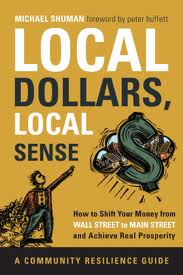
Local Dollars, Local Sense

localdollars

Local Dollars, Local Sense

by Michael Shuman

(Post Carbon Institute, 2012)

Book Review

Michael Shuman’s latest book, Local Dollars, Local Sense is valuable for three different groups of readers: sustainability activists seeking financial support for small locally owned businesses; local business owners seeking start-up and expansion capital; and investors seeking to move their IRA accounts and other Wall Street holdings to safer, more profitable and more socially responsible and environmentally friendly investments.

There is growing consensus among economists and anticorporate activists about the importance of relocalization as the centerpiece part of any realistic solution to the economic, energy and environmental crises that face us. Across the planet, thousands of neighborhoods and towns are coming together to opt out of corporate agriculture and energy production in favor of local food and energy production schemes. The biggest obstacle they face is finding sustainable funding to support their work.

A Dearth of Funding Options for Local Business

At present options for small businesses seeking start-up funding for organic farms, solar installation companies and similar “green” enterprises are extremely limited. A small business owner needing finance has two basic choices. They can take out a time-limited loan at interest or they can sell shares and allow other people to become part owners and share in the profits (or losses).

Even prior to the 2008 economic crisis, it was virtually impossible for small business owners to find conventional bank loans. Nearly all the neighborhood banks we grew up with have been bought out by global investment banks, which have no incentive to make loans to small local businesses. The recent move by millions of Americans to move their accounts out of global banks to local banks and credit unions – which do support local business – has been a move in the right direction. Yet as Michael Shuman points out in Local Dollars, Local Sense, this is merely a drop in the bucket compared to the $30 trillion Americans have invested – mostly through IRAs and pension plans – in Wall Street Fortune 500 companies.

Shuman, a member of the Post Carbon Institute and partner at Cutting Edge Capital makes, a compelling case for moving half ($15 trillion) of it out of Wall Street and investing it locally.  He presents strong evidence that local businesses provide a higher and more reliable return than the Wall Street casino, as well as providing a host of benefits for society and the environment. Unlike multinational corporations, they have to be accountable to local residents who patronize them. This translates into a strong incentive to be environmentally responsible, to treat workers fairly and to contribute positively to the community.

How Banks and Corporations Game the System

Although small local businesses produce 50% of the US GDP, as well as providing 50% have the jobs, fewer than 1% of Americans’ combined savings and investments help to finance local business. Most Americans still keep their short term savings (if they have any) in large multinational banks. In most cases, their only long term savings are tied up in IRA plans and pension funds. With the exception of municipal bonds, nearly all of this is invested in Fortune 500 corporations with no loyalty whatsoever to any community, state or country.

The main reason most Americans invest in Wall Street is because powerful bank and corporate lobbies give them no choice. There are serious legal obstacles preventing people from investing in local business. Outdated securities laws passed during the Great Depression make it virtually impossible for “unaccredited” investors (approximately 98% of Americans) to invest even small amounts in local companies. “Accredited investor is a term delineating the qualifications needed to participate in “high risk” investments, such as seed money, limited partnerships, hedge funds, private placements, and “angel” investments. In the US, an accredited investor must have an income of $200,000 (for three years) and a net wealth of at least $1 million (excluding their residence).

A new business seeking funding from “unaccredited” investors is required to register with the SEC and state regulators. This, in turn, requires the creation of a disclosure and other legal documents at a cost of $25,000-150,000 in attorney fees. The U-7 or SCOR (Small Company Offering Registration) form alone is 39 pages, and each form must be accompanied by 14 disclosure documents.

There seems little hope of reforming these archaic laws while powerful Wall Street lobbies control both Congress and the White House. However according to Schuman, communities across the US are trying exciting new financing models that circumvent existing securities law:

  • Worker and/or consumer cooperatives – workers and/or workers and consumers pool their resources and share ownership in the local business they are starting or taking over from a prior owner.
  • Pre-sales Contracts – companies generate start-up funding by lining up customers to pay in advance for their products.
  • Local Investment Opportunities Networks (LIONS) – local networks deliberately cultivate relationships between business owners and potential investors (the SEC and state regulators often waive the requirement for a SCOR if the investor is a family member or “friend”).
  • BIDCOs (Business Development Companies) – a type of investment club. BIDCOS aren’t required to register with the Security and Exchange Commission (SEC) but must provide managerial and technical assistance to beneficiaries as well as capitol. No Small Potatoes in Maine is an example of a BIDCO
  • Low cost DPOs (Direct Public Offerings) – if the business is limited to operating within state or offers the investment opportunity without public advertising, it may qualify for exemption from registration requirements. The business owner will still need to fill out a SCOR, but a number of public interest attorneys are seeking to streamline the process by creating “fill-in-the-blank” software.
  • Crowdfunding – a technique for pooling of large numbers of small contributions, usually via the Internet, for a specific project. If there is no expectation of return (except for a token gift or premium), there is no requirement to register with the SEC. Small business owners can register potential projects for crowdfunding at Kickstarter.
  • Local/Regional stock exchanges – in 1985 there were approximately a dozen regional exchanges (for example the Pacific Stock Exchange and the Boston Stock Exchange). Most were bought out by either the NYSE the AMEX or the NASDEQ. However according to Shuman, Mission Markets in New York is the most promising model for what future regional exchanges will look like. Mission Markets calls itself a “private marketplace” because obtaining SEC approval to become an “exchange” (where shares are traded) would involve major bureaucratic hurdles and cost half a million dollars.
  • Local Savings Pools – issues interest-free loans for a fixed period. According to Shuman, there is less risk of fraud as lenders and borrowers are more likely to know one another. Since there is no expectation of financial return, there is no requirement to register with the SEC or state regulators.
  • P2P (person-to-person) lending – www.kiva.org, an international microlending (providing loans as small as $25 to third world entrepreneurs) website, is the best example. Inspired by the Grameen Bank founded in Bangladesh by Muhammad Yunis, Kiva has many imitators.

Let Them Eat Crickets

cricket

(With apologies to Marie Antoinette. This post is dedicated to readers who have lost their pensions or unemployment benefits or who are looking at having their hours, wages or Social Security benefits reduced. Some simple cricket recipes below. Please note in preparing cricket flour, you must first remove the legs and antennae. Next week: garden snails recipe from Gordon Ramsay.)

Excerpts from the UN’s Edible Insects: Future Prospects for Food and Feed

By 2050 the population of the Earth will be 9 billion, and food production will have to double to feed them all. This will be a major challenge, given that oceans are already overfished and a growing shortage of fresh water, which will drastically worsen as the planet warms. The Food and Agriculture Organization of the United Nations believe that edible insects, both as food and animal feed, may be the answer to growing food shortages.

They point out that over 1900 insect species of insects edible and two billion people around the world already consume them as a regular part of their diet. Insects are a highly nutritious and healthy food source with high fat, protein, vitamin, fiber, omega-3 fatty acids and essential minerals. The most common insect species used food are bees, wasps, ants, grasshoppers, locusts, crickets, cicadas, leaf and planthoppers, scale insects and true bugs, termites, dragonflies and flies.

Farming insects for food or animal feed is relatively new but has enormous potential, especially in third world countries. Insect rearing is not necessarily a land-based activity and does not require land clearing to expand production. Moreover because they are cold-blooded, insects are very efficient at converting feed into protein (crickets, for example, need 12 times less feed than cattle, four times less feed than sheep, and half as much feed as pigs and broiler chickens to produce the same amount of protein). Like pigs, they can be fed on organic waste streams.

As a business, insect harvesting and rearing is a low-tech, low-capital investment option that offers entry to the very poorest sections of society, including the landless. Protein and other nutritional deficiencies are typically more widespread in disadvantaged segments of society and during times of social conflict and natural disaster. Because of their nutritional composition, accessibility, simple rearing techniques and quick growth rates, insects can offer a cheap and efficient opportunity to counter nutritional insecurity by providing emergency food and by improving livelihoods and the quality of traditional diets among vulnerable people.

Simple Cricket recipes (from http://www.insectsarefood.com/recipes.html)

It is important to note that crickets should only be purchased from reliable sources. Crickets should be treated much in the same manner as any other raw food, in particular seafood. In other words it is best to keep crickets fresh as possible. Prior to preparing your crickets for a meal place them inside a plastic container or storage bag and keep them in the refrigerator at least for an hour or until you are ready to use them. This will not kill the crickets, but rather slow down their metabolism, inducing a state of hypothermia, in other words, prohibiting their movement when removed from container. If you prefer however, as many people do, feel free to place them inside the freezer for an hour or two as this will definitely kill them, guaranteeing their immobility.

After removing from refrigerator or freezer, place them in a pot of boiling water sized to hold the specific amount of crickets you’re using. Add a few pinches of salt. Boil for about two minutes. This ensures cleanliness. Once boiled, remove from water and let cool. Crickets at this time can be placed in storage bags and kept in the freezer or used right away for any number of recipes. All crickets should be prepared in this manner prior to eating.

Dry Roasted Crickets

Served as a snack for any number of persons

Ingredients:

25 – 50 live crickets – or however many you wish to cook/serve

Directions:

Salt, or any preferred seasoning that can be shaken or sprinkled onto crickets after roasting.

Next, preheat oven to 200 degrees. Arrange the crickets on a cookie sheet, making sure none of them overlap. Proceed to bake at low temperature for about 60 minutes or until the crickets are completely dry or dry enough for personal taste.

Open up oven at the 45-minute mark and test a cricket to see if it’s dry enough by crushing with a spoon against a hard surface or if you prefer, between your fingers. The crickets should crush somewhat easily. If not place them back inside oven until crisp.

Once roasted and cooled down, place a few crickets between your palms and carefully roll them breaking off legs and antennae in the process. This ensures clean and crisp crickets without legs or antennae getting in the way of.

Season them with salt, Kosher salt, sea salt, smoked salt or whatever sort of seasoning you wish. They are very good and healthy to eat as a roasted snack. Eat them on the spot or place them back into the freezer for future use.

Cricket Flour

Ingredients:

4 cups of flour
1 cup of roasted crickets (¼ – ½ cup of crickets to every cup of flour works well.)

Directions:

Break off the antennae and legs by gently rolling the cricket between your hands.
Once you collect enough crickets in a bowl proceed to crush either using a mortar and pestle or rolling pin on a hard surface.

Gather the crushed crickets – they should look like small specks (usually of dark brown color) and blend them well into the flour of your choosing.

Once you’ve blended the crickets with the flour you’re set to use it in any way you wish.

Hoppin’ Good™ Cricket Fried Rice

Serves 4 – 6

Ingredients:

4 cups cold cooked brown rice
1 ½ cups of roasted crickets (about 3 – 4 dozen)
1 cup chopped scallions
½ cup cooked corn kernels
2 large eggs
1 teaspoon Kosher salt
Powdered ginger to taste
Powdered coriander to taste
Garlic powder to taste
1 teaspoon fresh ground black pepper, or to taste
4 tablespoons oil for stir-frying, or as needed
1 ½ tablespoons light soy sauce or oyster sauce, as desired

Directions:

Wash and finely chop scallions. Lightly beat the eggs with salt, ginger, garlic powder, coriander and pepper.

Heat a wok or frying pan and add 2 tablespoons oil. When the oil is hot, add the eggs. Cook, stirring, until they are lightly scrambled but not too dry. Remove the eggs and wipe clean the wok or frying pan.

Add 2 tablespoons of oil. Add rice. Stir-fry for a few minutes, using wooden spoon to break it apart. Add crickets. Add scallions. Stir in soy sauce or oyster sauce as desired. Continue stirring for a few more minutes.

When the rice is heated through, add the scrambled egg back into the pan. Mix thoroughly. Stir in corn kernels. Serve hot.

This dish goes great with any other dish or appetizer, i.e., cooked greens, egg rolls, dumplings, etc.