The Addiction of Compulsive Consumption

overspent american

The Overspent American: Why We Want What We Don’t Need

by Juliet Schor (Harper Perennial 1998)

Book Review

The Overspent American is a study of the psychological and sociological factors that drive Americans’ compulsive consumption. In the mid twentieth century, we all believed that a big boom in mechanization and productivity would translate into a significant increase in leisure time. Instead the 21st century found Americans working harder than ever. Growing income inequality, with a bigger percentage of our work product, going to corporate profit, is a big part of the answer. Another important part is compulsive spending patterns that have trapped Americans into in painful desire-debt-spend-overwork cycle.

In many, compulsive spending is an addictive behavior. Many shopaholics regret their purchases once they get them home and never use them.

According to Schor, around 80% of Americans feel that US society is too materialistic, while simultaneously under-estimating their own compulsive consumption and indebtedness. In 1998 (when Schor published The Overspent American), 80% of Americans had personal debt beyond their home mortgage. Across the entire population, average debt was the same as average annual income.

Schor’s purpose is to examine why the promise of greater leisure time due to greater mechanization and productivity never materialized. In 1998, when she wrote the book, Americans were working twice as hard in the fifties. In her few, this is only partly due to corporate exploitation. Many Americans are forced to work more hours than they would really like owing to the compulsive spending parents, especially if they get hooked into the desire-debt-overwork cycle.

Competitive Consumption

I had always blamed Americans’ obsessive consumerism on their constant bombardment, by the media, with psychologically sophisticated pro-consumption messaging. According to Schor’s and others’ research, the problem is far more complex.

Overspending, according to Schor is based in competitive consumption, i.e. the achievement of social status based on what you spend, rather than what you earn. It’s a very old phenomenon. Adam Smith mentions it in Wealth of Nations.

Schor’s research primarily concerns the middle class. Individuals with a strong working class identity tend to be less susceptible to competitive consumption pressures, in part because they have little or no discretionary income and limited access to credit and reject bourgeois ideals in favor of non-consumerist values (eg solidarity).

She also examines two specific groups that are oblivious to competitive consumption pressures. I found this particularly valuable in understanding my own lack of desire to consume and acquire material goods.

Defensive Spending

According to Schor, middle class Americans spend defensively for fear of losing status. The fear of falling behind and ceasing to be middle class became particularly intense in the 1970s, when US companies first began shutting down and moving overseas. Between 1980 and 1995, the upper 20% of the US population experienced an increase in income. Everyone else got a reduction in income. By 1996, the middle class was noticeably shrinking, despite the entry of women into the workforce.

People who were downsized between 1980 and 2000 incurred massive debts to preserve their middle class status. Unlike the fifties, middle class spending expectations no longer revolved around comfort but around conspicuous consumption of luxuries. If you couldn’t afford a four bedroom house, two cars, cable, a VCR, microwave, blender, coffee maker, computer, printer, expensive vacations, massages, personal trainers, lavish gifts at Christmas and other special occasions (one third of which gift receivers neither want nor use), you borrowed money on your credit cards to pay for it. Once you maxed out your credit cards, you ceased to qualify for middle class membership.

The Effect of TV

I was very surprised by the lack of hard research that TV ads stimulate consumption in adult spenders. In Schor’s studies, she found that consumer desires were mainly generated to by exposure to the lifestyles of a reference group, ie the group closest to us in the social hierarchy (workmates, family, friends). Where TV (and films) most influence spending is by offering an inflated view of how other Americans live and what they buy and own. This occurs because the vast majority of TV characters are upper middle class. With growing social isolation, TV itself serves as a reference group for many people.

Downshifters and Simple Livers

Schor classifies people who are resistant to compulsive consumption pressures as either downshifters or simple livers. I found the distinction she makes to somewhat arbitrary, especially when she refers to Quakers, Shakers, Transcendalists and hippies as downshifters. By her own definition, I would tend to call all these groups simple livers:  they resisted material accumulation out of moral conviction and were supported by a reference group that shared these values.

According to Schor, downshifters are more likely to be individuals who have given up compulsive consumption due to a debt crisis or intense work stress. They would prefer to have more money and time, but are forced to opt for time due to some personal crisis. Between 1990 and 1996, 20% of Americans downshifted voluntarily. Twelve percent did so involuntarily due to job loss or wage cuts.*

Simple livers reject the notion that material goods determine status. They set a low level of sufficiency income (some set it as low as $6,000 – 15,000 a year). Beyond this level, spending is no longer positive because it creates clutter, harms environment and alienates them from their peer group. They reject the notion that material goods determine status.

Voluntary simplicity circles first started in the Pacific Northwest in the 1990s. Thanks to immense popularity of The Simple Life by David Shi and Your Money or Your Life by Vicki Robin and Joe Dominguez, they are now widespread across the country.


*Thanks to ongoing recession, in 2014 the percentage of Americans involuntarily downshifted is nearly 50%.
**According to Schor’s classification system, I’m a simple liver. It’s something that seemed to come naturally because my parents were non-college educated simple livers who rejected conspicuous consumption in favor of non-material values. Most people in my current reference group (the Green Party) are also simple livers.
Why Capitalism is Failing

The Zero Marginal Cost Society

Authors at Google (2014)

Film Review

As the global economy continues to tank, it becomes increasingly apparent that capitalism is incapable of meeting the survival needs of the great majority of the planet. In the video below, economist Jeremy Rifkin explains the concept of zero marginal cost, a phenomenon that is steadily shrinking the global economy. He blames a fundamental “paradox” in the capitalist economic model. Marx also identified a similar structural flaw that would eventually cause capitalism to collapse.*

Here’s how Rifkin explains it:

All businesses have two types of costs: fixed costs and marginal costs. Your fixed costs are your initial investment in the facilities and equipment you need to manufacture products or provide services. Your marginal costs are the recurring expenses you incur to keep the business going – wages, energy, phone, stationery, paper clips, postage and so on.

Due to competition, entrepreneurs face continual pressure to increase productivity and decrease their marginal costs. In this way, they can lower their prices and increase their market share. Businesses that don’t compete effectively go bankrupt.

Over the past forty years, businesses that haven’t moved overseas, have mainly lowered marginal cost by replacing workers with machines. The advent of the Internet has speeded up this process by reducing the marginal cost of numerous products to zero or near zero.

Napster and YouTube led the way by enabling young people to download music and films for free. As the formal economy continued to shed jobs and cut wages, consumers discovered they could get news, how-to information and books for free on the Internet. This killed off the recording industry and has nearly killed off newspapers, book sellers and publishers.

How Renewable Energy, 3D Printers and Car Sharing Reduce Marginal Cost

Marginal costs are also approaching zero in other sectors of the economy. Take renewable energy. After consumers pay off their fixed costs for their wind turbines and solar panels (which takes 3-8 years), the energy they use in their homes is virtually free.

Meanwhile 3D printer technology makes it possible to produce an endless array of consumer goods at near zero marginal cost. After the initial fixed cost, the consumer downloads free software and uses recycled feedstock (in Scandinavia, they’re using recycled plastic and paper and even sand and gravel).

The growing trend by millenials to share cars, bicycles, cabs, home stays, tools and toys significantly increases the range of products and services they can get for nothing. Millions grow their own food and barter to meet other essential needs.

The Internet of Things (IoT)**

By increasing efficiency (by interconnecting devices, systems and services), the Internet of Things will further reduce the marginal cost of even more products and services. Rifkin calls this the third industrial revolution. When most goods and services are free or shared, we will no longer need vertically organized companies to serve as middlemen.

The Jobs Issue

The most obvious impact of the technological innovations Rifkin describes will be the continuing loss of jobs in the formal market exchange economy. Rifken believes jobs will be less important in an economy where people cease to rely on money to meet their basic needs. He also feels that most of the new jobs will be in the nonprofit social commons. The social commons, which has always operated in parallel to the formal market economy, is responsible for social capital, i.e. providing education, social welfare, culture, sports, community and existential meaning.

Ironically the social commons has been growing as the market economy shrinks. Between 2000 and 2010, it saw a 42% increase in revenue, while overall GDP only increased by 16%.

Why the US is Falling Behind the EU and China

According to Rifkin, who consults internationally, Europe and China are eagerly embracing this third industrial revolution. Sadly the US is still desperately propping up an archaic economic model on the verge of collapse. He contrasts China, which is investing $80 billion to roll out a distributed energy network to enable all its residents to produce their own energy, with Obama’s proposal to spend $3 billion over 20 years on a centralized “smart” and (horribly inefficient) electrical grid.***

The Flies in the Ointment

Rifkin envisions two serious obstacles that may obstruct the full roll out of the third industrial revolution. The first relates to pending legislation that would end Net Neutrality.**** Cable companies and Internet providers are lobbying hard for the right to charge a premium for Internet access. This would allow rich people priority access (faster and more expansive) to the Internet.

The second relates to profound disruptions in the water cycle (stemming from global warming) that may have disastrous implications for food production.

*Marx predicted that replacing workers with technology would ultimately cause capitalism to self-destruct. According to Marx, the only source of profit is surplus value (the difference between what you pay a worker and the value of the work they perform). There is no surplus value if you replace a worker with a machine. You have to pay a machine the full value of the work it performs.
**The Internet of Things (IoT) refers to the interconnection of uniquely identifiable embedded computing like devices within the existing Internet infrastructure. Typically, IoT is expected to offer advanced connectivity of devices, systems, and services.
***Under a centralized grid system, only 30-35% of the energy generated by a power plant comes out as electricity at the other end.
****Net Neutrality is the principle that Internet service providers and governments should treat all data on the Internet equally, not discriminating or charging differentially by user, content, site, platform, application, type of attached equipment, and modes of communication.


A Roadmap to Redesigning Civilization

Redesigning Civilization – with Permaculture

by Toby Hemenway (2013)

Film Review

Toby Hemenway defines permaculture as a branch of ecological design that employs natural ecosystems as a model. Although most permaculture design relates to food production, its principles can be applied to the management of all human needs, including water, shelter, waste, energy, finance, culture/spirituality and even sports and security.

Permaculture-based food production focuses on returning to a “horticultural” method of food production with “food forests” and other self-maintained food systems, as opposed to our current mechanized, open field method of food production. Permaculture relies on ecologically designed gardens, rather than open fields, and mixed crops, rather than monoculture. It also employs the continuous plant succession typical of natural ecosystems, rather than starting with a clear cut every year.

For me, the most interesting part of the film is Hemenway’s discussion of archeological evidence that civilization preceded the Agricultural Revolution (around 10,000 BC). This contradicts the prevailing belief that the agricultural made civilization possible by creating a food surplus. It’s been argued for more than a century that the creation of a food surplus through open field agriculture freed up non-farmers to specialize in higher pursuits, such as art, science, music, religion, and literature.

According to Hemenway, more recent archeological evidence suggests that civilization came first. This includes Venus figurines which dating from 40,000 years ago, religious symbols from 30,000 years ago, evidence of horticulture (plant tending) 30,000 years ago and evidence of irrigation 20,000 years ago.

He makes reference to an archeological site in Gokikli Tepi Turkey from 14,000 years ago suggestive of routine spiritual gatherings of hundreds of people. Feeding large crowds poses a specific technological challenge.

Hemenway believes these large gatherings may have been the impetus for large scale open field cultivation. “Agriculture” (from “ager” meaning field) made it possible to produce large amounts of grain which, unlike other foods, can be stored for long periods.

Hemenway goes on to discuss some of the immediate drawbacks of grain-based agriculture (based again on archeological evidence):

  1. Overpopulation, famine, and warfare – agriculture immediately caused a population boom, as grains are the one of the easiest foods to convert to calories. They increase female fertility, as well as allowing for early weaning (breast feeding inhibits ovulation). This population boom made settlements more susceptible both to conquest from neighboring tribes and famine due to failed harvests.
  2. Shorter life span and poorer health – following the introduction of agriculture, people tended to be shorter, suffer from more degenerative disease, and have shorter life spans (by about 20-30%). They also became subject to deadly viral epidemics (such as small pox) transmitted from domesticated animals.
  3. Less leisure time – following the introduction of agriculture, people had to work 60+ hour weeks just to survive. This was in part due to the need to support a priesthood, nobility, and military to protect the grain surplus. A hunter gatherer can generally collect sufficient food in four hours to last him a week.
  4. Agriculture created a fear of nature (of insects, weeds, wilderness, wild animals, and wild people) and a mindset in which people came to see themselves as separate, rather than part of nature.

Hemenway goes on to outline the basic permaculture design principles, with specific examples of their application to all aspects of sustainable living:

  • Catching, storing, and reusing energy and materials, essentially eliminating the concept of waste.
  • Becoming pattern literate – learning to observe ecosystems to see how a small change can have a big effect.
  • Focusing on community and regional self-reliance rather than individual self-sufficiency.

Drawing on real-life examples, the film finishes with recommendations of what viewers can do to facilitate the transition to a “permaculture” lifestyle in their own communities.

Originally published in Dissident Voice

Speculating with our Food

In 2011, “food derivative” speculation replaced financial derivatives as the hot new investment promoted by major investment banks like Goldman Sachs and JP Morgan. According to numerous studies, food speculation rather than shortages, are the main reason for skyrocketing food costs.

The really scary news is that in addition to speculating heavily on food commodities, these same private equity funds are also buying up huge tracts of land in the third world.

The Great Land Grab

A 2009 research project by the Oakland Institute (The Great Land Grab) reveals startling facts about the corporate land grab in the third world – another major factor in skyrocketing food prices.

According to the International Food Policy Research Institute (IFPRI), foreign investors have secured more than 50 million acres of African farmland to develop factory farms for export crops. In addition to investment banks and private equity funds, multilateral agencies, such as the International Financial Corporation (the private sector branch of the World Bank), are also major players in the “corporatization” of global agriculture.

The IFC plays a dual role in increasing private investment in the third world – via direct investment and by pressuring developing countries to create “business enabling environments.” Another World Bank agency, The Foreign Investment Advisory Service (FIAS ), also plays a role by pressuring third world governments to improve their “investment climate,” by relaxing environmental, tenant rights and food security laws and abolishing tax and duties on foreign investments.

Africa is the major target, both for western investment banks and booming Asian economies, driving tens of thousands of subsistence farmers off land they have farmed for generations.

Corporatizing the Global Food Supply

A UK company started in 1997, called  Emergent Asset Management, claims to be the largest speculative fund investing in African industrial agriculture. It uses private equity to take control of large tracts of African farm land. Their prospectus attracts investors by predicting a armed conflict between the West and China will trigger mass food shortages – accompanied by price spikes that guarantee a handsome return to investors. Emergent’s founders, Susan Payne and David Murrin are former high level traders for Goldman Sachs and JP Morgan – well-known as the architects of food derivative speculation.

Emergent’s direct control of large amounts of agricultural land – combined with its ability to attract investors through its equity fund – puts unprecedented control of the global food supply in private hands. It does so by creating a new type of vertical integration, in which a single company controls vast amounts of land, food production and processing — while simultaneously inflating global food prices due to the speculative nature of the fund. As you can see in the video Emergent uses in their pitch to investors:

The Perp Walk – the 1% Have Names

In 2011, the Oakland Institute fingered other millionaires and billionaires grabbing African land via unscrupulous deals with corrupt village leaders (who sign away communal land rights without community consultation) – and by helping to orchestrate armed attacks on families who refuse to leave their land. At the top of the list are

Bruce Rastetter — CEO of Pharos Ag, which has bought more than 300,000 hectares in Tanzania for large-scale food crop, beef, poultry, and biofuel production. This project will displace tens of thousands of civil war refugees awaiting Tanzanian citizenship.

Leonard Henry Thatcher and David Neiman — runs Nile Trading and Development (NTD), which has bought 600,000 hectares in South Sudan through a secret agreement with influential locals who went behind the backs of other community members.

Kevin Godlington — (close associate of former prime minister Tony Blair) CEO of Crad-l and Director of Sierra Leone Agriculture (SLA) and its parent company, the UK-based CAPARO Renewable Agriculture Developments. SLA has bought 43,000 hectares in Sierra Leone to plant palm oil plantations.

Enter the Bill and Melinda Gates Foundation

The March 31 Guardian reports that the Bill and Melinda Gates Foundation (along with USAID and the Dutch and Danish governments) are backing a new World Bank scheme to further industrial agriculture at the expense of the smallholder farmers who produce 80% of the food consumed in the developing world. The new program is a ranking system called the Benchmarking the Business of Agriculture (BBA).

Here’s what the Our Land is Our Business campaign, organized by the Oakland Institute and like-minded food rights groups, has to say about the BBA:

“Despite a language that claims concerns for small farmers, the goal of this new agriculture-focused ranking system is far too clear: [to] further open up countries’ agriculture sectors to foreign corporations. The doing business [rankings] give points to countries when they act in favor of ‘ease of doing business’. This consists of smoothing the way for corporations’ activity in the country by, for instance, cutting administrative procedures, lowering corporate taxes, removing environmental and social regulations or suppressing trade barriers.”

People can sign on at Our Land is Our Business to send a message to the World Bank about looking after people rather than corporations.


How Big Corporations Avoid Tax

The Tax Free Tour

Film Review

VPRO-Marijee Meerman 2013

The Tax Free Tour is an hour long Dutch documentary (in English) about the highly specialized field of corporate tax avoidance. I found it astounding how many American corporations use overseas tax havens to avoid paying tax in the US. Some of the better known names include Walt Disney, Wells Fargo, Google, AT&T, Apple and even companies that promote themselves as socially responsible, like Starbucks and Amazon.

Apple, one of the worst offenders, pays only 1.9% of their annual income in corporate tax. As a US company headquartered in Silicon Valley, Apple should be liable to the standard 35% corporate tax rate. Their secret is diverting nearly all their income to a subsidiary in Ireland (which has one of the lowest corporate tax rates) – after first passing their royalty income through a Netherlands subsidiary (the Dutch charge virtually no tax on intellectual property revenue), a company listed in Virgin Islands and back to Ireland. In the accounting trade, this is known as a Double Irish with a Dutch sandwich.

The filmmakers calculate that profits offshored for tax avoidance purposes totaled more than $20 trillion in 2010. Approximately 100 of the world’s largest companies have subsidiaries in the Netherlands, owing to their low taxes on intellectual property royalties. Walmart has six Dutch companies, even though they don’t have a single Dutch store. Starbucks also diverts all their royalty income to the Netherlands. Because they have a trademark on “frappuccino,” they declare a certain percentage of the price as a “royalty” (and pay no tax on it).

My favorite part is near the end when a British Select Committee challenges a Starbucks executive on his claim that their British coffee houses have been running at a loss for fifteen years. After asking why they don’t close their British stores, she gets him to admit they avoid $1.6 million pounds in corporate taxes by diverting their UK income to the Netherlands. He won’t tell her how much tax they pay the Dutch government. Allegedly Starbucks and the Dutch government have a secret agreement not to disclose the amount. The committee chair sternly reminds the executive of all the free public services Starbucks receives in the UK, at the expense of other taxpayers.

Amazon avoids corporate tax by diverting a sizable portion of their revenue to Luxemburg. Google shelters their profits in Bermuda. Other favored corporate tax havens include Cyprus, the Cayman Islands, Mauritius, Singapore, Hong Kong, the UAE and Kenya.

The irony is that most of this income can’t be transferred to shareholders. Paying it out as dividends would necessitate repatriating the revenue to the company’s home country – and paying the prevailing corporate rate. Thus much of this money is loaned (as treasury bonds) to deeply indebted western countries – who struggle to balance their books owing to the trillions of dollars lost from tax avoidance.

Crossposted at Daily Censored

Giving Capitalism a Feminine Face

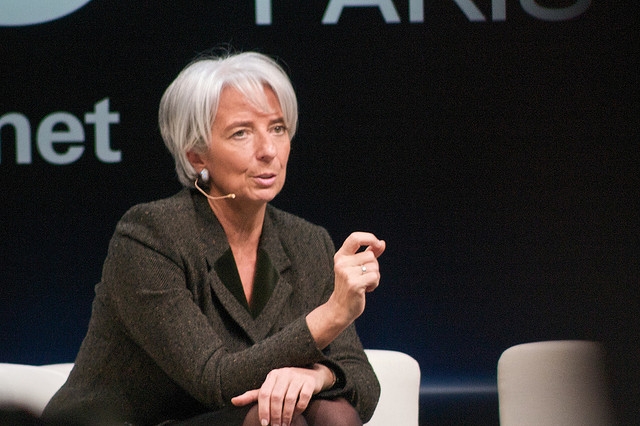
lagarde

Historically the IMF and World Bank, like the WTO, have been characterized by “faceless” leadership. Prior to the mid-nineties, only a handful of liberal intellectuals knew these powerful international institutions existed. Even after the 1999 Battle of Seattle effectively launched the antiglobalization movement, the leaders of these august institutions remained anonymous. When the IMF issued warnings against countries with excessive public spending, they originated from the agency itself, rather than IMF officials.

Prior to his June 2011 arrest for alleged sexual assault, no one outside of France had heard of Dominique Strauss-Kahn, who ran the IMF between 2007 and 2011.

The Historic Role of the IMF

The IMF was founded at the end of World War II at Bretton Woods. The British delegation, led by economist Maynard Keynes, wanted the IMF to be a cooperative fund member states could draw on to maintain economic activity and employment through the periodic economic crises that are characteristic of capitalist economies. The US delegation saw the IMF as more of a bank serving the needs of private lenders by ensuring borrowing states repaid their debts on time (see IMF History).

The US prevailed, and IMF loans came to be known as “structural adjustment” loans because they forced borrowing governments to adjust the structure of their economic activity. In most cases, this involved extreme austerity measures favorable to multinational corporations seeking access to cheap resources and labor markets. Such measures included privatizing publicly owned assets (airlines, telecoms, railroads, health systems, etc); liberalizing trade and financial markets; increasing incentives (corporate and individual tax cuts and waivers of environmental/labor regulations) for foreign investment; and supporting commercial export crops at the expense of food production.

Developing countries that blindly followed these policies, especially in South America and Africa, found their countries mired in debt and huge social inequalities. Russia was one of the most extreme cases: its economy shrank by 55% before President Vladimir Putin set the country on an alternative path to recovery.

Repackaging the IMF’s Image

Given the historic anonymity of the IMF leadership, you have to wonder about all the publicity being lavished on Christine Lagarde, the current IMF managing director. Although global economics is a low priority in the US media, she receives near daily attention in the British and international media. At sixty, Lagarde is still a strikingly attractive woman. Presumably, however, there is some political agenda behind the decision to promote this “rock star of the economic world,” as several media outlets have branded her

Lagarde’s Mission

Besides her carefully cultivated public persona, Lagarde is also unique in her willingness to lay out the IMF’s economic and political agenda. The policies she advocates include

  • Stronger economic growth (allegedly to promote global re-employment)
  • Deeper “integration” of European economies (translation: creation of a centralized fiscal body capable of making budgetary decisions for the entire Eurozone)
  • Improved “fiscal consolidation” for the US and Japan (translation: less deficit spending)
  • More domestic consumption and less reliance on foreign investment and exports in emerging economies (especially China)
  • A stronger firewall against debt contagion (translation: no bailouts) around weaker Eurozone nations like Greece, Italy and Spain
  • “Structural reform” (translation: anti-union legislation and reduced public spending) to improve the “competitiveness” of the industrial north.

Rebranding Structural Adjustment

Lagarde gives double messages about structural adjustment and austerity cuts. After warning that budget cuts lead to “recessionary tendencies,” she states that some countries (which, like Greece, are on the verge of economic collapse) need to cut their public budgets immediately. She feels others can stretch their cuts out over time.

Among specific “structural reforms” Lagarde favors are pension reform, with an optimal retirement age of 67, “wage restraint” (i.e. abandoning the expectation that wages will keep pace with inflation), and social service reforms in which “recipients of social assistance are expected to improve their situation.”*

The Fox Guarding the Henhouse

LaGarde isn’t without her critics. Former IMF chief economist Simon Johnson refers to her appointment as “the fox guarding the henhouse.” Johnson, like former World Bank economist Joseph Stiglitz, has been highly critical of the extreme concentration of financial power and it threat it poses to the global economy. This is the subject of Johnson’s recent book, Thirteen Bankers.

His criticism.of Lagarde centers mainly around her proposal to solve the Eurozone crisis by issuing additional loans to the debt-ridden “peripheral” countries (Greece, Spain, Italy, Portugal and Belgium). He maintains all these countries are looking at a default scenario, no matter how much money she throws at them. He accuses her of allowing EU leaders to use the IMF to conceal flaws in the Eurozone structure from voters.

*A questionable objective in countries with double digit unemployment

photo credit: Adam Tinworth via photopin cc

The Real Cause of Greece’s Economic Crisis

Debtocracy

(2011) Katerina Kitidi and Aris Hatzistefanou

Film Review

The 2011 Greek documentary Debtocracy effectively dispels the media myths about lazy Greek workers and and scofflaw Greek taxpayers being responsible for Greece’s present economic crisis.

The film begins with an overview of what its filmmakers (and I) feel has been a basic goal of both globalization and the creation of a single European currency – namely “labor discipline” and the suppression of wages in heavily unionized countries.

They show how sweeping deregulation in the industrialized world in the 1980s allowed manufacturers to eliminate unions by shutting plants down and reopening them as sweatshops in the third world. The subsequent creation of the Euro as a single currency allowed the central European countries (Germany and France) to use the mechanism of debt to weaken strong unions in peripheral Eurozone countries like Greece, Spain and Italy.

Thanks to relatively weak unions following reunification, Germany imposed a virtual ten year wage freeze. While workers suffered, German companies and banks racked up immense profits and stacks of cash, which they loaned to “peripheral” countries to finance big corporate tax cuts.

The bulk of the film focuses on the concept of “odious” debt and whether the Greek people should be forced to repay fraudulent loans from which they received no direct benefit. As Debtocracy poignantly depicts, Athens and other Greek cities are experiencing a third world humanitarian crisis, with massive homelessness, hunger and untreated illness.

Odious Debt: An American Invention

Odious debt was a principle invented by the US in the early 20th century to avoid repaying Spain’s war debt after the US took possession of Cuba following the Spanish-American War. George Bush invoked it following the US occupation of Iraq. His goal was to avoid repayment of Sadam Hussein’s debts to China, France, Germany and Russia. Since then approximately a dozen countries – most notably Argentina, Ecuador and Iceland – have repudiated so-called “illegitimate” debt incurred by deposed leaders.

The film focuses mainly Argentina’s and Ecuador’s default on their foreign debt. In 2001 the structural adjustments the IMF forced on Argentina bankrupted the country. A popular uprising forced the Argentine president to flee (in a helicopter), and the new government declared the IMF debt illegal and unconstitutional.

When Ecuador experienced a similar economic crisis and uprising in 2007, they, too, sent their president packing in a helicopter. In 2008, their new president Rafael Correa appointed a Debt Audit Commission to study the strong arm tactics (some of which John Perkins describes in Confessions of an Economic Hit Man) that caused Ecuador to borrow billions of dollars to pay for US-built infrastructure that only benefited Ecuador’s wealthy elite. Correa’s Debt Audit Commission ascertained that only 30% of their external debt was legitimately incurred.

CADTM’s Call for a Greek Debt Audit Commission

Iric Toussaint, a French economist who participated in the Ecuadorian Debt Audit Commission, believes a major proportion of Greek debt may have been fraudulently incurred. The following evidence supports this view:

  • Nearly one billion euros of debt resulted from a risky swap (of yen and dollars for euros) Goldman Sachs persuaded Greece to make in 2001. The transaction netted Goldman Sachs $600 million in profit (see Secret Greek loan).
  • Major German and French loans were issued on condition that the Greek government incur further indebtedness to purchase hundreds of millions of euros of German and French armaments.
  • Billions of dollars of Greek debt resulted from major cost overruns on the 2004 Greek Olympics (which cost twice as much as the Sydney Olympics in 2000). These have never been explained nor investigated.
  • In 2010 a former Goldman Sachs official was hired to manage the Greek public debt authority, with the result that the entire 2010 rescue package (103 million euros) was used to bail out Greek banks.

The film also discusses the March 2011 call by the Committee for the Abolition of Third World Debt (CADTM) to create an audit commission to examine Greek public debt. It ends with the ominous sound of a helicopter, eerily foreshadowing the forced resignation of Greek prime minister George Papandreou last November, when CNN advised him to get a helicopter to save himself from angry protestors (see Fall of Papandreou).

Economics for the Young (At Heart)

Four Horsemen (Ross Ashcroft 2012)

Film Review

 Four Horsemen is full length documentary specifically produced for YouTube and aimed at a younger audience. Its primary goal is to demystify economics, which is a total turn-off for most people because it appears so complicated and uninteresting.

In the view of the filmmakers, a corrupt system of money creation and taxation has enabled a greedy corporate oligarchy to usurp control of western democracy and institute an obscene wealth transfer from the poor to the rich. The corporate elite has cleverly concealed this enormous Ponzi scheme by inventing a kind of voodoo economics to discourage people from taking a closer look at how the economy actually operates.

How Banks Create Money Out of Thin Air

The film provides an elegant description of fractional reserve lending, in which banks create money out of thin air and lend it to us at interest. Although this has been the main form of money creation for centuries (except briefly under Lincoln), most people still mistakenly believe that government issues and controls the money supply.

So do the majority of lawmakers. Ironically the majority of economists also believe that government creates the money we use to run the economy. This is because our banks fund the universities and think tanks where economic theory is taught. In other words, it’s a deliberate deception.

The banks also don’t want us to know where government debt comes from, i.e. that all governments borrow money from banks to fund military, intelligence and public services. Or that repaying all public and private debt would cause the global economy to collapse because this is the only mechanism we have for issue money.

What’s the Solution?

The filmmakers believe that the only solution to the economic, ecological and resource crises faced by humankind is for ordinary people to rebuild a new society from the bottom up.

They have started a YouTube channel called Renegade Economist, as well as publishing a book Four Horsemen: the Survival Manual. According to the authors (Ross Ashcroft and Mark Braund), it describes a model of bottom-up reform that combines government-issued money with a land value tax that replaces income and sales tax.

The second video is a public debate they held a few months after the release of Four Horsemen. The purpose of the debate was to begin public discussion about how to go about how to go about building the new society they envision. In my view the Q&As starting at 47:00 are the most interesting part of the discussion.

How the US Lost Out to Spain in Concentrating Solar Power

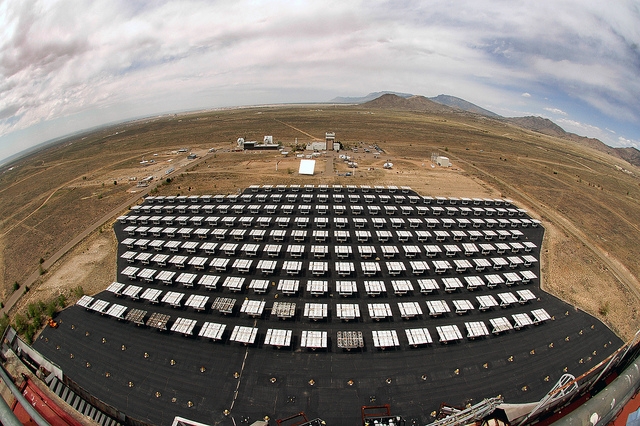
concentrating solar power

Renewable energy is a multibilion dollar global industry. One in which the US has fallen rapidly behind. Instead of using his presidency to build a world class renewable energy industry, like Germany, Spain, Italy or China (the world’s leading exporter of  PVC solar panels), Obama has pissed away his six years in office pimping dangerous and environmental destructive practices like fracking and deep sea oil drilling.

Concentrating solar power, aka Solar Thermal Energy (STE) is a technology that receives scant attention in the US, even in environmental circles. CSP systems use mirrors or lenses to concentrate a large area of sunlight, or solar thermal energy, onto a small area. Electrical power is produced when the concentrated light is converted to heat, which drives a heat engine (usually a steam turbine) connected to an electrical power generator.

The Italian inventor Giovanni Francia designed and built the first concentrating solar plant near Genoa, which first went on-line in 1968. In 1981 the 10 megawatt (MW) Solar One power tower began operation in the Mojave Desert in Southern California. The nearby Solar Energy Generating Systems (SEGS), consisting of nine solar plants with a total of 254 MW generation capacity, went on-line in 1984.

How Spain Became the World Leader in CSP

According to Solar Server, despite a worsening economic crisis, austerity cuts, street protests and general strikes,  Spain met a whopping 42% of its 2013 electricity needs through renewable power generation.

26% of Spain’s electricity comes from solar and wind generation and 16% from hydrogeneration. Globally, Spain has the third highest percentage of solar electricity generation (following Germany and Italy), and the highest percentage of CSP electricity generation.

The main advantage of CSP over rooftop photovoltaic cell (PVC) solar generation is the ability of CSP to generate a load large enough to power a grid. It also has the advantage of providing cheap and efficient thermal (i.e. heat) energy storage, which means it can produce electricity continuously night or day, especially during peak demand periods (summer evening hours or winter mornings).

In 2007 Spain installed Europe’s first commercial concentrating solar power plant, which generates a 11 MW load, near Seville. By 2010, they had surpassed the US as the world leader in CSP production. By October 2011, an additional 420 MW had gone into operation, with an additional 2500 MW anticipated by the end of 2013.

According to the Department of Energy, the US has a current CSP load capacity of 800 MW, with four new plants scheduled to come online in 2014.

Economic Benefits of CSP

In October 2011 the Spanish Association of the Solar Thermal Industry commissioned Deloite, one of the Big Four international financial powerhouses to analyze the economic viability of Spain’s CSP industry. According to the Deloitte report, Macroeconomic Impact of the Solar Thermal Electricity Industry in Spain, the total contribution of the CSP industry to Spain’s 2010 GDP was 1.6 billion Euros.

More importantly, the number of workers employed came to 23,844 in 2010. Many of the jobs created relate to the export of parabolic mirrors and other CSP technology and expertise to the rest of the world.

The five years Spain has spent refining CSP technology has made them the unquestioned leader in the Concentrating Solar Power Alliance. The CSPA is an international industry lobby group formed in March 2012 to to promote the benefits of CSP, specifically to US lawmakers, regulators, utilities and grid operators. With America’s insatiable energy needs, the US is clearly the market they need to penetrate.

Given the iron control the fossil fuel industry exerts over the Congress, White House and media, they have their work cut out for them.

photo credit: SandiaLabs via photopin cc

Reclaiming Adam Smith

wealth of nations

Contrary to conservative claims, Adam Smith was a liberal who argued for government intervention to ensure economic growth and “general prosperity.” I find it intriguing that he attributes Britain’s global economic dominance to “division of labor” and a superior agricultural system. Despite an entire chapter in Book I on the origin of money, he makes no mention of the role of English banks in creating money (which started in 1666), which kick started the industrial revolution. 

The Wealth of Nations

by Adam Smith

Abridged Version by Laurence Dickey, Professor of History, University of Wisconsin-Madison (Hackett Publishing 1993)

Book Review

The Wealth of Nations consists of five books (written between 1767-1784). Adam Smith’s work is cited extensively by neoliberals and neoconservatives as justification for ending government regulation of corporations . Free marketeers argue that regulation negatively impacts the totally unobstructed free market Adam Smith allegedly advocates.

I think it’s high time for liberals, progressives and left libertarians to reclaim Adam Smith as one of our own. Smith self-identifies as a liberal – one of the first in Europe. He also frequently advocates for what he calls “progressive” economics, i.e. government intervention to ensure that rich people invest their profits in increasing productive labor, rather than corruption and vice.

The 1993 Edition

Smith’s writing tends to be quite repetitive, as large sections of the later books predate the earlier ones. In his abridged version, Dickey merely summarizes material Smith has introduced in earlier sections. There is also a generous preface, as well as appendices, that position Smith among the various writers of the 18th century Scottish Enlightenment. In this way Dickey shows that, to a large extent, the Wealth of Nations is a consolidation of widely held views on basic economic principles.

The overall intent of the Wealth of Nations is 1) to make general observations about the economic and social changes that underlay the transformation from feudalism to modern industrial society and 2) to lay out basic macroeconomic principles that Smith believes are essential for a prosperous, politically stable nation which provides an adequate standard of living for its workforce. The latter is extremely important to Smith, both as a principle of social justice and to prevent social unrest.

Contrary to claims made by free market conservatives, nowhere does The Wealth of Nations make the case for a totally unregulated free market economy. Quite the contrary, Book V Revenue of the Sovereign or Commonwealth makes a strong argument that government intervention is essential in free markets to ensure economic growth and general prosperity.

Book I (Of the Causes of Improvement in the Productive Powers of Labour)

Book I describes the historical development of international trade and the origin of money. It also lays out Smith’s belief that “division of labor” – in which individual farmers stopped making their own plows, dwellings, shoes, clothes, etc. and organized into specialized trades to provide these services – was the fundamental socio-economic change that made modern economic development and western-style democracy possible.

A notable omission here is Smith’s failure to mention the role private banks assumed in issuing money after the 1666 Free Coinage Act. Carroll Quigley (see The Real Vampires: an Insider’s View of Banks ) argues that Britain’s control over international finance (not British agriculture and “division of labor”) was responsible for Britain’s lengthy dominance over world commerce and trade. I suspect that Smith, like many modern day politicians, had no idea that private banks were creating the money supply out of thin air.

Book I also makes the case that daily “subsistence” (i.e. wages) should be proportioned to the cost of daily necessities and that slavery is uneconomical:

“No society can surely be flourishing and happy, of which the far greater part of the members are poor and miserable. It is but equity, besides, that they who feed, clothe and lodge the whole body of the people should have such as share of their own labour as to be themselves totally well fed, clothed and lodged.”

Book II (Of the Nature, Accumulation, and Employment of Stock)

Book II lays out Smith’s view that capital accumulation (the reinvestment of profits to employ more workers) further advances divisions and subdivisions of labor to improve the “productive power of labor” and the wealth of society. Here Smith emphasizes the importance of spreading wealth to wider and wider circles of people to keep employment constant and prevent social disorder.

Book II also emphasizes what Smith calls “frugality” or the “mediocrity-of-money” as being essential to this capitalization. He also calls for limited government intervention (which Book V elaborates on) to ensure “doux-commerce.” This he defines as an economy based on “frugality,” in which rich people invest their profits in increasing productive labor, rather than luxuries, corruption and vice, which contribute nothing to a society’s economic well being.

Neoliberals often make Smith out as an advocate of laissez-faire economics, in which economic imbalances and social injustice is addressed by the “invisible hand” of competitive market forces. It was actually one of Smith’s contemporaries J. Harris who made this argument.

Book III (Of the Different Progress of Opulence in Different Nations)

Book III elaborates on Smith’s ideas about the accumulation of capital and “frugality,” as well as describing the rise of cities and mercantilism, which in Smith’s view negatively impacts investment in agriculture. Using numerous historical examples, he argues that the inability of a country or empire to produce their own food (and subsequent reliance on food imports) always results in their downfall.

Book IV (Of Systems of Political Oeconomy)

Book IV is a frontal attack on mercantilism, which Smith despises. “Monopoly,” according to Smith, “is the sole engine of the mercantile system.”

Smith, who makes the strong argument that money has no intrinsic value of its own, blames mercantilism on an overemphasis on accumulating gold and silver reserves (money), at the expense of genuine productive capacity and overall economic wealth. He’s highly critical of European nations for being obsessed with a positive balance of trade (to build up their gold and silver reserves). He’s also critical of the wrongheaded way they go about it, through the granting of monopoly rights and protective tariffs, and quotas, which always negatively impact domestic production.

This book also outlines Smith’s views on government intervention. According to Smith, a sovereign (government) has three duties:

  1. To protect society from violence or invasion
  2. To protect, as far as possible, every member of society from injustice or oppression from every other member of society). Smith calls for direct government intervention in “facilitating” investment in agriculture.
  3. To maintain certain public works and institutions “which can never be for [the benefit of] certain individuals or groups of individuals.”

Book V (Of the Revenue of the Sovereign or Commonwealth)

Book V – elaborates on specific interventions Smith would allow government to make “in relations between the rich and poor.” He argues for a government role in ensuring that educational institutions provide moral up-lift (i.e. a “culture of frugality”) to ensure the continuing investment necessary to create jobs.

Here he also delves at length into the effect of military spending on economic wealth. He argues that military spending must be strictly limited and never paid for by borrowing. He predicts that indebtedness for military spending will eventually cause the economic ruin of all European countries.