This is a brief documentary about three programs in New Zealand, the UK and the US seeking to address an alarming drop in insect populations. A 2017 German study reveals some areas of the world have experienced a 75% drop in insect populations in 27 years. Entomologists blame excessive pesticide use and loss of natural habitat. The survival of the human species is totally dependent on insects, both for food crop pollination and waste decomposition.
The New Zealand program is a industrial-scale wetapunga breeding program at the Auckland zoo. The wetapunga is an enormous prehistoric locust-shaped insect dating from the dinosaur era. Once the nearly extinct wetapunga reach adolescence, they are released to special predator-free islands where there are no introduced mammals (eg rats, ferrets, stoats, etc) to eat them.
The UK program seeks out abandoned industrial sites (brown fields) to transform into insect reserves. One abandoned, these sites are rapidly reclaimed by wild vegetation. This makes them perfect for insects because the soil is totally pesticide-free.
In the US, an entomologist has invented a special microphone that can be hidden in beehives to monitor for signs of colony collapse.
This film, a moving tribute to the late radical psychiatrist Dr Joel Kovel,* is a critique of Al Gore and his signature documentary An Inconvenient Truth. Owing to his failure to make important links between capitalism and global warming, Kovel believes Gore deserves much of the blame for the failure of the current climate movement to stop global warming.
Kovel’s main criticism of Gore, who first learned of the link between carbon emissions and global warming in the late seventies, was his failure to use his immense power as Clinton’s environmental point man to pursue government action to reduce carbon emissions. Instead Gore “played the game” and continued to advance the interests of the Wall Street corporations responsible for skyrocketing emissions (eg fossil fuel companies, car makers, etc). And the banks and PR and advertising companies responsible for unrelenting psychological pressure on Americans to over-consume.
Kovel believed Gore was deliberately dishonest about labeling climate change a “moral” issue. Instead of blaming capitalism and the corporate oligarchy for climate change, Gore blamed human nature. In the process, he played along with a system that seeks to “commodify” every human need and desire for its profit making potential. Ironically his documentary resulted in the creation of two brand new commodities: carbon credits and green technology.
According to Kovel, ending climate change is impossible without ending the continual economic expansion that is fundamental to capitalism.** Individuals are helpless to stop climate change through behavior change .
Kovel, who died in April 2018, was a presidential candidate in the 2000 Green Party primary but lost out to Ralph Nader.
*Commodification is confiscation of human needs and wants (land, goods, services and ideas) into products that can be sold for a profit.
**Kovel is a bit fuzzy about why continual expansion is essential under capitalism. I suspect it relates to Marx’s failure to address the role of private banks (in creating 98% of our money as debt) in infinitely increasing debt and the necessity of continuous economic expansion to pay it.
Taken for a Ride is about a conspiracy initiated by General Motors to destroy America’s public transit system. At a time when only one out of ten Americans owned an automobile, the first president of General Motors Alfred P Sloan started National City Lines (NCL), with the explicit goal of shutting down the country’s popular, world class electric trolley lines.
With the financial support of Standard Oil, Phillips Petroleum, Firestone and Mack Truck, NCL bought up every trolley company in the US s systematically shut them down. This was despite widespread public opposition – the NCL buses that replaced the trolleys were far slower and more polluting than the trolleys.
Once they had a monopoly on city transit, NCL gradually raised fares and cut services until city buses were so unprofitable they had to be taken over by city government.
In 1946, after intensive investigation, the Justice Department filed suit against GM for conspiracy to monopolize public transportation. After finding them guilty, the court fined them a mere $5,000.
GM Also Behind Interstate Construction Conspiracy
In 1932, Sloan also founded the National Highway Users Conference, a consortium of oil and auto companies that would ultimately become the Highway Lobby – for decades the most powerful lobby in Washington. When Eisenhower was elected in 1952, GM president Erwin Wilson became his Secretary of Defense (and convinced of the need for superhighways – to move tanks as Hitler had done in Germany) and Francis DuPont (DuPont was the largest GM shareholder) as the Commissioner of Public Roads. Under Eisenhower, Congress enacted a federal gas tax to pay for the massive federal Interstate highway system his administration created.
There was strong public opposition in many cities to Interstate construction that threatened to displace entire neighborhoods and close down businesses, schools and churches. A national coalition – blocking urban Interstate extensions in 50 cities – but most went ahead as planned.
Sam Alito Exposes GM Conspiracy
In the 1970s, a strong grassroots environmental movement formed to address the growing problem with superhighway gridlock* and auto-related air pollution. A high point of this film is footage of a 1974 Senate Antitrust Committee hearing in which Los Angeles mayor Sam Alito reminds senators of the GM conspiracy to shut down LA’s public transit system.
Following the hearing, Congress relented and allowed cities to use federal gasoline taxes to rebuild their public transport networks. This would enable Washington and San Francisco to build subway systems and Baltimore, Portland, Seattle and other cities to begin plans for light rail (the modern term for electric trolleys) systems.
When this documentary was made in 2014, public transportation was in major crisis in most cities, due to budget cuts stemming from the 2008 global economic crash. At the time, Congress had just passed a bill to build a new national highway network four times the size of the current Interstate system.
Fortunately this plan has been shelved due to federal budgetary problems and the wholesale rejection of the private automobile by the millennial generation.
*Did you ever notice that TV ads never depict their cars stuck in highway gridlock – but on lonely stretches of country road?
Part 2 of Pricing the Planet is even more disgusting than Part 1. It concerns the “green conferences” organized by oil, chemical and mining companies to promote ways they can invest in “credits” to mitigate their activities that degrade the environment.
All the industries that attended a recent “green conference” continue to lobby heavily against government regulation to curb the environmental damage they cause. However now that they see an opportunity to profit from carbon and species trading they’re suddenly spouting off about the future of our planet.
The documentary shows footage of Dow Chemical and Nestle executives at a recent green conference. Dow has one of the worst reputations for environmental degradation. Dow produced Agent Orange, responsible for cancer and birth defects in thousands of Vietnam veterans and Vietnamese civilians and their offspring. They also own the subsidiary responsible for the chemical factory that exploded in Bhopal India, poisoning thousands. Nestle is notorious for depleting fresh water all over the planet, which they sell back to us as bottled water.
Unsurprisingly the World Bank supports corporations who buy and sell the right to destroy the environment by selling Green Bonds (which corporations use to mitigate their environmentally harmful activities). Carbon and endangered species trading are also strongly supported by the United Nations.
The high point of the film is a vignette featuring Indian environmentalist Vendana Shiva explaining how financialization always leads to degradation. She further states, “Wherever a price is placed on nature, nature has been destroyed.”
She maintains the continual destruction of the environment in the name of economic growth is a sickness in the human mind.
This documentary is about an endangered species trading scheme in which banks like J P Morgan and Goldman Sacks invest in projects that protect endangered species (eg bees, coral reefs, orangutans) or ecosystem services (eg (rain forests, clean water, wetlands clean air, topsoil). They then sell credits in these projects to corporations who wish to engage in mining and development that kill these species or destroy rain forests and wetlands.
In 1988, Bush Senior was the first to promote this model of environmental protection with his No Net Wetlands Loss policy. It enabled corporations that were destroying wetlands to purchase credits in wetlands that being set aside for preservation. This model was later employed in carbon trading schemes in which industries are allowed to emit CO2 pollution if they purchase credits in reforestation projects that capture CO2. After nearly 20 years of operations, this scheme has made speculators in carbon credits fantastically rich while allowing CO2 emissions increase exponentially.
Bankers and corporate executives argue that endangered species trading is the only way to save the planet because government regulation hasn’t worked (largely because banks and corporations have blocked effective environmental regulation). Most grassroots environmentalists oppose species trading. They argue that bees, reefs, orangutans and rain forests can only be saved with a total ban on activities that endanger them.
Globally Malua BioBank runs the largest “mitigation” project. They recently purchased the Malua Forest in Borneo for $64 million. They sell credits in the Malua Forest to palm oil companies to enable them to destroy other Indonesian rain forests, as well as companies that use palm oil products.
The Nature Conservancy (whose current CEO is a former Goldman Sachs banker) and other large environmental NGOs support “species banking” because they rely on large corporate donations to cover their staff salaries.
The video can be viewed free at the Al Jazeera website: Pricing the Planet
These two videos are about China’s vast reforestation project aimed at reducing the size of the Gobi Desert. The project, which started in 1978, has planted 68 billions trees altogether and reduced the Gobi Desert by 4,800 acres. It has also forced roughly 350,000 rural farmers to relocate to urban areas. Most are unable to find work and receive no government assistance other than housing.
The first film is by France 24 – the second by China 24. Although the latter is clearly a government propaganda piece, most of the facts appear accurate. It claims China is reducing the size of its deserts by 2,000 square kilometers a year, as well as offering training to all Silk Road countries in reforestation technology.
The Chinese government is also quite proud of endangered species laws they have enacted, which make harming endangered plants, animals and marine life a crime (hopefully they have also quit locking up environmental activists). They also boast about new laws to penalize companies for polluting their waterways, as well as decreasing urban air pollution by reducing steel production by 65% and coal production by 290 million tons.
The end of the China 24 documentary boasts about lifting millions of Chinese residents out of poverty, though it fails to mention China’s skyrocketing inequality. Nor the millions of Chinese farmers who have lost their livelihood after being driven off their land – nor the millions of urban street vendors whose businesses are being bulldozed for urban renewal projects.
*The Silk Road was a centuries-old trade route connecting Asia with Europe. China has invested billions of dollars in building superhighways and high speed networks along the Silk Road route through Kazakhstan and Russia.
This documentary is about taking back control of our Internet connectivity. Ironically it starts by recommending a new app that allows you to identify increasingly rare “white spots” – areas of the earth that aren’t blanketed with WiFi signals. One MIT psychology professor, who bans cellphones, laptops and tablets in her classes, is part of a movement to create sacred spaces in these white spots – areas where people fully engage with each other instead of their electronic devices.
The filmmakers also talk about the late Steve Jobs and other prominent Silicon Valley moguls not allowing their kids to have cellphones and tablets and sending them to low tech Montessori and Waldorf schools. Increasingly the well-to-do are seeking out expensive retreats and detox facilities to cure their Internet addiction. While growing numbers of law firms and security agencies patronize a highly successful Dutch firm selling Faraday cages and microwave shields to protect clients from electronic snooping and damaging microwave radiation.
The Amish, of course, have a cheap low-tech solution to Internet addiction – namely a value system that rejects most advanced electronic technology.
The video concludes by explaining the concept of “surveillance capitalism,” in which our personal information is “monetized,” ie in which the data Google, Facebook and Amazon collect on us is sold to advertisers.
A key strategy of surveillance capitalism is to use drones, satellites and giant balloons to expand connectivity to remote areas of the developing world. At the time of filming, Facebook was pressuring the Indian government to allow the introduction of Free Basics (free Internet connectivity) to all Indian residents, with Facebook retaining control of their Internet access. Google, meanwhile, is pushing to extend 100% connectivity to Sri Lanka by launching giant WiFi balloons.
According to one analyst, the drive to acquire massive troves of Indian personal data is a ploy to placate shareholders. The latter are understandably concerned about a drop-off in Facebook users in the developing world – due to privacy concerns and the recognition that most Facebook content is meaningless drivel.
For people who still have lingering doubts about the reality of global warming, this brief documentary reminds us that the Arctic Ocean (for the first time in recorded history) is now open to navigation during the summer. Prior to 2007, it was frozen solid year round.
During summer months, China, the US, Canada and European countries routinely save travel time and money by shipping freight over the top of the world.
According to filmmakers, Canadian treaties allegedly guarantee indigenous Inuit “input” into the new Arctic waterways – to protect the pristine environment their livelihood (hunting seals) depends on.
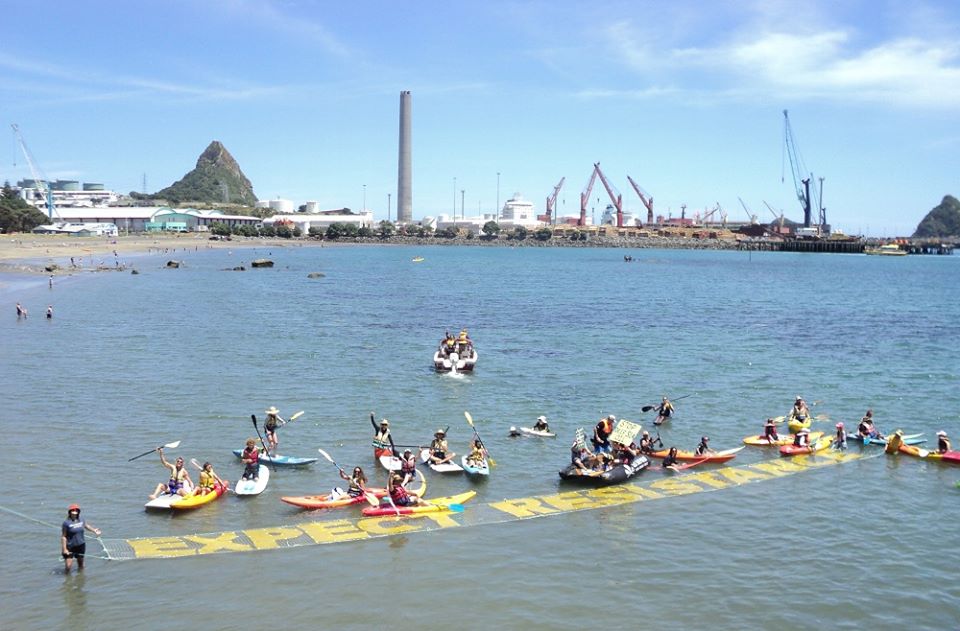
This was us yesterday protesting seismic blasting in a proposed sanctuary for the endangered blue whale and Maui dolphin. The Amazon Warrior, which is exploring for deep sea oil, lets out loud seismic explosions every eight seconds that disrupt their feeding, breeding and ability to communicate.
Climate Justice Taranaki is campaigning to fight climate change by leaving the fossil fuels that remain in the ground. Fossil fuel mining (mainly in the form of fracking) has been enormously destructive to our local environment and people’s health and lives.
Toxic e-waste is equally poisonous to the planet and the third world poor who are forced to process it for a living. The only truly humane and sustainable solution to toxic e-waste is to force big tech giants like Apple, Google and Dell (and the billionaires who run them) to assume responsibility for end-of-life disposal, instead of externalizing this cost to the rest of us.
This documentary is about Agbogbloshie in Acra Ghana, the largest toxic waste dump in the world, and the men, women and children who pick through electronic waste from Asia, the US, Australia and western Europe. Although it’s illegal to employ child labor or import e-waste in Ghana, these laws are never enforced.
The filmmakers interview various “waste managers” who run the site, as well as a 10 year old boy, a fifteen year old girl and the “waste site coordinator.” The latter adjudicates disputes and deals with the police when fights break out. The 10 year old (an orphan) earns about $8-10 a days from the scrap metal he collects. This is enough to buy two meals. The 15-year-old was forced to leave school because her parents had no money to pay for her school fees, uniform or textbooks. She prepares food to sell to other scavengers and hopes to return to school and become a nurse.
Scavenging e-waste among the burning rubber and plastics at Agbogbloshie is a highly dangerous occupation due to the high risk of cadmium and lead toxicity. Doctors at a nearly clinic also report an increased incidence of respiratory infection among children who live and work there.


 The Most Revolutionary Act