Western Medicine: Still Stuck in the 20th Century

Origins

well.org (2014)

Film Review

In brief, Origins is a film about saving the planet by improving your diet and lifestyle. The filmmakers assert that a healthier diet will enable people to think more clearly about the imminent crises confronting civilization. While I totally disagree with the premise – I don’t believe real change is possible without confronting corporate corruption and growing inequality – I liked the film. It offers the clearest explanation yet of the fundamental role of the microbiome* in human health and the rhizophere** in plant health.

Western medicine, as currently practiced, has become totally obsolete owing to its inability to view the human body as a holistic integrated unit. The end result is that roughly half of us are in really poor health. While I disagree with the premise of the film, I’m willing to concede that many of us aren’t healthy or fit enough to tackle major social or political change.

A secondary premise of the film is that we need to fundamentally rethink the way we use technology – mainly because we’re systematically poisoning ourselves through air pollution and toxic endocrine disruptors that mimic estrogen in our bodies. This heavy estrogen effect is a major factor in an epidemic of breast, prostate and other cancers, as well as infertility, obesity and anxiety/depression.

My favorite part of the documentary concerns the microbiome, which turns out to be primary source of our immunity. Owing to the overuse of antibiotics in medicine and agriculture (in livestock feed), most of us have experienced a mass extinction of our intestinal bacteria. This, in turn, plays an even bigger role than toxic chemicals in diseases triggered by inflammation, such as obesity, cancer, type 2 diabetes, heart disease and autoimmune illnesses.

Origins goes on to stress the importance of vaginal birth and breast feeding in establishing a healthy microbiome in infants and the avoidance of antibiotics, antibiotic soaps and commercial household cleaners and toxic chemicals in keeping it that way. Letting kids play in the dirt is another important source of beneficial bacteria. As are are fermented foods and fresh (unprocessed) chemical free foods.

I was also pleased to see the filmmakers brutally debunk the low fat, high sugar, high carbohydrate diet*** Food Inc and western medicine have been trying to sell us for the last fifty years. This is the number one reason half of Americans suffer from “diabesity” (aka metabolic syndrome), even though many of them may not realize it yet.

To their credit, thousands of doctors (according to filmmakers) are taking their patients off GMO foods, resulting in rapid relief of allergies, chronic illnesses and infertility.

I was also pleased to see the comparison filmmakers make between the soil rhizosphere and the gut microbiome. While we’ve been destroying our intestinal bacteria with antibiotics, Food Inc has been systematically destroying essential soil bacteria with pesticides, herbicides and GMOs.

Citing a recent UN study, Origins explodes the myth that GMO technology is the only solution to world hunger. According to the UN, we could double current crop yields in ten years simply by switching to organic farming methods that restore the health and integrity of our soil.

Ignore the background music (I hate documentaries with soppy background music). It’s worth putting up with for the excellent section on diet.


* Microbiome, as defined in this film, refers to the millions of intestinal bacteria that are essential to healthy digestion and immunity.

** The rhizosphere is the narrow region of soil that is directly influenced by root secretions and associated soil microorganisms.

***For a great book summarizing the research that debunks the low fat diet, see Why the Low Fat Diet Makes You Fat and Gives You Heart Disease, Cancer and Tooth Decay
The Ugly Truth About Monsanto and Genetic Engineering

GMO-OMG

Jeremy Seifert (2013)

Film Review

GMO-OMG is an excellent first documentary by a young father on a quest to understand the science of GMO technology and its impact on the environment and human health. The film starts by focusing on the general ignorance of the American public about GMOs. This contrasts markedly with other countries, where popular pressure has led many governments to ban GMOs.

What filmmaker Jeremy Seifert describes, in essence, is the systematic hijacking and poisoning of the US food supply by three companies (DuPont, Monsanto and Syngenta), all without the knowledge of the American people. At present 85% of all corn grown in the US is genetically modified, 91% of all soy and 90% of all beet sugar. In addition, most non-organic meat and dairy products come from animals fed on GMO corn and/or soy.

Seifert first learned about the potential dangers of GMOs due to a major anti-GMO protest in Haiti following the 2010 earthquake. Monsanto’s response to the earthquake was to donate 470 tons of GMO seeds, which protestors burned because of the threat they posed to their seed stock and food sovereignty.

The film highlights four broad areas:
• The powerful Monsanto lobby that engineered FDA approval of GMO seeds in the 1990s without totally inadequate scientific evidence of their safety.
• Recent research into the negative health impacts of GMOs.
• False claims by Monsanto and GMO seed merchants and farmers that GMO technology, which they erroneously claim increases yields, is the only answer to global hunger.
• Monsanto’s determination to stymie consumer choice by blocking GMO labeling laws.

Revolving Door Regulation

As Seifert ably demonstrates, the FDA is a typical “revolving door” agency. in which FDA chief Michael Taylor has alternatively worked for the FDA and Monsanto over many years. In this regulatory environment, where corporations practically regulate themselves, the FDA approved GMO seeds as GRAS (Generally Recognized as Safe), despite the absence of a single, longitudinal study demonstrating their safety in humans. None of the Monsanto studies submitted for FDA approval were peer reviewed* or longer than three months. It so happens Monsanto’s studies can’t be peer reviewed because the company refuses to release the raw data. In the research described below, rats fed Roundup Ready Corn only developed health problems after month four.

Health Problems in Rats Fed Roundup Ready Corn

In a recently published two year study by French researcher Dr Giles-Eric Seralini, rats fed a steady diet of Roundup Ready** corn developed many more mammary tumors than control rats. This was in addition to kidney, liver and pituitary damage. It remains unclear, however, whether these health effects related to the GMO corn itself or from traces of Roundup in the feed from heavy herbicide spraying. More recent studies have shown that Roundup (aka or glyphosate) causes serious health problems on its own (cancer, kidney damage and reduced sperm counts).

Organic Farming Produces Better Yields

Seifert interviews several organic farmers in the film, who debunk Monsanto claims that GMO crops increase yields. The farmers refer to thirty years of data showing that organic crops consistently outperform GMO crops, particularly during droughts and floods. On average, organic methods produce a 30% better yield. In part, the poor performance of GMO crops relates to the creation of superweeds that can’t be killed by Roundup or any other herbicide.

Monsanto Spends Hundreds of Millions Blocking GMO Labeling Laws

Seifert also interviews Congressman Dennis Kucinich (before he lost his seat in 2012) about his GMO labeling bill. Since 1997, the EU has required all foods (except meat and dairy) to be labeled for GMO ingredients. Because European consumers refuse to buy products containing GMOS, Monsanto aggressively opposes GMO labeling in the US. Seifert also discusses the GMO labeling laws passed in Vermont*** and Connecticut, which were subsequently repealed after Monsanto threatened to sue both states. He also talks about the hundreds of millions Monsanto has spent in around twenty other states to block anti-GMO legislation in 32 other states.


*Scholarly peer review is the process of subjecting an author’s scholarly work, research, or ideas to the scrutiny of others who are experts in the same field.

**Roundup Ready corn is a plant which has had its DNA modified to withstand the weedkiller Roundup. This allows a farmer to kill weeds by spraying massive amounts of Roundup on his fields without killing the corn.

***Vermont enacted a new GMO labeling law in May 2014. As threatened, the National Association of Manufacturers, the Grocery Manufacturers Association and other trade associations have filed suit to block the law. A federal judge has already denied their request for an injunction to block the law’s implementation: see Vermont GMO Labeling Injunction Appeal

https://vimeo.com/106081930

Plows, Plagues and Petroleum

plows plagues and petroleum

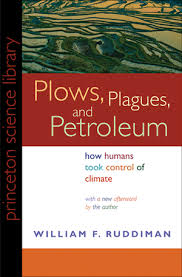
Plows, Plagues and Petroleum: How Humans Took Control of Climate

By W F Ruddiman

Princeton University Press (2010)

Book Review

In Plows, Plagues and Petroleum, paleoclimatologist W F Ruddiman makes the argument that the human species began interfering with climate – by increasing CO2 emissions – long before they began burning fossil fuels during the industrial revolution. After studying millions of years of ice core records, Ruddiman concludes that agricultural activities that began roughly 10,000 years ago increased atmospheric CO2 sufficiently to reduce planetary cooling and reduce a long overdue ice age.

Ruddiman’s book carefully traces the domestication of local plants and animals that occurred simultaneously in Mesopotamia, China, Africa and the Americas between 8,500 and 4,000 BC. Plant and animal domestication was accompanied by large scale clearing of forest land for fields and pasture. This massive loss of trees was accompanied by a big increase in atmospheric CO2.

Ruddiman has always been curious about periodic drops in CO2 concentrations that began around 540 AD. Theorizing that these dips correlated with temporary declines in global population, he examined historical records for evidence of wars, famines and pandemics that might have wiped out large numbers of people. What he discovered was a close link between infectious epidemics and declines in CO2 concentrations, as forests reclaimed large swaths of agricultural land.

The first epidemic in the recorded history was an outbreak of bubonic plague in the Roman Empire in 540 AD. By 590 AD, it had wiped out 40% of Mediterranean Europe. European plague outbreaks continued to occur every ten to fifteen years until 749, when a long plague-free period was accompanied by a rebound in population growth, deforestation and atmospheric CO2. By 1089, virtually all of Europe was deforested.

An even more severe plague pandemic occurred in the mid-1300s, wiping out a third of Europe (25 million people). In some cities, mortality rates were as high as 70%. The resulting labor shortage gave serfs who survived immense bargaining power. As they moved from estate to estate seeking good working conditions, they began to be treated as tenant farmers rather than slaves.

There were new plague outbreaks, accompanied by reduced atmospheric CO2, in the mid-1500s and mid-1600s.

The large pre-industrial drop in CO2 emissions occurred with what Ruddiman refers to as the North American pandemic (1500-1750. This was caused by the arrival of Europeans – who Ruddiman describes as flea infested, lice ridden peoples who shunned bathing – with a host of illnesses (smallpox, influenza, hepatitis, diphtheria, measles, mumps, whopping cough, scarlet fever, cholera and plague) to which native populations had no immunity. This was in addition to untold numbers of natives slaughtered by Europeans.

Prior to the arrival of Europeans, the population of North America was estimated between 50-60 million. Ninety percent (50 million) would die over the next 250 years. This amounted to 10% of the global population. Nearly all their agricultural settlements were reclaimed by forest, resulting in the third and largest pre-industrial drop in atmospheric CO2.

Download a free PDF of this book at Plows, Plagues and Petroleum

Climate Change Throughout History

forecast

Forecast: The Consequences of Climate Change, from the Amazon to the Arctic, from Darfur to Napa Valley

by Stephan Faris

Henry Holt (2009)

Book Review

Forecast is about historic and present day political, economic and health consequences of extreme climate disruption.

Farr begins by unpacking the Sudan civil war that began in Darfur in 2003. He makes a convincing case that decreased rainfall and desertification led to a bloody land war d between nomadic Arab camel herders and African farmers. He disputes that the conflict arose out of ethnic and religious differences, as the two groups shared the region harmoniously for hundreds of years until the climate changed.

He goes on to discuss studies comparing ice core findings to historical records. They conclude that all major European wars and Chinese dynastic changes followed major climate change.

Arctic Territorial Disputes

At the present time, the melting of Arctic sea ice has led to major border conflicts between countries eager to exploit the region’s vast mineral wealth. Tension is particularly high between Russian and Norway, Canada and Denmark and Canada and the US (over the border between the Yukon and Alaska). The opening of the Northwest Passage* to navigation for the first time in 2007 has led to an ongoing dispute whether these waters are Canadian territory or an international right of way, as claimed by the US.

International Alert predicts that forty-four countries are at risk of conflict (mainly over water rights) due to climate change. At the top of the list are India, Pakistan, China, Iran, Indonesia, Algeria, Nigeria, Somalia, Bolivia, Columbia, Peru and Bosnia and Herzegovina.

Emergence of Epidemics

Faris’s section on the health consequences of climate change discusses the major epidemics that have emerged due to warmer, wetter weather patterns. This includes a big increase in malaria in Brazil and Mexico; in hantavirus, West Nile virus and Lyme disease in the US; ebola in Africa and in plague in Kazakhstan and India.

Ice core findings suggest the medieval Black Death (plague) in Europe was also triggered by climate change.

The Effect of Native American Genocide

The most interesting section of the book argues than human beings have been altering the climate, through deforestation, livestock husbandry and population explosions since the agricultural revolution. Climate scientists believe major deforestation in Europe started 7,500-8,000 years ago. Atmospheric carbon concentrations reached a peak during the Roman period and took a big dip (most likely due to depopulation) after Rome collapsed. They began to rise again in 1000 AD. Their sharp decline in 1500 coincided with a Little Ice Age characterized by brutally cold winters.

Faris agrees with William Ruddiman (Plows, Plagues and Petroleum: How Humans Took Control of Climate) who believes this steep drop stemmed from the decimation of Native American agricultural settlements (from genocide, smallpox, typhus, cholera and measles, diseases to which they had no immunity) in North and South America. Over two centuries, their population dropped from 50-60 million (one tenth of the global population) to five million. As they disappeared, forests and jungles, particularly in the Amazon, reclaimed the fields they had cleared for cultivation.


*The Northwest Passage is a sea through the Arctic Ocean, along the northern coast of North America via waterways through the Canadian Arctic Archipelago. It decreases the transit time from the Atlantic to the Pacific Ocean (compared to the Panama Canal) by four days.

How Radical Architects are Transforming the Planet

Radical Architecture

Al Jazeera (2014)

Film Review

Rebel Architecture is a six-part Al Jazeera documentary series about architects who are using their skills to serve the public good rather than wealthy corporations.

Part 1 is about a Spanish architects collective that works with activist collectives loosely connected with Spain’s anti-austerity movement. Thanks to the Spanish government’s severe austerity measures and public service cuts, activist collectives have assumed major responsibility for social welfare. Occupation of public and abandoned spaces is a key tactic. The role of the architects collective is to help activists construct safe buildings in these spaces from cheap and recycled materials. In most cases the structures are unpermitted and technically illegal.

Part 2 is about Pakistan’s first woman architect and her role in helping poor Pakistani communities devastated by floods and earthquakes to rebuild flood and earthquake proof homes as cheaply as possible. Unsurprisingly she discovered that traditional building materials, such as mud bricks, lime and bamboo, are a key to the solution.

Part 3 is about an Israeli architect in the West Bank who studies the “intersection” between architecture and violence. He gives a fascinating presentation describing how the Israeli government uses architecture as a weapon against the Palestinians. This includes the deliberate layout of Israeli settlements in such a way that they strangulate Palestinian communities. And the deliberate use of bulldozers in dense urban communities as an instrument of war.

Part 4 is about Nigerian architect and urbanist Kunle Adeyemi, who works with illegal floating communities to design and build (unpermitted) floating schools and community centers.

Part 5 is about the Vietnamese architect Va Tron Nghia, who has dedicated his life to creating more green spaces in Ho Chi Minh city and building cheap durable homes for peasant farmers in the Mekong Delta. Owing to recurrent flooding, typical Delta homes last only three to four years. The film shows Nghia and local residents building a $4,000 bamboo house for a family of four.

Part 6 (my favorite) is about a pedreiro (Portuguese for stone mason) in Rocinha, the largest favella in South America – located in Rio De Janeiro. All the housing in Rocinha, population 180,000, is unpermitted and illegal. The Brazilian government turns a blind eye to all this illegal building because they need the cheap labor and have no resources to build public housing. This last segment shows how Rocinha residents organized to demand a sewage system to replace the open sewer in their streets. Instead the Brazilian government built a cable car for the benefit of tourists attending the 2014 Brazilian World Cup and the 2016 Brazilian Olympics. It was largely angry Rocinha residents who instigated the mass protests before and during the World Cup. Though the protests were widely reported in the corporate media, there was no mention of Rocinha residents’ ongoing struggle to remove the sewer of human excrement from their streets.


The Taboo Topic of Overpopulation

The Mother: Caring for 7 Billion

Christophe Forchere (2011)

As the title suggests, The Mother is about the taboo topic of global overpopulation and its role in serious environmental degradation and growing food and water shortages. The film maintains that our refusal to discuss the population issue leads to confusion and oversimplification. Based on our success in halving population growth over the last fifty years, policy makers make out the problem is solved and there’s no need to discuss it any longer. This complacency can be very dangerous, especially as various countries, worried about supporting a large aged population, start bribing women to have more babies.

According to the filmmakers, population pressures play out differently in developed and developing countries. In developed countries overconsumption compounds the impact of population growth on fragile ecosystems and increasingly scarce resources. This overconsumption is largely driven by artificially created consumer demand orchestrated by a political/economic system obsessed with continuous economic growth. In the US, especially, population pressures (eg media pressure on women to have babies) are an important driver of consumer demand and economic growth

When you include immigration, the US is the third fastest growing country in the world. Rapid population growth is a major culprit in continuing joblessness in the US. The economy would need to add 150,000 jobs per month just to keep up with their growing population, yet clearly falls short of this number.

In the developing world, overpopulation plays an important role in malnutrition, starvation deaths and epidemic disease levels. Here, the film asserts, the number one cause of excess population growth is male dominance over women. In many developing countries, poverty leads families to marry off their daughters as young as nine or ten, while patriarchal fundamentalist religions forbid them from using birth control.

For me the high point of the film was a section on the Population Media Center, which works to empower Ethiopian women and improve their access to education and contraception. Their most effective strategy has been to create radio soap operas with charismatic female characters who serve as role models for young women.

One study revels these programs increased the use of contraception by 150% in a single year. They also gave teenage girls confidence to stay in school rather than following family dictates to marry older men. Research consistently shows that educating girls postpones them marrying and having children, keeps them HIV negative and causes them to have fewer children.

The film also stresses the importance of microfinance in empowering women – and communities – as women are more likely than men to invest their profits in their communities. Globally only 1% of women are able to obtain loans from traditional banks.


*Microfinance is the provision of savings accounts, loans, insurance, money transfers and other banking services (usually by non-profit organizations) to customers that lack access to traditional banks. Traditional microlending models gear these services towards women in developing countries.

The American Obsession with Lawns

Gimme Green

Eric Flagg and Isaac Brown (2007)

Film Review

Americans are more obsessed with lawns than any other nationality. Lawns are a comparatively new innovation associated with the boom in home ownership the US experienced in the mid-twentieth century. They were virtually unknown in 1900, when 75% of Americans rented their homes. In 2007 when this film was made, US wilderness was being converted to lawn at a rate of 5,000 acres per day.

In many cases, lawns are a middle class luxury imposed by local authorities determined to preserve neighborhood “property values.” In the film, a homeowner who has created a bird habitat out of trees and shrubs is ordered to cut them down.

Americans spend $40 billion a year maintaining their 41 million acres of lawn. The largest irrigated crop in the US, lawns consume 30,000 tons of pesticide yearly. And contrary to manufacturer claims, 17 of the 30 most commonly used pesticides end up in drinking water. Fifteen of them are possible or probable carcinogens. Children in families that use pesticides on their lawns have a 6.5 times greater risk of leukemia.

The water wasted on lawn maintenance is equally concerning. Forty to sixty percent of household water goes to landscaping, an average of 200 gallons per American per day.

Severe drought conditions are forcing California and the Southwest to rethink their lawn addition. In 1999, Las Vegas instituted a turf-rebate program that paid homeowners up to $1.50 per square foot to rip out their lawns. At present, the city bans grass front yards in new developments. Alternatives explored in the documentary are artificial (plastic turf) or natural desert landscapes.

My personal preference, climate permitting, is to convert lawns to edible landscape. My property was entirely lawn and ornamental shrubs when I first moved in. In eight years, I have replaced nearly all of it with fruit trees, perennial herbs and runner beans and vegetables.

https://vimeo.com/101252944

Did Humanity Make a Wrong Turn at Agriculture?

Natural Farming with Manasobu Fukuoka

PermaculturePlanet (2012)

Film Review

The late Manasobu Fukuoka (1913-2008) was a Japanese natural farmer and philosopher celebrated for his natural farming and re-vegetation of desertified lands.

I first became interested in Fukuoka’s work when I was researching organic methods of ridding my veggie garden of the obnoxious weed oxalis. According to one website, the only effective organic method of controlling oxalis was to seed your vegetables in a continuous green cover crop of clover or alfalfa. After trying it, I found this approach not only suppressed oxalis and other weeds, but it greatly improved soil quality and vegetable growth, while simultaneously reducing the need for watering.

Fukukoa also used trees, shrubs and naturally growing weeds, in addition to nitrogen-fixing legumes, to support his fruit trees and vegetables. His methodology specifically forbids plowing, cultivation, watering, weeding or use of manure or prepared compost.

It strikes me that this that this approach closely approximates the original horticulture anthropologist Toby Hemenway describes as preceding agriculture by tens of thousands of years. Fukukoa comes to the identical conclusion Hemenway does – that it was in the transition from horticulture to agriculture, which systematically replaced natural landscapes for monoculture crops, that humankind made the first wrong turn.

According to Fukukoa, turning the soil over through plowing or cultivating is the worst because it kills the delicate soil microorganisms that support healthy plant growth. When a farmer employs natural methods, the trees, moles, legumes and earthworms do all the plowing for him. Artificially watering is nearly as damaging because it tends to compact the soil and stunt root development.

After seventy years of perfecting his technique, Fukukoa discovered the best way to sew vegetable in a pre-existing patch of trees, shrubs and weeds is to encase the seeds in clay balls he throws directly into the weeds. By encasing the seeds in clay, he protects them from being devoured by birds and insects.

He was always highly critical of agricultural methods that deliberately fell trees to produce monoculture crops supported by chemical herbicides and pesticides. Trees are essential in natural farming because they protect smaller plants against disease and play a fundamental role in producing rain. Denuding a region of trees is the fastest way to produce a desert.

Fukukoa is also highly critical of lawns, a European innovation he equates with the beginning of so-called civilization. They are also one of the main causes of insect infestation.

Crop yields produced by Fukukoa and his students always vastly exceed those industrial agriculture produces. With the development of agriculture, humankind became so obsessed with reducing labor inputs and improving efficiency, they failed to recognize they were killing their soil and destroying their yields.

The film below profiles one of Fukukoa’s last public appearances, a visit to some of his students’ farms in India.


*Six months after planting my first cover crop, a local permaculture instructor advised me that raising the soil pH (with lime) is also an extremely effective method of eradicating oxalis.

California Governor Order Mandatory Water Cuts


 drought monitor

image credit Zero Hedge

Guest Post by Kevin Moore

The item below indicates the kind of devastation that has occurred, and will increasingly occur, as a consequence of outlandishly high energy consumption and the abject failure throughout most of the world to address energetic and environmental matters.

As long as New Plymouth District Council (NPDC) continues to focus on business-as-usual (economic growth, covering ‘everything’ with concrete and asphalt, tourism, entertainment, boondoggles etc. ) everything in the district will continue to be made worse by NPDC, until everything collapses.

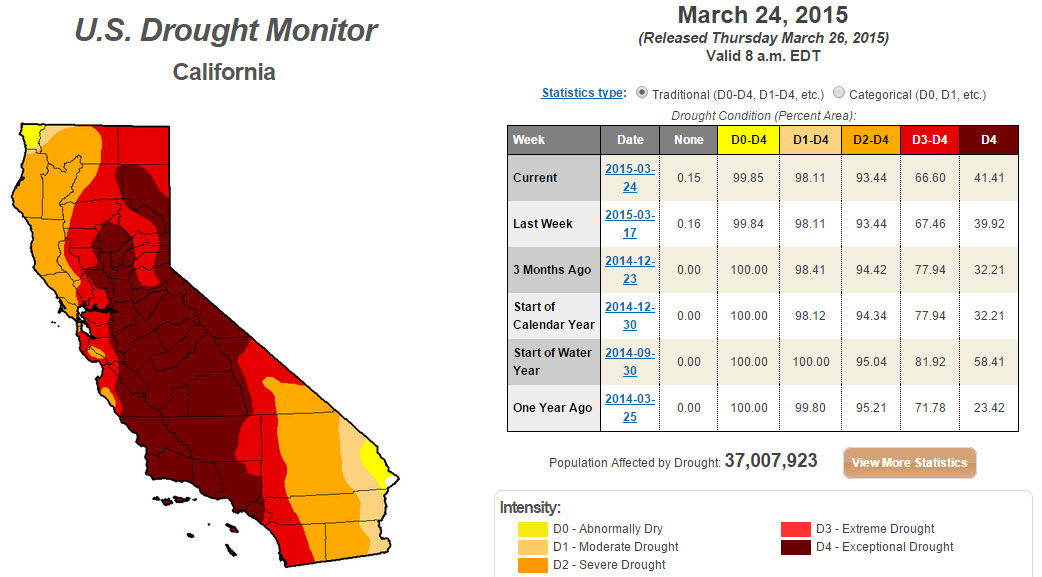
With California (population 40 million and ‘food-basket’ for America going under, we are in for a very ‘interesting’ period 2015 to 2016.

For First Time In History, California Governor Orders Mandatory Water Cuts Amid “Unprecedented, Dangerous Situation” (from Zero Hedge)

Amid the “cruelest winter ever,” with the lowest snowpack on record, and with 98.11% of the state currently in drought conditions, California Governor Jerry Brown orders mandatory water cuts in California for the first time in history…

And finally some action…

As ABC reports,

California Gov. Edmund G. Brown Jr. announced a set of mandatory water conservation measures today, as the state continues to struggle with a prolonged drought that has lasted for more than four years.

“Today we are standing on dry grass where there should be five feet of snow,” Brown said in a statement after visiting a manual snow survey in the Sierra Nevadas. “This historic drought demands unprecedented action.”

Read more here


Kevin David Moore, a fellow New Plymouth resident, is a founding and executive member of ASPO-NZ (The Association for the Study of Peak Oil). He’s New Zealand’s leading energy-environment-economic analyst, and has written five books on the global economic system and its effects on both the global environment and on ordinary people. He is noted for highest-level analysis, for telling truths most people shy away from, and for challenging the dysfunctional policies formulated and implemented by central and local government.

Health Benefits of Time Banks

give and take

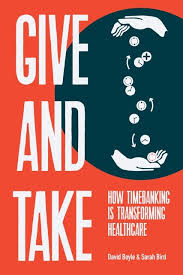
Give and Take: How Timebanking is Transforming Health Care

by David Boyle and Sarah Bird (Timebanking UK 2014)

Book Review

Give and Take summarizes a remarkable 2012-13 study by Timebanking UK, in which time banks were incorporated into GP practices to address unmet needs of patients over 65-year olds.

The project was the brain child of Timebanking UK coordinator Susan Ross-Turner and incorporated the work of John McKnight, founder of the Asset-Based Community Development Institute in Chicago. Ross-Turner saw it as an innovative solution to an overburdened health and social service sector struggling to serve a burgeoning elderly population.

High unemployment and lower wages – combined with high prices for food and energy – are really bad news for local economies. Residents want and need products and services local merchants have to offer but no money to pay for them.

A complementary currency is an alternative form of money used alongside an official or national currency. New Plymouth has had a complementary currency called the “talent” since the mid nineties. It was created by a group of retired and disabled residents to swap home grown veggies, soap, preserves, hand knit sweaters and second hand clothes books, books and household items.

A time bank is used to trade services rather than products. Through the Taranaki Time Bank, I can earn an hour credit for weeding someone’s garden. I can then use that credit to get my law mowed or the washers replaced in my sink.

Besides affording the cash-poor a new avenue to meet basic needs, forming a time bank is also very effective way of rebuilding communities that have been fragmented by globalization and corporatization.

Cooperation and mutual interdependence are fundamental to any healthy society. Time banks help move us in that direction. They encourage us to rely on one another for basic needs, rather than experts and technology.

The Timebanking UK Experiment

A total of 92 GP practices joined Ross-Turner’s timebanking project. They enrolled 1660 patients over 65 in time banking activities. They would participate in over 29,000 exchanges.

In one area, GPs wrote prescriptions for home visits by fellow patients instead of medication. Unsurprisingly both patients derived health benefits from the exchange. Other research confirms that the ability to a make meaningful social contribution is the single most important factor in elderly mortality rates. In one study, people over seventy who volunteered 1,000 or more hours a year were one-third less likely to die and two-thirds less likely to report bad health.

In another district, the time bank operated a health self-help telephone service. Time bank volunteers staffed the service using an assessment designed by clinicians.

One rural health scheme automatically enrolled every hospitalized patient over 65 in a time bank at the time of discharge.

Other health-related time bank services offer included prostate cancer group meetings, pilates classes, tai chi classes, aquafit classes, sewing groups and a “keep history alive” group.

Study findings:

  • Time bank involvement led to a significant decrease in depression, social isolation, hospitalizations and ER visits.
  • Time bank involvement enabled participants to remain in their own homes longer and postpone the need for nursing home care.
  • Time banks were an excellent way to attract people who don’t normally volunteer.


Joining a Time Bank

I have just joined the Taranaki Time Bank here in New Plymouth.

People can find a time bank in their own area through the following links:

Time Banking UK http://www.timebanking.org/

TimeBanks USA http://timebanks.org/

Time Bank Australia http://www.timebanking.com.au/

Time Bank Aotearoa New Zealand http://www.timebank.org.nz/