Planned Obsolescence: A Corporate Conspiracy

The Lightbulb Conspiracy

Directed by Cosima Dannoritzer (2010)

Film Review

The Lightbulb Conspiracy is about the history of planned obsolescence, ie deliberate strategies by multinational corporations to reduce the lifespan of common products to increase consumer demand.

The documentary traces the origin of planned obsolescence to 1920, when a secret cartel of lightbulb manufacturers agreed to reduce the lifespan of a lightbulb from 2,500 to 1,000 hours.

It describes a similar conspiracy by the textile industry to make nylon fibers less durable. The first nylon stockings never got runs in them. Manufacturers couldn’t take the risk that women would only buy two or three pairs in a lifetime.

The film also reveals Ipod’s “dirty little secret;” namely Apple’s coy scheme to power the Ipod with irreplaceable batteries that die after 18 months, as well as explaining the secret chip in printers that automatically disables them after a designated number of copies.

Like the victim in the film, about six months ago I started getting a message that my “ink reservoir” was full and I needed to return my printer for servicing. Of course we all know “servicing” cost three times as much as a new printer. Following the filmmaker’s advice, I easily found free software on the Internet that overrides this chip.

The Lightbulb Conspiracy ends by profiling some of the Cradle to Cradle* activists who are fighting back against planned obsolescence and taking active steps to reduce the mountain of electronic waste it creates.


*Cradle to cradle design is a zero waste approach to the design of products and systems. It models human industry on nature’s processes  – viewing materials as nutrients circulating in healthy, safe metabolisms.

Improving Food Production by Subtracting Oil

The following video is the keynote address by Indian activist Vendana Shiva at the 2015 Soil Not Oil conference in Richmond California. Her primary theme is the destructive effect of industrial agriculture on soil, human health, water balance, climate, ecological diversity, economic inequality and world peace (as the driver of continual resource wars).

She maintains industrial agriculture is an extremely inefficient method of food production – requiring ten calories of oil for every calorie of food produced. Factory farming is only economically viable because of heavy government subsidies of oil production and the synthetic nitrogen fertilizer manufactured from natural gas. If Food Inc were required to pay the full cost of industrial farming (including the toxic effects of the chemicals they use), it would be many times more expensive than organic farming.

She maintains real purpose of industrial farming is to increase GDP by producing more commodities, when it should be to maintain soil and human health.

Prior to the industrial age, farming was as much about soil regeneration as food production. The talk particularly emphasizes the importance of “carbonizing” soil with organic matter. It cites studies showing that a two ton per hectare increase in organic matter removes ten gigatons of CO2 from the atmosphere. This also makes the soil drought resistant by improving its capacity to store water.

Bottled Water: Neither Pure Nor Safe

Tapped

by Stephanie Soechtig and Jason Lindsey (2009)

Film Review

Tapped is about the negative health and environmental effects of bottled water, and the obscene greed and dishonesty of multinational bottling companies like Nestle, Coke and Pepsi. With the recent decline in soft drink sales (owing to health concerns), the world’s biggest soft drink companies have latched onto the bottled water scam. According to the filmmakers, 40% of bottled water is actually bottled tap water. Acquafina (bottled tap water) is the major Pepsi brand. Dasani is made by Coke.

The Citizens Movement Against Water Mining

The film opens with a snapshot of citizen campaigns in Maine, Colorado and Michigan trying to stop the Swiss food giant Nestle from emptying their fresh water aquifers – free of charge – and selling it back to them for 1900 times the cost of tap water.

It goes on to feature Raleigh and Atlanta residents who were ordered to restrict water usage during a recent drought – while bottled water companies continued to remove hundreds of thousands of gallons from their shrinking aquifers.

Health and Environmental Hazards of PET Plastic

In addition to the depletion of aquifers, rivers and streams by the $800 billion bottled water industry, the manufacture and disposal of plastic bottled water containers is even more hazardous to human health and the environment.

In the US, all the paraxylene used in water bottles is manufactured (from petroleum) at in Corpus Cristi Texas. An extremely dirty industry, the Flint Hills factory releases benzene and other toxic contaminants to the surrounding air, water and soil. Accordingly, Corpus Christi has a far higher rate of cancer and birth defects than anywhere else in Texas.

Neither “Pure” Nor Safe

Contrary to all the advertising hype, unlike tap water, no federal or state agency is responsible for monitoring the purity or safety of bottled water. Independent testing of major brands has revealed contamination with bacterial pathogens, arsenic and cancer causing chemicals such as vinyl chloride, benzene, butadiene, styrene and toluene.

This is in addition to the phlalates and bisphenyl A that leach into the water from the plastic. The National Institutes of Health has linked bisphenyl A, one of the most toxic chemicals known to man, to childhood diabetes; obesity; breast and prostate cancer; liver, ovarian and uterine disease; and reduced sperm counts.

The Disposal Nightmare

Along with plastic bags, a large proportion of discarded water bottles (which never totally degrade) end up in the ocean, where they have resulted in enormous dead zones in the central and south Pacific, the North and South Atlantic and the Indian Ocean.

In view of all these concerns (and the refusal of Nestle, Pepsi and Coke to address them), some cities and universities have taken the bold step of banning bottled water sales. Six states have introduced a container deposit charge on plastic bottles to ensure they are recycled.

The Sinister Purpose of Western Education

Schooling the World: the White Man’s Last Burden

Directed by Carol Black (2010)

Film Review

Schooling the World, featuring Indian environmental activist Vendana Shiva and Helene Norberg Hodge (producer of Economics of Happiness), is about the colonizing function of western education. The “White Man’s Burden” is a Victorian reference to the schooling of ignorant natives for the purpose of “civilizing” them.

Historically, the primary purpose of western education has been to facilitate the seizure of occupied land by destroying native language and culture. At present, however, its main purpose is to train children to use corporate products in a modern environment and to become compliant workers in a global industrial system. Thanks to western education, “backward” third world children transition from self-sufficient members of local economies to dependent cogs in the global economy.

The documentary gives three examples of this philosophy in practice: the historical outrage of indigenous Americans being kidnapped from their parents (in both Canada and the US) to have their language and culture forcibly stripped from them and modern day Ladakh and India, where rural parents experience intense pressure to send their kids to English schools.

In Ladakh, a Buddhist education teaching children compassion, cooperation and respect for nature has been replaced by an education valuing conformity, regimentation and love for money. Meanwhile many Indian parents sell their homes to pay for western-style education they believe will win their kids positions as doctors or engineers. In the end, the majority end up unemployed, with a lucky few finding entry level work.

Instead of teaching them sustainable living in harmony with nature, Western education teaches children to see themselves as separate from the natural world by locking them up in dark, airless, ugly spaces – and giving them books about nature.

The filmmakers challenge the wisdom of allowing the industrial north to force their educational model on the entire world when it clearly isn’t working for western youth. They refer to statistics showing that 16 million American young people suffer from depression and 1.6 million take psychotropic medication.

They also challenge that “development” (ie colonization) and western education lifts the “developing” world out of poverty. Historical evidence shows clearly that third world misery is a direct result of systematically stripping native inhabitants of their land, local economies, language and culture.

My First Flash Mob

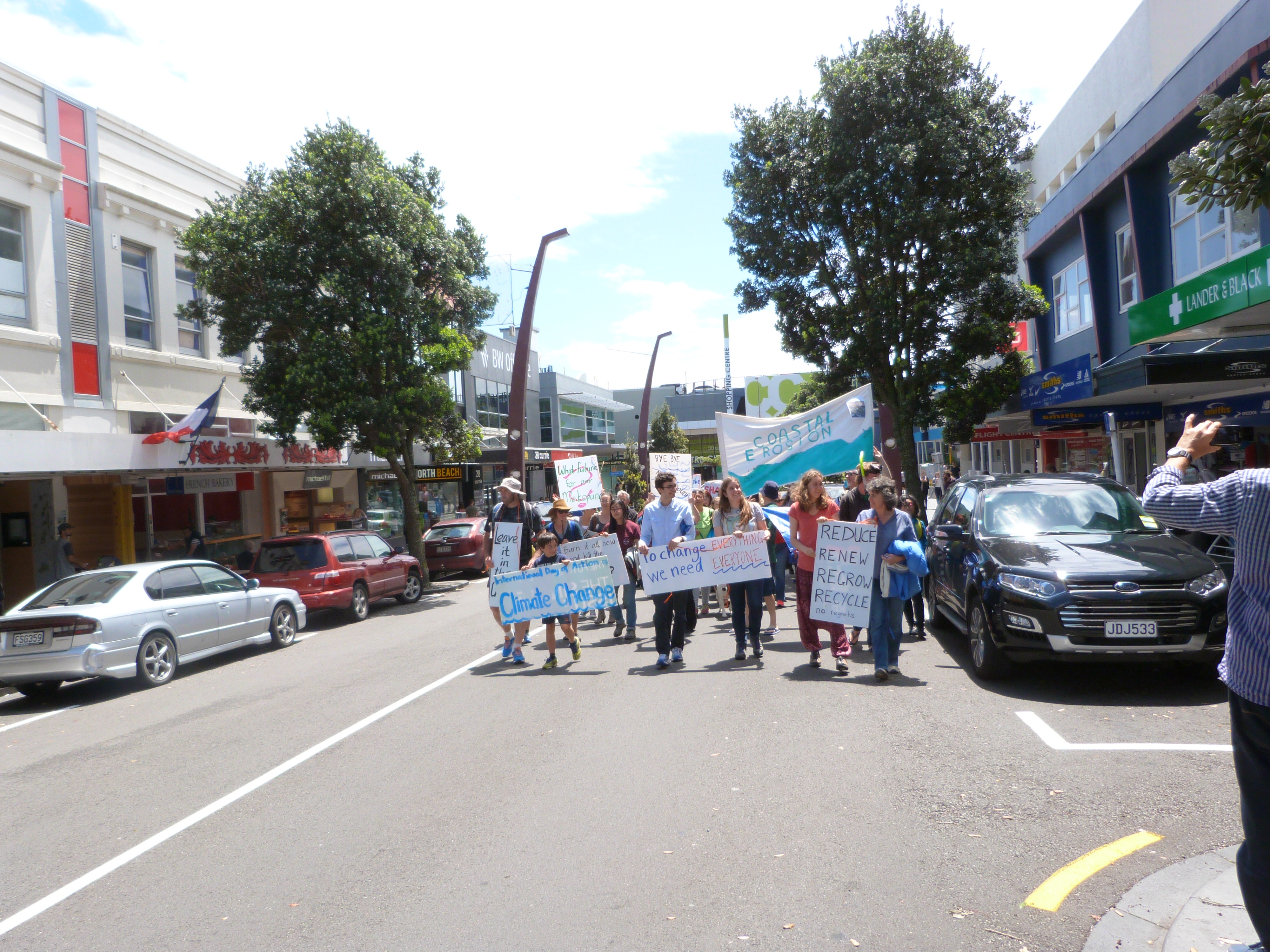
Yesterday New Plymouth was one of 35 New Zealand communities kicking off the global Peoples Climate March calling for real action on climate change at COP21.

In our community, 100 people celebrated with a Peoples Climate Picnic and rally, followed by a flash mob in our mall and a march down Devon Street.

We chose City Centre mall, based on predictions it will be under water with a 6 meter rise in sea levels (to be honest, I’m not sure if that’s a bad thing).

Fifteen thousand people marched in Auckland, ten thousand in Wellington and eight thousand in Christchurch.

More coverage of other marches here: New Zealanders Rally to Global Peoples Climate March

devon streeturs

The Global Climate Justice Movement

Two nights ago, the New Plymouth Green Party and Climate Justice Taranaki sponsored the showing of Naomi Klein’s This Changes Everything. We used the Tugg theatrical-on-demand platform, which allows individuals and groups to show one night film screenings at their local theater. Our cinema was packed (with 90 people) in contrast to the 12-15 watching Hollywood films in the other auditoriums.

The documentary, based on Naomi Klein’s best selling book of the same name, is about the global climate justice movement. Both the book and film take their title from Klein’s premise that the problem of climate change can’t be solved under our current capitalist economic system.

The documentary mainly showcases the mass global protests against the environmental destruction caused by the fossil fuel industry. Klein, who narrates the film, notes a major shift in the environmental movement, with growing numbers of poor and indigenous peoples fighting a fossil fuel industry whose slash and burn mentality threatens their ability to provide food, water and other basic necessities for their families.

The main premise of the film (and the book) is the carbon pollution, like other large scale environmental damage is the result of a dysfunctional story we’ve been telling ourselves over the last 400 years – namely that nature is a kind of machine that must be mastered and dominated at all costs. According to Klein and the numerous activists she interviews, this needs to be replaced by the much older story about humanity living in harmony with nature.

One highlight of the film is her visit to an ultra right free market think tank called the Hartland Foundation. Funded by billionaire fossil fuel barons like the Koch brothers, Hartland is the primary sponsor of the US climate denial movement.

This Changes Everything can be rented from Vudu for $3.99

Groups interested in bringing This Changes Everything and other anti-capitalist documentaries to their local theater can contact Tugg at their website.

A New Angle on Climate Change

Atmosphere of Hope

Pirate TV (2015)

Film Review

Atmosphere of Hope is a recent talk in which Australian environmentalist Tim Flannery summarizes the prospects for limiting and reducing atmospheric CO2 levels. Flannery is a new breed of environmentalist who questions the value of climate alarmism.

The upcoming COP21 conference in Paris will be very different from past climate conferences in that participating countries have already committed to specific emission reduction targets. Because these commitments have been made public (see How COP21 commitments stack up) environmentalists can already predict the effect they will have on total CO2 levels.

Thanks to the recent “decoupling” of reduced fossil fuel use and economic growth, Flannery is extremely confident that most governments will keep their commitments. While these targets are inadequate to limit global warming to 2 degrees centigrade (and preserving civilization as we know it), Flannery is extremely confident that new carbon capture technologies will make up the shortfall.

Successfully Decoupling Fossil Fuels and Economic Growth

The main argument our political leaders give against reducing fossil fuel consumption is the negative effect on economic growth. Thanks to a big drop in the cost of renewable energy (and a big increase in energy efficiency), this argument no longer holds water. Between 2013 and 2014 there was no increase in global fossil fuel consumption (causing an oil glut that dropped prices to $40 a barrel). Yet the global economy continued to grow, thanks to the substitution of cheap renewable energy for fossil fuels.

Flannery also believes that “wavy energy” technology also played a big role in this decoupling. “Wavy energy” refers to a distributed grid technology (developed in Germany) that compensates for the intermittent nature of solar and wind energy – at any given moment some place in Germany is generating some form of renewable energy.

The Role of Carbon Capture Technologies

For me the most interesting part of the talk was the discussion of all the new carbon capture technologies being developed. Flannery divides geoengineering technologies into two categories. The first, which he refers to as “second way, “involves blocking sunlight by injecting sulfur based chemicals into the stratosphere. In his view, this is highly dangerous due to the risk of climate rebound effects (to say nothing of the health effects of the chemicals).

In contrast, “third way geoengineering” technologies remove CO2 from the atmosphere and sequester it. There are further subdivided into biological (natural) and chemical (industrial) based technologies. The latter require external energy input, which means they only reduce CO2 concentrations if they employ renewable energy.

Examples of biological third way technologies include
• Reforestation
• Biochar (charcoal produced from plant matter and stored in the soil as a means of removing carbon dioxide from the atmosphere)
• Wood waste based plastics
• Carbon farming – Australia rewards farmers for replacing annual grasses and crops with perennial varieties that store carbon.

Examples of chemical third way technologies include
• Carbon negative concrete which absorbs CO2 over its lifetime
• Crushed serpentinites – minerals that capture CO2 as they weather and can be used for beaches, playgrounds, smoke stacks and carbon negative roof paint.
• CO2 based plastics
• CO2 based carbon fiber (used in the Boeing dream liner and carbon fiber cars) – would be cheaper than current carbon fiber, aluminum or steal
• A South Korean technology that employs used coffee grounds to capture methane.
• Chiller boxes in Antarctica – powered by wind energy, they would cause CO2 to solidify and fall as snow and then bury it under regular snow.

The Ugly Side of the Fashion Industry

The True Cost

By Andrew Morgan (2015)

Film Review

The True Cost is about the immense environmental and human cost of the fashion industry – all for the sake of a few people raking in immense profits.

The modern trend of “fast fashion” is the most destructive. Over the last few decades, the big fashion brands have sought to make clothes so cheap that consumers only wear them a few times before discarding them and buying new ones.

The average American purchases 80 pieces of clothing a year, 400% more than two decades ago. The US disposes of 11 million pounds of textile waste a year, an average of 82 pounds per person.

Reliance on Sweatshops

Lowering the cost of clothes has necessitated moving 97% of clothing manufacture overseas. Bangladesh, where workers (who are 85% women) earn less than $3 a day,  is the favorite of most big name brands like the Gap.

The women work and live in total squalor. In the past few years , 1,000 workers were killed when the Rana Plaza garment factory collapsed. Hundreds more have died in a series of fires. The pay is insufficient for the women to provide housing for their children. They remain with relatives in the countryside and see their mothers at most once or twice a year.

Thanks to Global Exchange and the anti-sweatshop campaigns of the 1990s, all the big fashion brands sign voluntary codes of conduct to makes sure their local contractors respect the human rights of their sweatshop workers (which they never enforce). The big brands also systematically obstruct federal legislation that would make such codes compulsory.

The Second Most Polluting Industry in the World

The environment degradation caused by “fast fashion” is equally horrific. The garment industry is the most polluting in the world (second only to oil). The global proliferation of GMO cotton has had devastating health effects in India and the Lubbock Texas area. Until I saw this film, I was unaware that Lubbock is one of the largest cotton producing regions in the world.

In Texas most of the GMO cotton is Roundup Ready, Monsanto’s best selling pesticide. Heavy exposure is responsible for a large cancer cluster among Lubbock area residents.

In India, both Roundup Ready and Bt Cotton are grown. The former is responsible for a significant increase in birth defects, cancer and mental illness. The latter is responsible for a serious reduction in crop yields (the pesticide Bt Cotton produces kills the soil bacteria responsible for soil fertility). The loss of soil fertility has led to farmers losing their land and livelihood, as well as over 200,000 farmer suicides in the last 15 years.

India is also experiencing massive chromium contamination of the Ganges River and surrounding groundwater, from chemicals used in tanning leather for the western fashion industry.

Spin, Propaganda and Lies

The fashion industry pumps out propaganda that sweatshops are good because they create jobs for people who otherwise would have no alternative. This ignores the deleterious effect of “free trade” treaties that have destroyed the rural economies of many third world countries.

The official narrative also belies collusion between the fashion industry and the Vietnamese government, known for brutally beating and killing garment workers during peaceful protests demanding a minimum wage.

The full film was available on YouTube last week but has been taken down. You can rent it from VHX or iTunes for $3.99: Watch now

Food Inc

Food Inc

Directed by Robert Kenner (2008)

Film Review

Food Inc is a 2008 classic only recently available for free on-line screening. Featuring investigative journalist Eric Schlosser and food activist Michael Pollan, it’s the first and (in my view) the best expose of factory farming.

This film mainly focuses on the deplorable disease-inducing conditions of battery chicken houses and industrial feedlots and slaughterhouses. However it also draws attention to the current epidemic of food borne illness, diabetes and heart disease; the corporate capture of regulatory agencies meant to protect us; the federal subsidies that make junk food cheaper than fresh fruits and vegetables; Monsanto’s vicious treatment of farmers who choose not to grow GMO crops and the food disparagement and anti-labeling laws meant to keep consumer sin the dark about where their food comes from.

Most importantly this documentary questions whether the “cheap” food produced by industrial farming is really so cheap when you add in the health costs (especially of chronic diseases like diabetes and cardiovascular disease)

The cinematography captures horrific scenes of factory chicken houses where chickens live on top of each other in total darkness and feed lots in which cows spend their whole life knee-deep in manure. The latter cakes their hides and inevitably contaminates carcasses at the slaughterhouse.

The films draws interesting parallels between the abysmal treatment of animals and workers in the industrial food chain. Food executives argue that animal suffering is inconsequential because they’ll all be dead soon. They also regard immigrant workers as expendable because there are so many of them.

The filmmakers catch meat processors deliberately recruiting illegal laborers in Mexican villages devastated by the North American Free Trade Act (NAFTA). Employers are never prosecuted for these activities. Only immigrant workers are targeted.

https://vimeo.com/29575879

Using Nature to Heal Nature


shark's paintbrush

The Shark’s Paintbrush: Biomimicry and How Nature is Inspiring Innovation

by Jay Harman

White Cloud Press (2013)

Book Review

Before reading this book, I was vaguely aware of the field of biomimicry. For some reason, I had the idea it was purely experimental. I had no idea that it had so many successful commercial applications.

The term biomimicry was coined by Jeanine Benyus in her 1987 book Biomimicry. It’s defined as the design and production of materials, structures, and systems that are modeled on biological entities and processes. Being modeled on biological processes, these materials, structures and systems are more efficient and consume less energy. They also produce less environmental damage and toxic waste.

The latter has important implications for human health. The average human being carries an average of 200 toxic chemicals in their bloodstream – many of them linked to the current epidemic of cancer, infertility and autoimmune disease.

Pax Scientific Designs

Harman currently runs Pax Scientifc Designs and produces energy efficient refrigerators, turbines, fans, pumps and mixers that use naturally-based spiral contours to maximise natural fluid flow geometrics. Leonardo Da Vinci, who was the greatest biomimic of all time, was the first to study fluid dynamics by observing the operation of bird and insect wings and the fluid dynamics of the human heart.

Venture capitalists have a keen interest in the biomimicry industry. By 2025, Harman estimates $1 trillion of global capital will be invested in biomimicry. He predicts it will comprise 15% of chemical manufacturing, waste management and remediation, 10% of architecture, engineering, transportation and textile production and 5% of food production, construction, plastics and computer hardware.

The Cutthroat World of Venture Capitalism

A third of the book describes how the cutthroat world of venture capitalism and hostile takeovers has significantly hampered the widespread implementation of biomimicry research.

The rest of it is devoted to a comprehensive overview of biomimicry-based products that have been or are about to be brought to market. Some of the highlights include

• An antibacterial paint synthesized to mimic sharkskin.
• A new sunscreen synthesized to mimic hippopotamus sweat, which is much more effective than existing sunscreens and contains no cancer causing chemicals.
• An adhesive bandage that simulates the microtubules that allow geckos to hang from the ceiling and non-toxic adhesives based on the natural blue mussels use to cling to rocks.
• Fabrics, paint and electronic screens in which color is created by light refraction, as in peacock feathers and butterfly wings.
• Aircraft and vehicles that reduce drag (and energy consumption) by mimicking irregularities in fish scales and bird wings.
• Surfaces mimicking the water resistance of butterfly wings to prevent ice from forming on aircraft, roads, bridges, power lines, pipes and windshields.
• Communication technology mimicking dolphin squeaks to make wireless signals more efficient in penetrating clouds and fog.
• New drugs against antibiotic resistant bacteria based on cockroaches that produce nine molecules that are deadly to bacteria.
• New software using the swarm behavior of bees to predict crowd behavior. A Toronto company has used it to reduce energy needs by as much as 30% in malls, hospitals, hotels and factories.
• High strength fibers that mimic spider silk and window glass that prevents bird strikes by incorporating the ability of spider webs to reflect UV light (birds can detect UV light).
• A mechanical leaf being developed at MIT that uses a catalyst made from cobalt and phosphate to split water into oxygen and hydrogen gas (to be used in fuel cells).
• A carbon capture technology that uses the chemical actions of coral to remove CO2 from chimney flues and converts it to calcium carbonate – which can then be used to make concrete.

The book also describes a unique website called AskNature, which provides a comprehensive catalog of “natural” design solutions for inventors and engineers needing specific technological solutions. For example, under “chemically break down,” the database lists 40 natural mechanisms for breaking down organic compounds, six for breaking down inorganic compounds and eight for breaking down polymers.