Deja Vu All Over Again

With the US, Britain, France and Russia rapidly escalating military aggression against Syria, I thought it would be useful to look back at this Al Jazeera documentary from 2004. Al Jazeera analysts were the first to predict (2003) that the US and their allies would lose the war in Iraq.

The Control Room – Propaganda of the Iraq War

Directed by Jehane Noujaim (2004)

Film Review

The Control Room is about the Qatar TV network Al Jazeera and their coverage of the 2003 US invasion and occupation of Iraq. It alternates between footage of the Doha control room and the US Central Command media center. Highlights include vignettes of US officials condemning Al Jazeera for showing footage of civilian casualties and dead and captured Americans.

Because of the Pentagon’s tight control over US media, Al Jazeera was the only mainstream outlet to address the issue of civilian or GI deaths.

Al Jazeera was first launched in 1996 and several Arab countries banned it for criticizing their regimes. In 2003, they would broadcast coverage of the US invasion to 40 million Arab viewers, eventually becoming the most popular Arab TV station.

Their analysts would also be the first to predict (in 2003) that the US had “miscalculated” by invading Iraq – that the Iraqi resistance would eventually defeat the occupation.

The commentary by Al Jazeera senior producer Samir Khader is definitely the high point of the film, especially his discussion of the importance of propaganda in war. I was really surprised by his strenuous efforts to balance pro-US and pro-Iraqi propaganda.

I was astounded by his comment that he would take a job at Fox News if they offered it to him – to “trade the Arab nightmare for the American dream.” He speaks openly about his plans to send his children to the US to study.

The most heart-wrenching part of the film involves the deliberate assassination (via a US missile) of Al Jazeera reporter Tarek Ayyoub as he was broadcasting from the roof of the Al Jazeera building in Baghdad. His death would result the first of many anti-occupation protest marches.

Let’s All Move to Michigan, Shall We?

michigan

Exported from Michigan

Jon Vander Pol (2014)

Film Review

Exported from Michigan is a slick rah-rah promotional film about the glories of doing business in the state of Michigan. Even though it’s an obvious propaganda piece, it’s always interesting to track the key messages the mainstream media is trying to foist on us. The main message I see this film promoting is that society (ie government and corporations) no longer have an obligation to guarantee full employment. It’s up to the 20-30% of American young people who are unemployed to solve the problem themselves by becoming self-employed entrepreneurs.

Despite the film’s irritating lack of balance, I was gratified to see its heavy emphasis on local economies, civic engagement and community building. I’m in total agreement that local businesses are the key to a thriving economy – states tried to increase employment with tax breaks for multinational corporations learned from bitter experience corporations have no loyalty to the welfare of local communities.

The filmmakers argue that Michigan began sliding into recession long before the 2008 economic crisis, owing to a steady exodus of the big three automakers that began in the 1970s. Michael Moore’s 1989 film Roger and Me focuses on the economic devastation Flint Michigan experienced after GM closed their auto plant and laid off 30,000 workers.

Among the film’s highlights are the urban agriculture movement in Detroit, where one-third of the land is abandoned; the craft beer movement, involving 140 microbreweries across the state and employing 37,000 people; a proliferation local art fairs and music festivals aimed at building community awareness and civic engagement, high tech manufacturing start-us that focus on robots and wind and solar technology and the development of a specialized medical research center in Grand Rapids. In all these endeavors, there’s a strong expectation that new physical plants will be sustainably constructed and adhere to triple bottom line principles.*

The decision to showcase the Big 3 auto companies, which still employ one out of seven Michigan workers, mystified me. A GM executive talks about the failure to innovate and “complacency” over consumer needs that led to their bankruptcy and bailout in 2008. He doesn’t mention the 30 million vehicles GM recalled in February 2014 due to faulty ignition features that caused cars to catch fire – nor that GM knew about the fault for a decade before issuing the recall.

Although there’s brief mention of the Detroit seniors who’ve had their pensions cut as the city’s 2013 bankruptcy, the film fails to examine the tragic effect of these cuts on their lives. There’s also no mention of the tens of thousands of Detroit residents who’ve experienced water shutoffs nor the city’s condemnation by UN human rights.

View the film free at Exported from Michigan


*Triple bottom line principles place people and planet before profit.


Forget Shorter Showers

Forget Shorter Showers

by Tom Shadyac (2011)

Film Review

Forget Shorter Showers is a documentary based on an essay by anarchist Derrick Jensen that challenges neoliberal dogma that makes each of us personally responsible for reversing the ongoing environmental destruction caused by industrial capitalism. Consumers who have joined the campaign to fly and use their cars less, change their light bulbs and take shorter showers are the victims of systemic misdirection by a pernicious PR industry. The latter continuously churns out propaganda that we can save the planet through market-based solutions such as shopping.

Al Gore’s movie An Inconvenient Truth is a classic example of this deliberate misdirection. Instead of calling for policy changes that hold corporate polluters to account, his film deliberately disguises the reality that industry is responsible for the vast majority of carbon emissions. In doing so, Gore incorrectly blames powerless individuals for the climate crisis, instead of the elites who hold real the real power.

Lifestyle Only Accounts for 22% of Emissions

If the entire global population adopted a low carbon footprint lifestyle, it would only decrease carbon emissions by 22%. Climate scientists tell us we need to decrease them by 70% to stave off catastrophic climate disruption.

In a similar vein, reducing individual water usage isn’t going to solve the freshwater shortage. Ninety percent of all freshwater is used by agriculture and industry. Five percent is used by municipalities, and 5% by individuals.

Industry is also responsible for the vast majority of energy consumption and waste production.

How We’re Conned into Taking Personal Responsibility

The filmmakers point out that we’re easily conned into taking personal responsibility for all these environmental issues because it’s less scary than acting decisively to stop the industrial capitalism from destroying the planet. Among other fears, people worry the grid might go down, causing us to lose access electricity, clean water and cellphone service – not because we need these perks to survive but because we’ve become addicted to them.

Fear of state violence is also a biggie. The documentary provides numerous historic examples of courageous activists who have overcome such fears.

Climate Denial: Big Oil’s Multimillion Dollar Disinformation Campaign

The Climate Deception Dossiers

On July 9, 2015, the Union of Concerned Scientists released The Climate Deception Dossiers – collections of internal company and trade association documents revealing a three decade campaign by the world’s largest fossil fuel companies about the realities and risks of climate change. Some documents have been leaked to the public by industry whistleblowers. Others have come to light through lawsuits or Freedom of Information (FOIA) requests.

Each dossier provides an illuminating inside look at this coordinated campaign of deception, an effort underwritten by ExxonMobil, Chevron, ConocoPhillips, BP, Shell, Peabody Energy, and other members of the fossil fuel industry.

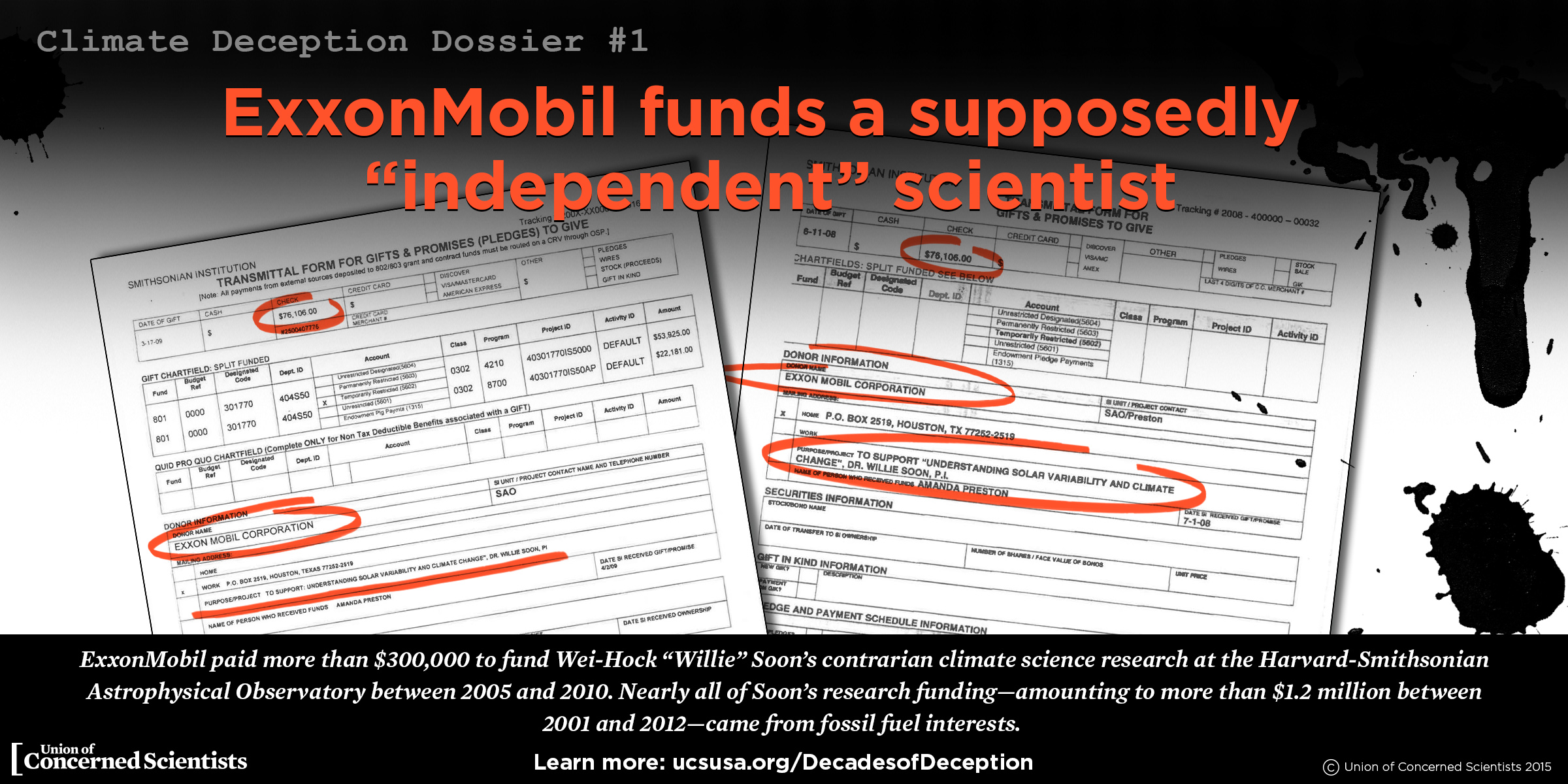
Tactics employed by these companies include a million dollar contract supporting the work of climate contrarian aerospace engineer Wei-Hock “Willie” Soon:

gw-minigraphic-climate-deception-dossier-1-willie-soon-contracts

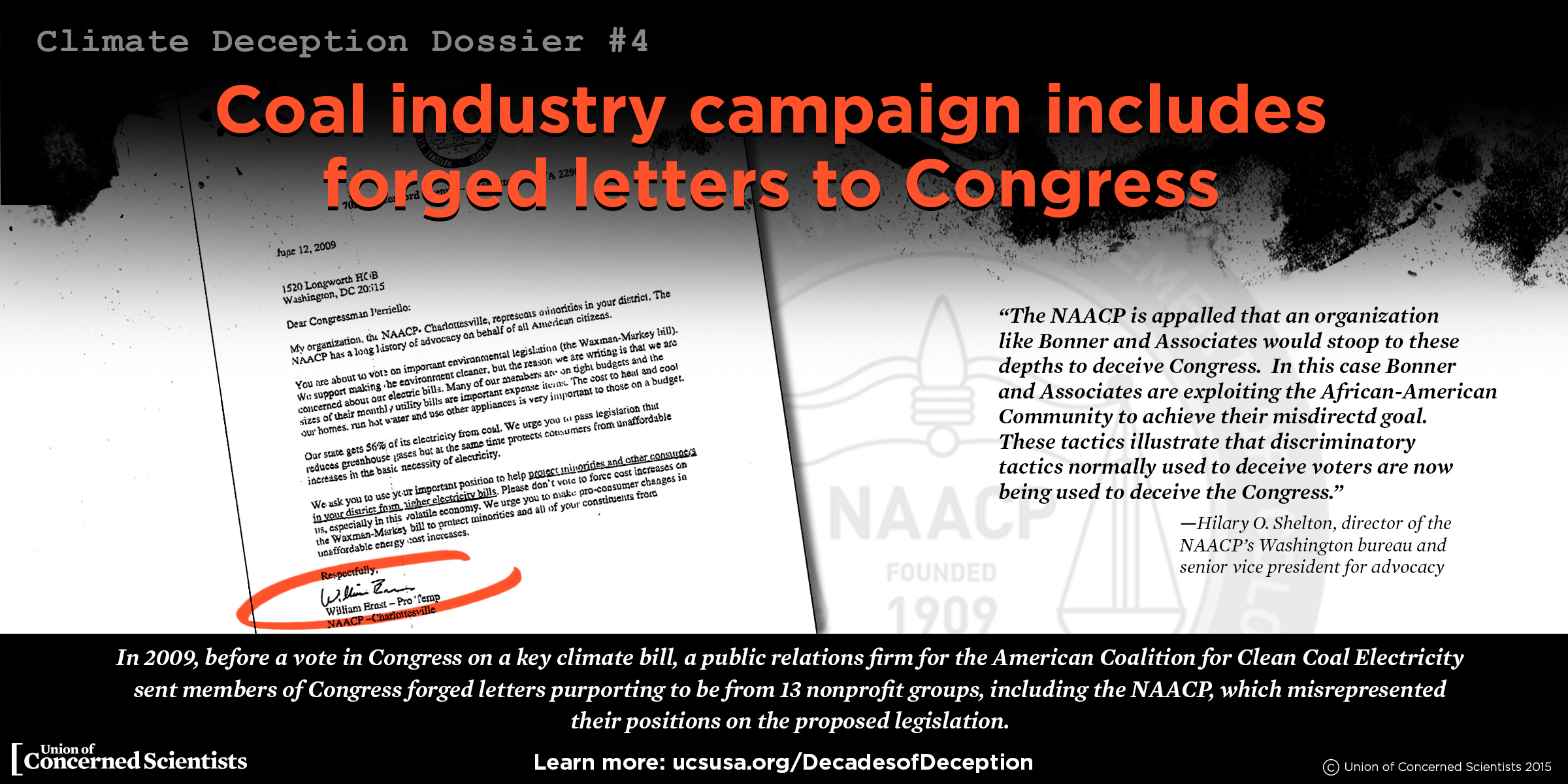
The fossil fuel industry also forged documents and letters and formed fake “astroturf” groups that purported to act on behalf of taxpayers rather than oil companies:

gw-minigraphic-climate-deception-dossier-4-ACCCE-forged-letters

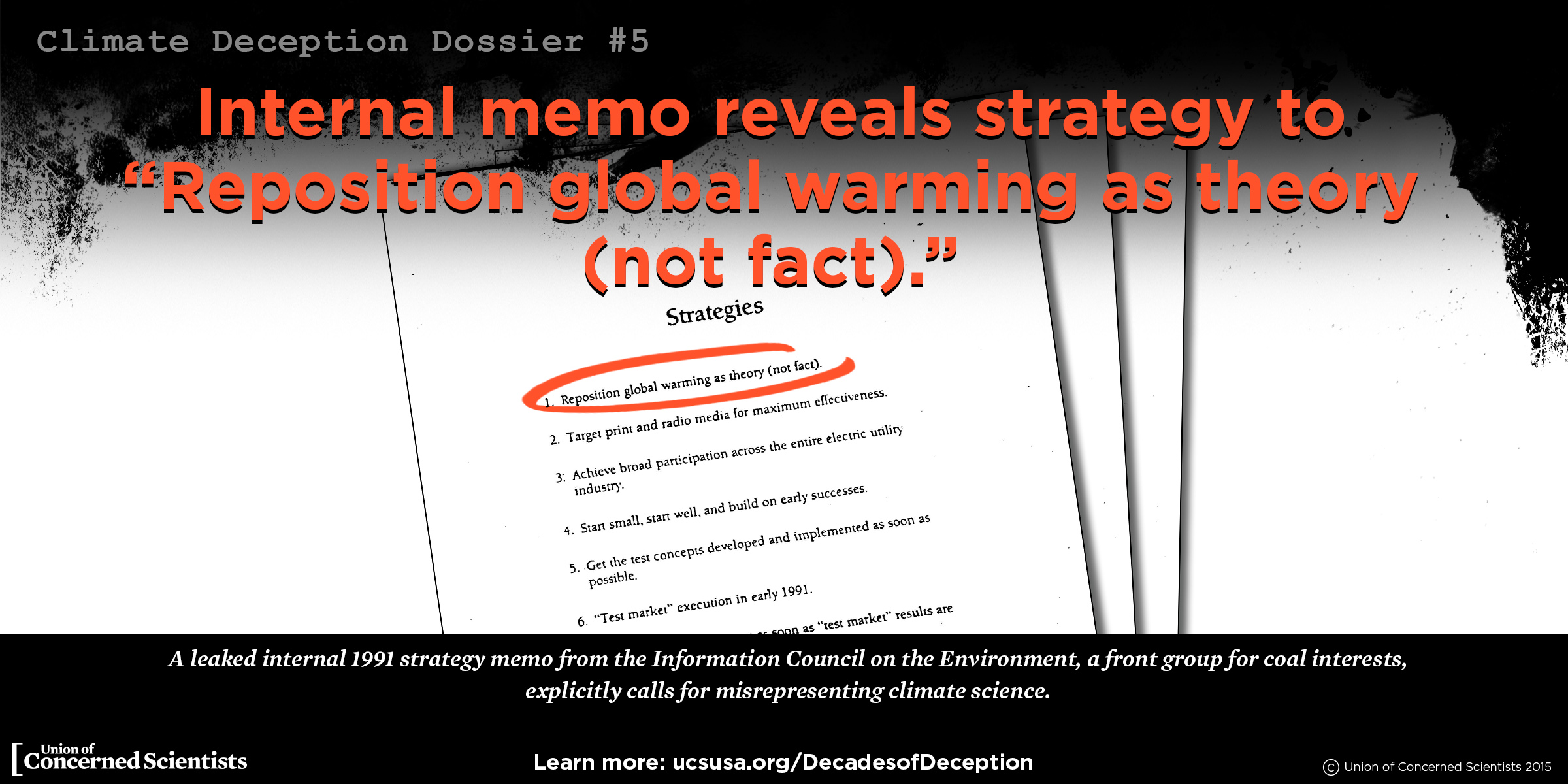
As well as launching a sophisticated, multimillion dollar public relations campaign:

gw-minigraphic-climate-deception-dossier-5-ICE-memo

An Exxon whistleblower reveals his company first got interested in the greenhouse effect and global warming when it was seeking to develop the Natuna gas field off Indonesia. An Exxon memo raises concern about it becoming the “largest point source of CO2 in the world.”

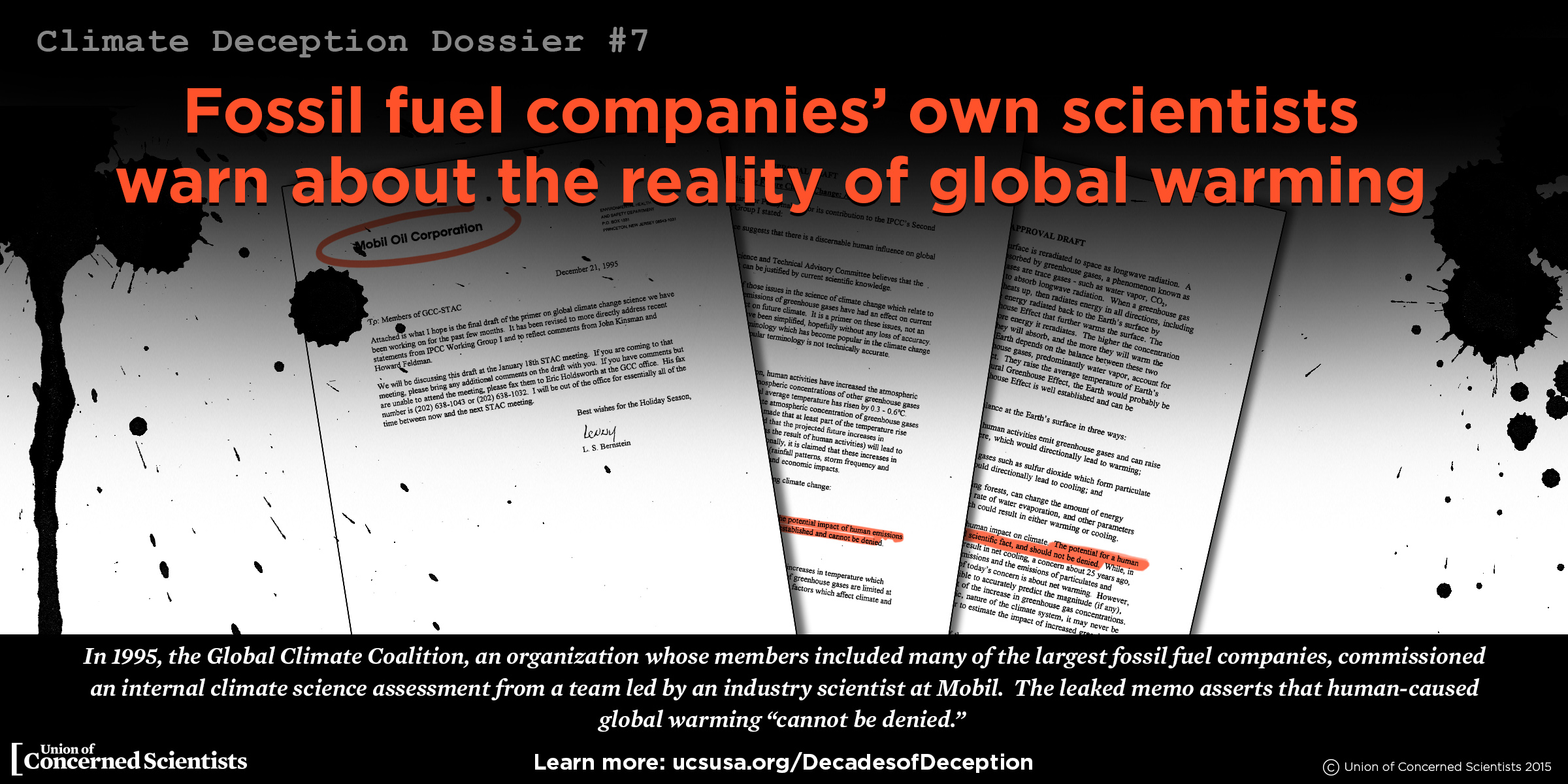
In 1995, the same whistleblower (working for Mobil) co-authored a memo to to the Global Climate Coalition (GCC), a fossil fuel lobbying group. The memo, was distributed to other member companies and warned unequivocally that burning fossil fuels was causing global warming – that the relevant science “is well established and cannot be denied.”

gw-minigraphic-climate-deception-dossier-7-fossil-fuel-climate-science-primer

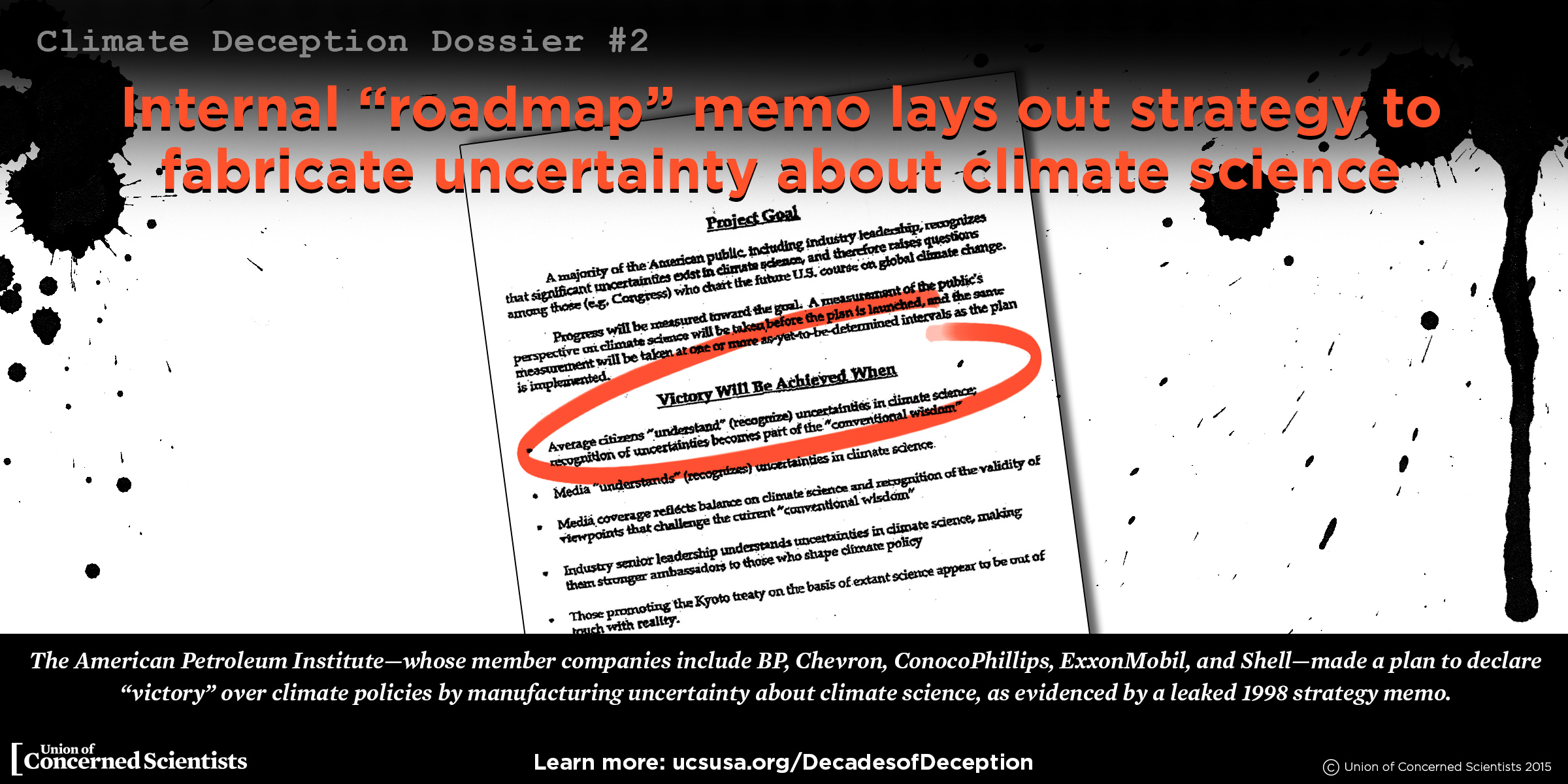
Many of the same companies – including BP, Chevron, Conoco, Exxon, Mobil, Phillips, and Shell – were members of the American Petroleum Institute (API) in 1998 when the trade group drafted a plan to secretly support “independent” researchers to publicly dispute established climate science:

gw-minigraphic-climate-deception-dossier-2-API-roadmap-memo

Link to full report: Climate Deception Dossiers

The Truth Behind Crapitalism*

The Truth Behind Capitalism

Truth Behind Politics UK (2015)

Film Review

The Truth Behind Capitalism examines the current demonization of “socialism” in the mainstream media and the corporate interests who drive it. It begins by exploring growing interest in Marxism stemming from the obvious failure of capitalism to cope with the 2008 economic collapse. It also attempts to correct the popular misconception that Karl Marx was responsible for the totalitarian dictatorship that developed in the former Soviet Union. About half the film is devoted to three century battle against central banks and the privilege governments grant them to create debt-based money out of thin air. It incorporates lengthy segments from Inside Job, an excellent 2010 documentary narrated by Matt Damon.

The filmmakers, who describe Marx as a sociologist, philosopher and student of capitalism, maintain his central concern was capitalism’s use of exploitation and oppression to keep poor people poor. Oversimplifying considerably, they summarize his ideal society as one run by workers themselves through a combination of worker cooperatives and state owned enterprises.

The film ends with examples from all over the world – including the 2008 Iceland revolution, the Occupy movement and the rise of Syriza in Greece – of working people organizing to strip private banks of the control they exert over our lives.


*Crapitalism (def): an economic system that treats ordinary people like crap. See A Mini-Dictionary of Neoliberalism

Miss Representation

Miss Represention

Jennifer Siebel Newsom (2011)

Film Review

Miss Representation takes an in-depth look at sexualization of women and girls by the corporate media. In addition to examining the psychological damage this inflicts, the film explores the largely commercial factors behind it, as well as potential solutions.

The primary role of American media (TV programming and ads, movies, music videos, billboards, etc) is to convince women that their personal appearance and the approval of men should be their number one priority.

Even more pernicious, the media project a totally unattainable standard of beauty. What makes this messaging particularly harmful is that girls and women incorporate it subconsciously without realizing it. It’s especially dangerous for the developing brains of teenagers, who lack the critical judgment skills to weigh what they see and hear. By age 17, 78% of girls are unhappy with their bodies. Even more ominous, 68% of American women and girls develop an eating disorder in their determination to be skinnier.

The effect of this messaging on men and boys is to condition them to value a woman’s appearance above intelligence, integrity and other personal characteristics.

TV’s Fixation with Youth

Although women forty and over represent 44% of the population, they only play 26% of TV roles. Being youthful isn’t enough for female TV celebrities – who are frequently pressured to lose weight or undergo breast enhancement and/or botox and collagen injections.

The film outlines three principle reasons for the entertainment industry’s one dimensional portrayal of women. The pressure to live up to an impossible ideal is incredibly effective in selling beauty products. American women spend millions of dollars yearly on cosmetics and plastic surgery, far more than they spend on education.

The media’s constant parade of stunning, sexually provocative bodies is also essential in luring men aged 18-34 (the demographic targeted by advertisers) into watching TV. Men this age tend not to watch TV, except for sports.

Finally nearly all the decision makers in the entertainment industry are men. At Walt Disney, only 4 out of 13 board members are women. At GE (which runs NBC), the ration is 4/17. At Time Warner, it’s 2/13, Viacom 2/11, CBS 2/14 and Fox 1/16. Only 16% of movie and TV directors, producers and editors are women and only 7% of screenwriters

Low Representation in Government

The objectification of women by the mass media discourages them from playing leadership roles in business, community affairs, academia and politics. The US is rapidly falling behind developing countries in this regard. Unlike the US, 67 other countries have elected female presidents and prime ministers, and the US is 90th in female representation in government. China, Cuba, Afghanistan and Iraq all have more female representatives in their national legislatures.

Two direct outcomes of this low representation are unequal pay (American women still only earn 77% of what men earn for comparable work) and the failure of the US to mandate parental leave (like all other industrialized countries) following childbirth.

Even more ominously, numerous studies link the media’s objectification of women with growing rates of domestic violence and sexual assault.

The Negative Effect on Men

Miss Representation also speaks briefly to the negative effect of this systematic gender distortion on men. Bombarded by constant media pressure to be smarter, more powerful and more respected than women – as well as making more money – men can find it difficult to cope when this fails to pan out real life. This psychological conditioning also causes young men to be “emotionally constipated.” Lacking realistic no role models, men can have a hard time learning to express emotions in a healthy way.

.

Sext Up Kids

Sext Up Kids: How Growing Up in a Hyper Sexualized Culture Hurts Our kids

Doc Zone (CBC) 2012

Film Review

The ubiquitous sexualization of children in the mass media is having devastating effects on our adolescents. Sext Up Kids interviews a range of experts, including teachers, psychologists and teen sex bloggers. They all agree that pop culture has become a virtual porn culture, with the increasing prevalence of sexually provocative teen and pre-teen (as young as 9) girls in advertising, music videos and movies.

Teenage girls seem to bear the brunt of the psychological damage. They feel immense pressure to copy the sexualized image of their teen idols, at risk of being unpopular or socially excluded if they don’t. The pressure is aggravated by boys, who are also constantly exposed to the same soft porn and call them sexually abusive names if they don’t measure up.

With boys as young as five accessing hard porn on the Internet, there’s also intense pressure for girls thirteen and up to engage in sexual activity. Because boys base their sexual expectations on male-dominated pornography, intercourse is frequently painful because the girls do it without being aroused or lubricated.

Pressure for girls to engage in oral (fellatio) and anal sex is also intense. Teenage boys expect it because they see it on-line. In one study by an Atlanta psychologist, 22% of teenage girls reported having anal sex in the past sixty days.

Sext Up Kids also covers the controversial topic of sexting, sending sexual explicit texts and selfies. Sexting can have extremely painful consequences for both girls and boys, especially aggravated sexting, a form of bullying in which the naked photos a girls sends her boyfriend are forwarded and go viral.

Apparently girls succumb to their boyfriends’ requests for nude selfies out of fear boys won’t like them if they don’t flaunt and promote themselves. While increasingly boys run the risk of being charged with sex crimes for possessing pornographic photos of girls under eighteen.

The documentary concludes with a plea to parents, urging them to talk to their teenagers about their sexual choices. Experts agree this is the best way support them in resisting pressure to be sexual before they’re emotionally and psychologically ready.

Climate Change-Lite for Kiddies.

saving my tormorrowSaving My Tomorrow – Part 1 and 2

HBO (2014)

Film Review

I watched this two part film with some trepidation, assuming that an HBO documentary would be full of spin. Sadly it fulfilled my worst expectations. Aimed at age 5-12, the video offers a fairly accurate presentation of the theory of greenhouse warming. Children will also enjoy some great shots of insect life and the devastation Hurricane Sandy caused on Long Island.

That being said, I think a lot of adults will react as I did and feel manipulated. Developmentally, children up to age 18-19 adopt strong political views under parental (and occasionally teacher) influence. Rather than portraying this honestly, Saving My Tomorrow makes it appear as if a bunch of American child prodigies suddenly woke up one morning and decided to protest against oil trains and fossil fuel dependence. Despite being a strong climate activist, I resent being propagandized as much as the next person.

In my case, this sense of manipulation was compounded by the slick packaging, consisting of cute wise-child soundbites, interspersed with celebrity readings and musical numbers written by the kids themselves. In my view, the filmmakers needed to be more transparent by exploring the parents’ behind-the-scenes role in promoting their children’s activism.

The other glaring dishonesty was HBO’s failure to mention the role of genetically modified organisms (GMOs) in the near demise of the American monarch population (we don’t allow GMO crops in New Zealand and have plenty of monarch butterflies).

While adults will be annoyed by the slick packaging, the documentary is probably a good introduction to climate change for young children. I myself really enjoyed the scene of Long Island children reading their essays on Hurricane Sandy and the energy saving tips kids give during the credits.

***

Since I first posted this review, I note that HBO has had both videos taken down by YouTube. Don’t worry you’re not missing much.

How Advertising Hurts Women

Killing Us Softly 3

Jean Kilbourne (2000)

Film Review

Killing Us Softly 3 is the third Jean Kilbourne documentary on the advertising industry’s destructive effect on women. It updates Killing Us Softly (1979) and Still Killing us Softly (1987). It’s presented in lecture format, illustrated by dozens of ad images.

The majority of Americans deny being influenced by advertising. Kilbourne challenges this. Modern advertising deliberately targets the unconscious. Ads are everywhere, continuously surrounding us with unconscious messaging about values and attitudes, as well as products.

Advertising has a massive impact on the way women think about themselves and the way they are viewed in society. The number one message pounded home by the ad industry is that women should be judged by the way they look. The expectation is flawlessness (young, thin, white and perfectly proportioned and groomed). Important secondary messages are the hard work it takes to look that way and that women who don’t measure up should feel guilty and ashamed. Sex is used to sell everything. Kilbourne is particularly concerned about the sexualization of children and teenagers in ads deliberately modeled after child pornography.

Only 5% of women have a model’s tall thin body type, with the narrow hips, long legs small breasts (unless they’re enhanced) favored by the fashion industry. This body type is based on genetic inheritance and can’t be achieved by diet, exercise or surgery, no matter how hard the advertising industry tries to persuade us otherwise. Often models are airbrushed to appear thinner and more flawless than they really are.

This constant emphasis on an unachievable ideal also negatively impacts the way men feel about real women, who are pear shaped. In addition, the objectification of women (ie their portrayal as sex objects) is directly linked to increased violence towards women. Viewing people as objects rather than human beings makes it easier to commit violence against them (and is used in military training).

The problem is aggravated by a growing tendency to eroticize violence and male dominance in advertising imagery.

Killing Us Softly 4, produced in 2010, isn’t available on YouTube for copyright reasons. It can be viewed for free on trutubetv (an uncensored noncorporate alternative to YouTube now that it’s been taken over by Google).

Killing US Softly 4 repeats most of the same ad images as number 3 but puts more emphasis on upsurge of appearance medicine (plastic and laser surgery, botox injections, etc). It also bemoans the introduction of size 0 and size 00 clothing, the pressure this places on models to starve themselves and the rise of eating disorders in the industry. Anna Carolina Reston was still modeling in 2009 when she died of anorexia nervosa.

Rupert Murdoch’s War on Journalism

Outfoxed: Rupert Murdoch’s War on Journalism

Robert Greenwald (2004)

Film Review

Outfoxed makes the case that media mogul Rupert Murdoch is first and foremost a politician – that he uses Fox News and his vast media monopoly* to promote conservative politicians who protect his financial interests. As evidence, it provides dozens of Fox News broadcast clips, samples of Roger Ailes’ daily editorial memos, and interviews with former Fox producers, reporters and commentators.

Murdoch used 21st Century Fox and the six TV stations owned by Metromedia he acquired in 1986 to form the Fox Broadcasting Company. In 1996, he entered the cable news market, hiring Roger Ailes to set up and run the Fox News Channel, a 24-hour cable news stations.

The former reporters and producers featured in the documentary talk at length about Ailes’ daily memos about topics they were required to cover (and avoid) and the spin he expected. Murdoch has a special hatred for the Kennedys, Bill Clinton, anti-war movie stars and Jesse Jackson and Fox employees were expected to invent opportunities to demonize them. The memos they received also heavily emphasized terrorism, fear of terrorism and divisive wedge issues, such as abortion, gay rights and religion, especially in election years. The intention was to distract US voters from issues, like the economy, that were problematic for Republicans.

Reporters and producers who failed to follow Ailes’ directives would be chewed out, demoted or fired. Commentators who failed to follow Murdoch’s party line would have their contracts canceled.

Election and War Coverage

Outfoxed devotes special attention to the biased coverage of the 2000 and 2004 election campaigns and the War in Iraq. In their vicious demonization of John Kerry in 2004, Fox News engaged in a deliberate attack campaign more typical of a political party.

The Fox Effect

Filmmaker Robert Greenwald also examines the effect Fox News has on other TV networks when they feel pressured to report Fox-initiated propaganda as news. The rumor that John Kerry looked and acted French – a pure Fox News invention – is a case in point. Likewise in 2000, ABC, NBC and CBS all declared Bush the winner at 2 am on election night, immediately after the Fox analyst (Bush’s first cousin) did so. Only Associated Press reported, correctly, that the Florida race was too close to call.

The Internet Effect

Produced ten years ago, the film’s call to action – lobbying the Federal Communications Commission (FCC) – is totally obsolete. Greenwald had no way of predicted the social media revolution or its negative effect on traditional media. Young people no longer rely on TV for news and information. Young Americans (age 25-54) particularly avoid Fox News – there’s no way a network catering to an older male Republican base can possibly address the issues that concern them. This is reflected in a steady decline in Fox News ratings over the last five years.


*In addition to Fox Networks, Rupert Murdoch owns Harper Collins, the Wall Street Journal, the New York Post, the British Sun, Times and Sky Television, five regional US newspapers and more than 100 national and regional Australian newspapers.