The CEO Who Chained Himself to a Bridge

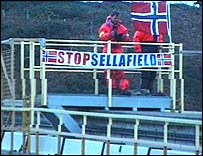
stordalenphoto credit: http://news.bbc.co.uk/2/hi/business/2941073.stm

His name is Petter Stordalen, and he’s a billionaire Norwegian property developer and the chief executive of Choice Hotels. In 2002, he chained himself to a bridge in Seascale England, demanding that the Sellafield nuclear reprocessing plant be shut down. I try to imagine Bill Gates chaining himself to something. Somehow I can’t quite picture it.

Stordalen is one of numerous Norwegian business executives and political leaders fighting for more than a decade to close Sellafield. Why does Norway want the British nuclear reprocessing plant shut down? Studies show that air and water currents carry Sellafield’s accidental and “operational” discharges to the west coast of Norway. The latter would also bear the brunt of a major accident, which, owing to the plant’s abysmal safety record, looked increasingly likely in 2002.

Including, but not limited to

  • between 1950-2000, 21 serious incidents or accidents involving offsite radiation release. This includes the Windscale Pile disaster, when a large heap of radioactive waste that caught fire in 1956
  • a 1999 citation for falsifying quality assurance data between 1996-1999
  • in 2003 a study commissioned by the Minister of Health revealing an increased incidence of childhood leukemia and non-Hodkins lymphoma in local residents
  • in 2005 a plutonium leak that went undetected for three months
  • in 2010 three accidental releases, with a fourth in early 2011, that were concealed from the public until a whistleblower leaked the documents to the Guardian

Why Reprocessing Plants Are Especially Dangerous

Sellafield first started up as a nuclear power station in the mid-fifties. Its mixed oxide (MOX) processing plant was built in 1996 and went on-line in 2001. Its role as a reprocessing plant means it accepts nuclear waste (spent nuclear fuel rods) from all over the world and reprocesses them for reuse. First plutonium and uranium must be separated from other fission products. One byproduct, a mixture of plutonium and uranium known as MOX, is used in thermal and fast breeder reactors. Sellafied’s reprocessing role also means that it accumulates massive amounts of “highly active liquor” (HAL), which requires constant cooling to prevent it from exploding.

Even CEOs Have Children

Few outside Britain and Norway have ever heard of Sellafield, much less the Neptune Network, an organization of Norwegian business executives turned environmental activists. Under the leadership of their executive director, long time businessman Frank-Hugo Storelv, the group has played a vital role in recruiting other Norwegian business leaders to lend their support to Norway’s antinuclear and anti-toxics campaign. In the video below, Storelv explains the urgent need for companies to operate more sustainably and be seen as good environmental citizens.

Like Petter Stordalen, Storev and other business executives in the Neptune Network were arrested numerous times for committing civil disobedience, both at Sellafield and numerous contaminated sites in Norway. In April 2011 he and four other members of the Neptune Network were arrested (under Britain’s anti-terrorism law) outside the gates of Sellafield for blocking a railroad shipment of new nuclear waste.

Victory for the Neptune Network

The MOX reprocessor at Sellafield closed August 3, 2011, after Japan (as a direct result of Fukushima) announced they would cease buying MOX for use in their reactors. The British government responded by proposing to build a new MOX plant at Sellafield, which would produce fuels for use in more modern reactors. In the face of massive public opposition, Cameron’s coalition government backtracked and committed to decommission and close Sellafield by 2018.

What’s Wrong With American CEOs?

So what’s the major difference between American and Norwegian CEOs? Why is it so hard to imagine Bill Gates, Warren Buffett, the Koch Brothers, George Soros (or any of our elected representatives, for that matter) chaining themselves to a bridge? They have children and grandchildren, just like Norwegian business executives. What’s more they all (presumably) have the educational background to understand that massive wealth won’t protect their offspring from the devastating health consequences of radiation poisoning.

In addition to the hundreds of thousands of cancer deaths and deformed babies stemming from nuclear accidents, leaks and “operational” releases, we still have no safe method of storing and/or disposing of the mountains of radioactive waste we have already created. Surely they know all this, right?

Originally published in Dissident Voice

The Worker Revolution in Cleveland

In 2008, the Cleveland Foundation approached Democracy Collaborative co-founders Gar Alperovitz* and Ted Howard* about revitalizing Cleveland’s decaying inner city.  With the help of the Cleveland Clinic, University Hospitals, Case Western Reserve University, and Cleveland’s municipal government, they formed Evergreen Cooperatives (EC)

EC is a network of for-profit, employee-owned, green businesses. Network-based worker cooperatives have several advantages over independent worker cooperatives. In addition to their ability to attract funding from foundations, philanthropists and investors, they are more likely to enhance buy-in from “anchor” institutions. “Anchor” institutions are large businesses, such as hospitals, universities and hotels, that are permanently linked to the community.

Belonging to a network also makes it easier for worker cooperatives to resist pressure to cut corners (in competing with investor-owned companies) on environmental and work safety standards.

Creating Jobs and Revitalizing Cleveland’s inner city

EC’s  goal is to create ten living wage, environmentally sustainable jobs in six low-income neighborhoods (43,000 residents with a median household income below $18,500). Each worker-owner purchases a $3,000 stake in the cooperative, with wages adjusted to allow a 50% payroll deduction until the buy-in is paid off.

They have create three so far and plan to create many more:

  • Evergreen Cooperative Laundry – serves Cleveland University, as well as Cleveland hospitals, hotels and other “anchor” institutions.
  • Evergreen Snergy Solutions – designs, installs, and develops PV solar panel arrays for institutional, governmental, and commercial markets.
  • Green City Growers – produces leafy greens in a 3.5 acre hydroponic greenhouse (America’s largest urban  greenhouse) for Cleveland’s “anchor” institutions, as well as local hotels, supermarkets and restaurants. It sells sustainably grown produce at the same price as factory farmed vegetables imported from other states and countries. Yet because it’s produced locally it has a 7 day longer shelf life.

Atlanta, Washington DC, Pittsburgh (Amarillo) Texas are launching similar non-profit schemes to use worker cooperatives to create jobs in low income neighborhoods.

It’s extremely gratifying to learn that neighborhoods and communities are finding real life solutions for income inequality and the extreme economic distress in our marginalized communities. Imagine if this stuff were headline news, instead of the idiotic garbage John Kerry spouts about Ukraine.

*Gar Alpervitz is an historian, political economist, activist and author of The Next American Revolution and What Then Must We Do.

*Ted Howard is a social entrepreneur, author, and co-founder and executive director of the Democracy Collaborative.

Open Source: Reclaiming the Commons

wikipedia

The Wikipedia Revolution

By Andrew Lih

(Aurun Press Ltd 2009)

Lih’s Wilkipedia Revolution stands as a testament to the unsung heroes of the Open Source (OS) movement. From the outset, there has been a split between entrepreneurs like Bill Gates and Steve Jobs, who have viewed the Internet as an opportunity to become enormously rich, and true visionaries like Jimmy Wales, who see it as a medium of social change with the potential to improve the lives of billions of people.

In Lih’s view, Wikipedia would never have been possible without the freely shared knowledge and software of the Open Source movement. He makes this clear by skillfully interweaving the personal biography of Jimmy Wales with the history of the Internet, the World Wide Web and the OS movement itself.

Hacker Ethics and the Open Source Movement

Wales, who has a master’s degree in finance, had a first career selling derivatives for Chicago Options Associates. In 1996, he used his programming and hacking skills to start a dot com in with Tim Shell, who he met through an on-line philosophy mailing list. At the time, Wales was a big fan of Ayn Rand’s objectivist philosophy, i.e. the belief in obtaining objective knowledge form measurement. This would ultimately inspire his faith in using measurement by the masses to create an on-line reference work.

Wales and Shell called their dot com Bitter Old Men in Suits (BOMIS). Their first project was a Yahoo-style directory for the city of Chicago. This was around the time (1996) that two Sun Microsystems engineers started DMOZ (directorymozilla.org), the first Internet-wide search engine. They did so with the explicit intent of employing volunteer labor and freely distributing it to the public, under the principle of “Copyleft” or General Public License that underpinned the free software movement. Later renamed the Open Source movement, this was started in 1985 by MIT hacker Richard Stallman, helped by an extensive on-line network of hackers.

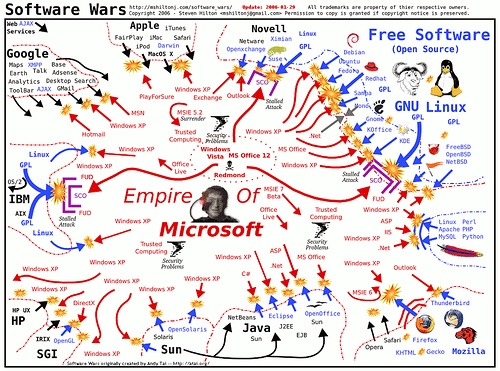
The hacker community has a very strong ethic that it’s okay to hack into computers and steal software code provided you use it to improve and share the software. Refusing to share what you have stolen and improved on for personal profit (like Bill Gates) is considered totally unethical. Making your software code public, instead of keeping it secret, allows thousands of programmers to improve on it. This why free downloadable Open Source programs always have fewer operating and security glitches than Microsoft and other proprietary software.

Netscape, Linux and Wikiwiki Web

DMOZ subsequently morphed into Netscape, which dropped out of public view after Microsoft pirated and monopolized the concept, by loading their own Microsoft Explorer on every new computer. Netscape would ultimately be reborn as Mozilla Firefox, a free Open Source browser many users prefer for its greater safety and reliability. Because the code that runs it is freely and publicly available, it undergoes continuous quality improvement by the thousands of programmers who use it.

Other significant innovations that made Wikipedia possible were the creation of the World Wide Web in 1992 by Tim Berners-Lee and the creation of Wikiwiki Web by Ward Cunningham in 1994. Prior to 1992, there were a half dozen different protocols (including Gopher and WAIS) that had to be laboriously typed in to access documents posted on the Internet. Berners-Lee created a Uniform Resource Locator (URL), using a Hypertext Transfer Protocol (http) for finding on-line documents. Cunningham’s Wiki software enabled any user anywhere to edit any website without having specialized software or knowledge of programming or html (the language used to construct a web page).

The Birth of Wikipedia

In 2000, Y2K enthusiast Larry Sanger joined BOMIS, bringing a large number of followers from his on-line Y2K digest. The Y2K movement was an informal network of programmers and community activists formed to rectify the widespread use, in early computers, of two digit dates. There was legitimate concern that computers built before 1990 would be unable to distinguish whether “00″ represented the year 1900 or the year 2000 – and crash. Disaster was averted, thanks to the frantic rewriting (in 1998 and 1999) of millions of lines of code in government and corporate computers.

After Sanger joined BOMIS, one of their first projects was an on-line encyclopedia-style “blog” called Nupedia. Wales, Shell and Sanger drew in friends and on-line acquaintances to help with drafting and editing articles.

Wiki Protocol

The initial process of editing successive on-line drafts was extremely slow and cumbersome. BOMIS’s discovery of Cunningham’s Wiki protocol changed all this, enabling first hundreds, then thousands and eventually hundreds of thousands of computer users anywhere to post and edit articles Wales, Shell and Sanger registered Wikipedia Foundation as a non-profit organization in January 2001 The only rules were that Wikipedia had to be freely accessible to the public, have a Neutral Point of View (NPOV), and only describe existing research (original research is forbidden).

In the beginning detractors predicted that allowing thousands of strangers to post and edit articles would lead to total anarchy. According to Lih, order is maintained by hundreds of volunteer administrators and System Operators who are passionate about the concept of maintaining Wikipedia as a free and open encyclopedia.

Other critics periodically express concern about the CIA and various public officials rewriting Wikipedia entries to coincide with their political interests.

Open Source and Sustainability

open source

As strange as it may sound, switching to Open Source operating systems and software can save a lot more carbon emissions than changing your lightbulbs.

I myself have switched to Firefox (instead of Microsoft Explorer) and Open Office (instead of Microscoft Word) and plan to download Linux soon to replace Windows. As a community organizer for 30+ years, Microsoft has been the bane of my existence. Most of the activists I work with use MS Word (and before that MS Works) to create documents. Predictably Microsoft has come out with a new version of Word that is unreadable by older versions. Clearly this is a calculated maneuver to force customers to continually purchase new upgrades.

Opening Pesky Docx Files

This time, however, I followed the advice of a fellow Green Party member and downloaded Open Office, provided free by Sun Microsystems Open Source software. Thanks to the Open Source movement, every time Microsoft comes out with a new word processing program, Open Office offers upgrades to translate the new program to either Open Office or an older version of Word. Not only does it open those pesky docx files, but it creates spreadsheets and slideshows and allows you to save graphics as either PDF or JPG files. It probably does lots of other things I haven’t discovered yet.

The other great thing about Open Office is that, like other Open Source software, it runs faster than Microsoft programs, crashes less and is less much likely to have security problems. This is because Sun Microsystems makes Open Office code freely available for other programmers to improve and build on. Computers aren’t like soup. By involving more people in creating code, you make it far more likely someone will find all the bugs and security problems.

Download Open Office Free at https://www.openoffice.org/

New Zealand residents have their own Open Office site: http://www.openoffice.org.nz/

How Open Source Reduces Carbon Emissions

So, people ask me, how does this reduce carbon emissions? There are obviously small energy savings (related to DVD production, packaging, transportation, etc) when an individual downloads software instead of buying it off the shelf. However the big emissions savings occur when large companies that maintain vast amounts of data switch to Open Source. Recently the Bank of New Zealand vastly reduced their energy costs and carbon emissions by converting their front end systems to Open Source.

They save money and energy by  speeding up and simplifying their data processes with a single (Red Hat Linux) program, instead of relying on three or four programs for different functions.

Companies Going Open Source

In response to the global recession, the immense cost savings is leading many government agencies and Fortune 500 companies to switch to Open Source for part or all of their data processing. The best known are BART (Bay Area Transit System), Burlington Coats, CISCO, Conoco, the Mobil Travel Guide (Exxon’s consumer website), Royal Dutch Shell, Panasonic, Hilfiger, Toyota Motor Sales USA, US Army, US federal courts, the Pentagon, the Department of Homeland Security and the US Post Office.

Countries Going Open Source

Third world countries are also benefiting from Open Source cost savings. Brazil was the  first to mandate Open Soft systems for all their government offices.  In 2013, 16 third world countries (Nigeria, Uganda, Tanzania, India, Kenya, Guatemala, Botswana, Rwanda, Togo, Lesotho, Mali, Ghana, Namibia and Chad) saved over $100 million dollars by installing Open Soft software to track their health care workforce.

Open Source Design: Reclaiming the Commons

Engineers, architects and climate change activists in the Open Sustainability movement are expanding Open Source Design beyond its computer applications to ensure the rapid spread of ideas and technologies that reduce energy use and carbon emissions.

Examples include

    1. Open Source green architecture and renewable energy technologies
    2. The Creative Commons – a nonprofit California organization devoted to expanding the range of inventions and creative works available for others to share and build on.
    3. Singularity University – “a grand scheme to assemble, educate and inspire a cadre of leaders who strive to understand and facilitate the development of exponentially advancing technologies to address Humanity’s Grand Challenges.”
    4. Public Library of Science – a nonprofit open access scientific publishing project aimed at creating a library of open access journals, with the eventual goal of making all scientific medical research freely available to the public.
    5. Wikipedia – a free open source encyclopedia (which I discuss in my next post).

photo credit: guccio@文房具社 via photopin cc

Reclaiming Our Streets: A Model for Social Change

mental speed bumps

Mental Speed Bumps: A Smarter Way to Tame Traffic.

by David Engwicht, Envirobook 2005

Book Review

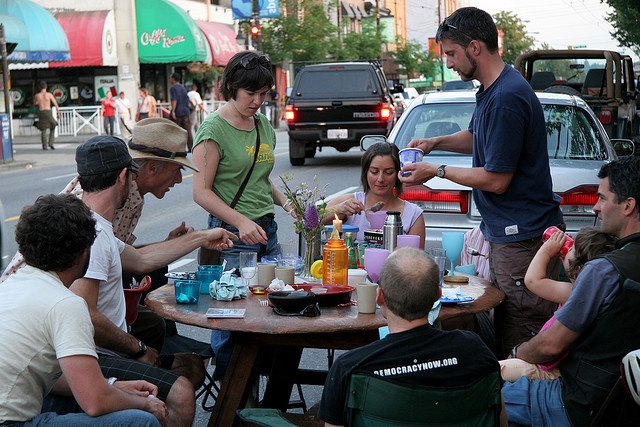
David Engwicht is an Australian social inventor who consults internationally with town planners and social engineers about traffic calming measures. Mental Speed Bumps describes a revolutionary bottom-up approach to traffic calming called “street reclaiming.” The main focus of street reclaiming is to reclaim city streets for people instead of motor vehicles.

Because of their immediate change effect, street reclaiming activities are extremely effective for inspiring optimism about political change. As well as helping to repair broken social networks, they encourage ordinary citizens to see themselves as change agents, rather than waiting for indifferent and/or corrupt political leaders to make changes on their behalf.

As Engwicht points out, most people tend to blame someone else – either city officials – or drivers from other neighborhoods – for their traffic problems. However on closer scrutiny, they usually discover that they and their neighbors are responsible for about one third of the traffic on their street.

The “Living Room” Analogy

Based on working with neighborhood activists all over the world, Engwicht recommends street reclaimers follow five basic steps:

1. Reclaim your street as a socializing space
  • Move some of your normal activities closer to the street (e.g. reading your book in your front yard or on the sidewalk – working on painting, refinishing, and other do-it-yourself projects in your parking space instead of your garage or basement).
  • Supervise children playing on the sidewalk or in the roadway.
  • Walk your kids to school
  • Walk to local destinations and greet people you encounter.
  • Hold a street party.
2. Move more slowly and gently
  • Reduce your own car use to a minimum.
  • If you must drive, do it more slowly and casually.
  • Teach your kids to walk or cycle to school.
3. Intrigue travelers by engaging them in the social life of the street.
  • Wave to motorists.
  • Put something intriguing, such as a veggie garden, in your front yard or parking strip
  • Blur the boundary between your private home and the street (e.g. take down your front fence and curtains). This is common in many European communities to maintain the street as a social space.
4. Work with neighbors to create “Linger Nodes” to facilitate social life in your street.
  • Create a socializing node on your private land (seating, drinking fountain community notice board, sculpture, etc) or on the sidewalk.
  • Encourage local businesses to connect with the street by placing an activity outside their premises.
5. Evolve your street from a "corridor" into a "room."
  • Put “furniture” and “art” in your room.
  • Work with your city on design elements that make your street feel more like a room (for example a landscaped entryway, a ceiling made of flags or banners, and walls created from furniture or art).

Examples of street reclaiming activities:

parking meter party

Vancouver parking meter party

Above: Parking meter party (Vancouver)

photo credit: Andrew Curran via photopin cc

Below: Walking school bus (Montreal)

photo credit: Dylan Passmore via photopin cc

walking school bus

More free traffic taming information and materials available from Creative Communities

***

read an ebook week

In celebration of read an ebook week, there are special offers on all my ebooks (in all formats) this week: they are free.

This includes my new novel A Rebel Comes of Age and my memoir The Most Revolutionary Act: Memoir of an American Refugee

Offer ends Sat. Mar 8.

The Failure of Nonviolence

failure of nonviolence

The Failure of Nonviolence: From the Arab Spring to Occupy

 By Peter Gelderloos (2013 Left Bank Books)

Book Review

You occasionally read a totally mind bending book that opens up a whole new world for you. The Failure of Nonviolence by Peter Gelderloos is one of them, owing to its unique evidence-based perspective on both “nonviolent” and “violent” resistance. It differs from Gelderloos’s 2007 How Nonviolence Protects the State in its heavy emphasis on indigenous, minority, and working class resistance. A major feature of the new book is an extensive catalog of “combative” rebellions that the corporate elite has whitewashed out of history.

Owing to wide disagreement as to its meaning, Gelderloos discards the term “violent” in describing actions that involve rioting, sabotage, property damage or self-defense against armed police or military. In comparing and contrasting a list of recent protest actions, he makes a convincing case that combative tactics are far more effective in achieving concrete gains that improve ordinary peoples’ lives. He also explodes the myth that “violent” resistance discourages oppressed people from participating in protest activity. He gives numerous examples showing that working people are far more likely to be drawn into combative actions – mainly because of their effectiveness. The only people alienated by combative tactics are educated liberals, many of whom are “career” activists working for foundation-funded nonprofits.

Gelderloos also highlights countries (e.g., Greece and Spain) which have significantly slowed the advance of neoliberal capitalism via combative resistance. In his view, this explains the negative fiscal position of the Greek and Spanish capitalist class in addressing the global debt crisis. Strong worker resistance to punitive labor reforms and austerity cuts has significantly slowed the transfer of wealth to their corporate elite, as well as the roll-out of fascist security measures.

The Gene Sharp Brand of Nonviolence

Gelderloos begins by defining the term “nonviolent” as the formulaic approach laid out by nonviolent guru Gene Sharp in his 1994 From Dictatorship to Democracy and used extensively in the “color revolutions” in Eastern Europe and elsewhere. This approach focuses exclusively on political, usually electoral, reform. Gelderloos distinguishes between political revolution, which merely overturns the current political infrastructure and replaces it with a new one – and social revolution, which overturns hierarchical political infrastructure and replaces it with a system in which people self-organize and govern themselves.

The nonviolent approach Sharp and his followers prescribe relies heavily on a corporate media strategy to promote their protest activity to large numbers of people. This obviously requires some elite support, as the corporate media consistently ignores genuine anti-corporate protests. As an example, all the nonviolent color revolutions in Eastern Europe enjoyed major support from the State Department, billionaire George Soros and CIA-funded foundations such as the National Endowment for Democracy and the National Republican Institute.

Is Nonviolence Effective?

Gelderloos sets out four criteria to assess the effectiveness of a protest action:

  1. It must seize space for activists to self-organize essential aspects of their lives.
  2. It must spread new ideas that inspire others to resist state power and control.
  3. It must operate independently of elite support.
  4. It must make concrete improvements to the lives of ordinary people.

As examples of strictly nonviolent protest movements, Gelderloos offers the “color” revolutions (see 1 below), the millions-strong global anti-Iraq war protest on February 15, 2003 and 2011 Occupy protests, which were almost exclusively nonviolent (Occupy Oakland being a notable exception).

In all the color revolutions Gelderloos describes, the goal has been strictly limited to replacing dictatorship with democracy and free elections. None attempted to increase economic democracy nor to reduce oppressive work and living conditions. In fact, most of the color revolutions forced their populations to give up important protections to integrate more thoroughly into the cutthroat capitalist economy.

So-called “democracies” such as the US are just as capable as dictatorships of engaging in extrajudicial assassination, torture, and suspension of habeas corpus and other legal protections. However US corporations generally find “democracies” more investment-friendly. Owing to greater transparency, they are less likely to nationalize private industries or arbitrarily change the rules for doing business.

Besides failing to meet any of his criteria, the 2003 anti-Iraq war movement failed to stop the US invasion of Iraq and the 2011 Occupy protests failed to achieve a single lasting gain.

Successful “Combative” Protests

He contrasts these strictly nonviolent  protests with nearly 20 popular uprisings (see 2 below) and two (successful) US prison riots that have incorporated “combative” tactics along with other organizing strategies. Most have been totally censored from the corporate media and history books or whitewashed as so-called “nonviolent” actions (e.g., the corporate media misportrayed both the 1989 Tiananmen Square rebellion and the 2011 Egyptian revolution as nonviolent protests).

The US, more than any other country, uses prison to suppress working class dissent. Most prison struggles employ a diversity of tactics combining work stoppages and legal appeals with property damage, riots and attacks on guards. Nonviolent protest tends to be particularly ineffective in the prison setting. A nonviolent hunger strike usually reflects a situation in which prisoners have so little personal control that the only way to resist is to refuse to eat.

Gelderloos also analyzes a number of historical combative uprisings, pointing out their relative strengths and weaknesses. He devotes particular attention to the Spanish Civil War (a failed working class revolution), the anti-Nazi partisan movements during World War II, combative Indigenous peoples resistance to European colonizers and autonomous liberated zones created in Ukraine, Kronstadt, and Siberia following the Bolshevik Revolution and in the Skinmin Province of Manchuria in pre-World War II China.

Who Are the Pacifists?

He devotes an entire chapter to the major funders and luminaries of the nonviolent movement. Predictably most of the funding comes from George Soros, the Pentagon, the State Department and CIA-funded foundations such as USAID, NED, and NIR. Among other examples, Gelderloos describes the Pentagon running a multi-million dollar campaign to plant stories in Iraqi newspapers to promote “nonviolent” resistance to US occupation.

___________________________________________________________________________________________________

1. Examples of political/regime change color revolutions:
  • Philippines – Yellow Revolution 1983-86
  • Serbia – Bulldozer Revolution 2000
  • Georgia – Rose Revolution 2003
  • Ukraine – Orange Revolution 2004
  • Kyrgyzstan – Tulip Revolution 2005
  • Lebanon – Cedar Revolution 2005
  • Kuwait – Blue Revolution 2005
  • Burma – Saffron Revolution 2007
2. Examples of combative uprisings:
  • 1999 Battle of Seattle – contrary to media whitewashing (I was there), the combative component wasn’t a matter of a few Black Bloc anarchists breaking windows. Numerous “peaceful” marchers joined in destruction of corporate storefronts, looting and throwing rocks at police. Inspired 3rd world WTO delegates to shut down Doha round of WTO negotiations.
  • 1990 Oka Crisis (near Montreal) – in which Mohawk warriors took up arms to stop a golf course expansion on their lands. Successful in defeating the golf course expansion.
  • 1994 Zapitista (Mexico) – armed uprising against NAFTA. Successfully seized space, liberating numerous villages which continue to be run by popular assemblies.
  • 2000 2nd Palestinian Intifada – successful in seizing and defending space, defeating the CIA/Israeli army invasion of Gaza in 2009. Inspired combative insurrections in Tunisia and Egypt.
  • 2001 Kabbylie Black Spring armed protest to liberate Berber territory occupied by Algeria. Successfully seized space to bring back traditional assemblies and reverse erosion of Berber culture. Won increased autonomy of Kabylie, including official recognition of Berber language.
  • 2003-2005 Bolivia Water and Gas Wars against strict water privatization implemented by Bolivian government and Bechtel. Successful in ending years of Bolivian dictatorship, slowing advance of neoliberalism and restoring indigenous autonomy. Received no elite support until 2005 union and political party support elected the movement into government, putting neoliberalism back on track.
  • 2006 Oaxaca (Mexico) Rebellion – coalition of indigenous people, teachers and workers fought police and military and ran Oaxaca by popular assembly for one month. No elite support until assembly taken over by politicians who convinced them not to fight back against the military. Greatly improved quality of life while it lasted.
  • 2006 CPE France – combative (rioting, burning cars, fighting police and occupying public buildings) uprising against new legislation allowing bosses to fire younger workers without cause. Defeated new law.
  • 2008 Athens insurrection – millions-strong armed uprising (consisting of arson attacks on banks and police stations, occupation of vacant lots and buildings to create community gardens, community centers and popular assemblies) triggered by police murder of a teenager. Besides destroying debt and tax records and providing brief period of self-governance, it inspired new cycle of anarchist activity throughout Greece.
  • 2009 Guadalupe General Strike – inspired by poor living standards, especially high cost of living combined with low wages and high unemployment. After three days of rioting, setting fire to cars and businesses and opening fire on the police, demonstrators won an increase of $200 euros per month in the lowest salaries and 19 other demands.
  • 2009 Oscar Grant riots (Oakland) – prompted by police murder of an African American named Oscar Grant. Spontaneous rioting, property damage, looting and shooting back at police. Resulted in first case in California history in which an on-duty police officer was charged with murder. Influenced Occupy Oakland to adopt a diversity of tactics that included combative resistance.
  • 2010 Tunisian revolution – contrary to corporate media white washing, this was a violent uprising in which protestors burned tires and attacked the office of the ruling party. It failed to create any new self-organized spaces. It only received elite support, which pressured Tunisians to accept a purely political solution (i.e. regime change), when local authorities failed to quell popular unrest. Economic tyranny and police abuse/violence remain unaddressed.
  • 2010 15 M Movement and General Strikes (Spain) – millions took part in general strike against austerity measures incorporating sabotage of the transportation infrastructure, blockades, looting, rioting and fighting with police. Established numerous police-free zones (which persisted for months) throughout Spain run by popular assemblies. Occupied numerous hospitals and primary care centers and established urban gardens and collective housing facilities. Prevented privatization of numerous health clinics and inspired anti-capitalist focus of Occupy movement.
  • 2011 Egyptian revolution – combative rebellion (contrary to corporate media claims that it was nonviolent). Protesters burned over 90 police stations and used clubs, rocks and Molotov cocktails to defend themselves against police and government thugs. Set up self-governing assemblies in Tahrir Square and inspired a large number of activists to remain in the streets to fight the repressive Islamic government that replaced Mubarak.
  • 2011 Libyan Civil War – began as spontaneous uprising but quickly transformed into a foreign military intervention. Gelderloos uses Libya to demonstrate why revolutions that wish to end oppressive social relations must never allow military or political revolution to assume precedence.
  • 2012 Quebec student movement – rioting, looting, property damage and fighting back against the police prompted by massive tuition hike. Provided thousands of young people direct experience of self-governing assemblies and successfully spread critiques of debt, austerity and capitalism throughout Canada. Forced government to reverse tuition hike.
  • 2013 Mapuche (indigenous nation occupied by Chile and Argentina) struggle – long history of combative resistance continues to present day. Employs both nonviolent and combative methods, including arson, sabotage against mining and logging companies and armed land occupations. In January 2013 (5th anniversary of unprosecuted police murder of Mapuche teenager) they liberated large tracts of land.

Originally published in Dissident Voice

The Role of Ideology in Inspiring Change

tvs

The space between the TV screen and the child is nothing less than sacred ground – Mr Rogers

Crossroads: Labor Pains of a New World View

Joseph Obeyon 2012

Film Review

Crossroads is an exciting and surprisingly uplifting new documentary about the role of ideology in finding solutions to the urgent global crises humankind faces in the 21st century.

In bringing an evolutionary perspective to these urgent economic and ecological crises, the film offers a uniquely optimistic view of political and social change. Featuring a broad range of scientific experts, it focuses primarily on the role of ideology in preventing or facilitating change. For the last few centuries a competitive/individualistic view of ourselves was helpful in driving the engines of development and technological progress. However increasing evidence suggests that this widely embraced ideology is no longer sustainable.

This competitive/individualist worldview is also totally at odds with the collectivist/interdependent way of life our genes have programmed us for. Scientists have discovered that people share much of the same genetic code that enables schools of fish and flocks of birds to perform complex maneuvers as if they were a single organism. Primitive peoples have preserved the ability to see themselves this way, but it has been lost to most of industrialized society.

Crossroads stresses the role of television advertising, which pressures people to consume by making them feel insecure, in perpetuating this flawed individualistic view of ourselves. Constant bombardment with psychologically sophisticated messaging is far more powerful than actual experience. Studies consistently show that people derive the most happiness from activities that connect them with other people.

The dilemma facing 21st century political and environmental activists is how to get large numbers of people to make major changes quickly. Crossroads frames this and the multiple crises humankind faces as questions to be answered, rather than problems. High levels of global unrest suggest a substantial proportion of the world’s population already knows the old answers don’t work any more. The secret to finding new answers, according to one social scientist interviewed, is to get people to answer the fundamental question of what it means to be human.

The film ends by asking whether enough of humankind can change quickly enough to save the human species. Obeyon clearly believes we can. He cites studies showing that only a critical mass of 10% of a population is necessary to bring about cataclysmic social change. The same studies reveal that below this number it appears as if no visible progress is being made.

He stresses that global political and business leaders won’t be leading the change: they have too much to gain from maintaining the status quo.

photo credit: vauvau via photopin cc

Crossposted at Daily Censored

Activism in New Zealand

Maori protest

(The last of 8 posts describing my new life in New Zealand)

For me personally, the advantages of living in New Zealand far outweigh the negatives. One of the major positives is the greater willingness of Kiwis to get involved in grassroots campaigns for political change. Give my 30+ year history of activism, this is obviously a high priority.

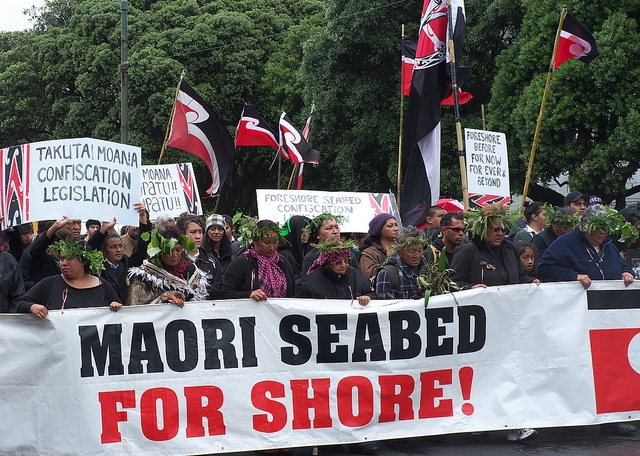
Overall, I find Kiwis to be less alienated and apathetic than their American cousins, less likely to be taken in by the corporate hype they see on TV, and more confident about their ability to bring about change through collective action. I believe this relates, in large part, to a well-organized, militant indigenous (Maori) movement. Their highly visible activism models the importance of collective struggle for other New Zealanders, in much the same way the American civil rights struggle provided a role model for the US antiwar movement, and the women’s, gay and disability rights movement.

There are also a number of institutional and social features about New Zealand society that make political organizing somewhat easier.

Institutional features:

  • New Zealand has a parliamentary democracy coupled with elections conducted via proportional representation (which Kiwis won through strenuous grassroots organizing). The New Zealand Green Party (which I joined in 2002) presently has 14 MPs in Parliament.
  • New Zealand has no illusions about being a great military empire. In my experience, it’s only after they leave that Americans fully realize how much US militarism overshadows every aspect of their life.
  • New Zealand is 100% anti-nuclear (both nuclear power and weapons), and US naval ships are banned in our ports because the US government refuses to indicate whether specific vessels are nuclear powered or carry nuclear arms. This, too, was won by sustained grassroots organizing.
  • New Zealand has no death penalty.
  • At presented, genetically engineered crops and farm animals aren’t legally permitted in New Zealand (except in the laboratory). That being said, keeping New Zealand GE-free requires constant vigilance and sustained organizing.
  • The cattle supplying New Zealand’s world famous dairy and beef export industry are grass fed (except during drought years), and no Kiwi farmer would dream of injecting them with hormones or feeding them antibiotics to stimulate growth.

Social Features:

  • New Zealand has a predominantly working class culture, owing to a misguided student loan policy which has led about one million college graduates to emigrate (mainly to Australia and the UK. Given my own working ckass background, I fit in really quickly. Americans from more middle class backgrounds seem to have more difficulty.
  • While much of the New Zealand media is foreign-owned and blatantly pro-corporate, there are still vestiges of an independent media that routinely challenges and embarrasses the government in power.
  • Kiwis are much more likely to have a civic life than their American counterparts. Here in New Plymouth (population 55,000), most of my friends belong to the Green Party or the sustainability movement. However I also have friends who belong to Lions, Rotary or one of the many sports clubs (lawn bowling, cricket, soccer, rugby) or hobby groups (stamp club, little theater, orchid society, tramping club, canoe club and four cycling groups).
  • New Zealand has a much stronger sustainability movement than the US. The late arrival of both TV and cheap Asian imports in means most Kiwis are only one generation away from growing vegetables, raising their own chickens and “making do” with jerry-rigged plumbing and home repairs and homemade cleaning and beauty products. The majority of my female friends still hang their laundry on the line, and community currencies introduced during the last recession still survive in several local communities.

photo credit: lancea via photopin cc

Britain’s Famous Anarchist Superhero

v for vendetta

I have spent the last few days enjoying the ten issue graphic novel whose superhero “V” wore a Guy Fawkes mask that Anonymous has adopted for their hactivist campaign against banks, defense contractors, the Pentagon, CIA and other US government sites, as well as PayPal, Visa and Mastercard for their close links to NSA and other intelligence entities (and their refusal to process Wikileaks donations after November 2010). Following the September 2011 launch of Occupy Wall Street, the stylized Guy Fawkes mask was widely adopted by the Occupy movement.

The V for Vendetta series, written between 1982 and 1985, was published in its entirety in 1988. The plot line is set in a future fascist state in the United Kingdom. A mysterious masked anarchist revolutionary superhero, who calls himself “V,” works to destroy the totalitarian government. Alan Moore, who is credited with coining the term “graphic novel” for sophisticated adult-oriented comics, is the author of V for Vendetta. David Lloyd is the illustrator responsible for the iconic image of their anarchist superhero.

Moore produced other critically acclaimed graphic novels. At least four were made into films From Hell (2001), The Watchmen (2009), League of Extraordinary Gentlemen (2003) and V for Vendetta (2005).

The film production of V for Vendetta involved many of the same filmmakers who worked on the Matrix trilogy. In addition to retelling the story of the original seventeenth century Guy Fawkes Gunpowder Plot (one of the first modern false flag operations), the film version includes many topical references to oppressive aspects of George W Bush’s presidency – including government surveillance, torture, media manipulation, corporate corruption and the so-called “war on terror.” It also features footage of both the war in Iraq and an anti-Iraq war demonstration, as well as references to a rabidly right wing TV network called BTN. This is believed to be a fictional version of Fox News.

It was the film version of V for Vendetta that popularized the stylized Guy Fawkes mask. According to the New York Times, it’s the number one bestselling mask on Amazon.

Although the rights to the mask belong to Time Warner, both Moore and Lloyd are pleased to see such wide use of the superhero they created in mass protests against tyranny (see Alan Moore Still Knows the Score! and V for Vendetta masks: Who).

Link to online version of V for Vendetta (the graphic novel): V for Vendetta

A Primer on Anarchism

revolt

Revolt! – The Next Great Transformation from Kleptocracy Capitalism to Libertarian Sociasm through Counter Ideology, Societal Education, and Direct Action

By Dr John Asimakopoulos (2011 Transformative Studies Institute Press)

 Book Review

The general public has a lot of misconceptions about what anarchists believe. The problem is that the word “anarchism” is used to describe a lot of different ideologies. Revolt!, a 159 page booklet directed at an academic audience, is a good introduction to some of the theoretical beliefs that underpin the anarchist movement.

The author, the executive director of the Transformative Studies Institute (TSI)* identifies himself as a “libertarian socialist.” He begins Revolt! with a detailed description of kleptocracy capitalism, the label he gives America’s corrupt, corporate-controlled political system. He goes on to outline the theoretical framework of libertarian socialism. The latter maintains that legislative reform inadequate to remove the corrupt oligarchs who have usurped America’s democratic institutions. Libertarian socialists believe the only solution is to build a working class movement to dismantle capitalism altogether.

Asimakopoulos’s formal definition of libertarian socialism is “a group of political philosophies that aspire to create a society without economic or social hierarchies, in which all violent and coercive institutions are dissolved and everyone has free and equal access to the tools of information and production.” As with other anarchist tendencies, a key goal of libertarian socialism is to eliminate all forms of government in favor of self-government and direct democracy.

The Hazards of Violent Revolution

Rebel! also expresses serious reservations about the role of violent revolution in overthrowing capitalism, for two main reasons: 1) sudden spontaneous riots lack organization and leadership and the resulting chaos can cause massive social dislocation and a cataclysmic loss of human life and 2) historically all violent revolutions (i.e. Soviet Union, China, Cuba) have led to the rise of new totalitarian regimes.

Instead it argues mainly for “evolutionary” change brought about through militant direct action that forces the ruling elite to adopt reforms that shift the balance of power towards workers. Examples of the “evolutionary” reforms Asimakopoulos envisions include universal government-funded health care, free tertiary education, and the replacement of corporate boards of directors with worker councils like they have in Germany and France.

The kind of direct action he calls for forces the corporate elite to agree to reforms by inflicting real damage on their ability to produce profits. He sees a rejuvenated labor movement, in coalition with grassroots community organizations, as spearheading these direct actions. According to Asimakopoulos, the current US labor movement has allowed itself to be co-opted by the capitalist system, with its meek acceptance of Taft Hartley Law restrictions, as well as state and federal laws outlawing strikes by public workers. For labor to regain the effectiveness it enjoyed in the 1930s, large numbers of workers need to be prepared to commit civil disobedience by holding wildcat and sympathy strikes (both illegal under Taft Hartley) and engaging in illegal public worker strikes.

Organized Lootings, Subversive Financial Activities, and Electronic Resistance

Other types of direct action he proposes include mass organized lootings (in 2008 Greek anarchists organized mass supermarket lootings and gave the food away to the poor), subversive financial activities, high stakes tax resistance, electronic resistance, and establishment of counter institutions (such as TSI) organizing for radical change. Examples of subversive financial activities include organized credit fraud, in which workers refuse to pay their mortgages and credit card and car payments. Asimakopoulos sees another role for unions helping people file for bankruptcy and organizing mass actions to keep their homes and cars from being seized. “Electronic” resistance includes hacking and denial of service attacks, similar to those carried out by Anonymous on corporate and government websites.

The Role of Violent Direct Action

Asimakopoulos advocates a cautionary approach towards violence. He believes demonstrators have an absolute right to defend themselves against police and military aggression. He also argues that violence against corporate property (looting, rock throwing, vandalism, and arson) is always more effective than nonviolent civil disobedience in pressuring the ruling elite to agree to radical change.

He offers several historical examples to make this point, including the Black Power movement of the 1960s, whose violent direct actions forced the federal government to negotiate with Dr Martin Luther King about enacting major civil rights reform.

*TSI (www.transformativestudies.org) is a fully volunteer social justice think tank managed and operated by a global team of scholar-activists and grassroots activists. Their goal is to establish a tuition-free accredited graduate school to foster interdisciplinary research that will bridge theory with activism and encourage community involvement to alleviate social problems.