The Case for Unconditional Basic Income (UBI)

Transitions for Society: Job Guarantee and Basic Income

Prosocial Progress foundation (2014)

Film Review

This 20 minute documentary attempts to address the structural unemployment that seems to have become a permanent feature of monopoly capitalism. According to the St Louis Federal Reserve, as of February 2015, only 62.8% of working age Americans have jobs – translating into a 36.2% unemployment rate. A substantial proportion of the jobless are young adults between 16 and 24. Who face more or less permanent exclusion from the economy.

The premise of the film is somewhat unusual. The filmmakers lay out the proposition that the political elite could save capitalism by enacting an unconditional basic income (UBI) for all citizens. However based on past history, they probably won’t. Instead of making the necessary reforms, they will allow human misery and social unrest to increase until the system is overthrown by popular revolt. They see a small chance one or more European countries could enact a UBI. A grassroots Swiss movement has successfully petitioned for a (binding) UBI referendum in 2016.

Martin Luther King’s Call for a UBI

Martin Luther King first called for a UBI in 1967 – in combination with a job guarantee. He maintained the US could easily afford such a program based on the massive automation-related productivity gains. He could not have predicted the financialization of the US economy that would occur in the 1970s, when Wall Street abandoned manufacturing to focus on selling financial products. Nor that this transformation would ensure that the benefits of higher productivity would accrue to the capitalist class, rather than workers.

A UBI, financed by progressive taxation, pays a fixed income to all citizens regardless of their employment or financial status. The most common argument against UBI is that it’s wrong to pay people for doing nothing. However as one interviewee points out, western governments presently pay billions in subsidies to corporations who provide no social benefit whatsoever. If we paid these subsidies to real people instead of corporations, society as a whole would gain gains by reducing the social costs of chronic unemployment and poverty.

How UBI Increases Productivity

Studies in third world countries show that guaranteeing income security causes people to increase their productivity by working more.

The most interesting section of the film describes a pilot program in Madhya Pradish India, in which all men, women and children were paid a UBI. After eighteen months, investigators found their was a clear reduction in illness (due to better nutrition and improved access to health care), a clear increase in the number of women farming their own land and a significant increase in school attendance.


Beating Wall Street at their Own Game

The People’s Hedge Fund

Robin Hood Minor Asset Management Cooperative (http://www.robinhoodcoop.org/), the first cooperatively owned hedge fund, is another novel method of funding political activism. Unlike Enric Duran’s act of “financial civil disobedience” (see Spain’s Modern Day Robin Hood), it’s totally legal.

Founded in Finland in 2012, the main purpose of the Robin Hood Co-op is to use experimental investment technologies to expand the commons and public domain, while offering ordinary people access to income outside of paid work. Among its founding members are several former economics professors from Aalto University (who were fired for starting the Robin Hood Co-op). The co-op presently has over 350 members from 15 different countries and is valued at roughly half a million euros.

Like a hedge fund, the fund’s growth is based on the principle of producing new financial assets by hedging existing ones. Fund managers employ a data mining algorithm called “Parasite,” which follows all the transactions of the US stock markets, identifies the spreads and the star investors and follows their “swarming.” In other words, Parasite is designed to imitate the emerging consensus actions of the world’s best investors.

In the nearly three years since its formation, it has consistently kept pace with the S&P index. In its first year the value of its portfolio rose 30.75%. In the second year, it rose another 9.4%. Since June 2014 it seems to be performing slightly under the S&P index. Profits are primarily used to fund anti-corporate projects that expand the commons or public domain.

Microsoft Word - Robin Report 20150213.doc

How to Join

To join the cooperative, people need to buy one share (30 euros) and pay a onetime membership fee (30 euros). They can buy as many additional shares as they want at any point.

Every member has one vote independent of the numbers of shares they own. They use it to vote in on-line member meetings, where important co-op issues are decided. They can also suggest Robin Hood Projects, become part of the selection board and participate in the work of the cooperative. For examples of proposed projects for to 2015 go to Projects.

When new members buy shares, they are given six options for how they want their net profits (profit minus co-op’s costs) between themselves Robin Hood Projects. If they choose to keep more than 50% of the profit, there is a onetime fee.

Once a month, the new money invested in shares is exchanged for dollars and sent to the co-op’s broker, Interactive Brokers, in New York. This creates a new series, which is invested based on information from the Parasite algorithm. Thus, the performance of the investment fund depends both on the euro/dollar exchange rate fluctuations and the success of the co-op’s investment portfolio on the stock exchange.

Robin Hood Co-op is a “slow” investment organization. Thus people must notify the co-op management if they wish to sell their shares. The actual value of each share is calculated after the end of the fiscal year (end of June) when costs of the co-operative are deducted from them. Finnish law allows them to transfer monies from sold shares six months after the end of the fiscal year. People can also sell their shares to other members.

Avoiding Outrageous Bank Fees

The co-op website is set up to use Transferwise, a low cost non-bank method of overseas money transfer. In countries (like Australia and New Zealand) that aren’t set up yet for Transferwise, Robin Hood Co-op encourages members to avoid exorbitant bank charges by paying their membership fee and buying shares in bitcoins (BTC).

I paid my 60 euros by exchanging $NZ 97for 0.27248653 BTC at Coined (a New Zealand bitcoin exchange) and using Coinbase to transfer the bitcoins to Robin Hood Co-op.

The Obsolete “Means of Production” Narrative

Below is Max Keiser’s interview with Daniel Hassan about Robin Hood Co-op (starts at 11:42). In it they discuss how the leftist “means of production” narrative is obsolete in a global economy where most wealth is produced via financial transactions. They also discuss how the Parasite algorithm works and how they choose activist projects to support with their profits.


*Bitcoins are a type of digital currency which operate independently of any central bank and in which encryption techniques are used to regulate the generation of units of currency and verify the transfer of funds.

**Kiwibank is a full service commercial banked owned and operated by the New Zealand government.

Also posted at Veterans Today

Spain’s Modern Day Robin Hood

Come Back: A Story We Wrote Together

Radi.ms (2014)

Film Review

Come Back describes how a coalition of Spanish activists used 492,000 euros expropriated from 39 banks to build a large anti-capitalist coalition that would form the basis for the Los Indignados occupation in 2011. The latter would inspire the international Occupy movement in September and October 2011.

Enric Duran, the individual responsible for the 492,000 euros in unpaid bank and credit card loans, first began planning his “financial civil disobedience” in 2002. The funds were used to finance a network of anarchist collectives and cooperatives which coalesced as the Catalan Integral Cooperative (CIC) in 2010. The CIC’s objective is to generate a self-managed free society outside the law, state control and the rules of the capitalist market. Over the past five years, the CIC has allowed member collectives to progressively construct practices that move them away from the capitalist system towards the world they want to live in.

Creating the Finance Network for Social Projects

In 2005, when Duran began his aggressively borrowing, he and others formed the Finance Network for Social Projects, which allowed self-organized collectives to bid for funding for their local projects through a centralized website. One project highlighted in the film was the 2006 Anti-Growth March. More a tour than a march, the project traveled to more than 20 communities throughout Spain, promoting the development local farming cooperatives, self-organized clinics and schools and other alternatives to capitalism.

The direct outcome of the Anti-Growth March was the Cooperative for Local Assemblies, a network linking local initiatives. In 2010, this would morph into the CIC.

The latter, involving roughly four to five thousand participants, is made up of 300 productive projects, 30 local nodes and econetworks, 15 or so communal living projects and 1700 collectives. CIC governance involves general assemblies and is based on a decentralized direct democracy model that supports the self-governance of autonomous projects.

Political Goals of CIC

Rather than trying to destroy the state, the goal of the CIC is to practice civil disobedience in ways that are consistent with the self-organizing projects their collectives are trying to build. According to a 2014 interview with Duran (see Spanish Robin Hood Enric Duran on Capitalism and Integral Revolution), any action they take towards pressuring the state will be strategically chosen to protect constructive projects and the people involved in them or to generate consciousness and vision among people and groups involved in the change-making process.

Some examples of CIC projects include

• Development and promotion of approximately twenty community currencies, in addition to the Local Exchange Trading System (LETS), a mutual credit network that operates on South African CES software.
• Local food pantries linked to the Catalan Provisioning Centre.
• Activist-run health clinics, schools and housing cooperatives.
• Radi.ms, a digital collective focused on promoting the creation of self-organized co-ops worldwide.

Duran’s Legal Status

On September 17, 2008, in the midst of the global banking collapse, the network (which would become the CIC in 2010), made public, through their own CRISIS newspaper, that Duran had distributed 492,000 in bank loans to Spanish anti-capitalist groups. In March 2009, he was arrested, as six of the 39 banks had laid charges against him. He spent two months in prison before being released on 50,000 euros bail. Although he gone underground, he continues to be an active participant in the CIC.

https://vimeo.com/89454294

Nestle Enjoys Unlimited Water Despite Sacramento Drought

california drought

The city of Sacramento, in their fourth year of severe drought, continues to allow the Nestle water bottling plant to draw unlimited (estimated at up to 80 million gallons a year) from local aquifers. Meanwhile according to IndyMedia reporter Dan Bacher (Nestle Continues Stealing World’s Water During Drought), Sacramento residents have been slapped with drastic water restrictions.

On March 12, Jay Farniglietti, senior water scientist at the NASA Jet Propulsion laboratory/Caltech, wrote in the LA Times that California has only one year of water left in its reservoirs – while the state’s backup supply, their groundwater aquifers are rapidly depleting.

The city charges Nestle the residential rate, 65 cents, for each 470 gallons it takes. The company then rakes in record profits by selling the water back to Sacramento residents for close to five dollars a gallon.

Under brand names such as Perrier and San Pellegrino, Nestle is currently the world’s largest bottled water supplier. They are notorious for denying that water is a human right at the 2000 World Water Forum

The Crunch Nestle Alliance, a coalition of environmentalists, Native Americans and other activists, is demanding that the city charge Nestle commercial rates for their water or tax their profits. Or better still that Nestle voluntarily shut down their Sacramento bottling plant.

Bacher’s article also notes that Governor Jerry Brown seeks to further limit Sacramentans access to water by fast tracking his Bay Delta Conservation Plan (BDCP). This would involve construction of peripheral tunnels to ship Sacramento River water to corporate agrobusiness, Southern California water agencies and oil companies that require massive amounts of water for fracking operations. If it goes forward, the BDCP would force vast tracts of Sacramento Delta farmland out of production for the benefit San Joaquin Valley factory farms and the fracking industry.

In the video below Nestle’s CEO Peter Brabeck explains why he believes water should be privatized – after forcefully arguing for Europe to remove their ban on genetically modified foods.

The Crunch Nestle Alliance, which doesn’t have a website, can be contacted through Andy Conn at camphgr55@gmail.com.

photo credit: CalPERS and the Drought via photopin (license)

Health Benefits of Time Banks

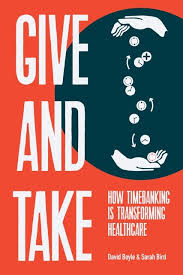
give and take

Give and Take: How Timebanking is Transforming Health Care

by David Boyle and Sarah Bird (Timebanking UK 2014)

Book Review

Give and Take summarizes a remarkable 2012-13 study by Timebanking UK, in which time banks were incorporated into GP practices to address unmet needs of patients over 65-year olds.

The project was the brain child of Timebanking UK coordinator Susan Ross-Turner and incorporated the work of John McKnight, founder of the Asset-Based Community Development Institute in Chicago. Ross-Turner saw it as an innovative solution to an overburdened health and social service sector struggling to serve a burgeoning elderly population.

High unemployment and lower wages – combined with high prices for food and energy – are really bad news for local economies. Residents want and need products and services local merchants have to offer but no money to pay for them.

A complementary currency is an alternative form of money used alongside an official or national currency. New Plymouth has had a complementary currency called the “talent” since the mid nineties. It was created by a group of retired and disabled residents to swap home grown veggies, soap, preserves, hand knit sweaters and second hand clothes books, books and household items.

A time bank is used to trade services rather than products. Through the Taranaki Time Bank, I can earn an hour credit for weeding someone’s garden. I can then use that credit to get my law mowed or the washers replaced in my sink.

Besides affording the cash-poor a new avenue to meet basic needs, forming a time bank is also very effective way of rebuilding communities that have been fragmented by globalization and corporatization.

Cooperation and mutual interdependence are fundamental to any healthy society. Time banks help move us in that direction. They encourage us to rely on one another for basic needs, rather than experts and technology.

The Timebanking UK Experiment

A total of 92 GP practices joined Ross-Turner’s timebanking project. They enrolled 1660 patients over 65 in time banking activities. They would participate in over 29,000 exchanges.

In one area, GPs wrote prescriptions for home visits by fellow patients instead of medication. Unsurprisingly both patients derived health benefits from the exchange. Other research confirms that the ability to a make meaningful social contribution is the single most important factor in elderly mortality rates. In one study, people over seventy who volunteered 1,000 or more hours a year were one-third less likely to die and two-thirds less likely to report bad health.

In another district, the time bank operated a health self-help telephone service. Time bank volunteers staffed the service using an assessment designed by clinicians.

One rural health scheme automatically enrolled every hospitalized patient over 65 in a time bank at the time of discharge.

Other health-related time bank services offer included prostate cancer group meetings, pilates classes, tai chi classes, aquafit classes, sewing groups and a “keep history alive” group.

Study findings:

  • Time bank involvement led to a significant decrease in depression, social isolation, hospitalizations and ER visits.
  • Time bank involvement enabled participants to remain in their own homes longer and postpone the need for nursing home care.
  • Time banks were an excellent way to attract people who don’t normally volunteer.


Joining a Time Bank

I have just joined the Taranaki Time Bank here in New Plymouth.

People can find a time bank in their own area through the following links:

Time Banking UK http://www.timebanking.org/

TimeBanks USA http://timebanks.org/

Time Bank Australia http://www.timebanking.com.au/

Time Bank Aotearoa New Zealand http://www.timebank.org.nz/

Unemployed? Broke? How to Start a Co-op

Own the Change: Building Economic Democracy One Worker at a Time

GritTV (2015)

Film Review

Own the Change is a documentary about how to start a worker cooperative. The inability of the global economy to provide a living wage for millions of Americans has prompted a surge in the formation of cooperatives, where workers own and run their own business and share equally in the profits. I expect this will be an extremely inspiring film for people of any age who are unemployed or earning a wage that is too low to survive on. The biggest problem in starting a coop, as with any small business is start-up funding. Most new coops rely on individual members’ savings for capital, as major banks no longer offer small business loans. Members with no upfront cash can contribute their buy-in as a payroll deduction. Sometimes new coops can access grants and low interest loans from non-profit groups and government agencies. Crowdsourcing* is another increasingly common option. The second most difficult aspect of coop formation is learning to make decisions collectively. Democracy is a foreign concept to most people. Many are more comfortable with someone in authority telling them what to do. It takes practice to learn how to make decisions by consensus. As one coop member explains in the film, a good coop uses horizontal (equal) decision making at the board level to make basic operating decisions. Vertical decision making works better in the field, where people with technical knowledge and skill need to be in charge of how the work product is delivered. The most inspiring coop depicted in the documentary is a Bellingham Washington cooperative started by caregivers fed up with their extremely low pay and lack of input into working conditions. For people thinking of starting a coop, the best place to start is the US Federation of Worker Cooperatives, a national grassroots organization for worker cooperative businesses. Their website is a fantastic source of legal and business advice, including funding options: https://www.usworker.coop/ *Crowdsourcing is the process of obtaining needed services, ideas, or content by soliciting contributions from a large group of people, and especially from an online community, rather than from traditional employees or suppliers. https://www.youtube.com/watch?v=8G1-SYMatNc

Seattle’s New Youth Movement

For Martin Luther King day, the Garfield High School Black Student Union held a panel discussion on Seattle’s burgeoning Black Lives Matter movement. In their first major protest, thousands of Seattle students walked out of their high schools when the grand jury failed to indict Darren Wilson for killing unarmed black teenager Michael Brown.

The keynote speaker is John Carlos. Carlos is the former track and field athlete whose Black Power salute (along with Tommie Smith’s) during the 1968 Olympics caused massive international controversy.

Pirate Bay, Wikileaks and the Swedish Pirate Party

TPB AFK: The Pirate Bay Away from Keyword

Simon Klose (2013)

Film Review

This film’s title comes from hacker jargon – AFK (away from keyboard) means “in real life,” as opposed to “virtual.” It’s about the Swedish trial of the world’s largest file sharing site. In 2009 when the Swedish government shut them down (for the first time), TPB controlled half of all the BitTorrent* traffic internationally. The film’s main them concerns the clash of values between a younger generation adamant about Internet freedom and an older generation fixated on dominance and control and toadying to US interests.

The Birth of the Pirate Party

The four defendants in this case had immense support from Swedish youth. The Pirate Party organized numerous demonstrations and rallies in their support. Following their guilty verdict, the Pirate Party gained 10,000 new members and ultimate won two seats in the Swedish parliament.

Activists? Or Common Thieves?

Although the prosecution and judge (who just happened to be a member of the industry group the Swedish Association of Copyright) portrayed TPB defendants as common thieves, the filmmakers portray them more as Internet freedom activists. They talk about being inspired to start TPB (in 2003) after the music industry sued Napster** and shut them down and Big Pharma sued South Africa for prescribing generic antiviral drugs for AIDS patients.

One of the four defendants also started the “America’s Dumbest Soldiers” website around the same time. The site asked visitors to rate the intelligence of GI’s killed in the US occupation of Iraq. The Bush administration demanded the Swedish government shut their server down. Site administrators mounted fierce resistance. Until the whole thing became too much of a hassle and they started using the server for TPB instead.

In their defense, TPB argued their website merely providing a blank page – that the users who created the content were ultimately responsible for illegally downloading copyrighted material. They also argued that the purpose of copyright was to reward artistic creative, not to allow powerful record and motion picture companies to become filthy rich by locking up large numbers of copyrights.

TPB’s crusading spirit is clearly evident from their determination to restore the site after the Swedish government shut it down. The Pirate Party would ultimately provide servers for TPB and for Wikileaks when they came under attack from the Obama administration.

No Financial Motive Established

Although the prosecution claimed that TPB generated more than $1 million annually from ad revenue, they couldn’t produce bank records to prove this. Actual TPB revenue (from four ads) seems to have been closer to $100,000. This possibly explains the light sentences TPB defendants ultimately received.


*In the BitTorrent file distribution system, a torrent file is a computer file that contains metadata about files and folders to be distributed, as well as a list of the network locations of “trackers,” computers that help participants in the system find each other.
**Napster was a pioneering peer-to-peer file sharing service devoted to sharing audio files, typically music, encoded in MP3 format. The original company ran into legal difficulties over copyright infringement, ceased operations and subsequently became an online music store.

Tor 101: Protecting Yourself Against Internet Surveillance

Inside the Dark Web

BBC (2014)

Film Review

Inside the Dark Web is about Tor, a technology that prevents government and corporations from spying on us when we use the Internet.

The World Web has been described as the world’s best tracking device, thanks to the wealth of information it provides about our daily activities. Many families have computerized home appliances that are connected via the Internet (referred to as the Internet of Things). This enables coffee makers, furnaces, coffee makers, etc to turn themselves on and off automatically when we wake up or enter or leave the house. These set-ups allow private companies to collect and store vast amounts of information about our personal lives.

Government and Corporations Are Building Dossiers on Us

No one realized how much Internet data NSA and their British counterpart GCHQ were collecting until Edward Snowden began leaking documents about it in 2013. Private technology companies compile even more detailed documentation (which they regularly turn over to NSA and GCHQ about our Internet activities). Every time we browse, they build detailed dossiers about our reading and browsing habits and sell them to multiple advertisers. For example, if a young woman Googles for pregnancy related information, within hours, she will be bombarded with pregnancy and childbirth ads.

The Onion Router

Tor, which stands for The Onion Router, was develop by the US Naval Research Laboratory in the 1990s for the purpose of protecting online intelligence communications. It combines three layers of encryption with three relay computers belonging to Tor volunteers. Each relay computer removes a layer of encryption and passes the original signal to the intended recipient without revealing the original user.

In 2004, the Navy released the code for Tor under a free licence, and the Electronic Frontier Foundation (EFF) began funding its continued development. The State Department actively encouraged its usage by anti-Assad activists in Syria and various Arab spring organizers. The US government is less happy about American dissidents using Tor to expose his criminal activities. Whistleblowers used Tor to leak documents to Wikileaks and Snowden used it to leak confidential files.

Silk Road

The term “dark web” refers to criminal enterprises that use Tor to escape detection by government authorities. The most notorious is Silk Road, a website that connected anonymous illicit drug dealers and buyers. Purchases were paid for in bitcoins, a virtual currency created by computer algorithm as opposed to a bank. Like cash, bitcoins are totally untraceable because the users are anonymous.

On Silk Road, people responded to a drug offer by depositing the specified amount of bitcoins in an escrow account. Once they notified the Silk Road administrators they had received the drugs, the bitcoins held in escrow were released to the seller.

In 2013 the FBI temporarily shut down Silk Road by arresting its anonymous founder Ross Ulbricht (aka Dread Pirate Roberts), a Texas investment advisor. Ulbricht has just recently been convicted of conspiring to sell narcotics, hacking and counterfeiting documents. You can read all about the trial on Wired

Criminal enterprises also use Tor and bitcoins for other illegal activities, such as websites that sell guns, stolen credit card details and the sexual services of children.

To download free Tor software go to: https://www.torproject.org/

A Suspense Thriller About Hacking

Algorithm: the Hacker Movie

By Jonathan Schiefer (2014)

Film Review

From the title, I mistakenly assumed this film was a documentary. It’s actually an extremely well made thriller about a group of hackers who are kidnapped and tortured by Homeland Security.

The film noir style is vaguely reminiscent of The Girl with the Dragon Tattoo. Algorithm is the better film in my view.

Besides making an important existential statement about the brutal thuggishness of the US security state, it’s also a good introduction for novice hackers to TOR (a protocol developed by Naval Intelligence that prevents the hack from being traced), the “can of worm” (the hardware patch used to break into a computer network), “port knocking” and “black rooms” (where you cover the walls with tinfoil to exclude wi-fi signals).

The easiest way to break into a computer network is to cut the power and install the hack while the system reboots. This is because the firewall always loads last.

I also learned some interesting new torture techniques.