Money for Free is about Unconditional Basic Income (aka Universal Basic Income), a form of social security system in which all residents of a country, city or region receive an unconditional sum of money in addition to any other income they receive.
The documentary profiles Michael Bohmeyer, a German web developer who crowd funded a UBI (German residents can apply for it through his website), New York venture capitalist Albert Wenger (who helped fund Bohmeyer’s UBI), and British economist Guy Standing. Standing has conducted UBI experiments in India and Namibia.
All three see a strong need for UBI in a globally economy that is rapidly shedding jobs and leaving millions of young people permanently unemployed.
At present Bohmeyer has raised 12,000 euros, which means eight people (chosen by lottery) receive his UBI.
Most opponents of UBI claim it will destroy people’s motivation to work. Standing’s experiments in India and Namibia show just the opposite. People who received a UBI in his pilot program increased their economic activity and eared income (as a result of improved nutrition and health).
The filmmakers also interview Alaska residents who receive a guaranteed income from a resource tax on the state’s oil industry.
France, Netherlands and Finland all have basic income pilot schemes in the pipeline. Switzerland will hold a referendum on UBI later this year.
“I’d rather have roses at my table than diamonds on my neck.” Emma Goldman
Roses on My Table is a short documentary about daily life in a Richmond Virginia anarchist collective called Wingnut. It was produced in response to a statement by Virginia State Senate Majority Leader Tommy Norment describing Wingnut residents as “armed and dangerous terrorists.” It attempts to correct common misconceptions about what anarchists believe and how they seek to accomplish their political objectives.
Wingnut first formed in 2009 when one of their members purchased a condemned home and enlisted a group of anarchist friends to live there and make it fit for human habitation.
Like other anarchists, Wingnut residents believe society would be better off without a state and arbitrary coercive authority. Their anti-government, anti-police and anti-prison views are well received in their mostly minority neighborhood. In part, this relates to the community services they offer. The house is open to the public twice a week with free Internet access and meeting space to discuss neighborhood concerns. In addition to providing kitchen space for the Richmond chapter of Food Not Bombs (a national group dedicated to feeding the homeless), Wingnut also performs a once a week neighborhood cleanup.
The group collectively makes all decisions about the house and the political activities they undertake. When neighbors ask how they seek to bring about political change, they assert it’s not up to them, that autonomous groups of people need to decide “how life should be.”
Two specific Wingnut actions the film depicts are the March 18, 2011 occupation of a neighborhood park to stop the city from selling it to developers and a citywide clean-up of fallen trees and other storm damage following Hurricane Irene in August 2011. As part of the occupation of Monroe Park, the collective helped set up a homeless community for park residents, as well as collecting food and starting a free market This was six months before the formation of Occupy Wall Street in Zuccotti Park.
Towards the end of the film, a homeless person involved in the occupation neatly sums up Wingnut’s vision and purpose: “If society collapses people won’t be able to survive on their own – human society has always operated collectively. Society works better by helping people out.”
Radical Rome is a short French documentary about Rome’s anarchist anti-austerity movement.
The film focuses mainly on private property the group has reclaimed as public space. One self-governing public space called ESC (Excel, Subtract, Create) has been occupied by activists for over 30 years and boasts a tea room, bike shop, cinema, theater, community kitchen, school for migrants and a sewing factory run by migrants. ESC is non-hierarchical and governs itself via weekly assemblies.
At present, Rome’s youth unemployment rate is 44%. Its anti-austerity movement is mainly driven by students, unemployed youth and older activists over 40.
WikiRebels is a documentary about the history of Wikileaks. It traces Julian Assange’s early history from his first arrest for computer hacking at 21. A short time later, posting a secret Church of Scientology manual on-line would lead to a run-in with with a private investigator they hired to track him down in Australia.
Convinced that disclosure of government corruption could serve as a preventative against abuse of power, he and a global network of hactivists registered Leak.com in 1999. Inspired by the collaborative nature of Wikipedia, they changed their name to Wikileaks in 2006. Their goal was to publish evidence of government criminality while simultaneously guaranteeing whistleblowers absolute anonymity.
Some of Wikileaks’s earliest disclosures include the Kenyan president who was embezzling funds and organizing death patrols to target political opponents; the private company dumping toxic waste in the Ivory Coast; email messages from the private account Sarah Palin used to conduct government business; and lists of websites being censored by China, Thailand and Iran.
Enter Bradley Manning
In early 2010, Private Bradley Manning leaked over 100,000 classified military and diplomatic documents to Wikileaks. These files provide an hour by hour chronicle of the US wars in Iraq and Afghanistan, including details of casualties (on both sides) that the Bush and Obama administration had deliberately concealed.
Recognizing he had no way of releasing such a massive amount of data in in a meaningful way, Assange shared the leaked documents with the New York Times, the Guardian and Der Spiegel, in the hope of widely publicizing them.
The most famous file Manning released is the July 12, 2007 “Collateral Murder File” showing US attack helicopter personnel deliberately firing on unarmed civilians in Baghdad.
US Government Retaliation
The US government instantly retaliated against Assange by leaning on Visa, Mastercard and PayPal to discontinue payment services on the Wikileaks website. This was in addition to threats made in Congress to either assassinate him or kidnap him and try him for espionage.
In August 2010, Assange receives a rock star welcome in Sweden when he arrives for a speaking tour. Within days, he finds himself accused of sexual assault. After comparing notes, two female fans approached Swedish police about compelling him to have an HIV test. After bringing him in for questioning, the police release him without charge.
Filmed in 2010, the documentary ends here – before Assange leaves Sweden for England, a second prosecutor reinstates the charges, a British court orders his extradition to Sweden and he seeks sanctuary in London’s Ecuadorian Embassy. Assange fears, as do his supporters, that the Swedish authorities will extradite him to the US, which has laid the groundwork to try (and execute) him on espionage charges.
According to Mother Jones, the sexual assault charges are extremely murky, especially since the woman he’s accused of raping has asked to have the charges dropped. Assange denies forcing either woman to have sex with him. In both cases, the actual accusation is that he had sex without a condom. In one instance, the condom broke. In the other, after having sexual intercourse with a condom, he allegedly initiated intercourse a second time while the woman was half asleep and refused to put on a condom.
In Sweden, the official term is “withdrawal of consent.” Without knowing all the facts, it’s impossible to ascertain, it’s impossible to ascertain whether one or both women did, in fact, withdraw consent.
However the timing of the charges, the fact that one woman has CIA links and the possible role Republican puppet master Karl Rove (a long time adviser to Swedish Swedish Prime Minister Fredric Reinfeldt) Karl Rove played in the affair all suggest Assange may have been framed.
Recently it was announced that the Swedish prosecutor has finally agreed to come to London to question Assange in the Ecuadorian Embassy.
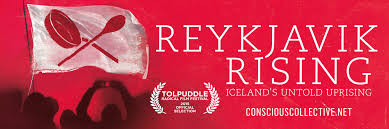
Reykjavik Rising casts the cold light of reality on Iceland’s 2009 so-called “revolution.” Although the “pots and pans” revolution made a few meaningful reforms, in Iceland, as everywhere else, people are no closer to genuine democracy than they were before the 2008 economic meltdown.
This documentary profiles the three months of daily protests and direct action that brought down Iceland’s right wing government in early 2009. The new left wing government elected in April 2009 brought charges against the key bankers responsible for the country’s financial collapse. Although most were found guilty, none served sentences.
The People Write a New Constitution – Which Parliament Ignores
The new government also called a national assembly to rewrite the constitution, a key demand of the protests. The assembly was made up of 1,000 individuals drawn randomly from the National Register. It was their role to decide, by consensus, the core values the new constitution would embrace. They also elected 30 people to draft it.
Despite being ratified by 70% of Icelandic voters in an October 2012 referendum, state television (which was still controlled the right wing) ignored the outcome and the Icelandic parliament refused to ratify it.
Six months later, new elections restored to power the original right wing parties responsible for the financial crisis.
Why the Revolution Failed
The filmmakers interview activists with a variety of viewpoints on why Iceland’s revolution failed. Most agree that no single protest anywhere is going to achieve real social change. Years of preparation is required for ordinary people to successfully seize power from the global elite that controls our governments.
At the same time the “pots and pans” revolution led to a profound shift in popular attitudes. A majority of Icelanders now recognize that their so-called representative democracy is just a façade – that real power rests with banks and corporations. This corresponds with a proliferation of grassroots organizations and think tanks dedicated to the development of direct democracy.
There also seems to be strong agreement that activists must be prepared to push rapidly for change when the next crisis arrives. They must be prepared to actually take power and defend themselves against those who seek to usurp them.
For a month during the “pots and pans” revolution, ships with 1,000 Danish commandos were waiting offshore to retake Parliament if the protesters managed to take control.
I watched an intriguing documentary on Maori TV this week about a group of white anti-apartheid musicians who decide to investigate the background of an obscure Detroit singer who became the hero of the white anti-apartheid movement. Prior to watching the film, I was totally unaware of South Africa’s white anti-apartheid movement.
During the early 1970s, apartheid South Africa was a virtual police state. White and black activists who spoke out against apartheid (or censorship, police violence, death squads, etc) faced three year prison terms. Those who engaged in street protests faced even harsher penalties. According to the musicians interviewed in the film, Sexto Rodriguez’s iconoclastic music gave a whole generation of white South Africans the courage to resist the oppressive regime they lived under.
An anti-establishment Afrikaans band was the first to widely popularize Rodriguez’s music. Prior to 1994, it mainly circulated underground as specific songs were specifically banned by the apartheid regime. Despite being virtually invisible in the US, his two albums eventually sold 500,000 copies in South Africa.
Despite his immense popularity, South African musicians and activists knew absolutely nothing about Rodgriguez’s background. In fact, there were rumors circulating his career had ended when he committed suicide during a performance (in one version he shot himself in the head, in another he set himself on fire).
After months of investigation, music historian Craig Bartholomew-Strydom eventually learned that Rodriguez was still alive working in housing demolition in Detroit. He and other Rodriguez fans arranged to bring him to South African in 1998 for a revival concert attended by 20,000 people.
Following the concert he returns to his quiet working class life in New York, though he eventually performs six more concerts.
Hits (in South Africa) serve as the soundtrack for the film. Despite his strident anti-establishment views, he’s clearly an extremely accomplished singer-songwriter. Thus I guess it’s no surprise, his music was suppressed* in the US.
For copyright reasons, I’m unable to embed the film. However it can be viewed free (for the next few weeks) at the Maori TV website:
*In the US, anti-capitalist music isn’t overtly censored. Prior to the Internet and YouTube, people never heard it if record companies chose not to promote it.
Beyond Elections: Redefining Democracy in the Americas
Directed by Silvia Leindecker and Michael Fox
Film Review
Beyond Elections is about the global participatory democracy (aka direct or deliberative democracy) movement – the grassroots effort to replace so-called representative democracy (aka polyarchy*) with a process in which citizens participate directly in policy decisions that affect their lives. Historically participatory democracy began in ancient Athens, where people governed directly through large public assemblies (unfortunately assemblies were limited to free born men, who comprised only one-fifth of the population).
According to the filmmakers, participatory democracy died out until 1989, when the Brazilian Workers Party resurrected it in Porto Allegre Brazil by creating participatory budget assemblies. In my view, this isn’t strictly correct, as the Russian anarchist Mikhail Bakunin, who the Marxists expelled from the First International** , advocated for a system of participatory democracy called “collective anarchism.” Workers used participatory democracy to run the 1871 Paris Commune, as did numerous Spanish cities during the Spanish Civil War.
The Spread of Participatory Democracy
The documentary explores how this new style of local government spread throughout Brazil and to other Latin American countries, as well as to Europe, Africa and even parts of Canada (Guelph Ontario and parts of Montreal). A few US activists are campaigning for more American communities to adopt participatory democracy (several are described in the 2012 book Slow Democracy), but most Americans have never heard of it. The only aspect of participatory democracy widely adopted in the US are workers cooperatives.
Beyond Elections presents numerous examples of participatory democracies in the various Latin American countries that have implemented it. Under representative democracy, local councils are nearly always controlled by local business interests, and elected officials typically enact budgets that benefit these interests. When ordinary people control the budgeting processes through popular assemblies, they spend the money on programs benefiting the entire community, eg on clean safe housing, health centers and basic sanitation.
The Venezuelan Example
Following Hugo Chavez’s election in 1998, the Venezuelan government called a constitutional assembly to write a new constitution. The latter enabled Venezuelans to directly govern their communities through communal councils, as well as water committees, workers committees (to set up and run workers cooperatives), health committees and land committees (to implement land reform and set up farmers cooperatives).
The projects carried out by the communal councils and various committee were funded by grants from the central government. Despite endemic corruption in the Venezuelan bureaucracy, these new grassroots-run structures succeeded in bringing health care, decent housing and basic sanitation to Venezuelan slums for the very first time.
The film also examines the adoption of participatory democracy in Bolivia, Ecuador and parts of Mexico controlled by the Zapatistas.
The film is in 16 parts of roughly 5 minutes. Each successive segment starts automatically as the preceding segment finishes.
*In a polyarchy, power is closely guarded by a wealthy elite and the population remains passive except for periodic “free elections” in which they vote for the elites of their choice. When a tiny minority controls nearly all the wealth, “free elections” are only possible if the majority is systematically controlled with psychological propaganda. See Emancipate Yourself from Mental Slavery
**The First International Working Man’s Association was an international organization which aimed at uniting a variety of different left-wing socialist, communist[1] and anarchist political groups and trade union organizations that were based on the working class and class struggle.
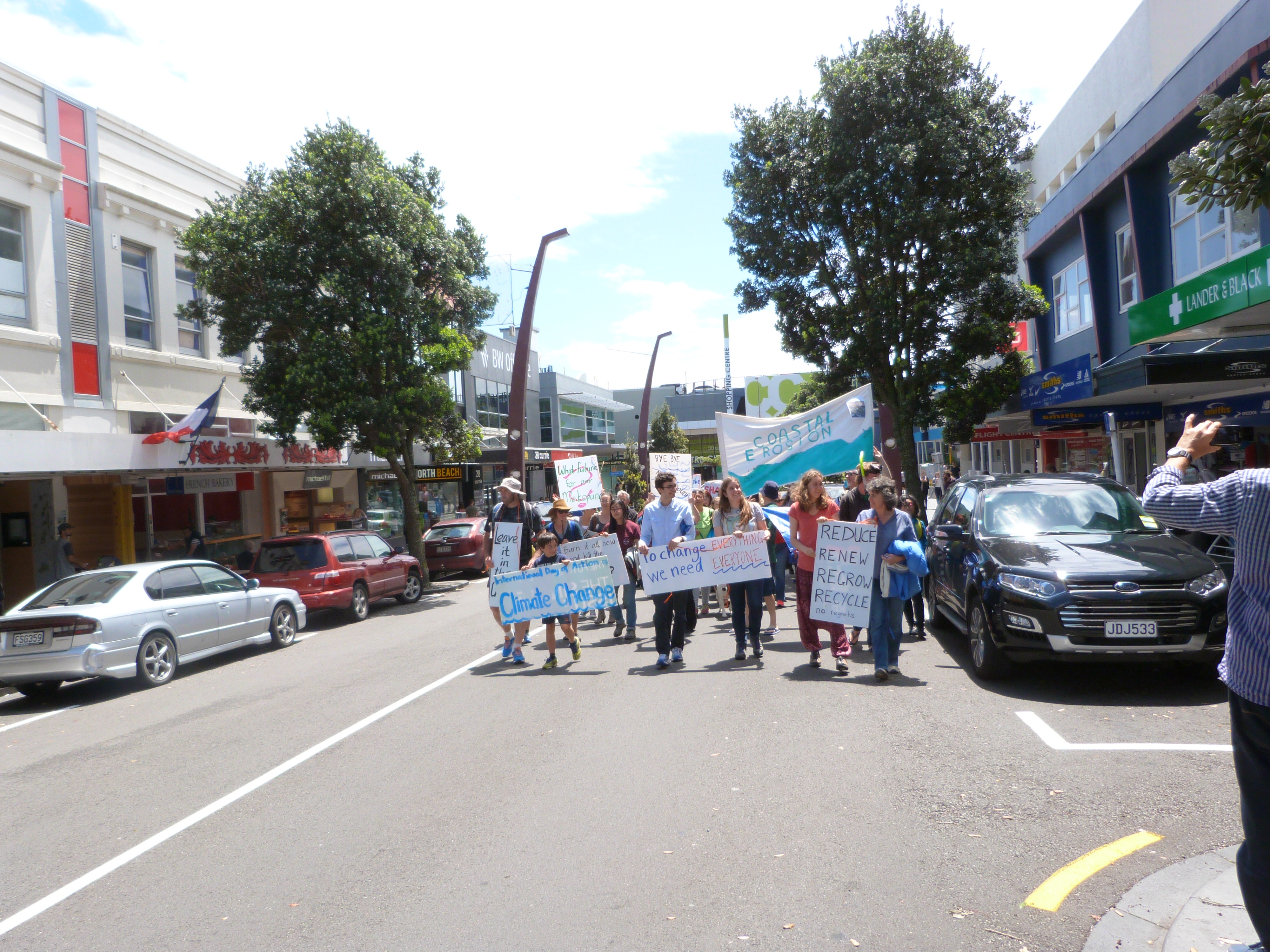
Yesterday New Plymouth was one of 35 New Zealand communities kicking off the global Peoples Climate March calling for real action on climate change at COP21.
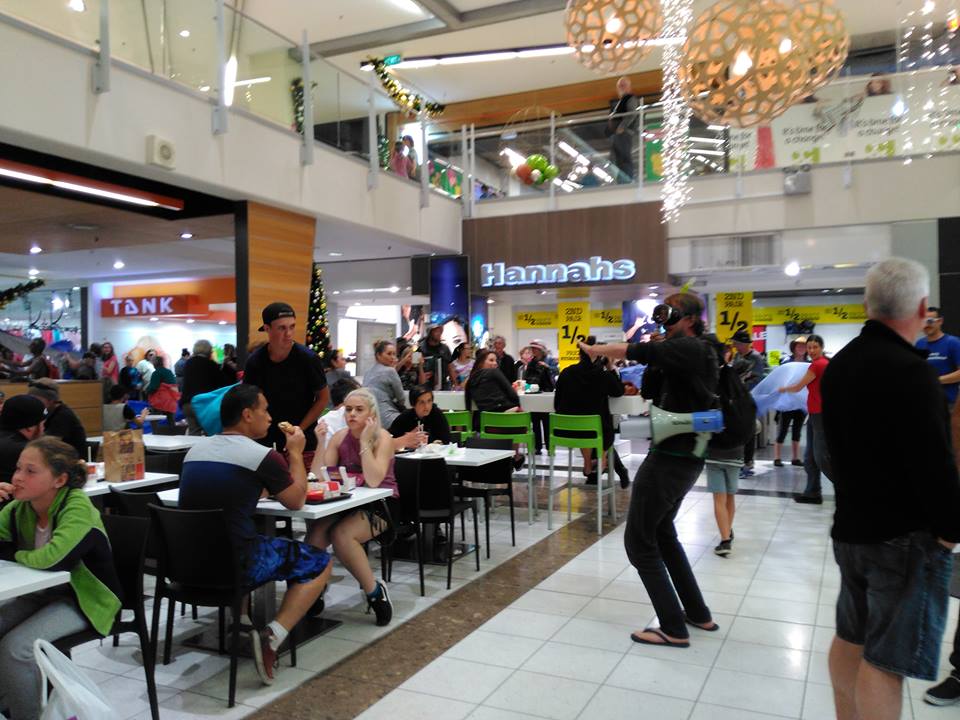
In our community, 100 people celebrated with a Peoples Climate Picnic and rally, followed by a flash mob in our mall and a march down Devon Street.
We chose City Centre mall, based on predictions it will be under water with a 6 meter rise in sea levels (to be honest, I’m not sure if that’s a bad thing).
Fifteen thousand people marched in Auckland, ten thousand in Wellington and eight thousand in Christchurch.
Corridors of Resistance: Stopping Oil and Gas Pipelines
By Leah Temper
Film Review
Corridors of Resistance is about the inspiring Unisto’ot’en campaign in northwest British Columbia to block the intrusion of oil and gas companies on their territory. This has to be the most effective grassroots challenge I’ve seen to the supposedly unchallengeable oil and gas industry.
Although the Unisto’ot’en never ceded their territory by treaty, British Columbia and the former Harper government illegally granted seven oil and gas companies concessions for ten pipelines. The purpose of the pipelines is to carry tar sands condensate, fracked natural gas and liquefied natural gas to Pacific seaports.
The right of Unisto’ot’en to occupy their unceded traditional lands was recognized by the Canadian high court in 1997.
The Canadian indigenous group isn’t merely protecting their land rights. They also have major concerns about the health and environmental effects of fracking and tar sands mining. Studies show people living adjacent to these activities are dying of cancer and losing livestock owing to air and water contamination. Likewise a pipeline spill or leak could wipe out the salmon and animals they hunt, which would be catastrophic to their survival.
The Unisto’ot’en also worry about Canada’s excessive reliance on fossil fuels and the threat it poses to climate stability.
Many “colonized” (ie city dwelling) Unisto’ot’en, as well as European supporters, are moving back to their traditional land to help maintain the blockade.
My favorite part is the scenes in which Unist’ot’en women confront oil and gas workers who attempt to enter their territory and turn them away.
Udita is an inspirational film about the unionization of the female garment workers in Bangladeshi sweatshops (see The Ugly Side of the Fashion Industry) over the last five years.
In addition to exposing the deplorable living conditions of these women and their children, the documentary also profiles two disasters that significantly increased union membership: the 2012 fire in the Tazreen factory that killed 57 workers and the collapse of the Rana Plaza factory in 2013 that killed 1021 workers.
Udita differs from other sweatshop documentaries in that in focuses minimal attention on the western brands (Walmart, Gap, etc) that reap obscene profits from employing third world women in conditions of virtual slavery. This film is more about the lives of the workers, who are often single mothers abandoned by their husbands.
The film begins by profiling one organizer who first tried to form a union in 2010, when the minimum wage in the garment factories was $22 a month. Deducted from this was the $13 a month a typical garment worker paid to live in a one room shack with shared bathroom facilities.
Overtime was compulsory, with workers only getting only one day off a month. They were also subject to beatings and/or firing if they complained about maltreatment or non-payment of wages (it was common for paymasters to dock their pay for non-existent infringements). One of the early grievances the National Garment Workers’ Federation (NGWF) won was the case of 250 workers who hadn’t been paid for three months.
NGWF members grew significantly following the Tazreen fire. The main reason the fatality rate was so high was because workers were doing compulsory overtime on a big Walmart order and the doors and gates had been locked to keep them from leaving. Following the 2012 fire, NGWF held a number of large protest marches and forced the government to increase the minimum wage to $64 a month.
The documentary also profiles a woman forced to assume custody of her two grandchildren after both daughter and a son-in-law are killed in the Rana Plaza disaster. Because she had no money to pay their school fees, both children were kicked out of school (public schooling is virtually non-existent in Bangladesh).
The film ends with a humongous 2014 protest march, in which the woman and her grandchildren participate. The principal demand is compensation from the factory owner for the 1121 deaths.


 The Most Revolutionary Act