Currency Wars: Zimbabwe Adopts the Chinese Yuan

Zim_map

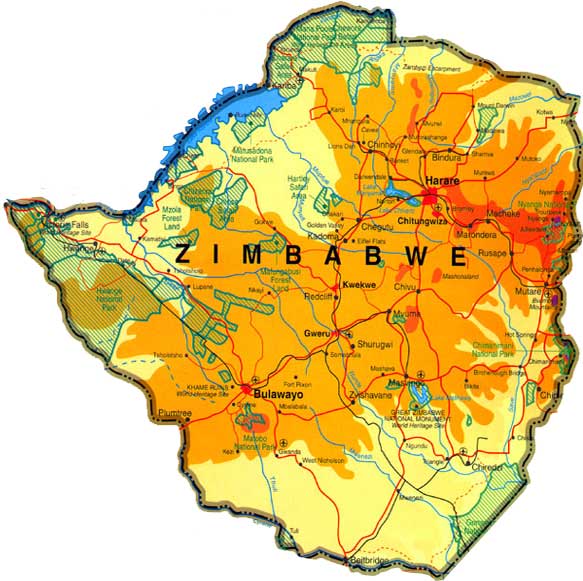
According to the Guardian (and Al Jazeera, the Canadian Broadcasting Corporation, the Globe and Mail, the Australian Broadcasting Corporation and the New Zealand Herald), the US dollar took another major hit this week after Zimbabwe has made the Chinese yuan legal tender. According to minister of finance Patrick Chinamasa, the move comes after President Xi Jinping cancelled $40 million of Zimbabwean debt that comes due in 2015.

Zimbabwe abandoned its own dollar in 2009 after hyperinflation, which peaked at around 500 billion percent, made it unusable.

Following the demise of the Zimbabwean dollar, the country did business in various foreign currencies, including the US dollar, the South African rand and eventually the yuan. However up until now, most business was conducted in US dollars, and the yuan wasn’t approved for public transactions.

China is Zimbabwe’s biggest trading partner following Zimbabwe’s isolation by its former western trading partners over the country’s poor human rights record.

Deliberate Censorship

This story has been widely reported outside the US, but seems to have been blacked out in the US media. Reporting bad news at this time of year is too likely to disrupt the mindless consumption and debt accumulation expected of Americans over the holiday season.

In the corridors of power, there are deep concerns about the continued stability of the US dollar in the face of America’s decrepit manufacturing base and soaring deficits. Over the past decade, the Obama administration has been particularly concerned about growing Chinese investment in Africa. According to the Financial Times, China is the largest investor in African infrastructure, representing an estimated $13.4 billion in 2013.

Analysts across the political spectrum increasingly view Obama’s misguided foreign policy (his threats against Russian and China, his deranged Middle East military policy and his desperate attempt to ram the Transpacific Partnership* through Congress) as a desperate attempt to shore up the dollar against massive Chinese economic gains.

True to form, the Obama administration has addressed these concerns with military force, involving US troops in a series of African wars that they’re trying to conceal from the American public. See The War in Africa the US Military Won’t Admit It’s Fighting


*The Transpacific Partnership (TPP) is a so-called “trade agreement” seeking to isolate China from its Asian-Pacific trading partners – by deliberately excluding China from the treaty.

Photo credit: Wikimedia Commons


How Marx and Lenin Defeated Participatory Democracy

state and revolution

State and Revolution: the Marxist Theory of the State and the Tasks of the Proletariat in the Revolution

by V.I. Lenin (1927)

Book Review

Free download from State and Revolution

State and Revolution is principally a diatribe against anarchism. Vladimir Lenin, the leader of the October 1917 Bolshevik revolution,  wrote this book in hiding in Helsingfors (Finland). He defines the state as “an organ of domination of one class by the other by means of a standing army, police, prisons and an entrenched bureaucracy.”

I was particularly intrigued to re-read State and Revolution in view of Carroll Quigley’s revelations, in Tragedy and Hope, about the role Wall Street interests played in funding the Bolshevik revolution.

Lenin notes three main differences between Marxists and anarchists as regards the state:

1. Anarchists demand abolition of the state within 24 hours. In contrast, Marxists “know” the state can’t be dissolved until class differences are eliminated. They believe the state (ie the dictatorship of the proletariat) will wither away once the capitalist elite is dissolved.
2. Following revolution, Marxists will substitute organized armed workers for the old state. Anarchists (according to Lenin) have no idea what will replace the state.*
3. Marxists want to make use of the modern (ie capitalist) state to prepare workers for revolution – anarchists reject this as a strategy.

State and Revolution reiterates many of the arguments Marx and his supporters used to expel Bakunin from the First International Working Men’s Association at the 1872 conference in the Hague. Although the anarchists made up most of the sections of the First International (they were extremely powerful in Spain, where they had the largest contingent of grassroots supporters), Marx and his supporters controlled the General Council (the leadership body) of the First International.

Bakunin, who was unable to attend the Hague conference, called a second rival congress in Saint Imier Switzerland. Bakunin’s international working men’s association was far larger and lasted longer than its much smaller Marxist rival. The latter was largely isolated in United States and collapsed in 1876

I take strong exception to a number of Lenin’s arguments for a strong central state following revolution. Dismissing the anarchist proposal for a federation of self-governing units as totally “Utopian,” he claims that “human nature can’t do without subordination, control and managers” and that a strong (armed) central government is essential to “suppress excesses on the part of idlers, gentlefolk and swindlers.”

In my view, Lenin makes a big mistake in blaming “human nature” for the social problems that clearly result from capitalist oppression and exploitation.

Nevertheless his observations about the fraudulent nature of representative democracy suggest little has changed over the last hundred years:

“In any parliamentary country, the actual work of the state is done behind the scenes and is carried out by the departments, the offices and the staffs. Parliament itself is given up to talk for the specific purpose of fooling the people.”


*Untrue. Bakunin, the founder of collective anarchism (aka participatory democracy), proposed replacing the state with federations of collective work places and communes.

The Billionaires at 740 Park Avenue

Park Avenue: Money, Power and the American Dream

Directed by Alex Gibney (2012)

Film Review

Park Avenue is about the 31 billionaires who live in the luxury cooperative building at 740 Park Avenue. The building was originally commissioned by Jackie Kennedy’s grandfather James T Lee. He lived there with a consortium of Wall Street millionaires who engineered the 1929 stock market crash. Most of the present residents are hedge fund managers.

The documentary examines how 740 Park Avenue billionaires use their money and power to become even richer – funding election campaigns and lobbying for tax cuts and laws that reduce financial, environmental and health and safety regulation.

I’ve always found this level of geed quite puzzling. A psychologist featured in the film discusses his research into the sense of entitlement conferred by extreme wealth. An interview with the building’s doorman is even more revealing.

Among the billionaires profiled, two of the most powerful are Steve Schwarzman and David Koch. Schwarzman headed mergers and acquisitions at Lehman Brothers when they went bankrupt and is presently CEO of the Blackstone Group*. He (and his pal Senator Charles Schumer) were personally responsible for blocking the repeal of the “carried interest provision” in the federal tax code. This provision taxes the earned income of a hedge fund manager at the capital gains rate of 15%. Largely thanks to Schumer (who has raised the most Wall Street money of any Democratic candidate), Obama’s initiative to repeal this loophole failed, even with a Democratic majority in both houses.

David Koch, whose primary wealth is in oil and coal, has (with his brother Charles) donated to the campaigns of over half the members of the house and senate, as well as numerous right wing think tanks. The Koch brothers are also the big money behind the Tea Party, numerous right wing think tanks they have created and (along with Exxon) the climate denial movement.

The brothers are personally responsible for the recent anti-union legislation in Wisconsin and other Midwest states. They’re also the main sponsors of Paul Ryan’s rise to fame, as well as the Republican Party’s adoption of Ryan’s Path to Prosperity. The latter advocates for privatizing Social Security, Medicare and Medicaid, in addition to trillions in tax cuts that would virtually do away with all public services outside the military and police.


*An American multinational private equity, investment banking, alternative asset management and financial services corporation based in New York City.

The Ugly History of the War on Drugs

Exile Nation: An Oral History of the War on Drugs

Directed by Charles Shaw (2011)

Film Review

In laying out the sordid history of the US prison industrial complex, Exile Nation helps us understand how the US came to have the largest prison population in the world, far exceeding that of China, which has over four times as many people.

A significant proportion of US inmates are African Americans and Hispanics locked up for “victimless” drug offenses. At present 500,000 of American’s 2.3 million prison population is inside for using heroin, cocaine or methamphetamine. Thirty thousand are there for cannabis possession.

The documentary intersperses commentary by “experts” (cops, judges, sociologists, psychiatrists, defense attorneys, jail monitors, medical marijuana activists and prison rights advocates) with those of ex-offenders.

The US Invents Mass Incarceration

Crime rates in the US first reached a high point in 1830, largely due to high levels of alcohol abuse. The US would be the first country in the modern era to introduce mass incarceration as punishment for law breaking. The Pennsylvania Quakers believed that locking people up would force them to “repent” – the origin of the word penitentiary. The experiment failed. Studies consistently show that imprisoning convicts neither rehabilitates them nor discourages them from re-offending.

Nixon’s War on Drugs

Nineteenth century crime rates slowly declined, plateauing during the Civil War era. From then on, they remained constant until the 1970s, when Nixon declared the first war on drugs. His primary target was the immense social movements of the late sixties and early seventies. Nixon couldn’t constitutionally punish hippies for opposing the Vietnam War nor African Americans for demanding the right to vote. Instead he targeted their behavior, ie the widespread use of marijuana, LSD and cocaine that accompanied these movements.

In doing so, Nixon deliberately ignored the recommendation of a 1972 bipartisan commission that recommended that marijuana use be criminalized.

Reagan’s War on Drugs

The prison industrial complex received a second major boost in 1984, when Reagan declared a second war on drugs. Unlike Nixon, who envisioned drug arrests as a form of social control, Reagan used the drug war (particularly against crack, a new bargain basement form of cocaine) to demonize African Americans and win votes from white blue collar workers.

The Mainstream Media Revolts

The media turned against the drug war and prison industrial complex in the 1990s, with Ted Koppel producing several excellent documentaries highlighting the drawbacks of mass incarceration. The resulting shift in public opinion would lead the federal government and many states to begin downsizing their prison populations. Sadly 9-11 and the War on Terror interrupted this process.

A high point for me were the interviews with medical marijuana activists describing the history of their movement (leading to the legalization of marijuana for medical purposes in 23 states sates).

I also really liked the sections on the medical use of MDMA (ecstasy) in treating post traumatic disorder and the psychedelic ibogaine in treating heroin addiction.

South Africa’s 2012 Miners Massacre


Miners Shot Down

By Rehand Desai (2014)

Film Review

Miners Shot Down follows the Marikana Commission of Inquiry investigation into the government massacre of striking platinum miners in August 2012. Thanks to the public investigation, filmmakers gained access to secret police files and footage that totally demolishes their claim that they fired at the miners in self-defense. In total 112 miners were shot. Thirty-four of them died.

The documentary paints an extremely ugly picture of the worsening economic apartheid which followed the end of political apartheid in 1994. Prior to their 2012 strike, miners at the Lonmin platinum mine lived in abject poverty, earning an average wage of 5,000 South African rand ($US 500) a week. The 2012 strike was a wildcat strike, owing to the refusal of the corrupt Nation Union of Miners (NUM) to support miners’ demand for higher wages.

Eyewitness testimony and documentary and forensic evidence presented to the Marikana Commission leave no doubt whatsoever that orders to fire on the miners came from the highest level of government.

Among the more damning evidence is the decision by the Commissioner of Police to supply police with four mortuary vans, in addition to 4,000 rounds of ammunition. Police footage shows them ordering protesting strikers to disperse, boxing them in with razor wire and armored vehicles, demanding journalists leave and shooting down fleeing miners.

Eyewitnesses report the police repeatedly shot strikers as they were surrendering.

Following the massacre the strike lasted another four weeks, and Lonmin miners eventually won pay increases of 7-22%. The Marikana massacre prompted 100,000 miners to undertake wildcat strikes across Africa.

The Marikana Commission report, issued in June 2015, largely exonerates key government figures implicated in the massacre, and victims families plan to the case to the International Criminal Court (ICC).

270 miners have been charged with murder based on events at Marikana. No police officers have been charged.


The Battle of Blair Mountain

storming heaven

Storming Heaven

by Denise Giardina

Ballantine Books (1987)

Book Review

Storming Heaven, a fictional account The Battle of Blair Mountain (featured in the recently released film Plutocracy), has to be one of my favorite novels of all time. The author, Denise Giardina, grew up in a coal camp.

The book concerns the unionizing drive (often employing skilled African American organizers) among West Virginia mine workers leading up to the Battle of Blair Mountain in 1921. This was one of the most shameful episodes of US history, in which the US Army attacked 10,000 striking pro-union miners with airplanes, bombs and poison gas.

Giardina strikes just the right note in juxtaposing the brutal corruption of the miners who stole the land deeds, homes and labor of the entire region – and the energy, excitement and pure romance of a union drive that organizes against immense odds to reclaim its members’ rights to a living wage and safe working conditions.

In her afterward, the author reveals that the leaders of the United Miners Association District 17 were arrested and tried for treason. Although they had strong popular support and were acquitted, it would be another twelve years before Roosevelt abolished the mine guard system that terrorized union organizers and awarded mine workers the freedom to form unions.

When she wrote the book in 1987, Giardina was president of her local coal union. In the late nineties she became active in the movement opposing mountain top removal. In 2000 she ran for governor of West Virginia.

Reclaiming Our History

plutocracy

Plutocracy: Political Repression in the United States

Scott Noble (2015)

Film Review

As German philosopher Walter Benjamin famously stated, “History is written by the victors.” In the US, most history books are written by and for the corporate oligarchs who run our government. Plutocracy is the first documentary to comprehensively examine early American history from the perspective of the working class. Part II (Solidarity Forever) will cover the late 19th Century to the early twenties. The filmmaker is currently seeking donations to complete the project. If you’d like to help, you can donate to their Patreon account.

The film can’t be embedded but can be viewed free at Plutocracy

Plutocracy starts with Shay’s Rebellion in 1786, the insurrection of Massachusetts farmers against the courts and banks that were fleecing them of their meager wealth and property. Similar rebellions in Rhode Island and Virginia would cause leading US bankers, merchants and plantation owners to organize a secret convention to create a central government and standing army. Each of the 13 original states, which in 1787 were still independent and sovereign, sent delegates to Philadelphia to revise the Articles of Confederation.

Instead of revising the Articles, as authorized by their state legislatures, the delegates closed the meeting to the public and voted to replace them with a federal constitution. The latter substantially limited the freedom and power of state legislatures and ordinary Americans.

Plutocracy moves on to cover the massive Irish immigration of the mid-nineteenth century and the appalling squalor so-called “white Negroes” lived in. During the 19th century, 80% of babies born to Irish immigrants died in infancy.

The film touches only briefly on the Civil War, describing laws that enabled robber barons like John Rockefeller, J.P. Morgan, Andrew Carnegie and Cornelius Vanderbilt to evade the Civil War draft by paying a poor person $300 to replace them.

It offers a detailed depiction of post-Civil War Reconstruction, which coincided with the 1871 Paris commune and saw blacks collaborating with poor whites to establish the South’s first public schools and hospitals. This was in addition to the election of numerous former slaves to judgeships and legislative positions.

Their eagerness to return Negroes to productive status on plantations led northern industrialists to pressure Congress to end Reconstruction by removing the federal troops protecting the rights of former slaves. It also led to their passive acceptance of unconstitutional Jim Crow laws and Ku Klux Klan terrorism. The chief aim of both was to prevent poor backs and whites from associating with one another.

The federal troops withdrawn from the South were redeployed in genocidal campaigns against Native Americans and Mexicans. By the end of the 19th century, not only had Mexico ceded half their territory to the US (including California, Texas, Utah, Nevada and parts of New Mexico, Arizona, Colorado and Montana – in the 1984 Treaty of Guadalupe), but US corporations enjoyed de facto control of all land remaining under sovereign Mexican control.

Stripping the Native Americans and Mexicans of their land in the West, readied the US for the rise of the robber barons of industry (Rockefeller, Morgan, Carnegie and Vanderbilt) and a corrupt system of federal and local government run entirely by bribery and patronage.

The corruption and squalid living conditions of the late 19th century would give rise to militant trade unionism, socialism, anarchism and populism. Plutocracy depicts the Pullman and similar strikes in which strikers were brutally beaten and killed by Pinkerton’s Detectives and other goons hired by industrial bosses, as well as national guardsmen and, on several occasions, federal troops.

The film opens with a poignant depiction of the Battle of Blair Mountain, the largest labor uprising in US history. It’s the largest armed uprising since the Civil War, involving 10,000 coal miners. Denise Giardini memorializes the Battle of Blair Mountain in her 1987 novel Storming Heaven.


*Rockefeller and Morgan had a relative monopoly on the banks, Carnegie on steel and Vanderbilt on the railroads.


Big Sugar, Inc

Big Sugar: Sweet, White and Deadly

Brian McKenna (2005)

Film Review

Big Sugar is about the sugar lobby and how they use their wealth and power to prevent the World Health Organization (WHO) and other regulatory agencies from dispensing accurate information about the link between high sugar intake and obesity, type 2 diabetes and heart disease.

This Canadian documentary is divided into two parts. Part I deals with the links between sugar and slavery and the modern sugar barons have replaced the slaveholders who effectively controlled British foreign and domestic policy for 200 years. Part II is about the global obesity epidemic and efforts by WHO in 2005 to issue guidelines limiting daily sugar intake to 10% of total calories. The powerful sugar lobby defeated this initiative by employing many of the same techniques as the tobacco industry (and the climate denial industry). After attacking the science linking high sugar intake and obesity, they attacked the scientists themselves as biased fanatics. They then got them fired, demoted, and/or transferred. Under pressure from Big Sugar, both Bush administrations threatened to withhold the funding they owed WHO, and the pesky nutritionists who sought to warn people about the dangers of sugar magically vanished.

The documentary focuses on two of the most prominent slave holding families, as well a Canadian woman of African descent whose ancestors were owned by the Church of England and worked on a plantation in Barbados. The filmmakers liken these historical paragons to a modern day Cuban exile family in Florida called the Fanjuls. The latter donate generously to both major parties to make sure the US government continues to subsidize sugar production. The Fanjuls and other Florida sugar barons reap $1.5 billion in subsidies for $3.1 million in campaign contributions.

In addition to exposing the ecological devastation sugar cultivation has caused in the Florida Everglades, the filmmakers also visit the Fanjuls’ sugar plantations in the Dominican Republic. Despite the official abolition of slavery, working conditions on Dominican sugar plantations remain virtually unchanged. The Fanjuls lure Haitian immigrants across the border with a promise of paying work. Once their passports are confiscated, they become virtual slaves. Workers, who are paid $2 for a twelve hour day, experience chronic hunger and malnutrition. Forbidden to grow their own vegetables, they’re forced to rely on a company store that charges them three times the normal price for food. They have no access to medical care, and child labor is rife.

The Arab Spring: Made in the USA

arabesques image

Arabesque$: Enquête sur le rôle des États-Unis dans les révoltes arabes

(Investigation into the US Role in the Arab Uprisings)

by Ahmed Bensaada

Investig’Action (2015)

(in French)

Book Review

Arabesque$, an update of Ahmed Bensaada’s 2011 book L’Arabesque Américaine, concerns the US government role in instigating, funding and coordinating the Arab Spring “revolutions.” Obviously most of this history has been carefully suppressed by the western media.

The new book devotes much more attention to the personalities leading the 2011 uprisings. Some openly admitted to receiving CIA funding. Others had no idea because it was deliberately concealed from them. A few (in Egypt and Syria) were officially charged with espionage. In Egypt, seven sought refuge in the US embassy in Cairo and had to be evacuated by the State Department.

Democracy: America’s Biggest Export

According to Bensaada, the MENA (Middle East and North Africa) Arab Spring revolutions have four unique features in common:

1. None were spontaneous – all required careful and lengthy (5+ years) planning, by the State Department, CIA pass through foundations, George Soros, and the pro-Israel lobby.*.
2. All focused exclusively on removing reviled despots without replacing the autocratic power structure that kept them in power.
3. No Arab Spring protests made any reference whatsoever to powerful anti-US sentiment over Palestine and Iraq
4. All the instigators of Arab Spring uprisings were middle class, well educated youth who mysteriously vanished after 2011.

Nonviolent Regime Change

Bensaada begins by introducing non-violent guru Gene Sharp (see The CIA and Nonviolence), his links with the Pentagon and US intelligence, and his role, as director of the Albert Einstein Institution, in the “color” revolutions** in Eastern Europe and the attempted coup against Hugo Chavez in 2002.

The US goal in the Arab Spring revolutions was to replace unpopular despotic dictators while taking care to maintain the autocratic US-friendly infrastructure that had brought them to power. All initially followed the nonviolent precepts Sharp outlines in his 1994 book From Dictatorship to Democracy. In Libya, Syria and Yemen, the US and their allies were clearly prepared to introduce paid mercenaries when their Sharpian “revolutions” failed to produce regime change.

Follow the Money

Relying mainly on Wikileaks cables and the websites of key CIA pass through foundations (which he reproduces in the appendix), Bensaada methodically lists every State Department conference and workshop the Arab Spring heroes attended, the dollar amounts spent on them by the State Department and key “democracy” promoting foundations,*** the specific involvement of Google, Facebook, Twitter and Obama’s 2008 Internet campaign team in training Arab Spring cyperactivists in encryption technologies and social media skills, US embassy visits, and direct encounters with Hillary Clinton,  Condoleezza Rice, John McCain, Barack Obama and Serbian trainers from CANVAS (the CIA-backed organization that overthrew Slobodan Milosevic in 2000).

Bensaada focuses most heavily on the Tahrir Square uprising in Egypt. The Washington Post has estimated approximately 10,000 Egyptians took part in NED and USAID training in social media and nonviolent organizing techniques. For me the most astonishing information in this chapter concerned the role of an Egyptian exile (a former Egyptian policeman named Omar Afifi Suleiman) in coordinating the Tahrir Square protests from his office in Washington DC. According to Wikileaks, NED paid Suleiman a yearly stipend of $200,000+ between 2008-2011.

When Nonviolence Fails

Arabesques$ devotes far more attention to Libya, Syria and Yemen than Bensaada’s first book.

In the section on Libyia, Bensaada zeroes in on eleven key US assets who engineered the overthrow of Gaddafi. Some participated in the same State Department trainings as the Middle East opposition activists and instigated nonviolent Facebook and Twitter protests to coincide with the 2011 uprisings in Tunisian and Egypt. Others, in exile, underwent guerrilla training sponsored by the CIA, Mossad, Chad and Saudi Arabia. A few months after Kaddafi’s assassination, some of these same militants would lead Islamic militias attempting to overthrow Assad in Syria.

Between 2005 and 2010, the State Department funneled $12 million to opposition groups opposed to Assad. The US also financed Syrian exiles in Britain to start an anti-government cable TV channel they beamed into Syria.

In the section on Syria, Bensaada focuses on a handful of Syrian opposition activists who received free US training in cyberactivism and nonviolent resistance beginning in 2006. One, Ausama Monajed, is featured in the 2011 film How to Start a Revolution about his visit with Gene Sharp in 2006. Monajed and others worked closely with the US embassy, funded by the Middle East Partnership Initiative (MEPI). This is a State Department program that operates in countries (such as Libya and Syria) where USAID is banned.

In February 2011, these groups posted a call on Twitter and Facebook for a Day of Rage. Nothing happened. When Sharpian techniques failed to produce a sizable nonviolent uprising, as in Libya, they and their allies (Saudi Arabia, Turkey, Qatar and Jordan) were all set up to introduce Islamic mercenaries (many directly from Libya) to declare war on the Assad regime.


*I was astonished to learn that Forum Fikra, a forum for Arab activists working against authoritarian governments, was mainly funded by the Nathan and Esther K Wagner Family Foundation. The latter also funds numerous pro-Israel groups and projects, as well as the Washington Institute for Near East policy (a pro-Israel group with close ties to AIPAC).

**The color revolutions were CIA-instigated uprisings that replaced democratically elected pro-Russian governments with equally autocratic governments more friendly to US corporate interests:

Serbia (2000) – Bulldozer Revolution
Georgia (2002) – Rose Revolution
Ukraine (2004) – Orange Revolution
Kyrgyzstan (2005) – Tulip Revolution

***Democracy promoting foundations (as used here, “democracy” is synonymous with capitalism, ie favorable to the interests of US investors). Here are seven of the main ones involved in funding and training Arab Spring activists:
USAID (US Agency for International Development) – State Department agency charged with economic development and humanitarian aid with a long history of financing destabilization activities, especially in Latin America.
NED (National Endowment for Democracy) – national organization supported by State Department and CIA funding dedicated to the promotion of democratic institutions throughout the world, primary funder of IRI and NDI.
IRI (International Republican Institute) – democracy promoting organization linked with the Republican Party, currently chaired by Senator John McCain and funded by NED.
NDI (National Democratic Institute for International Affairs) – democracy promoting organization linked with the Democratic Party, currently chaired by Madeline Albright and funded by NED.
OSI (Open Society Institute) – founded by George Soros in 1993 to help fund color revolutions in Eastern Europe. Also contributed major funding to Arab Spring revolutions.
• Freedom House – US organization that supports nonviolent citizens initiatives in societies were liberty is denied or threatened, financed by USAID, NED and the Soros Foundation.
CANVAS (Center for Applied Non Violent Action and Strategies) – center originally founded by the Serbian activists of Otpor who the US funded and trained to over throw Slobodan Milosevic and who were instrumental in training Arab Spring activists. Funded by Freedom House, IRI and George Soros.

Originally published in Dissident Voice


The Bush Crime Family

family of secrets

Family of Secrets

by Russ Baker

Bloomsbury Press (2009)

Book Review

Family of Secrets is about the Bush family and the Shadow Government responsible for all major domestic and foreign policy decisions over the last sixty years. For evidence, Baker relies partly on declassified documents and partly on face-to-face interviews of corporate executives, low level politicians and retired intelligence officers who have worked closely with the Bush family.

Two-thirds of the book is about George Herbert Walker Bush and CIA ties that date back to 1948 when he left Yale and went to work for Dresser Industries. Baker lays out strong evidence that Dresser and Zapata Petroleum, the oil services company Bush senior started in 1953, served the primary purpose of front companies for global industrial espionage and CIA intelligence gathering.

In this way Bush senior replicated the role his father Prescott Bush played in the World War II spy service Office of Strategic Services (OSS). Prescott was a friend and colleague of founding CIA Director Allen Dulles at the Wall Street law firm Brown Brothers Harriman. Brown Brothers Harriman bought Dresser in 1928.

According to Baker, Bush senior played a pivotal role in helping Dulles create “off- the-shelf” CIA operations – disguised as front companies – to circumvent federal legislation that prohibited the CIA from spying domestically.

For me, the high points of this book include the background Baker provides on Lee Harvey Oswald’s career as a covert CIA operative, the on-off relationship between Bush senior and Oswald’s Dallas control George de Mohrenschildt and the crucial role Bush senior played in setting up Nixon as the fall guy in the Watergate break-in and cover-up.

Baker, in essence, corroborates earlier research by Mae Brussell that the Watergate scandal was a CIA coup to remove Nixon from office.

A third of the book covers the hidden history of George W Bush, including his early alcohol and cocaine abuse, the abortion he organized for one his girlfriends, his purported Christian conversion and his AWOL from the Texas Air National Guard unit – a notorious scandal that would cost CBS anchor Dan Rather his job.

George W’s brothers Neil, Marvin and Jeb receive only brief mention related to their illegal diversion of savings and loan funds, leaving taxpayers on the hook for hundreds of millions of dollars when the savings and loan associations went bust in the late eighties and had to be bailed out.

Baker maintains a nonprofit investigative news service at http://whowhatwhy.org/

Below is a 2009 Ron Reagan radio interview with Russ Baker about Family of Secrets that someone tweeted me:

Russ Baker interview