The Vietnam War in 1970: GIs Kill Their Own Officers While Government Slays Student Protestors

A Sea of Fire, Episode 8

The Vietnam War

Directed by Ken Burn and Lyn Novick

Film Review

This week Maori TV showed A Sea of Fire, Episode 8 of the Vietnam War series. It covers the period from April 4, 1969 to May 1970 and the massacre of four students at Kent State and two at Jackson State

By April 1969, there were 543,482 US troops fighting in Vietnam, with thousands more on nearby naval vessels and support bases. By that date, 40,794 GIs had died in Vietnam.

In October Nixon, who privately acknowledged the US couldn’t win, replaced a complicated draft deferment system with a more popular lottery based on draftees date of birth. In December, Secretary of Defense Melvin Laird announced the “Vietnamization” of the war (eg a transfer of responsibility to to South Vietnamese troops) and began drawing down US troop numbers (10,000 by the end of 1970).

The move led many serving GIs to become deeply demoralized about being sent to die in an unwinnable war. Accordingly, 1970 would see a big increase in “fragging,” the deliberate murder of officers by men under them. It would also see a big increase in draftees seeking asylum in Canada (30,000 in total).

I was disappointed this episode failed to cover the role of the CIA and South Vietnamese army setting up a thriving trade selling heroin to US GIs. My former partner served in Vietnam from 1967-1969 and returned to the US addicted to it.

The years 1969-70 would also see a big surge in the US peace movement. The October 15th Vietnam Moratorium was actually a general strike, with hundreds of university campuses closing down and tens of thousands of Americans staying off work in cities around the country. It would be the largest mass protest in US history.

In November, independent journalist Seymour Hersh broke the story of the My Lai Massacre, the brutal murder of 400 South Vietnamese civilians, which had occurred 20 months earlier. It would be only one of many civilians massacres in Vietnam.

In 1970, the peace movement, which had died down in response to Nixon’s gradual troop withdrawal, was reignited following the April 30, 1970 invasion of Cambodia by 30,000 US troops. Four million American students protested the invasion, 448 campuses were shut down and 16 states called out the National Guard.

At Kent State, the National Guard fired 67 rounds into a crowd of peaceful demonstrators, killing four, including an ROTC (Reserve Officer Training Corp) scholarship student who was merely an onlooker.

On the same day, police shot two peaceful African American antiwar protestors at Jackson State University in Mississippi.


Nixon’s Treason in Vietnam

Chasing Ghosts, Episode 7

The Vietnam War

Directed by Ken Burn and Lyn Novick

Film Review

Last night, Maori TV showed Episode 7 of the Vietnam War series, covering the second half of 1968. 1968 was a year of global revolution, when working and oppressed people all over the world revolted against their governments. This happened even in countries like Mexico, Czechoslovakia, Nigeria, Ecuador, Brazil, Chile and Uruguay that had nothing to do with the Vietnam War. See 1968

This episode incorporates excellent footage of the antiwar protests at the 1968 Chicago Democratic Convention and the bloody police riot that ensued. Esteemed CBS journalist Walter Cronkite referred to Chicago as a “police state.”

By mid-1968 the new Secretary of Defense Clifford Clark was begging President Johnson to stop bombing North Vietnam. Clark no longer believed the US could win the war, and this was a North Vietnamese condition to begin Paris peace negotiations.

1968 also marked the start of the CIA’s controversial Phoenix program, in which US and South Vietnamese intelligence murdered 20,000 South Vietnamese in an effort to root out the Viet Cong (a secret South Vietnamese revolutionary group) and their supporters.

In the lead-up to elections, Democratic candidate Hubert Humphrey also called for an end to the bombing. When Johnson finally halted the bombing on October 31, Humphrey’s poll numbers surged ahead of Nixon’s.

A few days before the election, Nixon sent a secret envoy to South Vietnam promising President Thieu a “better peace deal” if he withdrew from the peace talks – which he did. Because the CIA had caught the conversation on a secret bug in Thieu’s office, Johnson confronted Nixon, who denied it. Viewing it as treason, Johnson chose not to make the incident public. He didn’t want the South Vietnamese government (or the American public) to know how he obtained the information.

Immediately after Nixon’s 1969 inauguration in January, he began secretly (and illegally) bombing Laos and Cambodia. Parts of the Ho Chi Minh trail (which North Vietnam used to send troops, weapons and food south) snaked through Laos, and Cambodia was known to offer sanctuary to North Vietnamese troops.


1968: The Year Americans Turned Against the Vietnam War

Things Fall Apart, Episode 6

The Vietnam War

Directed by Ken Burn and Lyn Novick

Film Review

Last night Maori TV showed episode six of the PBS Vietnam War series, covering the first half of 1968. Most of this episode deals with the January 31 Tet Offensive from the North Vietnamese standpoint. Although it was a failure militarily for North Vietnam, it was a public relations disaster for the US. It was the first time the North Vietnamese Army/Viet Cong had entered Saigon (they nearly capture the US Embassy.

After watching the nightly coverage of bloody conflict on US TV, the American people realized that Johnson had been lying when he claimed the US was winning the war. Esteemed TV journalist Walter Cronkite covered the Tet Offensive on the ground and came out against the war when he returned to the US.

When Johnson nearly lost the New Hampshire primary to anti-war candidate Eugene McCarthy (on March 30), he announced his decision not to seek a second term.

On April 4, Martin Luther King was assassinated (after coming out against the war a year earlier). Later that month, Bobby Kennedy entered the Democratic primary on a pledge to end the war. He seemed poised to win the Democratic nomination when he was assassinated in June.

Vietnam War: Why Johnson Sacked McNamara in 1967

This is What We Do

The Vietnam War

Directed by Ken Burn and Lyn Novick

Film Review

This week, Maori TV showed Episode 5 of the Vietnam War series, which covers 1967. By the end of 1967, over 20,000 Americans had died in Vietnam. In addition to raising taxes, Johnson was forced to gut his war on poverty to help pay for the war.

This episode explains the strategy pursued by US military leadership as well as replaying media footage of key ambushes and interviewing surviving veterans from both the US and Vietnam.Vietnamese veterans talk about the ease of tracking US GIs due to the trail of cigarette butts they left behind.

Many US fatalities stemmed from the use of the M16, viewed by one military analyst as a “piece of shit.” It frequently jammed under jungle conditions and was no match for the Soviet-made AK47 the North Vietnamese Army and the Viet Cong used.

1967 was the year that university students across the US held their first mass anti-Vietnam War protests in New York and Washington DC. Secretary of Defense Robert McNamara sent Johnson a private memo advising him the US couldn’t win the Vietnam war. It recommended the President freeze troop levels and cease carpet bombing North Vietnam to bring them to the negotiating table. Johnson promptly appointed him to head the World Bank and installed Clark Clifford as Secretary of Defense. McNamara would remain silent about his reservations about Vietnam for over 20 years.


“If You’ve Got Dough, You Don’t Have to Go”

Episode 4 – Doubt

The Vietnam War

Directed by Ken Burn and Lyn Novick

Film Review

Maori TV showed Episode 4 of the Vietnam War series this week. 1966, Lyndon Johnson’s second year in office, saw a massive escalation of US forces in Vietnam – increasing from 200,000 in January to 500,000 in June 1967. Australia, New Zealand, the Philippines and South Korea also sent troops to serve in Vietnam. Because both Australia and New Zealand had compulsory conscription until the early 1970s, there was a sizeable anti-Vietnam War movement in both countries.

The UK and Europe, in contrast, opposed the Vietnam War and called for the withdrawal of foreign troops.

Johnson also substantially escalated bombing campaigns against North Korea, Laos and Cambodia (the North Vietnamese used a network of jungle roads in Laos and Cambodia to transport arms and personnel to South Vietnam). North Vietnamese civilians, most of them women, worked day and night restoring the so-called “Ho Chi Minh trail following US bombing raids.

Because the US was incapable of gaining territory in Vietnam, it used body counts to measure its success. The latter frequently included civilians and were always exaggerated. The US goal was to reach a “crossover point” – where the US killed more North Vietnamese soldiers than North Vietnam could replace. This never happened.

In May 1966, the US puppet government in South Vietnam nearly collapsed owing to mass demonstrations in Saigon demanding representative democracy and a negotiated settlement to the war.

As US forces swelled in Vietnam, the Pentagon was forced to begin drafting college students, which massively fueled the antiwar movement. It was common for well-to-do families (like the Bushes) to arrange deferments tor their kids. As the saying went, “If you’ve got dough, you don’t have to go.”

In Vietnam, as in Iraq and Afghanistan, a disproportionate number of draftees and casualties were African American.

Gun Control and the True Historic Purpose of the Second Amendment

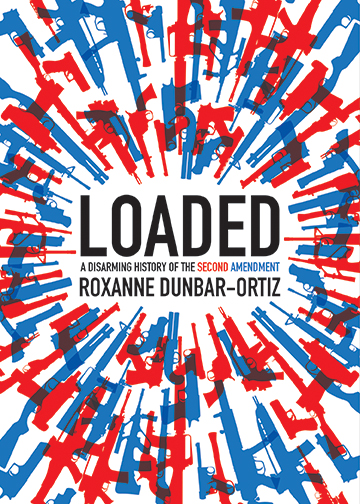
Loaded: A Disarming History of the Second Amendment

by Roxanne Dunbar Ortiz

City Lights (2018)

Book Review

According to Dunbar-Ortiz, the main function of the Second Amendment, is to enshrine the voluntary militias used by white settlers to dispossess Native Americans of their land and compulsory slave patrols to hunt down and capture runaway slaves.

She disagrees with gun control advocates on many fronts:

First she disagrees that the Second Amendment right to “keep and bear arms” relates only to their use in a “well-regulated militia.” She maintains that it clearly refers to an individual right, like the other guarantees in the Bill of Rights. The Second Amendment is modeled on various state constitutions (which were already in effect) that guarantee gun possession as an individual right. Moreover the right to form state militias is already covered in Article 1 of the Constitution.

Second citing other countries like Switzerland and Canada (which rarely experience gun violence) with few or no gun control laws, she disagrees that more gun control laws will reduce gun violence in the US.

Third she disputes Democratic Party claims that blames opposition to gun control on NRA lobbying. Noting that American gun culture precedes the NRA by more than a century, she argues the organization spends far less on lobbying than Big Oil or Big Pharma.

Dunbar-Ortiz contends that US gun culture is deeply rooted in the racist, white nationalist, God-ordained nature of the virulent capitalism sanctified by the US Constitution. She reminds us of the real issue that triggered the Revolutionary War: namely the British ban on illegal settlement on unceded Indian land west of the Appalachians. George Washington and our other founding fathers derived most of their wealth from illegal surveying and speculation in Native land.

Thus when the US finally won independence in 1791, a massive escalation of “savage war” was unleashed against the indigenous nations that had civilized North America. “Savage war,” aka “irregular warfare,” refers to deliberate violence directed against women, children and the elderly, along with the infrastructure that supports their survival. Although the US government gives lip service to the Geneva Convention, which prohibits acts of war against civilians, their wars have always mercilessly targeted civilians. Prime examples are the 1846 Mexican-American War, the war against Cuba (1898-1900) and the Philippines (1898-1948) and numerous undeclared wars of the 20th century (the Korean War, Vietnam War, Central American War (1981-89), Afghan War, Iraq War, Libya War, Syria War, etc)

The most surprising part of the book is the introduction, in which Dunbar-Ortiz describes becoming a gun owner and joining the NRA when an activist group she belonged to was spied on and stalked by police and intelligence operatives.

Vietnam: An Unwinnable War from the Outset

The River Styx Episode 3

The Vietnam War

Directed by Ken Burn and Lyn Novick

Film Review

Last night Maori TV showed Part 3 of the Vietnam War series. The title refers to the river dead people cross in Roman mythology to reach the Underworld.

The third episode covers the period 1964-1965 under President Lyndon Johnson. The latter reversed Kennedy’s initiative to withdraw US military “advisors” from Vietnam. Within days of the assassination, the new president increased the number of forces “advising” the South Vietnamese Army to 16,000. He also began secretly bombing and shelling North Vietnam (which was supplying arms to the South Vietnamese Army of Liberation). He concealed the bombing from the US public because 1964 was an election year.

By January 1965, the South Vietnamese Army of Liberation had nearly wiped out the South Vietnamese Army, and Johnson was forced to introduce “conventional” troops. In August 1964, Congress had passed the Gulf of Tonkin Resolution, which granted Johnson the authority to militarily “assist any Southeast Asian country which was being threatened by Communist aggression.” The Resolution was passed in response to an alleged unprovoked North Vietnamese attack on a US spy ship that, according to declassified documents, never happened.

The introduction of US ground forces would draw the North Vietnamese Army into the war, in support of the South Vietnamese Liberation Army. It would also lead France, Vietnam’s former colonial oppressor, to call for an end to all foreign intervention in Vietnam.

By May, Johnson had sent 50,000 GIs to Vietnam and pledged another 50,00 by the end of 1965. From the outset US troops deliberately waged a “counterinsurgency” war, ie one that clearly targeted civilians. The anger this provoked among the South Vietnamese population greatly enhanced recruitment efforts by the South Vietnamese Liberation Army.

On the domestic front, the introduction of ground troops (via a compulsory draft) would fuel a growing anti-Vietnam War protest movement by mid-1965.

At the end of 1965, General Westmoreland, who commanded US forces during the Vietnam War, requested an additional 200,000 troops. Johnson would comply, even though by that point, he and Defense Secretary Robert McNamara realized the Vietnam War was unwinnable.


A Voice of Sanity in the Gun Control Debate

In the following film, historian and Native activist Roxanne Dunbar-Ortiz discusses her book Loaded: A Disarming History of the Second Amendment. The major premise of her most recent book is that the Second Amendment relates mainly to the right and obligation of white settlers to keep guns, which they used in voluntary militias to massacre Native Americans and (in many cases) compulsory slave patrols to hunt down runaway slaves.

She begins by reminding us of the real issue (not the one we we’re taught in school) that triggered the Revolutionary War – namely the British ban on white settlement on unceded Indian lands west of the Appalachians. The hated Stamp Act, which triggered the familiar cry of “taxation without representation,” was enacted to finance British troops to roust settlers who were illegally squatting on Native lands.

She also points out that George Washington and most of the other founding fathers acquired their substantial wealth by illegally surveying and speculating in unceded Native land.

She disagrees with gun control advocates that the Second Amendment right to “keep and bear arms” only relates to their use in “well-regulated militias.” She insists that it refers to an individual right, like all the other amendments in the Bill of Rights. She argues the right to participate in voluntary militias is already covered in Article 1 of the Constitution. Moreover the Second Amendment was specially modeled on an individual right to gun ownership in various state constitutions.

I found the Q&A’s at the end the most interesting part of her talk. Dunbar-Ortiz doesn’t believe gun control laws would end mass shootings in the US – mainly because American gun violence is directly rooted in the historically racist and genocidal nature of US gun culture. She contrasts the US with Switzerland and Canada. Despite the absence of any gun control laws (the Swiss are required to keep weapons in their homes), there is no gun violence in Switzerland. Likewise Canada has much less gun violence despite fewer gun control laws.

In both cases, she attributes the absence of gun violence to the historical absence of slavery or rampant militarism.

Dunbar-Ortiz also disputes Democratic claims that opposition to gun control stems from NRA lobbying. Noting that the US gun culture precedes the NRA by more than a century, she adds that the NRA spends far less on lobbying than Big Oil and Big Pharma. The NRA mainly derives its strength by mobilizing thousands of volunteers at the state level, where most gun control laws originate. These volunteers track the voting records of every state and local politician to ensure that anti-gun legislators don’t get re-elected.

Hawk or Dove? JFK on the Vietnam War

The Vietnam War

Part 2 “Riding the Tiger”

Directed by Ken Burns and Lynn Novick (2017)

Film Review

Last night Maori TV showed Part 2 of The Vietnam War series, entitled “Riding the Tiger”. In my view it provides the most honest analysis of President Kennedy’s role in escalating the Vietnam War. Its only drawback – which is major – is its failure to acknowledge the CIA role in the coup against President Ngo Dinh Diem.

Following his assassination, many historians have been inclined to portray JFK as a dove on Vietnam. In my view, the facts exposed in this documentary suggest otherwise. In 1962 JFK

  • authorized US special forces (16,000 by November 1963) to accompany the South Vietnamese army into battle. This was a clear violation of the 1954 peace treaty signed in Geneva see What You Never Learned in School About Vietnam
  • authorized delivery of dozens of helicopters and armored personnel carries, as well as napalm and toxic defoliants (eg Agent Orange) to the South Vietnamese army. He deliberately concealed this escalation from the American public.
  • supported a massive “pacification” program by the South Vietnamese army that forcibly removed South Vietnamese farmers from their lands and forced them to live in fortified villages. The anger this generated in rural South Vietnam significantly aided recruitment by the South Vietnamese Liberation Front (aka the Vietcong) that was fighting to overthrow the US-installed dictator Ngo Dinh Diem.

By the time of Diem’s assassination in November 1963, Kennedy realized the US was losing the Vietnam War. At the same time he feared withdrawing US forces. He believed allowing South Vietnam to fall would cost him the 1964 election. At the time of his assassination in November 1963, he had ordered a gradual withdrawal of US forces to finish at the end of 1965.

What You Never Learned in School About the Vietnam War


vietnam war

The Vietnam War

Part 1 “Deja Vu”

Directed by Ken Burns and Lyn Novick (2017)

Film Review

Last night Maori TV started a ten-part series on the Vietnam War. The first episode covers the brutal French occupation of Vietnam (1858-1961) and the rise of Ho Chi Minh and General Giap, considered one of greatest military strategists of the 20th century. It was quite alarming to realize that so much I’ve been taught about Vietnam is pure disinformation.

Among other shocking facts I learned about this shameful chapter in US history:

  • The OSS (Office of Strategic Services – precursor to the CIA) dropped a secret team into Vietnam in 1941 to meet with Ho Chi Minh (who was fighting for independence from the French) and provide his men with arms and military equipment.
  • Immediately after the atomic bombing of Hiroshima, Ho Chi Minh and his followers overpowered French officials to declare independence, with the support of the OSS.
  • As a senator John F Kennedy unconditionally supported Vietnamese independence and self-determination. He later reverse himself as president.
  • Ho Chi Minh repeatedly wrote to Truman requesting US support after French troops re-invaded Vietnam in 1946. The CIA intercepted the letters and never gave them to the President.
  • The line dividing North and South Vietnam, drawn at a 1954 Geneva peace conference, was purely arbitrary. The Vietcong American troops were fighting was actually a South Vietnamese resistance movement against South Vietnamese dictator Ngo Dinh Diem.

This first episode is aptly named “Deja Vu” – this wouldn’t be the last time OSS/CIA- backed “freedom fighters” would go on to bite the US government in the butt.