
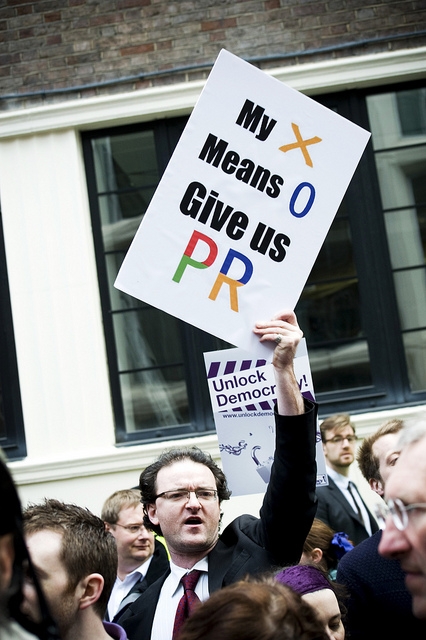
The US, UK and Canada are the only western democracies that still conduct their national elections via archaic “winner takes all” systems. These so-call “first past the post (FPP)” voting systems only give people a choice between two corporate-sponsored candidates. Because the corporate media ignores them, third party candidates are virtually invisible to the vast majority of the public. Thus rather than “wasting” a vote on a third party candidate, progressive and libertarian activists feel pressured to vote for the “lesser of two evils.” Believing they have no voice in a political system controlled by corporations, an increasing number opt not to vote.
The end result is a deeply polarized system of governance in which the party in power only represents a minority of the population.
Countries other than the US, UK and Canada use some type of proportional representation to choose the public officials who represent them. Proportional representation comes in many forms. The two features they all share in common are 1) instead of electing one representative in each small district or ward, multi-member districts (or wards) are established in which several candidates are elected at once and 2) the candidates who win seats in these multi-member districts are determined by the total proportion of votes their party receives.
Life Under Proportional Representation
As an American, I had no prior experience with proportional representation before I emigrated to New Zealand in 2002. In 1993, New Zealand adopted a Mixed Member Proportional (MMP) system, as a result of a citizens initiated referendum. This followed a series of elections in which the FPP system resulted in minority governments opposed by a majority of voters.
Under MMP, each voter gets two votes for Parliament – one for the candidate they prefer and the other for their preferred political party. In addition to candidates who win their electorates, each party receiving at least 5% of the vote is allocated a proportion of seats depending on their percentage of the party vote. These party seats are filled from a pre-chosen list of candidates each party files with the Electoral Commission.
In 2011, the NZ Green Party received 11.06 percent of the vote and were allocated 14 MPs in Parliament.
Having Voice in Government
In more than 20 years as a grassroots organizer in the US, I practically sweated bullets for mostly invisible peace and justice issues (such as single payer health care and the Equal Rights Amendment – does anyone even remember the Equal Rights Amendment?). So you can imagine how thrilling it’s been to see Green Party candidates I campaigned for (in 2005, 2008 and 2011) elected to national government.
It’s sad but true that the two pro-corporate political parties (Labour and National) continue to dominate the New Zealand political landscape. This relates mainly to the overwhelming support they receive from our foreign-controlled media. That being said, when voters are given a real choice, it’s quite rare for either of the major parties to receive a majority of votes. This forces them to negotiate with minor parties to form a government.*
What MMP Has Meant for the Green Party
Although the New Zealand Green Party has never been in formal coalition with either National or Labour, both parties frequently need our vote on their own bills. In return they have supported important Green Party legislation. In the last eleven years, this has included legalization of prostitution and gay marriage; enactment of a national antibiotics surveillance program; a flexible working hours mandate; a school food and nutrition mandate; a law allowing women to breast feed in prison, creation of a complementary health adviser position in the Ministry of Health; repeal of the Sedition Law and a loophole that allowed parents to legally beat their children; millions of dollars for government grants and guaranteed loans for solar water heaters and home insulation; a national cycle trail; restrictions on animal testing and new transparency laws regarding MP accountability.
Perhaps even more important is the platform (and media attention) a presence in Parliament provides to challenge the flagrantly pro-corporate policies of the major parties – while simultaneously advancing Green issues and policies.
Achieving Proportional Representation in the US
People might be surprised to learn that many US cities** have adopted Instant Runoff Voting (IRV) or Single Transferable Voting (STV). This has largely come about due to budgetary restrains stemming from the 2008 downturn (IRV/STV eliminates the cost of holding primary elections). Technically IRV isn’t a form of proportional representation. However it’s much more democratic than FPP because it allows voters to indicate a preference for a minority party without feeling their vote is wasted.
In IRV a voter is asked to rank all the candidates on the ballot in his/her order of preference. If his/her first choice fails to meet a certain threshold, his/her vote is automatically transferred to his second choice and so on.
Electing US Presidents or Senators by proportional representation would require constitutional amendment. However there’s nothing in the Constitution that would prevent states from choosing their Congressional delegation as a bloc by proportional representation or their senators by IRV or STV. Prior to the passage of the 12th amendment in 1803, the President and Vice-President were chosen by STV. The Constitution merely stipulates that each state shall have two senators and that “representatives shall be apportioned among the several states by their apportioned numbers.”
For more information on proportional representation, check out http://www.fairvote.org/
*Under a Parliamentary system, any government that can’t command a majority of votes on budget legislation is forced to resign and call a new election.
**Cities using IRV or STV
- Alabama (only overseas voters): By agreement with a federal court, used in special election for U.S. House, 2013
- Arkansas (only overseas voters in runoffs): Adopted in 2005 and first used 2006
- Berkeley, California: Adopted in 2004 and first used 2010 (for mayor, city council and other city offices)
- Hendersonville, North Carolina Adopted and used as part of a pilot program in 2007, 2009 and 2011 (mayor and multi-seat variation for city council) and under consideration for future elections
- Louisiana (only overseas and out-of-state military voters in federal and state runoffs): Adopted and used since the 1990s
- Minneapolis, Minnesota: Adopted in 2006 and first used in 2009 in elections for mayor, city council and several other city offices, including certain multi-seat elections
- Oakland, California: Adopted in 2006 and first used in 2010 (for a total of 18 city offices, including mayor and city council)
- Portland, Maine: Adopted in 2010 and first used in 2011 (for electing mayor only)
- San Francisco, California: Adopted in 2002, first used in 2004 and used every November election since then (for mayor, city attorney, Board of Supervisors and five additional citywide offices)
- San Leandro, California: Adopted as option in 2000 charter amendment and first used in 2010 and every two years since (for mayor and city council)
- South Carolina (only for overseas voters in federal and state primary runoffs): Adopted and first used in 2006
- St. Paul, Minnesota: Adopted in 2009, first used in 2011 and to be used every two years (mayor and city council)
- Springfield, Illinois (for overseas voters only): Adopted in 2007 and first used in 2011
- Takoma Park, Maryland: Adopted in 2006 and first used in 2007, with elections every two years and with some special elections in between (for mayor and city council)
- Telluride, Colorado: Adopted in 2008 and first used in 2011 (for mayoral elections).
photo credit: lewishamdreamer via photopin cc


 The Most Revolutionary Act