The War Against Children

My next two posts relate to the unspeakable trauma Americans experience as children. The first film concerns the transformation of American schools into virtual prisons. The second discusses the deliberate targeting of children by corporate advertising. In both cases, parents are largely helpless to protect their kids. The scars created carry into adulthood.

The War On Kids

Cevin Soling 2009

Film Review

The main focus of The War on Kids is the Zero Tolerance approach to school discipline. The goal of Zero Tolerance is to keep guns, drugs and so-called “super-predators” out of public schools by treating all students like criminals.

The film is full of examples of high performing students receiving lengthy suspensions (as long as six months) for bringing so-called “contraband” to school. This includes nail clippers, nail files  (“weapons”) and Scope mouthwash, Alka Seltzer, Midol and ibuprofen (“drugs”). The documentary describes one girl being suspended for drawing a soldier with a machine gun. A boy who threatened to throw a spitball at another student was referred to police and charged with felony assault.

The increasing presence of armed police in public schools is especially chilling. Instead of allowing school principals to deal with minor behavior problems, police are called and alleged perpetrators (as young as six) are handcuffed and taken to jail.

Often these arrests violate children’s Fifth Amendment rights, especially when the principal asks the alleged perpetrator to write out a statement and hand it over to the police. This typically happens in the absence of legal representation, parental notification or a Miranda warning that students may be incriminating themselves.

Teaching Learned Helplessness

As part of Zero Tolerance, schools demand absolute conformity in dress, appearance, attitude and behavior. Teachers enforce conformity by constantly bullying and yelling at kids. Curiosity and creativity are systematically discouraged by an educational approach that force feeds kids with information.

Near daily exposure to this brutally oppressive environment is inducing a state of learned helplessness and apathy that persists into adulthood. Students are leaving high school with absolutely no idea how a democratic society functions. In a recent survey, 36% of high school students indicated that all newspapers should seek government approval for the news stories they publish.

Erroneous Information about ADHD

The two parts of the film I have a problem with are one that blames declining achievement on teachers’ unions (an urban myth promoted by neoliberal champions of the charter schools movement) and one in which psychiatrist Peter Breggin and two psychologists assert that ADHD is a fictitious disorder promoted by lazy teachers and drug companies.

Breggin, who is an adult psychiatrist without specialized child psychiatry training, makes a number of assertions that are factually inaccurate. The first relates to the diagnosis of Attention Deficit Disorder (ADHD). Here Breggin quotes out of context from the American Psychiatric Association’s to make it appear that schools and teachers are deliberately trying to drug bright and energetic children to shut them up. He also makes claims that Ritalin and similar stimulants cause permanent brain damage and lead to drug addiction. These are also urban myths which are totally unsubstantiated by peer reviewed research evidence.

The assertion by one of the psychologists that Britain has banned the use of Ritalin in children is a blatant fabrication. In 2010, UK doctors dispensed Ritalin prescriptions for 661,413 British children.

Although ADHD is a genuine disorder documented by decades of careful peer reviewed research, the real issue is that 1) it’s being over diagnosed in the US compared to other countries and 2) American kids who take Ritalin and similar stimulants aren’t receiving adequate medical monitoring. There’s also an alarming increase in children’s prescriptions for antidepressants and antipsychotics – despite the lack of efficacy or safety research in patients under eighteen.

It would have been far more helpful if the filmmakers had stuck to established facts, rather than focusing on urban myths and half truths.

The Myth of Homework

The documentary features excellent segments at the end on cliques, bullying and the failure of homework to enhance learning.

Link to film: http://www.filmsforaction.org/watch/the_war_on_kids_2009/

38 States Call for Constitutional Convention


Washington_Constitutional_Convention_1787

Can Red and Blue States Unite to Save Democracy?

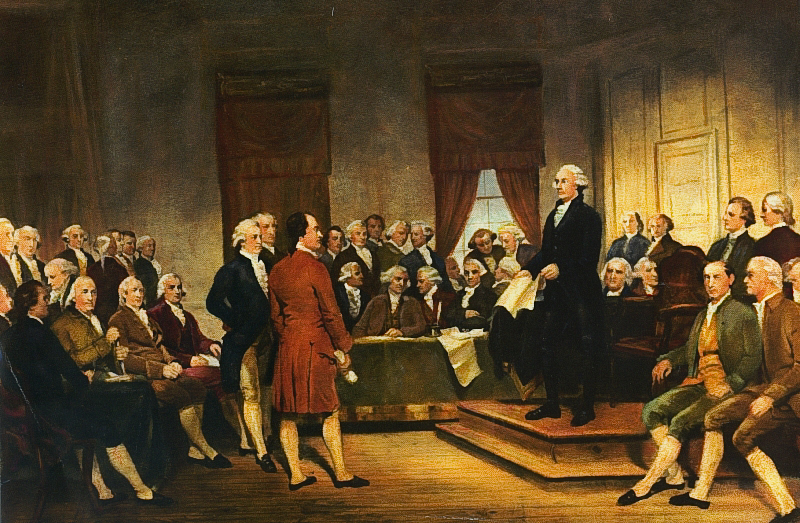
One news item receiving virtually no corporate media attention is that thirty-eight state legislatures have officially requested a constitutional convention under Article V of the US Constitution. There has only been one constitutional convention – the first – in 1787. Article V requires Congress to call a constitutional convention if 2/3 of (34) states request one.

Most, but not all the resolutions are from red states calling for a balanced budget amendment. However two blue states, California and Vermont, have requested a constitutional convention to end corporate personhood and restrict corporate funding for elections.

Tallying the numbers is a bit complicated. According to the Congressional Record, forty-nine states* have requested constitutional conventions. Eleven of these forty-nine states later rescinded their requests.

ALEC Seeks to Restrict Delegate Freedom

Forbes Magazine argues you also have to subtract the states which have passed a delegate limitation act. This would prohibit delegates from considering any amendments other than those requested by their state.

The American Legislative Exchange Council (ALEC), the lobby group founded and funded by the billionaire Koch brothers, is very keen to see all states pass a delegate limitation act and have even drafted model legislation.

ALEC and the corporations they represent believe the delegates to a constitutional convention must be closely controlled to prevent a runaway convention from passing amendments unfriendly to corporate interests – e.g. an amendment ending corporate personhood and limiting the ability of corporations to overrule state and municipal laws. Three states (Georgia, Indiana and Florida) have passed delegate limitation legislation. Another seven states (Idaho, Michigan, New Hampshire, Oklahoma, South Dakota, Virginia, and Wisconsin) are considering it.

Using a Balanced Budget Amendment to Abolish the Fed

Clearly ALEC is calling for a balanced budget amendment in the hope it will force the federal government to cut spending for Social Security, Medicare and other social programs. This strategy could backfire if it leads to a debate on abolishing the Federal Reserve and stripping private banks of their power to create money.

Eliminating federal debt will be extremely difficult, if not impossible without scrapping a system in which nearly all our money is produced as debt (i.e. loans by private banks). There’s growing grassroots support on both the right and the left to abolish the Fed (see James  Corbett’s excellent documentary explaining how banks create money out of thin air.) A constitutional convention could be the ideal scenario to make this happen.

Why Red and Blue States Need to Work Together

red and blue states

California and Vermont are only the first of many blue states in the Move to Amend coalition seeking a constitutional convention to end corporate personhood. The vital question here is whether red states seeking a balanced budget amendment will be open to talking to blue states seeking to limit the de facto ability of corporations to overturn state and municipal laws.

The corporate media has been extremely cagey of late about magnifying the distrust and enmity between the two camps. I find this quite sad as there are many issues on which the so-called “extreme” right and left agree, like ending NSA spying, ending the wars in the Middle East, abolishing the Fed, restoring civil liberties guaranteed under the Bill of Rights, ending the President’s abuse of executive power and curtailing the power of the corporate oligarchy.

I think it’s a very good sign that a non-partisan group called Friends of the Article V Convention is keeping count of the states. There has been some talk the Friends may file suit if Congress fails to set wheels in motion for a constitutional convention.

States Seek Broad Range of Amendments

In addition to requesting a constitutional convention to pass amendmentss calling for a balanced federal budget and an end to corporate personhood, various state petitions seek amendments to limit federal income taxes, to begin negotiations for a world federation (i.e. one world government), to change apportionment for the Electoral College and the House of Representatives, to increase federal revenue sharing, to end federal interference in school management, to guarantee a right to life, to end unfunded federal mandates, to end judicial taxing power, to establish term limits for federal office holders and to restrict new laws to a single subject.

There are a few more I would add to this list, including constitutional amendments abolishing the Electoral College, restoring Posse Comitatus and limiting the ability of the President to rule via executive order. I’m sure readers have their own personal favorites.

*The 49 states which have formally requested a constitutional convention:

  • Alabama: balanced budget, June 2011
  • Alaska: federal fiscal restraints and term limits, April 2014
  • Arizona: ending judicial taxing power, Mar 1996, rescinded 2003
  • Arkansas: right to life amendment, May 1977
  • California: abolish corporate personhood, June 2014
  • Colorado: unfunded federal mandates, June 1992
  • Connecticut: prohibit interstate income tax, May 1958
  • Delaware: balanced budget amendment, Feb 1976
  • Florida: balanced budget, term limits, limit laws to 1 subject, April 2014
  • Georgia: balanced budget, Feb 2014
  • Idaho: limit income tax, April 1989, rescinded 1999
  • Illinois: increase federal revenue sharing, June 1976
  • Indiana: right to life, balanced budget, 1977, 1979
  • Iowa: balanced budget, June 1979
  • Kansas: balanced budget, May 1978
  • Kentucky: change apportionment for House, Oct 1965
  • Louisiana: balanced budget, May 2014
  • Maine: limit income tax, April 1941
  • Maryland: right to life, Jan 1977
  • Massachusetts: right to life, 1977
  • Michigan: balanced budget, Nov 2013
  • Minnesota: change apportionment for House, May 1965
  • Mississippi: right to life, Feb 1979
  • Missouri: unfunded federal mandates, Mar 1993
  • Montana: change apportionment for Electoral College, Mar 1973, rescinded 2007
  • Nebraska: balanced budget, April 2010
  • Nevada: right to life, unfunded federal mandates, June 1979
  • New Hampshire: balanced budget, May 2012
  • New Jersey: right to life, April 1977
  • New Mexico: balanced budget, Feb 1979
  • New York: federal interference with school management, Oct 1972
  • North Carolina: balanced budget, Feb 1979
  • North Dakota: end judicial taxing power, Mar 1996
  • Ohio: balanced budget, Nov 2013
  • Oklahoma: change apportionment for Electoral College, May 1965, rescinded 2009
  • Oregon: balanced budget, Feb 1979, rescinded 1999
  • Pennsylvania: balanced budget, Feb 1979
  • Rhode Island: right to life, May 1977
  • South Carolina: balanced budged Feb 1979, rescinded 2004
  • South Dakota: unfunded federal mandates, rescinded 2010
  • Tennessee: balanced budget, April 2014
  • Texas: balanced budget, Mar 1979
  • Utah: right to life, rescinded 2001
  • Vermont: corporate personhood, April 2014
  • Virginia, change apportionment for House, May 1964, rescinded 2004
  • Washington: change apportionment for House, Mar 1963
  • West Virginia: increase federal revenue sharing, Jan 1971, rescinded 2001
  • Wisconsin: change apportionment for Electoral College, Mar 1963
  • Wyoming: change apportionment for House, mode of amending constitution, Feb 1963, rescinded 2009

Photo credit Wikimedia Commons

Also posted in Veterans Today

The Art of Cult Branding

The Persuaders

PBS Frontline (2005)

Film Review

Unlike The Century of the Self, The Persuaders focuses more on contemporary public relations techniques. This PBS documentary begins by examining growing industry concerns that consumers are becoming “immune” to the unconscious messaging Edward Bernays perfected.

Pseudo-spiritual and Cult Branding

Pseudo-spiritual and cult branding are two of the latest mass marketing techniques. Pseudo-spiritual marketing is designed to convince consumers that brand loyalty will provide identity and meaning in their lives. The stellar success of Starbucks and Nike are given as examples. Starbucks (allegedly) creates meaning in peoples’ lives by offering them a “third place” (not home or work). While Nike offers consumers “transcendence”* through sport.

Inspired by Starbucks’ and Nike’s phenomenal “branding” success, marketing analysts went out and interviewed cult leaders to understand how they won the loyalty of their followers.

Volkswagen, Mac, Harley Davidson, Linux and Saturn are the leading examples of cult brands. By offering a sense of belonging and community, they successfully pitch their brands to consumers longing for the community values which have been lost in contemporary society.

I find this incredibly ironic. First the corporate public relations industry connives to systematically dismantle labor unions and other community groups and institutions. Then they cynically package and market luxury consumer goods to satisfy our unmet needs for civic engagement.

Aiming for “Visceral Appeal”

One of the marketing gurus the film profiles is Frank Luntz, a political consultant renowned for his expertise in using language to promote the “visceral appeal” of political campaigns. His goal is to hit voters at an emotional level that motivates them to act.

Luntz’s credits include helping Newt Gingrich devise the Contract with America to help the Republicans win control of Congress in 1994. Luntz is also responsible for helping Republicans win points on specific issues by reframing them, e.g. by changing “tax cuts” to “tax relief,” “estate tax” to “death tax” and “global warming” to “climate change.”

The Technique of Narrow Casing

The Persuaders concludes by examining “narrow casing,” a campaign technique first developed by John Kerry’s 2004 presidential campaign. Narrow casing is largely credited for Obama’s victory in 2008. It involves data mining the vast amount of information corporations collect on our purchases (mainly via loyalty and credit card records). This data is used to categorize people into demographic groups based on specific issues (health, education, immigration, gun control) that are most likely to appeal to them. This allows campaign teams to beam issue-related advertising to specific groups (via email, direct mail and doorbelling), rather than relying on the more general messaging of mass marketing.

Republican political consultant Karl Rove has been highly successful in using narrow casing around issues such as gun control, immigration and the confederate flag to persuade blue collar white males to vote Republican.

*Transcendence is defined as existence or experience beyond the normal or physical level, as in spiritual transcendence.


http://www.dailymotion.com/video/x16kgyk_frontline-the-persuaders-part-1_creation


http://www.dailymotion.com/video/x16kkkg_frontline-the-persuaders-part-2_creation

Marketing Politicians Through Social Engineering

Social-engineering-attack-scdor-hack

The Century of the Self is a four part BBC documentary that delves deeply into the work of Edward Bernays, commonly known as the father of public relations. Parts 3 and 4 explore the glorification of selfish consumption after World War II and how Reagan, Thatcher, Clinton and Blair perfected the “politics of self” to win and hold power.

The Century of the Self

BBC Documentary (2005)

Film Review

Part 3 (There’s a Policeman Inside All Our Heads) and Part 4 (Eight People Sipping Wine in Kettering)

Link to Part 1 and 2

The Politics of Self

Following World War II, the CIA hired Sigmund Freud’s nephew Edward Bernays to advise them on controlling the “irrational aggression” of the masses. They were concerned that 49% of US soldiers evacuated from combat had to leave the battlefield for “emotional problems.” Today their condition would be diagnosed as post traumatic stress disorder (PTSD).  In the mid-forties, the psychoanalysts who interviewed them diagnosed that they had unresolved conflicts related to their unconscious aggressive and sexual drives.

Convinced these problems were widespread among the greater population, in 1946 the Truman administration championed the passage of the Mental Health Act. The Act funded new guidance centers throughout the US to assist Americans to control and suppress their dangerous unconscious drives.

Meanwhile the public relations industry hired psychoanalysts to set up focus groups to use advertising more effectively to improve consumer demand for corporate products. These early focus groups employed psychoanalytic techniques to help advertisers improve sales by secretly appealing to unconscious needs and insecurities.

Students Opt for Self-Liberation

The anti-Vietnam War movement of the late sixties quickly morphed into a broader anti-capitalist movement that attacked corporations for corrupting government and brainwashing the public. This movement was strongly influenced by Wilhelm Reich and Herbert Marcuse, who had split with Sigmund and Anna Freud over their belief that unconscious aggressive and sexual drives had to be suppressed and controlled. Reich and Marcuse taught that it was repression itself that distorted unconscious aggressive and sexual drives and made them dangerous.

In 1970 the National Guard massacre of unarmed Kent State students in 1970 split in this anti-capitalist movement. For the most part middle class student supporters shifted their focus to “liberating” themselves rather than organizing for political change.

In addition to widespread experimentation with illicit drugs, this shift led to a surge of self-improvement initiatives and therapies, collectively called the Human Potential Movement.

Values and Lifestyle Marketing

Employing computer technology and psychologists trained in self-improvement techniques, the public relations industry adapted to this new individualism and preoccupation with self-expression with “values and lifestyle marketing.”

One of their main strategies was to blur the line between advertising and journalism by incorporating three key messages into news reporting: selfishness is good, the needs of individuals are more important than the needs of society and that only business can properly satisfy individual needs.

The Politics of Self

This deliberate promotion of selfishness and individualism cut across social classes and was a key factor in persuading blue collar voters to vote for Ronald Reagan and Margaret Thatcher – and programs that significantly hurt their own economic interests.

Ultimately it was Bill Clinton and Tony Blair who perfected this new “politics of self” by incorporating focus groups and lifestyle marketing into their political campaigns. Their advisers convinced them that voters had to be regarded as consumers and that the secret to getting elected was by catering (i.e. pandering) to voters’ unconscious primitive selfish desires. It was a hell of a way to run government and would cause the Democrats to get the boot in 2000 and the Labour Party in 2010.

The Science of Thought Control

bernays

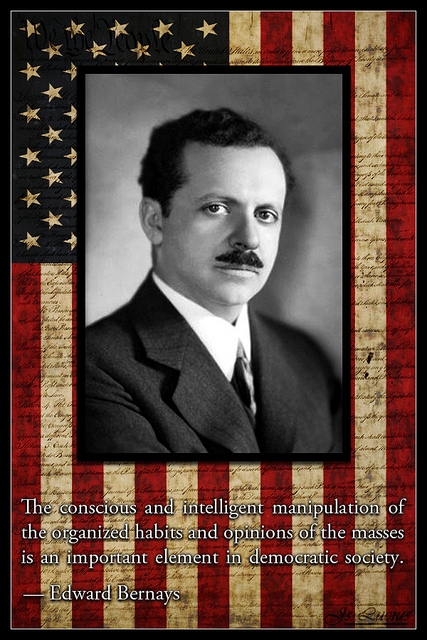
The Century of the Self is a four-part BBC documentary that delves deeply into the life and work of Sigmund Freud’s nephew Edward Bernays. Bernays was the first to perfect the science of thought control. In the political sphere, he referred to mass psychological manipulation as “engineering consent.” When he used propaganda and psychological manipulation to sell corporate products, he called it “public relations.” Parts 1 and 2 focus on the Freudian theories underpinning the early public relations movement.

The Century of the Self

BBC Documentary (2005)

Film Review

Part 1 (Happiness Machines) and Part 2 (Engineering of Consent)

The Transformation from Citizen to Consumer

The twentieth century is frequently referred to as the selfish century. This documentary lays the blame for this at the feet of Sigmund Freud and his nephew Edward Bernays.

Prior to World War I politicians and businesses used facts and information to win votes or to persuade people to buy their products. When Woodrow Wilson hired him to run his Committee for Public Information to produce pro-World War I propaganda, Bernays incorporated Sigmund Freud’s theory that human behavior was based on unconscious instinctual drives. By appealing to these unconscious and irrational feelings, he succeeded in selling World War I to a profoundly isolationist American public

 As well as his pivotal role in engineering corporate and government propaganda, Bernays was also responsible for popularizing Sigmund Freud’s work by emphasizing its sexual content.

 The Shift from a Needs to a Desire Based Culture

Curious whether similar techniques would also work in peace time, Bernays hired himself out to corporations to help them improve their sale of consumer products. His goal was to shift US society from a needs culture, where people only bought what they needed, to a desire culture, where they purchased products to make them feel better. Aware that the word propaganda had an extremely negative connotation, Bernays coined the term “public relations.”

Bernay’s stunning success gave birth to 1920s “consumptionism” and was largely responsible for the economic bubble that resulted in the 1929 crash. Already by 1927, social critics were concerned that Americans were no longer citizens but consumers. Confident of their ability to engineer consumer demand, banks funded national expansion of department store chains and hired Bernays to persuade ordinary people to borrow money to buy shares in the stock market.

Driven to record levels by borrowed money, the stock market collapsed.

During the Great Depression, Bernays shifted gears to focus more on influencing public political views. Neither Freud nor Bernays believed in the equality of man. Frightened by the rise of fascism in Europe, both believed that democracy was a fundamentally unsafe form of government (due to human beings’ dangerous unconscious drives).

Both believed that people must be controlled – that mass democracy could only work if popular consent was engineered. Bernays was also convinced that the best way to control people in a mass democracy was to render them passive consumers – by triggering a continuous irrational desire to consume and satisfying it with consumer goods.

Roosevelt Tries to Rein in Business

Unlike Freud and Bernays, Franklin Roosevelt believed that people were capable of knowing what they wanted and relied on the new science of public opinion polling (pioneered by George Gallup) to ascertain what people were thinking. His response to the Great Depression was to grant himself extensive executive power and subject business to central economic planning, which they hated.

In 1936, the National Association of Manufacturers hired Bernays to initiate an ideological campaign against the New Deal (and the rise of unionism as Alex Carey mentions in Taking the Risk Out of Democracy.

When World War II ended, the CIA hired Bernays to advise them on how to control the “irrational aggression” of the masses. In his CIA role, Bernays devised a campaign for the Eisenhower administration to convince the American public they were under imminent threat from Soviet Communism.

As part of this campaign, Bernays mobilized public and congressional support for the 1954 coup against Guatemala’s democratically elected president Jacobo Arbenz. Bernays also worked for the United Fruit Company, which was concerned about Arbenz’s plans for land reform, i.e. breaking up their extensive Guatemalan banana plantations.

The First Focus Groups

Meanwhile the public relations industry hired psychoanalysts to set up focus groups to use advertising more effectively to improve consumer demand for corporate products. These early focus groups employed psychoanalytic techniques to help advertisers improve sales by secretly appealing to unconscious needs and insecurities.

photo credit: Saint Iscariot via photopin cc

Originally posted in Veterans Today

Corporate Brainwashing and Thought Control


taking the risk

This is the first in a series of posts about “engineering consent,” a form of brainwashing and thought control perfected in the 20th century. Its purpose is to allow the elites who control western democracies to maintain political power without resorting to brute force.


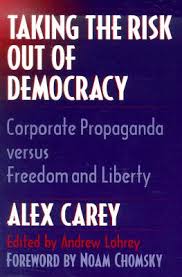
Taking the Risk Out of Democracy: Corporate Propaganda versus Freedom and Liberty

By Alex Carey (1995 University of New South Wales Press)

Book Review

Taking the Risk Out of Democracy: Corporate Propaganda versus Freedom and Liberty is a collection of essays written by Australian psychologist Alex Carey prior to his death in 1988. The essays were posthumously edited and assembled into a book by Andrew Lohey. Carey’s book details the 100 year history of the deliberate manipulation of popular consciousness by the corporate elite.

According to Carey, the main purpose of corporate social engineering is to persuade the voting public to serve the interests of the privileged class, rather than their own working class needs. This type of propaganda relies heavily on emotionally-laden symbols and a black and white view of society in which people and issues are either good or evil. Owing to virtually unlimited corporate financing, it’s spectacularly effective. Conservative regimes that enacted reactionary social policy (in the US) between 1919-1929, 1946-1956, and 1976-2014 didn’t just happen – they were deliberately engineered by the business lobby and corporate propagandists.

Women and Blacks Win Vote

In the view of the US business elite, a dedicated program of social engineering became essential at the beginning of the 20th century when women and northern blacks acquired the right to vote. In 1880, only 10-15% of the US population was eligible to vote. By 1920, this percentage had increased to 40-50%. The corporate elite couldn’t take the risk that this large crop of new voters would elect candidates keen on regulating corporate activities that posed a threat to public health and welfare.

Edward Bernays, known as the father of public relations, played an instrumental role in advancing the art and science of corporate propaganda. During World War I, he assisted Woodrow Wilson, who ran as an antiwar president, in convincing a fiercely antiwar and isolationist American public to support US intervention in the war between Britain and Germany.

Peacetime Propaganda

After World War I, Bernays worked for the National Association of Manufacturers and other corporate groups with a primary agenda of turning public opinion against unions, immigrants and the corporate regulation enacted by President Teddy Roosevelt between 1901 and 1912.

By combining a vast media campaign with concerted employee indoctrination, Bernays created a wave of anti-union and anti-immigrant hysteria. By convincing Americans that corporate regulation was akin to Bolshevism. In this way, he successfully ushered in the first (1919-1921) of three periods of corporate rule. While post-war Europe enjoyed a wave of radical liberalism resulting in the rise of democratic socialism, the US was caught in the grips of a reactionary agenda that would set the stage for the repressive Red Scare and Palmer Raids (in which politically active immigrants were rounded up and deported).

Labor Paralysis, Korea and Vietnam

The other two periods in which a corporate agenda dominated US domestic and foreign policy occurred between 1946-1950 and 1976-80. Between 1929 and 1946, the Great Depression and World War II dramatically curtailed the effectiveness of corporate propaganda. In the late forties, corporate interest groups roared back with a vengeance. The ideological agenda they broadcast on radio and in print media equated free enterprise with freedom and democracy, patriotism with social harmony and the New Deal with creeping socialism. Liberals who supported corporate regulation were portrayed as communist sympathizers. During this period, the Chamber of Commerce launched the first major publicity campaign warning that communists had infiltrated government, universities and other major institutions.

Thanks to these propaganda efforts, in Republicans took control of Congress for the first time since 1928. In 1947 they enacted the Taft Hartley Act (1947), virtually paralyzing American unions. By blanketing the media with their reactionary agenda, pro-corporate ideologues also laid the ground work for the second Red Scare, aka the McCarthy Era from 1950-1956.

Senator Joseph McCarthy’s House Committee on Unamerican Activities had an even more destructive effect on foreign policy than it did on civil liberties. In addition to pressuring Truman to pursue an unwinnable war in Korea, McCarthy also forced Eisenhower to reverse US policy on Vietnam and China. Under Truman, the US State Department had opposed the French return to Vietnam (i.e. they supported Vietnamese independence). They had also sought to mediate (in 1945) between Mao Tsai Tung and Chiang Kai Shek in the Chinese civil war.

After McCarthy succeeded in stripping the State Department of more than 500 personnel with Asian expertise, the ultraconservative, CIA-linked John Foster Dulles succeeded in throwing US support behind the incompetent and corrupt Chiang Kai Shek and transforming French opposition to Vietnamese independence into a battle to prevent world Communist domination.

The Rise of Pro-Corporate Neocons

The anti-Vietnam War, Nixon’s resignation and public anger over against CIA domestic spying led to a strong anti-business backlash during the late sixties and early seventies. Corporate ideologues fought back with the launch of “treetop” propaganda efforts. As opposed to grassroots media-based propaganda, treetop propaganda focuses on recruiting rich conservatives to fund conservative think tanks to promote conservative “economic education” and lobby Congress to defeat consumer protection and labor rights legislation.

The American Institute for Public Policy Research (AEI) (neoconservative think tank founded in 1970), the Heritage Foundation (founded in 1973) and would be instrumental in promoting “economic” ideological beliefs that full employment and clean air and water initiatives are detrimental to the economy because they hurt business. These think tanks also hammered Congress and universities with the notion that the US would collapse under a socialist dictatorship unless corporate regulations were rolled back.

Their success in bombarding all sectors of society with these reactionary ideas would pave the way for Ronald Reagan’s election and the rollback of corporate regulation and social safety net programs that occurred during his administration.

During the early 1970s, these conservative think tanks began exporting these reactionary belief systems to British and Australian corporate interest groups. In Britain, American-inspired treetop and grassroots pro-corporate propaganda would lead to Margaret Thatcher’s election in 1979.

***

Below the 1993 documentary based on Noam Chomsky’s book Manufacturing Consent. The title is based on a term coined by Bernays: “engineering consent.” Carey had studied with Chomsky at MIT.

Originally posted at Veterans Today

CIA Whistleblower Incarcerated for 12 Months Over 911

extreme prejudice

Former CIA asset Susan Lindauer describes how the Department of Homeland Security locked her up on a military base for 12 months and tried to detain her indefinitely without a hearing and drug her with Haldol and other psychotropic medication. Why? Because she possesses extensive documentary evidence that the CIA had foreknowledge of the 9-11 attacks as early as February 2001. This, along with other important documents related to the Lockerbie bombing and the US wars on Iraq and Libya, are published as an appendix in her 2010 book Extreme Prejudice.

Prior to her arrest, Lindauer was the chief CIA asset in charge of Iraqi and Libyan back-channel communications. She was under indictment for five years. Eventually her late partner’s exhaustive efforts to publicize her case paid off and she was granted a hearing – and released.

Towards the end of her talk, she describes her late partner’s conversation with Amy Goodman, host of Democracy Now! Amy’s flimsy excuses for refusing to cover the story, during a period when Lindauer was being held incommunicado at Caswell Air Force Base, aren’t at all surprising. Especially when you have a look at the CIA-funded foundations that finance Democracy Now! See Does the CIA Fund Both the Right and the Left?

Why the FBI Shut Down the US June 4th Movement

june 4Bodies from Tienanmen Square

There has been massive corporate media coverage in the last few days of the 25th anniversary of the June 4, 1989 massacre in Tienanmen Square. The US has always had a very schizophrenic reaction to Chinese human rights violations. Much has been written about the underground June 4th movement that arose in China following the massacre. However you never read anything about the parallel June 4th movement that emerged in the US in the months after Tienanmen Square. It was led by Chinese university and graduate students on campuses all over the US – with the support of American pro-civil liberties advocates across the political spectrum.

For two to three months, it got extensive mainstream media coverage. I recall seeing an article in the Seattle Times about an upcoming meeting at the University of Washington. I planned to attend but came down with the flu.

By September 1989, the US June 4th movement had vanished without a trace. I found this extremely odd until six months later, we learned from a retired FBI investigator exactly how the federal agency had shut it down.

It was quite simple really. The FBI went to all the Chinese students attending the June 4th meetings and told them their student visas would be revoked unless they agreed to inform on the other activists. This is a very old strategy – still in use today (see  FBI allegedly using no-fly list to recruit Muslim snitches). Unsurprisingly the students chose to keep their visas and disband the movement.

Why Bush Senior Shut Down June 4th

So why did Bush senior want the US June 4th movement shut down? In 1989 the President was engaged in major trade negotiations with China. Their big fear was that an American movement would translate into major political and financial support for China’s underground democracy movement. To consummate the trade agreements, Bush senior had to guarantee this wouldn’t happen.

The FBI has a long history of spying on peace and social justice activists. The operation that shut down down the June 4th movement in the US is but one of many examples I discuss in my 2010 memoir The Most Revolutionary Act: Memoir of An American Refugee

photo credit: undersound via photopin cc

The Deep Politics of the Boston Marathon Bombing

boston marathon

Russ Baker, author of Family of Secrets: The Bush Dynasty, America’s Invisible Government, and the Hidden History of the Last Fifty Years (Bloomsbury Press 2009), talks about the myriad of contradictions and unanswered questions in the Boston Marathon Bombing.

Baker is highly critical of the conspiracy of silence by the corporate and alternative media regarding the obvious discrepancies in this case. The “official” version of the bombing and FBI investigation makes even less sense than the official narrative concerning 9-11 or the JFK assassination.

Baker and investigative staff lay out the results of their year-long investigation at his on-line non-profit news site: http://whowhatwhy.com/

In the video below, he also discusses the role of the media in perpetuating a sense of helplessness and apathy in the American people and what we can do about it.

photo credit: thestatusjoe via photopin cc

Is the President Being Blackmailed?

surveillance

 Whistleblower Reveals NSA Spied on Obama Before 2004

In 2005, NSA whistleblower Russ Tice exposed illegal and unconstitutional NSA involvement in widespread surveillance against lawmakers, the Supreme Court and the American public. In the video below, he reveals the NSA was spying on Barack Obama long before his 2004 election to the senate.

Back in 2005, the corporate media dismissed Tice’s allegations, based on NSA assertions he was mentally ill and a liar. Now, based on Edward Snowden’s momentous disclosures, he feels 75% of his claims have been vindicated. He promises there are even more shocking disclosures to come.

Tice states that the Washington Post informed the NSA two weeks before Snowden went public that they had a leak, necessitating Snowden’s urgent flight from Hawaii to Hong Kong.

He also reveals that NSA was already spying on Obama and his family and staff long even before he ran for the US senate. He hypothesizes the NSA may be blackmailing the President, just as former FBI director J Edgar Hoover used his extensive files on Kennedy’s sex life to blackmail John F Kennedy.

According to Tice, this may explain why Obama has reversed himself on so many of his campaign promises, especially those related to the restoration of constitutional civil liberties.

Former intelligence insider Wayne Madsen and other pundits have speculated that Obama is being blackmailed over gay sexual activity in his past.

photo credit: sea turtle via photopin cc