Has the Tough on Crime Era Ended?

Brennan_Center_American_Leaders_April_30_2015-for-cghnyc-drupalb

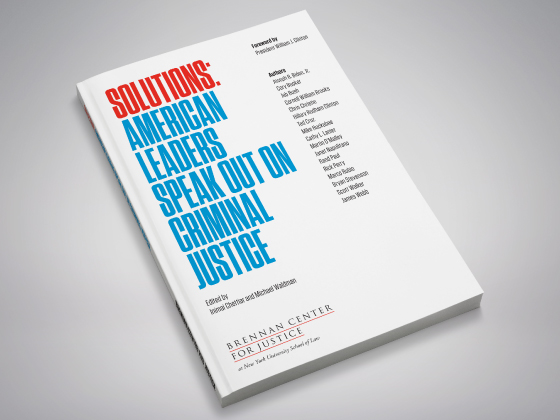
Solutions: American Leaders Speak Out on Criminal Justice

Edited by Inimai Chettiar and Michael Waldman

Book Review

Michelle Alexander’s 2010 book The New Jim Crow has helped spark a national debate on the mass incarceration of Africans. Solutions, a collection of essays, is intended as a response. As many are written by presidential hopefuls, the range of solutions is cautious. None of the authors support the most obvious (and popular) criminal justice reform, namely legalizing or decriminalizing marijuana use.*

Likewise there are no essays by anti-Wall Street senators Elizabeth Warren and Bernie Sanders. Both were viewed as prospective presidential candidates when Solutions was being readied for publication.

That being said, I was intrigued to see so many Republican politicians, both of the neoconservative Christian and the libertarian stripe, abandon their tough-on-crime rhetoric to argue for reducing prison populations. The forward, by Bill Clinton, argues that despite extreme political polarization on other issues, ending the incarceration of Americans for minor and victimless crimes is one area ripe for genuine bipartisan cooperation.

In his essay, Marc Levin, Director of the Center for Effective Justice at the Texas Public Policy Foundation, suggests that conservatives, applying their core principles of personal responsibility, accountability and limited government, have become “the most vocal champions of prison reform.” In this regard, he and other key conservatives have clearly parted company with the Koch brothers and the American Legislative Exchange Council (ALEC), which continues to lobby for tough-on-crime legislation and increasing prison privatization.

Levin and editor Inimai Chettiar hold up Texas, Georgia, South Carolina and Pennsylvania as model states, due to their shift from prison building to community based alternatives. As Levin readily admits, Texas reforms were driven by a need to control ballooning prison costs in an era of severe budgetary shortfalls. He brags how Texas has saved taxpayers billions of dollars by eliminating mandatory minimum sentences (allowing judges more discretion in sentencing), by offering drug and mental health treatment as an alternative to incarceration, by increasing formal rehabilitation and through various measures aimed at increasing the employability of ex-offenders (including a provision for law abiding ex-offenders to seal their criminal record).

A few of the essays read like stump speeches, full of vague ideological platitudes without meaningful detail on how prison reform can be accomplished. Others are surprisingly detailed.

Here are some examples:

Vice-President Joe Biden (D): reads like a stump speech and quotes extensively from Martin Luther King. He calls for restoring police staffing cuts and more genuine community policing. Doesn’t explain where the funding will come from, given the massive debt this administration has racked up for bank bailouts and the wars in the Middle East.

Hillary Clinton (D): reads like a stump speech, with frequent references to what Robert Kennedy would do and “my friend” Nelson Mandela. Calls for respect for the law, ending inequality, reforming mandatory minimum sentencing, ending racial profiling by the police, increasing use of drug diversion (ie mandatory treatment as an alternative to incarceration), restoring police staffing cuts, increasing community policing and restoring voting rights to ex-offenders. She also makes no mention of how all this would be funded.

Ted Cruz (US Senator Texas – R): calls for more jury trials and an end to mandatory minimum sentencing. Proposes a federal law requiring prosecutors to disclose all exculpatory** evidence before an accused can enter into a plea bargain. Also supports the Military Justice Improvement Law. This would increase military convictions for rape by transferring responsibility for prosecution from unit commanders to independent federal prosecutors.

Mike Huckabee (former Arkansas governor – R): would eliminate waste by treating drug addicts, rather than incarcerating them. He would also work to build character in American young people by strengthening families.

David Keene (former president of the National Rifle Association (NRA) and the American Conservative Union: would reduce the number of crimes punishable by prison, end three strikes laws (which require mandatory life imprisonment for a third felony), amend grounds for probation revocation so they’re only used to protect communities from violent criminals and end arbitrary police violence against African Americans for nonviolent crimes.

Martin O’Malley (former Maryland governor – D): would abolish the death penalty because it’s expensive, ineffective, wasteful and unjustly applied (poor minorities are far more likely to receive the death penalty because they can’t afford adequate legal representation). He states that only six other (mainly authoritarian) countries have the death penalty: Iran, Iraq, China, North Korea, Saudi Arabia and Yemen. (For some reason he omits Egypt.)

Rand Paul (US Senator Kentucky – R): would end mandatory minimum sentencing, police militarization, disproportionate sentencing of minorities for drug crimes and civil asset forfeiture laws.** He would also allow juvenile/nonviolent offenders to have their criminal records sealed.

Rick Parry (former Texas governor – R): calls for increasing use of drug courts, expanded rehabilitation and mandatory drug and mental health treatment in lieu of incarceration.

Marco Rubio (US Senator Florida – R): would require federal government and regulatory agencies to publish all federal laws and regulations in one place, would end civil forfeiture laws and would rein in “out of control” regulatory agencies. (Me, too. I think they should start putting corporate white collar criminals in jail, but I doubt this is what he means).

Scott Walker (Wisconsin governor – R): advocates for more workplace drug testing and more programs to reduce heroin addiction.

James Webb (former US Senator Virginia – D): would appoint a federal commission on mass incarceration to study the problem some more (you can’t make this stuff up).


*At present marijuana has been legalized for recreational purposes in four states (Washington, Oregon, Alaska and Colorado) and for medical purposes in 11 other states. Marijuana possession has been decriminalized or reduced to a misdemeanor in many other states. Cannabis possession for any purpose remains a felony in only six states (Wisconsin, Texas, South Carolina, Oklahoma, Louisiana and Alabama).
*Exculpatory evidence is evidence that tends to exonerate a defendant of guilt.
**Civil asset forfeiture is a legal tool that allows law enforcement officials to seize, (without due process) property they assert has been involved in certain criminal activity. The burden remains on the defendant to initiate separate legal action to recover their property, even if they’re acquitted or charges are dropped.

Solutions is published under a Creative Commons license and can be downloaded free at Solutions
Erin Brokovich – Fluoridation Must End

Reposted from Fuoride Free New Zealand:

Erin Brockovich has called for an immediate repeal of all laws that require or enable fluoridation; holding of Fluoridegate hearings; and for professional associations and advocacy groups (who have never studied the science) to rescind allowing their names to be used to endorse fluoridation.

Erin Brockovich is famous for her work in bringing litigation against Pacific Gas and Electric (PG&E) for contaminating groundwater in Hinkley, California, with carcinogenic hexavalent chromium. PG&E told Hinkley residents that they used a safer form of chromium. The true story was later made into the 2000 feature film, Erin Brockovich.

Fluoride Free NZ completely supports Erin Brockovich’s stance.

The Ministry of Health has constantly denied the fact that fluoridation chemicals are industrial waste products contaminated with heavy metals such as lead, arsenic and mercury. This contamination is allowed under an industry-set (not government-set) standard for fluoridation chemicals. A recent request to the Ministry of Health Oral Health division to have the actual source of fluoridation chemicals added to the government’s website fluoride facts has been denied. If the Ministry of Health is so proud of their much vaunted water fluoridation programme they seem awfully shy in sharing the actual details.

Read full article at Fuoride Free New Zealand:

Shredding the Constitution: Obama’s War on Whistleblowers

War on Whistleblowers: Free Press and the National Security State

Robert Greenwald (2015)

Film Review

War on Whistleblowers details the cases of four US whistleblowers who experienced severe government retaliation after exposing systematic wrongdoing to journalists.

The men profiled are marine Franz Gaye, who broke the story about the Pentagon refusal to replace Humvees with much safer MRAPs in the US occupation of Iraq; NSA senior executive Thomas Drake, who first blew the whistle on illegal NSA mass surveillance; Lockheed-Martin engineer Michael DeKort, who broke the story that Lockheed was supplying the Coast Guard with substandard boats and radios that weren’t waterproof; and Department of Justice lawyer Jim Risen, who first exposed the Bush administration’s warrantless wiretaps.

Their stories are interspersed with commentary by iconic whistleblowers Daniel Ellsberg and Edward Snowden (via Internet linkup), as well as the handful of journalists who have been brave enough to publish evidence of government corruption and criminality and members of the Project on Government Oversight and the Project for Government Accountability.

Each of the four whistleblowers went up his workplace chain of command in his agency and exhausted every option for addressing the problem internally. Each was fully aware of the potential consequences of their actions of going to the press. Yet after much soul searching, they saw whistle blowing as a preferable alternative than to colluding in their superiors’ criminality.

Paying the Price

Only Gaye was allowed to resume his career as an active duty marine. DeKort had his Lockheed position cancelled and was blackballed from further work in the defense industry. In addition to losing their jobs, both Drake and Risen experienced financial ruin, spending tens of thousands of dollars fighting felony charges the Obama Justice Department brought against them. Drake was charged under the Espionage Act, even though the information he shared with the Baltimore Sun was unclassified.

After seven years of persecution by the Justice Department, Drake eventually pleaded guilty to a misdemeanor: excessive use of a computer without authorization. The charges against Risen were dropped after four years of legal battles.

The Distinction Between Leaking and Whistle Blowing

The film makes the clear distinction between leaking and whistleblowing. High level Obama administration officials constantly leak classified information to the press with no legal consequences.

Despite his campaign promises to make government more transparent and accountable, Obama has significantly increased government secrecy, as well as prosecuting more whistleblowers than all other presidents combined.

According to Snowden, the President’s purpose isn’t to make Americans more secure. It’s to protect government agencies and politicians from embarrassment a criminal prosecution.

His crackdown on whistleblowers is also a fundamental violation of the First Amendment. The whole intent of freedom of speech and the press is to ensure citizens’ right to criticize their government without being punished.

The Global Refugee Scandal

Europe or Die

VICE News (2015)

Film Review

According to UNHCR (the UN High Commission for Human Rights), more than 50 million people have been permanently displaced through wars in the Middle East, political persecution, climate change and grinding poverty. Of these, hundreds of thousands face such life threatening conditions at home that they risk death by crossing the Mediterranean in rusty, leaky, overcrowded boats.

Refugees typically take one of four routes in their desperation to reach Europe: illegal entry into one of the two Spanish enclaves in Morocco, a short choppy boat trip from Turkey to the Greek island of Lesbos or across the Avros River into mainland Greece, jumping a wire fence from Greece into Bulgaria or crossing the Mediterranean from Libya to the Italian island of Lampedusa.

Europe or Die is a four part documentary follows some of these migrants on their dangerous voyage and closely examines their treatment by EU countries on their arrival.

This documentary was a real eye opener for me. Given the majority of these refugees are the helpless victims of proxy wars started and funded by the US and wealthy EU countries, their refusal of to adopt consistent and humane immigration policies is clearly a crime against humanity under international law.

Part I: For most sub-Saharan refugees seeking illegal entry to Ceuta and Melilla, the two Spanish enclaves on the Moroccan coast, the best option is to jump three high razor wire topped fences. Under EU law, the first fence demarcates the Spanish border. Refugees who make it past the first fence (it’s really a kind of game) are home free and must be given the option of moving to mainland Spain. They’re also entitled to legal assistance and an interpreter to help them apply for asylum.

The most common is for thousands to storm the fence simultaneously and overwhelming the border guards. Typically two out of 1,000 will get through. It’s illegal, under EU law, for Spanish police to forcibly return them. However “pushbacks,” as they are called are common. As is shooting their hands and feet to make it harder to climb the fence. This is also against the rules.

Part 2: A second common route for migrants is to take the “death boat” from Turkey to the Greek island of Lesbos or across the Avros River to mainland Greece. Refugees can pay smugglers several thousand dollars to cram them into shabby, overcrowded boats that frequently capsize.

Greece is experiencing a five-fold increase in illegal migration as a direct result of the civil war in Syria. Recently they have experienced a big influx of Iraqi refugees (mainly Yazidis*) with the rise of ISIS. As part of the game, the EU has another law, called the Dublin rule, that political refugees become the responsibility of the country where they are first picked up, irregardless of the country’s ability to provide jobs or social services.

Part 3: A third route is to cross the razor wife fence separating Turkey from Bulgaria, the poorest country in the EU. Bulgaria keeps political refugees in unheated tents without access to clean water. Once they are granted asylum they are forced to leave the camp and end up homeless on the streets.

Part 4: The final, most common method of reaching Europe is to cross from Libya to the Italian Island of Lampedusa. Up until a few months ago, the Italian Navy operated the only search and rescue mission in the Mediterranean. Called Mare Nostrum, it was made up of 900 personnel and 26 naval vessels – at a cost of $9 million euros a month.

In 2013, Mare Nostrum saved 150,000 migrants from boats that had capsized. Owing to the refusal of the EU to support this fantastically expensive program, it had to be cancelled in 2014.

It’s been replaced by Triton, an air surveillance program that requests nearby merchant vessels (if there are any) to rescue migrants in leaky votes.

In 2014, 170,000 migrants made it safely to Italy and 3,000 drowned.


*Yazidis are a Kurdish ethnic group ISIS attempted to exterminate in August 2014.

America’s Favorite Billionaires

The Koch Brothers Exposed

Robert Greenwald (2014)

Film Review

The Koch Brothers Exposed examines the myriad of ways America’s favorite billionaires are using their inherited wealth to make themselves the dominant players in the US political system.

Their father Fred Koch made his fortune in the 1920s by helping Stalin establish the Soviet oil industry. On his death, Charles and David Koch used their inheritance to found Koch industries, the second largest privately* held corporation in the US. It has holdings in oil and gas, coal, paper products, plastic and consumer goods.

Koch Industries is notorious for breaking environmental laws (and other crimes, such as stealing 2 million barrels of oil from Indian reservations**). They have paid millions in fines in seven states for criminal pollution. Thanks to their generous campaign donation, George W Bush reduced the 97 counts in one federal indictment to one count – lowering their fine from $370 to $20 million.

Their Georgia Pacific plant in Crossett Louisiana, which discharges toxic chemicals to natural streams (illegal under the Clean Water Act), is responsible for more than a dozen cancer deaths. Yet instead of stopping the toxic discharges and cleaning up the streams, the Koch brothers bribe Republican politicians (through campaign donations and other perks) to weaken and discredit the Environmental Protection Agency (EPA), the entity responsible for enforcing the Clean Water Act.

Determined to roll back the Civil Rights Act, the Voting Rights Act, the minimum wage, labor rights, electoral financing reform, environmental protection laws and federal and state workplace safety laws, the brothers have spent more than $80 million creating and funding conservative and libertarian think tanks and Astroturf organizations – such as Americans for Prosperity and the Tea Party. They are also the primary funders, along with Exxon, of the climate denial movement.

They provided the financial backing in the Citizens United case***, in addition to sponsoring the attendance of two Supreme Court justices at an Americans for Prosperity conference. The prior involvement of Clarence Thomas and Antonin Scalia in this Koch brothers group posed a clear conflict of interest. Both had an ethical and legal obligation to recuse themselves. Obviously they didn’t.

The Koch brothers are also major funders and backers of Canada’s tar sands industry and the Keystone pipeline, as well as the American Legislative Exchange Council (ALEC). The latter writes model legislation for state legislators to use in creating vote suppression, labor rights and workplace safety legislation, as well as laws promoting anti-immigrant campaigns and prison privatization.

Meanwhile the Koch Foundation uses educational grants to over 150 cash-strapped colleges and universities to influence their educational policies. The grants are always conditional, ie dependent on hiring professors who share the Koch brothers conservative philosophy.


*A privately owned corporation is one in which partners provide the capital and share the profits, as opposed to publicly owned corporations in which shareholders provide the capital and share in the profits.
**Charles and David’s younger brother Bill blew the whistle on this operation in 1999.
***Citizens United v. Federal Election Commission was a constitutional law case in which the Supreme Court ruled that the First Amendment prohibits the government from restricting independent political expenditures by nonprofit corporations, for-profit corporations and labor unions. According to investigative reporter Greg Palast, a major agenda behind the decision was to retroactively decriminalize extensive past donations the Koch brothers had already made to Republican campaigns – in other words to keep them out of jail.

Shadow Government: Neither Secret Nor Invisible

national security and double governmentNational Security and Double Government

by Michael J Glennon (2014)

Available as free PDF: http://harvardnsj.org/wp-content/uploads/2014/01/Glennon-Final.pdf

National Security and Double Government is a lengthy article about the highly visible national security bureaucracy that presently runs the US government. The author, Michael J Glennon, is Professor of International Law at the Tufts University Fletcher School of Law and Diplomacy. Glennon disputes the claim by conspiracy theorists that a secret shadow government is attempting to overthrow constitutional democracy. In his view, the deep state is simply a vast, self-serving bureaucracy of technocrats – forty-six (as of 2011) federal departments and agencies engaged in intelligence gathering and analysis, military aggression, cyber operations and weapons development.

Glennon’s description of how the deep state operates, which strikes me as depressingly accurate, shatters any lingering illusions about reforming the US government. It can only be dismantled.

In essence, the real work of the US government is controlled by several hundred officials who run the national security bureaucracy. Removed from public view and the constitutional restrictions that restrain the President, Congress and the judiciary, they make most of the key decisions concerning foreign policy and national security. Although their budget is classified, Glennon estimates it engages millions of employees at an annual cost of $1 trillion.

The “Trumanite” Arm of Government

Glennon calls them the “Trumanite” arm of government because President Harry S Truman created the US national security apparatus. Under Truman, Congress enacted the National Security Act of 1947, which unified the military under a new Secretary of Defense, set up the CIA, created the modern Joint Chiefs of Staff, and established the National Security Council (“NSC”). Truman also set up the National Security Agency (NSA) to monitor  communications abroad. Truman’s vision was to create a civilian infrastructure strong enough to address the Soviet threat and rein in an errant military.

Both the Trumanite arm and the constitutional arm work really hard to maintain the fiction that the President is commander-in-chief. The reality is that the president only has the power to appoint 3,000-4,000 of the millions of federal employees nominally under his control. This means the Trumanite bureaucracy continues to operate pretty much under its own steam no matter which party is in office.

As Glennon describes it,

“President Obama could give an order wholly reversing U.S. national security policy, but he would not, because the likely adverse consequences would be prohibitive. Put differently, the question whether the President could institute a complete about-face supposes a top-down policy-making model. The illusion that presidents issue orders and that subordinates simply carry them out is nurtured in the public imagination by media reports of ‘Obama’s’ policies or decisions or initiatives, by the President’s own frequent references to “my” directives or personnel . . . But true top-down decisions that order fundamental policy shifts are rare.

The reality is that when the President issues an “order” to the Trumanites, the Trumanites themselves normally formulate the order. The Trumanites cannot be thought of as men who are merely doing their duty. They are the ones who determine their duty, as well as the duties of those beneath them. They are not merely following orders: they give the orders. They do that by ‘entangling’ the President… To avoid looking like a bystander or mere commentator, the President embraces these Trumanite policies, as does Congress, with the pretense that they are their own.’

Obama Forced to Agree to Drone Policy

As an example, Glennon quotes Vali Nasr’s* description of how the national security network strong armed Obama into expanding his drone policy:

When it came to drones there were four formidable unanimous voices in the Situation Room: the CIA, the Office of the Director of National Intelligence, the Pentagon, and the White House’s counterterrorism adviser, John Brennan.”

Defense Secretary Robert Gates, a holdover from the Bush administration, also strongly supported an increase in drone strikes. All five also suppressed any debate in national security meetings of the broader implications of this policy.

According to Nassr, it was the classic Henry Kissinger model: “You have three options, two of which are ridiculous, so you accept the one in the middle.”

Obama openly complained about the Trumanites only given him one option: “The military was “really cooking the thing in the direction that they wanted. They are not going to give me a choice.”

Obama Also Opposed Increasing Troop Levels in Afghanistan

Obama’s 2009 proposal to lower the military’s proposed troop levels in Afghanistan ran into the same unified opposition. According to Glennon, the Commander of U.S. and International Security Assistance Forces (“ISAF”) in Afghanistan (General Stanley McChrystal), the Commander of U.S. Central Command (General David Petraeus), the Chairman of the Joint Chiefs of Staff (Admiral Michael Mullen), and even Secretary of Defense Gates all threatened to resign over it.

As Glennon observes,

“No president has reserves deep enough to support a frontal assault on the National Security network. Under the best of circumstances, he can only attack its policies one by one, in flanking actions, and even then with no certainty of victory. Like other presidents in similar situations, Obama thus had little choice but to accede to the Pentagon’s longstanding requests for more troops” in Afghanistan.”

Clinton’s “Don’t Ask Don’t Tell” Fiasco

He reminds us of the uproar in the military and Congress when President Bill Clinton moved to end only one national security policy shortly after taking office—the ban on gays in the military. Forced to backtrack, Clinton ultimately enacted his “Don’t Ask, Don’t Tell” policy.

Glennon goes on to explore similar paralysis the President and Congress are experiencing in attempting to curtail spying by the NSA.

The final section of the article reviews possible options for reform and concludes the national security bureaucracy is too powerful (and has too much control over the media) to be reformed by constitutional means. Glennon believes that the only option for change is a bottom-up mobilization by the American people.

*Vali Nasr is dean of the Johns Hopkins School of Advanced International Studies. David E Sanger quotes him in Confront and Conceal: Obama’s Secret Wars and Secret Use of American Power.

This is What Democracy Looks Like

2014 marks the fifteenth anniversary of the Battle of Seattle, the week of protests in November-December 1999 that shut down the World Trade Organization (WTO) Third Ministerial Round. Also known as the Doha Round, the intention of these negotiations was to significantly expand the power of multinational corporations to challenge democratically enacted labor, environmental and health and safety laws.

Opening ceremonies had to be canceled on November 30, when seventy to one hundred thousand global protestors stormed downtown Seattle and hundreds of activists chained themselves to cement pipes to block delegates’ access to the Paramount Theater. The police riot which ensued was our first encounter with the police militarization that would characterize the new millennium. Rather than simply arresting them, Seattle police beat, tear gassed and shot rubber bullets at peaceful protestors, journalists and passersby alike.*

Organizing Began in January 1999

I still lived in Seattle in 1999 and participated in the local organizing. We began in January 1999 when Mike Dolan, Public Citizen’s national field organizer, called the first planning meeting at the Seattle Labor Temple. Dolan continued to visit Seattle for monthly meetings, as well as coordinating organizing efforts in Los Angeles, San Francisco, New York, Washington DC and other major US cities.

The biggest challenge in organizing the anti-WTO protest was that hardly any Americans had heard of the WTO in 1999, much less recognized the immense power Clinton was handing to private corporations with the North American Free Trade Act (NAFTA) and the Global Agreement on Tariffs and Trade, the treaty that created the WTO in 1994.

With 100,000 activists descending on Seattle, it became necessary to set up a home stay network to provide them with accommodation. I hosted seven activists in my home, two each from Los Angeles and Alaska, and three from the Mendocino County Rainforest Action Network.

The IFG Teach-In

The week started Friday night November 26, when 3,000+ of us packed into Seattle’s Symphony Hall for a two day teach-in organized by the International Forum on Globalization. World famous anti-globalization activists (including Indian anti-GMO activist Vendana Shiva, Malaysian economist and journalist Martin Khor, Canadian water activist Maude Barlow, Canadian environmentalist David Suzuki, French farmer activist Jose Bove, Ghanaian farmer activist Tete Hormeku, anti-sweatshop organizer Kevin Danaher and Owens Wiwa, brother of executed Nigerian environmental activist Ken Saro-Wiwa) each gave twenty minute presentations, followed by questions and small group discussion at the Seattle Art Museum across the street.

Maria Galaradin recorded all the presentations and has many of them archived at TUC Radio

On November 27-29, there were a series of small non-confrontational protest actions organized by specific interest groups. On November 28, I participated in a protest march to the Cargill grain elevator at the port to protest the corporate takeover of global food production by large companies such as Cargill and Monsanto. It was led by representatives of the Zapatistas, Via Campesino and the US National Family Farm Coalition.

Protest organizers had scheduled the main protest, involving fifty thousands global trade unionists and tens of thousands of farm and environmental activists for November 30, the day WTO negotiations were meant to start. We had planned three days of workshops and small localized protests for December 1-3.

Mayor Paul Schell Declares Martial Law

All this changed when Mayor Paul Schell declared martial law and made it illegal to carry anti-WTO signs, wear anti-WTO buttons, chant anti-WTO slogans or carry anti-WTO leaflets into downtown Seattle. Angered by the unprovoked police violence and suspension of our first amendment rights, organizers cancelled all previously scheduled events. Instead we held daily spontaneously organized marches into downtown Seattle – in direct defiance of Schell’s suspension of the Constitution.

Both of the videos below were produced in 2000. The first, Trade Off, by documentary filmmaker Shaya Mercer, focuses mainly on Dolan, his organizing strategy and the wide range of international organizers and groups who helped make the protest possible.

The second video This is What Democracy Looks like was produced by Seattle Independent Media Center, which would spawn the birth of the global IndyMedia network. This film focuses more on the militarized police violence against peaceful protestors and the role of the week long protests in convincing third world WTO delegates to reject the draconian demands of the US and its first world allies.

Obama Resorts to Secret Treaties

Despite numerous attempts by the Bush and Obama administrations, the Doha Round of negotiations was never revived – thanks to the staunch stance of third world delegates.

Obama’s solution has been to try to introduce the same draconian corporate protections through two secret treaties, the Transpacific Partnership Agreement (TPPA) and the Transatlantic Trade and Investment Partnership (TTIP). Negotiations for both treaties are being held in total secret. Although 600 corporations have been allowed to see (and write) the both of them, members of Congress and national parliaments are forbidden to see either treaty until they’re signed. Several sections of the TPPA draft have been leaked by Wikileaks. See New Zealand Kicks Off Global Protest Against TPPA

Obama is lobbying for fast track authority on TPPA. Under fast track, the Senate would be forced to vote the treaty up or down without debating its provisions. Congressional Democrats defeated Obama’s efforts to win fast track on TPPA earlier this year. Recently, however, the President expressed confidence a new pro-business Republican Congress will grant him this authority in 2015.


*Seattle Chief of Police Norm Stamper resigned one week after the WTO protests. He subsequently apologized, in 2009, for excessive and inappropriate use of force by Seattle police. In 2007, a federal jury ruled the city of Seattle was liable for arresting protesters without probable cause, a violation of their constitutional rights. As a result the city awarded a $1 million settlement to the 600+ activists arrested during the 1999 protests.
**The Zapatistas are a Mexican international liberation army founded in 1994 in reaction to the North American Free Trade Act (1994). They control several autonomous areas in rural Chiapas.
***Via Campesina is an international movement which coordinates peasant organizations of small and middle-scale producers, agricultural workers, rural women, and indigenous communities.

All Wars are Bankers’ Wars

john adams quote

All Wars Are Bankers’ Wars

Michael Rivero (2013)

Film Review

The purpose of war, according to this brief documentary by radio host Michael Rivero, is to force central banks on countries that try to issue their own money.He makes a compelling argument, illustrated by numerous historical examples. The film’s main value, in my view, is in dispelling common misconceptions about where money comes from. Contrary to popular belief, western democracies don’t issue the money they use to run government services. They borrow the money at interest from privately owned central banks. In the US, this private central bank is called the Federal Reserve.

The American Revolution

Rivero begins by quoting Benjamin Franklin, who saw George III’s Currency Act as the main trigger for the American Revolution. The Currency Act prohibited colonists from using colony-issued currency. Instead they were required to use English bank notes. The latter were borrowed at interest from the England’s private central bank, the Bank of England. This interest payment amounted to a de facto tax on each and every financial transaction.

After the Revolution, the new American government returned to issuing its own currency. This ended in 1791, when Alexander Hamilton persuaded Congress to appoint a private central bank to finance government services. The First Bank of the United States was funded (at interest) by the Bank of England, which was controlled by Nathan Mayer Rothschild.

The War of 1812

Plagued by inefficiency and corruption, the First Bank of the United States was so unpopular that Congress ignored Rothschild’s threats and refused to renew its charter in 1811. Rothschild, whose control over British money enabled him to control both the economy and Parliament, had warned that Britain would declare war to re-colonize the US unless Congress renewed the charter. Although the US won the War of 1812, they were forced to charter the Second Bank of the United State in 1816 to repay their massive war debt. American’s second central bank lasted until 1832, when voters returned Andrew Jackson to a second term based on a campaign promise to shut it down.

The Civil War

From 1832-1862, the so-called “free banking era,” all banks were state charted. In 1862 Lincoln created a national system of banks to fund the federal government and issue currency. When he authorized the US Treasury to issue $150 million in interest-free “greenbacks,” the London Times called for the destruction of the US because of the major threat this posed to the global economy (i.e. international bankers). To punish Lincoln, England and (and France) would provide financial and material support to the southern Confederacy.

Government-issued currency ended for good in when the Wall Street banks conspired with Woodrow Wilson to create a permanent (private) central bank. The Federal Reserve Act was  written in secret by the US banking establishment and rammed through Congress during the 1913 Christmas recess.

World War I and II

According to Rivero, World War I was also a banker’s war, intended to punish Germany for the strict limitations it imposed on its central bank. At the end of World War I, the Treaty of Versailles forced Germany to repay all the war debts of the other European countries, even though Germany hadn’t started the war.

Crushed by this war debt, the only way Hitler could salvage the German economy was to abolish Germany’s central bank and return to interest-free government-issued currency. This move, which infuriated international bankers, resulted in rapid Germany re-industrialization when the rest of the developed world was mired in deep economic depression. It was lauded internationally as the “German miracle.”

Meanwhile in 1933, American bankers and industrialists plotted a “Bankers’ Putsch,” an attempted military coup against Roosevelt. Their goal was to install corporate fascism in the US, along the lines of Mussolini’s government in Italy. General Smedley Butler, the war hero they enlisted to lead the coup, foiled it by exposing it to the House McCormick-Dirkson Committee. The largely pro-business committee instituted a cover-up, until journalist John Spivac uncovered their secret report in 1967.

Breton Woods

In 1946, following World War II, forty-four nations signed an agreement at Breton Woods New Hampshire for the US dollar to replace the British pound as the world’s reserve currency. This was done with two stipulations: 1) that the US dollar would be redeemable for gold at a price of $35 an ounce and 2) that the Federal Reserve wouldn’t issue more dollars than they could redeem in gold.

Because the Federal Reserve is a private banking network, the federal government has no control whatsoever over the quantity of US dollars they issue. In 1971, it became obvious that the Fed was issuing far more dollars than it could redeem (the vast majority of money the Fed creates is electronic money – only about 3% is in notes and coins*). When France asked to redeem its dollar reserves for gold, Nixon unilaterally suspended the gold standard agreed at Breton Woods.

The Birth of the Petrodollar

At this point the US dollar became a “fiat” currency, theoretically back by nothing. In reality, it was backed by oil, through a complex agreement whereby the US agreed to “defend” countries (i.e. not destabilize or declare war on them) if they committed to buying and selling oil in dollars, aka “petrodollars.”

According to Rivero, the US invasion against a long list of Muslim countries is an indirect result of this agreement. Islam prohibits lending money at interest. As Rivero points out, none of seven Muslim countries retired General Wesley Clark has identified as targets for US military aggression (Iraq, Iran, Syria, Libya, Sudan, Somalia, Lebanon) had private central banks prior to US invasion and occupation.**

Historical Inaccuracies

Apart from several minor historical inaccuracies (eg the purpose of Executive Order 11110 that John Kennedy signed in 1961 and Nixon’s alleged pledge of the National Park system as security on US debt), the film serves as an excellent introduction to the hidden role played by private banks in issuing and controlling the global money supply.


*See 97% owned
**Retired General Wesley Clark first revealed the existence of this campaign to conquer the Middle East and North Africa during a Democracy Now interview in 2007.

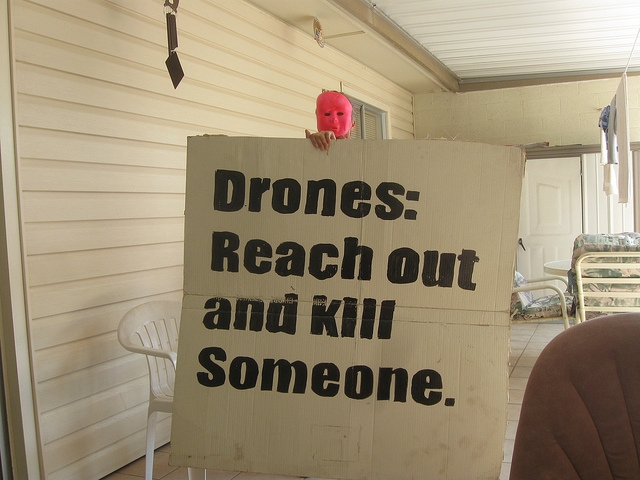
photo credit: Serfs UP ! Roger Sayles via photopin cc

Also posted at Veterans Today

Drone Nation

drones

Part 5 of Counter-intelligence: Shining a Light on Black Operations

The final episode of Counter-intelligence is dedicated to drone technology and Barack Obama’s virtual repeal of the Fifth Amendment. The Fifth Amendment of the Bill of Rights guarantees that “no person shall be deprived of life, liberty or property without due process of law.” Obama’s National Defense Authorization Act (NDAA) allows the government to detain individuals indefinitely without charge, trial or conviction. Obama has also granted himself the authority, via executive order, to arbitrarily execute civilians (including American citizens) without due process, evidence or accountability to Congress or the courts. Both overturn hundreds of years of common law preventing the rich and powerful from using government to attack their personal enemies.

Filmmaker Scott Noble reminds us that Obama deliberately leaked details of his weekly White House “kill list” meetings. Individuals are added to the kill lists, which are maintained by the CIA and a covert unit of the U.S. military called the Joint Special Operations Command (JSOC)*, following “determinations” that secret criteria are satisfied. Noble maintains the primary purpose of the leaks of the leak was to terrorize Americans into submission.

Death by Drone

Thus far, the only presidential assassinations we know of have been carried out by drones. “Drone Nation” highlights the cold impersonality of a technology that’s conveniently similar to video games teenager males are raised on. Thus it comes as no surprise that drone victims are dehumanized (they’re called “bug splats”) in the eyes of young drone operators who sit behind consoles thousands of miles away.

Nor that drone strikes typically target random groups of people, such as wedding parties. Drone technology has no capability of distinguishing between civilians and combatants. 98.5% of all the people killed by CIA drones are civilians – only 1.5% are so-called “high value targets.”

Insect-sized Drones

Even more frightening are the millions of dollars the Pentagon is shelling out for killer robot research, including hummingbird and insect sized drones that require no human operator.

By 2020 tens of thousands of drones will be flying in US skies.

The series ends with a moving tribute to all the whistleblowers who made the documentary Counter-intelligence possible.

*JSOC is covered in Part 1 of Counter-intelligence.


Counter-intelligence: Shining a Light on Black Operations
Scott Noble
Metanoia Films (2013)


photo credit: codepinkphoenix via photopin cc


Also posted at  Veterans Today

Obama’s Setback in Beijing

itsourfuture


Did China Just Scupper the TPPA?

The Transpacific Partnership Agreement (TPPA) is a secret free trade treaty Obama is negotiating with eleven other Asian Pacific countries (US, New Zealand, Australia, Malaysia, Japan, Chile, Peru, Canada, Mexico, Vietnam, Singapore and Brunei). The President had hoped to seal the deal at the recent Asian Pacific Economic Cooperation (APEC) summit in Beijing. Instead all 21 Pacific Rim countries have agreed to develop a roadmap for a Free Trade Area of the Asia-Pacific (FTAAP) treaty. The FTAAP would include China and Russia, whereas the TPPA excludes them.

China Deliberately Excluded

The TPPA is viewed as a centerpiece of Obama’s “strategic rebalancing” towards Asia. Also known as the “Asian pivot,” Obama’s intention is to counter China’s growing economic strength by isolating them economically and militarily.

The US has required the twelve countries participating in TPPA negotiations to sign a secrecy clause. Only corporations (i.e. the 600 corporations that helped write it) are allowed to see the text of the treaty. Not even Congress is permitted access. If Wikileaks hadn’t leaked large sections of the draft agreement, we wouldn’t even know it existed.

Is TPPA Really a Trade Treaty?

Scheduled to coincide with the APEC summit, November 8 was an International Day of Action against the TPPA, with major protests in New Zealand, Australia, Malaysia and the US. From the sections which have been leaked, it seems the TPPA isn’t a trade treaty at all. It’s really an investor protection treaty, granting corporations the right to sue countries for laws that potentially hurt their ability to make a profit. These lawsuits, involving hundreds of millions of dollars, would be heard by secret tribunals run by corporate lawyers. There would be no right of appeal.

In other words, the intent of the TPPA is to allow corporations to overturn the environmental, labor and healthy and safety laws and regulations of member countries. There’s even a special “transparency” clause inserted by the pharmaceutical industry that would allow them to challenge formularies (in the US this would include Medicaid and the VA) that promote cheaper generic medications.

If finalized, the TPPA would also allow oil and gas companies to overturn fracking bans, Monsanto to overturn GMO labeling laws, investment banks to overturn banking regulations and the telecommunications industry to overturn Net Neutrality laws.

Why the Secrecy?

It’s pretty obvious why Obama is trying to negotiate the TPPA in secret. Prior investor protection treaties (e.g. the Free Trade of the Americas Agreement) have gone down in flames thanks to massive public lashback, both in the US and in treaty partner countries.

Congress isn’t too happy, either, about being denied access to the draft TPPA treaty. In November 2013 Congress voted down Obama’s request for “fast track” authority on the TPPA. Fast track, otherwise known as Trade Promotion Authority, would require Congress to accept the final TPPA deal or reject it. No debate would be allowed on specific provisions.

There are rumors Obama plans to reintroduce TPPA fast track authority before Christmas, hoping for a better outcome with a new, pro-business Republican congress.

The POTUS also had hopes of ramming through an agreement on the TPPA treaty in Beijing, at a side meeting in the US embassy. It appears he did try and failed, as Pepe Escobar describes in a recent RT article Lame Duck Out of the Silk Trade Caravan.

The Effect on Australia and New Zealand

A trade deal that excludes China, their major trading partner, makes absolutely no sense for Australia and New Zealand. Kiwi and Aussie environmental and labor activists are also deeply concerned about signing an international agreement that allows multinational corporations to sue their governments in a secret corporate tribunal. They’ve worked damned hard to win laws and regulations guaranteeing minimal environmental, labor and health safety standards. If the TPPA goes through, these could all be wiped out with the stroke of a pen.

China Aims to Suppress US Influence in Asia

In an interview with Chinese media, Obama denies he was trying to isolate China by pressuring Asian Pacific countries to sign a secret trade deal that excludes them. Yet it’s pretty obvious to all concerned that’s exactly what he’s trying to do.

It’s also pretty clear that Chinese president Xi Jinping outmaneuvered him. In addition to getting all 21 APEC nations to sign onto an FTAAP feasibility study, China signed other trade deals geared towards reducing US dominance in the region.

On Monday the Chinese and Malaysian central banks signed a deal to establish a yuan clearing bank (to facilitate energy and other trade deals in local currencies rather than US dollars).

Russia and China signed a  similar deal to conduct oil trades in rubles and yuan, rather than US dollars. According to Russian president Vladimir Putin, the new agreement will significantly reduce US influence over world energy markets.
Back in October,

Back in October, China launched the Asian Infrastructure Investment Bank a rival to the US-dominated World Bank and Asian Development Bank.


photo credit: rawEarth via photopin cc

Also published in Veterans Today