The Most Revolutionary Act

Uncensored updates on world events, economics, the environment and medicine

The Most Revolutionary Act
Unknown's avatar

About stuartbramhall

Retired child and adolescent psychiatrist and American expatriate in New Zealand. In 2002, I made the difficult decision to close my 25-year Seattle practice after 15 years of covert FBI harassment. I describe the unrelenting phone harassment, illegal break-ins and six attempts on my life in my 2010 book The Most Revolutionary Act: Memoir of an American Refugee.

The Price of Amazon’s “Prime” Business Model is Our Bodies

The billion-dollar company profits off pushing workers like me to our physical limits — only to ignore us when we’re hurt on the job.

Amazon is notorious for having one of highest injury rates in the warehouse industry.

What’s less well known is that Amazon will ignore, overcomplicate, or outright deny workers their right to disability accommodations, forcing them to perform physically impossible and excruciating work or risk giving up their income entirely.

I should know — it happened to me several times.

That’s why, alongside United for Respect, I’m demanding that Amazon abide by the Americans with Disabilities Act and reform its accommodations system to ensure that workers don’t have to sacrifice their health to keep their jobs.

I spend about 10 hours a day moving and sorting products that can weigh up to 49 pounds each. After four years of physically intense labor with minimal breaks, my shoulder finally gave out during one especially busy day last summer.

Like other workers who’d been injured before me, I was dissuaded from visiting my own doctor and encouraged to consult AmCare, Amazon’s on-site first aid clinic, instead. For a month, they gave me ice packs or heat treatments meant to help me endure the pain as I continued working through my injury.

But as the pain became unbearable, I escalated my case and consulted a doctor from the company’s list of approved providers.

I learned that I had damaged my rotator cuff. In order to fully recover, I was put on lifting restrictions with gradually increasing increments, from 5 to 20 pounds. The gradual increase was meant to help my healing process.

At first, I was allowed to return to work on light duty. But just a few weeks later, as we prepared for the holiday shopping season, Amazon expected me to go against my doctor’s orders. When I told management that I was physically unable, I was placed on indefinite leave and escorted out of the building.

During that time, I underwent surgery for my shoulder. When I was cleared to go back to work in February, again with restrictions on what I could lift, Amazon stonewalled me. Even as I sent in medical documentation proving my steady recovery, Amazon never answered whether I could continue working with my disability.

Instead, they kept extending my indefinite leave. With a mortgage to pay and a retirement to plan for, I was left with two bad options: Work my regular duty job or lose my house. With no other choice, I was back on the warehouse floor lifting 49 pounds for 40-60 hours a week.

Unsurprisingly, my injury is only getting worse.

Stories like mine are a part of a larger problem at Amazon, where workers are pushed to our physical limits only to be disregarded, ignored, and neglected by a billion-dollar company that makes its profits off our backs.

I know many co-workers who’ve been victims of Amazon’s careless, and at times illegal, accommodations practices. Some are military veterans who came to Amazon with physical disabilities only to be pressured to take on work that exacerbates their pain. Others have been terminated after trying to request accommodations for panic-inducing anxiety disorders.

These practices are unreasonable and inhumane. That’s why our worker-led campaign is sharing a petition calling on Amazon to implement immediate changes to the accommodations process. You can sign on in support at http://www.United4Respect.org/Campaigns.

No one should be kept in the dark about their employment when they have families to feed and roofs to keep over their heads. And no one should be discriminated against or harassed because of their disabilities.

The price of Amazon’s “prime” business model is our bodies and well-being. I’m speaking up with Amazon workers nationwide to say we won’t stand for it anymore.

[…]

Via https://otherwords.org/the-price-of-amazons-prime-business-model-is-our-bodies/

NZ doctors avoided Covid jabs while insisting patients have them

Guy Hatchard

TCW

THE New Zealand Ministry of Health granted vaccine exemptions to thousands among its key staff whilst hypocritically insisting that the public be vaccinated.

An Official Information Act (OIA) request to the ministry dated August 2, 2023 asked the following question:

‘According to the legislation at the time in 2021, there were operational exemptions available for those who were not getting vaccinated against Covid-19. How many requests were received? How many were approved by the ministry?’

Matt Hannant, Interim Director, Prevention, National Public Health Service, replied:

‘From 13 November 2021 to 26 September 2022, a total of 478 applications for Significant Service Disruption exemption (SSD) were received. 103 applications were granted, covering approximately 11,005 workers. Please note that it is not possible to provide the exact number of workers that were covered by SSDs. This is because it was possible for an organisation to submit an application to cover more than one worker.’

So exactly how many Ministry of Health staff and associated contractors benefited from the vaccine exemptions? I have made inquiries and found some staff prepared to leak information. One source has told me that 95 consultants in the Dunedin region alone benefited from vaccine exemptions. Another source has pointed to a group of doctors working in Northland who arranged among themselves to remain unvaccinated. The total appears to run to hundreds and possibly more.

It seems that those granted exemptions were restrained by gag orders so that they could not tell anyone that they had been granted exemptions: it was a secretive process that the Ministry of Health was anxious to hide from the public.

In any case, any doctor advising a patient that mRNA Covid vaccination might be risky faced disciplinary action, and many were suspended.

So medical staff allowed themselves to be manipulated into a position whereby, if they were unvaccinated themselves, they were still required to advise their patients to vaccinate, a recipe for widespread hypocrisy in the health service.

This process was certainly approved by Dr Ashley Bloomfield (then chief executive of the Ministry of Health) who gained considerable notoriety by refusing vaccine exemptions to those among the public severely injured by their first jab, insisting that they continue with a vaccination schedule. Given Dr Bloomfield’s close working relationship with Jacinda Ardern and Chris Hipkins (then Health Minister, now Prime Minister) it is quite likely that they approved it. The opposition leaders were also likely kept in the loop.

The criteria for granting exemptions apparently entailed an assessment concerning how vital staff were to the working of the health service. In other words, senior figures and those holding key surgical positions could insist that they remain unvaccinated and continue to be allowed to work. Meanwhile unvaccinated nurses, for example, could not gain exemptions and lost their positions.

If senior staff who wished to remain unvaccinated had spoken out publicly, the issue of Covid vaccine safety might have been given a public airing. Instead the Ministry of Health and the government kept a lid on all and any discussion. It did so through liaison with mainstream and social media outlets to censor content and through tight control of staff.

Senior medical staff who chose to remain unvaccinated may have been aware of a 2019 paper in Frontiers in Oncology journal entitled Gene Therapy Leaves a Vicious Cycle which reported: ‘Gene therapy has been caught in a vicious cycle for nearly two decades owing to immune response, insertional mutagenesis, viral tropism, off-target activity, unwanted clinical outcomes (ranging from illness to death of participants in clinical trials), and patchy regulations.’

As someone who has analysed social data over the last fifty years, I do sympathise with the doctors who opted for caution. That would be a normal reaction to new medications. It takes years to assess safety. So how unsafe is the mRNA Covid vaccine? Extremely unsafe, as shown by the 2023 excess death data across OECD nations.

The most highly Covid vaccinated nations in the OECD are in order Portugal, Chile, Canada, Iceland, New Zealand, Spain and Australia. Their average percentage of the population vaccinated is 91 per cent. Their average rate of excess deaths so far in 2023 is 12 per cent above the five-year historical average.

The least Covid vaccinated nations in the OECD are Slovak Republic, Slovenia, Poland, Estonia, Czech Republic, Hungary and Switzerland. Their average percentage of the population vaccinated is just 63 per cent. Their average rate of excess deaths so far in 2023 is 0 per cent compared to the five-year historical average. In other words, they have averaged a normal death rate.

Anyone who suggests that the death rate among the unvaccinated is higher than the vaccinated is running against the tide of evidence. This view doesn’t fit with the international data.

The standard way to resolve this inconsistency would be to refer to prospective studies which assemble two matched groups, vaccinate one group and leave the other unvaccinated and measure what happens over a significantly long period. In the normal course of vaccine approval this would have been done for around ten years prior to approval. No one has done this.

In the Pfizer trial the unvaccinated control group were all vaccinated after a few months, ensuring that long-term comparative outcomes are unavailable. In any case, during those few months more people died in the vaccine group than the unvaccinated control group. There are also many studies differentiating the outcomes of the vaccinated and unvaccinated that we have reported including journal citations.

How concerning is the excess death problem? According to the OECD there were 1.2million excess deaths in 2022 among their member countries, with a combined population of 1.2billion: one excess death in every 1,000 people.

Now it is becoming accepted that both Covid and Covid vaccination began their lives in a biotech lab, it doesn’t seem to much matter what proportion of excess deaths are due to Covid and what to Covid vaccination, but for the record in 2022 there were approximately 200,000 deaths ‘with Covid’ in the OECD. In summary, OECD excess deaths not attributable to Covid were one million in 2022 alone. This probably extends to a few millions worldwide, about the same as the annual deaths during World War one.

[…]

In this light we can now assess the motivations of those still poking fun at the vaccine injured or accusing the ‘vaccine hesitant’ of seeking to undermine the government. For example the New Zealand Disinformation Project, funded by the Prime Minister’s Office, in common with many politicians, have described vaccine injury as a conspiracy theory. They are trying to hide their own mistakes which have undermined the health of the nation.

[…]

The Ministry of Health has been hiding these disturbing facts while quietly and hypocritically acknowledging their staff have a right to avoid these risks. They have not just gaslighted the public, they have recklessly put the public’s lives at great risk. This has broken families and communities, pitting one against another. It has caused tragedies affecting families across the nation, while the Ministry of Health and the government are going through tortuous and secret processes in order to conceal what is happening. Moreover they have plans to continue to roll out more experimental vaccines.

Footnote: Guy Hatchard has updated the figures for health staff avoiding vaccination in light of information received. You can read the report here.

[…]

Via https://www.conservativewoman.co.uk/nz-doctors-avoided-covid-jabs-while-insisting-the-public-had-them/

The 1215 Mongol Conquest of Beijing

Episode 18 The Battle of Beijing

1215: Years That Changed History

Dr Dorsey Armstrong (2019)

Film Review

The great Mongol warrior Tamugen (aka Genghis Khan) conquered and amalgamated not only warring Mongol tribes but also the Uighurs, Turks, Huns and other steppes nomads into the Mongol Empire, the largest the world has ever known. Tamugen himself referred to it as the People of Felt Walls (referring to the felt ghers they lived in).

Armstrong attributes his success to his

  1. insistence on total freedom of religion,
  2. total ban on looting (after battle) until there was clear and decisive victory*
  3. distribution of booty equally among all his followers (and their widows and families).
  4. organization his warriors into decentralized administrative units of 10, 100 and 1000 troops.
  5. lack of foot soldiers or supply trains to slow the onslaught of his mounted warriors. His army survived mainly on yak’s milk, the occasional slaughter of an animal for meat and hunting.
  6. recruitment of Chinese engineers to build siege technology and help him divert the Yellow River to drown opposing armies.
  7. ingenious use of spies and agents provocateurs.

The 1215 Battle Zhongdu (Beijing)

When Genghis Khan conquered Beijing in 1215, China was divided into warring Song, Tangut (Xia Xi) and Jurchen Jin kingdoms. He made the decision in 1210 to attack the Jurchen capitol Zhongdu when the Jurchen emperor sent an envoy to him demanding that he pay tribute. Tamugen first allied himself with the Tangut (in modern day Tibet) and the Khitans in eastern inner Mongolia so could move his forces through their territories.

As his warriors sacked the rural Jurchen provinces, they created a flood of refugees seeking shelter in the walled city of Zhongdu. As the capitol ran out of food and began turning refugees away, many defected to join the invading forces. In fact, many Jurchen peasants (and even Jurchen generals) eagerly welcomed Genghis Khan, believing he had the mandate of heaven.

Crippled by the Mongol siege on his capitol, the emperor Xuanzong agreed in 1214 for Jurchen Jin to become a Mongol vassal state, offering Genghisi Khan tools, jewels, silk  and his daughter in marriage. Accordingly, Genghis Khan withdrew his forces and returned to Mongolia.

When Xuanzong reneged on his promises, Genghis Khan and his forces returned, forcing the Jurchen emperor to flee south (where he established a new capitol in Keifind) and leave his Zhongdu undefended.

The conquest of Zhongdu resulted in a continuous transfer of bronze, iron, silk, jade, gold and silver to Mongols remaining on the steppes, promoting a major step change in their nomadic ways.


*His rivals allowed looting before enemy forces had surrendered, exposing their warriors to  counterattack.

**See China’s Mandate of Heaven: The Right to Overthrow Morally Unfit Rulers

Film can be viewed free with a library card on Kanopy.

https://www.kanopy.com/en/pukeariki/watch/video/12392969/12393006

House Cuts WHO Funding Through 2024, But Critics Push for Full Withdrawal to Protect U.S. Sovereignty

By  Suzanne Burdick, Ph.D.

The U.S. House of Representatives last week voted to halt World Health Organization (WHO) funding for 2023-24, but critics call for exiting the WHO to stop the advisory U.N. agency’s stated plans to become “a governing body” with power “to override decisions made by sovereign nations regarding health measures.”

The U.S. House of Representatives last week approved a bill that cuts U.S. funding to the World Health Organization (WHO) for the 2023-24 fiscal year.

The House approved H.R. 4665, the Fiscal Year 2024 Department of State, Foreign Operations, and Related Programs Appropriations Act, including the provision that, “None of the funds appropriated or otherwise made available by this Act may be made available for the World Health Organization.”

The bill’s passage comes as a sharp turnaround after the U.S. in 2022-23 was the WHO’s top contributor, surpassing the Bill & Melinda Gates Foundation, and over the past decade provided the WHO between $200 million to $600 million annually.

The bill, which passed by a 216-212 vote, is seen as a partial victory for critics of the WHO’s proposed pandemic treaty and amendments to the International Health Regulations (IHR), which would give the global health agency the power to dictate policies during health emergencies.

H.R. 4665 stipulates that the U.S. Senate must first ratify any WHO proposal, including a pandemic treaty, before the U.S. Department of State can use taxpayer dollars to implement it.

The bill also states the Constitution’s Senate treaty ratification requirement applies to “any international convention, agreement, protocol, legal instrument, or agreed outcome with legal force drafted by the intergovernmental negotiating body of the World Health Assembly or any other United Nations body.”

The bill goes next to the Senate, where it was placed on its legislative calendar.

Dr. David Bell, a public health physician and biotech consultant in global health, praised the bill, telling The Defender, “As WHO is obviously advocating for policies that are contrary to basic principles of democracy, human rights and ethical public health at present, defunding such work is necessary to protect society.”

Bell — who formerly worked as a medical officer and scientist at the WHO — said there are important aspects of cooperation in international health that the U.S. needs to support, but there are “other avenues for this that do not undermine human dignity” instead of working through the WHO.

The WHO’s response to COVID-19 demonstrated that it is “compromised by vested interests that are seeking to profit by imposing human rights restrictions based on false assertions, using fear and coercion,” Bell said. “It is irrational to use taxpayers’ money to support such approaches.”

‘A good start, but not quite good enough’

Francis Boyle, J.D., Ph.D., a professor of international law at the University of Illinois, told The Defender the House bill limits funding but said nothing about preventing the U.S. from signing or adopting documents like critics fear.

“This is a good start, but not quite good enough,” he said.

“The fiscal cut-off and the treaty ratification requirement will only be for the fiscal year,” Boyle said, “but the Globalists will keep coming after us to establish a worldwide totalitarian police state under the auspices and the guise of the WHO.”

In February, the WHO’s intergovernmental negotiating body convened to discuss its latest draft of a pandemic treaty, which the U.N. agency now calls the “WHO convention, agreement or other international instrument on pandemic prevention, preparedness and response” — or “WHO CA+” (sometimes also referred to as “PPPR”).

WHO CA+ seeks to create a global pandemic authority with the power to enforce universal vaccination and vaccine passports, lockdowns and other nonpharmaceutical interventions, establish early warning virus surveillance systems, and roll out “One Health” initiatives and censor “misinformation,” including anything that could induce “vaccine hesitancy.”

The estimated price tag is $30 billion annually.

The president of the WHO General Assembly in September approved a nonbinding pandemic declaration, without a vote of the full assembly and over the objections of 11 countries, aimed at mobilizing the national and global political will for completing the pandemic treaty negotiations by May 2024.

Proposed amendments to the IHR, currently numbering over 300, include recommendations such as:

  • Changing the WHO “from an advisory organization … to a governing body whose proclamations would be legally binding” (Articles 1 and 42).
  • Removing language preserving “respect for dignity, human rights and fundamental freedoms of people” (Article 3).
  • Giving the WHO “authority to require medical examinations, proof of prophylaxis, proof of vaccine and to implement contact tracing, quarantine and treatment” (Article 18).
  • Instituting “a system of global health certificates in digital or paper format” (multiple articles and annexes).
  • Empowering the WHO’s Emergency Committee “to override decisions made by sovereign nations regarding health measures” (Article 43).

Pandemic treaty ‘a skillfully crafted decoy’

James Roguski, an author and researcher who has written extensively on stopping a global pandemic treaty and the IHR amendments, wrote that the Zero draft of the pandemic treaty “is a real thing” but also “a skillfully crafted decoy” designed to distract from the proposed IHR amendments, which he called “a clear and present danger.”

Together, the WHO CA+ and IHR amendments represent “a huge grab of power” by “unelected, unaccountable bureaucrats,” warned Andrew Bridgen, a U.K. member of Parliament in April.

Responding to these criticisms, U.N. officials and international public health experts claimed in a Sept. 25 letter appearing in the Lancet that the WHO CA+ does not threaten national sovereignty.

The letter stated as “categorically false” claims the WHO would “deploy troops to enforce the treaty,” dismissing rumors of vaccine mandates and digital passports and the WHO’s purported “authority to sanction countries,” which would cede authority to the WHO.

But Boyle said the WHO was attempting to conceal its true intentions.

In an earlier interview with The Defender, he said the WHO CA+ and IHR amendments — one or both — would set up a totalitarian medical and scientific police state beyond the control of national, state and local government authorities.

Boyle said:

“[Director-General] Tedros [Adhanom Ghebreyesus, Ph.D.] and the WHO … are basically a front organization for the Centers for Disease Control and Prevention, Tony Fauci, Bill Gates, Big Pharma, the biowarfare industry and the Chinese Communist government that pays a good chunk of their bills.”

Pandemic treaty drafted to ‘be brought into force upon signature’

Boyle explained that the WHO CA+ was intentionally drafted so that it could immediately be brought into force upon signature.

Boyle, author of several international law textbooks and a bioweapons expert who drafted the Biological Weapons Anti-Terrorism Act of 1989, said, “I don’t know, in any of my extensive studies of international treaties, let alone treaties setting up international organizations, of any that has a provision like that in it.”

“It’s completely insidious,” he added.

According to Boyle, “The only way to protect the Sovereignty of the United States of America and for other States to protect their own Sovereignty is to pull out of the WHO. The sooner the better!”

Roguski agreed, telling The Defender he believes defunding the WHO is not going to stop the WHO from moving its global agenda forward.

“I advocate that the United States and all other nations exit the WHO,” he said.

‘WHO Withdrawal Act is what we really need’ 

Both Boyle and Roguski said they support a bill called, the “WHO Withdrawal Act,” introduced on Jan. 9 by Rep. Andy Biggs (R-Ariz.), that would repeal the 1948 act establishing U.S. membership and participation in the WHO.

“The Biggs legislation is what we really need to solve all of the problems here,” Boyle said.

Should the Bigg’s legislation be passed, it will be the second time in the last three years that the U.S. has tried to extricate itself from the WHO.

In April 2020, the Trump administration stopped U.S. financial support to the WHO, arguing that the U.N. agency should be held accountable for mismanaging and covering up the spread of the COVID-19 virus after it emerged in China.

Then-President Donald Trump in July 2020 initiated a process to withdraw the U.S. from membership in the organization.

However, President Joe Biden, upon taking office in January 2021, reversed the decision and restored U.S. funding to the WHO.

U.S. taxpayer money still makes its way to WHO

Despite the passage of the appropriations bill, U.S. governmental funding is still making its way to the WHO, Roguski pointed out. He said:

“In the National Defense Authorization Act that was passed in December 2022, the federal government pledged to provide up to $1 billion per year to the World Bank-led Pandemic Fund.

“Earlier this year, several hundred million dollars were allocated from the Pandemic Fund and the WHO was the ‘implementing entity’ in the majority of those projects.”

[…]

Via https://childrenshealthdefense.org/defender/united-states-house-cuts-who-funding-sovereignty/?

NASA: US to Continue Using Russian Spaceships

US to continue using Russian spaceships – NASA official

RT

The US space agency has no intention of cutting cooperation with Russia in manned expeditions to the International Space Station (ISS), Sean Fuller, a senior NASA official, has said. Being able to use each other’s spacecraft makes exploration safer for everyone, according to Fuller.

TASS caught up with the veteran space official, who previously headed NASA’s Human Space Flight Program office in Moscow, on the sidelines of this week’s 74th International Astronautical Congress in Baku, Azerbaijan. Fuller said he sees “no reason” for astronauts to stop using Russian Soyuz spaceships.

NASA and its Russian counterpart Roscosmos have an arrangement that allows them to use each other’s capsules. For almost a decade after retiring the Space Shuttle program, the US relied solely on Russian Soyuz flights to rotate ISS crews.

After 2020, when piloted Crew Dragon craft were cleared for manned missions, the two parties returned to a ride-sharing scheme. It was last renewed in July 2022, despite relations between Moscow and Washington having soured over the Ukraine conflict.

Fuller stressed that US-Russian cooperation could become crucial if the ISS were to encounter an emergency requiring swift evacuation. Expedition members can use whichever spacecraft is docked to return home, he explained.

The SpaseX Endurance capsule is currently in orbit, having delivered four passengers, including Russia’s Konstantin Borisov, to the station in late August. It is the third mission for the reusable capsule.

The Soyuz MS-23 was the latest spacecraft to bring back to Earth ISS crew members, including astronaut Loral O’Hara. It landed in late September.

Fuller currently works as NASA’s International Partner Manager for the Gateway Program, the project to build a space station orbiting the Moon to facilitate further missions beyond the immediate neighborhood of the Earth.

Via https://www.rt.com/news/584165-nasa-roscosmos-ride-sharing/

Clinton Calls for “Formal Deprogramming” of Trump Supporters

>

Jonathon Turley

Former Secretary of State Hillary Clinton has caused another stir by suggesting that the millions of Trump supporters may require a “formal deprogramming” in a CNN interview. It was a moment clearly enjoyed by CNN’s Christiane Amanpour, who previously suggested that the FBI should have stopped Trump from making certain campaign statements.  Even former FBI Director James Comey balked at Amanpour’s suggested censorship. Now, Amanpour has clearly found a kindred spirit.

My concern over the comment is less whether Hillary Clinton is serious. (I really do not know). I am more concerned by the continued reckless rhetoric from national leaders. I previously objected to other comments by Trump. Yet, the media rarely applies the same level of scrutiny to such comments or personal attacks from figures on the left.

Discussing the recent vacating of the position of the Speaker by all of the Democrats and eight Republicans, Clinton said that Democrats had to groom selected Republicans while treating the rest as sick cultists:

“[S]adly, so many of those extremists, those MAGA extremists take their marching orders from Donald Trump, who has no credibility left by any measure. He’s only in it for himself. He’s now defending himself in civil actions and criminal actions. And when do they break with him? Because at some point, you know, maybe there needs to be a formal deprogramming of the cult members, but something needs to happen.”

It appears that the “basket of deplorables” are now a cabal of cultists due to “emotional, psychological needs and desires.”

Amanpour was clearly bemused by the suggestion, but the combination of the two is chilling for those of us concerned about free speech in this age of rage. Many countries have historically treated dissenters as mentally ill or requiring reeducation.

The media has long embraced the need to educate the public to accept its views. Former President Barack Obama joined a number of journalists in discussing how to reeducate the public. Obama denounced “anger-based journalism” while promoting an advocacy-journalism model in which the media shape the news for citizens who supposedly need help to properly frame ideas.

The fact that Amanpour elicited these comments only magnified the unease over the underlying intolerance for opposing viewpoints. In an interview with James Comey, Amanpour pressed Comey on why the FBI did not “shut down” President Donald Trump’s “hate speech” during the 2016 presidential election.

Comey correctly pushed back on Amanpour by noting that she was suggesting something grossly improper and unconstitutional: “That’s not a role for government to play. The beauty of this country is people can say what they want even if it’s misleading and it’s demagoguery.”

Neither CNN nor Amanpour ever addressed a CNN host suggesting the use of the FBI to shutdown political debate.

Now, however, Amanpour has found a leader who is willing to treat political opponents as sick cultists. The sense of smug superiority is precisely why Hillary remains one of the least popular political figures in America. What is ironic is to watch Amanpour and Clinton denounce the right for reckless rhetoric and anti-democratic sentiments as they voice voice intolerant and inflammatory views.

[…]

Via https://jonathanturley.org/2023/10/06/deprogramming-the-deplorables-hillary-clinton-raises-need-for-formal-deprogramming-of-trump-supporters/

Has the Sun’s True Role in Global Warming Been Miscalculated

CERES-Science

A new international study published in the scientific peer-reviewed journal, Research in Astronomy and Astrophysics, by 20 climate researchers from 12 countries suggests that the UN’s Intergovernmental Panel on Climate Change (IPCC) might have substantially underestimated the role of the Sun in global warming.

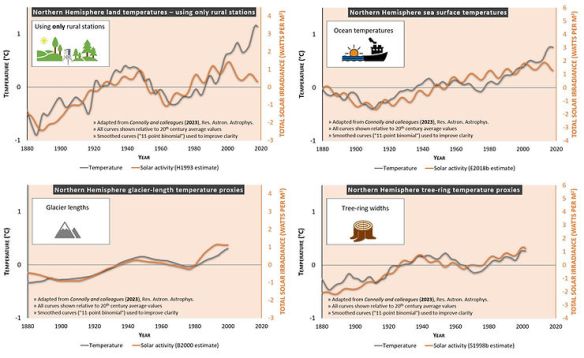
The article began as a response to a 2022 commentary on an extensive review of the causes of climate change published in 2021. The original review (Connolly and colleagues, 2021) had suggested that the IPCC reports had inadequately accounted for two major scientific concerns when they were evaluating the causes of global warming since the 1850s:

  1. The global temperature estimates used in the IPCC reports are contaminated by urban warming biases.

  2. The estimates of solar activity changes since the 1850s considered by the IPCC substantially downplayed a possible large role for the Sun.

On this basis, the 2021 review had concluded that it was not scientifically valid for the IPCC to rule out the possibility that global warming might be mostly natural.

The findings of that 2021 review were disputed in a 2022 article by two climate researchers (Dr. Mark Richardson and Dr. Rasmus Benestad) for two main reasons:

  1. Richardson and Benestad (2022) argued that the mathematical techniques used by Connolly and colleagues (2021) were inappropriate and that a different set of mathematical techniques should have been used instead.

  2. They also argued that many of the solar activity records considered by Connolly and colleagues (2021) were not up-to-date.

They suggested that these were the reasons why Connolly and colleagues (2021) had come to a different conclusion from the IPCC.

This new 2023 article by the authors of the 2021 review, has addressed both of these concerns and shown even more compelling evidence that the IPCC’s statements on the causes of global warming since 1850 are scientifically premature and may need to be revisited.

The authors showed that the urban component of the IPCC’s global temperature data shows a strong warming bias relative to the 98% of the planet that is unaffected by urbanization. However, they also showed that urbanized data represented most of the weather station records used.

While the IPCC only considered one estimate of solar activity for their most recent (2021) evaluation of the causes of global warming, Connolly and colleagues compiled and updated 27 different estimates that were used by the scientific community.

Several of these different solar activity estimates suggest that most of the warming observed outside urban areas (in rural areas, oceans, and glaciers) could be explained in terms of the Sun. Some estimates suggest that global warming is a mixture of human and natural factors. Other estimates agreed with the IPCC’s findings.

For this reason, the authors concluded that the scientific community is not yet in a position to establish whether the global warming since the 1850s is mostly human-caused, mostly natural or some combination of both.

The lead author of the study, Dr. Ronan Connolly, of the Center for Environmental Research and Earth Sciences (CERES-Science.com) described the implications of their findings,

“In scientific investigations, it is important to avoid beginning your analysis with your conclusions decided in advance. Otherwise you might end up with a false sense of confidence in your findings. It seems that the IPCC was too quick to jump to their conclusions.”

Another author of the study, Dr. Willie Soon, also of the Center for Environmental Research and Earth Sciences, explained:

“If the IPCC had paid more attention to open-minded scientific inquiry than trying to force a premature ‘scientific consensus’, then the scientific community would be a lot closer to having genuinely resolved the causes of climate change. Hopefully, our new analysis and datasets can help other scientists to get back to doing real climate science.”

This study reaches similar conclusions to another study that was recently published in a separate scientific peer-reviewed journal, Climate. This other study involved many of the same co-authors (led by Dr. Soon) and focused on a detailed case study of two solar activity estimates and two temperature estimates. It took a different approach to analyzing the problem but confirmed that varying the choice of solar activity and temperature estimates can lead to very different conclusions on the causes of global warming.

For media inquiries, please contact Dr. Ronan Connolly (Center for Environmental Research and Earth Sciences) at ronan@ceres-science.com or Dr. Willie Soon (Center for Environmental Research and Earth Sciences) at willie@ceres-science.com.

Manufacturer Hid Known Dangers of Ventilators Used to Treat Children, Elderly

By Debbie Cenziper, ProPublica; Michael D. Sallah, Michael Korsh and Evan Robinson-Johnson, Pittsburgh Post-Gazette; and Monica Sager, Northwestern University

Tainted continuous positive airway pressure (CPAP) machines and ventilators went to children, the elderly and at least 700,000 veterans despite internal warnings. Company insiders said the devices posed an “unacceptable” risk.

The first complaints landed at the offices of Philips Respironics in 2010, soon after the company made a fateful decision to redesign its bestselling breathing machines used in homes and hospitals around the world.

To silence the irritating rattle that kept users awake at night, Philips packed the devices with industrial foam — the same kind used in sofas and mattresses. It quickly became clear that something had gone terribly wrong.

The reports coming into Philips described “black particles” or “dirt and dust” inside machines that pump air to those who struggle to breathe. One noted an “oily-like” substance. Others simply warned of “contamination.”

The complaints targeted some of the company’s most celebrated devices built in two factories near Pittsburgh, including ventilators for the sick and dying and the popular DreamStation for patients who suffer from sleep apnea, a chronic disorder that causes breathing to stop and start through the night.

Yet Philips withheld the vast majority of the warnings from the U.S. Food and Drug Administration (FDA), even as their numbers grew from dozens to hundreds to thousands and became more alarming each year.

“Black shavings in the chamber,” said one 2011 report that was kept from the government.

“Contaminated with unknown sticky substance,” noted another three years later.

By 2015, the year Philips launched the DreamStation, the company had amassed at least 25 complaints that pointed to a specific cause — the foam was falling apart.

In June 2021, more than a decade after the first reports, Philips announced a recall of millions of machines that had been delivered to nearly every corner of the U.S. and dozens of other countries.

The company acknowledged that the foam it had chosen could crumble in heat and humidity and send potentially “toxic and carcinogenic” material into the noses, mouths, throats and lungs of users.

In a series of statements, the industry giant said it acted as soon as it learned of the “potential significance” of the problem.

But an investigation by ProPublica and the Pittsburgh Post-Gazette of the 11 years between the first complaints and the recall reveals a different story — one of a company that sought to protect its marquee products as stock prices soared to the highest levels in decades.

Again and again, previously undisclosed records and interviews with company insiders show, that Philips suppressed mounting evidence that its profitable breathing machines threatened the health of the people relying on them, in some cases to stay alive.

Federal law requires device makers to turn over to the government within 30 days all reports of patient injuries, deaths and malfunctions that have the potential to cause harm and to take action to investigate them.

A ProPublica and Post-Gazette analysis of tens of thousands of reports shows that Philips withheld more than 3,700 complaints over 11 years from the FDA, which oversees medical devices.

The company did not launch a formal investigation of the problem until 2019 — nine years after the first wave of complaints and three years after the first known tests for the company found that the foam was degrading.

Instead, as the complaints continued to pile up in company files, Philips waged aggressive global marketing campaigns to sell more machines, including new models fitted with the hazardous foam.

The sales pitch worked: The devices went to infants, the elderly and at least 700,000 veterans. The company also promoted machines meant for some of the sickest people in the country, rolling out a new ventilator filled with the foam in the early months of the COVID-19 pandemic.

Philips didn’t stop even after the company learned the foam was breaking down in its ventilators in Japan and had to be replaced — and after tests in the U.S. revealed that the material released chemicals at dangerous levels.

Among them: formaldehyde, a compound used in fertilizer, dyes and glues that has been tied to respiratory problems and certain cancers.

In 2018, the company called more than a dozen engineers and safety supervisors to a series of urgent meetings in Pittsburgh to investigate the problem in what eventually became known to insiders as Project Uno.

Still, the public was not warned.

All the while, people using Philips machines were suffering from illnesses that no one could explain: vomiting, dizziness and headaches, along with newly diagnosed cancers of the lungs, throat, sinuses and esophagus.

One man in Philadelphia coughed so hard that he broke his ribs, and a Florida woman with a hacking cough was hospitalized for days and placed on oxygen.

[…]

To examine what happened at Philips, reporters interviewed more than 200 former company supervisors, doctors, toxicologists, patients and the relatives of those who died and obtained company records that show officials knew about the dangers but continued to sell machines that the FDA had since said are capable of causing severe illness or death.

Reporters also reviewed thousands of complaints submitted to the company and government describing device malfunction and injuries, including more than 370 reports of deaths.

As part of the investigation, the news organizations collaborated with Mediahuis NRC, the publisher of one of the largest newspapers in the Netherlands, where Philips’ parent company is located.

In a statement to the news organizations, Philips said its top priority is patient safety and that it regretted “the distress and concern” caused by the recall.

“We deeply apologize for that and continue to work hard to resolve this,” the company said.

Philips said complaints about the foam were limited in the years before the recall and that the reports were evaluated on a case-by-case basis. The company added that it became aware of the potential significance of the problem in early 2021 and launched the recall shortly after that.

Former company engineers and safety supervisors, who spoke on the condition of anonymity because they still work in the industry, said top officials at Philips repeatedly dismissed a dangerous breakdown that ultimately set off a worldwide health crisis involving as many as 15 million devices.

“It was a catastrophic series of errors,” said a former compliance supervisor. “There were people who knew and knew for a long time.”

In the months since the recall, the company has walked back its initial acknowledgment of the health risks posed by the degrading foam, saying tests on the DreamStation and similar devices show the chemicals released by the material fall within safety thresholds.

“The whole product complies with safety norms,” Roy Jakobs, chief executive officer of parent company Royal Philips, said last year.

ProPublica and the Post-Gazette obtained copies of four tests carried out in 2021 that were solicited by Philips. Three experts who reviewed the results for the news organizations dispute the company’s claim and point to another finding that they say is even more alarming.

The foam tested positive multiple times for genotoxicity — the ability of a chemical to cause cells to mutate, a process that can lead to cancer.

“You’re basically changing cells,” said one engineer who was familiar with the testing. “I don’t even know if we really scratched the surface of how bad this really is.”

In New York, 58-year-old retired music teacher and father of three Mark Edwards said he’ll spend the rest of his life fearing that a sleep apnea machine caused years of respiratory infections and two benign tumors in his throat.

Edwards brought home a DreamStation in 2017 and set it up next to his bed, where he sleeps with his rescued German shepherd, Tyson. He continued using it even after he said he began to spot black particles in his mask.

[…]

A competitive edge

[…]

Throughout the 1980s, McGinnis invented a series of breathing masks and ultimately developed the nation’s first mass-produced continuous positive airway pressure, or CPAP machine, sold under the banner of his growing company, Respironics.

During a scientific renaissance that transformed Pittsburgh from a steel town into a hub for medical innovation, the company became a dominant player in a thriving industry that would change the lives of those struggling with sleep apnea.

[…]

Locked in a race to make its breathing machines quieter, the company inserted the foam to muffle the sound. The change was a triumph in the world of sleep apnea, a way to quiet the humming, vibrating machines that disturbed patients and their partners as they slept.

[…]

It was a risky move. Studies published in scholarly journals showed the foam broke apart in heat and moisture. The company used it anyway, even though the machines send air for hours at a time into the lungs of users.

“Anybody who has half a brain cell in chemistry knows that this was a stupid idea,” said the engineer who was familiar with the recent testing.

Soon, alarming reports began to surface.

In June 2010, Philips found that a machine sent back to the company by a customer was contaminated with “foam particles,” FDA records show.

Rather than alerting the government as federal law required, records reveal that the company kept the report about the problem in-house for the next decade.

[…]

By the end of 2014 — about six years after Philips started using the foam — more than 500 reports from healthcare workers, patients and others had flooded the company in a pattern that would not be revealed to the government or the public for years, the records show.

[…]

Philips received more than 3,700 reports about foam problems before recalling machines

For more than a decade, the company used polyester-based polyurethane foam in its ventilators and CPAP machines to reduce noise. In that time, it received thousands of complaints about “dust contamination,” “black particles” and “foam degradation.”

[…]

Mounting Injuries

[…]

The company alerted the FDA but said nothing to its customers — news reports at the time were largely limited to the company’s positive earnings. Over the next six weeks, more complaints came in, one after another:

[…]

Philips withheld thousands of complaints about foam problems from the FDA

After Philips issued a recall in 2021, the company turned complaints over to federal regulators, including more than 2,500 that it had withheld for more than two years.

[…]

The true extent of the crisis may not be known for years.

As news of the problem spread, customers and others stepped forward by the thousands, describing emergency room visits and sudden illnesses in reports submitted to Philips and the government.

The reports detailed nearly 2,000 cases of cancer, 600 liver and kidney illnesses and 17,000 respiratory ailments.

[…]

Via https://childrenshealthdefense.org/defender/philips-respironics-ventilators-children-elderly/

More on the Secret Exemptions for Mandated Healthcare Workers in NZ

Guy Hatchard

Whilst the Government Threatened the Public With Police Action if They Asked for Exemptions

Ursula Edgington PhD, who writes under the title Informed Heart on Substack has sent me a partial breakdown of 6,700 medical staff granted vaccine exemptions provided through a 29th September 2022 OIA H2022009529. It appears from the OIA HNZ00023978 dated 2 August 2023 that we reported yesterday that the actual total may be as high as 11,005. This figure includes over 1,500 administrative managers.

The health service employs around 80,500 staff. This means that as many as 14% of MoH staff were granted exemptions. Previous mainstream media coverage accessible to the public has only reported that a total of 81 vaccine exemptions (not the actual 11,005) were granted to Ministry of Health staff.

This completely misleading media coverage gave the impression that Ministry of Health staff had almost to a person willingly taken the mRNA vaccine with the exception of 2,400 workers who euphemistically ‘left their jobs’ as a result of mandates.A far smaller number than the 11,005 medical personnel and administrators who secretly received vaccine exemptions and retained their jobs in the health service despite being unvaccinated.

Many dutifully vaccinated members of the public were left with the false belief that they were joining shoulder to shoulder with a health service totally united behind Covid mRNA vaccines. This erroneously strengthened a belief in the false ‘safe and effective’ government narrative. Many who failed to meet vaccination requirements may recall being refused permission to visit loved ones in hospital or care facilities, whilst we now know unvaccinated staff and doctors might have been treating them.

So why did so many MoH staff apply for vaccine exemptions?

They might have read a 2018 paper authored by Drew Weissman and published in Nature entitled “mRNA vaccines — a new era in vaccinology”. Yesterday, Weissman shared the NZ$1.7 million Nobel Prize for medicine with Katalin Karikó for contributing “to the unprecedented rate of vaccine development during one of the greatest threats to human health.”

In this paper, Weissman listed a number of very serious adverse effects that had resulted from prior mRNA vaccine trials. These included:

  • Local and systemic inflammation (including the lymph nodes)
  • Widespread biodistribution throughout the body and persistence of expressed immunogens (similar to what happens with vaccine-induced Covid spike protein).
  • Stimulation of auto-reactive antibodies (associated with thyroiditis, type 1 diabetes and liver disease)
  • Toxic effects of novel nucleotides and vaccine adjuvants (similar to that causing vaccine-induced myopericarditis)
  • Development of autoimmune disease (including skin inflammation, joint pain, digestive disruption and swollen glands)
  • Development of oedema (build up of swollen tissue in legs etc.)
  • Blood coagulation (clotting) and pathological thrombus formation (known to be associated with strokes and heart attacks)

Weissman suggested that his research had found ways around these problems. We now know he hadn’t. All of the above are common adverse effects resulting from Covid mRNA vaccination now widely recognised in the scientific literature that we have been citing in our regular reports. He was promising the cure of multiple diseases, but this has turned out to be only hope and hype.

A close reading of Weissman’s 2018 paper reveals that he was subtly stating the case for widespread experimentation on human populations. He wasn’t to be disappointed. Two years later mRNA Covid vaccines were approved for general use in the whole world’s population, based not on sound trial results, but mostly on assurances from authority figures like Weissman.

The motivations are unclear. It is certain that thousands of medical personnel, researchers, and regulators including executives in the pharmaceutical and biotechnology fields knew of the researched risks. Many also rapidly and correctly concluded that the Covid virus came from a laboratory. However there were trillions of dollars of profits at stake stretching into an imagined biotech future.

Rapidly a well established pharmaceutical public relations and lobbying machine with a global reach sprang into action. Its aim was to suppress any discussion of known risks. It succeeded beyond the wildest dreams of those aiming to profit from the pandemic. Many corporations and individuals have become fabulously rich and/or renowned as a result.

We can now conclude that instead of wealth and fame some are deserving of notoriety.

Exactly who knew what and to what extent some pushed a vaccine they knew to be very harmful and sometimes fatal is to a large extent unknown. Whatever may be judged by way of culpability in the future, it is imperative that those who realise the extent of the problem speak up publicly now.

The secret programme the government initiated to grant vaccine exemptions to thousands of Ministry of Health employees contrasts with the public stance of Chris Hipkins who was the Minister of Health and for the Covid-19 Response from 2020 to 2022. In November 2021 Hipkins complained to RNZ there were people who were aggressively demanding vaccine exemptions. He said:

“Anybody seeking to exert pressure [to gain a vaccine exemption] in the way that we have seen is a matter that the police will be involved with if necessary,”

Hipkins said he was going to establish a central process for approving medical vaccine exemptions. We now know that 11,000 exemptions were granted to people working for the Ministry of Health (headed by Hipkins), whilst almost no exemptions were granted to members of the public and those working in other professions. Even people severely injured by their first Covid vaccine were routinely denied an exemption by the then Director General of Health Dr. Ashley Bloomfield.

Hipkins’ centralised process appeared to be a system designed to deny vaccine exemptions to almost everyone applying other than 11,000 privileged Ministry of Health employees. Simultaneously the General Medical Council was cracking down on any doctors informing the public of vaccine risks and threatening them with suspension and disbarment. The media were repeatedly reprinting the false safe and effective narrative derived not from research but from PR hype. Jacinda Ardern was firming up her policy aim to create a two tier society—vaccinated and unvaccinated. Under this kind of pressure, families were being torn apart by what is now known to be calculated disinformation.

[…]

Via https://hatchardreport.com/additional-information-thousands-of-moh-workers-were-granted-covid-vaccine-exemptions/

Visualizing the BRICS Expansion in Four Charts

BRICS Expansion 2023

Marcus Lu

Visualizing the BRICS Expansion in 4 Charts

BRICS is an association of five major countries including Brazil, Russia, India, China, and South Africa. Distinguished by their emerging economies, the group has sought to improve diplomatic coordination, reform global financial institutions, and ultimately serve as a counterbalance to Western hegemony.

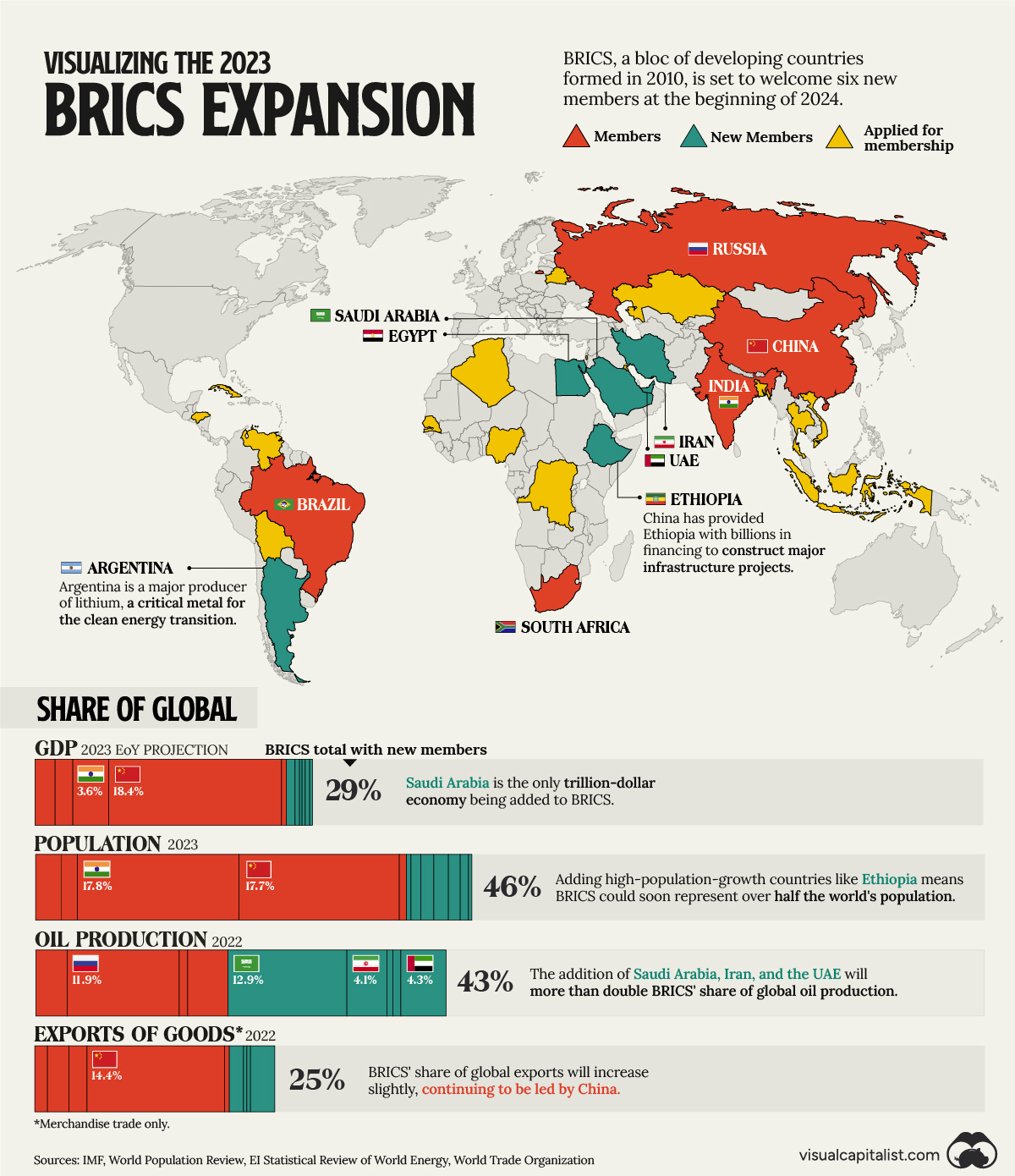
On Aug. 24, 2023, BRICS announced that it would formally accept six new members at the start of 2024: Saudi Arabia, Iran, Ethiopia, Egypt, Argentina, and the United Arab Emirates (UAE).

In this graphic, we provide a data-driven overview of how the BRICS expansion will grow the group’s influence and reach.

Share of Global GDP

Because most of the new BRICS members are considered to be developing economies, their addition to the group will not have a major impact on its overall share of GDP.

The following table includes GDP projections for 2023, courtesy of the IMF.

Original BRICS
Member
Country GDP (USD billions) Share of Global (%)
Yes 🇧🇷 Brazil $2,081 2.0%
Yes 🇷🇺 Russia $2,063 2.0%
Yes 🇮🇳 India $3,737 3.6%
Yes 🇨🇳 China $19,374 18.4%
Yes 🇿🇦 South Africa $399 0.4%
No 🇸🇦 Saudi Arabia $1,062 1.0%
No 🇮🇷 Iran $368 0.4%
No 🇪🇹 Ethiopia $156 0.1%
No 🇪🇬 Egypt $387 0.4%
No 🇦🇷 Argentina $641 0.6%
No 🇦🇪 UAE $499 0.5%
BRICS Total $30,767 29.3%
Rest of World $74,362 70.7%


The original six BRICS members are expected to have a combined GDP of $27.6 trillion in 2023, representing 26.3% of the global total. With the new members included, expected GDP climbs slightly to $30.8 trillion, enough for a 29.3% global share.

Share of Global Population

BRICS has always represented a major chunk of global population thanks to China and India, which are the only countries with over 1 billion people.

The two biggest populations being added to BRICS are Ethiopia (126.5 million) and Egypt (112.7 million). See the following table for population data from World Population Review, which is dated as of 2023.

Original BRICS
Member
Country Population Share of Global (%)
Yes 🇧🇷 Brazil 216,422,446 2.7%
Yes 🇷🇺 Russia 144,444,359 1.8%
Yes 🇮🇳 India 1,428,627,663 17.8%
Yes 🇨🇳 China 1,425,671,352 17.7%
Yes 🇿🇦 South Africa 60,414,495 0.8%
No 🇸🇦 Saudi Arabia 36,947,025 0.5%
No 🇮🇷 Iran 89,172,767 1.1%
No 🇪🇹 Ethiopia 126,527,060 1.6%
No 🇪🇬 Egypt 112,716,598 1.4%
No 🇦🇷 Argentina 45,773,884 0.6%
No 🇦🇪 UAE 9,516,871 0.1%
BRICS Total 3.7 billion 46.0%
Rest of World 4.3 billion 54.0%
It’s possible that BRICS could eventually surpass 50% of global population, as many more countries have expressed their desire to join.

Share of Oil Production

Although the world is trying to move away from fossil fuels, the global oil market is still incredibly large—and BRICS is set to play a much bigger role in it. This is mostly due to the admission of Saudi Arabia, which alone accounts for 12.9% of global oil production.

Based on 2022 figures from the Energy Institute Statistical Review of World Energy, BRICS’ share of oil production will grow from 20.4% to 43.1%.

Original BRICS
Member
Country Thousand Barrels
per Day
Share of Global (%)
Yes 🇧🇷 Brazil 3,107 3.3%
Yes 🇷🇺 Russia 11,202 11.9%
Yes 🇮🇳 India 737 0.8%
Yes 🇨🇳 China 4,111 4.4%
Yes 🇿🇦 South Africa 0 0.0%
No 🇸🇦 Saudi Arabia 12,136 12.9%
No 🇮🇷 Iran 3,822 4.1%
No 🇪🇹 Ethiopia 0 0.0%
No 🇪🇬 Egypt 613 0.7%
No 🇦🇷 Argentina 706 0.8%
No 🇦🇪 UAE 4,020 4.3%
BRICS Total 40,454 43.1%
Rest of World 53,394 56.9%


It’s worth noting that China has been pushing for oil trade to be denominated in yuan, and that Saudi Arabia’s acceptance into BRICS could bolster this ambition, potentially shifting the dynamics of global oil trade.

Share of Global Exports

The last metric included in our graphic is global exports, which is based on 2022 data from the World Trade Organization. We can see that the BRICS expansion will grow the group’s share of global exports (merchandise trade) to 25.1%, up from 20.2%.

Original BRICS
Member
Country Exports (USD billions) Share of Global (%)
Yes 🇧🇷 Brazil 334 1.3%
Yes 🇷🇺 Russia 532 2.1%
Yes 🇮🇳 India 453 1.8%
Yes 🇨🇳 China 3,594 14.4%
Yes 🇿🇦 South Africa 123 0.5%
No 🇸🇦 Saudi Arabia 410 1.6%
No 🇮🇷 Iran 73 0.3%
No 🇪🇹 Ethiopia 3.9 0.02%
No 🇪🇬 Egypt 49 0.2%
No 🇦🇷 Argentina 88 0.4%
No 🇦🇪 UAE 599 2.4%
BRICS Total 6,259 25.1%
Rest of World 18,646 74.9%


Unsurprisingly, China is the world’s largest exporter. Major exporters that are not a part of BRICS include the U.S. (8.3%), Germany (6.6%), the Netherlands (3.9%), and Japan (3.0%).

Who Else Wants to Join?

According to Reuters, there are over 40 countries that have expressed interest in joining BRICS. A smaller group of 16 countries have actually applied for membership, though, and this list includes Algeria, Cuba, Indonesia, Palestine, and Vietnam.

[…]

Via https://www.visualcapitalist.com/visualizing-the-brics-expansion-in-4-charts/