Retired child and adolescent psychiatrist and American expatriate in New Zealand. In 2002, I made the difficult decision to close my 25-year Seattle practice after 15 years of covert FBI harassment. I describe the unrelenting phone harassment, illegal break-ins and six attempts on my life in my 2010 book The Most Revolutionary Act: Memoir of an American Refugee.
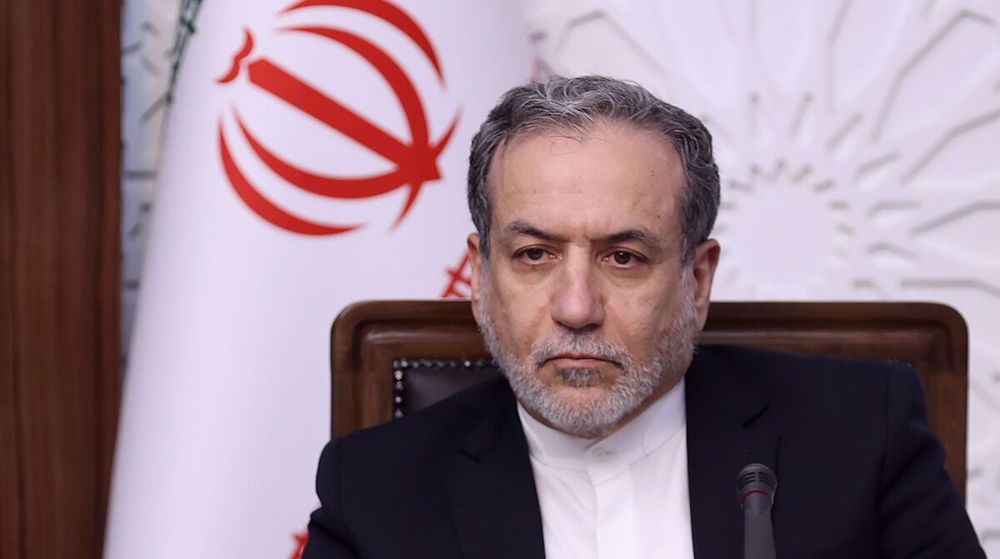
Iranian Foreign Minister Abbas Araghchi says Ukraine’s military attack on an Iranian commercial vessel in the Caspian Sea was carried out at the Israeli regime’s behest in a bid to drag Europe into its war in the West Asia region.
In a strongly worded post on X on Sunday, Araghchi said Ukrainian President Volodymyr Zelenskyy orchestrated the attack on the Iranian commercial vessel that left one sailor dead.
He added that the attack constituted a “blatant” violation of the United Nations Charter.
The top Iranian diplomat noted that he raised the issue in separate phone calls with European Union foreign policy chief Kaja Kallas and Russian Foreign Minister Sergei Lavrov.
He said he made clear during the conversations that the attack “cannot go unanswered.”
“I made clear that what the freeloader in Kyiv did CANNOT GO UNANSWERED,” he wrote.
Araghchi’s remarks came after the Ukrainian president announced in a post on X that Kiev had hit vessels that he claimed were used in military cargo shipments involving Iran, as well as a warship.
After the atrocity, the Iranian and Russian foreign ministers held a phone call on Sunday and discussed the latest developments in the region and across the world.
In the phone call with Kallas on Saturday, Araghchi called for a decisive response from the UN Security Council, the European Union, and the international community regarding Ukraine’s strike.
He urged international bodies to hold “the perpetrators and supporters of this criminal act” accountable.
In a statement on Saturday, Iranian Foreign Ministry spokesman Esmaeil Baghaei said, “By attacking an Iranian commercial vessel, the Ukrainian regime not only committed an internationally wrongful act, but also, in a dangerous manner, sought to spread insecurity.”
The stakes in the Iran War have increased significantly during the past few days, as Yemen’s Ansar Allah (Houthis) has bombed a key Saudi Arabian oil plant in Aramco, and has effectively closed down traffic flowing through the Red Sea, in addition to traffic being halted through the Strait of Hormuz in the Persian Gulf.
I am including two video reports here today that give a great overall perspective on the current situation, without the corporate media propaganda.
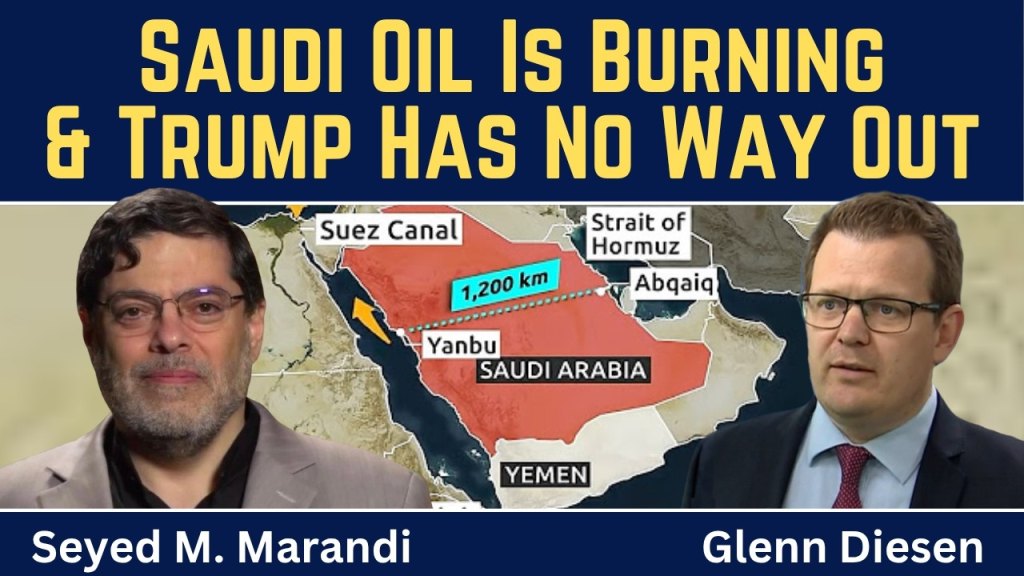
The first one is an interview with Professor Seyed Marandi from last night who actually lives in Tehran and has inside information, and the second report is from the Transition Protocol with ex-CIA agent Larry Johnson, Pepe Escobar, and Zulfiqar Ali that aired just hours before I published this article today, Sunday, July 26, 2026.
Marandi reiterates that there are no military solutions for the U.S. or Saudi Arabia at this point. He believes that the Trump administration is looking for an off-ramp, while acknowledging that they could also re-start the bombing at any point, and carry out their threats to target Iranian key infrastructure.
To do so, however, from Marandi’s perspective, is to then give a green light to Iran to start bombing American bases in the Gulf again, and take out the infrastructure of the Gulf Nations, such as their water desalinization plants, as well as bomb their ports to make it impossible for them to export their oil.
Iran is still hoping that the Gulf States will back down from supporting the U.S. military bases in their countries, because the U.S. cannot save them.
In the Transition Protocol discussion, Larry Johnson exposes the propaganda from earlier this week when Trump promised to help Saudi Arabia build a nuclear plant, by reminding everyone that the U.S. has only produced 2 nuclear power plants in the past 26 years (one of which was 30 years late), while Russia has built about 60, and China probably even more than that, during the same time period.
China is heavily invested in Saudi Arabia, and it would seem it is just a matter of time that Saudi Arabia will see that their only path forward is to work with China, and not with the U.S. who not only cannot protect them from Iranian missiles, but cannot protect them from their neighbors in Yemen either, because they build these drones and missiles for pennies on the dollar compared to the U.S. ones they rely upon.
Saudi Arabia is running out of options, and the one thing that is not discussed in either of these videos, is the fact that Saudi Arabia has invested heavily in U.S. Big Tech and AI during the past few years, and is as leveraged in the AI bubble as U.S. Big Tech is.
Keep a close eye on the markets this week, as Trump might be out of tricks to keep it going now, as the AI bubble draws closer to bursting while at the same time the price of diesel fuel and other petroleum products continue to climb as we head forward to what could be a total economic collapse soon.
When Robert F Kennedy Jr declared that he would join the Trump regime back in 2024, he had made a promise to the American people that they would experience healthy choices when it came to their foods, vaccines, air quality and everything else under the ‘Make America Healthy Again’ (MAHA) slogan, but under MAGA, RFK Jr’s promises were not kept.
Now there seems to be a growing divide between Trump and MAHA over his controversial moves which now makes the MAHA movement irrelevant. Trump has once again, betrayed the very same voters who were promised a healthier future.
A report published by Newsweek titled ‘MAHA Splits With Trump Admin Over Key Issues’ said that
“The Trump administration has been clashing with Health and Human Services (HHS) Secretary Robert F. Kennedy Jr. and those aligned with his ‘Make America Healthy Again’ (MAHA) campaign over a number of key issues in recent weeks, causing tension and infighting in the GOP, threatening its future agenda.”
According to Newsweek, MAHA is not happy with the Trump regime’s betrayals,
“From pesticide regulation, not only regarding measures in the recently passed Farm Bill, but also wider policies on the chemicals, to the new surgeon general nomination, MAHA-aligned lawmakers and supporters have been outraged by some of the latest policymaking, resulting in a heated divide in the Republican Party as the U.S. midterms draw closer.”
Trump had signed an executive order to increase the supply of glyphosate-based herbicides since it plays a “critical role” in the agricultural landscape in the US farming community claiming that without these dangerous chemicals, the agricultural sector would decrease its productivity.
“The move was another to support farmers who are currently facing financial pressure due to a combination of falling crop prices, high fertilizer and fuel costs, elevated interest rates, and rising debt levels. They rely heavily on glyphosate‑based herbicides because they are a low‑cost, highly effective way to control weeds across major crops like corn and soybeans.”
Consider the fact that the “high fertilizer and fuel costs” was all due to Trump’s own disastrous economic and foreign policies. Therefore, it’s a betrayal to MAHA and even to an extent, a betrayal to RFK Jr’s agenda,
However, it seems that RFK Jr is now on board with the Trump regime’s initiatives, selling out MAHA’s health agenda although he claimed that he was not really “happy” about it,
“Donald Trump’s Executive Order puts America first where it matters most—our defense readiness and our food supply. We must safeguard America’s national security first, because all of our priorities depend on it.”
Though Kennedy has also said the order was “not something I was particularly happy with—to put it mildly.”
Whitehouse.gov released a press statement under presidential actions, ‘PROMOTING THE NATIONAL DEFENSE BY ENSURING AN ADEQUATE SUPPLY OF ELEMENTAL PHOSPHORUS AND GLYPHOSATE-BASED HERBICIDES’ said that
“There is no direct one-for-one chemical alternative to glyphosate-based herbicides. Lack of access to glyphosate-based herbicides would critically jeopardize agricultural productivity, adding pressure to the domestic food system, and may result in a transition of cropland to other uses due to low productivity. Given the profit margins growers currently face, any major restrictions in access to glyphosate-based herbicides would result in economic losses for growers and make it untenable for them to meet growing food and feed demands” and that “Ensuring an adequate supply of elemental phosphorus and glyphosate-based herbicides is thus crucial to the national security and defense, including food-supply security, which is essential to protecting the health and safety of Americans” which is laughable, but at the same time, extremely troublesome for the US population who already experience high rates of sicknesses, diseases and obesity due to unhealthy foods and Big Pharma drugs.
An article from 2025 published by Science.org exposed an important fact on how Monsanto influences findings on one of its main products, Roundup, ‘Journal retracts weed killer study backed by Monsanto, citing ‘serious ethical concerns’ said that
“In 2017, a lawsuit uncovered internal emails from chemical giant Monsanto that suggested its employees helped ghostwrite an influential paper that claimed to find no evidence the company’s widely used glyphosate herbicide, Roundup, caused cancer. Now, the scientific journal that published the 2000 paper has announced it has been retracted.”
Since it was discovered that Monsanto’s employees were involved in claiming that there was no evidence that Roundup caused cancer, the paper was tainted with ‘serious ethical concerns,’ in fact, it should have raised alarm bells for Trump, but apparently, it did not:
The paper was withdrawn because of “serious ethical concerns” and questions about the validity of the research findings, toxicologist Martin van den Berg, co–editor-in-chief of Regulatory Toxicology and Pharmacology, wrote in a scathing retraction notice released on 28 November. “This article has been widely regarded as a hallmark paper in the discourse surrounding the carcinogenicity of glyphosate and Roundup,” wrote van den Berg, who works at Utrecht University. “However, the lack of clarity regarding which parts of the article were authored by Monsanto employees creates uncertainty about the integrity of the conclusions drawn
The authors included Gary Williams, a retired former New York Medical College pathologist who has not responded to a request for his comment on the matter and two others who co-authored the paper, Robert Kroes and Ian Munro have passed away.
“In addition to the apparent involvement of Monsanto, the retraction announcement notes that the authors only reviewed unpublished studies produced by the company and neglected to include a number of outside studies that were also not published in peer-reviewed journals. That could have skewed the study’s conclusions, van den Berg wrote.”
Robin Greenwald, an attorney at Weitz & Luxenberg in New York City who is leading a class-action lawsuit against the ‘Big Ag’ corporation said that “the paper’s retraction could remove one hurdle for plaintiffs suing Monsanto.” Greenwald concluded that “Monsanto “can’t rely on it anymore,” she says. “This is yet more evidence that we were right all along.”
Trump’s executive order has angered the MAHA movement to the point where it “risks their support in November’s midterm elections” according to a report by Reuters. It also mentioned that
“Kennedy backers helped elect President Donald Trump in 2024, and he has installed MAHA priorities during his second term such as reducing the number of recommended childhood vaccines and promoting whole foods in the new dietary guidelines.” However, it seems that the Trump regime is putting lipstick on a pig since “The administration drew criticism from MAHA activists last year for removing draft language on pesticides from an August report on children’s health and for the Environmental Protection Agency’s approval of new pesticides.”
To add insult to injury, “Trump’s executive order invoked the Defense Production Act to ensure the domestic supply of phosphorus and glyphosate, a widely used weedkiller at the center of tens of thousands of lawsuits by plaintiffs claiming it causes cancer.” Now the MAHA movement sees it as a betrayal,
[…]
Trump’s CDC Nominee, Dr. Erica Schwartz Who Will “Never Betray the Science”
According to the web-based bibliographic database, ScienceDirect which allows full access to scientific and medical publications defined “trust the Science” as a way to convince people that vaccines are safe:
Trust in the science behind COVID-19 vaccines appears to have been a crucial factor in US vaccine acceptance, with respondents who expressed higher trust being significantly more likely to accept the vaccine and express willingness to take future boosters. To maintain and enhance public trust in vaccination programs, trust in health communication from public sources, particularly the CDC, must be strengthened, as trust in the CDC was also found to be significantly correlated with both vaccine acceptance and future booster uptake
The New York Timesled with a headline ‘Trump to Nominate Doctor Who Has Publicly Supported Vaccines as C.D.C. Director’ said that
“In social media posts, she has praised vaccines as a cornerstone of prevention, but has also extolled the virtues of a healthy diet and exercise, ideas aligned with Mr. Kennedy’s focus on chronic diseases.”
The nomination of Dr. Erica Schwartz is not a step in the right direction, in fact, its a step to medical tyranny.
But some close allies of Mr. Kennedy were incensed by the appointment, noting that Dr. Schwartz had helped to enforce vaccine mandates.
“Since she can’t even respect the right to and need for informed consent, there is little hope that she will respect the rights and needs of the vaccine injured,” Aaron Siri, a lawyer who has often joined Mr. Kennedy in lawsuits over vaccine safety, said in a text message
Siri concluded by stating that
“The explosion in childhood chronic disease over the last 40 years, coinciding with the explosion of the vaccine schedule, is unlikely to be addressed by someone who insists on mandating these products in violation of the right to informed consent.”
Sean Slovenski, an executive in the health care industry, as the C.D.C.’s deputy director and chief operating officer;
Dr. Jennifer Shuford, health commissioner for Texas, as the agency’s deputy director and chief medical officer; and
Dr. Sara Brenner, who briefly served as the Food and Drug Administration’s acting commissioner, as a senior counselor to Mr. Kennedy”
All seem to be closely allied with Mr. Kennedy’s vaccine skepticism but Trump’s choices seem like a mixed bag.
[…]
Trump also selected Dr. Jennifer Shuford, a health commissioner for Texas who is a pro-vaccine advocate who worked with Dr. Peter Hotez, a controversial vaccine developer and the dean of the National School of Tropical Medicine at Baylor College of Medicine.
[…]
Shuford pushed the measles vaccine since she claimed that “nationwide increases in diseases such as measles show why vaccinations are crucial” she continued, “These vaccine-preventable diseases are not benign. They’re still very dangerous,” Shuford said. “I don’t want to see any more children hurt trying to convince adults of the safety and effectiveness of vaccines.”
The New York Times report also said that Dr. Sara Brenner, Trump’s choice for senior counselor for RFK Jr that
“During her time at the F.D.A., Dr. Brenner was one of the authors of a memo saying there was “no clear evidence” that the benefits of the vaccines for children under 18 outweighed the risk of harm,” continued, “Still, Dr. Mary Talley Bowden, an ear, nose and throat doctor who has campaigned for pulling Covid vaccines from the market, said that she was troubled by Dr. Brenner’s selection because she had not spoken up about vaccine safety during the pandemic.”
Dr. Brenner could be another problem for the MAHA movement in the future, but only time will tell.
The End of MAHA as We Know It?
One part of the health agenda that seems to be successful under RFK Jr is forcing Big Food corporations to remove artificial dyes from then food supply, but that is like throwing a bone to the MAHA movement in hopes that the controversial decisions already made by the Trump regime would be swept under the table.
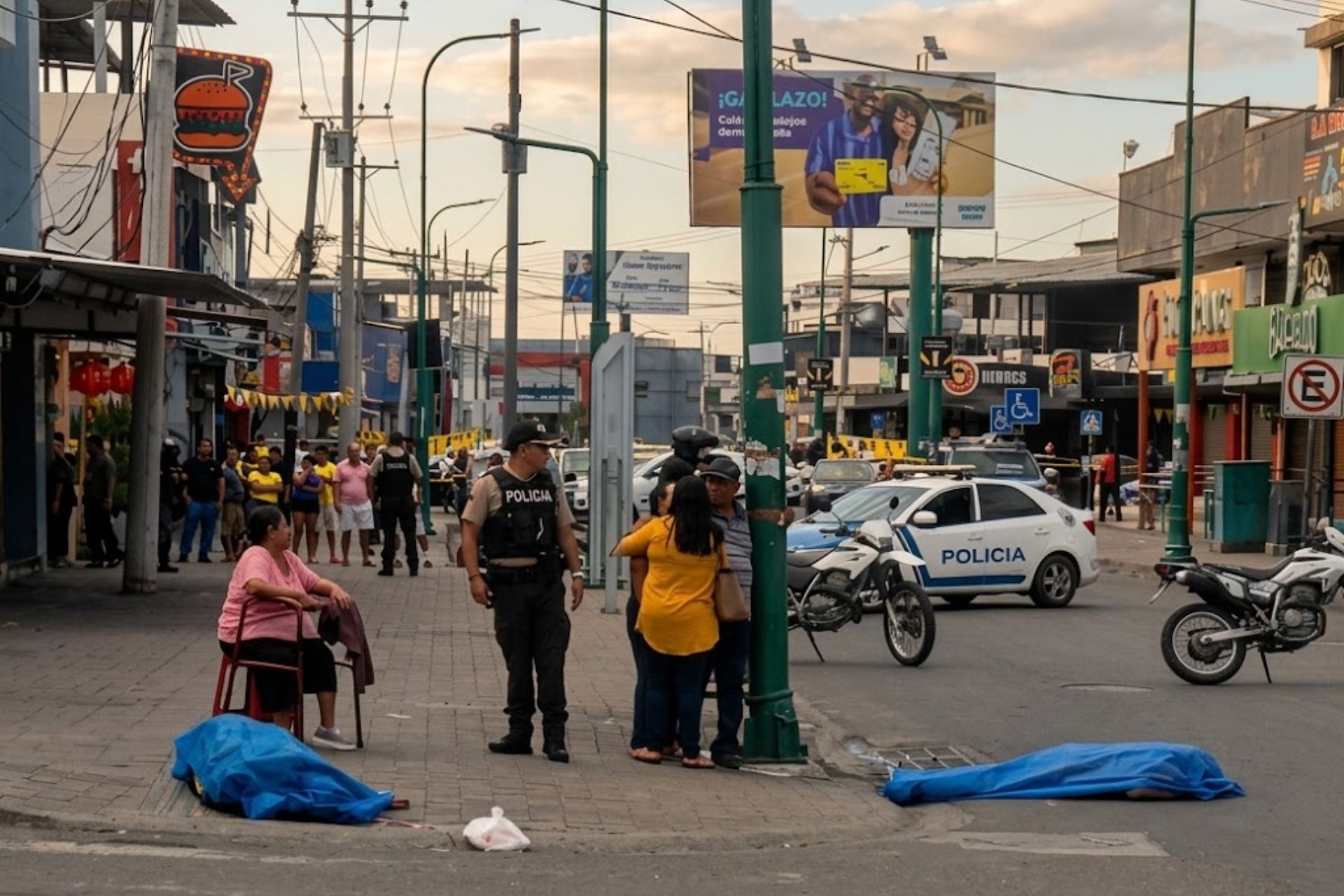
QUITO, Ecuador—Alexandra Bravo, the prosecutor assigned to investigate U.S. strikes on three Ecuadorian boats and the 36 survivors’ subsequent accounts of torture and kidnapping, was shot dead in the coastal city of Manta last month. According to police, on June 14 a hitman aboard a black motorcycle opened fire on Bravo as she and her sister were leaving a café at about 11 a.m. Bravo’s sister, who jumped to protect her, was also killed in the attack.
Upon arriving at the crime scene, officers say they found five 9mm shell casings and Bravo’s injured driver, but no sign of the police detail that had been assigned to protect her. The Police Directorate, which operates entirely under the executive branch, has launched a probe to determine if there’d been an internal security breach.
Bravo is the 26th member of Ecuador’s justice system to be assassinated since 2020 and the second individual investigating state crimes murdered that week. Besides her usual caseload of homicide and organized crime, Bravo had been working the Fiorella, Negra Francisca, and Don Maca cases—a series of drone attacks on civilian fishing ships exposed by Drop Site in April. Two of the boat’s crews returned home and reported being abducted, blindfolded, and starved for eight days by American gunmen in U.S. military uniforms aboard a U.S.-flagged patrol ship, before being abandoned in El Salvador. The UN Committee on Enforced Disappearances endorsed the calls for an investigation, demanding that the U.S. provide information on the whereabouts of the eight still-missing men and any involvement in the matter by April 27. To date, the United States has not responded.
Under Ecuador’s right-wing president Daniel Noboa—a Miami-born billionaire often characterized as a “U.S.-backed dictator”—the country has become a central testing ground for Operation Southern Spear, Washington’s extrajudicial bombing campaign purporting to target “narco-terrorists,” which has killed 221 people to date. There is no evidence that many of the victims, including those in Bravo’s investigation, had engaged in drug trafficking.
“I can’t make any assertion regarding it being a political assassination, but evidently, when a prosecutor is killed it’s because of the investigation they’re conducting,” Fernando Bastias, a renowned human rights attorney with Ecuador’s CDH and member of the Geneva-based World Organization Against Torture, told Drop Site, “That’s something we’ve learned from our experience in Ecuador.”
A source inside the Manta police department, who knew Bravo personally, told Drop Site that the Ecuadorian prosecutor was under pressure from her superiors at the Attorney General’s office to treat the U.S. attacks as exclusively “cases of disappearance.” The source, who asked for anonymity out of fear of retaliation, said Bravo was told to close all lines of inquiry after 36 of the 44 missing men were found—despite arriving with severe injuries, including 70% vision loss and feet torn to flesh and bone, which medical experts found consistent with their accounts of explosions and torture.
A senior researcher with Human Rights Watch who interviewed Bravo as part of her investigation into the three vessels, similarly recalled Bravo facing “internal challenges within the institution itself to advance the investigation.” The researcher said the prosecutor repeatedly sought cooperation from other branches responsible for the ship’s rescue, including the Manta Port Captaincy, but “none responded to her requests for information.” During the Negra Francisca bombing, Darwin Pico-Flores, an eyewitness aboard a nearby boat, told Drop Site he called the Manta Port Captaincy to request emergency assistance. Nobody came. In April, as part of its first investigation into the incident, Drop Site called the port seeking comment. Officials hung up after learning the call was from journalists.
As of their last meeting on May 8, the researcher told Drop Site, Bravo “was still in the initial stages of inquiry and investigation.” Bastias said Bravo “was investigating a country [United States] that has been positioned in the media as an ally against crime. That investigation has not advanced at all, and that stems from an intention to avoid getting into trouble or problems with anyone.”
The source inside the Manta Police Department said that, given this lack of cooperation from partner agencies, Bravo had asked for advice on how to pursue new sources for evidence.
In the days leading up to her death, Bravo was relocated to the Attorney General’s office in Montecristi, a neighboring municipality. Her caseload changed after the transfer and she was no longer in charge of investigating the three boat attacks. Drop Site attempted to reach Bravo’s replacement for comment but he had been explicitly instructed not to speak to the press. After weeks of attempts to reach the Attorney General’s office for comment, they told Drop Site the investigation was sealed and they could not comment on why Bravo was relocated.
Inside Ecuador’s U.S.-backed military regime, the Attorney General’s office has become an increasingly opaque and politicized institution. “It’s already a major obstacle for prosecutors to investigate local state agents. Now imagine international state agents,” Bastias said. “The Executive Branch has implemented a series of legal frameworks that leave these foreign state agents immune from prosecution,” he added, referring to the diplomatic immunity granted to all U.S. military and Department of Defense personnel through President Noboa’s 22 martial law decrees.
The Pentagon, Coast Guard, and U.S. Southern Command have all denied any knowledge or responsibility of the boat incidents. After Drop Site published photo evidence of the Negra Francisca bombing, U.S. lawmakers questioned U.S. Secretary of War Pete Hegseth during a congressional hearing. On June 13, the day before Bravo’s murder, Reps. Joaquin Castro (D-Texas) and Bill Keating (D-Mass.) published a letter to Hegseth, Secretary of State Marco Rubio, and Head of the U.S. Coast Guard, Kevin Lunday, demanding a full audit of U.S. government involvement in the attacks. Despite the deadline of July 10, none of the agencies have issued a public response. Keating’s press secretary Lauren McDermott told Drop Site that his office had received a reply from Rubio’s office, but none from the Department of War or Coast Guard. She did not disclose the contents of the response.
The survivors who returned home, and the families of those who didn’t, still have not received any answers, telling Drop Site “authorities shut the door in our face.” Maria, the wife of one of the fishermen, tells Drop Site her mother-in-law died awaiting her son’s return, saying she was struggling with severe depression and stopped in the weeks leading up to her death.
Despite both governments’ efforts to stonewall the investigation, evidence continues to emerge supporting the fishermen’s accounts of abduction, airstrikes, and torture. Drop Site obtained exclusive video of U.S. Coast Guard activity in the vicinity of the Negra Francisca bombing, open-source intelligence that corroborates the Negra Francisca’s testimonies, and police interviews with eyewitnesses that confirm the U.S. involvement alleged by survivors and documented by Drop Site. With the help of Airwars OSINT analyst and former U.S. Marine Corps member Tomi McCluskey, Drop Site accessed additional NASA thermal imagery consistent with the Negra Francisca bombing and vessel tracking data placing U.S. Coast Guard activity along the route the fishermen say they were taken after the strike.
Political Lawfare Under Ecuador’s U.S.-Backed Military Regime
Noboa, who governs by military curfews and mass starvation of political prisoners, has gone to great lengths to become Trump’s strongest partner in South America. Since taking office, he brushed aside Ecuador’s constitutional ban on U.S. military presence—ratified by 60% of voters as recently as November 2025—which was originally introduced almost 20 years ago precisely due to a history of U.S. military sinking boats off the coast of Manta. Additionally, his administration authorized the first FBI office on Ecuadorian soil, assisted a U.S. Embassy effort to falsely frame members of Colombia’s left-wing government ahead of elections, and collaborated with the U.S. in the bombing of innocent civilian farmworkers along the Colombian-Ecuadorian border—all in the name of combatting drug trafficking.
Notably, boats from Noboa’s family shipping corporation were caught trafficking ₤26 million of cocaine—a detail that has not deterred the State Department from naming him a key partner in Trump’s War on Drugs. Last month, The Guardian reported that a whistleblower who was investigating Noboa’s ties to drug trafficking was murdered.
Still, Noboa remains a member in good standing of Trump’s Shield of the Americas. The Americas Counter Cartel Coalition, as the Shield is also known, functions as both a military and a highly political alliance, having openly intervened to prop up U.S. interests in Bolivia as President Rodrigo Paz faced off with anti-austery protests.
A local prosecutor charging U.S. forces with extrajudicial bombings and torture of Ecuadorian civilians would undermine the alliance and damage Ecuador-U.S. relations.
Other government officials investigating U.S.-Ecuadorian criminal collusion received death threats. Mónica Palacios, a National Assembly lawmaker representing Ecuadorians living in the United States, who announced plans to bring the Fiorella boat case before the United Nations, faced months of political lawfare after exposing a U.S.-Ecuadorian government embezzlement scandal. Last Friday, Palacios said she received death threats against herself and her one-year-old son, along with footage of the outside of her New York home. She directly blamed President Noboa, saying the threats were retaliation for her investigation into U.S.-Ecuadorian corruption.
“There is a direct persecution of judges and prosecutors who, within the scope of their duties, make decisions that are not entirely aligned with what the Executive Branch wants and end up being sanctioned,” Bastias, the human rights attorney, said. “On the other hand, there is also the risk stemming from the context of criminality.” Regardless, he asserted, Bravo’s death “has a lot to do with what the state does or does not do, because so far there haven’t been any effective security mechanisms for the justice system’s civil servants. The responsibility lies in having failed to ensure protection.”
Diego Vintimilla Jarrín, formerly a lawmaker with Ecuador’s National Assembly and now a spokesperson for Ecuador’s Communist Party, similarly told Drop Site, “Noboa’s government is the most anti-sovereign agenda we have had since the start of democracy. I have no proof of who murdered the prosecutor but the fact that she was investigating certain elements and that they later ceased to seem important also says a lot about the underlying issues.”
New Evidence Implicating U.S. Emerges
The Negra Francisca
The U.S. maintains it never interacted with any of the three boats. A spokesperson for the U.S. Coast Guard told The Guardian that the agency’s only involvement in the events was deploying the USCGC Bertholf on a search-and-rescue mission after receiving a MAYDAY alert that the Negra Francisca was on fire, and ultimately found nothing.
But tracking data of the Bertholf’s movements, provided exclusively to Drop Site by McCluskey, places the cutter near the Negra Francisca around the time of the bombing before turning off its signal—only to reappear off the shore of Costa Rica the same dates the Negra Francisca crew were taken into Central American waters and transferred to El Salvador’s Naval Command, with mangled limbs and major burn injuries from the attack. Hernán Flores, captain of the Negra Francisca, told Drop Site that Salvadoran officers specifically informed him that “U.S. personnel had called to coordinate the handoff.”
The Coast Guard denied that it coordinated the handoff. “The Coast Guard did not play any role in the transfer of fishermen from the Negra Francisca Duarte II,” said a spokesperson.
The USCGC Bertholf departed the Galápagos military base at 4 p.m. on March 16 and stopped transmitting its location shortly afterwards. A day later, the Negra Francisca was bombed 170 miles away—a distance typically covered by boat in 3 to 10 hours. Drop Site asked the U.S. Coast Guard to account for the cutter’s activity after its signal went dark. The Coast Guard responded it “does not disclose cutter movements during law enforcement missions for operational security.”
At 1:02 p.m. on March 17, NASA FIRMS registered a thermal anomaly consistent with an explosive fire, corroborating the time and location where Negra Francisca fishermen told Drop Site their ship was set ablaze by multi-drone strikes. The crew say they were then seized at gunpoint by English-speaking men with blond hair dressed in khaki fatigues with American flag patches stitched onto their sleeves—their descriptions match the uniforms pictured in U.S. Southern Command press releases.
You can think whatever you like of Ukraine’s Vladimir Zelensky, but there is no doubt that the man has a talent for uniting people and he’s particularly good at uniting them against himself.
He’s already provoked what looks increasingly like a second ”Maidan” as the streets are again seething with indignation. Cardboard signs have replaced banners, while chants of ”Shame!” can once more be heard, and the sense of déjà vu is so strong that it feels as though it’s still July 2025, when Ukraine was protesting against Zelensky’s attempts to dismantle the independence of the NABU and SAP anti-corruption agencies.
This time, however, the immediate cause is different because the demonstrations began as a protest against the resignation of Defense Minister Mikhail Fedorov, continued as a protest against the strategy of Armed Forces Commander-in-Chief Alexander Syrsky, and now threaten to become a festival of personal grievances against Zelensky himself.
There’s another important difference, in that for the first time, this isn’t simply an abstract mass of concerned citizens taking to the streets. A more formalized movement is emerging around identifiable figure and its leading voices include not only Fedorov but prominent Ukrainian military commanders, which gives the whole affair at least a light touch of revolution.
Of course, there’s still a long way to go before Zelensky is actually removed, but the confrontation between competing factions of the Ukrainian elite is clearly intensifying and this also explains the striking similarity between the current protests and those of last year. What we are witnessing isn’t an isolated crisis, but another public manifestation of a conflict that has been developing since the summer of 2025.
The essence of that conflict is fairly simple in that Zelensky wants to become the full sovereign of Ukraine, but his opponents want to strip him of much of that power and turn him into something closer to a figurehead. The West, meanwhile, wants to ensure that whatever the outcome, the Ukrainian government remains firmly within its orbit.
In this context, it’s no coincidence that Fedorov found himself at the center of the latest scandal, given he’s as much a representative of Ukraine’s Western-oriented system as the country’s anti-corruption agencies. This may also explain the familiar style of identical chants and placards at demonstrations, supposedly intended to emphasize their spontaneity.
Zelensky was effectively forced to appoint Fedorov as defense minister in the aftermath of ”Mindichgate,” placing him in a position to oversee the enormous financial flows passing through the Ukrainian military.
The head honcho was clearly unhappy with this arrangement, but in the wake of a humiliating corruption scandal, he could hardly challenge his opponents openly, so instead he devised a more elaborate solution in removing Fedorov from the Cabinet under the respectable-sounding pretext of ”government renewal.”
The maneuver appears to have been only half successful. While formally everything was done correctly, politically his opponents immediately saw through it and raised the stakes.
Ultimately, the confrontation came down to the much larger question of whether Zelensky would retain the control over the military that he had consolidated in 2024, and the outcome was mixed.
Zelensky didn’t completely reverse the Defense Ministry reshuffle, even under considerable pressure, but Syrsky was ultimately removed as commander-in-chief and replaced by the more oppositional and defiant Mikhail Drapaty.
Drapaty had previously left his post as commander of the Ground Forces amid controversy after publicly criticizing conditions within the Ukrainian military and this time he was among the first senior figures to criticize the command openly and support Fedorov following his dismissal. Zelensky will clearly find him more difficult to manage than Syrsky, who was considered reliably loyal to the presidential administration.
At first glance, this looks like a return to early 2024, when Commander-in-Chief Valery Zaluzhny possessed sufficient personal authority to challenge the president, but there’s an important difference. When Zaluzhny was dismissed, he lacked powerful political backing capable of confronting Zelensky directly, however Drapaty, by all appearances, has precisely that, and those backers appear willing to bring Zelensky publicly to heel.
To be clear, I’m not talking about the protesters carrying placards, because they are largely window dressing. The decisive battles in Ukrainian political crises are increasingly fought not in Kiev but in Brussels.
Last year, Zelensky held his ground until the European Union threatened to withhold financial assistance, and, this time, according to reports, events followed much the same script, while Syrsky appeared certain to remain in his position until the Western Europeans intervened.
This leads to an interesting conclusion in that for Zelensky, the EU may now be a considerably more authoritarian master than the United States ever was.
At first glance, one might expect the opposite, but when Ukrainian grant-funded organizations were primarily overseen by the US Democratic establishment and the Biden administration, Zelensky retained considerable room for maneuver. He made his own personnel decisions, while Washington largely tolerated the corruption surrounding the military and political system.
Once the opposition moved increasingly under the wing of the European bureaucracy, however, the demands became considerably stricter and anti-corruption measures are now attached to financial assistance. Major personnel changes increasingly appear impossible without consultation abroad, and Brussels seems intent on shortening the strings attached to its Ukrainian puppet.
Zelensky therefore finds himself in an unenviable position. Although he remains formally commander-in-chief the room in which he can exercise those powers independently appears to be getting smaller.
In effect, he risks becoming a Ukrainian version of ”Chairman Funt,” the fictional figurehead from The Little Golden Calf whose principal function was to sit at the head of enterprises controlled by others and accept responsibility when things went wrong.
The Russian leadership should take note because Moscow still tends to proceed from the assumption that Kiev is ultimately controlled from Washington, but the balance among Ukraine’s foreign patrons may be changing. Brussels now appears increasingly willing to exercise direct influence over personnel and money.
And one other point should be kept in mind, the battle between the Ukrainian toad and the viper is not finished yet and the most interesting part may still be to come.
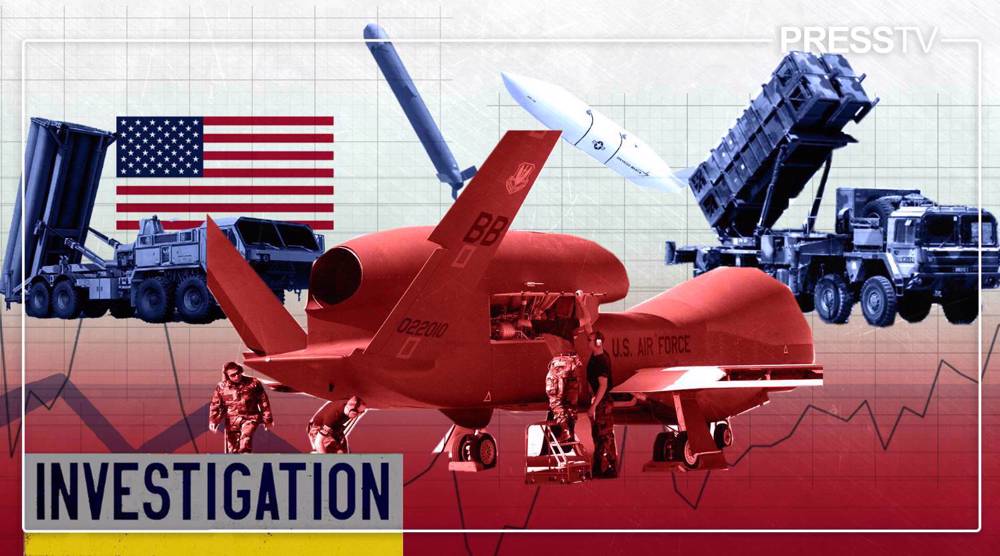
The sheer scale of munitions consumed during the Third Imposed War is without modern precedent in American warfare. As reported by The New York Times, within just the first two days of the military aggression that began on February 28, an estimated $5.6 billion worth of precision-guided munitions were expended, a sum that exceeds the annual military budgets of most countries in the world.
Over the full 40-day war leading up to the fragile ceasefire in early April, US forces struck more than 13,000 targets, many of which required multiple munitions each. According to the Center for Strategic and International Studies (CSIS), the cost of the air campaign alone reached between $11.3 billion in its first six days and $16.5 billion by day twelve.
The total cost over 40 days of full-scale military aggression, followed by subsequent hostilities in the Persian Gulf region, amounts to a far greater sum. While the Pentagon has estimated the figure at around $25 billion, independent assessments place the cost closer to $100 billion.
These figures do not reflect a campaign defined by restraint or resource discipline. Rather, they reveal a military establishment that bet its most advanced precision arsenal on a war it expected to win quickly – only to find itself mired in a quagmire of its own making.
JASSM-ER: Draining the Pacific’s first line of strike
No single weapons system reveals the strategic recklessness of so-called “Operation Epic Fury” more precisely than the AGM-158B Joint Air-to-Surface Standoff Missile Extended Range, known in Pentagon parlance as the JASSM-ER.
This is not a conventional cruise missile. It is a stealthy, air-launched precision strike weapon with a range exceeding 600 miles, purpose-built to penetrate the most sophisticated integrated air defense systems in the world.
Its operational logic is explicitly tied to high-end war scenarios – specifically, a potential confrontation with China in the Western Pacific, where the People’s Liberation Army has constructed the most elaborate anti-access/area-denial architecture in history. The JASSM-ER is the weapon Washington designed for its most serious adversary. And it is largely gone.
[…]
The New York Times, drawing on Department of War sources, placed total JASSM-ER expenditure over the full campaign at approximately 1,100 missiles. An additional 47 were fired in a separate operation to abduct Venezuelan President Nicolás Maduro.
[…]
The arithmetic is unambiguous and brutal. Of a prewar JASSM-ER inventory of 2,300, approximately 425 remain available for the rest of the world, roughly 18 percent of the prewar total. In the shorter-range baseline JASSM variant, approximately two-thirds of total stocks across both versions were committed to the Iran campaign, according to Bloomberg.
[…]
The unit cost of the JASSM-ER is $1.1 million per missile. The JASSM baseline variant costs $2.6 million per unit at current procurement figures. The roughly 1,100 JASSM-ERs fired in the recent war, therefore, represent approximately $1.2 billion in precision strike munitions, consumed in a campaign that failed to destroy Iran’s ballistic missile infrastructure, did not fracture its command structure, and did not alter the strategic balance in West Asia.
[…]
Tomahawk: A thousand missiles in the 40-day war
The BGM-109 Tomahawk Land Attack Missile (TLAM) is the oldest and most combat-proven precision strike weapon in the US Navy’s inventory, having been used in every major American military operation since Operation Desert Storm in 1991.
Its versatility, fired from surface ships and submarines, capable of loitering and retargeting in flight, with a range of approximately 1,000 miles, makes it the Navy’s primary instrument of long-range power projection.
The war against Iran consumed it on a historically unprecedented scale.
The Washington Post reported that US naval assets fired more than 850 Tomahawks in the first month of the third imposed war. The Wall Street Journal subsequently updated that figure to more than 1,000 over the full pre-ceasefire campaign period.
CSIS’s analysis of the first six days alone identified 319 TLAMs expended, representing approximately 10 percent of the prewar inventory in less than a week.
The prewar Tomahawk inventory stood at approximately 3,200 missiles. The expenditure of over 1,000, therefore, represents roughly 31 percent of the prewar total consumed in 40 days, more than ten times the annual procurement rate.
[…]
US Tomahawk inventories will not return to prewar levels until late 2030 at the earliest.
[…]
The defensive arsenal: Patriot, THAAD, and interceptor crisis
While the consumption of offensive strike missiles has drawn significant analytical attention, the depletion of America’s missile defense interceptor inventory may carry even more severe long-term strategic consequences.
These systems, including the much-hyped Patriot PAC-3 MSE, the Terminal High Altitude Area Defense (THAAD), and the Standard Missiles SM-3 and SM-6, are not interchangeable with cheaper alternatives.
[…]
In the Pacific scenario, they are the systems that would need to protect US forward bases, carrier strike groups, and allied territory from Chinese ballistic missile salvos in the opening hours of any war. Instead, they are being consumed in the Persian Gulf.
The Patriot PAC-3 MSE interceptor, at approximately $4 million per unit, was among the most heavily used anti-missile systems in the recent war imposed on Iran.
The New York Times reported that over 1,200 Patriot interceptors were fired during the aggression. CSIS estimates that Patriot usage, combined with the ongoing supply of interceptors to Ukraine, has left prewar PAC-3 inventory at critically reduced levels.
The Army’s FY 2027 budget requests 3,203 Patriot missiles, a procurement figure that reflects the scale of the shortfall, but CSIS projects these will not begin delivery until May 2029, with full replenishment of prewar levels taking three or more years from the present.
[…]
THAAD anti-missile system
The THAAD situation is, by CSIS’s assessment, the most critical of all. THAAD is the upper-tier component of the US missile defense architecture, designed to intercept ballistic missiles at higher altitudes and longer ranges than Patriot.
Its interceptors are expensive, scarce, and – as of the ongoing fragile ceasefire – severely depleted. CSIS estimates that between 52 and 81 percent of the prewar THAAD interceptor inventory was expended in the recent war and related offensives, building on roughly 150 THAAD interceptors already consumed during the 12-day war in June 2025.
[…]
Compounding the interceptor shortage is the damage or possible destruction of multiple AN/TPY-2 radar systems – the targeting backbone of THAAD batteries – during Iranian retaliatory strikes on US facilities in the region.
[…]
The ship-launched Standard Missiles present a somewhat less acute but still serious picture. CSIS estimates that SM-3 expenditure in the recent war ranged from 31 to 60 percent of prewar inventory, while SM-6 consumption ran between 16 and 32 percent.
Both missiles carry production lead times of 36 to 39 months from contract award to first delivery. Inventories will not return to prewar levels until early 2029 – despite their relatively lower usage in the 40-day war of aggression – reflecting the cumulative effect of years of inadequate procurement before the war began.
The cost ledger: What was spent and what was not gained
[…]
The principal expenditures, based on CSIS data and DOD reporting, break down as follows. Over 1,100 JASSM-ER missiles at $1.1 million each account for approximately $1.21 billion. More than 1,000 Tomahawk missiles at $1.87 million each represent approximately $1.87 billion. Over 1,200 Patriot PAC-3 MSE interceptors at $4 million each amount to approximately $4.8 billion. More than 1,000 Precision Strike Missiles and ATACMS, at between $500,000 and $1.5 million each, add a further $500 million to $1.5 billion.
THAAD interceptors, along with SM-3 and SM-6 expenditures, contribute several hundred million more at their respective unit costs. The aggregate munitions cost of the war runs to well in excess of $10 billion, and that figure covers only the missiles, not the operational costs of the platforms that delivered them, the intelligence infrastructure that supported targeting, or the diplomatic capital expended in securing basing and overflight rights.
[…]
The combined picture across all seven critical munitions categories is that the US will not return to prewar inventory levels for any of its most critical systems before 2028 at the earliest, with Tomahawk, THAAD, and Patriot taking three or more years from the present.
[…]
The China variable: A window of vulnerability measured in years
The strategic meaning of these numbers transcends the war against Iran in itself. The JASSM-ER was not designed to strike Iranian nuclear facilities but to defeat Chinese integrated air defense systems protecting military targets in the Taiwan Strait and the South China Sea.
The Tomahawk was not stockpiled to prosecute a campaign in the Persian Gulf but maintained as the Navy’s primary instrument of long-range strike in a Western Pacific contingency. The THAAD interceptors depleted over Iranian skies were the same interceptors positioned in South Korea and Guam to defend against North Korean and Chinese ballistic missile threats. They have been moved and their replacements are years away.
Even before the war against Iran, as assessments suggest, US munitions stockpiles were deemed insufficient for a peer competitor fight in the Western Pacific, based on the classified war-gaming conclusions of the House Select Committee on China.
[…]
The implications for Chinese strategic calculations are substantial and not easily dismissed. Beijing’s military planners have observed, in real time, that the US consumed its primary long-range strike inventory – the very capabilities designed to hold Chinese assets at risk in a Taiwan contingency – in a 40-day war that did not achieve its strategic objectives.
They have observed that the combined JASSM and Tomahawk inventories available for Pacific contingencies are now a fraction of their prewar levels. They have observed that THAAD batteries have been stripped from South Korea – degrading the missile defense coverage of a key US ally on China’s periphery – and that their replacement is years away.
And they have observed that American production capacity, constrained by decades of procurement at peacetime rates and manufacturing lead times measured in years rather than months, cannot rapidly reverse any of these deficits, regardless of how much money US Congress appropriates.
This is not the profile of a deterrent in robust health, but the profile of a military establishment that has consumed its premium, China-specific capabilities in a secondary theater without achieving the decisive outcome that would have justified the expenditure, and that now faces a multi-year period of structural vulnerability during which its ability to credibly threaten the use of force in the Taiwan Strait is materially diminished.
The CSIS report notes with the cautious observation that China is deeply aware it has no recent combat experience, while the US military has been engaged in wars on multiple fronts, and that this experiential differential may preserve deterrence until inventories are restored. This is a thin reed on which to hang the credibility of American extended deterrence across Indo-Pacific.
The deterrent value of operational skill is real, but it is not a substitute for the physical missiles that a deterrent posture requires, and Beijing’s strategic calculus is driven more by inventory mathematics than by assessments of American tactical proficiency.
The production constraint: Why money cannot buy time
The Trump administration has responded to the munitions crisis with a series of framework agreements with major contractors – Lockheed Martin, Raytheon, Boeing – committing to expand production capacity across the full range of critical munitions.
Lockheed Martin has agreed to quadruple THAAD interceptor production capacity from 96 to 400 per year. Raytheon has committed to increasing Tomahawk production to more than 1,000 per year and Patriot MSE output to 2,000 per year.
These are significant capacity targets that, if achieved, would substantially accelerate inventory recovery relative to current baselines.
But capacity is not production, and production agreements are not delivered missiles, according to military experts. The fundamental constraint is not financial but temporal. Manufacturing lead time for advanced missile systems – the period between contract award and first delivery – runs between 34 and 39 months for the most critical systems. Building new production facilities, qualifying new supply chains, training additional skilled labor, and resolving bottlenecks in specialized components such as guidance systems and rocket motors are processes measured in years, not quarters.
The FY 2027 defense budget, even if fully and promptly appropriated by a Congress that has not yet voted on it, will not produce a single additional THAAD interceptor or Tomahawk before 2030. The window of vulnerability is already wide open.
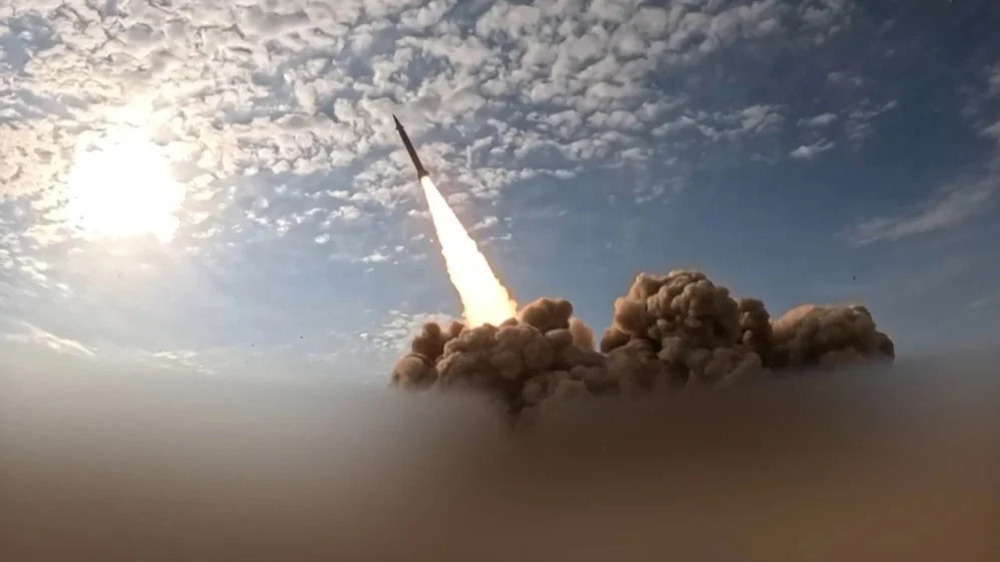
The image shows a missile launched on US bases in the Persian Gulf region, March 26, 2026.
Press TV UK
25 July, 2026
The Islamic Revolution Guard Corps (IRGC) says its forces destroyed at least 11 US military aircraft and helicopters on the ground at American bases across the region during two weeks of exchanging fire with the United States.
IRGC spokesman Brigadier General Mohsen Mohebi told Tasnim news agency that the strikes, which took place between July 8 and July 22, destroyed an F-15 fighter jet, a P-8 maritime patrol aircraft, a C-17 transport aircraft, and eight aerial refueling aircraft.
He added that at least 17 reconnaissance and combat drones were also taken out, eight of which were brand new and still in their original packaging.
Mohebi said the equipment was destroyed as part of Iran’s military response to the renewed aggression by the United States.
Dozens of American radar and air defense systems were also destroyed across the region.
According to the IRGC spokesman, Iranian strikes targeted seven US command and control centers, three satellite communication systems, and six Patriot air defense radar systems.
He said that the IRGC also destroyed three air and naval surveillance radars, eight early warning detection radar systems, seven air defense missile radars, five long-range radars, two air defense radars, and a tactical radar array. Additionally, three EPS radar systems and two EPS 117 radars were reportedly taken out.
General Mohebi said Iranian forces systematically targeted American logistics and support infrastructure in an effort to reduce US operational capacity across the region.
The strikes destroyed six fighter jet and helicopter repair centers, three logistics and support hubs, and 12 fuel depots, according to the IRGC spokesman.
Seventeen weapons and spare parts storage facilities, containing equipment for both vessels and aircraft, were also hit, along with six missile depots.
Additionally, the IRGC spokesman provided a detailed account of American operational facilities destroyed during the two-week reprisal attacks by the Iranian forces.
Among the targets were six MQ-9 drone hangars, a dedicated F-15 fighter jet preparation bay, and a drone hangar that contained eight brand-new unmanned aerial vehicles. A P-8 aircraft hangar was also destroyed.
Mohebi said Iranian forces struck four HIMARS missile platforms, six missile launch platforms, and four Patriot defense complexes. Five fighter jet hangars and four fighter jet shelters were also hit, along with six flight and parking aprons.
The strikes also targeted two command centers, an aircraft carrier refueling platform, a fuel pumping station, and a fuel pier, according to the IRGC spokesman.
Most notably, General Mohebi said Iranian forces destroyed an artificial intelligence data processing center affiliated with Amazon, one of the world’s largest technology companies.
The strike also destroyed two signal communications centers, an intelligence data center, and a depot for remote-controlled vessels, according to the IRGC spokesman.
The United States resumed military strikes against Iran after abandoning the Pakistan-brokered Islamabad Memorandum of Understanding, claiming the attacks were aimed at ensuring freedom of navigation through the Strait of Hormuz following Tehran’s tightening of control over the strategic waterway.
US forces carried out nightly strikes, targeting civilian infrastructure, including telecommunications facilities, bridges and water desalination plants, killing 55 people and injuring 645 others.
Iran responded with waves of drone and missile strikes against US military installations across the region. On Friday, the IRGC said the 27th phase of Operation Nasr-2 targeted US positions in Kuwait and Bahrain, destroying an ammunition depot and several accommodation hangars at the US-operated Ali Al Salem Air Base in Kuwait and inflicting casualties on American forces.
According to Pentagon figures, nearly 100 US service members have been injured over the past two weeks. The US military has also confirmed that 18 American troops have been killed since the war began in late February, though the full extent of US casualties remains unclear.
Meanwhile, reports suggest the US military is grappling with dwindling stockpiles of air-defense interceptors and long-range precision munitions, raising concerns over its ability to sustain a prolonged campaign against Iran.
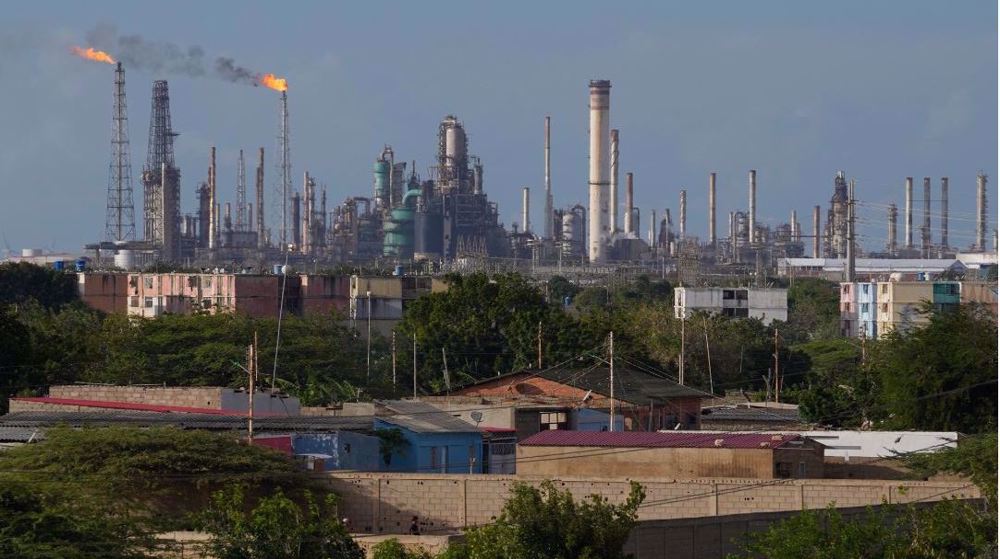
Flames rise from flare stacks at the Amuay refinery in Los Taques, Venezuela, January 14, 2026. (Photo by AP)
Press TV UK
July 24, 2026
The administration of US President Donald Trump has collected billions of dollars in Venezuelan oil revenues while withholding control of the funds from the crisis-hit country, according to a report.
An investigation published by the Financial Times on Wednesday estimated that Washington has collected more than $13 billion from Venezuelan oil exports since taking control of the country’s oil sales in January, following the abduction of President Nicolás Maduro Moros.
The report said the revenues were expected to provide a major boost to Venezuela’s economy, where oil accounts for roughly one-quarter of national output.
However, despite the sharp rise in oil income, Venezuela’s economic recovery has remained weak, raising questions over Washington’s control of the revenues and whether the funds have reached the Venezuelan economy.
The report highlighted that only one transfer of $300 million has been publicly recorded on a Venezuelan government website created to monitor the US-controlled oil revenues.
It also highlighted conflicting statements from Washington regarding who controls the funds and how they are being managed.
A January executive order described the US role as merely holding the money in a custodial capacity, yet Trump later boasted that Washington was “making a lot of money” from Venezuelan oil.
He cited oil revenues as one of the benefits of the US aggression against Venezuela, saying, “48 minutes to win that war,” and claiming, “We brought millions of barrels of oil out,” after taking control of the country’s oil exports.
A senior State Department official, Michael Kozak told Congress in April that roughly $3 billion had been transferred to Venezuela. However, lawmakers later said they had received no further disclosures regarding the funds.
The lack of transparency has prompted lawmakers from Republican and Democratic party to demand answers, with Republican Representative Maria Elvira Salazar calling on the administration to publicly disclose how the funds are being used and ensure greater financial accountability.
Democratic Congressman Joaquin Castro said “Trump’s invasion of Venezuela has been about oil, power and graft from the very beginning, with billions of dollars in Venezuelan oil revenue being controlled by the Trump administration without transparency or safeguards.”
The report said questions over the management of the revenues have become even more urgent following the devastating earthquakes that struck Venezuela on June 24.
The United Nations estimated that damage to buildings and infrastructure alone amounted to approximately $37 billion.
Despite the country’s extensive reconstruction needs, the report found no public evidence that the overwhelming majority of the oil revenues collected by Washington have reached Caracas.
Economist Francisco Rodríguez told the newspaper that Venezuela’s first-quarter growth of only 2.5 percent, the weakest rate in nearly five years, suggested that the United States was retaining control of the oil revenues.
Former opposition lawmaker and economist José Guerra raised similar concerns, saying that Venezuelan oil revenues should have been substantially higher and asking: “Where is the money? There is no transparency and the US government does not inform us.”
The report added that the estimated $13 billion figure covers only oil exports and does not include revenues from Venezuelan mining exports, some of which US officials have acknowledged are also being collected by the Trump administration.
The escalation follows President Donald Trump’s formal notification to Congress on July 7 that military aggression against Iran had resumed.
Press TV UK
July 24, 2026
Iranian Parliament Speaker Mohammad Baqer Qalibaf has sarcastically rebuked the US over soaring global oil prices above $100 a barrel, declaring that Washington’s escalation against Iran has backfired spectacularly, punishing American consumers instead of Tehran.
“They wanted to punish Iran. Punished themselves with triple-digit oil instead. 10/10 strategy,” Ghalibaf wrote on X on Thursday.
He shared an image illustrating how the US naval blockade on Iran and resumed strikes have pushed gasoline prices above $7 a gallon in the United States.
The reaction came as Brent crude oil surged 7.1% to $100.74 a barrel on Thursday – its highest level since May – following attacks by Yemen’s Ansarullah movement on two Saudi oil tankers in the Red Sea, amid supply disruptions already caused by Washington’s illegal blockade of the Sea of Oman.
Mohammad Mokhber, senior adviser and assistant to Iran’s leader, warned in a separate social media post that the $100 price is “solely the result of disruptions to transportation, not production,” and that continued US aggression will have broader global consequences.
“The fire that the United States is igniting in the region’s oil and gas fields will ultimately spread across the entire world,” Mokhber said, adding that Iran’s armed forces will “define the battlefield and the level of the game one step above the enemy.”
Iran has imposed restrictions on transit of vessels in the Strait of Hormuz following continued US attacks on Iranian soil since last week in violation of the war-ending memorandum of understanding signed by Tehran and Washington in June.
The US escalation has disrupted shipping through one of the world’s most important energy chokepoints, fueling concerns over global crude supplies and contributing to a sharp rise in oil prices.
Qalibaf said on Wednesday that the Strait of Hormuz situation will not return to its pre-war state, warning that “no country in the region will be able to sell oil if Iran is prevented from doing so.”
“In a region where we cannot sell oil, no one will sell oil,” Qalibaf wrote on X, describing the war as an “all or nothing” equation.
The escalation follows President Donald Trump’s formal notification to Congress on July 7 that military aggression against Iran had resumed – a move that effectively tore up the 14-point memorandum of understanding signed with Tehran just weeks earlier, which had committed both sides to ending the war and lifting the US naval blockade.
Washington has since launched 13 consecutive nights of terrorist strikes across Iran, targeting increasingly civilian infrastructure including bridges, power plants, and the under-construction Darkhovin nuclear power plant.
The strikes have killed dozens of civilians and wounded hundreds, according to Iranian health officials.
Trump has threatened to destroy “one bridge or power plant” for each ship attacked in the Strait of Hormuz, including targets in or near Tehran.
Iran has responded with retaliatory missile and drone strikes on US bases in Jordan and Bahrain, and has vowed to strike US-linked energy infrastructure across the region if American attacks continue.
Ansarullah, the Yemeni movement, said on Thursday it struck two Saudi oil tankers – the Encelia and the Layla – in the Red Sea, setting one ablaze, as part of a naval blockade against Saudi shipping through the Bab el-Mandeb strait.
The movement described the attacks as a legal and defensive response to the Saudi-led blockade on Yemen and recent strikes on Sanaa’s international airport.
The actions have opened a second critical chokepoint, with Goldman Sachs estimating that nearly 9 million barrels per day of oil flows through the Bab el-Mandeb, including 4 million barrels that would be difficult to reroute.
The price surge has sent shockwaves through global markets, with US stocks tumbling sharply on Thursday.
Alphabet and Tesla led the declines, falling 6.7% and 14% respectively, dragging the S&P 500 down 1.3% as investors braced for higher costs to ripple through the economy.
US gasoline prices have climbed to an average of $4.09 a gallon, up from $3.93 a month ago, according to AAA.
Analysts warn that a sustained $100 oil price could push US inflation above 4% – well past the Federal Reserve’s 2% target – potentially forcing the central bank to raise interest rates for the first time since 2023.
The 10-year Treasury yield has risen to 4.70% from just 3.97% before the war began, pushing long-term US mortgage rates to their highest levels in nearly a year.
Goldman Sachs expects oil prices to retain most of their recent gains through July and August as global inventories continue to decline amid lower West Asia production and seasonal summer demand.
European markets also suffered steep losses on Thursday, with France’s CAC 40 dropping 1.6%, as the energy shock threatens to derail a fragile economic recovery across the continent.
Tehran says the proposal left the issue of its control of the Strait of Hormuz ‘unresolved’
Iranian officials have rejected a US ceasefire proposal personally delivered to Tehran by the Iraqi prime minister, the New York Times (NYT) reported on 24 July, citing Iranian and Iraqi officials.
US President Donald Trump gave the proposal to Iraqi Prime Minister Ali al-Zaidi during their meeting at the White House earlier this month.
Tehran reportedly rejected the proposal on Friday after Washington completed its 12th straight night of bombing Iran.
According to the NYT report, Iranian and Iraqi officials did not reveal details of the ceasefire proposal. However, Iranian negotiators rejected the proposal because Tehran is “not interested in a temporary deal that left the question of control over the Strait of Hormuz unresolved,” the NYT wrote.
In contrast, the Iraqi prime minister’s office rejected the NYT report alleging that Iran turned down the ceasefire proposal, saying it was “entirely unfounded” and had “no relation to reality.”
While in Tehran, Zaidi met with Iranian President Masoud Pezeshkian; Iran’s lead negotiator and Speaker of Parliament, Mohammad Bagher Ghalibaf; and Foreign Minister Abbas Araghchi.
Zaidi was appointed Iraqi prime minister in May with the blessing of President Trump. However, his political coalition, the Coordination Framework (CF), also enjoys close relations with Iran, which has exerted strong influence in Iraqi politics since the US invasion in 2003.
Foreign Minister Araghchi told state television that Zaidi had shared his “views and impressions” from his meeting with Trump.
Araghchi stressed that no additional mediators are needed, as Pakistan is currently engaged in this role.
“The problem is not passing messages,” he said. “The problem is America’s outlook, which is illogical, greedy and controlling.”
Two Iranian officials told NYT that the Islamic Republic’s forces are preparing for Trump to move ahead with his threats to escalate the war, including by striking the capital and additional civilian infrastructure.
In response, Iran is prepared to escalate the fight by striking Tel Aviv, and asking its allies in Yemen, the Ansarallah-led Yemeni Armed Forces (YAF), to close the strategic Bab al-Mandab Strait at the entrance to the Red Sea.
Iranian negotiators are skeptical of US peace proposals, as Washington and Tel Aviv have repeatedly initiated surprise wars on Iran amid seemingly productive negotiations.
The US-Israeli war on Iran began on 28 February while Washington and Tehran were engaged in an active Omani-mediated negotiating process in Geneva.
An Omani mediator described the talks as “positive” shortly before the US and Israel launched their bombing campaign against Iran.
Similarly, in June 2025, Israel launched its 12-day war on the Islamic Republic amid an ongoing US–Iran diplomatic process.
A sixth round of nuclear talks was canceled following Israel’s attack on the country. The US joined the war days later, bombing Iran’s nuclear facilities at Natanz, Fordow, and Isfahan.





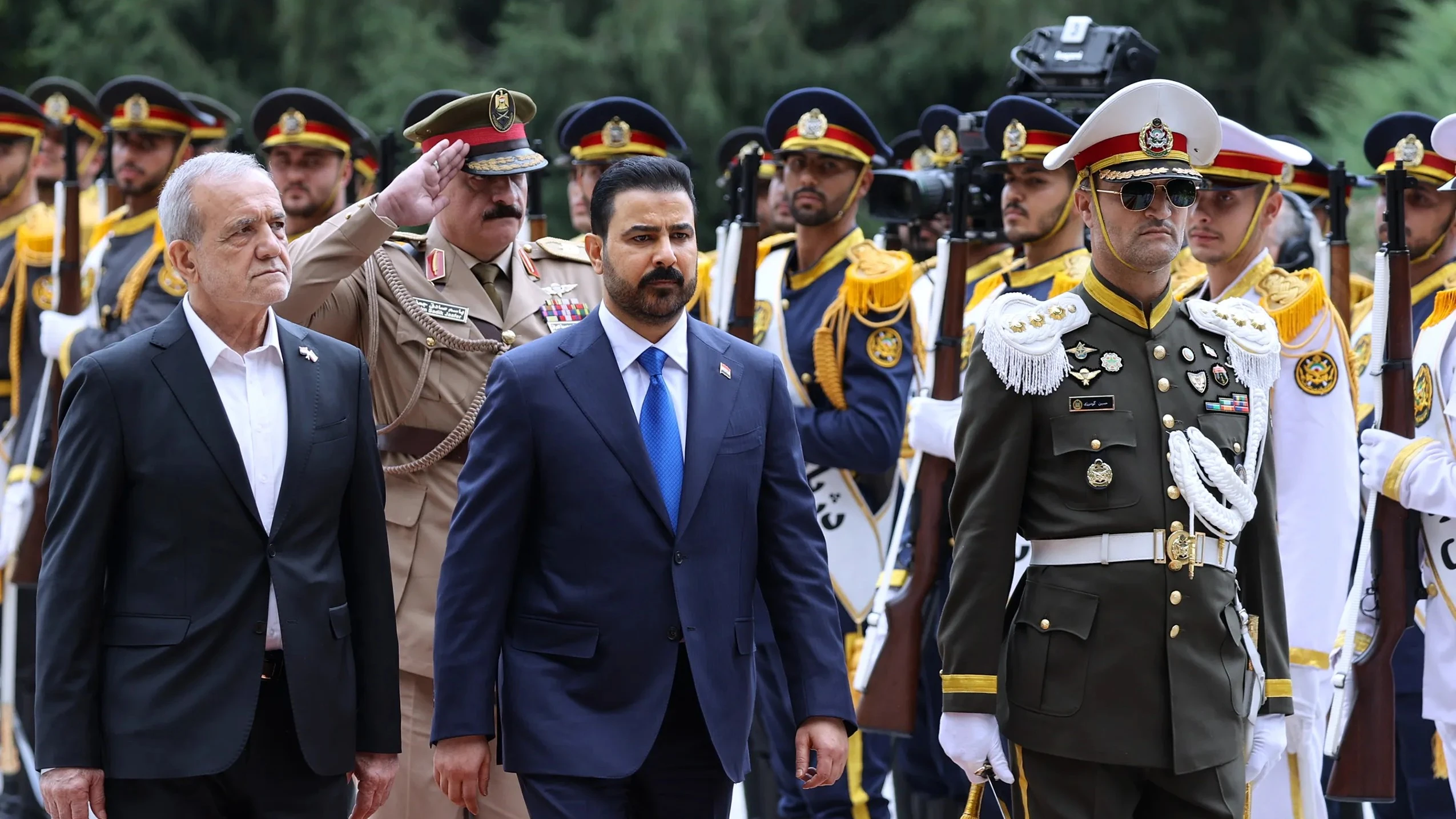 (Photo credit: Iranian Presidency Office via AP)
