The Most Revolutionary Act

Uncensored updates on world events, economics, the environment and medicine

The Most Revolutionary Act
Unknown's avatar

About stuartbramhall

Retired child and adolescent psychiatrist and American expatriate in New Zealand. In 2002, I made the difficult decision to close my 25-year Seattle practice after 15 years of covert FBI harassment. I describe the unrelenting phone harassment, illegal break-ins and six attempts on my life in my 2010 book The Most Revolutionary Act: Memoir of an American Refugee.

‘Cody’s Law’: Florida Lawmakers Weigh First State Law to Compensate Vaccine Injury Victims

By Michael Nevradakis PhD

Florida lawmakers are considering a bill that would expedite the review and payment process for vaccine injury claims under the Medicare, Medicaid and Medicaid Medically Needy Programs.

If passed, “Cody’s Law: Florida No Vaccine-Injured Patient Left Behind” would be the first such law in the U.S. and could supplant federal vaccine injury compensation programs.

The bill, filed in the Florida House of Representatives in January and the Florida Senate last week, is named after Cody Hudson, a previously healthy college student who sustained serious — and now terminal — vaccine injuries in 2021.

Cody’s mother, Heather Hudson, advocated for and drafted the legislation. She said the law would fill the “gaps of all the vaccine injury compensation programs and Social Security disability.”

“It provides expedited claims processing, like is done for other severe and major illnesses, by Medicare and Medicaid, and affords the vaccine-injured and Emergency Use Authorization protocol-injured medical care at the onset of injury, when it is needed most,” Hudson said.

[…]

Via https://tdefender.substack.com/p/codys-law-florida-first-state-compensate-vaccine-injury-victims

Trump’s Détente with Venezuela

President Nicolas Maduro and U.S. President Donald Trump’s envoy Richard Grenell shake hands at the Miraflores Palace, in Caracas, Venezuela January 31, 2025.

Roger D. Harris

Trump’s corollary to the Monroe Doctrine – “speak loudly AND carry a big stick” – has not been applied full force on Venezuela…as of yet. Instead the new administration appears to be testing a more nuanced approach. In his first administration, he succeeded in crashing the Venezuelan economy and creating misery among the populace but not in the goal of changing the “regime.”

Back in 2019, the Bolivarian Revolution, initiated by Hugo Chávez and carried forward by his successor, current Venezuelan President Nicolás Maduro, was teetering on collapse under Trump’s “maximum pressure” offensive. The economy had tanked, inflation was out of control, and the GDP was in freefall. Over 50 countries recognized Washington-anointed “interim president” Juan Guaidó’s parallel government.

In the interregnum between Trump administrations, Biden embraced his predecessor’s unilateral coercive economic measures, euphemistically called sanctions, but with minimal or temporary relief. He certified the incredulous charge that Venezuela posed an immediate and extraordinary threat to US national security, as Trump and Obama had before him. Biden also continued to recognize the inept and corrupt Guaidó as head-of-state, until Guaidó’s own opposition group booted him out.

Despite enormous challenges, Venezuela resisted and did so with some remarkable success, bringing us to the present.

Runup to the second Trump administration

In the runup to Trump’s inauguration, speculation on future US-Venezuela relations ran from cutting a peaceful-coexistence deal, to imposing even harsher sanctions, to even military intervention.

Reuters predicted that Trump’s choice of hardliner Marco Rubio at secretary of state augured an intensification of the regime-change campaign. Another rightwing Floridian of Cuban descent, Mauricio Claver-Carone was tapped as the special envoy for Latin America. He had been Trump’s senior director for Western Hemisphere affairs and credited with shaping Trump’s earlier aggressive stance toward Venezuela. Furthermore, on the campaign trail, Trump himself commented: “When I left, Venezuela was ready to collapse. We would have taken it over; we would have gotten to all that oil.”

At his Senate confirmation hearing on January 15, Rubio described Venezuela as a “narco-trafficking organization that has empowered itself of a nation state.” He was unanimously confirmed the very first day of the new administration.

The supposedly opposition Democrats all stampeded in his support, although Rubio severely criticized the previous Biden administration for being too soft on Venezuela. Rubio’s criticism was largely unwarranted because, except for minor tweaks, Biden had seamlessly continued the hybrid war against Venezuela.

Grenell Trumps Rubio

The first visit abroad by a Trump administration official was made by Ric Grenell, presidential envoy for special missions. Grenell briefly served in Trump’s first administration as acting director of national intelligence, becoming the first openly gay person in a Cabinet-level position.

Grenell flew to Caracas and posed for a photo-op, shaking hands with President Maduro on January 31. This was a noteworthy step away from hostility and towards rapprochement between two countries that have not had formal diplomatic relations since 2019.

The day after the Grenell visit, Rubio embarked on an uninspiring tour of rightwing Latin American countries. That same day, General License 41 allowing Chevron to operate in Venezuela automatically renewed, which was a development that Rubio had advocated against.

Diplomacy of dignity

Maduro entered negotiations with Grenell with a blend of strategic engagement and assertive resistance, aiming to navigate Venezuela’s economic challenges while maintaining sovereignty. The approach had win-win outcomes, although the spin in the respective countries was quite different.

Grenell claimed a “win” from the meeting with the release of six “American hostages” without giving anything in return. Venezuela, for its part, got rid of a half dozen “mercenaries.” Neither country has released the names of all the former detainees.

Grenell took a victory lap for getting Venezuela to accept back migrants who had left the country, a key Trump priority. Maduro welcomed them as part of his Misión Vuelta a la Patria (Return to the Homeland Program), which has repatriated tens of thousands since its inception in 2018.

Trump’s special envoy boasted that Venezuela picked up the migrants and flew them back home for free. Maduro was pleased that the US-sanctioned national airline Conviasa was allowed to land in the US and transport the citizens back in dignity. Congratulating the pilots and other workers, Maduro said: “The US tried to finish off Conviasa, yet here it is, strong.”

Evolution of imperialist strategy

Trump’s special representative for Venezuela in his first administration, Elliot Abrams, believes his former boss sold out the shop. He criticized Grenell’s visit as functioning to help legitimize Maduro as Venezuela’s rightful president, which it did.

In contrast, Robert O’Brien believes, “Grenell scored a significant diplomatic victory.” What is noteworthy is that O’Brien replaced John Bolton as Trump’s national security advisor in 2019 and had worked with Abrams as co-architect of the “maximum pressure” campaign against Venezuela, yet now acknowledges it is time for a shift.

Speaking from experience, O’Brien commented: “Maximum economic sanctions have not changed the regime in Venezuela.” He now advocates: “Keeping sanctions against Venezuela in place, while at the same time, granting American and partner nation companies licenses.”

According to Grenell, Trump no longer seeks regime change in Venezuela, but wants to focus on advancing US interests, namely facilitating deportations of migrants, while halting irregular migration to the US and preventing inflation of gas prices.

Ricardo Vaz of Venezuelanalysis suggests that Trump’s strategy is to adroitly use sanctions. Rather than driving Venezuela into the arms of China and Russia, Trump wants to incrementally erode sovereignty, compel sweetheart deals with foreign corporations such as Chevron, and eventually capture control of its oil industry.

Venezuela’s successes force imperial accommodation

Not only did “maximum pressure” fail to achieve imperial goals in the past, but the Bolivarian Revolution’s accomplishments today have necessitated a more “pragmatic” approach by the US.

Venezuela has resolutely developed resilience against sanctions, achieving an extraordinary economic turnaround with one of the highest GDP growth rates in the hemisphere. Venezuelan oil production is at its highest level since 2019. The oil export market has been diversified with China as the primary customer, although the US is still prominent in second place.

However, if Chevron operations in Venezuela get shuttered, that would take a bite out of the recovery. Trump threatened on February 26 to withdrawal the company’s license, departing from the initial engagement approach. This was seen as a short-term concession to foreign policy hardliners in exchange for domestic support. But even then, the license’s six-month wind-down period offers plenty of room for the two governments to negotiate their future oil relationship. Regardless, on March 1, the Office of Foreign Assets Control reissued the license for another six months.

The government is incrementally mitigating the economic dominance by the oil sector. It has also made major strides towards food self-sufficiency, which is an under-reported victory that no other petrostate has ever accomplished.

It has reformed the currency exchange system reducing rate volatility, although a recent devaluation is worrisome. Tax policy too has become more efficient.

Further, the collapse of the US-backed opposition leaves Washington with a less effective bench to carry its water. The opposition coalition is divided over whether to boycott or participate in the upcoming May 25 elections. The USAID debacle has now left the squabbling insurrectionists destitute. (Venezuela never received any humanitarian aid.).

Washington still officially recognizes the long defunct 2015 National Assembly as the “legitimate government” of Venezuela. At the same time, Trump inherited the baggage of González Urrutia as the “lawful president-elect” (but not as “the president”), leaving the US with two parallel faux governments to juggle along with the actual one. Lacking a popular base in Venezuela,  González Urrutia abjectly whimpered: “As I recently told Secretary of State Marco Rubio: We are counting on you to help us solve our problems.”

Although US sanctions will undoubtedly continue, Venezuela’s adaptations blunt their effectiveness. Venezuela’s resistance, bolstered by its natural oil and other reserves, have allowed that Latin American country to force some accommodation from the US. In contrast, the imperialists are going for the jugular with resistance-strong but natural resource-poor Cuba.

The future of détente

Shifting political forces can endanger the fragile détente. Indeed, on February 26, Trump announced that oil licenses would be revoked, supposedly because Venezuela was not accepting migrants back fast enough. The Florida Congressional delegation, it is rumored, threatened to withhold approval of his prized Reconciliation Bill, if Trump did not cancel.

Clearly there is opposition from his party, both at the official and grassroots levels, against détente with Venezuela. As for the Democrats, elements have distinguished themselves from Trump by outflanking him from the right. The empire’s newspaper of record, The New York Times, recently ran a piece calling for military intervention in Venezuela.

According to Carlos Ron, former Venezuelan deputy foreign minister, the issue of détente between Washington and Caracas goes beyond this particular historical moment and even beyond the specifics of Venezuela to a fundamental contradiction: the empire seeks domination while the majority of the world’s peoples and nations seek self-determination. Until that is resolved, the struggle continues.

[…]

Via https://libya360.wordpress.com/2025/03/03/trumps-detente-with-venezuela/

Ontario’s Premier Threatens to Cut Off Electricity to U.S.

Doug Ford NBC News

Ben Kew

The premier of Ontario, Doug Ford, has threatened the U.S. over Donald Trump’s plans to impose tariffs on Canadian exports.

After initially putting a hold on his planned tariffs against Canada and Mexico, Trump confirmed this week that he would move forward with plans to 25 percent tariffs on both countries until both countries agreed to his demands surrounding border security.

In an interview on NBC News, Ford said he had never met a single American who supported the idea of tariffs, despite the fact that the majority of Americans voted for Donald Trump.

Ford ranted:

We are the largest purchaser of alcohol in the world. We buy over 3,600 products from 35 states. I talked to the Governor of Kentucky and Mitch McConnell. Don’t touch our bourbon. I’m going after absolutely everything.

And I don’t want to. We keep the lights on for 1.5 million homes in manufacturing in New York, in Michigan, and in Minnesota.

If he wants to destroy our economy and our families, I will shut down the electricity going down to the U.S. And I’m telling you, we will do it.

Ford then went on to say that Americans, particularly those in red states, would feel immense pain as his retaliatory measures.

[…]

Via https://www.thegatewaypundit.com/2025/03/ontarios-premier-threatens-cut-electricity-u-s-says/

Russia ready to facilitate US-Iran negotiations

Russia ready to facilitate US-Iran negotiations – Kremlin

RT

Washington has ramped up sanctions on Tehran just weeks after the Islamic Republic signed a strategic partnership with Moscow

Russia is ready to broker talks between the US and Iran, including on Tehran’s nuclear program and its regional proxy network, Kremlin spokesman Dmitry Peskov told Bloomberg on Tuesday.

Trump expressed interest in talking to Iran about those issues, both in his phone call to Putin in February and via representatives at the high-level US-Russian meeting in Riyadh just days later, the news agency wrote, citing anonymous officials.

“Russia believes that the United States and Iran should resolve all problems through negotiations,” Peskov told Bloomberg when asked about such contact.

Moscow “is ready to do everything in its power to achieve this,” he added.

US President Donald Trump returned to his “maximum pressure” campaign on Iran last month, just weeks after Moscow and Tehran signed a landmark strategic partnership agreement. Trump’s executive order said that Washington would ramp up sanctions on Iran, aiming to disrupt its nuclear program, conventional missile deployment, and network of regional proxy groups.

The Iranian Foreign Ministry has said the country is building up its defenses, citing regular threats from US ally Israel.

“The Israeli regime’s FM and other officials keep threatening Iran with military action while the West continues to blame Iran for its defense capability. This is outrageous & irrational,” Iranian Foreign Ministry spokesman Esmaeil Baqaei said last week. Given that Israel is “addicted to aggression and lawless behavior,” it is “responsible and essential to maximize our defense capabilities,” he stressed.

The day before, Israeli Foreign Minister Gideon Saar warned that a “military option” should be on the table to stop the potential weaponization of Tehran’s nuclear program.

Israel and the West have long seen Iran’s uranium enrichment activities as a secret attempt to develop nuclear weapons – allegations that Tehran has repeatedly denied.

While Trump has touted harsher sanctions, he has also signaled that he is interested in signing a “verified nuclear peace agreement” with Tehran.

Iranian Supreme Leader Ayatollah Ali Khamenei has stressed that talks with the US are unlikely to bear fruit, citing the prior nuclear deal Trump unilaterally left during his first presidency.

Trump’s Crypto Reserve Will Bail Out Silicon Valley and Wall Street Billionaires at the Expense of Average Americans

$863M Liquidated as Trump's Crypto Reserve Plan Sparks Price Pump

by Brian Shilhavy
Editor, Health Impact News

One of Donald Trump’s campaign promises was to create a government “Crypto Reserve” where the U.S. Government would own cryptocurrency assets to be used to run the country.

Much of the talk was originally about the U.S. Government owning Bitcoin, but this past weekend Trump announced that it would include other cryptocurrencies as well.

The news originally sent cryptocurrency values higher, but most of them came crashing back down today, as did Wall Street in general.

Trump Crypto Rally Fizzles After Skepticism on Reserves Plan

(Bloomberg) — Donald Trump’s announcement that the US will include three lesser-known digital tokens in its strategic crypto reserve was greeted with skepticism in the industry, with investors questioning the project’s merits and the coins he selected giving up some of their initial gains.

Trump said Sunday on Truth Social that the XRP, SOL and ADA tokens will be included in the reserve, along with Bitcoin and Ether. The news ignited an immediate crypto rally, offering relief to an asset class fresh off its worst month since 2022.

Yet the initial euphoria soon gave way to questions about everything from the feasibility of Trump’s plan to the motivations behind it. Crypto markets were mostly back in the red on Monday, with XRP, SOL and ADA each suffering intraday declines of more than 10% after soaring the day before.

The February crypto rout had put pressure on Trump, who returned to the White House after the industry showered him with campaign donations and praise. Even the Securities and Exchange Commission’s reversal of a years-long crackdown had failed to stem the selloff, which many attributed in part to nervousness about Trump’s trade tariffs and dramatic moves to gut government programs. (Source.)

Financial advisor Catherine Austin Fitts of the Solari Report has been very vocal against any kind of Bitcoin or Crypto Reserve by the government, referring to it as a “reverse Robinhood” of stealing from the poor and giving it to the rich. Her fears are that such a reserve would be used to buy real assets, such as real estate, while leaving speculative cryptocurrencies in people’s pensions and retirement funds.

Here are a few short video interviews where she discusses this.

Catherine and the Solari Report has a Substack Page now, and she published a good overview and summary of this proposed Crypto Reserve at the end of December.

BITCOIN BAILOUT: Why a Bitcoin Strategic Reserve Is a Bailout of the Big Boys

Excerpts:

Who Is Proposing the Creation of Bitcoin Strategic Reserves?

Several proposals for a Bitcoin strategic reserve were floated during the 2024 U.S. presidential election campaign.

At the Bitcoin 2024 conference in Nashville in July, President Trump promised, if elected, to fire Securities and Exchange Commission (SEC) Chairman Gary Gensler, whose regulatory policies and enforcement are unpopular with the crypto industry. In addition, Trump proposed halting sales of existing DOJ holdings of approximately 208,000 Bitcoins representing asset seizures and moving the position to Treasury as a permanent holding. This would ease downward price pressure in the relatively illiquid Bitcoin market.

To great applause, at that same conference Robert F. Kennedy Jr. proposed a long-term mandated Bitcoin buying program by the federal government, promising that this would raise the Bitcoin price significantly. He also proposed that sellers should be allowed to remain confidential and have the opportunity to reinvest their proceeds on a tax-free basis by qualifying the exchange of Bitcoin for real estate as a qualifying Section 1031 like-kind exchange.11 This could result in extraordinary windfall profits to the “Bitcoin billionaires.”


How such purchases would be financed is not yet clear. At the federal level, purchases could be financed from appropriations, which depend on sales of Treasury notes and bonds, a growing percentage of which are purchased by American retirement funds or monetized through the Federal Reserve in a way that is driving inflation. Another source of funding for Bitcoin strategic reserves could be asset seizures by the DOJ.

[…]

Cui Bono? The Bailout of the Big Boys

We can see why large Bitcoin holders would want federal and state buying programs to help them increase prices and create a sufficiently liquid market to make it possible to exit their positions, particularly before the Bitcoin ecosystem becomes unsustainable and the competition for increasingly scarce energy resources and the growing environmental damage become more widely understood.

[…]

If government can afford to buy private crypto assets, it can afford to—and should—cut taxes instead. Let citizens decide if, in what, and when they wish to speculate. Citizens do not need Bitcoin to fight inflation. What they could use to fight inflation is lower taxes, basic infrastructure, and public services that support a productive economy.

(Full article.)

[…]

Via https://vaccineimpact.com/2025/trumps-crypto-reserve-will-bail-out-silicon-valley-and-wall-street-billionaires-at-the-expense-of-average-americans/

10 Days in North Korea

10 Days in North Korea

Directed by Angela Gallardo Bernal (2014)

Film Review

Russian and Spanish with English subtitles

Bernal is a Spanish-speaking documentary filmmaker who makes films for RT. This film ends by noting the pervasive self-censorship in North Koreans she’s allowed to interview. They’re 100% unanimous in their glowing praise for “the General)” for “giving us all his love and everything people need.”

They also steadfastly assert that North Korea has no political prisoners. It’s okay to have different views than the government but not to engage in property destruction or violence.* Felonies are punishable by compulsory labor on farms and construction sites and in mines.

Bermal’s film crew was only allowed to visit the capitol Pyongyang, which is impeccably clean (and totally devoid of street beggars or homeless people) without street beggars or homeless people) and characterized by meticulously arranged aesthetics (flowers, murals etc). The bodies Kim Jong-Un’s father Kim Jong-Il and his grandfather father Kim Il-Song are both embalmed and on display in a mausoleum in the capitol Pyongyang. Major buildings throughout the capitol are covered with gigantic portraits and memorabilia of both former generals.

In Korea as of 2014, the vast majority of North Koreans could only access an internal “Intranet” because the World Wide Web was only accessible to select scientists and researchers. The North Koreans interviewed felt this was a good thing, given the Internet is “full of inappropriate sexuality and American propaganda.” They admitted to being skittish about being exposed to other cultures, which in their view are “basically unstable.”

Ninety percent the delegates of the Supreme Peoples Assembly belong to the Workers Party and 10% to the Democratic Party or Chondoist Changu party. A handful of members have no party affiliations. North Korea’s current leader Kim Jong-Un (known as the “general” or “marshal”) was elected as a delegate after his father Kim Jong-Il died in 2011. He was subsequently elected as Supreme Leader by 100% of the delegates.

The North Korean army is on constant full combat alert. With ten years military service compulsory for all Korean men, in 2014, the country had one million soldiers in addition to their highly militarized police. With Soviet assistance, the government has built a massive fallout shelter to house all North Koreans in the event of a nuclear attack.

North Korea regards the Korean peninsula as a single country, arbitrarily divided by US aggression in 1954. Prior to George Bush II’s designation of North Korea as part of the Axis of Evil, there was an active program (known as the Sunshine Policy) working for North and South Korean reunification** Family reunions of North and South Korean families arbitrarily separated by the US-imposed line of demarcation began in 2000 and ended in 2008, when the Sunshine Policy ended. Regular reunions restarted briefly in 2018 as part of Trump’s efforts to improve US relations with North Korea.

The Kaesong Joint Economic Project (part of the Sunshine Policy**), which has continued, has greatly benefited North Korea’s economy. As of 2014, 100 South Korean companies participated, employing 53,000 North Koreans.

Western sanctions have really hurt North Korea, which relies mostly on tourist revenue and foreign currency generated by North Korean animators. The latter are extremely sought after by foreign filmmakers because they do high quality work very cheaply.

Food shortages are endemic as only 15% of North Korea is arable. The government sets production goals for North Korea’s collective farms and tries to boost farmer and factory morale by encouraging regular visits by students who boost morale via singing and flag waving ceremonies.

Although North Korea receives some UN aid, China is the main supplier of food aid. Roughly two million North Koreans pick up monthly food rations from food ration centers


*Kim Jong-un had his uncle executed in 2013 for high treason (he was accused of corruption and plotting to topple the regime).

**The Sunshine Policy grew out of a treaty (the Agreed Framework) the late president  Jimmy Carter negotiated with Kim Il Sung in 1994. Among other provisions, the agreement included substantial South Korean humanitarian aid to address North Korea’s chronic food shortages, loosening of restrictions on South Korean investment in North Korea, the opening of North Korea’s Kumgang Tourist Region to South Korean visitors, the establishment of a family reunification program, the opening of rail links through the Demilitarized Zone (DMZ) and a worker exchange program permitting South Korean workers to work at North Korea’s Kaesong Industrial Park.


Rotorua Lakes Council Letter to Minister of Health

Rotorua Lakes Council (RFC) have sent a letter to the Minister of Health, Mr Simeon Brown, asking for a withdrawal of the directive sent to them in November 2022 from the Director General of Health ordering them to fluoridate their water supply.

The Council has outlined all the reasons why they disagree with the Directive, pointing out that there is conflicting  evidence pertaining to both the efficacy and the safety of fluoridation.

They have also requested that a public inquiry be held so that this information can be discussed in the public domain.

It is long past the time when councillors, and New Zealanders in general, can rely unquestionably on the Ministry of Health on this issue. Two weeks ago the Ministry of Health sent two representatives to the RLC to try to convince the councillors that fluoridation was safe and effective. However, their presentations were an embarrassment to the Ministry. They either are completely ignorant of the research, or don’t understand it, or are saying whatever they think they need to so that the fluoridation programme can continue in New Zealand and the Ministry of Health won’t be found to have been wrong.

For example, Dr Shoemack, Medical Officer of Health in the Bay of Plenty and Lakes region, told the councillors that “fluoridation didn’t treat individuals, it treated the water”– obviously completely untrue. The whole point of fluoridation is to medically treat individuals. Dr Clark misled the council by claiming that the US National Toxicology Program review only looked at studies “well over 1.5ppm, very different to what we have here”. Once again, this was totally untrue.

Fluoride Free New Zealand calls on all local authorities in New Zealand to do the same as RLC. We also challenge anyone who agrees with fluoridation to provide a well referenced rebuttal of any claims made by RLC that are not in agreement with the New Zealand Ministry of Health.

See letter from Rotorua Lakes Council below.

[…]

Via https://fluoridefree.org.nz/rotorua-lakes-council-letter-to-minister-of-health/

Trump was rude to Zelensky, but told him the hard truths.

Nuclear-News

Much of what President Trump told Ukraine President Zelensky in their contentious public meeting Friday was valid…and needed to be said to achieve peace. A sampling of the truths Trump told Zelensky:

1. Ukraine must seek immediate ceasefire not more war

2. Why? The war is lost with Zelensky having “no more cards to play” to achieve his unrealistic, indeed delusional war objectives.

3. Only the US can achieve war’s end thru a negotiated peace with Russia. What Trump omitted is that this has always been America’s war simply using Ukraine proxies to fight it.

4. Ukraine is running out of soldiers, relying on old men and conscripts snatched off the street to fight a lost cause.

5. Zelensky could start WWIII with his efforts to keep war going by attacking deep into Russia.

Trump’s comments signaled a near complete break with predecessor Biden’s embrace of the weak, compliant Zelensky to fight the war to weaken Russia and keep it out of the European political economy.

Trump knows the war has nothing to do with Europe or America’s national security interests and must be ended.

If the Oval Office dustup offends people who want this war to continue indefinitely, possibly going nuclear, then by all means be outraged. But if you want to end this lost war utterly destroying Ukraine so US can weaken Russia, then join the peace community in supporting Trump’s peace initiative.

This war has put peoplekind at risk of nuclear annihilation for all 1,100 days since it began. That must end.

[…]

Via https://nuclear-news.net/2025/03/03/1-b1-donald-trump-was-rude-to-zelensky-but-he-did-tell-him-the-hard-truths/


Tulsi Gabbard questions if Ukraine is ‘aligned’ with US values

Tulsi Gabbard questions if Ukraine is ‘aligned’ with US values

RT

The national intelligence chief has suggested that many of Zelensky’s actions in recent years go against the ideas of freedom and democracy

Ukraine and many of its European backers may not be aligned with the US values of freedom, peace, and democracy shared by President Donald Trump, according to Washington’s director of national intelligence, Tulsi Gabbard.

In an interview with Fox News on Sunday, Gabbard was asked about last week’s heated exchange at the White House involving Ukrainian leader Vladimir Zelensky and Trump and his vice president, J.D. Vance. The tense meeting ended with Zelensky abruptly leaving the White House after being accused by Trump of ingratitude, “gambling with World War III,” and refusing to seek peace with Russia.

The incident has sparked a backlash from Trump’s critics, including several EU leaders, who have accused him of “bullying” Zelensky. However, according to Gabbard, anyone who has criticized Trump over his interaction with the Ukrainian leader is merely showing that they are “not committed to peace.”

“Many of these European countries, and Zelensky himself, who claim to be standing and fighting for the cause of freedom and democracy” are actually acting contrary to these values, Gabbard stated.

“When we actually look at what’s happening in reality in these countries, as well as with Zelensky’s government in Ukraine, it is the exact opposite,” she added. Gabbard pointed to the lack of elections in Ukraine, Kiev’s criminalization of opposition parties, the shutting down of Orthodox churches, and the complete government control over media outlets.

“It begs the question. It’s clear they’re standing against [Russian President Vladimir] Putin. But what are they actually really fighting for, and are they aligned with the values that they claim to hold in agreement with [the US], which are the values of freedom, peace and true security,” Gabbard said.

The DNI chief further criticized Washington’s EU partners, recalling Vance’s speech at the Munich Security Conference, where he accused European countries of implementing policies that “undermine democracy” and show that they “don’t actually believe in the voices of the people.”

“We’re seeing this in the United Kingdom, we’re seeing this in Germany, we saw it with the tossing out of the elections in Romania,” Gabbard said, suggesting that this shows a “huge divergence” between US values and those of the European nations that have backed Zelensky.

Russia has also suggested that last week’s clash between Zelensky and Trump once again proved that Kiev is not genuinely interested in peace. Kremlin spokesman Dmitry Peskov has stressed that the Ukrainian leader’s behavior in the Oval Office “demonstrated how difficult it will be to get on the path of a settlement around Ukraine.”

[…]

Via https://www.rt.com/russia/613608-tulsi-gabbard-ukraine-us-values/

Figures Suggest Measles Vaccine Caused 16 Times More Deaths Than Measles Since 2000

The Recent “Measles Outbreak” Scare Appears to Be a Big Pharma Campaign, Unsupported by Data.

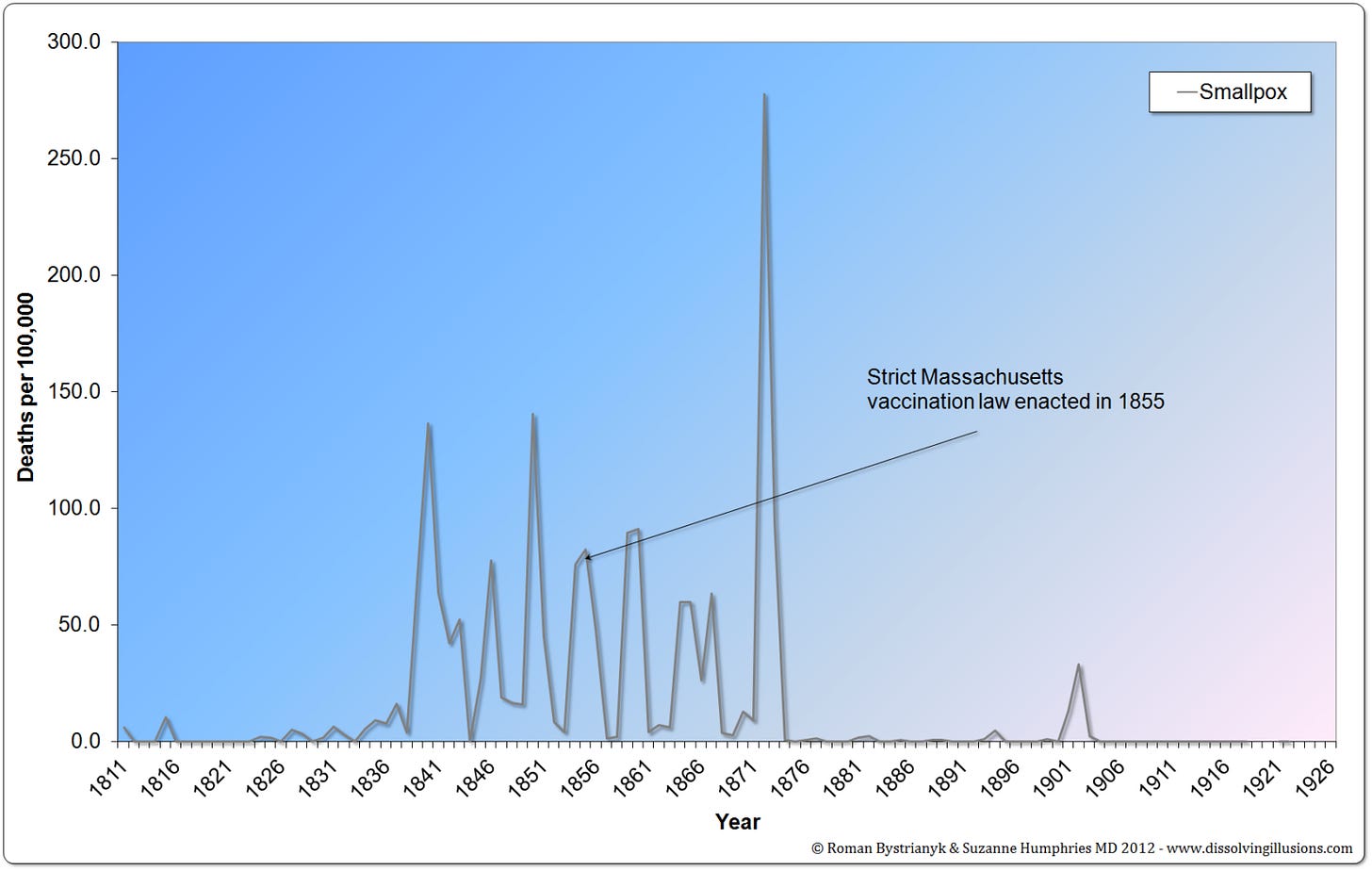
The recent headlines about the “measles outbreak” prompted me to examine the actual data. Notably, before the introduction of the first measles vaccine by Enders et al. in 1963, measles deaths had already declined by 97.2%, from 12,992 in 1919 to 364 in 1963—without vaccination.

After vaccination, deaths dropped to nearly zero. However, proving causality would require long-term placebo-controlled trials. Charting the pre-vaccination trend from 1949 to 1962 shows that both cases and deaths followed the expected trajectory, meaning the decline might have continued without vaccination. The sharper drop in cases may be influenced by bias, as doctors and parents—assuming vaccination prevents measles—could have attributed symptoms to other causes.

No randomized placebo-controlled trials for measles vaccination appear to exist. The renowned Cochrane Institute, while assessing measles vaccination as effective, rates the evidence as only low to moderate certainty, relying solely on observational studies rather than the gold-standard placebo-controlled trials.

Furthermore, measles deaths have remained lower than ten since the early 1980s, often attributed to mass vaccination. However, as shown above, no solid evidence supports this claim. In contrast, an analysis of VAERS reports on measles vaccine-associated deaths compared to confirmed deaths coded as measles (B05) suggests that since 2000, up to 16 times more people may have died from the vaccine than from the disease.

Of course, this comes with the usual challenges of attribution and causality, as well as potential underreporting. A 2010 Harvard study estimated that “[…] fewer than 1% of vaccine adverse events are reported,” suggesting that actual measles vaccine-related deaths in the U.S. could be significantly higher—potentially ranging from 200 to 2,000 per year.

While measles vaccination is widely credited with reducing deaths, the absence of randomized placebo-controlled trials leaves room for uncertainty regarding its true impact. Historical data suggests that measles mortality was already in sharp decline before the vaccine’s introduction, and the Cochrane Institute itself acknowledges only low to moderate certainty in the evidence for its effectiveness. Furthermore, VAERS data indicates that vaccine-related deaths may far exceed those from measles in recent decades, with potential underreporting suggesting a much higher actual toll. Given these factors, a more critical examination of measles vaccination policies and long-term safety data is warranted.

P.S. Both the AP and Robert F. Kennedy Jr. have falsely claimed that the recent death was the first in a decade. However, as shown above, the last recorded measles death occurred in 2019 and the data during the pandemic is not reliable. While AP has acknowledged this error to me, they have yet to correct their misleading headline.

[…]

Via https://www.usmortality.com/p/since-2000-measles-vaccines-may-have