
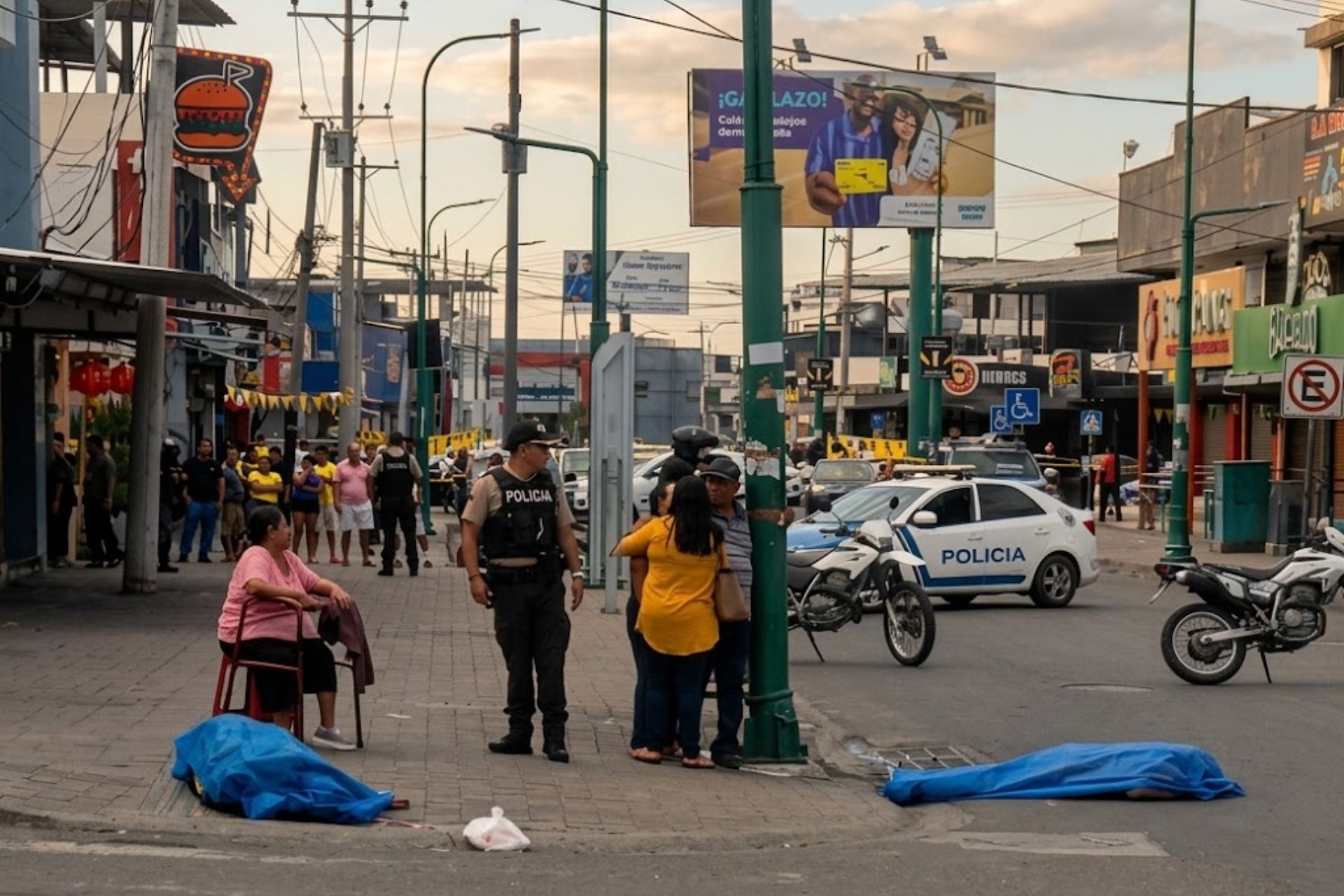
QUITO, Ecuador—Alexandra Bravo, the prosecutor assigned to investigate U.S. strikes on three Ecuadorian boats and the 36 survivors’ subsequent accounts of torture and kidnapping, was shot dead in the coastal city of Manta last month. According to police, on June 14 a hitman aboard a black motorcycle opened fire on Bravo as she and her sister were leaving a café at about 11 a.m. Bravo’s sister, who jumped to protect her, was also killed in the attack.
Upon arriving at the crime scene, officers say they found five 9mm shell casings and Bravo’s injured driver, but no sign of the police detail that had been assigned to protect her. The Police Directorate, which operates entirely under the executive branch, has launched a probe to determine if there’d been an internal security breach.
Bravo is the 26th member of Ecuador’s justice system to be assassinated since 2020 and the second individual investigating state crimes murdered that week. Besides her usual caseload of homicide and organized crime, Bravo had been working the Fiorella, Negra Francisca, and Don Maca cases—a series of drone attacks on civilian fishing ships exposed by Drop Site in April. Two of the boat’s crews returned home and reported being abducted, blindfolded, and starved for eight days by American gunmen in U.S. military uniforms aboard a U.S.-flagged patrol ship, before being abandoned in El Salvador. The UN Committee on Enforced Disappearances endorsed the calls for an investigation, demanding that the U.S. provide information on the whereabouts of the eight still-missing men and any involvement in the matter by April 27. To date, the United States has not responded.
Under Ecuador’s right-wing president Daniel Noboa—a Miami-born billionaire often characterized as a “U.S.-backed dictator”—the country has become a central testing ground for Operation Southern Spear, Washington’s extrajudicial bombing campaign purporting to target “narco-terrorists,” which has killed 221 people to date. There is no evidence that many of the victims, including those in Bravo’s investigation, had engaged in drug trafficking.
“I can’t make any assertion regarding it being a political assassination, but evidently, when a prosecutor is killed it’s because of the investigation they’re conducting,” Fernando Bastias, a renowned human rights attorney with Ecuador’s CDH and member of the Geneva-based World Organization Against Torture, told Drop Site, “That’s something we’ve learned from our experience in Ecuador.”
A source inside the Manta police department, who knew Bravo personally, told Drop Site that the Ecuadorian prosecutor was under pressure from her superiors at the Attorney General’s office to treat the U.S. attacks as exclusively “cases of disappearance.” The source, who asked for anonymity out of fear of retaliation, said Bravo was told to close all lines of inquiry after 36 of the 44 missing men were found—despite arriving with severe injuries, including 70% vision loss and feet torn to flesh and bone, which medical experts found consistent with their accounts of explosions and torture.
A senior researcher with Human Rights Watch who interviewed Bravo as part of her investigation into the three vessels, similarly recalled Bravo facing “internal challenges within the institution itself to advance the investigation.” The researcher said the prosecutor repeatedly sought cooperation from other branches responsible for the ship’s rescue, including the Manta Port Captaincy, but “none responded to her requests for information.” During the Negra Francisca bombing, Darwin Pico-Flores, an eyewitness aboard a nearby boat, told Drop Site he called the Manta Port Captaincy to request emergency assistance. Nobody came. In April, as part of its first investigation into the incident, Drop Site called the port seeking comment. Officials hung up after learning the call was from journalists.
As of their last meeting on May 8, the researcher told Drop Site, Bravo “was still in the initial stages of inquiry and investigation.” Bastias said Bravo “was investigating a country [United States] that has been positioned in the media as an ally against crime. That investigation has not advanced at all, and that stems from an intention to avoid getting into trouble or problems with anyone.”
The source inside the Manta Police Department said that, given this lack of cooperation from partner agencies, Bravo had asked for advice on how to pursue new sources for evidence.
In the days leading up to her death, Bravo was relocated to the Attorney General’s office in Montecristi, a neighboring municipality. Her caseload changed after the transfer and she was no longer in charge of investigating the three boat attacks. Drop Site attempted to reach Bravo’s replacement for comment but he had been explicitly instructed not to speak to the press. After weeks of attempts to reach the Attorney General’s office for comment, they told Drop Site the investigation was sealed and they could not comment on why Bravo was relocated.
Inside Ecuador’s U.S.-backed military regime, the Attorney General’s office has become an increasingly opaque and politicized institution. “It’s already a major obstacle for prosecutors to investigate local state agents. Now imagine international state agents,” Bastias said. “The Executive Branch has implemented a series of legal frameworks that leave these foreign state agents immune from prosecution,” he added, referring to the diplomatic immunity granted to all U.S. military and Department of Defense personnel through President Noboa’s 22 martial law decrees.
The Pentagon, Coast Guard, and U.S. Southern Command have all denied any knowledge or responsibility of the boat incidents. After Drop Site published photo evidence of the Negra Francisca bombing, U.S. lawmakers questioned U.S. Secretary of War Pete Hegseth during a congressional hearing. On June 13, the day before Bravo’s murder, Reps. Joaquin Castro (D-Texas) and Bill Keating (D-Mass.) published a letter to Hegseth, Secretary of State Marco Rubio, and Head of the U.S. Coast Guard, Kevin Lunday, demanding a full audit of U.S. government involvement in the attacks. Despite the deadline of July 10, none of the agencies have issued a public response. Keating’s press secretary Lauren McDermott told Drop Site that his office had received a reply from Rubio’s office, but none from the Department of War or Coast Guard. She did not disclose the contents of the response.
The survivors who returned home, and the families of those who didn’t, still have not received any answers, telling Drop Site “authorities shut the door in our face.” Maria, the wife of one of the fishermen, tells Drop Site her mother-in-law died awaiting her son’s return, saying she was struggling with severe depression and stopped in the weeks leading up to her death.
Despite both governments’ efforts to stonewall the investigation, evidence continues to emerge supporting the fishermen’s accounts of abduction, airstrikes, and torture. Drop Site obtained exclusive video of U.S. Coast Guard activity in the vicinity of the Negra Francisca bombing, open-source intelligence that corroborates the Negra Francisca’s testimonies, and police interviews with eyewitnesses that confirm the U.S. involvement alleged by survivors and documented by Drop Site. With the help of Airwars OSINT analyst and former U.S. Marine Corps member Tomi McCluskey, Drop Site accessed additional NASA thermal imagery consistent with the Negra Francisca bombing and vessel tracking data placing U.S. Coast Guard activity along the route the fishermen say they were taken after the strike.
Political Lawfare Under Ecuador’s U.S.-Backed Military Regime
Noboa, who governs by military curfews and mass starvation of political prisoners, has gone to great lengths to become Trump’s strongest partner in South America. Since taking office, he brushed aside Ecuador’s constitutional ban on U.S. military presence—ratified by 60% of voters as recently as November 2025—which was originally introduced almost 20 years ago precisely due to a history of U.S. military sinking boats off the coast of Manta. Additionally, his administration authorized the first FBI office on Ecuadorian soil, assisted a U.S. Embassy effort to falsely frame members of Colombia’s left-wing government ahead of elections, and collaborated with the U.S. in the bombing of innocent civilian farmworkers along the Colombian-Ecuadorian border—all in the name of combatting drug trafficking.
Notably, boats from Noboa’s family shipping corporation were caught trafficking ₤26 million of cocaine—a detail that has not deterred the State Department from naming him a key partner in Trump’s War on Drugs. Last month, The Guardian reported that a whistleblower who was investigating Noboa’s ties to drug trafficking was murdered.
Still, Noboa remains a member in good standing of Trump’s Shield of the Americas. The Americas Counter Cartel Coalition, as the Shield is also known, functions as both a military and a highly political alliance, having openly intervened to prop up U.S. interests in Bolivia as President Rodrigo Paz faced off with anti-austery protests.
A local prosecutor charging U.S. forces with extrajudicial bombings and torture of Ecuadorian civilians would undermine the alliance and damage Ecuador-U.S. relations.
Other government officials investigating U.S.-Ecuadorian criminal collusion received death threats. Mónica Palacios, a National Assembly lawmaker representing Ecuadorians living in the United States, who announced plans to bring the Fiorella boat case before the United Nations, faced months of political lawfare after exposing a U.S.-Ecuadorian government embezzlement scandal. Last Friday, Palacios said she received death threats against herself and her one-year-old son, along with footage of the outside of her New York home. She directly blamed President Noboa, saying the threats were retaliation for her investigation into U.S.-Ecuadorian corruption.
“There is a direct persecution of judges and prosecutors who, within the scope of their duties, make decisions that are not entirely aligned with what the Executive Branch wants and end up being sanctioned,” Bastias, the human rights attorney, said. “On the other hand, there is also the risk stemming from the context of criminality.” Regardless, he asserted, Bravo’s death “has a lot to do with what the state does or does not do, because so far there haven’t been any effective security mechanisms for the justice system’s civil servants. The responsibility lies in having failed to ensure protection.”
Diego Vintimilla Jarrín, formerly a lawmaker with Ecuador’s National Assembly and now a spokesperson for Ecuador’s Communist Party, similarly told Drop Site, “Noboa’s government is the most anti-sovereign agenda we have had since the start of democracy. I have no proof of who murdered the prosecutor but the fact that she was investigating certain elements and that they later ceased to seem important also says a lot about the underlying issues.”
New Evidence Implicating U.S. Emerges
The Negra Francisca
The U.S. maintains it never interacted with any of the three boats. A spokesperson for the U.S. Coast Guard told The Guardian that the agency’s only involvement in the events was deploying the USCGC Bertholf on a search-and-rescue mission after receiving a MAYDAY alert that the Negra Francisca was on fire, and ultimately found nothing.
But tracking data of the Bertholf’s movements, provided exclusively to Drop Site by McCluskey, places the cutter near the Negra Francisca around the time of the bombing before turning off its signal—only to reappear off the shore of Costa Rica the same dates the Negra Francisca crew were taken into Central American waters and transferred to El Salvador’s Naval Command, with mangled limbs and major burn injuries from the attack. Hernán Flores, captain of the Negra Francisca, told Drop Site that Salvadoran officers specifically informed him that “U.S. personnel had called to coordinate the handoff.”
The Coast Guard denied that it coordinated the handoff. “The Coast Guard did not play any role in the transfer of fishermen from the Negra Francisca Duarte II,” said a spokesperson.
The USCGC Bertholf departed the Galápagos military base at 4 p.m. on March 16 and stopped transmitting its location shortly afterwards. A day later, the Negra Francisca was bombed 170 miles away—a distance typically covered by boat in 3 to 10 hours. Drop Site asked the U.S. Coast Guard to account for the cutter’s activity after its signal went dark. The Coast Guard responded it “does not disclose cutter movements during law enforcement missions for operational security.”
At 1:02 p.m. on March 17, NASA FIRMS registered a thermal anomaly consistent with an explosive fire, corroborating the time and location where Negra Francisca fishermen told Drop Site their ship was set ablaze by multi-drone strikes. The crew say they were then seized at gunpoint by English-speaking men with blond hair dressed in khaki fatigues with American flag patches stitched onto their sleeves—their descriptions match the uniforms pictured in U.S. Southern Command press releases.
[…]
Via https://www.dropsitenews.com/p/prosecutor-investigating-ecuador-boat-strikes-murdered
 The Most Revolutionary Act