
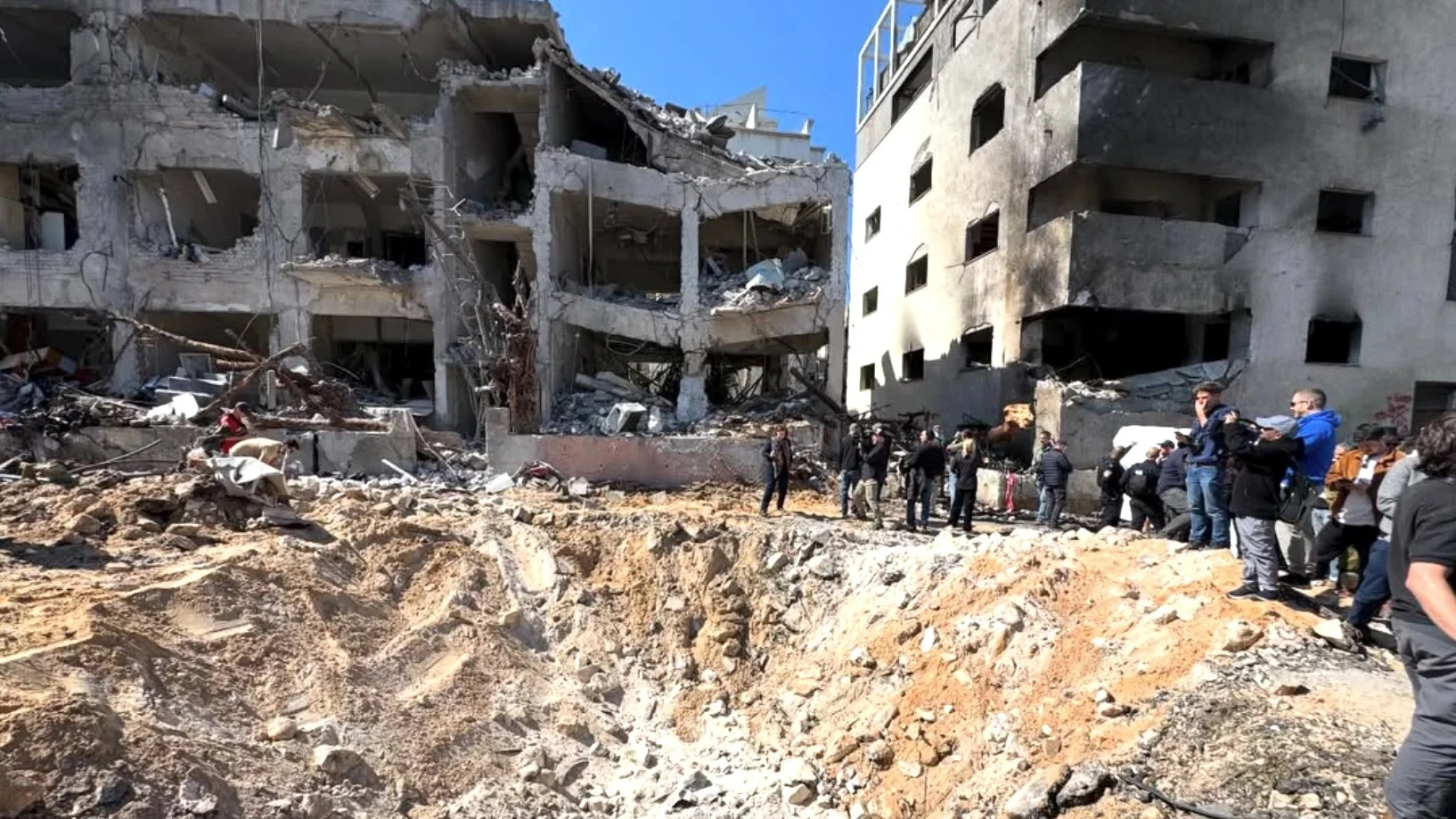
 (Photo credit: Historic Tel Aviv Bauhaus)
The Cradle
Iran announced on 6 April that it has conveyed its demands on a potential ceasefire with the US and Israel through intermediaries, as US President Donald Trump’s threat to bomb Iranian energy and water infrastructure looms.
Iranian Foreign Ministry spokesperson Esmail Baghaei told a news briefing that Tehran has communicated its demands “based on national interests” through regional mediators.
“We have formulated our own set of demands based on our interests and considerations. We are not ashamed to voice our legitimate and logical demands,” he said when asked about the prospect of an end to the war.
Iranian officials have previously stated that Tehran has four main conditions for an agreement: an end to the war and guarantees against future military attacks, compensation for losses during the conflict, recognition of formal control of the Strait of Hormuz, and no limits on its ballistic missile program.
Baghaei stressed that Iranian leaders are committed to continuing the war to defend the country from US-Israeli attacks if necessary.
“Expressing our positions quickly and courageously should not be interpreted as backing down,” he said.
The ministry at the same time expressed doubts about US intentions, stating that “America destroyed the path of diplomacy in months in the worst way, and the world sees that its claims do not match its actions.”
“America gives no value to the security of the region’s countries, and its only obsession is maintaining the existence of the Zionist entity,” the statement added.
The US and Israel launched an unprovoked war on Iran starting on 28 February, including assassinating the Islamic Republic’s supreme leader, Ali Khamenei, despite negotiations taking place at the time described by Omani mediators as “positive.”
US and Israeli attacks have so far killed over 1,340 people in Iran, according to Iranian authorities.
The Iranian Foreign Ministry announcement comes amid a report from Axios claiming that the US, Iran, and a group of regional mediators are discussing a potential 45-day ceasefire meant to lead to a permanent end to the war.
The negotiations are crucial, as US President Donald Trump gave a 48-hour deadline for Iranian leaders to reach a deal with him, including opening the Strait of Hormuz, while threatening to bomb Iran’s electricity and water infrastructure if they refuse.
However, Axios described the chances for reaching a deal before Trump’s deadline of Tuesday at 8:00 pm Eastern Time (ET) as “slim.”
“But this last-ditch effort is the only chance to prevent a dramatic escalation in the war that will include massive strikes on Iranian civilian infrastructure and a retaliation against energy and water facilities in the Gulf states,” the news outlet wrote.
On Sunday, Trump extended the deadline to Tuesday, telling Axios that he was “deep in negotiations” with Iranian officials.
“There is a good chance, but if they don’t make a deal, I am blowing up everything over there,” he claimed.
Last week, during a televised address to the nation, Trump threatened to bomb Iran “back to the Stone Age.”
If Trump orders deliberate attacks on Iran’s civilian infrastructure, such attacks would constitute war crimes.
They would be reminiscent of the US bombing campaign against Iraq during the 1991 Gulf War, which heavily damaged the country’s electricity and water purification facilities. Coupled with economic sanctions over the next decade, the US bombing campaign led to hundreds of thousands of Iraqi deaths.
If Trump makes good on the threat, Iran has, in turn, threatened to retaliate with attacks against power and water infrastructure in Israel and the Gulf states.
Iran’s shuttering of the Strait of Hormuz to the US and its allies has already struck a blow to Gulf oil production, while the targeting of Gulf desalination facilities could eliminate drinking water supplies for a combined 62 million people.
Two sources speaking with Axios said the plan for a major US-Israeli bombing campaign targeting Iran’s energy facilities is “ready to go,” if no deal is reached by the deadline.
The last-minute diplomatic effort reportedly involves Pakistani, Egyptian, and Turkish mediators, according to the four sources. Messages are reportedly being passed between Trump’s envoy Steve Witkoff and Iranian Foreign Minister Abbas Araghchi.
The sources said the mediators are discussing the terms of a two-phase deal: the first phase would involve a potential 45-day ceasefire, during which a permanent end to the war would be negotiated in the second phase.
According to the sources, a deal to open the Strait of Hormuz and a “solution” for Iran’s highly enriched Uranium, such as removing it from the country or diluting it, would only be reached in the second phase.
The Iranian officials have reportedly insisted to the mediators that they will not agree to a ceasefire similar to that reached in Gaza or Lebanon, where Israel had the ability to carry out additional attacks at any time despite the agreement.
[…]
 The Most Revolutionary Act