
By Ivan Kesic
April 5, 2026
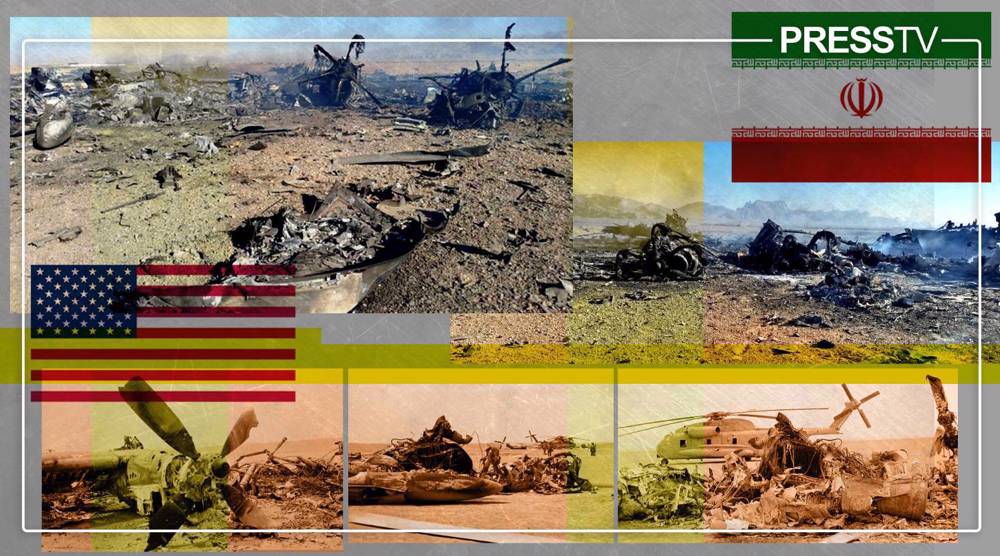
In a stunning display of coordinated defensive warfare, Iranian forces – combining the Islamic Revolution Guards Corps (IRGC), police commando units, Basij resistance fighters, and regular army elements – destroyed two American C-130 transport planes and two Black Hawk helicopters in southern Isfahan province early on Sunday.
The complex operation transformed a US rescue mission into the most embarrassing American military debacle since the 1980 Tabas desert catastrophe.
The thirty-seventh day of the US-Israeli aggression against the Islamic Republic of Iran did not begin with American triumph as some US officials claimed, but with Iranian fire.
Just after dawn on Sunday, Washington launched what it would later desperately frame as a successful rescue operation for a downed F-15E pilot from the 3 April engagements.
Instead, the mission became a complete operational collapse.
Within hours, the spokesperson for the Khatam al-Anbiya Central Headquarters announced that Iranian joint forces had destroyed two C-130 military transport aircraft and two Black Hawk helicopters in southern Isfahan province.
Images of burning wreckage – geolocated and verified by Press TV – circulated across global platforms, drawing immediate and unavoidable comparisons to Operation Eagle Claw, the failed 1980 American rescue mission that ended with eight US soldiers dead and aircraft abandoned in the Tabas desert in South Khorasan province.
For the Islamic Republic, it was not merely a defensive feat. It was historical revenge, divine justice, and a military-technological declaration that US power holds no sway over Iranian skies, contrary to the claims of US President Donald Trump and his war minister.
Desperate rescue born from earlier defeat
The events of Saturday cannot be understood in isolation. They were the direct consequence of the black day that had struck American air power on April 3, when Iranian integrated air defense networks downed an F-15E Strike Eagle over central Iran, along with an A-10 Thunderbolt II over the Persian Gulf, multiple MQ-9 Reaper drones, Hermes reconnaissance platforms, and cruise missiles.
The F-15E, a twin-seat multirole strike fighter valued at over $90 million, disintegrated upon impact in Kohgiluyeh and Boyer-Ahmad province in central Iran.
The crew member or members remained missing, despite an initial American extraction bid that cost the aggressors two Black Hawk helicopters damaged by Iranian ground fire on April 3. There is no evidence that the US forces were able to locate the pilot.
By Saturday, US commanders faced an impossible choice: abandon a missing airman to Iranian custody, or launch a deeper, riskier incursion into sovereign Iranian territory.
They chose the latter. That decision would prove catastrophic.
The Khatam al-Anbiya Central Headquarters later confirmed that the Americans had planned what they called a “deceive and immediate escape mission,” using an abandoned airport in southern Isfahan Province as a covert staging point.
Iranian intelligence, however, had already mapped the operation.
Morning of 5 April: Joint forces spring the trap
According to reports, at approximately 09:20 local time on April 5, American aircraft began entering Iranian airspace to search for the missing pilot.
The formation included two C-130 Hercules transport planes—four-engine turboprop workhorses designed for tactical airlift, paratroop drops, and medical evacuation—alongside two UH-60 Black Hawk helicopters providing close support and personnel extraction.
According to operational summaries released by the IRGC and confirmed by the Law Enforcement Command, the US aircraft attempted to descend toward the pre-identified abandoned airport.
What the Americans did not anticipate was the full integration of Iranian defensive assets: IRGC Aerospace Force radar and missile batteries, police special operations commando units positioned on the ground, Basij resistance fighters familiar with the mountainous terrain, and regular army air defence elements all operating under a single command structure.
The spokesperson for the Khatam al-Anbiya Central Headquarters described the response as “divinely guided and precisely timed.”
As the C-130s approached their landing zone, Iranian police commando units opened heavy fire from multiple directions, immobilizing the first transport aircraft before it could unload its personnel.
Minutes later, IRGC air defence systems locked onto the second C-130 and the two Black Hawks. One by one, the American aircraft were struck.
Two C-130s and two Black Hawks as the toll of defeat
By 10:20 local time, Iranian media began broadcasting the first official confirmations.
The Khatam al-Anbiya spokesperson announced that two Black Hawk helicopters and one C-130 military transport plane had been destroyed, left burning in southern Isfahan.
Subsequent detailed reporting, including images released by local media and verified by geolocation analysis, revealed the full scope: two C-130 aircraft had been hit, not one.
The discrepancy was explained by the dynamics of the engagement; the first C-130 was immobilized by police commando fire and then completely destroyed minutes later, while the second was struck during an attempted escape manoeuvre.
Both Black Hawk helicopters were downed in the vicinity of the abandoned airport, their wreckage scattered across the arid landscape.
At least five American personnel were killed in the operation, according to Iranian military sources. Some unofficial reports have put the death toll even higher.
The IRGC’s Public Relations Department issued a terse but devastating statement.
“The invading enemy aircraft in southern Isfahan, including two Black Hawk helicopters and two C-130 military transport aircraft, were hit and are now burning in the flames of the wrath of the heroic fighters of Islam,” it stated.
For the first time since the aggression began on 28 February, Washington had lost not just strike aircraft but the very platforms designed to retrieve downed pilots, a catastrophic failure of combat search-and-rescue doctrine.
Tabas parallel: History repeats as humiliation deepens
Even before the smoke had cleared over Isfahan, the city known for its picturesque gardens and magnificent monuments, Iranian officials and social media users alike drew an unmistakable historical parallel: the failed American Operation Eagle Claw of April 1980.
That aborted mission, launched during the first year of the Islamic Revolution, had sought to rescue US captives from Tehran but ended in disaster at a remote desert in Tabas.
A sandstorm, equipment failures, and a catastrophic collision between a C-130 transport plane and an RH-53 helicopter had killed eight American servicemen and left the wreckage of multiple aircraft abandoned on Iranian soil.
The United States had suffered not just military defeat but global humiliation at the time.
On 5 April 2026, 46 years later, history repeated itself with even greater Iranian proficiency.
Where the 1980 Tabas operation had failed primarily due to weather and mechanical issues, the 2026 Isfahan defeat was the product of deliberate, coordinated Iranian defensive action.
Iranian forces did not wait for nature to defeat the Americans; they destroyed them directly, using domestically developed weapons, real-time intelligence integration, and the courage of IRGC, police commandos and Basij volunteers.
Images circulating on social media juxtaposed the burning C-130 wreckage of 2026 with black-and-white photographs of the Tabas desert debris field from 1980.
The message was unmistakable: forty-six years after its first humiliation in the Islamic Republic, the United States had learned nothing and lost even more.
Joint nature of victory: Police, IRGC, Basij, and Army
What distinguishes the 5 April operation from previous Iranian defensive successes, including Tabas, is the breadth of its joint character.
The Khatam al-Anbiya Central Headquarters spokesperson explicitly named the participating forces: the IRGC Aerospace Force and Ground Forces, the regular Army, volunteer Basij resistance units, and law enforcement police commandos.
This was not a narrow military engagement but a national defensive mobilization.
The police special units, in particular, played a decisive role in immobilising the first C-130, demonstrating that Iranian law enforcement personnel are fully integrated into the country’s layered air defence architecture.
Local sources also reported that a refuelling aircraft belonging to the intruding US forces was shot down in southern Isfahan Province, targeted by elite police commando units.
The Law Enforcement Command confirmed that precise monitoring of enemy aerial movements, combined with rapid and coordinated responses, had made the operation possible.
For Iranian military planners, the Isfahan victory validated years of investment in joint command, control, communications, and intelligence integration—capabilities that American military assessments had consistently underestimated or dismissed.
American narrative: Desperate spin and visible silence
In the hours following the Isfahan debacle, US President Donald Trump took to social media to claim that a “daring” and “miraculous” rescue operation had successfully extracted the missing F-15E pilot with no American losses.
Iranian officials responded with immediate statements, mocking the US president’s claim.
Speaker of the Iranian Parliament Mohammad Baqer Qalibaf posted an image of the destroyed C-130 wreckage on his X account, writing with sharp sarcasm: “If the United States gets three more victories like this, it will be utterly ruined.”
The IRGC Intelligence Organization highlighted the absence of any photographs or video evidence of the supposedly rescued pilot—a stark contrast to the abundant Iranian imagery of burning American aircraft.
Iranian analysts noted that even if the American narrative were accepted at face value, the cost of the operation had been catastrophic: two C-130 transport planes, two Black Hawk helicopters, and an unknown number of casualties, all for the extraction of a single airman who had been shot down days earlier because American air superiority had already failed.
The Khatam al-Anbiya spokesperson dismissed Trump’s claims as an attempt to “justify the bitter defeat and failure of his weak army by creating ambiguity in public opinion,” adding that the United States had not even reported its full losses in the region for several days.
The contrast between Iranian transparency—releasing geolocated images, detailed operational summaries, and official confirmations—and American evasion could not have been starker.
Technical and strategic implications: The death of CSAR doctrine
The destruction of two C-130 transport aircraft and two Black Hawk helicopters on 5 April carries profound technical and strategic implications that extend far beyond the immediate tactical defeat.
Combat search and rescue, or CSAR, has been a cornerstone of American air power doctrine since the Vietnam War.
The Isfahan operation has demonstrated that Iranian defensive networks can not only shoot down American strike aircraft but also systematically dismantle the very rescue architecture designed to recover them.
The C-130, a four-engine turboprop transport with a maximum takeoff weight exceeding 70,000 kilograms, is not a nimble penetration aircraft; it relies on prior suppression of enemy air defences to operate safely.
Its destruction over southern Isfahan, experts say, proves that the US-Israeli aggression has failed to achieve any meaningful suppression of Iran’s integrated air defence network.
The Black Hawk, a twin-engine utility helicopter equipped with advanced avionics, night-vision capabilities, and defensive countermeasures, was similarly neutralized.
For American military planners, the lesson is devastating: no US aircraft, whether strike fighter or support transport, can consider Iranian airspace survivable.
[…]
 The Most Revolutionary Act