
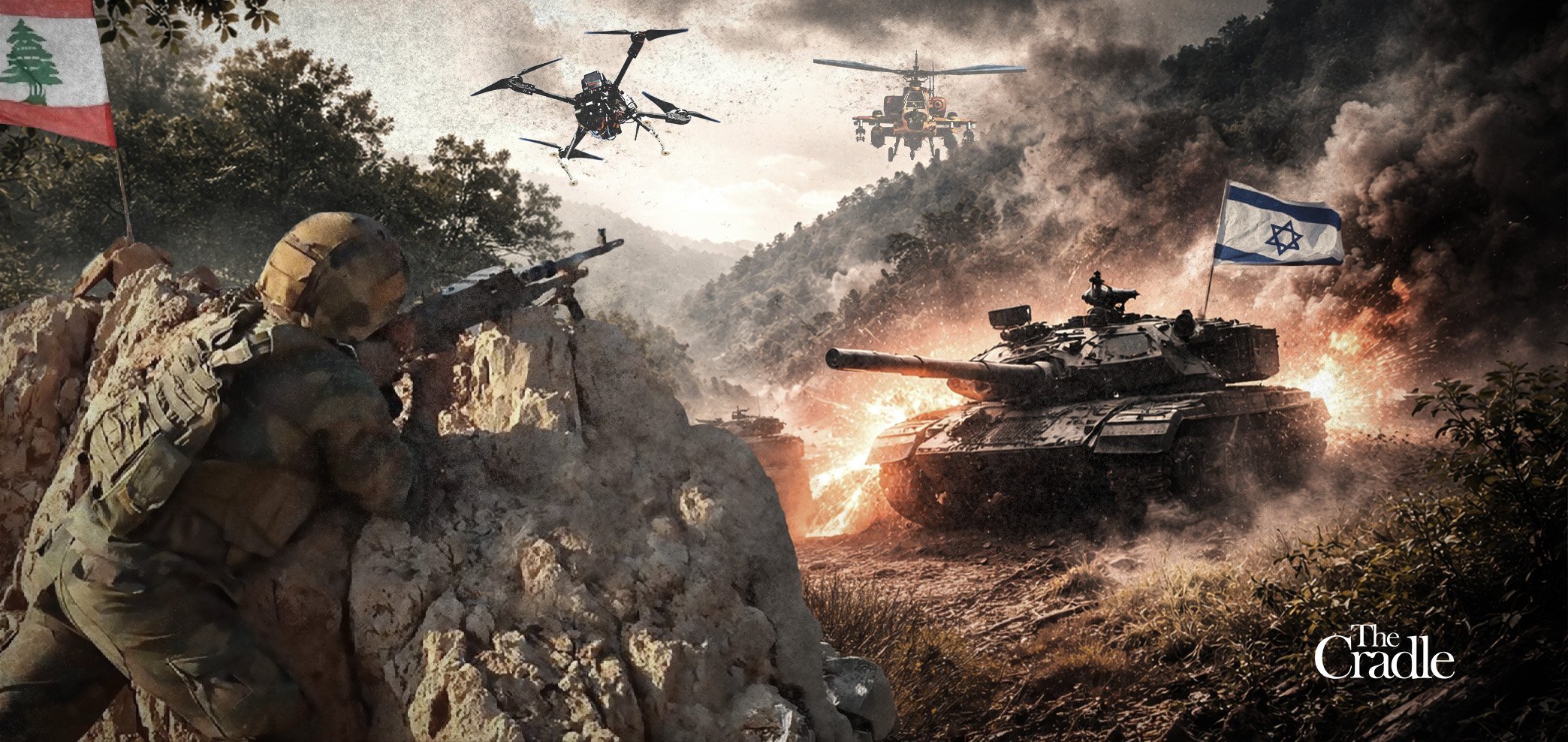
Southern Lebanon is witnessing escalating clashes, with resistance tactics sustaining a war of attrition against Israeli forces and limiting their battlefield progress.
A month after the start of the Israeli offensive on Lebanon, fighting in southern Lebanon continues to intensify within a highly complex battlefield environment. As the operation enters its second month, a clear field dynamic is taking shape – one defined by a focused attrition strategy imposed by Hezbollah, which manages engagements in a way that steadily increases the cost for advancing Israeli forces.
The ongoing ground operations in southern Lebanon fall within an asymmetric confrontation between the Israeli enemy’s army – as a conventional military force with air and technological superiority – and a non-conventional resistance that does not operate according to traditional military doctrine. Hezbollah does not rely on fixed territorial control or linear defense lines; instead, it employs a guerrilla warfare model based on operational flexibility, dispersion, ambushes, and concentrated strikes within a cumulative attrition framework targeting the Israel’s manpower and logistical capabilities.
According to field sources, the enemy’s ground incursions are distributed across several main axes, each with its own geographic and tactical characteristics, as follows:
Khiam axis
Khiam is a vital axis for the Israeli enemy due to its connection to villages where the resistance has no presence, as well as its linkage to the western Bekaa and the occupied Syrian territories – making it a corridor between Lebanon and Syria.
Hezbollah’s tactic here is based on steadfastness and defense through establishing combat pockets within the town, supported by fire from the second line in surrounding villages. So far, the Israel has not been able to fully control Khiam; its presence is limited to parts of it, while Hezbollah remains present. This axis also carries a retaliatory dimension for Israel due to the losses it sustained in attempts to seize it during the 2006 and 2024 wars.
Taybeh–Qantara axis
Taybeh represents the operational flank. Israeli forces aim to reach Wadi al-Hujeir after controlling Qantara, then advance toward the Litani River.
Here, Hezbollah adopts a different tactic than in Khiam – offensive attrition aimed at inflicting the maximum possible human and logistical losses on the enemy. Israeli troops are currently present inside Taybeh and are attempting to consolidate their positions, while the resistance continues targeting soldiers, tanks, and vehicles.
As for Qantara, it remains a close-range engagement zone. Meanwhile, nearby villages (Odaisseh, Rab al-Thalatheen, Kfar Kila, and parts of Markaba) are used as part of a tactic targeting enemy depth. These areas were previously under Israeli control and sustained extensive damage during earlier conflicts, the 60-day withdrawal period following a so-called ceasefire between Israel and Lebanon in 2024, and over the past 15 months.
The key question here is not whether the enemy can reach Wadi al-Hujeir, but rather the operational cost it will incur in doing so – especially since the resistance is not a conventional army and has not defined holding these villages as a strategic objective.
Naqoura axis
The Naqoura axis is a border extension along the coastal strip facing the Blue Line near the Lebanese–Palestinian border. Israel seeks to establish a buffer zone, secure its land and maritime borders, and target Hezbollah’s missile capabilities.
The area is wooded, and villages are connected through orchards, providing effective natural cover for the resistance forces. Another objective is to isolate this axis from its depth in the Tyre (Sur) region and cut supply and reinforcement lines.
Bint Jbeil axis
Field data indicates that Israel has begun troop mobilization and fire preparation for entering Bint Jbeil, which represents a vulnerable flank due to nearby villages where the resistance has no presence. It also holds significant symbolic importance in Israeli consciousness since 2000, following the famous statement by the late Hezbollah secretary-general Sayyed Hassan Nasrallah: “Israel is weaker than a spider’s web.”
This symbolism makes the city both a practical and psychological target. The resistance’s tactic is centered on preventing the city from falling.
Qawzah Axis (Qawzah–Beit Lif–Ramiya Triangle)
The “Qawzah–Beit Lif–Ramiya” triangle forms a strategic border axis, with its villages located on medium elevations overlooking surrounding areas, making it highly sensitive to ground movement and exchanges of fire.
Israel seeks to establish a buffer zone to secure its land borders and degrade the resistance’s missile capabilities. The terrain consists of forests and orchards connected to the villages, providing natural concealment for Hezbollah forces. Meanwhile, adjacent villages lack a resistance presence, making this axis a vulnerable flank that can be exploited, while also restricting military movement due to internal considerations.
General field situation and tactics
After approximately a month since the start of operations, Israeli forces remain positioned within the first line (border villages and the direct line of contact), without achieving a decisive breakthrough into deeper areas due to the ongoing attrition imposed by Hezbollah.
In contrast, the resistance adopts a tactic of allowing limited advances in certain front lines, then exhausting enemy forces from the second line through continuous fire or direct engagement. Unofficial field estimates indicate that the Israeli army has suffered significant human losses, estimated in the hundreds of killed and wounded (possibly reaching around 700), in addition to the targeting of more than 100 Merkava tanks according to data from the Hezbollah’s military media, as well as a number of vehicles and bulldozers. This level of losses would have been sufficient, under previous circumstances, to halt operations.
Hezbollah is currently following a gradual approach in the use of weapons and combat units, while maintaining full command, control, and communication – reflecting substantial remaining capabilities. The cohesion of the communication system among the central operations room, axis-level command rooms, and combat units is evident, as reflected in improved military and organizational performance and the rapid transmission of field information.
The resistance operates according to an anti-maneuver doctrine rooted in guerrilla warfare, benefiting from a cohesive command-and-control structure and sustained supply lines. In contrast, the enemy suffers from intelligence shortcomings that limit the effectiveness of its isolation-based strategies. Accordingly, the confrontation is taking shape as a struggle between a maneuver-based approach aimed at fragmenting the front – led by the Israeli army – and a systematic attrition strategy aimed at exhausting the attacking force and preventing its consolidation – led by Hezbollah.
Meanwhile, the Israeli army relies on an operational approach based on maneuver through encirclement and isolation rather than direct assault, with the aim of reducing human losses and accelerating the achievement of a field accomplishment that can be exploited for media purposes. This is pursued through attempts to fragment the Hezbollah’s combat structure into isolated pockets and to cut supply lines between the first and second lines south of the Litani River.
The enemy’s strategic dilemma
Israel is fighting without a clear strategic vision, as its declared operations aim to secure northern occupied Palestine and establish a buffer zone for the same purpose. However, even reaching the Litani River does not guarantee the neutralization of Hezbollah’s missile capability, which continues to pose the same threat to the north.
The options available to the enemy include a full-scale invasion to militarily eliminate the resistance – an option considered impossible under current conditions, given the deteriorated state of its army and its ongoing attrition. This reality was acknowledged by the Israeli Chief of Staff Eyal Zamir himself, who warned of the risk of the army’s collapse if confrontations continue in this manner.
The realistic option, therefore, is to move toward an agreement and indirect negotiations, or to achieve a limited field accomplishment by reaching Wadi al-Hujeir and taking photographs near the Litani River, accompanied by media momentum alongside a diplomatic track.
The media dimension is evident in the visit of Israeli Chief of Staff Eyal Zamir to Tel al-Awida in Kfar Kila and the visit of the army spokesperson to Odaisseh. These actions are presented as media maneuvers, as the two villages had previously been under Israeli control before the war, and are not considered to be deep within Lebanese territory as claimed. These media representations are intended to compensate for the absence of real field achievements.
Recovery of the resistance
In this regard, statements by Hezbollah Secretary-General Sheikh Naim Qassem regarding military recovery appear accurate. A clear improvement in performance is evident compared to the “Operation Al-Bas” battle, where combat was more individual in nature under the concept of fighters’ “field judgment,” and coordination gaps were apparent, particularly when local commanders were killed.
Today, however, operational plans and alternatives are in place, and earlier logistical and positioning problems have been addressed. This development has pushed the enemy to target bridges and roads, especially since, during “Operation Al-Bas,” there were significant difficulties in manpower logistics.
Firepower and technical capabilities
Hezbollah has demonstrated the continued effectiveness of its missile capabilities, with a clear recovery in its rocket units, reflected in long-range salvos reaching up to 200 kilometers (the Gaza envelope).
It has also shown capabilities in air defense, having succeeded in downing several drones and even attempting to target Israeli warplanes and force them to retreat – particularly in the skies over Beirut, marking a first in the history of the resistance.
In addition, Hezbollah maintains capabilities in anti-armor warfare and drone operations. The use of FPV suicide drones with high maneuverability and precision has become prominent, drawing on experience from the Russia–Ukraine war.
Despite the enemy’s technological superiority and aerial dominance, the resistance retains strong reconnaissance capabilities, overcoming obstacles created by enemy fortifications and constant aerial surveillance.
Security level
A source within the resistance’s security apparatus indicates that the recent targeting operations and assassinations resulted from individual security breaches rather than from a structural intelligence penetration, reflecting the cohesion of the Hezbollah’s security system.
The pattern of targets chosen by Israel reveals a state of intelligence blindness. The majority of airstrikes have targeted “security-burned” locations or sites of institutional or civilian character, which suggests a degradation in the effectiveness of the Israeli army’s target bank.
In a related context, the Israeli General Security Service (Shin Bet) issued exceptional instructions, most notably a ban on mobile phones and a complete prohibition on ministers and Knesset members visiting front-line areas in the western and central sectors until further notice. This was accompanied by changes in camouflage protocols, including the use of disguised civilian vehicles when necessary, after it was confirmed that Hezbollah is capable of identifying leadership convoys.
These measures followed an alleged attempt by the resistance to assassinate Israeli Defense Minister Israel Katz during a tour in southern Lebanon, according to Israeli media. Opposition leader Yair Lapid launched an attack on Israeli Prime Minister Benjamin Netanyahu’s government, describing the incident as a “catastrophic intelligence failure.”
Accordingly, this is considered a shock achieved by Hezbollah’s military intelligence unit, alongside its identification of newly established enemy positions and military sites.
Unity of fronts
In this war, the unity of fronts between Iran and its strategic allies is clearly evident, both at the military and political levels.
On the military level, coordination serves as a decisive factor that undermines any enemy attempt at isolation, as clearly demonstrated through field operational coordination.
On the political level, the unity of fronts is reflected in a coordinated stance at the regional and international tables, whereby battlefield gains are translated into diplomatic strength and attempts at isolation or pressure on the resistance are thwarted.
Mousawi: “No current prospect for agreements; the war is long”
Meanwhile, the official in charge of resources and borders in Hezbollah, Sayyed Nawaf al-Mousawi, stated in a private interview that “conditions have not yet matured for any agreements, and we remain in the heart of the battle,” stressing that “the focus now is on fighting in the field, and there is no prospect for agreements at the present time.”
[…]
 The Most Revolutionary Act