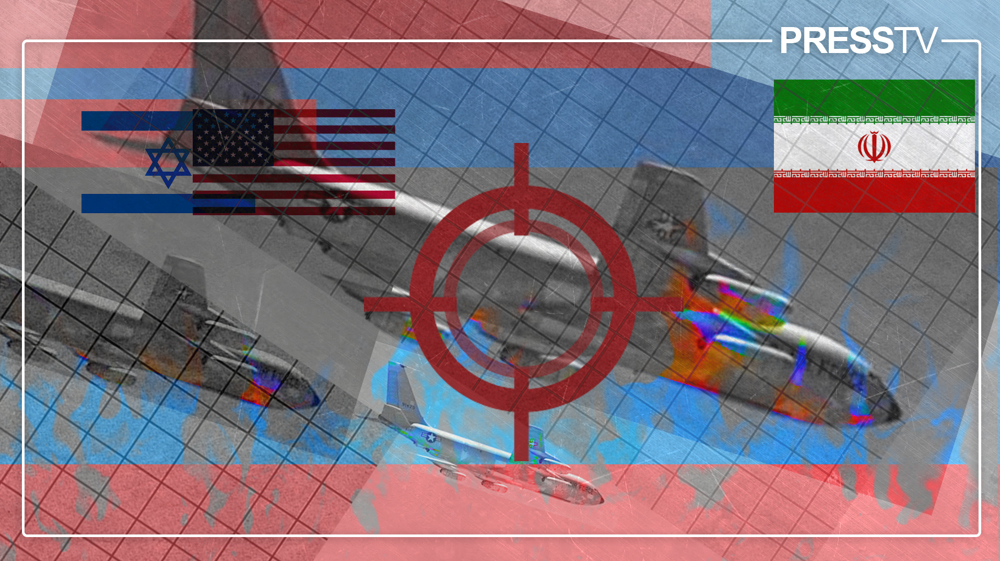
Aerial nightmare: How Iran, resistance axis destroyed fleet of US KC-135 Stratotankers

By Yousef Ramazani

In the span of just three days, Iran and the Axis of Resistance delivered the most devastating blow to American aerial logistics since the Vietnam War, destroying six KC-135 Stratotankers and damaging the seventh in coordinated strikes that have exposed the fatal vulnerability at the heart of the US-Israeli aggression against Iran.

It began on March 12, 2026, when the Islamic Resistance in Iraq, in coordination with the Iranian armed forces, launched a precision missile strike, sending a KC-135 plummeting from the skies over western Iraq. All six American crew members aboard were killed in the attack.

Two days later, on March 14, Iranian ballistic missiles pummelled the Prince Sultan Air Base in Saudi Arabia, destroying five more Stratotankers on the tarmac in a single devastating salvo.

The numbers tell a stark story: seven of America’s most strategically vital aircraft lost or damaged, thirteen American service members dead, and the entire logistical architecture of Operation Epic Fury thrown into disarray.

This is the inside story of how the tanker war became America’s worst nightmare.

The unglamorous workhorse of American air power

The KC-135 Stratotanker is not a weapon of thunderous strikes or stealthy infiltration. It is a gangly, 1950s-era aircraft, an awkward military adaptation of the first commercial jetliners.

Based on the Boeing 367-80, the same design lineage as the 707, it is essentially a flying fuel tank with wings.

Yet in the 21st century, and particularly in the high-stakes geography of the Persian Gulf, this elderly workhorse has become the single most critical component of American air power.

The numbers are impressive: up to 90,700 kilograms of transferable fuel, cruising at 850 kilometers per hour, operating at altitudes up to 15,000 meters, launching at a maximum gross weight of 146,000 kilograms.

Its flying boom is optimized for Air Force receivers, but the aircraft can also refuel probe-equipped platforms using a drogue adapter, bridging service-specific architectures and turning joint air campaigns into truly integrated operations.

The US Air Force has invested heavily in keeping the fleet viable. The most significant upgrade replaced the original turbojets with modern CFM-56 turbofans on the KC-135R and T variants. This transformation increased fuel offload capacity by 50 percent, improved fuel efficiency by 25 percent, and drastically reduced the maintenance footprint.

In the context of the aggression against Iran, this efficiency meant a tanker could loiter on station for hours longer, covering strike packages engaging in dynamic targeting deep inside Iranian territory. It was an asset the Pentagon believed was safe, operating from “secure” bases far from the front lines. They were disastrously wrong.

Each Stratotanker carries a crew of three – pilot, co-pilot, and boom operator – who lies prone in the tail guiding the refueling boom into the receptacle of the receiving aircraft. These are highly specialized professionals, their skills honed over years of training. Their loss is felt acutely throughout the refueling community.

The US Air Force manages a fleet of approximately 396 KC-135s spread across active duty, the Air National Guard, and the Reserve. Each aircraft is a finite and precious asset that cannot be quickly replaced. Each crew member, even more so.

What is the KC-135’s role in this war of aggression?

To understand why the destruction of these seven aircraft represents such a catastrophic blow to Operation Epic Fury, one must understand the unforgiving arithmetic of aerial warfare in the Persian Gulf region, according to military experts.

A strike package taking off from a base in the Persian Gulf or from an aircraft carrier in the Arabian Sea might just be able to reach targets in Iran without refueling, but they would do so with minimal fuel reserves, no ability to loiter, and a desperate, fuel-critical dash back to safety.

The Stratotanker obliterates these constraints. By loitering in established refueling tracks over western Iraq, Saudi Arabia, or international airspace, the tanker allows fighter-bombers like the F-15E and F-16 to take off fully loaded with weapons rather than fuel.

They meet the tanker en route, top off their tanks, press deep into Iranian airspace, and then refuel again on the egress before landing. This effectively brings the entire Persian landmass within striking distance.

Without the KC-135, the concept of a sustained strategic bombing campaign against a country the size of Iran would be logistically impossible.

On March 12, just hours before the first tanker was shot down, US Central Command released imagery showing a KC-135 refueling a Navy F/A-18F Super Hornet during Operation Epic Fury over the Middle East.

The aerial refueling mission highlighted how joint tanker support sustains strike tempo and extends combat endurance. The tanker in that pairing was far more than airborne logistics.

A carrier-based jet that tanks en route or on station can hold in a patrol box longer, wait for a time-sensitive target, escort other strike packages deeper inland, or recover with greater tactical flexibility instead of being pulled home by fuel state alone.

In Operation Epic Fury, KC-135s refueling F/A-18Fs means more time on station, more options for commanders, better responsiveness against fleeting targets, and a greater ability to keep pressure on Iranian air defense and missile networks without constantly resetting the air picture.

That is why the refueling pass matters. It is not a backdrop to the operation. It is one of the mechanisms that makes the operation sustainable.

At least 40 of these aircraft have been operating directly out of the Israeli regime’s Ben Gurion Airport, a clear indication of the integration of the US and Israeli air campaigns.

The operational tempo has been described as intense, with approximately 75 percent of the entire US tanker fleet airborne in the weeks leading up to the aggression, pre-positioning for the massive fuel demands of the aggression.

How were they lost to enemy fire?

The first strike came on March 12, 2026, when the Islamic Resistance in Iraq, in close coordination with the Islamic Revolution Guards Corps (IRGC), executed a precision missile attack against a KC-135 Stratotanker operating in western Iraq.

The spokesman for the Central Headquarters of Iran’s Military announced that the US military refueling plane was shot down by a missile fired by resistance groups, stating unequivocally that all six American service members on board the aircraft were killed in the strike.

IRGC’s public relations wing elaborated in a formal statement that its air defense systems, operating under the umbrella of the Resistance Front, successfully targeted the Boeing KC-135 at the precise moment it was engaged in refueling an aggressor fighter jet.

This detail is crucial, as it demonstrates the tactical sophistication of the Resistance Front, striking at the exact moment when the tanker was most vulnerable and when its loss would have maximum impact on ongoing combat operations.

The Islamic Resistance in Iraq formally claimed responsibility for the attack, framing the action as a defensive measure taken in defense of the country’s sovereignty and airspace.

The timing was particularly devastating for American morale, as the downing occurred just hours after the US Central Command had proudly released imagery of KC-135s refueling strike aircraft, projecting an image of seamless air superiority.

Within hours, that narrative lay in flames somewhere in the deserts of western Iraq.

Two days later, on March 14, a barrage of Iranian missiles struck again, this time targeting the logistics hub itself. Ballistic missiles rained down on Prince Sultan Air Base in Saudi Arabia, a key hub for US expeditionary forces.

According to reports confirmed by US officials, the strike caught five KC-135 Stratotankers on the ground, damaging them severely.

While the aircraft were not completely destroyed, they sustained significant damage requiring extensive repairs, effectively removing them from operational service at a critical moment in the campaign.

The strike at Prince Sultan Air Base demonstrates the sophisticated Iranian strategy. Rather than just targeting fighter jets in air-to-air combat, Iran is striking the logistical nodes that enable the entire American air campaign.

By damaging multiple tankers on the ground in a single precision salvo, Iran aims to ground the fighters in the air.

The attack, which Saudi air defenses failed to intercept, highlights the growing reach and precision of Tehran’s missile arsenal and the inability of American allies to protect US assets.

Global flight trackers monitoring the region between March 12 and March 16 reveal the immediate impact of these strikes. The Stratotankers now dare not enter Iraqi airspace.

Instead, they glide along the southern border, staying within Saudi airspace, unwilling to risk the fate that befell their sister ship just days earlier.

This visible avoidance of Iraqi airspace provides irrefutable evidence that the Resistance Front’s air defense capabilities are real and that the March 12 downing was indeed the result of hostile fire, despite American attempts to deny the obvious.

How significant is loss for the US military?

The destruction of six KC-135s and the damage to a seventh represent far more than a simple tally of lost aircraft. These seven tankers were not just airplanes; they were the fuel supply lines for the entire US air campaign.

The US Air Force manages approximately 396 KC-135s, meaning this single week of Resistance operations has removed nearly two percent of the entire strategic tanker fleet from service. In the high-stakes arithmetic of modern air warfare, that is a devastating loss.

The human cost is equally significant, with the six crew members of the downed KC-135 representing one of the deadliest single incidents for US airmen in this aggression.

Each of those crew members was a specialist whose skills cannot be quickly replaced. The boom operator who lies prone in the tail of the aircraft, guiding the fuel boom into receivers with precision, requires years of training and experience. Their loss is felt acutely in a community where such expertise is rare and valuable.

Trump’s response on March 14 revealed the extent of American embarrassment.

In a statement attacking the Fake News Media, the president claimed that the five tanker planes at Prince Sultan Air Base were not struck or destroyed, asserting that four of the five had virtually no damage and were already back in service.

Yet satellite imagery and confirmed reporting from US officials contradict this narrative. The aircraft were damaged, they are under repair, and they are not available for combat operations. The president’s desperate denial only underscores the magnitude of the humiliation.

The US has begun relocating portions of its refueling fleet from Prince Sultan Air Base, a move that underscores the shifting risk calculus as Iran and the regional resistance demonstrate their ability to hit high-value targets deep inside US operating zones.

When the world’s most powerful military is forced to reposition its assets out of range of Iranian missiles, the strategic balance has clearly shifted.

The death toll since the aggression escalated now stands at 13, with more than 140 wounded, including eight service members suffering severe injuries.

These numbers will continue to grow as the Resistance Front maintains its pressure on American logistics. The pattern is now clear: Iran and the regional resistance are targeting the logistical backbone of US power projection, refueling aircraft, fixed bases, and command infrastructure, while Washington struggles to maintain operational tempo and regional deterrence.

[…]

Via https://www.presstv.ir/Detail/2026/03/16/765441/aerial-nightmare-how-iran-resistance-axis-destroyed-fleet-us-kc-135-tankers


Iranian Foreign Minister: Any country except US and Israel can pass through Strait of Hormuz

Several tanker ships, including the Luojiashan, anchored in Muscat.

By Geoff Earle

Iran said Saturday that all  countries besides the US and Israel may pass through the Strait of Hormuz, in a desperate attempt at coalition busting less than a day after the US bombed military targets on its oil-critical Kharg Island.

“As a matter of fact, the Strait of Hormuz is open,” Iranian Foreign Minister Abbas Araghchi said.

“It is only closed to the tankers and ships belong[ing] to our enemies, to those who are attacking us and their allies. Others are free to pass,” Araghchi told MS NOW.

President Trump has threatened to destroy Iran’s oil infrastructure on  Kharg Island energy hub — through which  90% of its oil exports pass — if it refuses to allow safe passage.

Araghchi noted that many ships “prefer” not to undertake the journey due to “security concerns,” but insisted, “this has nothing to do with us.”

“And I can say that the Strait is not closed, but it is only closed to American, Israeli, you know, ships and tankers, and not to others.”

[…]

Via https://nypost.com/2026/03/14/world-news/any-country-except-for-us-and-israel-can-pass-through-strait-of-hormuz-iranian-foreign-minister-says/

No peace until US moves out of Persian Gulf

No peace until US moves out of Persian Gulf – senior Iranian official

Press TV

For the ongoing conflict between Iran and the US to conclude, the latter must withdraw its military forces from the Persian Gulf, according to a member of the advisory board of Iran’s supreme leader.

Mohsen Rezaee, a retired major general and former commander of the Islamic Revolutionary Guard Corps (IRGC), added that Tehran would also seek full restitution for the damage done and ironclad security guarantees from Washington.

In an interview with Iran’s SNN TV broadcaster published on Saturday, the member of the Expediency Discernment Council said that the “presence of the US in the Persian Gulf has been the main cause of insecurity over the past 50 years.”

“The end of the war is also in our hands,” Rezaee claimed, naming the “US withdrawal from the Persian Gulf” among the key prerequisites. Additionally, Iran expects to receive reparations from the US, he added.

According to Rezaee, the Islamic Republic has managed to “shatter America’s prestige,” and will eventually emerge from the ongoing conflict as a power with “greater stature in the region.”

In a post on X on Wednesday, Iranian President Masoud Pezeshkian similarly wrote that the “only way to end this war… is recognizing Iran’s legitimate rights, payment of reparations, and firm [international] guarantees against future aggression.”

The following day, Iranian media released the first public address of the newly appointed supreme leader, Mojtaba Khamenei, in which he, too, vowed to “extract reparations from the enemy.”

Meanwhile, in a post on his Truth Social platform last Friday, US President Donald Trump stated that “there will be no deal with Iran except UNCONDITIONAL SURRENDER.”

The US and Israeli militaries launched massive airstrikes on Iran on February 28, killing Iranian Supreme Leader Ayatollah Ali Khamenei and several senior commanders.

On the first days of the military campaign, a suspected US Tomahawk cruise missile razed the Shajarah Tayyebeh girls’ school, killing at least 175 people, most of them children. According to Iranian authorities, more than 1,300 civilians have lost their lives in the US-Israeli strikes.

[…]

Via https://www.rt.com/news/635003-no-peace-until-us-withdraws-persian-gulf-iranian-official/

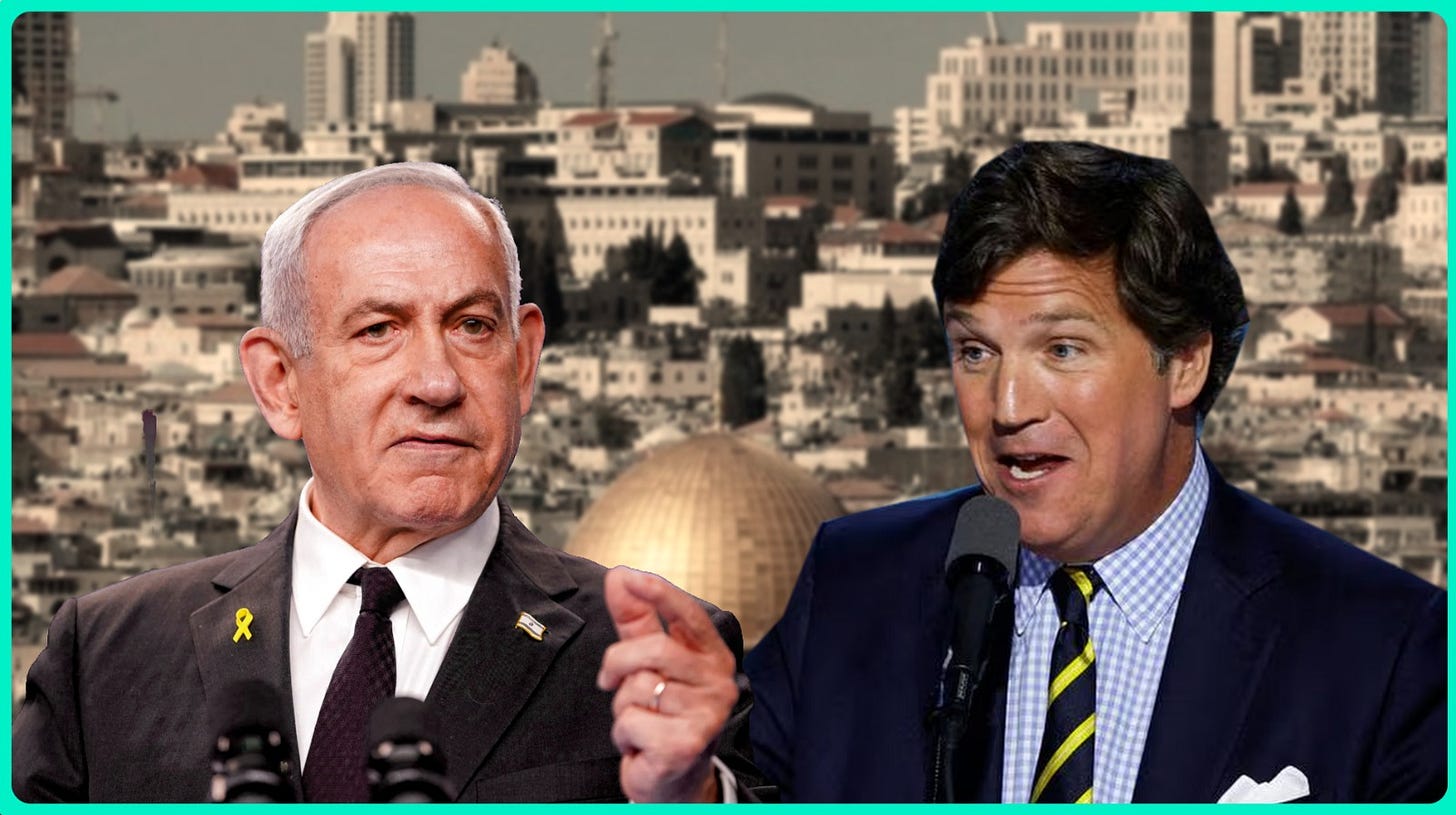
CIA Prepares Criminal Referral of Tucker Carlson, as Israel and its Loyalists Demand His Arrest

Glenn Greenwald

On Friday morning, I taped an appearance on Tucker Carlson’s program to discuss the ongoing Iran War, growing Israeli influence in the U.S., and proliferating attacks on free speech in the West in the name of shielding that one foreign country from critique (I presume it will air in the next few days). Perhaps the most notable part of our conversation was what Tucker told me prior to the cameras rolling.

Tucker said he had learned from several high-placed sources — and he obviously has many within the Trump administration — that the CIA was preparing a criminal referral about him to the DOJ. The subject of the agency’s report of suspected crimes: conversations he allegedly had with Iranian officials and others in Iran prior to the start of the Trump/Netanyahu war. The clear implication was that Tucker had committed acts of subversion or even treason by speaking to Iranians in advance of the war that was about to be launched on their country.

[…]

All of that is to say that I harbored zero doubts that Tucker was accurately conveying to me what he had heard. And I also knew this was not just idle low-level DC gossip. Tucker’s decades in mainstream media and especially his years as the highest-rated prime-time cable host in the history of the medium — to say nothing of his closeness to key figures in Trump world — have resulted in an array of friends and sources at the highest levels of American power centers. His regular visits to the White House to meet with Trump by itself proves that point.

But still, the idea that an American journalist of any kind, let alone one of Tucker’s stature, could be surveilled by the CIA and then criminally investigated by the DOJ for treason or related offenses — all for trying to report the truth about an imminent and indescribably dangerous war — is so inherently shocking and unimaginable that I just assumed his sources were hyperbolically sounding an alarm out of caution.

[…]

Perhaps I was being naive, but I still regard the prospect of Tucker Carlson being charged by the Trump DOJ with felonies for his reporting to be quite low. But the fact that it is being aggressively promoted — not by random accounts online but some of the most influential voices in Washington — is, at the very least, designed to create a climate of fear and intimidation for anyone who has been harshly criticizing both Israel and the Trump/Netanyahu war and, especially, for those reporting that the U.S. government’s triumphalist claims do not correspond with reality.

Hours after we concluded our interview, Tucker on Saturday night published on various social media platforms a five-minute summary of what he had told me. The video, entitled “when you discover the CIA has been reading your texts in order to frame you for a crime,” described how the CIA’s referral to the DOJ is based on private conversations which Tucker, as a journalist, had with people inside Iran.

As Tucker explained, the only way for the U.S. government to have obtained those conversations is through eavesdropping and surveillance on his texts and calls: carried out either by the NSA through domestic surveillance or through use of the Mossad or some other allied spying agency which furnished those conversations to the CIA. One major part of the reporting we did from on the Snowden files detailed how the NSA often used allied spying agencies to snoop on Americans and provide them with the findings, all a way to circumvent constitutional and other legal limits on the ability of American security state agencies to spy on their own citizens.

This is not the first time that the NSA and/or allied agencies have spied on Tucker in his work as a journalist. Both times that he attempted to arrange an interview with Russian president Vladimir Putin, those conversations were intercepted by US spies.

[…]

Via https://greenwald.substack.com/p/cia-prepares-criminal-referral-of/

Trump’s Jewish son-in-law seeks to make billions from Middle East war

👍 US-Israel-Iran war | @geopolitics_prime

Jared Kushner is reportedly seeking about $5B for his firm Affinity Partners, courting sovereign wealth funds from Saudi Arabia, the UAE and Qatar, the New York Times reports, citing people familiar with the matter. Riyadh alone has already poured $2B into the fund.

Affinity Partners, founded in 2021, manages $5B+ and holds stakes tied to Israel’s defense sector, including companies connected to Elbit Systems and Israel Shipyards.

👉 The fundraising push comes as Kushner has increasingly acted as the public face of US diplomacy in the Middle East, representing Washington in regional talks as if the State Department barely exists.

Meanwhile, speculation about his influence in the region (https://t.me/geopolitics_prime/65226) keeps growing. According to reporting cited by The New York Times and other US outlets, Kushner has been among the advisers shaping Washington’s approach to Iran during the current crisis.

War sweeps the region — and apparently also primes fundraising season.

[…]

Via https://t.me/healthimpact/3261

Supermarket shelves could soon be empty, Britain’s fruit and vegetable growers warn

Empty supermarket shelvesGETTY

‘Everybody’s obviously worried,’ one industry leader said

Britain’s fruit and vegetable growers have warned soaring energy and transportation costs caused by the war in Iran could leave supermarket shelves bare.

Growers’ associations across the country have raised concerns they may be forced to end their season early, with some comparing the situation to Russia’s invasion of Ukraine in 2022.

Lee Stiles, secretary of the Lea Valley Growers Association (LVGA), said: “Growers are in the same position now as they were when Russia invaded Ukraine, because the wholesale gas prices are creeping up.”

The LGVA represents 70 glasshouse growers across the UK, and produces around 75 per cent of Britain’s cucumbers, sweet peppers & aubergines.

Mr Stiles added: “With rising costs, many growers are thinking they might as well send the staff home, stop for the season and not produce anything.

“They’re going to have to make a decision in the next few weeks as to whether or not it’s going to be economic to continue for the rest of the year.”

The rising costs to heat glasshouses could lead to crops struggling to grow, subsequently reducing yields significantly.

“Back in 2022, when Russia invaded Ukraine, we ended up with empty shelves in the supermarkets,” Mr Stiles continued.

Britain’s fruit and vegetable growers have warned soaring energy and transportation costs caused by the war in Iran could leave supermarket shelves bare

“The supermarkets agreed a fixed price with growers last year. They can intervene now if they wish and agree to pay more for the produce because of the increased cost of production.

“But it looks as though they’re prepared to have empty shelves again and reduced availability.”

In 2022, shelves were left so depleted that major supermarkets were forced to limit the amount of cooking oil people could buy.

Meanwhile, Rachel Williams, from the West Sussex Growers Association, which represents a network of over 50 members based in and around Chichester, revealed that “everybody’s obviously worried”.

“They are worried about what will happen, how it will develop, and the uncertainty of it all,” she said.

The rise in transportation costs, input costs, supply chain disruption and cost of heating glasshouses are very concerning, Ms Williams explained.

“On the transport cost, red diesel has gone up by more than 50 per cent in just 10 days, that’s huge for open field growers using tractors too,” she said.

With oil prices levelling out at over $100 per barrel, and red diesel prices soaring from 79.44 pence per litre on March 1 to 131.26 pence per litre by March 12, according to BoilerJuice, the comparisons to 2022 have become very real.

The National Farmers’ Union (NFU) met with the Department for Environment, Food and Rural Affairs earlier this month to discuss urgent farming issues caused by the conflict in Iran.

NFU president Tom Bradshaw said: “We’ve already seen this situation play out with the Russian invasion of Ukraine which drove an ongoing cost-of-living crisis here. And, with the removal of farm support which added a layer of resilience for many farm businesses, farmers are more exposed than ever to global markets.

“While the impact on food production and food price inflation will depend on what happens over the coming weeks, it is yet another sobering reminder of the need to build resilience in UK farming.”

[…]

Via https://www.gbnews.com/news/iran-latest-supermarket-shelves-empty-britain-fruit-vegetable-growers

Iran Destroying Dubai – The Billionaire’s Middle East Paradise and Financial Center Built by Epstein

By Brian Shilhavy

It is easy to see why the UAE and western media does not want to show you these images and videos, and instead concentrate on the damage in Tehran (which is extensive also), or in Beirut as the poor Lebanese people, 30% of whom are Christians, just cannot catch a break from Zionist death and destruction.

Could we see attacks like this in American cities?

Absolutely we could. Whether or not they originate from Iran, or are “false flag” attacks from our own government, may not be so easy to determine, however.

But one thing I am sure about: A holy and righteous God will soon run out of patience with the American Christians who are supporting the pedophiles that run this country, and cheering on the death and destruction of people they do not like due to their Zionist Christian belief system.

Here are some of the articles I published on our Telegram channel today.

Grooming the Gulf: How Epstein Forged Emirati Elites Into Tools for Israel

From 21st Century Wire:

Hidden within (the Epstein) documents, leaks, and email excerpts now circulating online, are connections that stretch far beyond Manhattan, Palm Beach, or even Paris.

They reach deep into the Persian Gulf, into Dubai’s executive suites, and into the personal inboxes of officials in the United Arab Emirates.

These emails offer a unique glimpse behind the opulent shadows of Dubai’s towers, where untraceable billions flow like oil.

In that world, a convicted pedophile whispers ministerial appointments to a UAE diplomat while discussing port deals that could move cargo and secrets across continents.

Jeffrey Epstein was not acting alone or merely chasing thrills; he was allegedly operating as a geopolitical asset, cultivating leverage over Gulf elites, with places like Somaliland emerging as potential pawns in a larger strategic game.

Iran’s Kharg Island ‘obliteration’ is Trump’s fantasy and an apparent pullout signal – ex-CIA analyst

From Geopolitics Prime | Iran War Updates Telegram channel

Trump’s bombastic claim of flattening the island exposes his detachment from reality, Larry Johnson writes on Sonar21.

What’s Kharg Island?

🔴 Continental island of Iran in the Persian Gulf

🔴 About 25 km off Iran’s coast, 483 km northwest of the Strait of Hormuz

🔴 One of Iran’s oil export terminals

What’s wrong with Trump’s brag?

🔴 Trump “admits that the oil terminals were not attacked, just some unidentified military targets,” Johnson writes. “All bark, no bite.”

🔴 Only one of Iran’s five operational oil export terminals is located on Kharg Island

🔴 International firm Kpler’s data shows Kharg’s oil loadings jumped 1.5‑fold last month, implying Iran may have been drawing down storage ahead of the attack

🔴 Trump claimed the US destroyed all military targets and air defenses on Kharg Island, but air defense activity an hour later proved otherwise

Imagine if Kharg’s oil infrastructure were damaged. That could trigger retaliation on US allies’ oil facilities across the Gulf—is that what Trump wants?

Johnson details the likely paths of Iranian missiles:

♦️ Saudi Arabia: Ras Tanura – world’s largest marine oil loading center (6M b/d); Ras Al-Ju’aymah – second key terminal (3–3.6M b/d)

♦️ UAE: Fujairah – largest regional fueling hub; Jebel Ali – crude & petrochemical exports

♦️ Qatar: Ras Laffan – world’s largest LNG export facility

♦️ Kuwait: Mina Al-Ahmadi – main crude export terminal with deep docks

♦️ Bahrain: Sitra Terminal – refined oil exports

According to the CIA veteran, Trump’s brag can be seen two ways:

🔊 “Perhaps Trump’s lie about devastating Kharg Island is the start of his PR campaign to gaslight the American public into believing Iran is defeated, which would allow Trump to declare victory and start withdrawing US forces”

🔊 “Alternatively, he really believes the lie and is convinced that this latest strike will convince the Iranians to surrender.”

Panic is slowly gripping the stock market. Expect the selling to pick up next week.

From MarketWatch:

Options traders are signaling trouble, and systematic funds are expected to cut their exposure to U.S. stocks

Excerpts:

Storm clouds are gathering over Wall Street.

U.S. stocks drifted lower in a slow grind over the past two weeks, as the conflict with Iran stoked worries about inflation and interest ​rates as oil prices shot higher. And investors are bracing for what could be a painful leg lower next week.

The pace of the selling could pick up next week as systematic trend-following funds are poised to cut $36 billion worth of exposure to U.S. stocks, according to a Friday report from Goldman Sachs. If the market moves sharply lower, those funds could be forced to unwind their positions even more aggressively.

[…]

Via https://healthimpactnews.com/2026/iran-is-destroying-dubai-the-billionaires-paradise-and-financial-center-in-the-middle-east-built-by-epstein/

Banksy’s identity uncovered

Banksy’s identity uncovered – Reuters

RT

The real name of the mysterious street artist, who has been hiding under the alias ‘Banksy’ for years, is David Jones, Reuters has claimed, citing the results of its own investigation.

Banksy’s identity has fueled speculation since his first graffiti appeared in 1999. He has become one of the world’s most famous artists, with his artworks popping up in various locations around the globe, including conflict hot spots, selling for millions of dollars at auctions and being frequent targets of thieves.

In its article on Friday, Reuters noted that Banksy’s actual name had been first mentioned by the Daily Mail in 2008, which identified him as Bristol-born artist Robin Gunningham.

According to the agency, he had since then changed his ID and now carries a passport with the name ‘David Jones.’

It’s one of the most common first and last name combinations in the UK, with 6,000 people bearing it in 2017, it stressed. It’s also the birth name of iconic British rock legend David Bowie.

London police could expose Banksy’s identity – TelegraphReuters explained that it established Banksy’s identity after reviewing publicly available records, including financial statements by his former accountant.

The journalists said that they also got clues about the artist’s real name after looking into the circumstances of several of his graffiti appearing in Ukraine in 2022.

There is no evidence of Robin Gunningham entering the country, but there is data on David Jones crossing the Ukrainian border, they stressed. He had been accompanied by photographer Giles Duley and co-founder of the band Massive Attack and artist Robert Del Naja, who had been previously suspected of being the one behind the Banksy nickname, according to the journalists.

The date of birth in David Jones’ passport matches that of Robin Gunningham, a source told Reuters.

The agency said that they forwarded the results of their investigation and questions to the person they believe to be Banksy, but he “didn’t reply.”

The artist’s lawyer, Mark Stephens, also declined to confirm his identity, but urged the journalists against publishing the report, arguing that it would violate his client’s privacy, interfere with his art and endanger him.

[…]

Via https://www.rt.com/pop-culture/634984-banksy-identity-artist-reuters/

How Likely Is It US Will Contain Turkiye After It’s Done With Iran?

It probably won’t since Turkiye helps advance American interests at the crossroads of Afro-Eurasia in Iran, the Middle East-North Africa, and along Russia’s entire southern periphery.

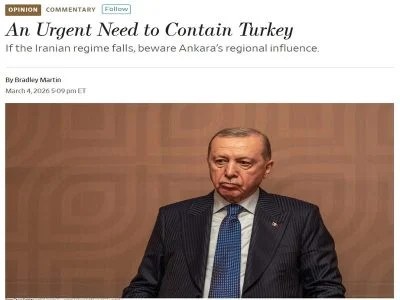
The Wall Street Journal published an opinion piece last week titled, “An Urgent Need to Contain Turkey”, which warned that “If the Iranian regime falls, beware Ankara’s regional influence.” The author is Bradley Martin, who’s Executive Director of the Near East Center for Strategic Studies and used to be a Senior Fellow with the news and public policy group Haym Salomon Center and deputy editor for the Canadian Institute for Jewish Research. He also contributes to the Jerusalem Post and Jewish News Syndicate.

His credentials thus led to some interpreting his article as Israel lobbying the US to contain Turkiye after the end of the Third Gulf War that was sparked by their joint attack against Iran. Whatever one’s opinion about the intention of his latest article and his speculative ties with the State of Israel may be, he argues that Turkiye must ultimately be contained because it “opposes U.S. foreign policy and is a headache for its allies.” Several examples are cited in support of this claim for justifying his post-war policy proposal.

These are President Recep Tayyip Erdogan’s opposition to the US’ war against Iran, his government’s ties with ISIS during the apex of its power, and its weaponization of the 2015 Migrant Crisis against the EU. What Martin didn’t mention, however, is Erdogan’s belief that the US colluded with his late American-based rival Fethullah Gulen to orchestrate summer 2016’s failed coup attempt. Turkish-US relations are therefore much complicated than he made them seem.

His oversimplification of them is obviously due to him wanting to manipulate his targeted American audience into supporting Turkiye’s post-war containment, but the argument can be made that regardless of whatever one thinks about the abovementioned examples, Turkiye’s expansion actually helps the US. For starters, it could launch a military intervention in Iran on the grounds of either targeting armed Kurdish rebels that it considers to be terrorists or helping its ally Azerbaijan, which might intervene first.

Even if that scenario doesn’t transpire, Turkiye reportedly plans to join the so-called “Islamic NATO”, whose core presently consists of September’s mutual defense alliance between Saudi Arabia and Pakistan. Whether or not it formally does so, Turkiye can still coordinate with those two and Egypt (another country with which Saudi Arabia might enter into an alliance) across the broad Middle East-North Africa (MENA) space, with all four US allies (each to varying legal extents) advancing its aims there.

Even in the absence of the aforesaid, Turkiye is now poised to expand Western – including NATO – influence along Russia’s entire southern periphery in the South Caucasus, the Caspian Sea, and Central Asia through last August’s “Trump Route for International Peace and Prosperity” (TRIPP). Unaware readers can learn more about how TRIPP threatens Russa’s national security here, which links to five other analyses about this, but it’s suffice to say that this is arguably the next front for containing Russia.

These three roles make Turkiye one of the US’ most strategic allies due to its ability to advance American interests at the crossroads of Afro-Eurasia. The US is accordingly unlikely to contain Turkiye after it’s done with Iran, but Israel might try to do so since it feels very uncomfortable with Turkiye’s rise as the most powerful Muslim country, possibly soon with its own ballistic missile and even nuclear programs too. Martin is therefore lobbying to advance Israeli interests over American ones even if unintentionally.

[…]

Via https://www.globalresearch.ca/how-likely-is-it-that-the-us-will-contain-turkiye-after-its-done-with-iran/5918422

Three Big Lies about Mammography Screening

The Three Big Lies about Mammography Screening

Peter C Goetzsch

I dedicate this article to all women invited to mammography screening and those who love them because the public has consistently been lied to, for over 40 years. In invitations to screening, women have been told that by detecting cancers early, screening saves lives and leads to less invasive surgery.1,2 I shall demonstrate that all three statements are wrong.

Women are still being told these lies, by professional associations, screening advocates, screening researchers, cancer charities, and national boards of health.3-5 The American Cancer Society declares in a headline that “Mammography Saves Lives”4 and claims, with no references, that results from many decades of research clearly show that women who have regular mammograms are less likely to need aggressive treatments like surgery to remove the entire breast (mastectomy).5

Screening Does Not Save Lives

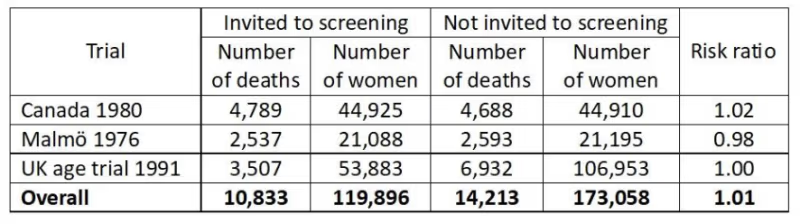
In the randomised trials of mammography screening, the risk ratio for overall mortality after 13 years of follow-up was 0.99 (95% confidence interval 0.93 to 1.03) for those trials with adequate randomisation.6 The estimate happened to be the same for the other trials, some of which were so poorly randomised that the average age in the two compared groups was not the same, which makes an analysis of overall mortality unreliable.

For two of the three adequately randomised trials, those from Canada and the UK, there are follow-up data after 25 and 23 years, respectively.7,8 The risk ratio for overall mortality was 1.01 (95% confidence interval 0.98 to 1.03) for all three trials (both with a fixed effect and a random effects model, Comprehensive Meta Analysis Version 3.0). In the table, the year means the year the trial started:

This is a very strong result as it is derived from a total of 25,046 deaths. We can therefore say with great confidence that mammography screening does not save lives.

If we restrict the analysis to the two trials with a very long follow-up, the result is the same, a risk ratio of 1.01 (0.99 to 1.04).

Breast Cancer Mortality Is a Seriously Flawed Outcome

It will surprise most people to learn that we cannot trust what has been reported in the randomised trials about the effect of screening on breast cancer mortality but this is an objective fact.6

A minority of the women who died were autopsied, and in several trials, cause of death was not assessed blindly.6 I have documented that assessment of cause of death was seriously biased.6,9 If we include all trials in the analysis, we would expect to see the greatest reduction in breast cancer mortality in those trials that were most effective in lowering the rate of node-positive cancers (cancers that had metastasised) in the screened group.

This was indeed the case, but the regression line was in the wrong place. It predicts that a screening effectiveness of zero (i.e. the rate of node-positive cancers is the same in the screened groups as in the control groups) results in a 16% reduction in breast cancer mortality (95% confidence interval 9% to 23% reduction).6,9 This can only happen if there is bias, and further analyses showed that assessment of cause of death and of the number of cancers in advanced stages were both biased in favour of screening.

Systematic reviews that include all the trials, also the poorly randomised ones, have reported that mammography screening reduces breast cancer mortality by 16-19%.6,10 As this estimate is of the same size as the bias in the regression analysis, this suggests that screening does not lower breast cancer mortality.

Another reason why breast cancer mortality is a flawed outcome is that screening leads to overdiagnosis, which is the detection of cancers and precursors to cancer (carcinoma in situ), which would not have come to the attention of the woman in her remaining lifetime and therefore would not have become a problem without screening. Since it is not possible to distinguish between harmless cancers and dangerous ones, they are all treated, and radiotherapy and chemotherapy given to women who are healthy increase their mortality.6

If we take into account the cardiac and lung cancer deaths caused by the type of radiotherapy used when the screening trials were carried out and generously assume that screening reduces breast cancer mortality by 20% and results in only 20% overdiagnosis of healthy women, then there is no mortality benefit from screening.11

Finally, it is noteworthy that the most unreliable trials were those that reported the greatest reductions in breast cancer mortality.6 The difference in the effect estimates between the adequately randomised trials and the poorly conducted trials was statistically significant, both after 7 and 14 years of follow-up (P = 0.005 and P = 0.02, respectively).12

Total Cancer Mortality

Since misclassification of cause of death often concerns deaths from other cancers,6 total cancer mortality is a less biased outcome than breast cancer mortality.

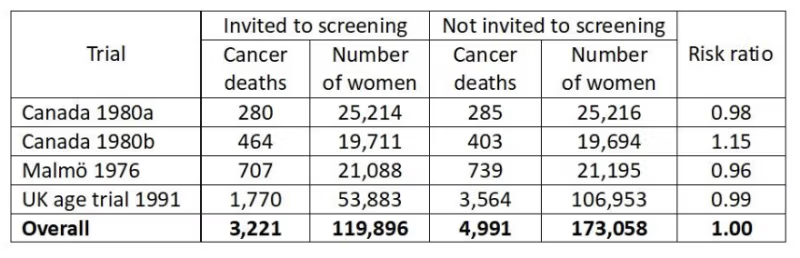
Some trialists have not reported what the total cancer mortality was but we have data from the three adequately randomised trials.6,8 There was no effect of screening on total cancer mortality, including breast cancer, risk ratio 1.00, 95% confidence interval 0.96 to 1.04. There were two different age groups in the Canadian trial, 40-49 (a) and 50-59 years (b):

Since total cancer mortality is less biased than breast cancer mortality, it is of interest to see what the expected cancer mortality (including breast cancer mortality) would have been if the reported reduction in breast cancer mortality of 29% after 7 years in the poorly randomised trials6 were true.

It would have been a risk ratio of 0.95, which is significantly lower (P = 0.02)6 than what was actually found. This provides further evidence that assessment of cause of death was biased in favour of screening.

Breast Cancer Is Not Detected Early but Very Late

If we assume that the observed doubling times in longitudinal tumour studies are constant from initiation till the tumour becomes detectable, the average woman has harboured the cancer for 21 years before it acquires a size of 10 mm and becomes detectable on a mammogram.13

Given this large time span, it is misleading to call it “early detection” also because the effect of screening is trivial, namely to advance the diagnosis by less than a year.13

Yet all authorities repeat this mantra. As it is impossible that everyone working with cancer is unaware of the basics of tumour biology, we can draw the conclusion that the public all over the world is being misinformed. This is fraud because it is deliberate and because women think “early detection” will save their lives.

I once asked a famous tumour biologist, Keld Danø, during a coffee break at an international meeting, whether he agreed with me that it was impossible to lower breast cancer mortality by 30% with screening, based on our knowledge of tumour biology.14 He agreed. When I asked why people like him didn’t participate in the scientific debate, he didn’t reply and it is not difficult to imagine why. It is not wise to point out that your colleagues are wrong when you are on the receiving end of major funds from a cancer charity that touts screening.

The women suffer while everyone else prospers.

The earliest cell changes, carcinoma in situ, are not detected unless the women get a mammogram. In our systematic review of countries with organised screening programmes, we found an overdiagnosis of 35% for invasive cancer and 52% when we included carcinoma in situ.15

Although less than half of carcinoma in situ cases progress to invasive cancer,16,17 the women are nevertheless routinely treated with surgery, drugs, and radiotherapy.

The deep irony is that the surgery is often mastectomy because the cell changes may be diffusely spread in the breast, and sometimes even in both breasts. In New South Wales, one-third of women with carcinoma in situ had a mastectomy,18 and in the UK, carcinoma in situ was more often treated by mastectomy than invasive cancer,19 and the number of women treated by mastectomy almost doubled from 1998 to 2008.20

This brings us to the third big falsehood in the propaganda about mammography screening.

Screening Does Not Decrease but Increases Mastectomies

Because of the substantial overdiagnosis of invasive cancer and carcinoma in situ, and because screening only advances detection of invasive cancers slightly,13 it is inevitable that screening increases mastectomies.

In the randomised trials of screening, we found 31% more mastectomies in the screened groups than in the control groups.6

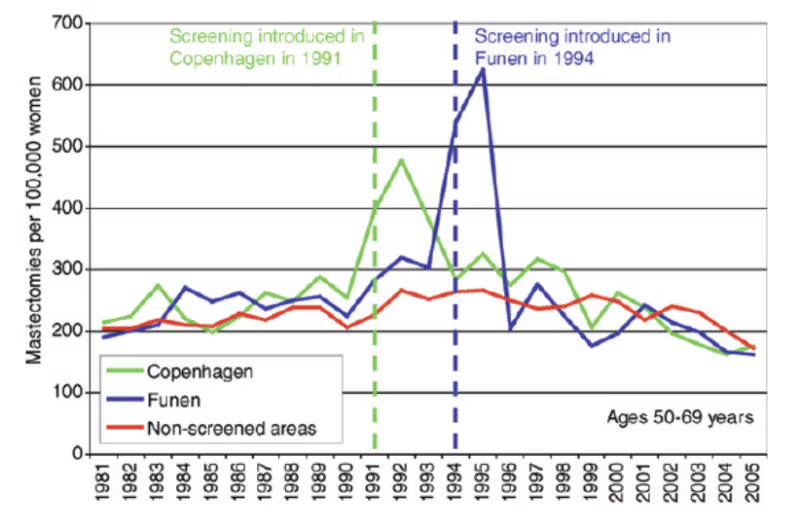
Denmark is a unique country to study this in practice as we had a period of 17 years (1991-2007) where only about 20% of potentially eligible women were invited to screening because some counties did not have screening.21 When screening starts, more breast cancer diagnoses than usual will be made and there will be more mastectomies. However, as can be seen on the graphs, the huge increases in mastectomies are not compensated by a drop in mastectomies later where there was a similar decline in mastectomies in non-screened areas as in screened areas:22

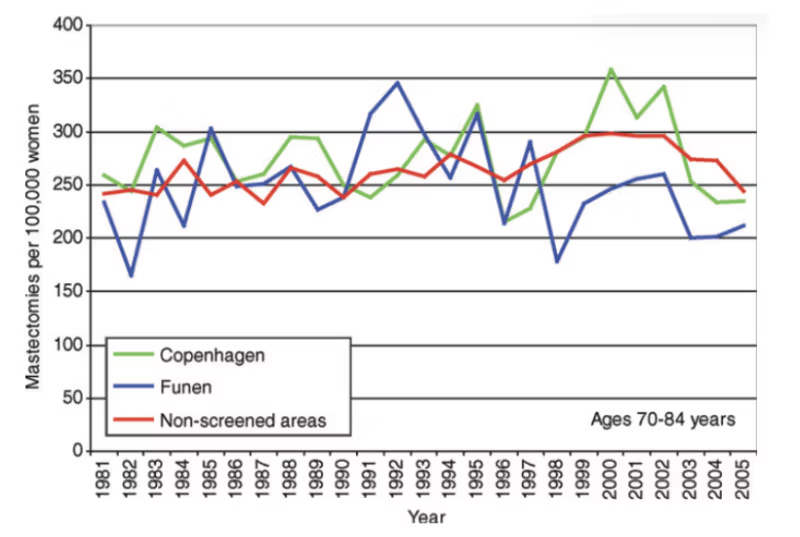
Moreover, as the next graph shows, there is no compensatory drop in old age groups:22

Yet women are told that screening leads to less invasive surgery, with fewer mastectomies. This is disinformation in the extreme.

The most commonly used trick used to disinform the women about this issue is to report percentages instead of numbers.3 Imagine a town with a certain level of crime. You divide the crimes into serious and less serious ones. Over a period of time, the rate of serious crime increases by 20% and the rate of less serious crime by 40%. This is a development for the worse. But although more people are exposed to serious crime and more people are exposed to less serious crime as well, a trickster would say that, as there are now relatively fewer cases of serious crime, the situation has improved.

It is deplorable that people who know better – screening researchers, cancer charities, national boards of health, etc – have lied to the public this way3 and still do, in direct contrast to logic and the scientific evidence.

I dryly remarked in my book that if they continued their line of research for other diseases, they may find the recipe for eternal life.3 I also noted that the problem with lying is that

sooner or later people usually contradict themselves, which they did in relation to a study they had published in The Lancet.3

A common way of duping the readers is to say that early detection of breast cancer “reduces mortality”34 without specifying what kind of mortality this is, which makes the reader believe that screening saves lives.

The most common error in the screening literature could be that people falsely translate a recorded effect on mortality from a cancer into an effect on all-cause mortality. We see claims everywhere that common cancer screening tests save lives but a systematic review of the randomised trials found that the only screening test with a significant lifetime gain was sigmoidoscopy. It extended life by 110 days on average, and as the 95% confidence interval went from 0 to 274 days, this result was on the verge of not being statistically significant.35

Another common trick is to use hypothetical statements when we have certain knowledge. For example, authors may write – even in our most esteemed medical journals – that overdetection “may” occur for invasive cancers and that it “may” cause harm through unnecessary labelling and treatment of patients who, without screening, “might” never have been diagnosed.34 These are not hypothetical possibilities; they are inevitable consequences of screening.

[…]

Via https://brownstone.org/articles/the-three-big-lies-about-mammography-screening/