The US will suspend all trade with Spain over Madrid’s decision to deny the US permission to use its joint military bases to attack Iran, President Donald Trump has announced. Spanish Prime Minister Pedro Sanchez has condemned Trump’s “unjustified and dangerous” intervention against Iran.
Speaking at the White House on Tuesday, Trump said that “we’re going to cut off all trade with Spain,” and that he doesn’t “want to have anything to do with” the Mediterranean nation. Trump did say when his supposed trade embargo would come into effect.
On Monday, Spanish Foreign Minister Jose Manuel Albares said that his government would not allow the US to use Naval Station Rota or Moron Air Base – both of which are shared by Spanish and American forces – in its ongoing war with Iran. Albares said that the bases were not used in carrying out Saturday’s opening strikes on Iran, “nor will they be used” for the duration of the conflict.
“Spain actually said that we can’t use their bases, and that’s alright,” Trump told reporters, before claiming that he could simply ignore the ban if he liked. “We could use their bases if we want,” he said. “We could just fly in and use it, nobody’s going to tell us not to use it.”
Both bases were extensively used by American cargo and fighter aircraft during the 2001 invasion of Afghanistan and the 2003 invasion of Iraq. Moron Air Base served as the main base for refueling tanker planes during NATO’s 2011 bombing of Libya. More than a dozen tankers left Rota and Moron on Monday, after Spain announced the ban.
The conflict with Iran has exposed divisions among the US’ European allies. Sanchez is the only EU leader to openly condemn the US’s strikes on Iran – describing ‘Operation Epic Fury’ as an “unjustified and dangerous military intervention that is outside international law.”
However, the UK initially denied use of its military bases to the US, until Prime Minister Keir Starmer made an about-turn on Sunday and signed off on the US using the facilities for “limited defensive” strikes against Iran’s missile infrastructure. France and Germany have also said that they are “open to enabling necessary and proportionate defensive action” against Iran.
The EU’s most pro-US members have gone further, with Lithuanian presidential adviser Asta Skaisgiryte declaring that his country would join the operation if asked by Trump.
Since Iran launched strikes on US bases within their borders, the Gulf monarchies have failed to muster even a coherent diplomatic response. As Tehran raised the stakes—targeting the region’s strategic oil and gas infrastructure—the sheikhdoms have remained utterly passive.
Here’s why they are powerless to push back:
🔴 The failed American umbrella: the Gulf states outsourced their security to the US, hosting foreign bases because their own militaries were no match for their neighbors. That bet has now backfired spectacularly.
🔴Trapped between giants: Washington’s failures have not only jeopardized critical energy facilities but have left the monarchies exposed. Iran has made it clear: any US attack launched from Arab soil will be met with retaliation against them. They are hostages in their own territory.
🔴 The only leverage is de-escalation: with no military option and no diplomatic card to play, their only move is to plead with Iran and demand Washington stand down. An attack on Gulf oil—or Qatar’s gas—is an attack on their economic survival. Strikes on Dubai’s airport or its superport can paralyze logistics across one of Asia’s most vital hubs.
🔴 The high cost of bluster: the monarchies understand that any public bravado against Tehran will only invite more attacks. Already powerless, they cannot afford further escalation. For them, silence isn’t a choice but the only thing standing between the current crisis and total chaos.
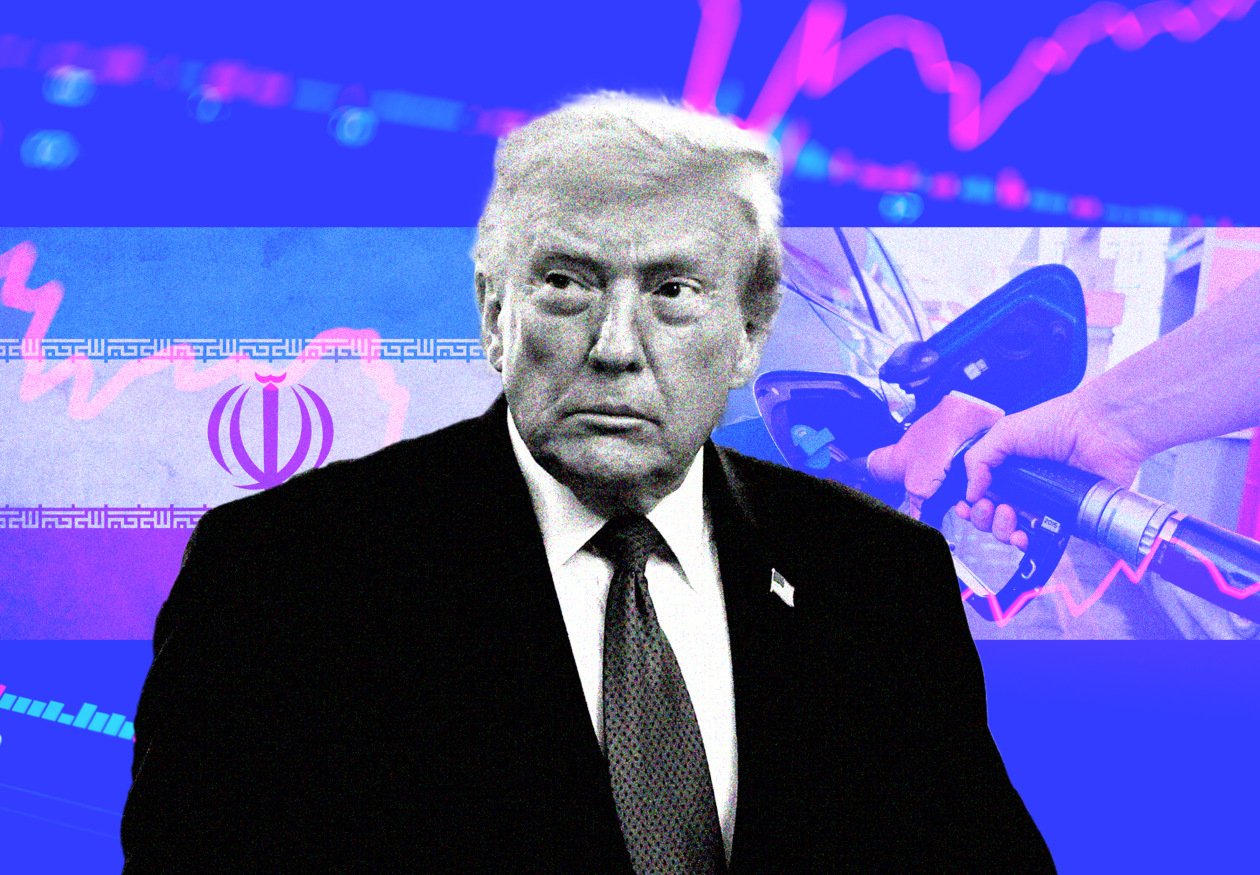
Financial markets are pricing in months of higher gasoline prices, stretching right through the summer and beyond. Photo: MarketWatch photo illustration/Getty Images, iStockphoto
Congratulations, President Trump: The Israeli-U.S. war against Iran has just wiped out all of the U.S. gasoline-price savings achieved since you took office in January of last year.
Average U.S. gasoline prices rocketed Tuesday to $3.109 a gallon, according to AAA. That’s exactly where they were on Jan. 20, 2025. That’s an astonishing jump of 15 cents since the start of the war a few days ago, and of 30 cents since the start of this year.
Trump wants oil at $50 per barrel — economics suggest otherwise. See All Videos
This is especially embarrassing, as it’s exactly a week since Donald Trump was bragging about how much gasoline prices had fallen since he took office. “Prices are plummeting downward,” the president told the American public and a joint session of Congress during his marathon State of the Union address. “Nobody can believe when they see the kind of numbers, and especially energy, when they see energy going down to numbers like that, they cannot believe it. It’s like another big tax cut.”
The costs of this war to regular Americans doesn’t stop there, either. Financial markets are now pricing in months of higher gasoline prices, stretching right through the summer and beyond. The futures markets think this war will still be adding at least 15 cents to a gallon of gas in September.
Meanwhile, panic is spreading across the rest of the markets, with stocks and bonds tumbling. The S&P 500 fell by 1.5% on Tuesday. The average stock in the index fell 2.6%, while the S&P 400 index of midsize companies, often seen as the backbone of the U.S. economy, fell 3.5%. Long-term interest rates have also surged as fears of rising inflation more than offset fears of an economic slowdown. The yield on the 10-year Treasury note jumped to 4.07%, up from 3.97% before the attacks on Iran. That will reverse the recent decline in 30-year mortgage rates, which had at last fallen below 6% just last month. Not for long, the way things are going.
Ominously, by Tuesday even energy stocks had started to fall, as investors began looking past the immediate surge in energy prices, which will benefit energy companies, to a possible wider economic slowdown, which will hurt them.
Writing about the financial implications of a geopolitical and humanitarian crisis requires a balancing act.
For example, a Substack column by Todd Legum, Rebecca Crosby and Noel Sims contrasts the terrible death toll of the war with the casino behavior of some … er … remarkably well-informed people. A small number of speculators have already made hundreds of thousands of dollars with brilliantly timed bets on the conflict. Somehow they knew or guessed just when war was about to break out. They placed their anonymous bets at two online betting exchanges that just happen to have business relationships with members of the Trump family and pay them money.
Nothing to see here, folks. Move along.
(Remind me to read some more tweets from Trump family adviser Roger Stone about the “Biden crime family” and the “Clinton crime family.”)
But regular Americans, who lack access to the kind of amazing insight that might allow them to make $100,000 in blood money by betting in advance on a war, face the opposite challenge: Working out how to protect their hard-earned savings from geopolitical turmoil and market mayhem.
In these circumstances, it’s reasonable to argue that for investors, at least, the news may be so bad it’s good: In other words, even the man who is actually calling the shots in the war on Iran knows that the TACO trade — “Trump Always Chickens Out” — must soon kick in.
Israeli Prime Minister Benjamin Netanyahu is presumably hoping to score as many wins as possible against Middle Eastern enemies before the president is forced into yet another one of his embarrassing U-turns.
Trump and his beleaguered party hardly want to go into the fall’s crucial midterm elections with skyrocketing energy prices and a collapsing economy.
So the odds have to be good that the president will reverse course. And the worse things look, the more likely that becomes.
👁 Digital prison plans hit a snag: Iranian attacks cast doubt on US AI mafia expansion in Mideast
Iranian retaliatory attacks have raised doubts about the safety and resilience of Big Tech AI digital infrastructure in the Persian Gulf region.
🔴 Drones hit Amazon data centers in the United Arab Emirates (UAE) and Bahrain, Reuters reports
🔴 Amazon cloud services are down and recovery is expected to take time
🔴 Amazon Web Services (AWS) says buildings took damage, power supplies were disrupted and firefighting caused water damage
🔴 Financial institutions using AWS have felt the impact, an anonymous source told Reuters
Why this is more than just an Amazon service cut
🔴 Gulf monarchies, particularly the UAE, have long been seen as safe havens and convenient hubs for technology and financial services
🔴 US Big tech considered the Gulf states ideal platforms for its AI expansion:
➡️ massive financial resources and sovereign wealth funds ready to invest in cutting-edge AI infrastructure
➡️ Government support for AI start-ups, tech-friendly regulations and partnerships
➡️ Stable and high-capacity power grid supported by oil and gas infrastructure
➡️ Cheap electricity compared with Western countries helps reduce operational costs
🔴 US tech giants were betting on the UAE as a regional AI powerhouse, with Microsoft investing $15 billion and Nvidia chips to power ChatGPT and other services
🔴 The latest missile and drone strikes have shown the finance and tech sectors that the region is no longer safe
🔴 A loosely coordinated group of cyber warriors called the “Cyber Islamic Resistance” has alarmed US and Gulf tech firms, Fortune reports. “The Islamic Republic has always had great pride in cyber capabilities within the security services,” said CIA veteran Brian Carbaugh.
🔴 Elon Musk tweet that “No country is perfect, but Dubai and UAE broadly are objectively safer and better run than many areas of Europe” will not dispel concerns
Amazon says Iranian drone strikes directly hit two AWS facilities in the UAE, while another strike landed close a facility in Bahrain. The recovery could potentially be slow.
UPDATE (3/3): Amazon Web Services (AWS) has confirmed that recent drone strikes by Iran took down three of its facilities in the Middle East.
“In the UAE, two of our facilities were directly struck, while in Bahrain, a drone strike in close proximity to one of our facilities caused physical impacts to our infrastructure,” Amazon posted at 4:19 p.m. PST on Monday.
The situation at the impacted facilities hasn’t improved since the update, and Amazon is unsure when the infrastructure will be restored. The strikes caused structural damage, knocked out power, and sparked fire, Amazon said, adding that efforts to control the fire caused additional water damage at the data centers.
The company is currently prioritizing employee safety and has asked its customers to route their workloads to AWS data centers in the US, Europe, or Asia Pacific.
AWS’s Health Status page hasn’t reported any casualties at the data centers so far. The war against Iran, however, could go on for four to five weeks, President Donald Trump said.
Original Story (3/2):
Amazon Web Services (AWS) has confirmed that some of its services in the United Arab Emirates (UAE) are experiencing disruptions after unidentified objects hit a data center in the Middle East.
The incident set off a fire at the facility and knocked out its power supply. The company is unsure when the power will be restored and is currently routing customer requests to a different data center.
Recommended by Our Editors
“At around 4:30 AM PST, one of our Availability Zones (mec1-az2) was impacted by objects that struck the data center, creating sparks and fire,” AWS posted at 9:41 p.m. PST on Sunday. “The fire department shut off power to the facility and generators as they worked to put out the fire. We are still awaiting permission to turn the power back on, and once we have, we will ensure we restore power and connectivity safely.”
As of late Sunday, the status hasn’t improved. “We expect recovery is multiple hours away,” AWS said in its latest update at 10:46 p.m. PST.
AWS hasn’t linked the “objects” to retaliatory strikes carried out across the Middle East by Iran over the weekend. When Reuters asked AWS about it, the company neither confirmed nor denied it. The company’s Service Health page indicates that a data center in Bahrain is also facing issues due to power outages.
A host of popular tech companies rely on AWS cloud infrastructure to provide services. A major outage in November took down Disney+, HBO Max, Hulu, Lyft, Reddit, Roku, Signal, Slack, Snapchat, Venmo, and others.
As of the time this story was published, DownDetector didn’t show any disruptions to Amazon, AWS, or any other dependent services for people in the US.
A US-funded opposition journalist revealed the Trump DOJ has crafted a secret indictment of Venezuela’s Acting President to “hold it over her head,” and will execute it if she “derails.”
The Trump administration is using a secret indictment to assert leverage over Venezuela’s Acting President Delcy Rodríguez, according to the editor-in-chief of the US government-funded outlet, Armando.info.
“One of the information we manage is that the US is holding an indictment against [Rodriguez] to make it public, just in case she derails,” Valentina Lares Martiz revealed during a February 6, 2026 webinar hosted by the Organized Crime and Corruption Reporting Project (OCCRP), an outlet also sponsored by the US government.
“Just to hold it over her head?” asked OCCRP deputy editor Julia Wallace.
“Yeah, so, I think she, she and her brother [Jorge Rodríguez], they are in this survival mode, and they will have the capacity to move the pieces, as long as the US backs her up,” Armando.info’s Lares Martiz affirmed.
A January 17, 2026 report by the Associated Press revealed that the Drug Enforcement Administration classified Acting president Rodríguez as a “priority target” almost as soon as she was appointed as Vice President in 2018.
David Smilde, an academic who crusades for regime change in Venezuela at the US government and ExxonMobil-funded Atlantic Council, described the DEA investigation of Rodríguez as “logical.” Smilde explained to the AP that the investigation “gives the U.S. government leverage over her. She may fear that if she does not do as the Trump administration demands, she could end up with an indictment like Maduro.”
During the OCCRP webinar, Steven Dudley of the State Department-funded Insight Crime outlet remarked that “this isn’t without precedent, in terms of [the US government] hanging an indictment over somebody to cajole them into doing their bidding.”
Dudley added, “They don’t need an indictment to cajole people. They have a giant military, and they’ve shown that they’re willing to use that military. That is the biggest stick.”
Confronting “a military aggression unprecedented in our history”
Delcy Rodríguez stepped in as Acting President following a deadly US military raid on Caracas this January 3 which left over 100 dead, including 32 Cuban military officers, and resulted in the kidnapping of President Nicolas Maduro and his wife, Cilia Flores. In an interview with The Atlantic the following day, US President Donald Trump recognized Rodríguez as the new leader, but warned, “if she doesn’t do what’s right, she is going to pay a very big price, probably bigger than Maduro.”
Since then, Rodríguez has presided over the passage of an Organic Law on Hydrocarbons which rolled back the socialist reforms the late President Hugo Chavez made to the country’s state oil company, PDVSA. In a January 16 speech to Venezuela’s National Council of Economic Productivity, Rodríguez explained the impetus for the new law:
“Enough time has passed, and Venezuela has been subjected to an unprecedented economic blockade. Well, recently, there has been a military aggression unprecedented in our history, and Venezuela must move forward…without compromising historical principles or compromising Venezuelan dignity. And in that direction, we have made the decision, seeing the successful results of the business models contemplated in the organic anti-blockade law, to take the models that are there and incorporate them into the Organic Law on Hydrocarbons.”
While the law allows Venezuela to draw new revenue streams from an oil sector that has withstood years of punishing sanctions, the Trump administration has assumed custody of Venezuela’s oil revenue at the point of a gun, holding the profits in a private account in Qatar which is not accountable to Congress.
Rodríguez and her older brother, Jorge, have both served in influential roles under Maduro, with Delcy Rodriguez operating as Vice President while overseeing hydrocarbon policy. In 2018, she initiated a project to survive Trump’s “maximum pressure” policy, successfully guiding an Organic Anti-Blockade law through the Constituent Assembly which reformed PDVSA. Since Maduro’s abduction, the Rodríguez siblings have been under mounting pressure to accommodate onerous demands from Washington in order to prevent a destabilizing process of regime change. Looming behind every move is the memory of their father, Jorge Antonio Rodríguez, a leftist militant who was tortured to death in prison by CIA-trained interrogators under a pro-US government in 1976.
In the past, the US Department of Justice (DOJ) has used sealed indictments to deny targets of its global lawfare regime the chance to pre-empt investigations. As The Grayzone revealed, Trump’s DOJ secretly indicted Wikileaks co-founder Julian Assange on December 21, 2017, just one day after CIA spies learned that Assange was planning to leave the Ecuadorian embassy in London where he had been given sanctuary. On April 11, 2019, British police stormed the embassy on US orders and arrested Assange in a blatant violation of diplomatic sovereignty.
Colombian-born Venezuelan official Alex Saab was also the target of a secret US indictment that was only publicized after he was abducted from an airport in Cape Verde while on an official diplomatic mission in 2020.
During the OCCRP webinar, Armando.info’s Lares Martiz noted that the US slapped sanctions on Delcy Rodríguez in 2017, however, “she doesn’t have an open and formal investigation against her.”
But that could all change, she insisted, if the Acting President defies the Trump administration’s paternalistic instructions.
Pro-transparency Armando.info: based at a Delaware mailbox, funded by Washington
Lares Martiz is in a prime position to know if the US is preparing a secret indictment of Rodriguez, as the publication she edits, Armando.info, functions at the center of a network of US government-funded journalistic outlets which exist to shop dirt on Latin American leaders targeted by Washington.
Though its staff operate from Bogota, Colombia, Armando.info is registered at a post office box in Newark, Delaware, where it is listed by Delaware’s Division of Corporations as “not in good standing.”
One of Armando.info’s top donors is the National Endowment for Democracy, a CIA spin-off which channels US money into opposition parties and media promoting regime change. The outlet is also listed as a member of the “global network” of OCCRP, which has received most of its budget from the US Agency for International Development (USAID).
A 2024-25 Frontline documentary series about Armando.info’s work in Venezuela, “A Dangerous Assignment,” made it clear the outlet’s staff were dedicated anti-Chavista operatives seemingly coordinating their work with the US government. The documentary chronicled the investigation by Lares Martiz and her colleague, Roberto Deniz, of the Colombian-born Venezuelan official Alex Saab, who had spearheaded a food importation program known as CLAP that aimed to prevent widespread hunger amid crushing American sanctions by providing food at below market value to the Venezuelan public. Published by the US government’s Public Broadcasting Service, “A Dangerous Assignment” received “investment support” from Luminate, an NGO founded by US intelligence-adjacent billionaire Pierre Omidyar.
In 2020, Saab was abducted under orders from US authorities following a series of Armando.info reports accusing him of using the CLAP program as an avenue for corruption. He was released from US federal prison through a December 2023 prisoner swap. By this point, Armando.info’s leadership had left Venezuela following lawsuits by Attorney General Tarek William Saab.
In the aftermath of Maduro’s abduction, the Armando.info team is homing in on Saab once again, and apparently working to whip up a dossier on the newly-inaugurated president.
But during the OCCRP webinar, Lares Martiz conceded that she lacks compromising information on Delcy Rodriguez and her brother, Jorge: “they are hardly [in any] cases of corruption that I have written [about], or in Armando.info, or even OCCRP has investigated.”
But she suggested that US intelligence is actively investigating Venezuela’s state oil company in search of dirt on Venezuela’s new president. “Everything is related to corruption in PDVSA,” she remarked. “I think it’s going to be looked up very carefully.”
On January 16, Rodriguez met in her office with CIA Director John Ratcliffe. Later that month, CNN reported that the CIA “is poised to help actively manage the Trump administration’s dealings with Venezuela’s new leadership.
People across South Florida are reacting to a major shift in U.S. policy toward Cuba, following the federal government’s announcement that it will allow fuel imports for the island’s private sector.
The Trump administration has given the green light for Venezuelan oil to be sold to Cuba’s private businesses, not the Cuban government. Supporters say the policy could help ease severe shortages that have crippled daily life on the island, while critics fear the Cuban government could still benefit indirectly.
Some residents say, in theory, the plan could offer relief to Cuba’s struggling economy. Others question whether the Cuban government can truly be kept out of the process.
“This really tells me that the Trump administration, particularly the president, is more interested in business than he is in regime change,” said Andy S. Gomez, a retired dean of international studies at the University of Miami.
Others believe the move could help everyday Cubans who have been hit hardest by the country’s worsening crisis.
“If he doesn’t do it, I don’t know that anyone else will,” said Armando Parada.
Still, many remain unconvinced.
“He hasn’t been allowing a lot of oil tankers to leave Venezuela,” said Richard Carlson. “And private companies in Cuba generally need permission from the government, permission that can be taken away.”
Cuba’s situation has grown increasingly dire after the country lost most of its oil imports from allies such as Venezuela and Mexico, following U.S. efforts to block shipments. Without fuel, electricity generation, transportation, and food production have been severely disrupted, contributing to widespread hardship.
“We’re giving the oil, and they’re giving us what? Nothing?” Gomez said. “Not even the release of political prisoners.”
Guidance from the U.S. Department of the Treasury and the U.S. Department of Commerce stipulates that the oil cannot be sold to the Cuban government or military. However, officials have not yet clarified the full scope of what has been authorized, adding to the confusion.
Gomez also questioned whether South Florida lawmakers will push for more answers from the administration.
“I wonder what kind of pressure the three Cuban American members of Congress from South Florida and Secretary Marco Rubio will put on the administration,” he said.
CBS News Miami has reached out to Carlos Gimenez, Mario Diaz-Balart, and Maria Elvira Salazar to ask what they know about the policy and whether they are pressing the administration for clarity. We have not yet heard back.
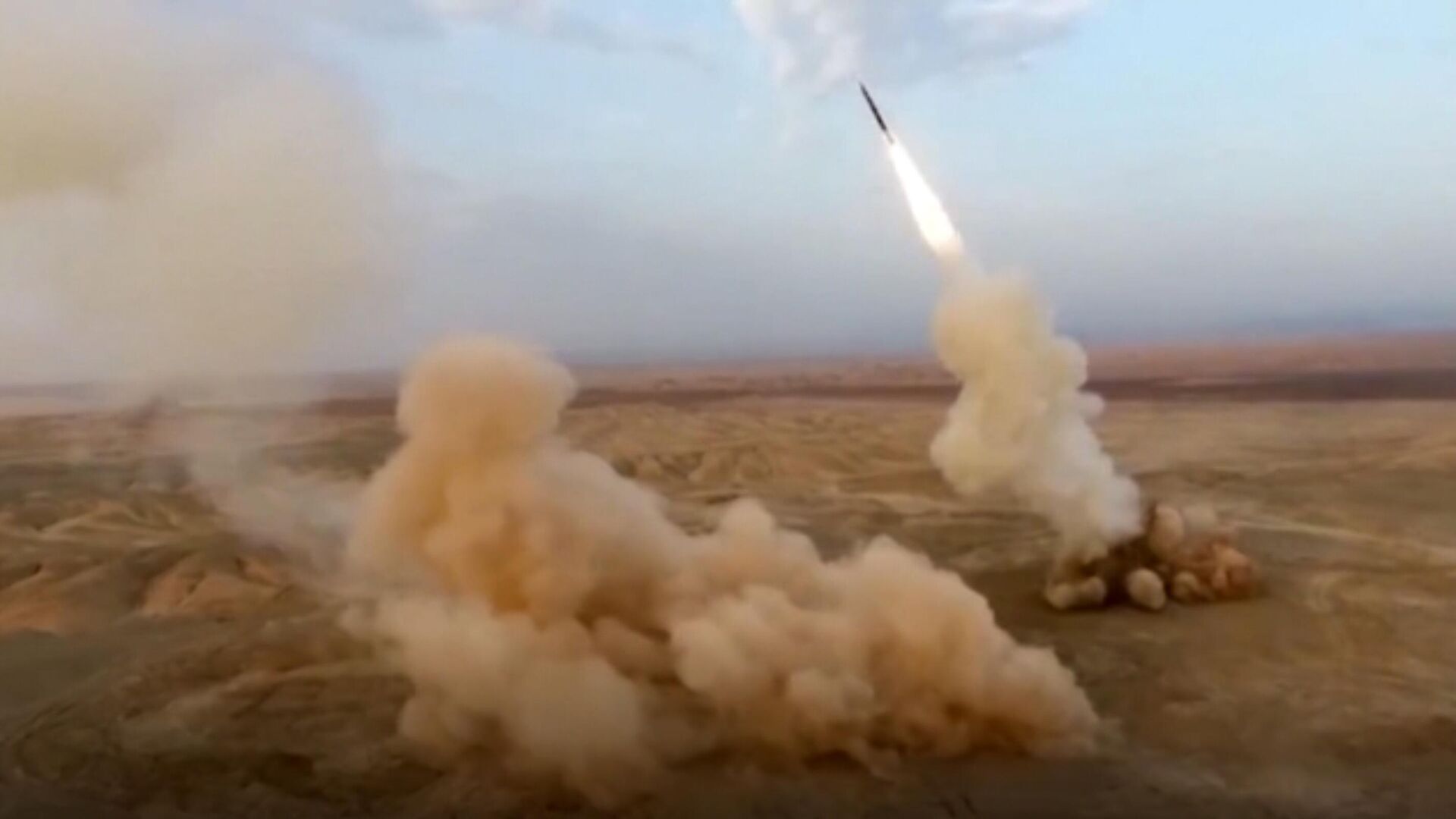
“If the US continues to use its missiles in such a manner, their stockpile will swiftly run out,” Russian military expert Yuri Knutov tells Sputnik, commenting on a recent video of apparently 10 Patriot interceptors downing just one Iranian ballistic missile.
Knutov explains that the US missile stockpile includes about 400 Terminal High Altitude Area Defense (THAAD) interceptors, which “may be already exhausted in 10 days even if they are used properly.”
“As for Patriot interceptors, their larger stockpile could be exhausted in around three weeks, especially if 10 such missiles are launched to hit one Iranian air target,” the expert points out.
According to him, the US quickly increasing the production of the aforementioned missiles is unrealistic, given that the monthly output currently stands at merely 55, which is “not serious.”
Iran’s ‘Trump Card’
“So, Iran now has a very important trump card. By strategically using its ballistic missiles and saving the advanced hypersonic Fateh missiles for the final stage, Tehran has a chance to deal a very painful blow to Israel and the US and avenge the surprise attack on the Islamic Republic,” the expert notes.
He says that when it comes to Iranian ballistic missiles, they might not be exhausted for another month, and despite their low accuracy, the mass use of this munition yields results.
“Out of a large number of launched missiles, one or two hit their targets, which is a significant result. It creates a psychological effect and, in turn, impacts the enemy’s morale. Therefore, when we talk about Iran’s use of ballistic missiles, this tactic has so far proven effective,” Knutov concludes.
The attack reflects Tehran’s willingness to target economic chokepoints in retaliation for recent airstrikes, raising concerns about potential escalation in the region
Saudi Arabia’s Ras Tanura refinery, the world’s largest oil refining facility, has been struck by drones, causing a major fire and forcing authorities to halt operations temporarily. The refinery, operated by Saudi Aramco, produces over 550,000 barrels of crude oil per day and serves as a critical hub for the kingdom’s oil exports.
According to sources, the drones responsible for the strike originated from Iran.
Saudi Aramco authorities are currently assessing the full extent of the damage, with operations at the site suspended until further notice. No official statement has yet been released by the company or the Saudi government regarding casualties or the broader impact on oil exports.
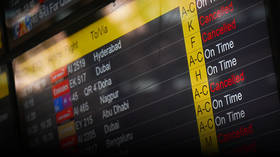
Hundreds of thousands travelers have been stranded across the Middle East following airspace closures triggered by unprovoked US-Israeli strikes on Iran, according to flight analytics firms.
Massive strikes against Tehran began Saturday, killing Iranian Supreme Leader Ayatollah Ali Khamenei, top officials, and hundreds of civilians. Tehran responded with hundreds of missile and drone attacks targeting US and Israeli bases across the Middle East.
Iran has also reportedly targeted several major regional aviation hubs, including the Dubai International Airport in the UAE – the world’s busiest – where damage and casualties were reported, as well as sites near international airports in Bahrain, Kuwait, and Iraq.
Following the escalation, Bahrain, Iran, Iraq, Israel, Jordan, Kuwait, Qatar, and the UAE announced partial or total airspace closures, forcing flight suspensions, cancellations, and diversions.
Kuwait's Public Authority for Civil Aviation says a drone targeted Kuwait International Airport, causing injuries and damage to one of the terminals.
Spokesperson Abdullah Al-Rajhi tells Kuna that the authorities immediately implemented emergency procedures, dealing with the… pic.twitter.com/a7vVkp7iMX
More than 3,400 flights have been canceled across seven major Middle Eastern airports on Sunday, according to flight tracker Flightradar24, affecting hundreds of thousands of passengers.
Emirates, Etihad and Qatar Airways – three major Gulf carriers that typically handle about 90,000 passengers daily – canceled roughly a third of their flights, according to aviation analytics firm Cirium.
Dubai Airport has turned into a massive waiting room
The difference between any other airport and Dubai is, atleast 40-50% of the people at the airport are for Transit (meaning Dubai is not final destination)
Numerous international airlines also canceled Gulf routes through the weekend as civil aviation authorities designated much of the Middle East as a high-security risk zone.
Air France, Lufthansa, KLM, Air India, and others suspended regional operations from at least March 3–7. FlightAware reported more than 19,000 global flight delays due to the Middle East crisis as of 2:30 am GMT on Sunday.
Russian carriers, including Aeroflot, also canceled or rerouted flights, and suspended services to Tehran, Dubai, and Abu Dhabi. According to the Association of Tour Operators of Russia (ATOR), about 8,000 Russian tourists have been stranded abroad while returning from vacations after missing Middle East connections. Rosaviatsia has been coordinating alternative routes to avoid Israel and Iran.
Analysts warn that the disruption is inflicting heavy financial losses on airlines and hotels, as well as travelers. Several airlines issued waivers and pledged to cover accommodation, meals, and rebooking for stranded passengers. However, multiple travelers have posted footage of overcrowded airports across the region on social media.
The crisis also disrupted shipping and cruise operations. MSC Cruises, TUI, and Celestyal canceled or suspended departures amid missile and drone activity. Container traffic through the Strait of Hormuz was halted or rerouted after Iran’s Revolutionary Guard issued warnings that no vessels are permitted to pass, although no formal blockade has been officially declared by Tehran. According to shipping analytics firm Linerlytica, about 170 containerships are currently inside the strait and facing restrictions on exiting.



 The Most Revolutionary Act