
Nathan Surendran, 27 March 2026
I watched Nicola Willis announce, at a press conference convened to address the worst oil shock in history, that the government’s Phase 1 action is an EECA ad campaign at fuelsavingtips.govt.nz. I checked. The Onion already did this.
In June 2025 I submitted to Parliament’s Finance and Expenditure Committee on the Regulatory Standards Bill. In that submission, I named the Strait of Hormuz specifically and warned that a blockade would cause catastrophic fuel shortages and price spikes exceeding the 1970s. I warned that NZ’s closure of Marsden Point had left us uniquely exposed. I used the phrase “energy blindness” to describe the way our policymakers treat the economy as a financial system that can grow forever, rather than an energy system subject to physical laws.
Today the government held a ministerial press conference to announce a four-phase Fuel Response Plan (and that ad campaign). Here are some thoughts in response.
The TL:DR version: the plan is a framework without numbers, the stock figures are misleading, the geopolitical situation is considerably worse than the ministers alluded to, and NZ Inc still doesn’t understand what we’re looking at in terms of the scale of this disruption in coming months…
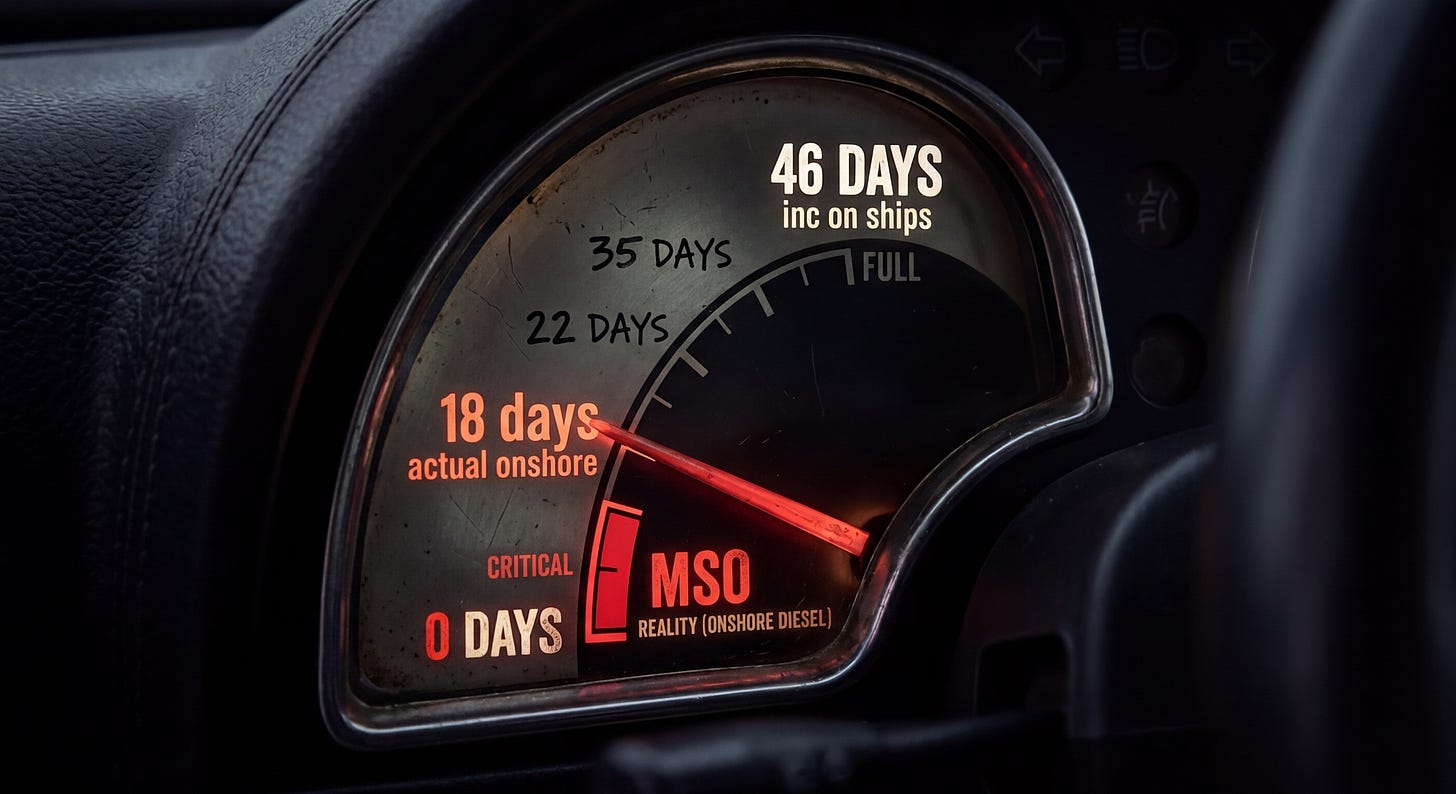
The 46 days that aren’t 46 days
The ministers claimed NZ has 49 days of petrol, 46 days of diesel, and 53 days of jet fuel as of midnight Sunday.
But their own press conference revealed the breakdown. For diesel: 18 days physically in the country. 16 days in NZ’s exclusive economic zone on ships unloading or transiting between ports. 12 days further out on the water.
Only 18 days is actually onshore. The rest is on ships that could be diverted, delayed, or fail to arrive if suppliers declare Force Majeure. Which is already happening across Asia.
MBIE released an unscheduled fuel update on 26 March after concerns about declining diesel stocks. Their own fuel supply analyst Mark Douglas confirmed that refineries in Singapore, Japan, and South Korea supplying NZ are now operating at reduced capacity, what he called “turn down”, processing crude at a slower rate to stretch remaining stocks.
As Bryce Edwards noted in his Democracy Briefing today, MBIE was forced to issue that update after independent analysts using ship-tracking data pointed out that its official figures on incoming fuel supplies were wrong. A website run by a BNZ financial markets analyst had better data than the ministry managing the crisis. The Taxpayers’ Union’s FuelClock.nz estimated NZ could run out of diesel by 16 April under business-as-usual, or by end of April even with emergency measures. Richard Harman’s reporting for Politik revealed that the Prime Minister held a private webinar briefing for top business CEOs while media were excluded. That’s not responsible communication management. That’s a two-tier information system.
The plan has tiers but no numbers
The four phases are sensible as a framework. Phase 1 is monitoring and voluntary conservation. Phase 2 is heightened risk with regulatory powers. Phase 3 is fuel prioritised to critical services. Phase 4 is strict allocation to life-preserving services.
The problem is that the government admitted it is “now consulting” on how to implement phases 3 and 4. They said they need “at least two weeks” to get the details right. They are building the lifeboat while the ship is taking on water.
[…]
Too much of the political conversation has been about petrol prices at the pump. That misses the point. As Edwards’ briefing notes, diesel is the crisis. Petrol shortages are inconvenient. Diesel shortages are existential. Diesel runs the trucks that stock supermarkets, the harvesters that pick crops, the milk tankers that collect from farms, the ambulances, the generators. The government’s own Phase 4 plan acknowledges this by prioritising “life-preserving services” – but the quantification of what that means in litres per day does not exist.
[…]
Phase 2 should already be active
The government published six triggers for moving between phases. The first is export restrictions on refineries NZ imports from. South Korea imposed mandatory export caps on gasoline, diesel, and kerosene on 13 March. China banned fuel exports entirely. Thailand banned most refined product exports. By the government’s own published criteria, the trigger for Phase 2 was crossed weeks ago.
The ministers implied they are considering when to move. The question is, what are they waiting for?
Force Majeure is not a theoretical risk. It is happening now.
Force Majeure declarations have cascaded across the entire NZ supply chain and well beyond. Confirmed declarations:
[…]
Refinery run cuts are confirmed and they affect NZ directly
[…]
MBIE’s own analyst Mark Douglas confirmed on 26 March that NZ’s source refineries in Singapore, Japan, and South Korea are all on “turn down.”
Australia’s energy minister confirmed that six fuel shipments from Singapore and South Korea have been cancelled or diverted since the war began. Australia sources from the same refineries as NZ.
[…]
South Korea’s GS Caltex has cut daily refining from 800,000 to 675,000 bpd. Korean airlines are cancelling routes. Hyundai Motor Group has suspended production of two vehicle models after a supply chain collapse. (Seoul Economic Daily, 25 March)
[…]
The US is not a backup plan
Shane Jones pointed to the US as a potential alternative fuel source, noting that Asian refineries are “capable of drawing product from the United States.”
The US currently supplies 2% of NZ’s fuel. On 23 March, a major explosion hit Valero’s Port Arthur refinery in Texas, one of the largest in the US at 435,000 bpd. Officials say equipment failure. Pro-Iranian accounts are claiming sabotage, no evidence for that. Either way, 435,000 bpd just went offline at a refinery the minister implied could help fill NZ’s gap.
US west coast refining capacity is already shrinking. Phillips 66 ceased its 139,000 bpd LA refinery at end of 2025. Valero is idling its 150,000 bpd Benicia refinery. US firms are chartering rare fuel cargoes from the Gulf Coast to Australia as emergency supply, which tells you how stretched the system already is.
[…]
Why Aotearoa New Zealand’s supply has held – and why that could change
Our fuel shipments have continued arriving so far partly because our fuel companies have established term contracts with South Korean and Singaporean refineries, and partly because we can afford to pay elevated prices. But this stability is price-dependent, not structural.
[…]
We sit in an awkward position in the middle of this hierarchy. Wealthy enough to outbid the Philippines or Bangladesh, but not using commodity leverage. Australia is using its coal and iron sands as bargaining chips to secure diesel – Hooton’s “you want coal? Then gizza your diesel.” Japan and South Korea can outbid most of Asia. Countries with navies are discussing escort operations for the Strait. Aotearoa has none of these cards. We consume about 24 million litres of fuel a day – a rounding error for the refineries supplying us. When those refineries are on turn-down and choosing which customers to prioritise, small volumes are the first to get bumped. Australia’s energy minister has confirmed six April shipments of about 80 per month cancelled or diverted.
NZ has food. Half the world wants it. That is leverage, if anyone in Wellington is willing to use it. Right now it appears that we are relying on commercial goodwill and market price alone, in a world that is rapidly moving towards bilateral barter and strategic allocation.
The government is not reading the room
Transport Minister Chris Bishop said something at an Infrastructure NZ conference this week that politicians rarely say: “It’s a scary prospect and I’m not 100 per cent sure the public have quite worked it out yet.” He added: “the reality is, it could happen.” Matthew Hooton, writing in the Herald today, put it more bluntly: “Thought Covid was bad? If New Zealand runs out of diesel, Covid will look like the rehearsal.” Z Energy chief executive Lindis Jones told Newsroom: “I heard it described as the biggest energy shock in the history of the world. It certainly feels like it.”
Hooton makes the point plainly. During Covid, the circulatory system of the economy kept pumping. Trucks delivered to supermarkets, harvesters picked crops, milk tankers collected from farms, ambulances ran. None of that is guaranteed now. And as he notes, “being the last station on the southern line makes New Zealand more vulnerable to disruptions to supply lines, not less.” (Both Hooton and Bishop are cited via Edwards’ Democracy Briefing.)
The Wareing Group, a major South Island logistics operator with 270 drivers, has been hitting fuel outages since Tuesday. Truck stops in Taupo, Sanson, parts of Christchurch, Ashburton, Oamaru, and Winton have been running dry. The company is paying $10 million more than expected for fuel. Health Minister Simeon Brown is seeking advice on the supply of helium for MRI machines – between a quarter and a third of the world’s helium comes from Qatar’s Ras Laffan facility, which has been struck. If helium runs short, cancer diagnoses get delayed.
Compare NZ’s response to what every other country in its supply chain is doing:
NZ’s own suppliers:
- South Korea (48% of NZ supply): fuel price caps, mandatory export caps, naphtha rationing, refinery run cuts, airlines cancelling routes, car manufacturers halting production lines, five-day vehicle rotation schemes. (Argus Media, 17 March; Seoul Economic Daily, 25 March; CNN, 25 March)
- Singapore (34% of NZ supply): refineries cutting runs to 50-60%. (Vertium/Wood Mackenzie, March 2026; Argus Media, March 2026)
- Japan (7% of NZ supply): largest-ever emergency oil reserve release, 10% refinery run cuts, cancelled export cargoes, public messaging on consumer goods hoarding. (CNN, 25 March; Argus Media, March 2026)
Wider international response:
- Australia: suspended fuel quality standards, relaxed minimum stockholding obligations, chartering emergency fuel from the US Gulf Coast. More than 500 petrol stations have run dry. Six fuel shipments from Singapore and South Korea cancelled or diverted. (The Spinoff, 26 March; Vertium, March 2026)
- Philippines: declared a national energy emergency. (CNN, 25 March)
- Sri Lanka: rationing fuel, motorists limited to 15 litres per week. (The Spinoff, 26 March)
- Pakistan: moved to a four-day working week in the public sector. (The Spinoff, 26 March)
- Italy: PM Giorgia Meloni flew to Algeria for emergency gas talks to replace lost Qatari LNG supply. (France 24, 26 March)
- UK and Germany: both signalled the crisis is accelerating their green energy transitions. (France 24, 26 March)
- IEA: triggered a record 412-million-barrel emergency stock release, the head of the IEA calling this the “greatest global energy security challenge in history.” (Argus Media, March 2026)
NZ launched an EECA ad campaign asking people to “stretch their tank by 20%.”
[…]
The economy is an energy system using money
[…]
France’s finance minister has confirmed it will take up to three years to restore destroyed Gulf infrastructure, and the UK and Germany have both signalled that the crisis is accelerating their green transitions. Italy’s PM flew to Algeria to negotiate for emergency gas. These are countries that understand the structural nature of what is happening.
What should be happening
Three things, starting today.
First, publish the actual depletion timeline. Not headline stock figures, but what happens if no more ships arrive. The public deserves to see the curve, not the snapshot.
Second, move to Phase 2 immediately. The government’s own triggers have been met. Voluntary demand restraint messaging should have started weeks ago. Every day of delay burns through stock that cannot be replaced at the current rate. Jumping straight from Phase 1 to Phase 4 will be unnecessarily destructive.
Third, quantify the allocation plan and prioritise food. Shane Jones himself has said it plainly: “A shortage of diesel would literally bring the economy to its knees.” He told CNBC: “You cannot have a food industry, you cannot have a forestry industry, you cannot have a fishing industry, you cannot have a horticultural industry unless you’ve got significant security and robustness about diesel supplies.”
[…]
If I were making this call today, I’d be ring-fencing diesel for domestic food production now: arable crops, vegetables, the minimum livestock operations for domestic meat and dairy, and the transport to get it to market.
[…]
Hooton makes a more provocative version of this argument. NZ has food. Other countries want it. He suggests Luxon should use that leverage with counterparts in Singapore, South Korea, and Malaysia: food in exchange for fuel. He acknowledges this would require “some sort of state control over international trade that we haven’t seen since 1984.” But the scale of the potential crisis justifies it.
[…]
 The Most Revolutionary Act