
 Photo Credit: The Cradle
Abbas al-Zein
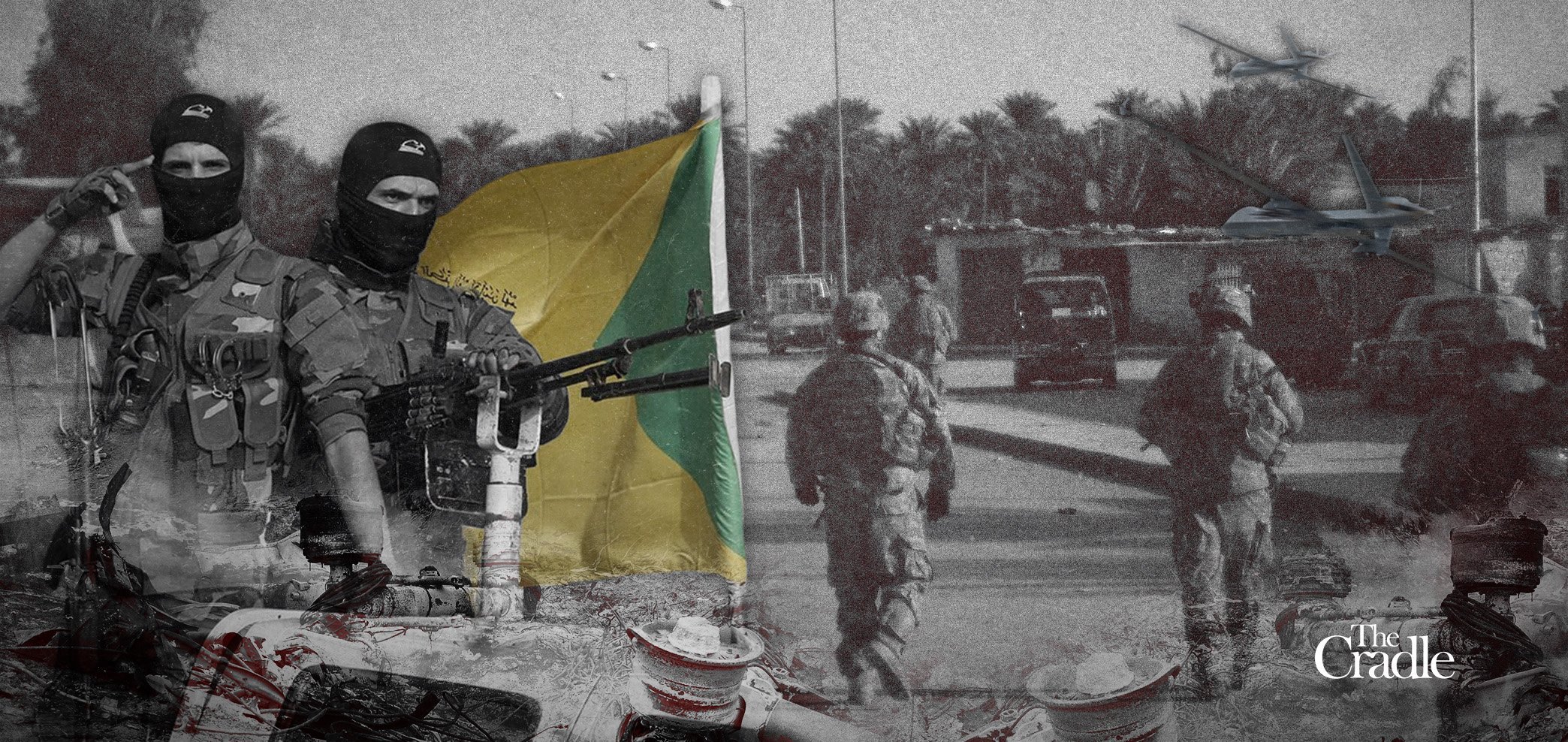
Iraq’s security environment has entered a markedly more volatile phase since the outbreak of the US-Israeli war on Iran in late February 2026. Armed factions operating under the banner of the Islamic Resistance in Iraq have intensified attacks on installations linked to US military deployment and logistical infrastructure across several provinces.
The recent escalation points to an effort to link domestic confrontation with wider regional war calculations, while also projecting Iraq as a front capable of exerting pressure on the trajectory of the conflict rather than merely absorbing its consequences.
Local reporting and faction-aligned statements describe successive waves of drone and rocket strikes targeting bases hosting US personnel. The tempo of these operations has reportedly risen beyond patterns observed in earlier years of intermittent confrontation, when attacks were more limited in scope and largely confined to specific theaters.
In recent weeks, the attacks have edged closer to the heart of the Iraqi state. Drone incidents and attempted strikes have reached sites in Baghdad tied to US logistics and diplomatic security activity – locations that were once treated as politically sensitive red lines.
The shift in targeting suggests a willingness by resistance factions to test the limits of US protection measures while sending a message that no part of the American presence in Iraq is beyond reach.
Resistance factions have announced the downing of a number of US military drones during the recent escalation, including aircraft described as playing a central surveillance role in American operations across Iraq and the wider region.
These incidents have been framed by resistance media as evidence of a shift in the balance of engagement, with attacks moving beyond harassment toward attempts to disrupt aerial monitoring and operational freedom.
The targeting pattern reflects an effort to sustain pressure on US deployments while signaling that the Iraqi front is now tied to the broader regional confrontation unfolding across Lebanon, Syria, and the Persian Gulf.
Intensified operational tempo
In the days following the initial escalation, resistance factions reported a sharp acceleration in operations. Statements circulated through faction media channels spoke of 27 attacks within a 24‑hour period at the beginning of March, followed by claims of 29 operations in a single day.
These figures were presented as evidence that the confrontation was evolving from sporadic harassment into coordinated waves of rocket and drone strikes directed at US military installations across several Iraqi provinces.
Subsequent communiqués described the escalation reaching a peak with announcements of more than 290 operations over roughly 12 days.
According to faction narratives, these attacks spanned Baghdad, western Iraq, and parts of the Kurdistan Region, particularly around Erbil International Airport and Harir Air Base.
From the outset of the war on 28 February, resistance messaging emphasized a rapid move into direct confrontation, highlighting synchronized strike attempts intended to demonstrate operational reach and sustained pressure.
In northern Iraq, tension has likewise centered on the vicinity of Erbil International Airport and nearby military facilities, which were subjected to regular, concentrated strikes using attack drones and Katyusha rockets, reflecting Kurdistan’s enduring strategic relevance as a logistical hub.
According to field reports, the Islamic Resistance in Iraq succeeded in downing around six drones in different areas: two in Anbar (western Iraq), one near Baghdad, one in Salah al-Din (Balad Air Base), and one in Diyala.
These operations included targeting the MQ-9 Reaper, considered “Washington’s eye” in the region due to its assassination and surveillance capabilities. Video footage reportedly showed the wreckage of such drones after being struck by upgraded air defense systems.
The most prominent strategic turning point came with the announcement that Iraqi resistance forces had shot down a US KC-135 refuelling aircraft in Anbar, killing its six-member crew. This operation was seen as a severe blow to US aerial support capabilities over Iraq.
Retaliation and escalation cycles
Following the sharp rise in attacks claimed by factions operating under the umbrella of the Islamic Resistance – including groups such as Kataib Hezbollah, Harakat al-Nujaba, and Kataib Sayyid al-Shuhada – the US moved toward more concentrated strikes on sites linked to these formations.
Airstrikes were reported in areas long associated with militia deployment and logistical depth, particularly Jurf al-Sakhar south of Baghdad, Al-Qaim along the Syrian border, and the Akashat region in western Anbar.
One of the most sensitive developments came with reports of an attempted assassination targeting Kataib Hezbollah Secretary‑General Abu Hussein al‑Hamidawi. According to resistance‑aligned sources, US aircraft struck locations in the Al‑Masbah–Al‑Arasat area of central Baghdad where senior commanders were believed to be meeting. Early media reports suggested that Hamidawi may have been killed, but subsequent faction statements denied this, describing the operation as unsuccessful.
On 16 March, Kataib Hezbollah announced the death of senior security figure Abu Ali al‑Askari, a development that resistance media framed as part of the ongoing escalation cycle. Within hours, drone and rocket fire were reported near the US embassy compound in Baghdad.
Taken together, these developments highlight several emerging dynamics. First, the tempo of confrontation has continued to rise, with both sides demonstrating a willingness to absorb risks associated with escalation.
Second, the geographic scope of operations has expanded to include the capital and strategically significant zones across western Iraq.
Third, the confrontation has begun to test long‑standing informal limits by targeting aerial capabilities, leadership structures, and logistical infrastructure, positioning the Iraqi front as a central pressure point within the wider regional deterrence equation.
Strategic messaging beyond Iraq
Alongside battlefield developments, Iraqi resistance factions have articulated a doctrine linking internal confrontation with regional flashpoints.
In a 6 March statement, the Iraqi Resistance Coordination Committee said the security of Beirut’s southern suburb (Dahiye) was “an integral part of the regional security equation,” warning that any attack would threaten US diplomatic and economic interests across West Asia.
This framing situates Iraq within a network of interconnected pressure fronts rather than treating it as an isolated arena.
Resistance messaging referenced potential threats to diplomatic missions of states perceived as supporting the war effort and to energy infrastructure associated with western oil operations in the Gulf. Such rhetoric seeks to elevate localized clashes into developments with global economic implications, particularly in light of the central role Gulf energy flows play in international markets.
Attention has also focused on the Kurdistan Region, where resistance statements spoke of “the consequences of involvement in supporting the Kurdish criminal gangs backed by the Zionist entity that seek to infiltrate” Iran. These warnings reflect long-standing concerns over intelligence penetration, logistical corridors, and the risk that Iraqi territory could be used to mount pressure on Iranian allies from multiple directions.
Syria and the axis equation
On 11 March, amid regional media reports of troop movements by forces aligned with Syria’s President Ahmad al-Sharaa (Abu Mohammad al-Julani) toward areas near the Lebanese border, Iraqi resistance rhetoric reached one of its sharpest points.
In a statement issued that day, the Coordination Committee warned that any hostile military step against Lebanon – particularly if carried out in coordination with what it described as the “Zionist-American enemy” – would be treated as a direct declaration of war on the entire Axis of Resistance.
The language amounted to a pre-emptive military veto, signaling that the Iraqi front could be activated as part of a wider deterrence response if Hezbollah’s strategic depth were threatened.
References to past battles against US forces and ISIS have also been invoked to reinforce claims of operational experience and ideological legitimacy.
From battleground to pressure front
Operational patterns and strategic messaging together point to a gradual redefinition of Iraq’s role in the regional conflict. For years, the country was widely regarded as a battleground where external rivalries played out through local proxies.
Current developments suggest efforts by resistance factions to convert Iraq into a pressure front capable of influencing the cost calculations of foreign military presence.
This trajectory remains shaped by several factors, including the sustainability of US deployments, the stance of Iraq’s central government, intra-Shia political competition, and the broader direction of the war involving Iran and Israel. Recent escalation nonetheless demonstrates how rapidly domestic security dynamics can intersect with regional confrontation and alter threat perceptions across neighboring states.
As diplomatic channels narrow and military tensions persist across West Asia, Iraq’s position may prove consequential in determining whether the conflict stabilizes into a tense deterrence balance or moves toward a phase of wider escalation involving multiple fronts.
Iraq’s evolving posture indicates that it is no longer viewed solely as a peripheral arena but as a component of a broader contest over military presence, strategic depth, and the future configuration of regional power.
[…]
Via https://thecradle.co/articles/iraq-steps-forward-in-a-regional-war
 The Most Revolutionary Act