
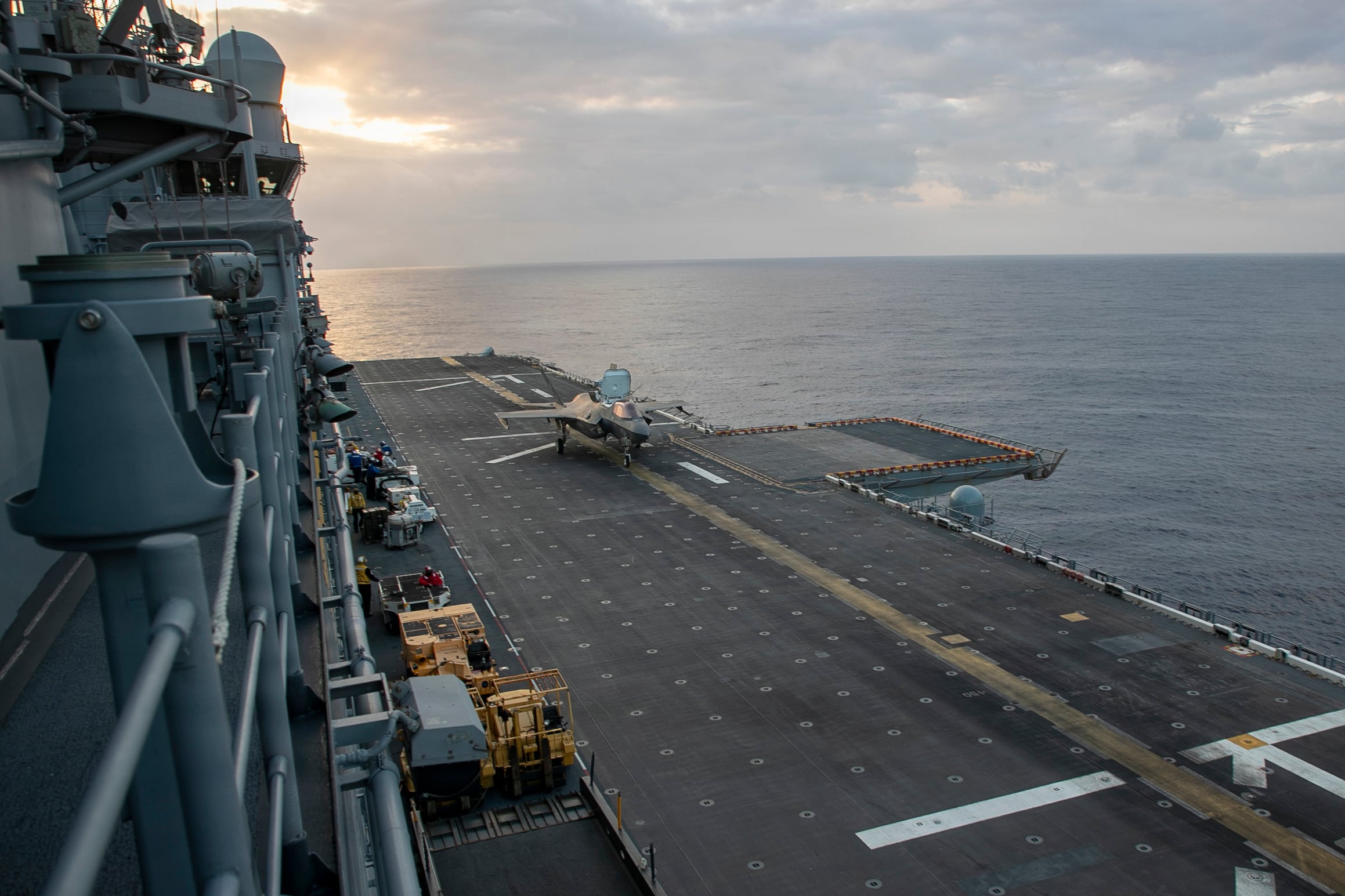
 An F-35B Lighting II prepares to take off from the USS Tripoli on Mar. 6, 2026.
Samuel Geddes
US Marines head to the Gulf aboard the USS Tripoli, but as Samuel Geddes argues, it may be more about optics than real military impact.
In mid-week, the 31st US Marine Expeditionary Unit aboard the USS Tripoli was sighted transiting the Straits of Malacca en route to the Gulf. Its crew and detachment, reportedly 2200 to 5000-strong, has been summoned from its station in Japan after President Trump’s dawning realization that the Islamic Republic of Iran would not meekly collapse after he assassinated its leader, Sayyed Ali Khamenei.
Given that he initiated the war by crossing the ultimate red line, Trump’s options for further escalation are vanishing quickly. He is caught between what he knows to be the universal unpopularity of the war among Americans, especially over its disastrous economic consequences, and the knowledge that if he washes his hands of the situation and walks away, Iran will almost certainly continue retaliating and end up in a vastly more powerful position than it had been in before the war.
These equal opposing forces, the need for an off-ramp and the need to demonstrate any kind of tangible success, have shifted the calculus to include US ground operations on Iranian soil. It is in this context that the Marine Corps’ dispatch to the region is widely interpreted.
What would 5000 US Marines, at most, realistically achieve in a ground operation in Iran?
The idea of a large-scale ground invasion of Iran was never seriously on the table to begin with. Besides the fact that the Trump administration has been uncharacteristically consistent that this will not happen, the entire active US military, 1.3 million personnel, would be required, along with at least as many conscripts, for such a thing to even be attempted. Iran is a 1.6 million square kilometer mountain fortress, holding more mountains, deserts, and over 90 million mobilized citizens within. The United States has never occupied or even attempted to occupy a country of this size. It is simply not happening.
With large-scale ground incursions eliminated, the one “boots-on-the-ground” scenario with at least some initial plausibility would be for the US to seize one or more of the Iranian islands in the Gulf, especially the Strait of Hormuz. These islands range from Hormuz and Qeshm in the east, westward to Kharg, where 90 percent of Iran’s oil exports originate.
Upon genuine examination, however, the force currently on its way is woefully insufficient even for this objective by several orders of magnitude. The closest analogue for such an operation, in scale and required manpower, would be the Volcano and Ryukyu islands campaign against Japan in World War II, the bloodiest theatre of the US war in the Pacific. In fact, Qeshm Island is only slightly larger than Okinawa, which required between 250,000 and 540,000 American soldiers to occupy. Success there came only at the cost of 12,500 Americans killed in action and 50,000 wounded. Taking the Island of Iwo Jima alone, famously the most intense engagement of the Pacific, required 110,000 troops and took the lives of 6,800, with 20,000 wounded. Iran’s smaller islands in the Strait, Hormuz, Larak, and Hengam are comparable in size (and presumably the density of their defenses) to the Japanese outer islands but compressed within a single theatre of only a few hundred kilometers across. Anyone seriously proposing such an operation would be looking at the most intensive and costly amphibious campaign since World War II, plausibly seeing US losses equaling those of the entire wars in Korea or Vietnam within a matter of weeks or months. Here too, the enormity of the operation places it far outside the US military’s current capacities. It is certainly outside the means of 5,000 American soldiers, assuming they are not being willfully sent to their deaths.
If the Marines on the USS Tripoli are insufficient to even take and hold a small island, the last remaining possibility is that they are intended to infiltrate Iranian territory to carry out some form of high-stakes, largely symbolic operation that Trump intends to publicize as him “winning” the war and unilaterally ceasing US involvement.
Other than standard acts of sabotage, it has been suggested that the Marines may be tasked with locating and capturing Tehran’s enriched uranium stockpile. Such an objective is almost certainly fanciful. There is no reason to assume the Americans have any idea where it is, or that even 5000 marines would be sufficient to seize it if they did. However, given this administration’s amply demonstrated detachment from reality, its utter lack of shame or respect for international law, Trump’s assertion alone that such a mission was successful, even if it failed or never occurred at all, might be the one “success” that the president could consider sufficient to end his part in this catastrophe. That such a “success” would be illusory and utterly devoid of any strategic value is at this point an entirely secondary consideration.
It may well be that when the expeditionary unit reaches the Strait of Hormuz within the next week, it will simply do nothing – its purpose being pure posturing. Whatever its true role, its size relative to the strength of the Islamic Republic all but guarantees that it will serve a solely symbolic function. Its real mission is to lessen the US president’s humiliation when he ultimately does, in the fashion of a mad Roman emperor, admit defeat to the Iranians.
[…]
 The Most Revolutionary Act