
RT
American military targets in six countries have come under Iranian fire, and the Pentagon is doing its best to hide the destruction
Within hours of the US launching ‘Operation Epic Fury’, Iran unleashed retaliatory strikes against American military bases in the Middle East. Behind a veil of censorship, it’s clear that the damage is far more severe than the Pentagon is admitting.
Ten days into the war, the US has admitted the deaths of eight service members. Three fighter jets have been lost in mysterious circumstances, while damage reports from American bases have come not from Pentagon press releases, but from satellite images and cell phone videos – often shot in defiance of strict wartime censorship laws.
These sources reveal that Iran is engaged in a campaign of precision strikes, aimed at keeping American planes on the ground, and more importantly, crippling the US’ cutting-edge ballistic missile defense network.
How many bases does the US have in the Middle East?
The US operates a network of 19 permanent and temporary military bases throughout the Middle East, with the largest – Al Udeid Air Base in Qatar – hosting 10,000 troops and serving as the forward headquarters for US Central Command (CENTCOM).
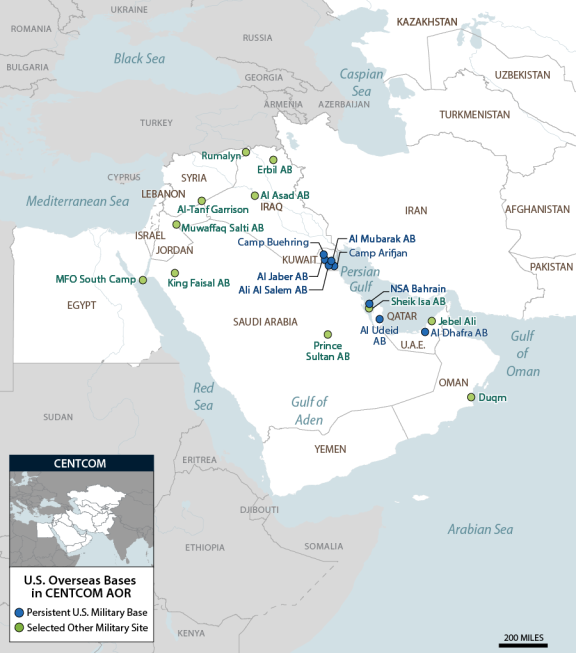
The eight permanent US installations are located in Bahrain, Egypt, Iraq, Jordan, Kuwait, Qatar, Saudi Arabia, and the United Arab Emirates, and as of mid-2025, there are between 40,000 and 50,000 American troops stationed in the region at any one time.
These bases surround Iran from the west and south, and are currently bolstered by the presence of the USS Abraham Lincoln and USS Gerald R. Ford in the Persian Gulf. These nuclear-powered aircraft carriers have a combined staff of more than 10,000, and carry more than 130 fighter jets.
All of the US bases in the region have been described as “legitimate targets” by the Iranian military, and facilities in six countries have already been hit by Iranian missiles and drones.
Which US bases have been hit?
As of March 10, the following US bases and associated buildings have been struck by Iranian missiles and drones, often more than once.
- Naval Support Activity, Bahrain (Headquarters of US Fifth Fleet)
- Manama, Bahrain (Multiple hotels housing US troops in the city)
- Erbil International Airport, Iraq (US base adjoining airport)
- Muwaffaq Salti Air Base, Jordan
- Ali Al-Salem Air Base, Kuwait
- Camp Buehring, Kuwait
- Camp Arifjan, Kuwait
- Mohammed Al-Ahmad Kuwait Naval Base, Kuwait
- Al-Udeid Air Base, Qatar
- Al-Dhafra Air Base, UAE
- Jebel Ali Port, UAE
- Prince Sultan Air Base, Saudi Arabia
What’s on Iran’s target list?
The strikes on American air bases serve the immediate goals of reducing US ability to conduct air sorties over Iran, and forcing it to move air assets further away, from where they must rely on aerial refueling to continue their attacks. Data from FlightRadar24 showed a mass exodus of KC-135 Stratotankers from Prince Sultan Air Base on March 9, after a combined drone and missile attack the night before. A rudimentary calculation by analyst Anusar Farooqui suggests that the US ability to fly missions over Iran has been degraded by 35-50%.
Iran’s campaign has focused heavily on blinding the US military and crippling its THAAD missile defense network. An Iranian Shahed drone slammed into an AN/TPS-59 radar dome at Naval Support Activity in Bahrain on the first day of the conflict, obliterating the $300 million system. Installed in 2007, the radar was described by Lockheed Martin at the time as “the only 360-degree coverage mobile radar in the world certified to detect tactical ballistic missiles.”
Radar domes were also destroyed at Camp Arifjan and Ali Al-Salem Air Base in Kuwait, and at Al-Dhafra in the UAE, according to satellite images and video footage. At Al-Udeid Air Base in Qatar, a $1 billion AN/FPS-132 early warning radar installation,one of only six worldwide, was hit by an Iranian ballistic missile on February 28, according to Qatar’s defense ministry.
By destroying the radar equipment, Iran has hampered the US and Israel’s ability to track incoming ballistic missiles. The consequences can be seen in Israel, where by March 6, Iranian missiles were hitting Tel Aviv less than three minutes after sirens sounded, instead of the usual eight minutes.
In at least four locations – Muwaffaq Salti Air Base in Jordan, Prince Sultan Air Base in Saudi Arabia, and two Emirati-run bases in the UAE – Iran has hit AN/TPY-2 radar systems linked to US-made Terminal High Altitude Area Defense (THAAD) batteries. Satellite images show that in Jordan and Saudi Arabia, these $500 million systems were completely destroyed.
Despite a drop in missile launches from Iran, the destruction of the US’ early-warning and THAAD infrastructure suggests that a higher percentage of Iranian missiles will hit their targets in the coming days and weeks.
How is the damage being covered up?
The US has adopted a policy of silence and denial, with the Pentagon refusing to answer press requests. Asked about damage to THAAD stations, the Department of War told CNN that “due to operations security, we are not going to comment on the status of specific capabilities in the region.”
An American KC-135 Stratotanker refueling aircraft went down in western Iraq on Friday, killing all six crew members on board, the United States Central Command (CENTCOM) said.
CENTCOM stated in a post on X earlier that four crew members had initially been confirmed dead and that rescue efforts were continuing. In a later update, the command said all six personnel were “now confirmed deceased.”
“The circumstances of the incident are under investigation. However, the loss of the aircraft was not due to hostile fire or friendly fire,” CENTCOM said.
CENTCOM has outright denied that Iran caused “severe damage at multiple US bases.” Despite satellite images and video footage suggesting otherwise, CENTCOM stated on social media that “damage to US installations was minimal and has not impacted operations.”
Satellite imaging firms Planet Labs and Maxar Technologies have both paused the release of footage from the region. Planet Labs, whose images revealed damage to bases in Bahrain, Kuwait, and Qatar, said that it would place a 14-day delay on new images to “prevent adversarial actors endangering the safety of allied and NATO-partner personnel.”
The Gulf monarchies have taken a more draconian approach, with the UAE threatening fines and jail time for anyone sharing videos of Iranian attacks, and Bahraini prosecutors reportedly seeking the death penalty for recording a video of a malfunctioning US Patriot air defense system hitting a residential area and allegedly killing more than 30 civilians. CENTCOM and the Bahraini government have claimed that an Iranian drone was responsible for the deaths.
How many US troops have been killed?
As of March 10, eight US troops have been confirmed killed since hostilities began. Six died in an Iranian attack on Camp Arifjan in Kuwait, when a missile hit what US Secretary of War Pete Hegseth described as a “tactical operation center that was fortified.” One soldier was killed in a missile attack on Prince Sultan Air Base in Saudi Arabia, according to the Pentagon, while another supposedly died in a “non-combat related” incident at Camp Buehring in Kuwait.
Around 140 American troops have been wounded since February 28, with eight of them
Tehran claims that the true US death toll is significantly higher. In an interview on March 7, Iranian Supreme National Security Council chief Ali Larijani accused US President Donald Trump of “lying” about the casualty count, predicting that the US would “probably later increase the number of deaths gradually under the pretext of accidents or something of the sort.”
Trump and Hegseth have both warned the American public that more deaths are likely. “Things like this don’t happen without casualties,” Hegseth said on March 8. “There will be more casualties.”
Who shot down the US F-15s?
Three US F-15E Strike Eagle fighter jets were shot down over Kuwait on March 2, in what CENTCOM called “an apparent friendly fire incident.” All six crew members ejected successfully, and CENTCOM maintained afterwards that they were “mistakenly shot down by Kuwaiti air defenses” during active combat with Iranian jets.
RT analyzed the incident in depth and concluded that this version of events was likely untrue. No telltale trails from Kuwait’s Patriot, HAWK, NASAMS, or Spada 2000 interceptors were visible in video footage of the incident, while the damage to the jets – which were hit near their engines – did not match up with the missiles fired by these systems.
Instead, it is more likely that the F-15s were brought down with heat-seeking missiles, fired either from Iranian or Kuwaiti fighter jets. Unconfirmed video footage suggests that at least one of the planes may have been shot down by a Kuwaiti F-18.
[…]
Via https://www.rt.com/news/633541-iran-attacks-us-bases/
 The Most Revolutionary Act