
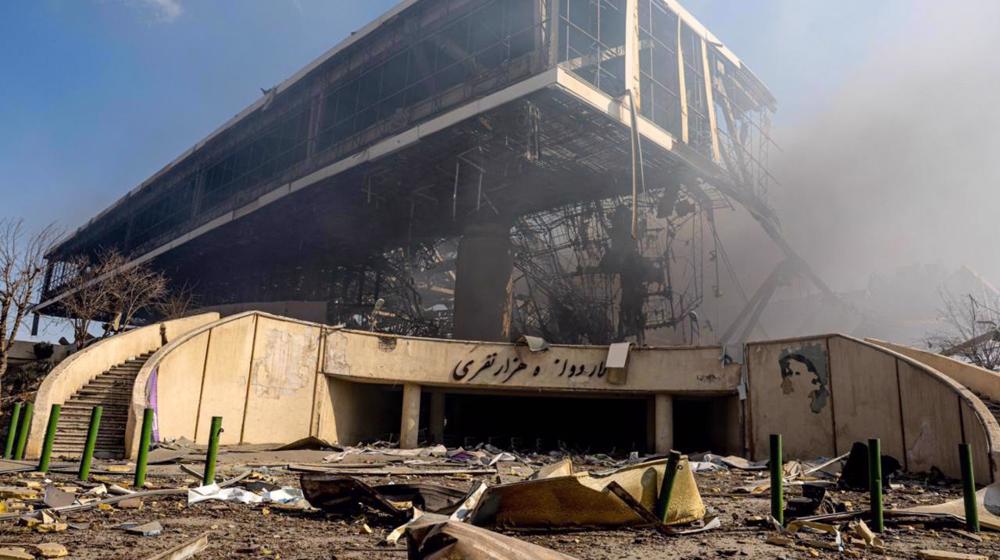
Tehran’s 12,000-seat Azadi Sports Complex was attacked in an American-Israeli aggression on March 5, 2026. (Photo by IRNA)
Press TV
A classified assessment by the National Intelligence Council has concluded that even a large-scale military offensive against Iran would be unlikely to topple the country’s political and security establishment.
The Washington Post, citing US officials familiar with the matter, reported on Saturday that the assessment suggests that the Islamic Republic’s system of governance is resilient enough to withstand even significant military pressure.
The report’s findings raise questions about the feasibility of the strategy advocated by US President Donald Trump, who has repeatedly said he intends to “clean out” Iran’s leadership structure.
According to officials cited in the report, the intelligence analysis examined potential outcomes of both limited strikes targeting senior leaders and broader attacks aimed at crippling Iran’s leadership and state institutions.
In both scenarios, analysts concluded that the country’s political and military institutions would preserve continuity of power.
The report determined that even with the assassination of Leader of the Islamic Revolution Ayatollah Seyyed Ali Khamenei, the country’s ruling system would continue to function through established succession mechanisms.
These procedures include the appointment of a new leader by the powerful Assembly of Experts, a body responsible for overseeing leadership transitions.
Intelligence analysts also concluded that the prospect of Iran’s fragmented opposition taking power after a military strike was “unlikely,” according to people familiar with the classified findings.
The assessment comes as the US-Israeli aggression against Iran enters its second week and expands across multiple regions.
Despite the intelligence community’s caution, the Trump administration has publicly emphasized its military objectives.
Trump has also suggested that Washington could influence Iran’s future political leadership.
However, Iranian officials have rejected any notion of outside involvement in determining the country’s leadership.
Iran’s Parliament Speaker, Mohammad Bagher Qalibaf, dismissed the idea that the US could influence the succession process, stating that Iran’s political future would be decided solely by the Iranian people.
 The Most Revolutionary Act