
[…]
Jeffrey Epstein, the convicted sex offender, financier, and Zionist intelligence agent, engaged in multiple activities across Africa that reflected broader patterns of elite exploitation and imperialist influence, often under the guise of philanthropy or business. These involvements, spanning trips and shadowy dealings, highlight how powerful networks perpetuate control over Global South nations, aligning with critiques of imperialism as a system of domination.
The Libyan Operation
Recent revelations from the U.S. Department of Justice’s unsealed Epstein files expose layers of predatory opportunism targeting Libya. In July 2011, amid the NATO-backed uprising that toppled Muammar Gaddafi’s government, an associate sent Epstein an email outlining “financial and legal opportunities” tied to Libya’s political and economic turmoil. The correspondence detailed plans to exploit approximately $80 billion in Libyan state assets frozen internationally after sanctions and the conflict, including $32.4 billion held in the United States alone. These funds, described in the email as “stolen and misappropriated”, were portrayed as ripe for recovery efforts that could yield massive profits, with the sender urging Epstein to pursue even a fraction of them.
The proposal explicitly invoked assistance from officials “formally” of Britain’s MI6 and Israel’s Mossad (it’s not clear if the word ‘formerly’ was intended), who reportedly expressed willingness to help trace and reclaim these assets under the pretext of identifying “embezzled” wealth. This networking underscores how Epstein’s circle leveraged intelligence connections — often linked to Zionist and Western security apparatuses — to capitalise on post-Gaddafi chaos, where Libya’s sovereignty was shattered, leading to ongoing civil strife, resource plunder, and foreign interference. The email framed Libya’s vast energy reserves and educated population as creating “a great opportunity” for reconstruction profiteering, estimating the country would need at least $100 billion in post-conflict spending — itself a direct consequence of imperialist destruction.
Such schemes exemplify how Zionist and Western ties treat destabilised African states as open-season for asset-stripping and influence peddling. The timing, shortly after Gaddafi’s overthrow and before his October 2011 killing, reveals intent to profit from engineered instability. Additional Epstein files link him to discussions involving Prince Andrew on potential Libyan loans to Dubai in 2010, during Gaddafi’s final years, further illustrating entangled royal, financial, and intelligence interests in Libyan resources. But Libya was not the only African country in which Epstein was interfering, as the files show.
A Trip to Africa
In September 2002, Epstein provided his private jet for a high-profile trip to Africa, accompanying former US President Bill Clinton, actor Kevin Spacey, actor and comedian Chris Tucker, and others on a purported humanitarian mission. The itinerary included stops in Ghana, Nigeria, Rwanda, Mozambique, and South Africa, framed as efforts to address HIV/AIDS through the Clinton Foundation. Unsealed court documents from Giuffre v. Maxwell detail flight logs confirming Epstein’s jet was used for this trip, with Maxwell admitting Clinton dined on the plane, underscoring elite access facilitated by Epstein.
Virginia Giuffre, an Epstein survivor, travelled on Epstein’s planes 23 times while underage, including instances with Maxwell. Survivor Chauntae Davies, who accompanied the group in 2002, later described feeling powerless amid Epstein’s associations with influential figures. Clinton’s spokesman confirmed two separate trips to Africa on Epstein’s plane during 2002 and 2003, involving staff, foundation supporters, and Secret Service agents, emphasising charitable intent but underscoring Epstein’s role in facilitating elite access to the continent. These unsealed records highlight the 2002 Africa trip as part of the work of the Clinton Foundation, illustrating how such ‘humanitarian’ excursions mask networks of power and potential exploitation.
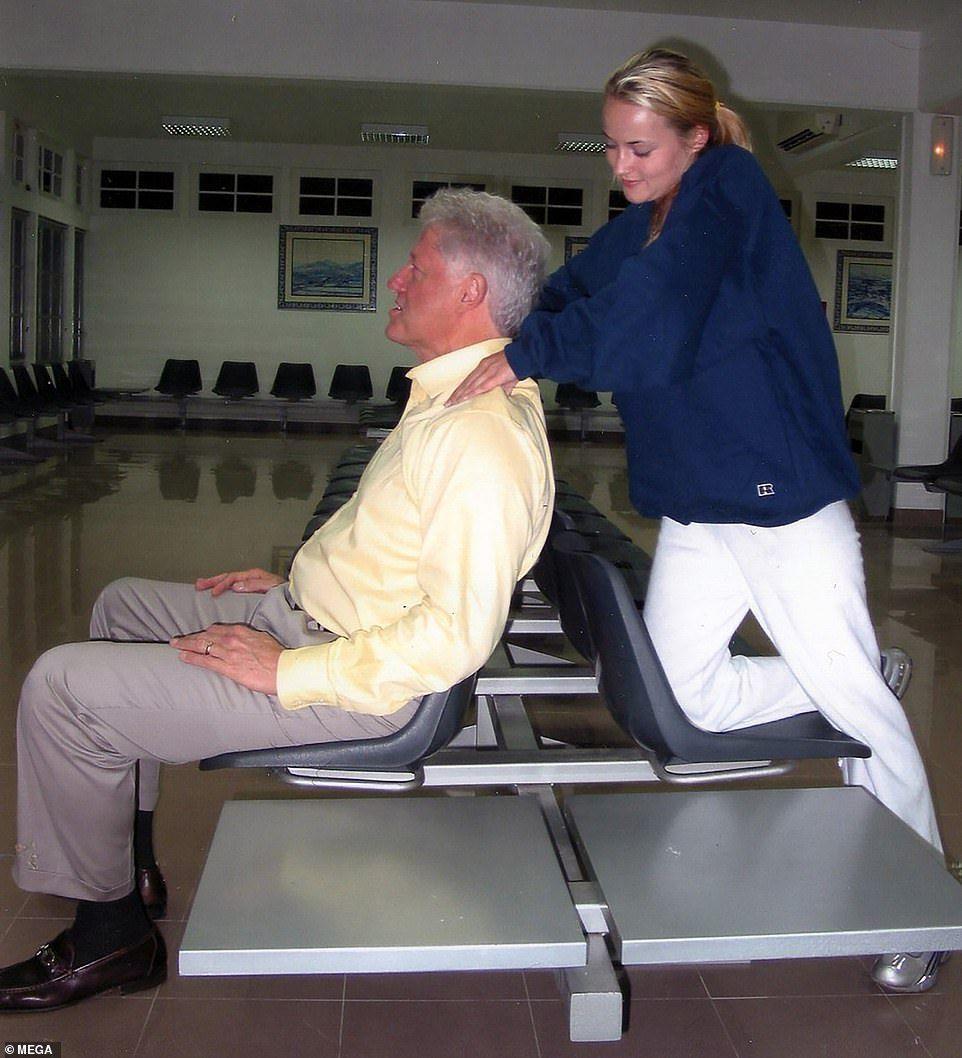 Bill Clinton is seen enjoying a neck massage from a Jeffrey Epstein victim, Chauntae Davies, then 22 years old, in a stop-over in Portugal on the way to Africa in 2002
Epstein’s African engagements extended into business realms by June 2011, when he urgently requested a second US passport from the State Department to manage overlapping international travels. As president of an international financial consulting firm, he cited planned trips to Sierra Leone, Mali, and Gabon for business purposes, needing visas for these African nations while using his primary passport in France. This logistical manoeuvre revealed Epstein’s pattern of frequent, multifaceted travels to Africa and West Asia, including undocumented visits to Senegal and other countries. Court filings in the unsealed documents discuss efforts to depose Clinton due to his close ties with Epstein and Maxwell, noting Giuffre’s 2011 claims of witnessing Clinton on Epstein’s island, though denied, which ties into broader travel patterns including Africa.
Côte d’Ivoire
By 2012, Epstein’s activities in Africa deepened through covert diplomacy, particularly in Côte d’Ivoire amid post-election instability. In June 2012, as Israeli Defense Minister and close Epstein collaborator Ehud Barak met Ivorian President Alassane Ouattara in Jerusalem to discuss counterterrorism and technology cooperation, Epstein hosted Ouattara’s son, David Dramane Ouattara, in New York. On 12 September 2012, Epstein met Ouattara’s niece, Nina Keita — a former model linked to Epstein since 2002 — before proceeding to a private discussion with Barak. In October 2012, Epstein travelled to Côte d’Ivoire, Angola, and Senegal, switching planes in London, with no public flight logs detailing the visits. These moves facilitated Israeli-Ivorian security ties, including a bilateral accord signed weeks later focusing on intelligence and cybersecurity.
Epstein’s role in advancing Zionist interests in Africa continued into 2013, as leaked emails show Barak, post-resignation as Israel’s Minister of Defense, coordinating with Epstein on surveillance projects for Côte d’Ivoire. On 19 March 2013, Barak received proposals for communications and video monitoring centres from MF Group, a French-Israeli security contractor run by Michel Farjon.
In April 2013, UN reports uncovered Israeli ammunition in Côte d’Ivoire, violating an arms embargo, prompting brief setbacks. By May 2013, Barak contacted Israeli defence executives involved in prior Ivorian deals. In July 2013, Barak planned a visit to Abidjan using health infrastructure proposals as cover. Arriving 1 August 2013, he met key officials, including Ouattara, to advance security collaborations. Epstein coordinated Barak’s New York meetings with Ivorian officials during the UN General Assembly that month.
These efforts culminated with the lifting of UN embargoes on Côte d’Ivoire in April 2014, followed by a June 2014 defence agreement signed during an Israeli ministerial visit. Epstein’s facilitation exemplified how private networks enable imperialist tech transfers, bolstering authoritarian control in African states like Côte d’Ivoire, where surveillance tools aided Ouattara’s power consolidation amid suppressed dissent. The unsealed Epstein documents further illuminate these patterns through references to Epstein’s international travels and associations, though specific African business dealings beyond the 2002 trip remain detailed in secondary reports.
Jeffrey Epstein’s emails show he had various connections and interests related to Africa, including organising meetings for prominent figures with African leaders and discussing potential business deals with Zionist intelligence agency-connected firms.
Epstein helped orchestrate meetings for former Israeli Prime Minister Ehud Barak with high-level officials from Côte d’Ivoire, including the Chief of Cabinet for President Ouattara, Sidi Tiémoko Touré. This effort reportedly bore fruit with a formal bilateral defence and internal security agreement between Israel and Côte d’Ivoire in 2014. The Zionists had, though, been supplying arms to Côte d’Ivoire for years.
Since 2004, during the country’s first civil war, Côte d’Ivoire had been subject to a UN arms embargo.
In April 2013, the UN Security Council reported the discovery of “dozens of crates” of Israeli ammunition at the presidential palace and the Attécoubé naval base, with Israel Military Industries labels and Spanish markings. It was reported that the ammunition had been relabelled and retransferred to Côte d’Ivoire from a third country.
In May 2013, former Prime Minister of the Zionist entity, Ehud Barak, called the Honorary Consul of Côte d’Ivoire in Israel, Michael ‘Micky’ Federmann. Federmann’s day job was Chairman of Elbit Systems. Elbit had supplied military helicopters to Côte d’Ivoire during the first Ivorian civil war.
It has been reported that Epstein and Barak worked together as a conduit for Israel’s intelligence sector in Côte d’Ivoire, where Barak was welcomed as a representative of the Israeli government even after leaving public office in 2013. Epstein helped Barak deliver a proposal for mass surveillance of Ivorian phone and internet communications, crafted by former Israeli intelligence officials.
In September 2013, the details of Israel’s offer to the West African country arrived in Barak’s inbox from Aharon Ze’evi-Farkash, former head of Israeli military intelligence (2002-2006) and a veteran of Unit 8200, to create a ‘signals intelligence’ (SIGINT) organisation in Côte d’Ivoire. Drop Site News reveals how Epstein facilitated this surveillance proposal.
The document, a 13-page PDF, mapped out the complete architecture for eavesdropping on phone calls, satellites, tactical radio, and “special targets” like cyber cafés. The data streams flowed to “media processing” servers to be reviewed by analysts, and then synthesised into reports for security leaders.
By June 2014, Avigdor Liberman, Israel’s Minister of Foreign Affairs, arrived in Côte d’Ivoire to sign an agreement on defence and internal security, accompanied by more than 50 businessmen who came to evaluate prospective investments in the country.
The Epstein emails and a hacked collection of Ehud Barak’s email inbox highlight how Epstein leveraged his network and financial influence to connect powerful people, explore business deals, and pursue Zionist military and intelligence interests. They show both the deeply embedded connections of Epstein to Zionist intelligence priorities and the emerging influence of the Zionist state in an area of the world far removed from West Asia.
Jeffrey Epstein appears to have been much more involved in pursuing Zionist regime interests in Africa than had previously been known. Epstein had multiple US passports, and even an Austrian passport with a fake name, which he reportedly had obtained to travel internationally, though he denied ever using it.
As early as 2001, Epstein was recorded as visiting Marrakesh in Morocco with a decorator to visit a house there. In both 2017 and 2019, he returned to Morocco for brief trips. It appears that Epstein owned a house in Morocco, but it is not clear whether Morocco was a node in his child trafficking activities. There is evidence that young girls were transported by him on his private jets and helicopters to other destinations.
Morocco has, of course, been in regular and extensive cooperation with the Zionists for decades prior to the normalisation announcement in 2020. Even The New York Times reports that “the two countries … have worked together closely but secretly on military and intelligence matters, assassinations, and migration of Jews to Israel”. In the early 1960s, King Hassan allowed Mossad “to establish a station in Morocco”, and the Zionist entity “helped organize the Moroccan intelligence service”. The Mossad presence in Morocco was, however, first established in the 1950s.
ha-Misgeret: The Framework’s Moroccan Origins
In 1954, the Zionist entity sent Yehudit Galili to Casablanca for a Jewish Agency educational project. She swiftly established a kindergarten that doubled as an Ulpan to teach young Jewish children Hebrew to facilitate them becoming settler colonists.
This seemingly benign institution quickly became a launchpad for ha-Misgeret (The Framework) — the Mossad’s secret underground network across North Africa. This account of its activities is entirely based on official Zionist sources. The operation aimed to build an armed terror network which would orchestrate their mass transfer to the settler colony. Galili gives a first had account of the arrival of the Mossad at the nursery:
[…]
Mossad-Morocco Intelligence Ties and Covert Operations
This collaboration between Morocco and the Zionist entity represents a stark example of anti-imperialist betrayal, where an Arab nation aligned itself with a settler-colonial regime built on the dispossession of Palestinians, all while suppressing its own people’s aspirations for genuine sovereignty. The Mossad’s infiltration of Morocco began in earnest during the late 1950s and early 1960s, a period marked by Morocco’s transition from French colonial rule to nominal independence under King Mohammed V, and later his son, Hassan II. Far from fostering true liberation, this era saw the Zionist intelligence agency embed itself deeply into Moroccan state structures, aiding in the creation and bolstering of repressive apparatuses that served both Zionist expansionism and Moroccan authoritarianism.
[…]
Via https://libya360.wordpress.com/2026/02/23/epstein-africa-and-zionist-intelligence-operations/
 The Most Revolutionary Act
Pingback: Epstein, Africa, and Zionist Intelligence Operations | Worldtruth