
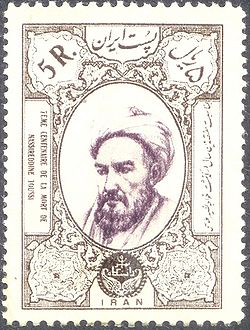
Al-Tusi
Episode 12 – Astronomy in the Islamic Golden Age
Islamic Golden Age (2017)
By Eamon Gearon
Film Review
Gearon begins this lecture by distinguishing between astronomy and astrology, both considered serious sciences prior to thee Middle Ages. Astronomy is a branch of natural sciences that arose independently in Greece, Babylonia, Persia and Norseland, relying entirely on natural observation. By the seventh century AD, all four cultures had identified (without a telescope) seven planets: Mars, Mercury, Jupiter, Venus, Saturn, Earth and the moon). In contrast astrology, which arose around 2,000 BC in Mesopotamia, was a science employing star charts to predict the future and choose auspicious dates for significant events. Both benefited from the Islamic conquest of Persia (633-651), the primary source of both astronomical and astrological discoveries in the Muslim world.
He then profiles the accomplishments of three Islamic astronomers:
- The mathematician al-Khwarizmi 759-850 AD (see The Arab Invention of Algebra and Algorithms) – After becoming court astrologer for the caliph, translated astronomical tables from Hindu and performed additional observations and calculations to detail the exact positions of the sun, moon and various stars and planets.
- Al-Haytham 965-1040 AD (see The House of Wisdom and Al-Haytham’s Book of Optics) – although better known for his work in optics, 25 of the 200 books he published concerned astronomy. One of the first to attack Ptolomy’s second century AD earth-centric model of the universe and lay ground work for Copernicus’s 15th century heliocentric model of the solar system.
- Al-Tusi 1201-1275 AD – born of a Shia Muslim family in northern Iran and traveled widely to study the Koran, mathematics and philosophy under various scholars. Translated Euclid, Archimedes and Ptolemy and published more than 160 books. Identified Milky Way cloudy patches as star constellations 300 years prior to invention of telescope. Observed that planets speed up and slow down in their orbits and challenged both Ptolemy’s views on both an earth-centric universe and the circular orbits of planets (Kepler subsequently confirmed mathematically they were elliptical). Oversaw construction of three observatories following 1258 Mongol takeover in Baghdad, Maragheh (Iran) and Damascus.
https://www.kanopy.com/en/pukeariki/watch/video/5756987/5757011
 The Most Revolutionary Act
Pingback: Astronomy in the Islamic Golden Age | Worldtruth
Pingback: The Fertile Crescent, Water and Al-Jazari | Worldtruth