
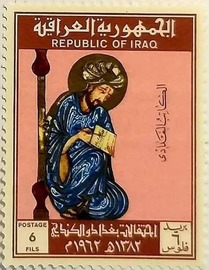
Al-Kindi
Episode 7 – The House of Wisdom
Islamic Golden Age (2017)
By Eamon Gearon
Film Review
Hunhan ibn Izhaq (809-873 AD), an Arab Nestorian Christian, was the Baghdad House of Wisdom’s most prolific translator of Greek as well as personal physician to caliph al Ma’mun. In the latter role, he was imprisoned for a year for refusing to prepare a poison to kill one of Ma’mun’s enemies.
Following his release, al-Ma’mun appointed him as the House of Wisdom’s head of translation. It’s thanks to him that Europe gained access to Galen (a Greek physician 129-216 AD), Euclid, Hippocrates, Plato and other Greek philosophers and scientists whose work inspired the European renaissance. Ibn Izhak also translated (into Arabic) the entire Greek version of the Old Testament.
As a representative of the world’s largest and wealthiest empire in history (to that date), Ibn Izhak paid House of Wisdom translators the book’s weight in gold for each text they translated. It’s also under his guidance, al-Ma’mun contacted the Persian emir and the Byzantine emperor, requesting a copy of every book in their libraries. Amazingly they complied.
Muslim Arab philosopher, mathematician and physician al-Kindi was the House of Wisdom’s most senior scholar and sometimes translator during the ninth century. One of his projects was to apply Aristotle’s and Plato’s emphasis on logic and reasoning. to support the concept of monotheism. Neither Al Ma-Mun nor al-Kindi aw any conflict between the Islamic faith and logic, though this view would change with the advent of Islamic fundamentalism.
Both ibn Izhak and al-Kindi set a new standard for translation that, instead of translating word for word, emphasized the overall context of the translated text. The two scholars checked and corrected each other’s translations.
The author of 230 original works, al-Kindi was the first philosopher in history to do a detailed outline of all the branches of science
His Decrypting Encrypted Correspondence was the most comprehensive and advanced treatise on code breaking until World War II. He primarily used frequency analysis of letters and combinations of letters to decipher codes.
https://www.kanopy.com/en/pukeariki/watch/video/5756987/5756999
 The Most Revolutionary Act
Pingback: Baghdad House of Wisdom: Interpreting and Defending the Quran | Worldtruth
Pingback: Alchemy and Chemistry in Early Baghdad | The Most Revolutionary Act